Ford F350 Towing Capacity Chart & Powertrain Complete Guide (2023-2026)

The Ford F350 Super Duty occupies a highly strategic and heavily contested position in the modern heavy-duty truck market. It effectively bridges the gap between the daily drivability of the F250 and the rigid, commercial-grade architecture of the F450.
For commercial operators and recreational buyers pushing trailer weights into the upper twenties or low thirties, understanding exact capabilities is paramount. A single specification change can drastically alter the legal, structural, and safe limits of the vehicle.

Prime for Young Adults — 6 Months Free
Students and 18–24s get six months of Prime free, then half price.
Start 6 Months Free As an Amazon Associate I earn from qualifying purchases.Towing capacities across the Ford Super Duty lineup vary significantly depending on a complex multitude of configuration factors. These critical variables include cab style, bed length, rear-wheel setup, drivetrain layout, differential axle ratio, engine choice, and hitch type.
Navigating these interconnected variables requires far more than just a quick glance at a dealership brochure or a specification sheet. It requires a fundamental, engineering-level understanding of how these mechanical components interact under extreme mechanical stress.
This comprehensive technical guide breaks down the complete Ford F350 towing capacity chart across modern model years.
It isolates every single variable that impacts towing and payload, helping consumers spec the correct truck for their heavy-hauling requirements.
The Ultimate Ford F-350 Towing Capacity Chart
Recommended Best Deal Products


Master your payload and trailering specs. Deep data analysis on the High Output Power Stroke, Godzilla V8, and optimal dually configurations.
Decoding the Super Duty Beast
Understanding your Ford F-350 towing capacity chart requires looking beyond just the marketing numbers.
Real-world hauling depends heavily on your engine choice, rear axle ratio, and whether you select a Single Rear Wheel (SRW) or Dual Rear Wheel (DRW) setup.
We have synthesized the latest engineering data to provide you with the most accurate, skimmable insights for your heavy-duty hauling needs.
Max Towing by Engine Type
The heartbeat of your towing capability lies under the hood. The 6.7L High Output Power Stroke dominates the heavy-duty landscape.

Audible — Listen Free for 30 Days
One free credit a month and thousands of titles included.
Listen Free for 30 Days As an Amazon Associate I earn from qualifying purchases.Gasoline options like the 7.3L Godzilla offer exceptional reliability and payload benefits, but sacrifice raw trailering metrics compared to diesel variants.
This chart illustrates the absolute maximum gooseneck capacities across the four primary powertrains for properly equipped F-350s.
Hitch Type Limits: Conventional vs Gooseneck
Bumper pull (conventional) towing faces structural limitations compared to 5th-wheel or gooseneck setups.
Mounting the hitch point directly over the rear axle drastically improves stability and weight distribution.
Notice how the DRW configuration scales exponentially when utilizing a gooseneck trailer.
The SRW vs DRW Towing Matrix
Choosing between single and dual rear wheels is the most critical decision for a heavy-duty truck buyer.
DRW provides the lateral stability required for high-profile trailers and heavy pin weights.
SRW offers better daily drivability and fuel economy when running empty.
| Config | Max Conventional | Max Gooseneck | Best For |
|---|---|---|---|
| SRW Gas (7.3L) | 19,500 lbs | 20,800 lbs | Equiment trailers, boats |
| SRW Diesel (6.7L) | 25,000 lbs | 27,500 lbs | Mid-size 5th wheels |
| DRW Gas (7.3L) | 21,000 lbs | 21,000 lbs | Heavy slide-in campers |
| DRW Diesel (6.7L HO) | 28,000 lbs | 38,000 lbs | Hotshot trucking, massive RVs |
The Payload vs. Towing Trade-off Curve
Many buyers max out their payload capacity long before hitting their absolute towing limit.
Gooseneck trailers typically place 15% to 25% of their total weight directly onto the truck bed as pin weight.
Audible Premium Plus — Annual Membership
12 audiobook credits up front, plus the full Audible catalogue.
See Annual Plans As an Amazon Associate I earn from qualifying purchases.This scatter plot simulates the critical boundary: as you add passengers and cargo (Payload), your available trailer weight drops linearly based on the Gross Combined Weight Rating (GCWR).
The Foundation of Towing: Physics, Standards, and Hitch Types
Comprehending the Ford F350 towing capacity chart requires a foundational knowledge of towing physics and engineering limitations. The physical hitch type acts as the primary mechanical bottleneck for any heavy-duty towing application. A modern truck’s towing capacity is fundamentally limited by chassis rigidity, weight distribution, and leverage. The Society of Automotive Engineers (SAE) testing standard J2807 defines the highly rigorous procedures required to determine a vehicle’s ratings.
Conventional Towing Dynamics and Limitations
Conventional towing utilizes a Class IV or Class V receiver hitch bolted directly to the frame rails beneath the rear bumper. Because the hitch point rests behind the axle, heavy tongue weights apply downward force at the rear while lifting the front. This teeter-totter leverage effect dramatically reduces steering traction and braking efficacy on the front wheels. For the F350 SRW platform, conventional towing tops out at 25,000 pounds. For the F350 DRW chassis, the conventional limit reaches 28,000 pounds with the High-Output diesel engine.
Gooseneck and Fifth-Wheel Towing Dynamics
For operators pulling the heaviest commercial or recreational loads, a gooseneck or fifth-wheel connection is strictly mandatory. These specialized hitches mount directly into the truck bed, anchoring to heavy-duty crossmembers spanning the frame above the rear axle. This structurally optimal placement entirely eliminates the rearward leverage effect inherent to bumper-pull setups. The heavy trailer pin weight presses straight down onto the rear suspension leaf springs, planting the dual tires firmly. Because of this superior geometry, the F350 DRW’s maximum towing capacity can soar to 38,600 pounds.
Super Duty Engine Specifications and Towing Influence
The mechanical heartbeat of the Ford F350 is its diverse powertrain lineup. Ford currently offers four distinct engine options for the Super Duty platform, each engineered for specific operational demands. Engine selection fundamentally dictates the starting point for both payload and towing capacities. Gas engines naturally offer higher payload numbers due to their physically lighter block weight. Diesel engines provide the extreme low-end torque strictly required for maximum trailer weight ratings.
6.8L V8 Gas Engine Architecture
Introduced as the standard gasoline engine, the 6.8L V8 provides a highly robust entry point for fleet buyers and retail customers. It generates a highly respectable 405 horsepower and 445 lb-ft of torque. When configured in an F350 DRW chassis, it effortlessly supports a maximum conventional towing capacity of 18,700 pounds. Because this specific engine is physically lighter, trucks equipped with the 6.8L V8 boast the absolute highest payload ratings. In specific regular cab DRW configurations, this payload rating can reach a staggering 8,000 pounds.
7.3L V8 “Godzilla” Gas Engine Architecture
The massive 7.3L OHV V8, affectionately nicknamed “Godzilla,” is the top-tier gasoline option. It is heavily engineered for relentless commercial duty cycles and lower overall lifetime maintenance costs. This enormous displacement cast-iron engine produces 430 horsepower and a stump-pulling 485 lb-ft of torque. It serves as the ideal middle ground for operators who want to avoid the upfront premium of a diesel powertrain. In the F350 DRW configuration, the 7.3L V8 increases the maximum gooseneck towing limit to an impressive 22,500 pounds.
6.7L Power Stroke V8 Turbo Diesel Architecture
The 6.7L Power Stroke diesel is a legendary powerplant in the heavy-duty trucking sector. It utilizes a unique 90-degree V-8 architecture and a compacted graphite iron (CGI) block. This standard-output version generates an immense 475 horsepower and a pavement-rippling 1,050 lb-ft of torque. This peak torque figure is fully available at a remarkably low 1,600 RPM, providing effortless acceleration from a dead stop. Equipped with this engine, the F350 DRW boasts a massive gooseneck rating of 35,000 pounds.
6.7L High-Output (HO) Power Stroke V8 Turbo Diesel
To conquer the absolute peak of the Ford F350 towing capacity chart, buyers must select the High-Output variant. This engineering marvel produces a class-dominating 500 horsepower and an earth-moving 1,200 lb-ft of torque. The HO engine features upgraded forged steel pistons and reverse-flow aluminum cylinder heads with dual water jackets. It utilizes an advanced high-pressure common-rail (HPCR) fuel injection system operating at 36,000 psi. With the HO Power Stroke, the F350 DRW reaches its awe-inspiring 38,600 pounds of gooseneck towing capacity.
Transmissions: The 10-Speed Heavy-Duty Evolution
All modern Ford F350 models exclusively utilize a heavy-duty 10-speed automatic transmission. However, the internal architecture and torque capacities vary significantly depending on the specific engine selection. Ford co-developed their overarching 10-speed transmission architecture in a joint venture with General Motors.
The 10R100 TorqShift-G Transmission Dynamics
The 10R100 transmission is typically paired directly with the standard 6.8L V8 gas engine. It is a slightly lighter-duty variant specifically designed to optimize the narrower powerband of the base V8. First gear features a deep 4.696 multiplication ratio for excellent off-the-line grunt. Tenth gear features a highly efficient 0.636 ratio, allowing the engine to cruise at low RPMs on the highway.
The 10R140 TorqShift Transmission Dynamics
For the massive 7.3L Godzilla V8 and both high-torque diesels, Ford utilizes the immensely robust 10R140 transmission. This heavily reinforced gearbox is specifically engineered to withstand the unrelenting 1,200 lb-ft of torque. Because the mathematical steps between the gears are so infinitesimally small, engine RPM drops only approximately 20% during upshifts. This prevents the turbocharger from falling out of its boost threshold while towing up steep mountain grades.
| Gear | 10R100 Ratio | 10R140 Ratio |
| 1st | 4.696 | 4.615 |
| 2nd | 2.985 | 2.919 |
| 3rd | 2.146 | 2.132 |
| 4th | 1.769 | 1.773 |
| 8th | 0.854 | 0.851 |
| 10th | 0.636 | 0.632 |
| Reverse | 4.866 | 4.695 |
Axles, Drivetrain, and Differential Geometries
Transferring well over a thousand pound-feet of diesel torque requires massive differential housings and thick axle shafts. The F350 platform utilizes three entirely different rear axle assemblies depending on the truck’s configuration. The Sterling 10.5-inch rear axle serves as the standard equipment for the lighter-spec F350 SRW gas models. While highly durable for moderate daily towing, it is not designed to handle the twisting forces of the HO diesel.
When an F350 SRW is optioned with any diesel powertrain, Ford automatically upgrades to the Dana M275 axle. This heavy-duty unit features thicker 4-inch axle tubes and robust 36-spline axle shafts. For the flagship F350 Dual Rear Wheel models, Ford deploys the absolutely gargantuan Dana M300 rear axle. It features industry-leading 4.5-inch axle tubes, providing unparalleled traction for hauling heavy fifth-wheel RVs.
Single Rear Wheel (SRW) vs. Dual Rear Wheel (DRW) Dynamics
The high-stakes decision between purchasing an SRW and DRW F350 is arguably the most critical chassis choice. It completely alters the vehicle’s physical footprint, payload capacity, and daily driving characteristics.
An F350 Single Rear Wheel measures approximately 80 inches in overall body width. This relatively standard track width allows the truck to easily navigate through standard urban parking spaces. Despite its conventional dimensions, the maximum gooseneck rating reaches a staggering 27,600 pounds.
The Dual Rear Wheel “dually” configuration expands the rear track width to a massive 96 inches. Those four rear tires create a massive, stable contact patch that practically eliminates terrifying trailer sway. The DRW setup is strictly required by Ford to unlock the F350’s maximum 38,600 pounds of gooseneck towing.
| Configuration Feature | F350 SRW Specs | F350 DRW Specs |
| Overall Width | ~80 inches | ~96 inches |
| Max Payload | 4,706 lbs | 8,000 lbs |
| Max Gooseneck Towing | 27,600 lbs | 38,600 lbs |
| Stability While Towing | Very Good | Excellent (4-tire contact) |
Comprehensive 2026 Ford F350 Towing Capacity Charts
To provide absolute clarity, the following charts break down the overall maximum capacities for the 2026 Ford F350. These figures represent the absolute maximum possible ratings achievable in perfect configurations. Actual real-world capacity will vary based on specific cab layouts, axle ratios, and optional factory equipment. Buyers should always consult Ford’s official towing calculators for highly specific, VIN-based calculations.
Maximum Towing Capacity by Engine Overview (SRW vs DRW)
| Engine Selection | Max Conventional (SRW) | Max Conventional (DRW) | Max Gooseneck (SRW) | Max Gooseneck (DRW) |
| 6.8L V8 Gas | 18,100 lbs | 18,700 lbs | 17,600 lbs | 18,900 lbs |
| 7.3L V8 Gas | 19,500 lbs | 22,000 lbs | 19,500 lbs | 22,500 lbs |
| 6.7L Power Stroke | 20,000 lbs | 24,800 lbs | 22,800 lbs | 35,300 lbs |
| 6.7L HO Power Stroke | 25,000 lbs | 24,800 lbs | 25,000 lbs | 38,600 lbs |
(Data sourced directly from Ford Super Duty capability engineering breakdowns )
SRW Gooseneck/5th-Wheel Capacity by Cab Configuration
Cab configuration plays a massive, often misunderstood role in determining final towing numbers. A larger cab inherently weighs more, which directly subtracts from the available GCWR budget. The following data outlines the peak fifth-wheel and gooseneck capacities based on cab size.
| Cab & Box Configuration | 6.8L V8 Gas | 7.3L V8 Gas | 6.7L Diesel | 6.7L HO Diesel |
| Regular Cab / 8′ Bed | Up to 18,200 lbs | Up to 19,500 lbs | Up to 23,100 lbs | Up to 23,100 lbs |
| SuperCab / 6.75′ Bed | Up to 17,800 lbs | Up to 19,500 lbs | Up to 22,800 lbs | Up to 24,000 lbs |
| SuperCab / 8′ Bed | Up to 17,400 lbs | Up to 19,500 lbs | Up to 22,800 lbs | Up to 24,000 lbs |
| Crew Cab / 6.75′ Bed | Up to 17,600 lbs | Up to 19,500 lbs | Up to 22,800 lbs | Up to 24,000 lbs |
| Crew Cab / 8′ Bed | Up to 17,200 lbs | Up to 19,500 lbs | Up to 22,800 lbs | Up to 25,000 lbs |
(Note: Ranges indicate slight variances based on 4×2 vs 4×4 drivetrains and specific axle ratios )
DRW Conventional Capacity by Cab Configuration
While DRW trucks are heavily favored for gooseneck towing, they also boast superior conventional receiver ratings. The heavier chassis weight and stiffer rear suspension geometry provide exceptional stability. The following data outlines the maximum conventional bumper-pull ratings for the DRW platform.
| Cab & Box Configuration | 6.8L V8 Gas | 7.3L V8 Gas | 6.7L Diesel | 6.7L HO Diesel |
| Regular Cab / 8′ Bed | Up to 18,100 lbs | Up to 19,500 lbs | Up to 22,000 lbs | Up to 22,000 lbs |
| SuperCab / 8′ Bed | Up to 17,400 lbs | Up to 19,500 lbs | Up to 22,000 lbs | Up to 22,000 lbs |
| Crew Cab / 6.75′ Bed | Up to 17,600 lbs | Up to 19,500 lbs | Up to 22,000 lbs | Up to 24,000 lbs |
| Crew Cab / 8′ Bed | Up to 17,200 lbs | Up to 19,500 lbs | Up to 22,000 lbs | Up to 25,000 lbs |
(Note: The absolute maximum 38,600 lb towing limits require specific Regular Cab DRW gooseneck configurations not listed in this conventional receiver chart )
Decoding Payload Capacity Math and Pin Weights
Towing capacity is realistically only half of the heavy-duty math equation. Payload capacity is equally, if not more, critical when spec’ing a truck for a massive fifth-wheel RV. Many eager buyers forget that the heavy trailer’s pin weight pushes directly down on the truck’s rear suspension. This massive downward force directly and rapidly consumes the truck’s available payload capacity.
To accurately calculate payload capacity, subtract the exact base curb weight from its Gross Vehicle Weight Rating (GVWR). The mathematical formula is absolute and legally binding: Payload Capacity = GVWR – Curb Weight. This represents the absolute maximum combined weight of passengers, cargo, and trailer tongue weight.
A standard conventional trailer exerts roughly 10% of its total loaded weight directly onto the hitch. Conversely, a large gooseneck trailer transfers a much heavier 15% to 20% of its gross weight. If a buyer attaches a massive 25,000-pound fifth-wheel RV, the pin weight alone consumes approximately 3,750 pounds of payload. This geometric reality is exactly why the F350 DRW’s 8,000-pound maximum payload capacity is mandatory for massive fifth-wheels.
Essential F350 Towing Packages and Option Codes
Achieving the massive numbers listed in the Ford F350 towing capacity chart requires specific, factory-installed packages. Without these critical structural upgrades, the truck’s legal ratings are severely diminished.
Fifth-Wheel / Gooseneck Hitch Prep Package (Option Code 53W)
For anyone towing a heavy fifth-wheel, the 53W Prep Package is an absolutely indispensable factory option. It provides heavy-duty under-box hardware bolted directly to the truck’s high-strength steel frame. Crucially, the OEM prep package provides a completely flat, unobstructed cargo box floor when the hitch is removed. The package also smartly includes a pre-wired 7-pin trailer harness receptacle located inside the bed.
High-Capacity Trailer Tow Package (Option Code 535)
To push the F350 SRW to its absolute upper limits, Ford strictly requires the High-Capacity Trailer Tow Package. This critical package is strictly available for trucks equipped with the 6.7L Power Stroke diesel engines. It encompasses the heavy-duty Dana M275 rear axle upgrade, increased GCWR, and highly specific suspension tuning.
Camper Package (Option Code 471)
For buyers intending to carry heavy, slide-in truck campers, the Camper Package is a required factory upgrade. This specialized package includes computer-selected, increased-capacity front springs. It also adds a heavy-duty rear stabilizer bar on SRW models and auxiliary rear springs to manage top-heavy loads.
Advanced Towing Technology and Software Assists
Modern Super Duty trucks leverage immense computing power to make heavy towing vastly safer and intuitive.
These software systems intervene faster than human reflexes ever could.
- Trailer Sway Control: Selectively applies individual truck wheel brakes and rapidly reduces engine power to stop sway.
- Integrated Trailer Brake Controller (TBC): Provides exceptionally smooth, proportional braking power directly to the trailer.
- Pro Trailer Hitch Assist: Utilizes machine learning to automatically steer and brake the truck to align the hitch ball.
- Onboard Scales with Smart Hitch: Actively estimates the trailer tongue weight to ensure the load is perfectly balanced.
Weight Distribution Mechanics and Safe Towing Practices
Even with a massive 8,000-pound payload capacity, absolute safety relies entirely on proper load management. Improper weight distribution can easily induce violent trailer sway and sudden loss of steering control. Approximately 60% of the allowable cargo weight should reside in the front half of the trailer. If a trailer is loaded too heavily in the rear, it creates a highly dangerous negative tongue weight scenario.
Drivers must continuously utilize the Tow/Haul mode integrated into the 10-speed TorqShift transmission. This mode actively alters shift maps and activates highly aggressive engine braking on steep downgrades. When perfectly paired with the diesel exhaust brake, this system prevents the physical wheel brakes from overheating.
Year-Over-Year Evolution: Analyzing 2023 to 2026
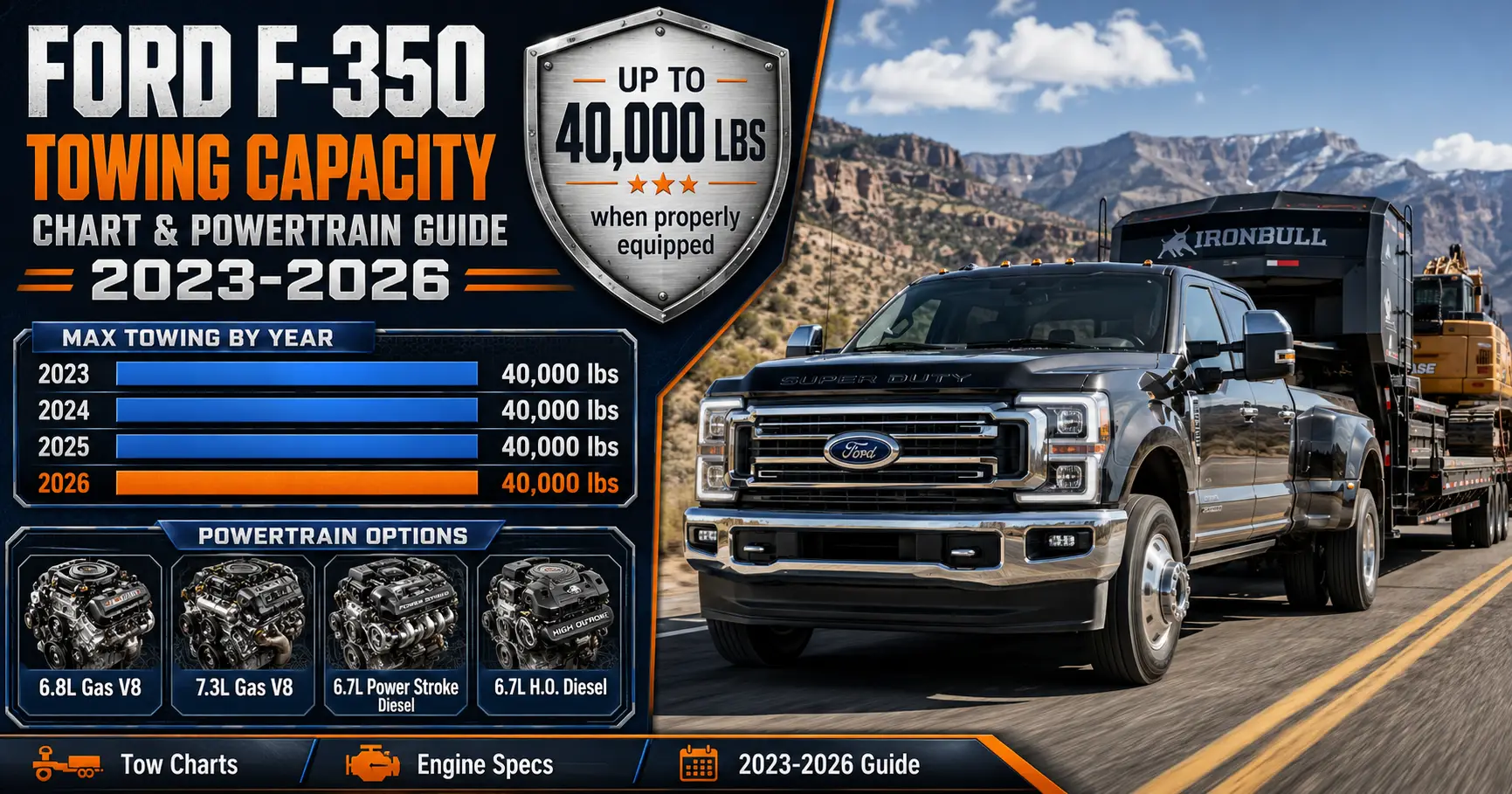
The current generation of the Ford Super Duty officially launched in the 2023 model year. It introduced a completely redesigned high-strength chassis and the standard 10-speed transmissions. Because the 2023 model year represented a massive generational leap, changes for 2024 and 2025 have been iterative. For 2026, the towing figures impressively remain at the very top of the heavy-duty truck class. Buyers researching a used 2023 or 2024 F350 can confidently reference the modern 2026 capacity charts.
Critical Questions for Heavy-Duty Buyers (People Also Ask)
What is the maximum Ford F350 towing capacity?
When optimally configured with specialized equipment, the Ford F350 reaches an astonishing maximum towing capacity of 38,600 pounds. Achieving this peak rating requires the Dual Rear Wheel (DRW) configuration and the 6.7L High-Output Power Stroke diesel engine. You must also spec a Regular Cab chassis, a 4.30 axle ratio, and a heavy-duty gooseneck hitch. Conventional bumper-pull towing, by contrast, maxes out at a still-impressive 28,000 pounds when properly equipped.
How does SRW vs. DRW affect F350 towing dynamics?
The Single Rear Wheel (SRW) configuration offers excellent daily drivability but limits maximum gooseneck towing to 27,600 pounds. The Dual Rear Wheel (DRW) “dually” setup provides a significantly wider rear track width and four rear tires. This expanded physical footprint balloons the maximum gooseneck tow rating to the aforementioned 38,600 pounds.
Why is gooseneck towing capacity much higher than conventional towing?
Conventional towing utilizes a receiver hitch located several feet behind the rear axle, creating a lever effect that unweights the front tires. Gooseneck and fifth-wheel hitches solve this by placing the heavy trailer pin weight directly over, or slightly ahead of, the truck’s rear axle. This optimal placement stabilizes the entire chassis and unlocks significantly higher towing capacities.
How does the differential axle ratio change the tow rating?
The axle ratio dictates exactly how engine torque is mechanically multiplied before reaching the drive wheels. A lower numerical ratio, such as 3.31, offers better highway cruising fuel economy but noticeably lower towing capacity. A higher numerical ratio, such as 4.30, provides the immense low-end torque multiplication strictly required to reach the F350’s absolute limits.
Does cab style genuinely affect Ford Super Duty towing capacity?
Yes, cab configuration plays a massive role in final towing figures. Regular Cab models inherently feature a lower base curb weight than the larger SuperCab or Crew Cab models. This lower base curb weight leaves significantly more available weight capacity for heavy trailers and payload.
Conclusion: Specifying the Right F350 for the Job
The Ford F350 is a highly modular engineering platform that can be tailored to fulfill wildly different roles.
If the primary goal is dragging heavy equipment, the 7.3L Godzilla V8 provides immense, reliable grunt.
If the mission dictates pulling a luxury RV, the F350 SRW delivers the perfect blend of brute force and comfort.
But for those who operate at absolute, uncompromising limits, there is only one correct configuration.
The F350 DRW equipped with the 6.7L High-Output Power Stroke is a true masterclass in towing physics.
By meticulously calculating payload and utilizing prep packages, owners can harness the full magnitude of the Ford F350.
Related Ford Guides
- Ford F-250 towing capacity by year
- Ford Expedition payload capacity chart
- how to reset the Ford F-250 DEF counter
Ford F-350 Towing Capacity By Year
- 2020 Ford F-350 Towing Capacity Chart
- 2022 Ford F-350 Towing Capacity Chart By Year
- Ford F-350 Towing Capacity Chart PDF
- 2000 F-350 7.3 Towing Capacity
- 2002 F-350 7.3 Towing Capacity
Full towing capacity guide: Ford F-150 Towing Capacity Chart (2004–2026)