Ford F250 Rear Axle Width Chart: Specs, Swaps, and Upgrades

Understanding the exact rear axle width of a Ford F-250 is paramount for automotive fabricators, off-road enthusiasts, and suspension engineers. The physical dimensions of the rear differential dictate vehicle stability, wheel fitment, and payload distribution.
Over the decades, the heavy-duty F-Series lineup has relied on a continuously evolving roster of rear axles. These axles have grown exponentially in size and strength to handle modern diesel engines producing over 1,200 lb-ft of torque.

Prime for Young Adults — 6 Months Free
Students and 18–24s get six months of Prime free, then half price.
Start 6 Months Free As an Amazon Associate I earn from qualifying purchases.From the venerable Sterling 10.25 to the modern Sterling 11.6, each generational shift introduced new track widths and Wheel Mounting Surface (WMS) measurements. Selecting aftermarket wheels or planning a complete axle swap requires absolute precision regarding these dimensional changes.
This comprehensive technical report aggregates decades of engineering data into a centralized, highly detailed resource. It examines every major Ford F-250 rear axle by generation, exact width, lug pattern, and internal specification.
Furthermore, the analysis covers critical fabrication data for off-road builders utilizing Super Duty axles in custom applications. By examining specific casting differences, gear ratios, and track widths, fabricators can avoid costly structural errors.
Ford F250 Rear Axle Width Chart
Recommended Best Deal Products


The complete, year-by-year measurement guide for WMS to WMS dimensions, Sterling vs. Dana comparisons, and swap compatibility.
Master F250 Axle Width Trajectory
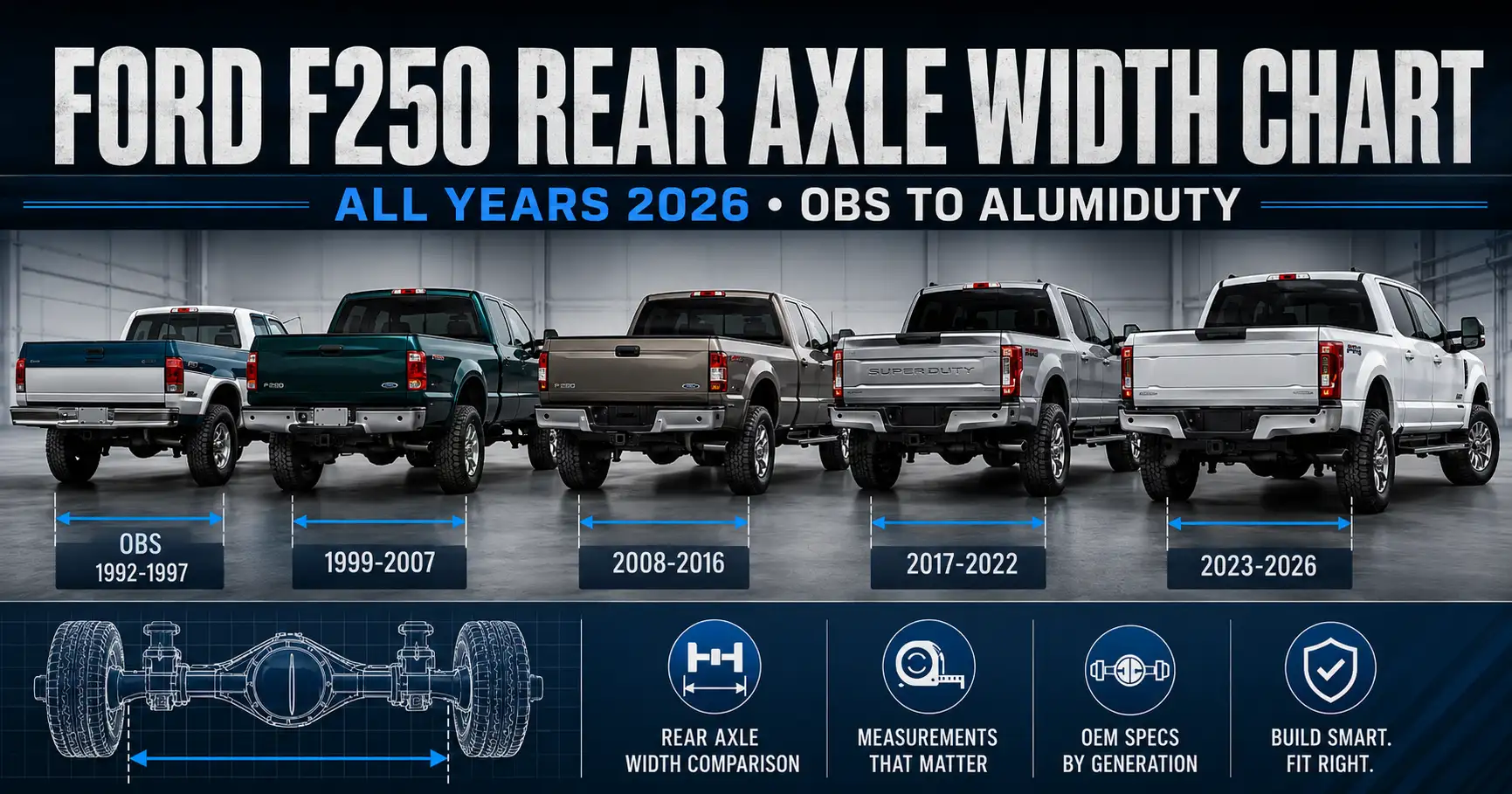
The F250 platform has steadily grown wider to accommodate heavier payloads, larger brakes, and modern stability requirements. This chart illustrates the Wheel Mount Surface (WMS) growth of Single Rear Wheel (SRW) trucks across five distinct generations.
Generational Axle Specifications
Recommended Best Deal Products


1973 – 1979 (Dentside Era)
The classic Dentside F250s primarily utilized the legendary Dana 60 rear axle. These trucks featured a relatively narrow track width compared to modern standards.
The standard WMS to WMS measurement for this era is approximately 65.25 inches. They utilized a standard 8×6.5 inch bolt pattern.
These axles are highly sought after by vintage off-roaders, as noted on Ford-Trucks enthusiast forums, due to their simplicity and durability.
1980 – 1997 (OBS Era)
Covering the Bullnose, Bricknose, and OBS (Old Body Style) generations, this era saw the introduction of Ford’s in-house rear end.

Audible — Listen Free for 30 Days
One free credit a month and thousands of titles included.
Listen Free for 30 Days As an Amazon Associate I earn from qualifying purchases.In 1985, Ford phased in the Sterling 10.25-inch axle. The WMS width remained incredibly similar to previous years, sitting right at 65.5 inches.
They retained the classic 8×6.5 bolt pattern. The Sterling 10.25 was available in both semi-float (light duty) and full-float (heavy duty) variations.
1999 – 2016 (Super Duty MK1-MK3)
The introduction of the Super Duty line in 1999 brought massive changes. The track width was significantly widened to improve towing stability and house massive disc brakes.
The upgraded Sterling 10.5-inch axle pushed the WMS out to 68.875 inches.
Crucially, Ford changed the wheel bolt pattern during this transition to the unique 8x170mm metric standard, making older wheels entirely incompatible.
2017 – Present (Alumiduty Era)
With the aluminum-bodied Super Duty, Ford increased the Gross Vehicle Weight Ratings (GVWR) to unprecedented levels.
To handle the extreme torque of modern Powerstrokes, the F250 WMS widened again to approximately 71.4 inches.
Ford introduced the massive Dana M275 rear axle for high-capacity models, as detailed by heavy-duty parts suppliers like Torque King, while retaining the Sterling 10.5 for lower trims.
Ring Gear Diameter Comparison
Beyond just the F250 rear axle width chart, the internal strength of the axle is dictated by the ring gear diameter. A larger ring gear handles higher torque loads from towing.
The transition from the Sterling 10.25 to the 10.5 brought thicker pinion shafts and better bearings. The modern Dana M275 (10.8 inches) dwarfs the older generation hardware.
Audible Premium Plus — Annual Membership
12 audiobook credits up front, plus the full Audible catalogue.
See Annual Plans As an Amazon Associate I earn from qualifying purchases.This visualization shows the physical size increase of the core rotational component across standard F250 factory offerings.
Decoding Axle Terminology: WMS versus Track Width
Before analyzing specific axle dimensions, the terminology used to measure these components must be strictly defined. The two most critical metrics in axle geometry are Wheel Mounting Surface (WMS) and Track Width.
WMS represents the exact linear distance from the flat mounting face of the driver-side wheel hub to the passenger-side wheel hub. This measurement is absolute and remains static regardless of the wheels or tires bolted to the vehicle.
Track width, conversely, measures the distance between the centerlines of the two rear tires where they contact the pavement. Track width is a dynamic measurement that immediately changes if wheels with a different offset or backspacing are installed.
For custom vehicle builders performing one-ton axle swaps, the WMS is the universal standard for measurement. It provides the fixed baseline required to calculate suspension clearances, shock mount locations, and frame rail geometry.
For standard F-250 maintenance and OEM specifications, track width is the metric most frequently published in official Ford documentation. On modern single rear wheel (SRW) Super Duty trucks, the rear track width is universally documented as 67.2 inches.
The Master Ford F250 Rear Axle Width Chart
The following table synthesizes the primary axle widths, lug patterns, and ring gear sizes for the Ford F-250 and F-350 SRW trucks from 1985 to the present day.
| Generation / Years | Axle Model | WMS / Track Width (SRW) | Lug Pattern | Ring Gear | Shaft Splines |
| 1985–1997 | Sterling 10.25 | ~65.5″ WMS | 8 x 6.5″ | 10.25″ | 35-Spline |
| 1999–2016 | Sterling 10.5 | 67.2″ Track Width | 8 x 170mm | 10.5″ | 35-Spline |
| 2017–2022 | Dana M275 (Diesel) | 67.2″ Track Width | 8 x 170mm | 10.8″ | 32-Spline |
| 2017–Present | Sterling 10.5 (Base) | 67.2″ Track Width | 8 x 170mm | 10.5″ | 35-Spline |
| 2023–Present | Sterling 11.6 (HO) | 67.2″ Track Width | 8 x 170mm | 11.6″ | 35-Spline |
Dual Rear Wheel (DRW) variants and commercial Chassis Cab trucks feature distinctly different track widths to accommodate dual wheel spacing. These specialized commercial dimensions are detailed extensively in subsequent sections of this report.
The Pre-Super Duty Era: Sterling 10.25 (1985–1997)
In 1985, the Ford Motor Company phased out the traditional Dana 60 and Dana 70 rear axles in favor of a proprietary in-house design. This new axle, manufactured at the Sterling Axle Plant in Michigan, became known as the Sterling 10.25.
The Sterling 10.25 features a 10.25-inch ring gear and was deployed across the heavy-duty F-250 and F-350 vehicle lineups. It utilized an 8×6.5-inch lug pattern, which was the prevailing industry standard for three-quarter-ton trucks at the time.
The standard Single Rear Wheel (SRW) Sterling 10.25 measures approximately 65.5 inches from Wheel Mounting Surface to Wheel Mounting Surface. The factory leaf spring perches are positioned roughly 45 inches apart, measured center-to-center.
During this era, Ford offered the 10.25 in both semi-floating and full-floating physical configurations. The semi-float version was commonly installed in light-duty F-250s carrying a Gross Vehicle Weight Rating (GVWR) of 7,200 lbs.
In a semi-floating axle, the axle shafts directly support the vehicle’s immense physical weight. This design limits the overall payload capacity and is considered inferior for extreme towing applications.
The highly desirable full-floating variant places the vehicle’s entire physical weight onto the external hub assembly. This vital engineering choice allows the internal 35-spline, 1.5-inch diameter axle shafts to strictly handle rotational torque.
The Short Yoke versus Long Yoke Evolution
There are two distinct generations of the Sterling 10.25 axle that fabricators must be aware of. The first generation was produced from 1985 through 1992 and is colloquially known as the “short pinion-yoke” version.
The early short yoke measured approximately 3.25 inches in height with a 1.25-inch spline length. Under extreme torque loads, this specific design occasionally suffered from the pinion yoke nut backing off and working loose.
To rectify this critical structural flaw, Ford introduced the second-generation “long pinion-yoke” design in 1993. This updated yoke measured 3.5 inches in height with a 1.75-inch spline length, vastly improving driveline durability.
All factory Sterling 10.25 axles from this early era were equipped exclusively with heavy-duty drum brakes. They were never factory-equipped with disc brakes, though modern aftermarket conversion kits remain widely available.
For modern rebuilds, it is important to match the correct 1410 Series Yoke to the specific axle generation. The 31-spline yoke with a 1-41/64″ hole length fits the late 10.25″ and 10.5″ axles, but will not fit the early short pinion variants.
The Super Duty Revolution: Sterling 10.5 (1999–2016)
The 1999 model year marked the birth of the modern Ford Super Duty platform. To handle the vastly increased towing capacities of the new chassis, Ford upgraded the rear differential to the Sterling 10.5.
The ring gear was enlarged to 10.5 inches (270 mm), providing a significantly higher torque capacity. This upgrade was highly necessary to support the legendary 7.3L Powerstroke diesel engine.
The internal differential carrier was also completely redesigned and upgraded. Ford introduced a much stronger 3-spider gear assembly, though the differentials remain interchangeable between the 10.25 and 10.5 variations.
Dimensionally, the Super Duty platform grew noticeably wider than the previous generation. The rear track width for the SRW F-250 expanded to 67.2 inches, perfectly complementing the new, wider front chassis geometry.
Simultaneously, Ford transitioned the entire heavy-duty lineup to a unique metric lug pattern. The industry-standard 8×6.5-inch pattern was permanently abandoned in favor of an 8x170mm lug pattern.
This specific lug pattern change is critical for automotive fabricators to note. Wheels sourced from a 1997 F-250 will absolutely not bolt onto a 1999 or newer Sterling 10.5 axle without custom billet adapters.
Braking Enhancements and Electronic Lockers
Another monumental engineering shift for the 1999 Sterling 10.5 was the standard inclusion of dual-piston disc brakes. This provided a massive leap in thermal dissipation and stopping power for heavy payloads.
The disc brake rotors on the initial Super Duty generation were sized at approximately 13.38 inches. However, for the 2013 model year, Ford enlarged the rotors to an impressive 14.29 inches for even greater braking force.
These heavy-duty axles also feature a specialized drum-in-hat parking brake system integrated into the rotor. The internal parking brake shoes measure 8.1 inches on older models and 9 inches on 2013 and newer models.
In 2011, the Sterling 10.5 received a highly anticipated factory upgrade: an electronic locking differential (ELD). Prior to this model year, the axle was only available with open or limited-slip (clutch-style) carriers.
While the 2011 and newer axles look nearly identical from the outside, the internal spline engagements and locker wiring differ. This means many internal parts are no longer backward-compatible with the 1999-2010 axle units.
Since approximately 2005, the internal gears within the Sterling 10.5 have been formed using the face hob process. This modern machining technique replaced the former face milled process, resulting in stronger, quieter gear mesh.
The Aluminum Body Era: Dana M275 (2017–2022)
With the introduction of the redesigned aluminum-body Super Duty in 2017, Ford pushed maximum towing capacities beyond 30,000 pounds. The traditional Sterling 10.5 was no longer deemed sufficient for high-output diesel applications.
To meet this extreme consumer demand, Ford partnered with Dana Incorporated to introduce the massive M275 rear axle. This axle features a 10.8-inch (275mm) ring gear, providing immense sheer strength under heavy fifth-wheel loads.
The Dana M275 is visually distinct from the previous Sterling series axles. While the traditional Sterling axles feature a 12-bolt differential cover, the Dana M275 utilizes a massive 14-bolt cover.
Despite the internal size increase, the exterior dimensions remained perfectly integrated with the Super Duty chassis. The rear track width holds perfectly steady at 67.2 inches for standard SRW configurations.
The Dana M275 also features incredibly robust full-floating axle shafts. Depending on the exact model year and GVWR package, these shafts utilize a massive 32-spline or 36-spline interface at the carrier.
It is highly important to note that the Sterling 10.5 did not disappear entirely in 2017. Ford continued to use the 10.5-inch axle under base-model F-250 trucks equipped with the standard 6.2L gasoline V8.
Only vehicles equipped with the 6.7L Powerstroke Diesel or the Heavy-Duty Max Tow packages received the Dana M275 upgrade. This creates a split market for differential covers and replacement parts during this generation.
The High-Output Heavyweight: Sterling 11.6 (2023–Present)
For the 2023 model year, Ford introduced the High-Output (HO) variant of the 6.7L Powerstroke engine. Producing over 1,200 lb-ft of torque, this powerplant required yet another massive driveline evolution.
Ford returned to in-house manufacturing, introducing the colossal Sterling 11.6 rear axle. As the nomenclature implies, it features a massive 11.6-inch ring gear designed to handle unprecedented torque loads.
This axle is easily identified by its unprecedented 16-bolt differential cover. It is noticeably larger and rounder than any previous SRW axle utilized in the consumer pickup truck market.
The Sterling 11.6 is standard equipment on 2023 and newer F-250 trucks optioned with the Max Tow package, the High Output diesel, and the Tremor off-road package.
Due to the extreme size of the hub assemblies on the Sterling 11.6, aftermarket wheel fitment has become highly complex. The protruding hub-centric lip is 3.75 inches long overall, which interferes with many aftermarket wheel center caps.
Installing wheel spacers on the 11.6 requires specific machining to clear the massive axle flange. Standard 8x170mm spacers designed for the older Sterling 10.5 will not seat correctly on the 11.6 hub without heavy modification.
Despite the colossal internal components and massive hub structures, the overall rear track width for the 2023+ F-250 remains 67.2 inches. This ensures the vehicle maintains standard lane compliance and OEM bed clearances.
Chassis Cab and Dual Rear Wheel (DRW) Variations
While SRW F-250 and F-350 models adhere strictly to the 67.2-inch rear track width, Dual Rear Wheel (DRW) and Chassis Cab trucks feature radically different dimensional layouts.
On factory DRW pickup trucks (F-350/F-450), the outside tire width measures an immense 95.9 inches. This extreme width requires the specialized fiberglass dually fenders attached directly to the pickup box.
The inner tire center width for a DRW pickup is officially recorded at 74.7 inches. This ultra-wide stance provides the foundational stability required to safely tow fifth-wheel trailers exceeding 35,000 pounds.
Chassis Cab vehicles (trucks sold without a bed for commercial upfitting) feature a completely different frame architecture. The frame rail width on an F-350/F-450 Chassis Cab is narrowed to an industry-standard 34.2 inches.
Because the commercial frame is physically narrower, the rear axle spring perches are moved inward. Consequently, a Sterling or Dana axle pulled from a Chassis Cab truck will not directly bolt onto a standard consumer pickup truck frame.
The WMS on a DRW Chassis Cab axle is also significantly narrower than a DRW pickup axle. Chassis Cab rear axles measure roughly 65.5 inches WMS to WMS, making them uniquely suited for flatbeds, ambulances, and utility boxes.
The Ultimate Jeep 1-Ton Axle Swap Guide
One of the most frequent uses for the Ford Sterling 10.5 axle is in custom off-road fabrication. Jeep Wrangler (JK, JL) and Gladiator (JT) owners routinely perform “1-ton swaps” to handle massive 40-inch tires.
The Ford Super Duty front Dana 60 (which boasts a massive 72-inch WMS) is frequently paired with the rear Sterling 10.5. The 67.2-inch track width of the Sterling perfectly matches the wide-stance requirements of heavily modified Jeeps.
Prominent off-road manufacturers like Artec Industries and RuffStuff Specialties manufacture dedicated weld-on truss kits. These kits supply the necessary coil spring, track bar, and control arm brackets specifically contoured for the Sterling 10.5.
However, there is a critical engineering hurdle when swapping a Sterling 10.5 into a Jeep chassis. The Super Duty rear differential housing is offset heavily to the passenger side to clear the Ford fuel tank.
This severe differential offset places the rear driveshaft pinion in direct alignment with the factory Jeep gas tank. Fabricators must either stretch the vehicle’s wheelbase significantly or install an aftermarket fuel cell to clear the driveline.
Alternatively, many builders opt for the GM AAM 14-bolt rear axle, which features a 68-inch WMS. The AAM 14-bolt features a more centralized pinion location, completely avoiding the Jeep gas tank clearance issues.
For fabricators who proceed with the Sterling, the axle requires extensive preparation. Builders must cut off the factory Ford leaf spring pads and weld the heavy-duty 1/4-inch steel truss directly to the cast iron center section.
Proper pre-heating and post-heating of the cast iron center section is mandatory when welding the truss. Failure to properly manage the thermal cycle can result in catastrophic cracking of the differential housing.
Thermal Dynamics: Performance Differential Covers
Given the incredibly heavy workloads applied to the F-250, upgrading the rear differential cooling capacity is a popular modification. The factory stamped steel covers offer minimal thermal dissipation under heavy towing stress.
Companies like Pacific Performance Engineering (PPE) and Mag-Hytec manufacture heavy-duty cast aluminum covers for the Sterling 10.5, Dana M275, and Sterling 11.6.
These premium A356.0-T6 aluminum covers feature deep external cooling fins. By significantly increasing the heat-dissipating surface area, the differential gear oil stays within optimal operating temperatures during extreme mountain towing.
Internally, high-end aftermarket covers utilize engineered windage scrapers. These internal baffles direct oil efficiently over the ring gear, reducing fluid churning, aeration, and parasitic power loss.
Upgraded cast aluminum covers also increase the total fluid capacity, often by roughly 0.8 to 1.0 quarts. More fluid volume inherently creates a larger thermal mass, meaning the axle takes much longer to overheat on steep grades.
Finally, premium covers feature high-power neodymium magnetic drain and fill plugs. These magnets actively strip harmful ferrous metal particles from the gear oil, drastically extending the service life of the carrier bearings and ring gear.
Many modern covers also include a pre-tapped 1/8 NPT port. This allows owners to easily install an aftermarket fluid temperature probe to monitor differential heat from the cab.
Deep Dive: Axle Torque Specifications and Maintenance
For technicians rebuilding or servicing Ford F-250 rear axles, adhering to strict torque specifications is mandatory. The high-torque diesel engines can easily destroy improperly preloaded bearings in a matter of miles.
The Sterling series requires precise setup parameters to ensure longevity. The differential cap bolts must be torqued precisely to 80 ft-lb, ensuring the carrier bearings are perfectly seated without warping the caps.
The massive ring gear bolts on the Sterling require 95 ft-lb of torque. It is highly recommended to use blue thread locker on these fasteners to prevent loosening under extreme driveline shock loads.
When installing brand new bearings, the pinion preload must be set between 20 and 35 in-lb. If a technician is reusing old bearings, the rotational drag should be set much lighter, between 6 and 8 in-lb.
Ring gear backlash is arguably the most critical metric for quiet operation and gear longevity. The Sterling differential must be carefully shimmed to achieve a backlash measurement of .006 to .010 inches.
Dana M275 Heavy-Duty Torque Specs
The Dana M275 utilizes even more robust hardware to handle the 6.7L Powerstroke output. The ring gear bolts (if equipped with 1/2-inch bolts) demand an immense 135 ft-lb of torque.
The 14-bolt differential cover on the Dana M275 should be torqued to 30 ft-lb in a strict crisscross pattern. Over-torquing these bolts can warp the sealing flange and cause persistent gear oil leaks.
For routine suspension and brake maintenance, the axle retainer nuts require 45 ft-lb of torque. The brake caliper carrier bolts must be secured at 55 ft-lb, and the smaller 13mm caliper slider bolts take 26 ft-lb.
| Component Specification | Sterling 10.25 / 10.5 | Dana M275 / M300 |
| Ring Gear Bolt Torque | 95 ft-lb | 135 ft-lb (1/2″ bolts) |
| Differential Cap Bolts | 80 ft-lb | 80 ft-lb |
| Pinion Preload (New) | 20 – 35 in-lb | 20 – 40 in-lb |
| Pinion Preload (Used) | 6 – 8 in-lb | 10 – 20 in-lb |
| Ring Gear Backlash | .006″ – .010″ | .005″ – .008″ |
| Diff Cover Bolts | 30 ft-lb | 30 ft-lb |
Front Axle Integration and Geometry
While this report focuses heavily on the rear axle width, it is impossible to ignore the front axle geometry. The Super Duty platform relies on the massive Dana 60 (and later Super 60) front drive axle.
From 1999 to 2004, the front Dana 60 featured leaf spring suspension and a slightly narrower track width. In 2005, Ford transitioned the front suspension to a coil-sprung radius arm design, vastly improving turning radius and ride quality.
The modern Super Duty front Dana 60 features an incredibly wide 72-inch WMS. This ultra-wide front stance is what gives the modern F-250 its dominant road presence and superior stability.
The front axle utilizes massive 3.75-inch outer diameter tubes with half-inch thick walls. This makes the Super Duty Dana 60 one of the strongest factory front axles ever produced for a consumer vehicle.
For fabricators performing swaps, the front axle requires massive 1480 series u-joints and features 35-spline inner axle shafts. The unit bearings are secured with nuts torqued to an immense 133 ft-lb.
People Also Ask: F-250 Axle Widths & Specs
What is the width of a modern Ford F250 rear axle?
Modern Ford F-250 SRW trucks (1999–Present) feature a rear track width of exactly 67.2 inches. Older OBS models (1985–1997) have a WMS of 65.5 inches.
What is the core difference between a Sterling 10.25 and 10.5?
The 10.5 features a larger ring gear, standard dual-piston disc brakes, and an 8x170mm metric lug pattern. The older 10.25 features drum brakes, a smaller gear, and an 8×6.5-inch lug pattern.
Will a Super Duty rear axle fit in a Jeep Wrangler?
Yes, but with significant fabrication caveats. The 67.2-inch width is excellent for 1-ton swaps, but the passenger-side pinion offset often collides with the factory Jeep gas tank.
Are Ford F-250 and F-350 rear axles the exact same?
In SRW configurations, they are dimensionally identical, utilizing the same 67.2-inch track width. However, F-350s are more frequently optioned with the heavier Dana M275 or Sterling 11.6 axles.
Full axle & spec guide: Ford Axle Code Chart (F-150, F-250 & F-350)