
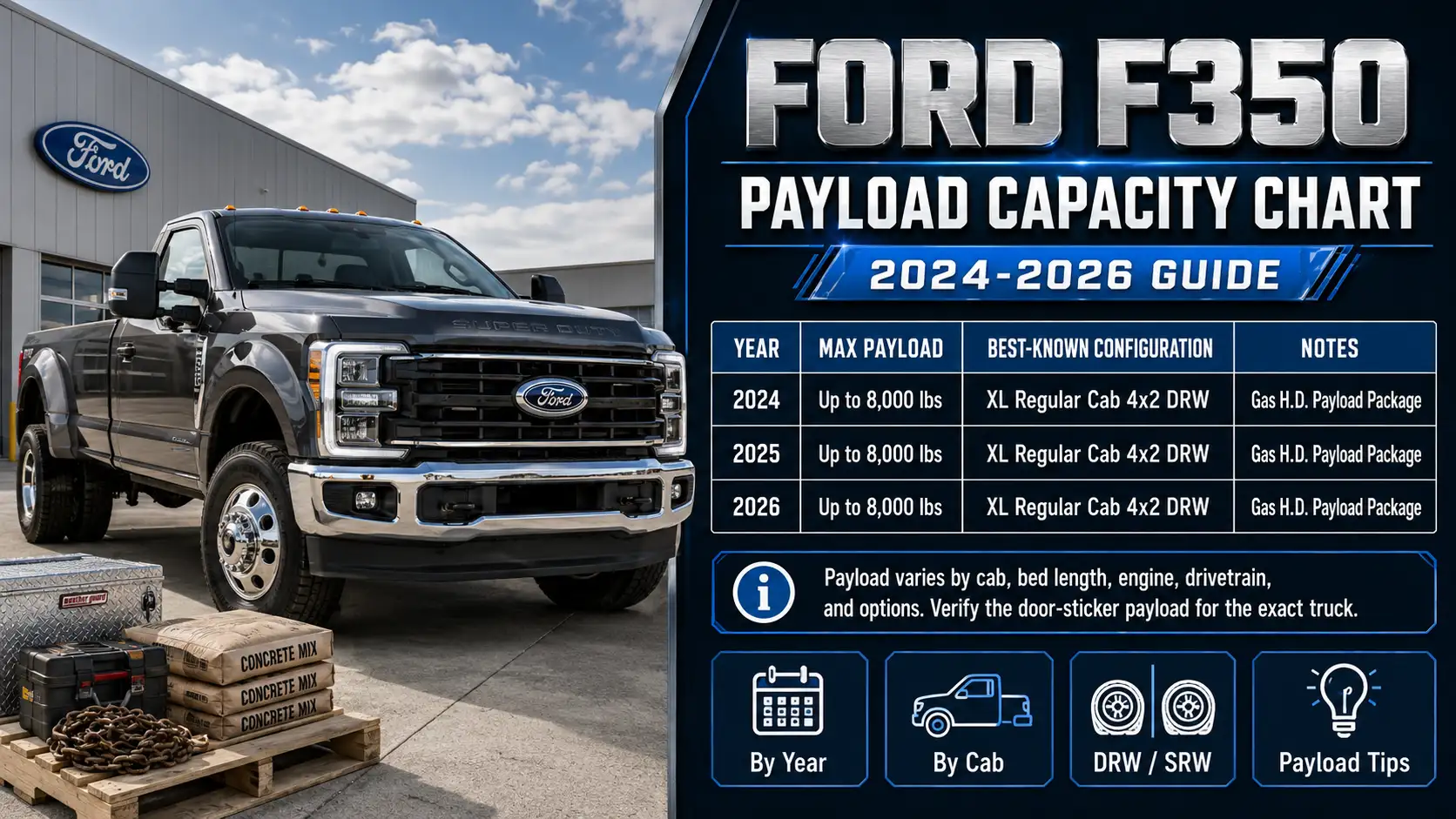
Ford F350 Payload Capacity Chart: Comprehensive Guide (2024-2026)

The Ford F-350 Super Duty operates within the highly competitive Class 3 truck segment.
This classification designates a Gross Vehicle Weight Rating (GVWR) between 10,000 and 14,000 pounds.

Prime for Young Adults — 6 Months Free
Students and 18–24s get six months of Prime free, then half price.
Start 6 Months Free As an Amazon Associate I earn from qualifying purchases.Within this heavy-duty category, the vehicle is engineered for severe commercial hauling and extreme recreational applications.
Payload capacity represents the absolute maximum weight the truck can safely carry within its cabin and cargo bed.
This calculation encompasses all passengers, aftermarket accessories, cargo, tools, and the downward pin or tongue weight of an attached trailer.
Failing to accurately calculate these variables can result in exceeding the vehicle’s safe operating limits, which compromises highway safety.
To fully grasp the Ford F350 payload capacity chart, buyers must examine the inverse relationship between GVWR and curb weight.
Curb weight represents the total mass of the base vehicle with a full tank of fuel and all standard fluids, but completely empty of cargo.
Subtracting the curb weight from the total GVWR yields the specific, legal payload capacity printed on the vehicle’s door jamb sticker.
Because curb weight fluctuates dramatically based on engine selection, cab dimensions, and trim levels, payload capacities vary wildly across the lineup.
The data indicates that the highest payload ratings always belong to the lightest baseline vehicle configurations.

Audible — Listen Free for 30 Days
One free credit a month and thousands of titles included.
Listen Free for 30 Days As an Amazon Associate I earn from qualifying purchases.For the modern Ford F-350, maximum payload reaches an astonishing 8,000 pounds when properly configured.
Achieving this peak 8,000-pound number requires strict adherence to a specific commercial build sheet.
Buyers must select a bare-bones Regular Cab, 4×2 drivetrain, Dual Rear Wheel (DRW) axle, and the lightweight 6.8L V8 gas engine.
Conversely, fully loaded luxury diesel models with four-wheel drive and heavy Crew Cabs will see their payload capacities drop significantly.
Ford F-350 Payload Capacity Master Guide
Recommended Best Deal Products


Unlocking the data behind the Super Duty. Visualizing how cab size, engine choice, and axle configurations impact your maximum hauling limits.
The Absolute Maximums
Before diving into the complex configurations, let’s look at the absolute peak performance numbers. These figures represent the absolute limit of F-350 engineering under perfect configuration conditions.
Keep in mind, hitting these numbers requires stripped-down, specific builds. Most consumer-grade trucks will fall slightly below these peaks due to added luxury features and heavier cab styles.
Max Payload Capacity
Requires: Regular Cab, 4×2, DRW, 6.8L Gas
Max Gooseneck Towing
Requires: Regular Cab, 4×2, DRW, 6.7L HO Diesel
Payload by Cab & Axle Setup
Recommended Best Deal Products


The single biggest factor in determining your F-350’s payload is your choice of rear axle. Dual Rear Wheel (DRW) setups significantly increase the Gross Vehicle Weight Rating (GVWR) compared to Single Rear Wheel (SRW) trucks.
Audible Premium Plus — Annual Membership
12 audiobook credits up front, plus the full Audible catalogue.
See Annual Plans As an Amazon Associate I earn from qualifying purchases.Additionally, the size of your cab directly eats into your payload capacity. A heavier Crew Cab leaves less remaining weight for cargo in the bed compared to a lighter Regular Cab.
The Engine Paradox
It seems counterintuitive, but upgrading to the massively powerful 6.7L Power Stroke Diesel actually reduces your payload capacity compared to gas engines.
Why? Because the diesel engine block and related components weigh hundreds of pounds more than the gas engines. This dead weight subtracts directly from your total GVWR.
The Trade-off: You sacrifice payload in the bed to gain massive towing capacity on the hitch.
Payload vs. Towing Trade-off
Analyzing the shift in capabilities across the four main engine options (Based on Crew Cab 4×4 DRW models).
How to Spec for Maximum Payload
Recommended Best Deal Products

If your primary goal is putting weight directly into the bed of the truck or carrying a massive slide-in camper, you must make strategic configuration choices at the dealership.
Minimize Cab Size
Choose a Regular Cab. Less sheet metal and interior seating means less base curb weight, leaving more room for payload.
Skip the 4×4
Opt for a 4×2 Drivetrain. Removing the front differential and transfer case removes ~400 lbs of curb weight.
Double the Wheels
Select Dual Rear Wheels (DRW). This provides the highest rated rear axle, drastically increasing your GVWR.
Stick to Gas
Pick the 6.8L or 7.3L V8 Gas Engine. The lighter engine block means hundreds of extra pounds allocated to payload.
The Master Ford F350 Payload Capacity Charts (2024-2026)
The following data sets provide an exhaustive breakdown of the maximum payload capacities for the 2024, 2025, and 2026 Ford F-350 models.
These charts isolate the critical engineering differences between Single Rear Wheel (SRW) and Dual Rear Wheel (DRW) architectures.
The numbers reflect the absolute maximum theoretical limits achievable by stripped-down commercial configurations.
Ford F-350 SRW Payload Capacity Chart
Single Rear Wheel (SRW) configurations are heavily favored by drivers who require daily drivability and easier parking maneuverability.
While SRW models sacrifice the extreme lateral stability of a dually, they still offer exceptional, commercial-grade hauling capabilities.
| Powertrain Option | Max. Payload Capacity (SRW) | Required Optimal Configuration | Required Tire Spec |
|---|---|---|---|
| 6.8L V-8 Gas | 5,137 lbs | SuperCab w/ 4×4 & 164.1-in WB | 18- or 20-in all-terrain |
| 7.3L V-8 Gas | 4,928 lbs | Regular Cab w/ 4×4 & 141.5-in WB | 18- or 20-in all-terrain |
| 6.7L Turbo-Diesel V-8 | 4,859 lbs | Regular Cab w/ 4×4 & 141.5-in WB | 18- or 20-in all-terrain |
| 6.7L H.O. Turbo-Diesel V-8 | 4,844 lbs | Regular Cab w/ 4×4 & 141.5-in WB | 18- or 20-in all-terrain |
Ford F-350 DRW Payload Capacity Chart
Dual Rear Wheel (DRW) setups are engineered strictly for uncompromising heavy-duty applications.
The addition of two extra rear tires drastically increases the truck’s rear Gross Axle Weight Rating (GAWR) and overall footprint.
This configuration maximizes in-bed carrying capacity and ensures absolute stability under extreme payload stresses.
| Powertrain Option | Max. Payload Capacity (DRW) | Required Optimal Configuration | Required Tire Spec |
|---|---|---|---|
| 6.8L V-8 Gas | 8,000 lbs | Regular Cab w/ 4×2 & 141.5-in WB | Standard Highway |
| 7.3L V-8 Gas | 7,635 lbs | Regular Cab w/ 4×2 & 141.5-in WB | Standard Highway |
| 6.7L Turbo-Diesel V-8 | 6,952 lbs | Regular Cab w/ 4×2 & 141.5-in WB | Standard Highway |
| 6.7L H.O. Turbo-Diesel V-8 | 6,935 lbs | Regular Cab w/ 4×2 & 141.5-in WB | Standard Highway |
The Engine Weight Paradox: Gas vs. Diesel
A common misconception among first-time heavy-duty truck buyers is that the most powerful engine provides the highest payload capacity.
In reality, commercial vehicle payload mathematics dictate the exact opposite outcome.
Because payload is calculated by subtracting curb weight from the fixed GVWR, a heavier engine inherently reduces the payload capacity.
Diesel engines utilize heavy cast-iron blocks and robust internal components designed to withstand massive internal compression ratios.
Furthermore, modern diesel powertrains require complex, heavy emissions systems, including Diesel Exhaust Fluid (DEF) tanks and Diesel Particulate Filters (DPF).
When reviewing data from sources like DAT Freight & Analytics, it becomes clear that diesel trucks are heavier, thus penalizing bed capacity.
This excess front-axle weight translates directly to a loss of approximately 1,000 pounds in payload capacity when compared to a gas variant.
The decision between gas and diesel ultimately forces buyers to choose between maximum in-bed payload or maximum trailer towing capacity.
The 6.8L V8 Gas Powertrain Profile
Introduced as the standard fleet workhorse, the 6.8-liter V8 gas engine provides 405 horsepower and 445 lb-ft of torque.
Because it is the lightest engine in the Super Duty lineup, it achieves the absolute maximum payload rating possible.
When paired with a DRW setup, this engine unlocks the headline-grabbing 8,000-pound payload limit for commercial fleets.
The 7.3L V8 “Godzilla” Gas Powertrain Profile
The 7.3-liter naturally aspirated V8 is designed for commercial buyers who require massive pulling power without expensive diesel maintenance schedules.
Generating 430 horsepower and 485 lb-ft of torque, this massive iron-block gas engine is slightly heavier than the 6.8L variant.
Consequently, its maximum DRW payload drops slightly from the peak to a still-massive 7,635 pounds.
The 6.7L Power Stroke V8 Turbo Diesel Profile
The standard output 6.7-liter Power Stroke delivers 475 horsepower and an immense 1,050 lb-ft of torque.
This immense torque output is engineered specifically for towing massive trailers across long distances, not for bearing static weight in the bed.
The physical mass of this turbocharged diesel, along with its cooling systems, drops the maximum DRW payload down to 6,952 pounds.
The 6.7L High-Output Power Stroke Profile
At the pinnacle of the powertrain lineup sits the High-Output diesel variant, featuring a water-jacketed turbine and upgraded exhaust manifolds.
This engineering marvel produces 500 horsepower and a class-leading 1,200 lb-ft of torque.
However, the extra cooling hardware and upgraded internals add incremental weight, resulting in the lineup’s lowest maximum DRW payload at 6,935 pounds.
How Cab and Bed Configurations Alter Payload
Just as engine weight dictates available payload, the physical dimensions of the truck’s cabin and cargo box play a critical role in capacity reduction.
Every square inch of high-strength steel, safety glass, and interior upholstery adds to the base curb weight.
Therefore, selecting larger cabs and longer beds will drastically reduce the amount of weight the vehicle is legally rated to carry.
Regular Cab Geometry
The Regular Cab features a single row of seating and two doors, representing the lightest possible body structure available.
Because it eliminates the mass of rear seats, rear doors, and extended rooflines, the Regular Cab is strictly required to hit the 8,000-pound payload benchmark.
This utilitarian configuration is almost exclusively favored by commercial fleets, agricultural workers, and industrial upfitters.
SuperCab Geometry
The SuperCab introduces rear half-doors and a secondary seating area suitable for occasional passenger use.
This additional sheet metal, glass, and interior hardware typically adds between 300 and 400 pounds to the vehicle’s unladen curb weight.
Consequently, payload capacities for SuperCab models will always be moderately lower than their Regular Cab counterparts.
Crew Cab Geometry
The Crew Cab is the most popular consumer configuration, featuring four full-size doors and expansive rear legroom.
However, this luxurious spaciousness comes at a severe cost to cargo-carrying capabilities.
The heavy structural components of the Crew Cab can reduce the vehicle’s payload capacity by 500 to 800 pounds compared to a base Regular Cab.
Cargo Box Length Considerations
Ford offers the F-350 with either a 6.75-foot standard bed or an 8-foot long bed.
While an 8-foot bed provides an impressive 78.5 cubic feet of cargo volume, the extra steel and longer wheelbase add significant curb weight.
Therefore, buyers must carefully balance their need for physical cargo volume against the numerical payload limits of the longer, heavier chassis.
The Single vs. Dual Rear Wheel Architecture
The decision between a Single Rear Wheel (SRW) and Dual Rear Wheel (DRW) truck fundamentally alters the vehicle’s core engineering limits.
This remains the single most impactful structural choice a buyer can make regarding payload capacity.
Reviewing the official metrics on Ford’s commercial towing hub demonstrates exactly how these axles change performance.
The SRW Engineering Profile
Single Rear Wheel F-350s utilize a standard pickup truck axle configuration, offering excellent daily drivability and standard width dimensions.
However, the entire rear weight of the vehicle and its cargo is supported by only two tires.
Even with commercial-grade, load-range E tires, the rubber contact patch becomes the ultimate limiting factor for payload ratings.
Maximum payload for an SRW F-350 peaks at 5,137 pounds, which remains highly capable for heavy slide-in campers or equipment hauling.
The DRW Engineering Profile
Dual Rear Wheel configurations, commonly known as “duallies,” feature an ultra-wide rear axle housing four independent tires.
This setup effectively doubles the rear tire contact patch and utilizes massive, heavy-duty leaf spring packs.
The DRW system is entirely responsible for elevating the F-350’s payload capacity into the 7,000 to 8,000-pound commercial range.
Furthermore, the wide rear track completely neutralizes lateral trailer sway, making it the uncompromising choice for hauling towering fifth-wheel RVs.
Trim Levels and the Luxury Weight Tax
Modern heavy-duty trucks are offered with sophisticated interior amenities that rival high-end European luxury sedans.
However, every technological feature, heavy leather seat, and panoramic sunroof adds tangible mass to the vehicle.
This continuous accumulation of luxury hardware creates a “weight tax” that directly lowers the payload capacity on premium trims.
Work Truck Trims: XL and XLT
The XL and XLT trims are purpose-built for maximum utility and minimal dead weight.
Featuring vinyl floors, durable cloth seats, and basic technological interfaces, these trims maintain exceptionally low curb weights.
To achieve the absolute highest payload ratings listed in official brochures, buyers must specify the base XL trim without options.
Mid-Tier Trims: Lariat and King Ranch
Moving into the Lariat and King Ranch trims introduces heavy components like power-adjustable seats, premium audio systems, and advanced driver-assist modules.
Features such as the 14-speaker B&O Unleashed sound system and power-deployable running boards significantly inflate the curb weight.
Owners of these well-appointed models often find their door sticker payload ratings are 300 to 500 pounds lower than the theoretical maximums.
Premium Trims: Platinum and Limited/Platinum Plus
At the very top of the hierarchy, the Platinum and Platinum Plus trims are saturated with heavy, premium luxury features.
According to reviews by experts like Edmunds, features like twin-panel moonroofs and 2.0 kW Pro Power Onboard generators add massive weight.
A fully optioned Crew Cab Platinum diesel 4×4 may exhibit a door sticker payload of less than 3,500 pounds, drastically reducing its commercial utility.
Specialized Payload and Towing Packages
Ford engineers have developed specialized option packages that drastically alter the F-350’s suspension geometry and legal weight ratings.
Understanding these packages is crucial for buyers intending to mount heavy slide-in campers or tackle severe off-road terrain.
Each package changes how the truck handles weight transfer and dynamic loading.
The Camper Package (Slide-In Certification)
Mounting a heavy slide-in truck camper fundamentally alters the vehicle’s center of gravity, making it incredibly top-heavy.
Ford offers a dedicated Camper Package (Option Code 471) designed explicitly to safely manage this unique payload dynamic.
The package includes heavy-service front springs, a thick rear stabilizer sway bar, and rear auxiliary helper springs.
Crucially, purchasing this package provides the official Slide-In Camper Certification required to legally and safely haul these units.
Tremor Off-Road Package Reductions
The popular Tremor Off-Road Package transforms the F-350 into a highly capable, factory-warrantied trail machine.
However, achieving extreme off-road articulation requires softer spring rates and specialized 1.7-inch twin-tube dampers.
To maximize suspension travel, Ford entirely removes the rigid rear stabilizer bar on Tremor-equipped models.
Furthermore, the package utilizes massive 35-inch all-terrain tires that feature softer sidewalls than standard commercial tires.
Because of these targeted off-road modifications, Tremor models suffer a significantly reduced payload limit, generally maxing out around 4,150 pounds.
GVWR Downgrade and Upgrade Packages
Vehicle registration fees, commercial tax brackets, and insurance rates are heavily tied to a truck’s official GVWR.
Ford offers a specific Payload Downgrade Package (Option 68D) that artificially caps the F-350’s GVWR at exactly 10,000 pounds.
This administrative adjustment allows private owners to avoid stringent commercial Department of Transportation (DOT) regulations and weight-based registration taxes.
Conversely, the High Capacity Axle Upgrade Package increases the SRW GVWR to 11,400 pounds, unlocking maximum legal cargo capacity for heavy operators.
Towing Capacity vs. Payload: The Tongue Weight Equation
A critical error made by many truck owners is assuming that towing capacity operates entirely independently of payload capacity.
In real-world applications, these two metrics are permanently linked through the physics of tongue and pin weight.
When an F-350 is towing a trailer, a significant portion of that trailer’s total weight rests directly on the truck’s rear suspension.
This downward force is legally classified as payload and must be subtracted from the truck’s overall cargo capacity.
Conventional Bumper-Pull Hitch Physics
For conventional bumper-pull trailers, such as utility trailers or travel campers, standard engineering dictates a 10% to 15% tongue weight.
If a driver is hauling a massive 15,000-pound conventional trailer, approximately 1,500 to 2,250 pounds of downward force is applied to the rear hitch.
This 2,250 pounds immediately consumes a massive portion of the truck’s available payload capacity.
Buyers must ensure that the remaining payload is sufficient to cover passengers and bed cargo.
Gooseneck and Fifth-Wheel Pin Weight
Gooseneck and fifth-wheel trailers utilize a hitch mounted directly above the rear axle, deep inside the cargo bed.
This design drastically improves towing stability but requires a much heavier downward pin weight, typically ranging from 15% to 25% of the total trailer mass.
If an F-350 is pulling a massive 25,000-pound fifth-wheel RV, the pin weight will generate between 3,750 and 6,250 pounds of payload force.
This extreme downward force illustrates precisely why Dual Rear Wheel (DRW) configurations are legally mandatory for the heaviest tow ratings.
Critical Questions (People Also Ask)
Why does my door jamb sticker show a lower payload than the Ford brochure?
The payload capacity advertised in official Ford brochures represents the theoretical maximum for a completely stripped-down, bare-bones vehicle.
The yellow Tire and Loading Information sticker on the driver’s door jamb represents the actual, real-world payload for your specific truck as it rolled off the assembly line.
Every factory option added to the vehicle—such as four-wheel drive, a diesel engine, panoramic sunroofs, and larger fuel tanks—adds physical curb weight.
Because payload equals GVWR minus curb weight, the addition of 1,300 pounds of luxury features will reduce your door sticker payload by exactly 1,300 pounds.
How much payload capacity is lost when choosing a 4×4 over a 4×2?
Selecting a four-wheel-drive (4×4) configuration adds significant mechanical hardware to the front end of the vehicle.
This includes a heavy front differential, transfer case, front driveshaft, and robust locking hub assemblies.
On average, upgrading from a 4×2 to a 4×4 drivetrain adds roughly 400 pounds of curb weight to the heavy-duty chassis.
Therefore, buyers can expect their maximum payload capacity to decrease by approximately 400 pounds simply by checking the 4×4 option box.
Is it legally safe to exceed the payload capacity if I upgrade my rear suspension?
Adding aftermarket air bags, overload springs, or stiffer sway bars will certainly help the truck sit level under a heavy load.
However, they absolutely do not increase the legal payload capacity of the vehicle.
The Gross Vehicle Weight Rating (GVWR) is a legally binding engineering limit certified by the manufacturer and the Department of Transportation.
Exceeding the payload printed on the door sticker is legally precarious, as it can void vehicle warranties and transfer liability to the driver in the event of an accident.
How does the 10,000 lb GVWR downgrade package actually work?
The 10,000 lb GVWR Downgrade Package (Option 68D) does not physically weaken the truck’s frame, axles, or heavy-duty brakes.
Instead, it is an administrative “paper downgrade” that artificially lowers the legal weight limit printed on the truck’s certification label.
This is primarily utilized to keep the vehicle strictly under the 10,001-pound threshold that triggers commercial vehicle regulations and costly weight-based registration taxes.
Because the GVWR is artificially lowered while the curb weight remains identical, the mathematical payload capacity shrinks significantly on paper.
Do I absolutely need the Camper Package for a slide-in camper?
Yes, if you intend to carry a heavy slide-in camper, the factory Camper Package (Option 471) is strongly recommended, and often legally required.
The high center of gravity created by a slide-in camper introduces extreme lateral sway and roll forces to the truck’s chassis.
The Camper Package combats this by adding a heavy-duty rear stabilizer bar, auxiliary rear helper springs, and computer-selected heavy-service front springs.
Crucially, it is the only way to receive the official Ford Slide-In Camper Certification document, which validates specific center of gravity limits.
How does the weight of a full fuel tank affect available payload?
The curb weight established by the manufacturer generally accounts for a full tank of fuel and all necessary operational fluids.
Therefore, a standard full tank of fuel is already factored into the payload capacity printed on the door jamb sticker.
However, buyers must be cautious when optioning the massive 48-gallon extended range fuel tank over the standard tank.
Diesel fuel weighs approximately 7.1 pounds per gallon; adding 14 extra gallons permanently increases the truck’s wet curb weight by roughly 100 pounds, which correspondingly reduces the available payload.
Can I get maximum payload and maximum towing in the exact same truck?
No, it is a physical and mathematical impossibility to achieve the highest advertised payload and highest advertised towing capacity in a single vehicle build.
Maximum payload (8,000 lbs) explicitly requires the lightest engine available, which is the 6.8L V8 Gas powertrain.
However, maximum gooseneck towing (up to 40,000 lbs) requires the immense torque of the heavy 6.7L High-Output Power Stroke Diesel.
Because the heavy diesel engine consumes over 1,000 pounds of payload capacity just sitting over the front axle, the ultimate towing machine will always have a lower in-bed payload limit.
What is the precise impact of Dual Rear Wheels (DRW) on trailer stability?
Beyond simply increasing payload mathematics, a Dual Rear Wheel axle drastically alters the vehicle’s yaw and roll resistance capabilities.
A heavy fifth-wheel trailer exerts immense side-to-side lateral forces on the truck’s rear end, especially in high crosswinds or during emergency maneuvers.
By spreading the load across four rear tires, a DRW truck provides a significantly wider track width and doubles the rigid tire sidewall resistance.
This effectively anchors the rear of the truck to the pavement, neutralizing trailer sway and providing commercial-grade stability that an SRW truck physically cannot replicate.
Final Payload Strategies for Fleet and Private Buyers
Analyzing the Ford F350 payload capacity chart reveals that heavy-duty hauling is an intricate balancing act between curb weight, engine selection, and axle architecture.
The data unequivocally proves that buyers seeking maximum in-bed cargo capacity must prioritize the lightweight 6.8L or 7.3L gas V8 engines.
When paired with a Dual Rear Wheel configuration, these gas powertrains unlock the absolute limit of Class 3 commercial hauling at 8,000 pounds.
Conversely, drivers prioritizing cross-country heavy towing capability must embrace the 6.7L High-Output Power Stroke diesel.
While the immense weight of the diesel engine inherently reduces the door-sticker payload capacity, its 1,200 lb-ft of torque is mandatory for pulling heavy 30,000+ pound gooseneck trailers.
Ultimately, prospective owners must explicitly calculate their anticipated trailer pin weights, passenger counts, and accessory additions before ordering a vehicle.
Relying solely on top-line brochure numbers will lead to overloaded axles and unsafe highway conditions.
By carefully matching the GVWR, cab configuration, and powertrain to the specific job, operators can ensure their Ford Super Duty performs flawlessly within its legal limits.
Related Ford Guides
Full payload guide: Ford F-150 Payload Capacity Chart

One Comment