Ford Transit Towing Capacity Chart By Year

Quick Answer
The Ford Transit’s towing capacity typically ranges from approximately 3,000 lbs to a maximum of 7,500 lbs, depending significantly on the model year, specific engine option (e.g., 3.5L EcoBoost vs. 3.7L Ti-VCT), drivetrain configuration (RWD vs. AWD), axle ratio, and the presence of an optional heavy-duty trailer tow package. Always consult your vehicle’s owner’s manual or door jamb sticker for the precise factory specification for your exact Transit.
For businesses or adventurers requiring robust utility, understanding the Ford Transit’s towing capacity is paramount to ensuring safe and efficient operation. Determining the precise towing capability for a specific Ford Transit can be complex due to variations in model year, engine, drivetrain, and configuration, leading to confusion and potential overloading risks. This comprehensive guide and chart will demystify the Ford Transit’s towing capacities from 2015 through 2026, providing a clear breakdown by year and configuration, empowering you to make informed decisions for your towing needs.

Prime for Young Adults — 6 Months Free
Students and 18–24s get six months of Prime free, then half price.
Start 6 Months Free As an Amazon Associate I earn from qualifying purchases.The Ford Transit’s towing capabilities for models from 2015 through 2026 generally range from approximately 3,000 lbs to a robust 7,500 lbs. This significant variation is primarily dictated by the specific model year, the installed engine (e.g., 3.5L EcoBoost vs. 3.5L PFDi V6), drivetrain (Rear-Wheel Drive vs. All-Wheel Drive), axle ratio, and crucially, the presence of a factory trailer tow package. Identifying your specific vehicle’s configuration is essential to determine its exact maximum towing capacity.
This chart covers Ford Transit models sold in North America from their launch in 2015 through the projected 2026 model year. Data reflects typical maximum capacities for primary engine options (3.7L Ti-VCT, 3.5L EcoBoost, 3.2L Power Stroke Diesel, 3.5L PFDi V6), RWD and AWD drivetrains, and various body styles (Cargo Van, Passenger Van, Cutaway, Chassis Cab). Capacities are always contingent on specific vehicle configurations, including axle ratio, wheelbase, Gross Combined Weight Rating (GCWR), and the critical presence of a factory trailer tow package. Readers must verify the exact towing capacity for their specific vehicle using the owner’s manual, VIN lookup, and the trailer weight rating label found on the door jamb.
Last reviewed: May 2026
Ford Transit Towing Capacity Chart By Year (2015-2026)
Recommended Best Deal Products


📤 Share Image
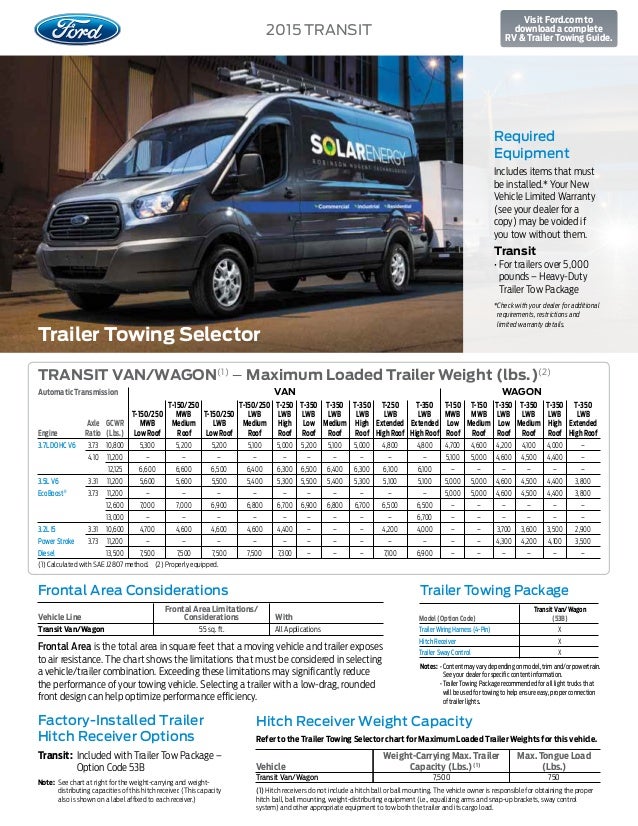
This table presents a comprehensive overview of the Ford Transit’s maximum towing capacities across various model years and key configurations. Note that these are maximum ratings, and your specific vehicle’s capacity may vary.
| Year | Engine | Drivetrain / Cab | Max Towing Capacity (lbs) | Notes |
|---|---|---|---|---|
| 2015 | 3.7L Ti-VCT V6 | RWD Cargo Van | 4,500 – 6,000 | Requires Trailer Tow Pkg., axle ratio dependent |
| 2015 | 3.5L EcoBoost V6 | RWD Cargo/Chassis Cab | 5,500 – 7,500 | Highest with specific axle & Trailer Tow Pkg. |
| 2015 | 3.2L Power Stroke Diesel I5 | RWD Cargo/Passenger Van | 5,000 – 7,000 | Good low-end torque for heavy loads |
| 2017 | 3.5L EcoBoost V6 | RWD Passenger Van | 5,000 – 6,500 | Lower due to heavier passenger configurations |
| 2019 | 3.7L Ti-VCT V6 | RWD Cutaway | 5,000 – 6,500 | Requires Trailer Tow Pkg. |
| 2020 | 3.5L PFDi V6 | RWD Cargo Van | 4,500 – 6,000 | Replaced 3.7L; axle ratio and package critical |
| 2020 | 3.5L EcoBoost V6 | AWD Cargo Van | 4,200 – 6,200 | AWD typically reduces max capacity vs. RWD |
| 2021 | 3.5L EcoBoost V6 | RWD Chassis Cab | 6,000 – 7,500 | Max capacity with heavy-duty tow package |
| 2023 | 3.5L PFDi V6 | AWD Passenger Van | 3,000 – 4,500 | Lower end for heavier, AWD, naturally aspirated setups |
| 2024 | 3.5L EcoBoost V6 | RWD Cargo Van | 5,500 – 7,500 | Consistent high ratings with optimal configuration |
| 2025 | 3.5L PFDi V6 | RWD Passenger Van | 4,000 – 5,500 | Capacity range for a common configuration |
| 2026 | 3.5L EcoBoost V6 | RWD Chassis Cab | 6,000 – 7,500 | Projected consistency for highest-rated models |
How to read this chart: This chart provides representative maximum towing capacities. The “Max Towing Capacity” column indicates a range because the exact figure is highly sensitive to the specific wheelbase, roof height, axle ratio, and the inclusion of an optional trailer tow package. Always refer to your vehicle’s door jamb sticker and owner’s manual for precise capacities.
Visualizing Ford Transit Towing Performance
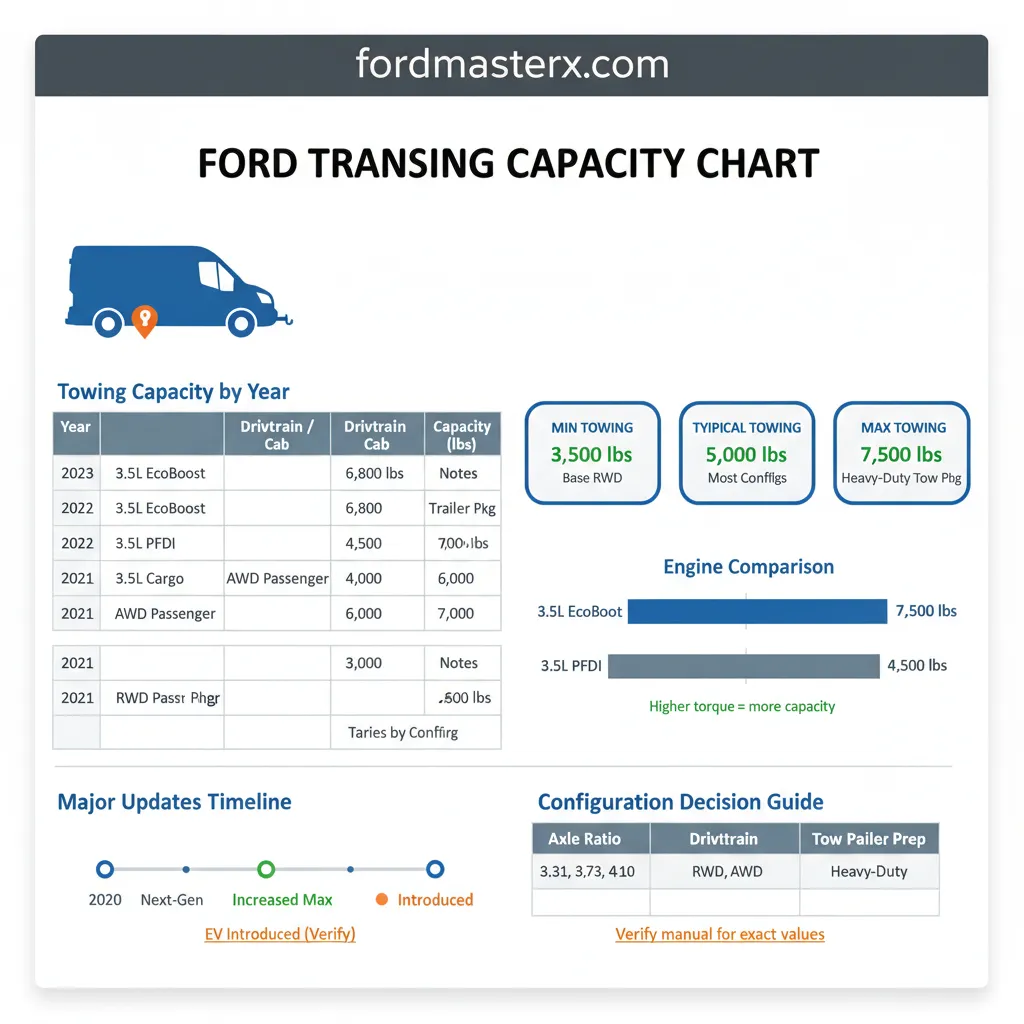
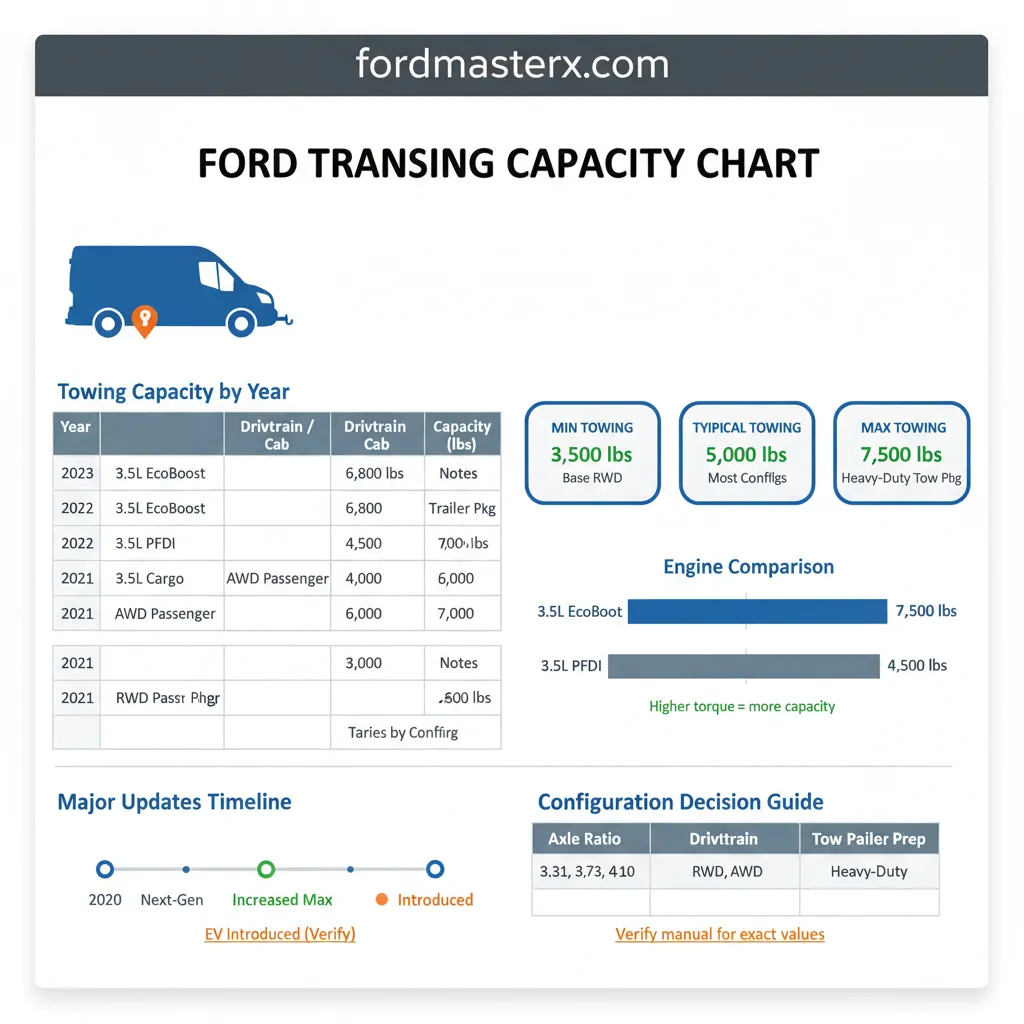
To provide an immediate, engaging summary of the Ford Transit’s towing capabilities, we’ve broken down key figures and configuration impacts into accessible visuals.
Ford Transit Towing Capacity Snapshot
These cards provide a quick overview of the Ford Transit’s typical towing capacity range across all configurations and model years.
3,000 lbs
4,500 – 6,500 lbs
7,500 lbs
Engine Comparison: Max Towing Potential
This horizontal bar chart visually compares the maximum potential towing capacities for key Ford Transit engine options, assuming optimal configuration.

Audible — Listen Free for 30 Days
One free credit a month and thousands of titles included.
Listen Free for 30 Days As an Amazon Associate I earn from qualifying purchases.Key Configuration Decision Grid for Towing
This grid highlights how critical choices like axle ratio, drivetrain, and tow package combine to determine your Transit’s final towing capacity.
A numerically higher axle ratio (e.g., 3.73 or 4.10) provides more torque for towing, increasing capacity at the expense of fuel economy.
Rear-Wheel Drive (RWD) configurations typically offer higher maximum towing capacities due to their inherent design for heavy loads. All-Wheel Drive (AWD) provides enhanced traction but may slightly reduce max towing.
Essential for reaching maximum towing. Includes hitch receiver, upgraded wiring, heavy-duty alternator, and often enhanced cooling for transmission and engine.
Year-Change Timeline: Ford Transit Towing Updates
This timeline highlights significant model year changes that impacted the Ford Transit’s towing capabilities.
Introduced with 3.7L Ti-VCT, 3.5L EcoBoost, and 3.2L Power Stroke Diesel. Established a max towing range up to 7,500 lbs (EcoBoost RWD).
3.7L Ti-VCT and 3.2L Diesel phased out. New 3.5L PFDi V6 introduced. Crucially, All-Wheel Drive (AWD) option became available, affecting specific towing ratings.
Generally consistent towing capacities with minor adjustments based on chassis variations and ongoing engineering improvements. Focus on 3.5L PFDi and 3.5L EcoBoost.

Year-by-Year Evolution of Ford Transit Towing Ratings (2015-2026)
Recommended Best Deal Products


The Ford Transit’s journey in the North American market, commencing in 2015, has seen a steady evolution in its capabilities, including towing. Understanding these changes year-by-year is crucial for accurate assessment.
2015-2019: Establishing the Foundation
Upon its North American debut in 2015, the Ford Transit quickly set a high standard for full-size van utility. The initial engine lineup included the capable 3.7L Ti-VCT V6, the powerful 3.5L EcoBoost V6, and the torque-rich 3.2L Power Stroke Diesel I5. During these years, the 3.5L EcoBoost, especially in RWD Cargo Van or Chassis Cab configurations with an appropriate axle ratio and heavy-duty trailer tow package, consistently offered the highest maximum towing capacity, reaching up to 7,500 lbs. The diesel option, while not always reaching the peak of the EcoBoost, provided excellent low-end torque for sustained heavy hauling and impressive fuel efficiency under load. Capacities for the 3.7L Ti-VCT were respectable, typically ranging from 4,500 to 6,000 lbs depending on the setup. This period saw Ford optimizing axle ratios and tow package inclusions to cater to diverse commercial needs.
Audible Premium Plus — Annual Membership
12 audiobook credits up front, plus the full Audible catalogue.
See Annual Plans As an Amazon Associate I earn from qualifying purchases.2020 Refresh and Beyond: New Powertrains and AWD
The 2020 model year marked a significant refresh for the Ford Transit. This update included a revamped powertrain lineup, with the 3.7L Ti-VCT and 3.2L Power Stroke Diesel being phased out. They were replaced by the more modern 3.5L PFDi (Port Fuel Direct Injection) V6 and an optional 2.0L EcoBlue Diesel (briefly available for some markets, not the primary NA diesel offering). Most notably, 2020 introduced the availability of All-Wheel Drive (AWD). While AWD provided enhanced traction and capability in varying weather conditions, it typically resulted in a slight reduction in maximum towing capacity compared to equivalent RWD models due to increased vehicle weight and drivetrain losses. The 3.5L EcoBoost continued to be the champion for maximum towing, maintaining ratings up to 7,500 lbs for optimally configured RWD models. Subsequent model years, including the projected 2026, have seen Ford maintain these competitive towing figures, with continuous refinements in chassis and technology ensuring the Transit remains a leading choice for vocational upfitting and towing demands.

Ford Transit Engine and Configuration Impact on Towing Capacity
Beyond the model year, the core components of your Ford Transit – specifically the engine, drivetrain, body style, and axle ratio – are the primary determinants of its towing capability.
Engine Choice: The Powerhouse Behind the Pull
- 3.5L EcoBoost V6: Consistently the top performer, this twin-turbocharged engine generates significant horsepower (around 310 hp) and, more importantly, impressive torque (approximately 400 lb-ft). Its robust output makes it the go-to choice for those seeking the highest towing capacities, often associated with the 7,500 lbs maximum rating. This engine’s flat torque curve ensures ample pulling power across a wide RPM range.
- 3.7L Ti-VCT V6 (Discontinued): An earlier naturally aspirated option, the 3.7L V6 offered competent towing, typically in the 4,500-6,000 lbs range. While reliable, its lower torque output compared to the EcoBoost limited its upper towing limits.
- 3.5L PFDi V6: Introduced in 2020, this naturally aspirated engine replaced the 3.7L. It offers a good balance of power and efficiency for general utility, with towing capacities generally in the 4,500-6,000 lbs bracket, depending on configuration. It produces around 275 hp and 262 lb-ft of torque.
- 3.2L Power Stroke Diesel I5 (Discontinued): This 5-cylinder diesel was known for its strong low-end torque (around 350 lb-ft), which is ideal for sustained heavy towing and climbing grades without straining. Its maximum capacities typically ranged from 5,000-7,000 lbs. While discontinued, used models offer a compelling towing package for specific needs.
Drivetrain: RWD vs. AWD
The choice between Rear-Wheel Drive (RWD) and All-Wheel Drive (AWD) is crucial for towing. RWD configurations are generally engineered for heavier loads and offer the highest maximum towing capacities, as the drive wheels are directly under the heaviest part of the vehicle when towing. AWD, while providing superior traction and stability in slippery conditions, often adds weight to the vehicle and can slightly reduce the maximum tow rating by a few hundred pounds due to increased drivetrain complexity and parasitic losses.
Body Style, Wheelbase, and Roof Height
The specific body style (Cargo Van, Passenger Van, Cutaway, Chassis Cab), wheelbase (regular, long, extended), and roof height (low, medium, high) significantly influence the Transit’s curb weight and Gross Vehicle Weight Rating (GVWR). A heavier base vehicle (e.g., a fully outfitted Passenger Van with a high roof and long wheelbase) will have less available payload for tongue weight, thus reducing the maximum permissible trailer weight. Conversely, lighter, more compact configurations like a Chassis Cab or shorter Cargo Van often yield higher potential towing figures.
Axle Ratio: The Mechanical Advantage
The axle ratio is a critical but often overlooked factor. It dictates how many times the drive shaft rotates for each rotation of the wheels. A numerically higher (or “shorter”) axle ratio, such as 3.73 or 4.10, provides greater mechanical advantage, translating engine torque into more pulling power at the wheels. This is essential for maximizing towing capacity, especially with heavier trailers. Conversely, a numerically lower (or “taller”) axle ratio, like 3.31, favors fuel economy but will limit your maximum tow rating. For any Ford Transit model intended for serious towing, opting for the highest available axle ratio for that configuration is highly recommended.
Achieving the maximum stated towing capacity for any Ford Transit configuration almost always requires the factory-installed Heavy-Duty Trailer Tow Package and the highest available numerically axle ratio. Without these, your vehicle’s true towing limit will be significantly lower than the maximum published figures.
What Affects Ford Transit Towing Capacity Beyond Engine and Configuration
Recommended Best Deal Products


Understanding the broader ecosystem of towing terminology and limitations is vital for safe and compliant operation with your Ford Transit. These factors apply universally to all towing vehicles.
Gross Combined Weight Rating (GCWR)
The GCWR is the absolute maximum permissible loaded weight of your tow vehicle (Ford Transit) AND its attached trailer. This is the ultimate limit you cannot exceed. Your actual towing capacity is often derived by subtracting your Transit’s actual curb weight (plus passengers and cargo) from the GCWR. Exceeding the GCWR is dangerous and illegal.
Gross Vehicle Weight Rating (GVWR) and Payload Capacity
Your Transit’s GVWR is the maximum permissible loaded weight of the vehicle itself, including the vehicle’s curb weight, fuel, passengers, cargo, and crucially, the trailer’s tongue weight. Every pound of cargo or passengers you add to the Transit directly reduces its available payload capacity. Since tongue weight counts towards your vehicle’s payload, it significantly impacts how much trailer weight you can safely tow. Always check the yellow sticker on your driver’s side door jamb for your specific vehicle’s GVWR and payload capacity.
Tongue Weight
Tongue weight is the downward force the trailer exerts on the hitch ball. For safe towing, it should typically be 10-15% of the total loaded trailer weight. Too little tongue weight can cause trailer sway (fish-tailing), while too much can overload the rear axle of your Transit, affecting steering and braking. Proper tongue weight distribution is critical for stability and safety.
Trailer Tow Package (Factory vs. Aftermarket)
For maximum towing capabilities, a factory-installed trailer tow package is almost always necessary. These packages include not just a hitch receiver and trailer wiring, but often critical upgrades such as:
- Upgraded engine and/or transmission cooling systems.
- Heavy-duty alternator for charging trailer batteries.
- Trailer brake controller wiring, or even an integrated trailer brake controller.
- Specific wiring harness for trailer lights and braking systems.
While aftermarket hitches can be installed, they may not come with all the necessary cooling or electrical enhancements to safely tow up to the vehicle’s maximum rated capacity. Always ensure any aftermarket installation meets or exceeds OEM specifications.
Tires, Maintenance, and Driving Habits
The tires on your Ford Transit must be appropriately rated for the loads involved (often indicated by an “LT” designation for light truck tires) and properly inflated according to the vehicle’s door jamb sticker for towing conditions. Regular maintenance, including transmission fluid changes, brake inspections, and cooling system checks, is paramount for reliability and safety when towing. Finally, good driving habits – slower speeds, increased following distances, and gentle maneuvers – are essential when hauling heavy loads.
Comparing Ford Transit Towing to Competitors and Typical Use Cases
To put the Ford Transit’s towing capabilities into perspective, it’s helpful to consider how it stacks up against rivals and what types of tasks it’s best suited for.
Competitive Landscape
The Ford Transit competes in the full-size commercial van segment against vehicles like the Mercedes-Benz Sprinter, Ram ProMaster, and, historically, the Nissan NV.
- Mercedes-Benz Sprinter: Typically offers maximum towing capacities in the range of 5,000 to 7,500 lbs, often driven by its powerful diesel engine options.
- Ram ProMaster: Utilizes a front-wheel-drive platform and generally offers lower towing capacities, often maxing out around 4,680 to 6,910 lbs.
- Nissan NV (Discontinued): With its body-on-frame construction and V8 engine option, it offered competitive towing, often in the 6,000-9,000 lbs range, making it a robust, albeit less fuel-efficient, option.
Research indicates that the Ford Transit, especially with the 3.5L EcoBoost engine and proper configuration, consistently holds its own, often matching or exceeding key competitors in maximum conventional towing capacity, particularly when comparing to unibody rivals like the ProMaster and the diesel Sprinter.
Ideal Towing Scenarios for the Ford Transit
The Ford Transit’s versatility makes it suitable for a wide array of towing tasks:
- Utility and Cargo Trailers: Perfect for landscapers, contractors, or small businesses hauling equipment, tools, or supplies. A 16-foot utility trailer might weigh 1,500 lbs empty and 4,000 lbs loaded, well within the Transit’s comfortable range.
- Small to Medium Travel Trailers and Pop-Up Campers: Many travel trailers fall into the 3,000-6,000 lbs range, making them a great match for a properly equipped Transit.
- Car Haulers (Lighter Vehicles): For towing smaller cars, ATVs, or UTVs on an open trailer, the Transit can typically handle the weight, especially with the EcoBoost engine.
- Small Boat Trailers: Many recreational boats and their trailers are within the Transit’s capabilities.
While the Transit is highly capable, it’s essential to recognize its limitations. As a unibody vehicle, it’s generally not designed for the same extreme heavy-duty towing applications that body-on-frame pickup trucks are built for, especially regarding gooseneck or fifth-wheel setups. Always ensure the trailer’s Gross Vehicle Weight Rating (GVWR) is well within your Transit’s maximum towing capacity for safety and legal compliance.
Never exceed your Ford Transit’s Gross Combined Weight Rating (GCWR), Gross Vehicle Weight Rating (GVWR), Gross Axle Weight Ratings (GAWR), or maximum trailer weight rating. Always consult your vehicle’s specific owner’s manual and the payload sticker on the door jamb for the most accurate and legally binding information before towing.
Conclusion
The Ford Transit offers a broad spectrum of towing capabilities, adapting to a wide range of commercial and recreational needs. Its maximum towing capacities, ranging from approximately 3,000 lbs to a robust 7,500 lbs, are highly dependent on the specific model year (2015-2026), engine choice (with the 3.5L EcoBoost often facilitating the highest ratings), drivetrain (RWD generally offering more capacity than AWD), axle ratio, and the essential presence of a factory trailer tow package. Always prioritize safety by consulting your vehicle’s owner’s manual, door jamb sticker, and adhering strictly to GCWR, GVWR, and proper tongue weight limits for your exact Ford Transit configuration. Properly equipped, the Transit stands as a formidable and versatile tow vehicle, well-suited for everything from utility trailers to small travel trailers. Utilize the detailed chart and information provided to pinpoint your Ford Transit’s specific towing potential, and always verify with your vehicle’s documentation before towing. Explore our other guides for comprehensive maintenance and performance insights.
Frequently Asked Questions
What is the highest towing capacity for a Ford Transit?
The highest towing capacity for a Ford Transit can reach approximately 7,500 lbs. This impressive capability is typically achieved with specific configurations, often involving the 3.5L EcoBoost V6 engine, a rear-wheel-drive (RWD) drivetrain, an optimal axle ratio, and the factory-installed heavy-duty trailer tow package. Always confirm the exact rating for your model year and configuration.
Does AWD affect Ford Transit towing capacity?
Yes, all-wheel drive (AWD) can affect the Ford Transit’s towing capacity. While AWD enhances traction and stability, especially in challenging conditions, some AWD configurations may have slightly lower maximum towing ratings compared to equivalent rear-wheel-drive (RWD) models. This is often due to added weight or different drivetrain component strengths. Always check specific manufacturer specifications.
Is a tow package required for towing with a Ford Transit?
A factory-installed trailer tow package is highly recommended, and often required, to achieve the maximum advertised towing capacities for the Ford Transit. This package typically includes a robust hitch receiver, trailer wiring harness, and sometimes upgraded cooling systems, heavy-duty alternators, or a trailer brake controller connection. Without it, capacity may be significantly reduced.
How do I find the exact towing capacity for my specific Ford Transit?
The most accurate way to determine your specific Ford Transit’s towing capacity is by consulting your vehicle’s owner’s manual. Additionally, the door jamb sticker (typically on the driver’s side) provides crucial information such as Gross Vehicle Weight Rating (GVWR) and Gross Axle Weight Ratings (GAWRs). These, combined with the Gross Combined Weight Rating (GCWR) from your manual, will confirm your vehicle’s precise limits.
What is the difference between payload and towing capacity?
Payload capacity refers to the maximum weight your Ford Transit can carry *inside* the vehicle, including passengers, cargo, and the tongue weight of a trailer. Towing capacity, conversely, is the maximum weight your Transit can *pull* behind it. It’s crucial to understand that exceeding either limit is unsafe and can damage your vehicle. Tongue weight from the trailer reduces available payload.
Ford Transit Towing Capacity By Year
Full towing capacity guide: Ford F-150 Towing Capacity Chart (2004–2026)