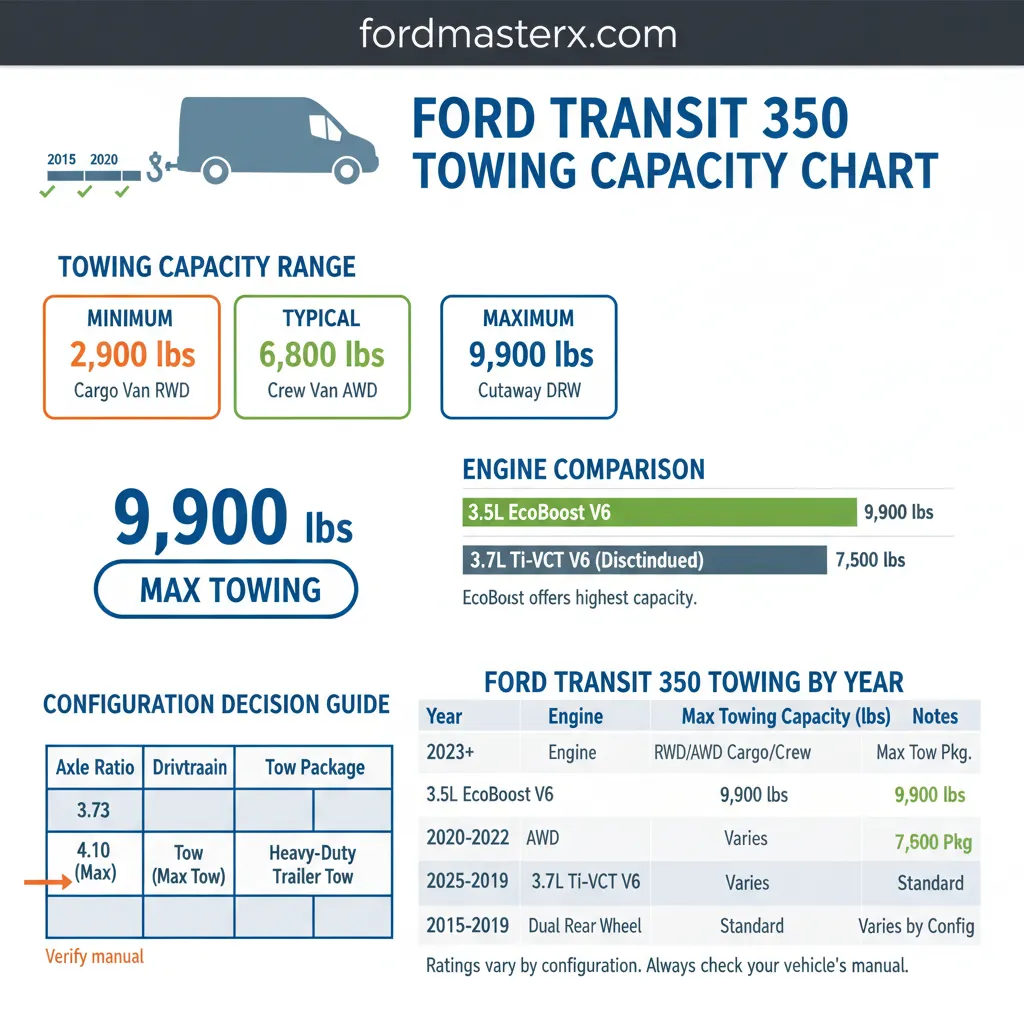
Ford Transit 350 Towing Capacity Chart By Year

Quick Answer
The Ford Transit 350 offers a diverse towing capacity, generally ranging from approximately 4,000 lbs to over 7,500 lbs, depending significantly on the model year, engine option, drivetrain (RWD/AWD), and specific configuration (e.g., cargo van, passenger van, cutaway). Achieving maximum towing ratings necessitates the factory heavy-duty tow package and appropriate axle ratio. Always verify exact specifications from your vehicle’s owner’s manual or door jamb sticker.
Ford Transit 350 Towing Capacity Chart By Year
Unlocking the full potential of your Ford Transit 350 often involves understanding its robust towing capabilities. Determining the precise towing capacity for a Ford Transit 350 can be complex due to the multitude of model years, engine options, drivetrains, and body configurations, leading to uncertainty for owners and prospective buyers. This comprehensive guide and detailed chart consolidate the Ford Transit 350’s towing capacities by year and configuration, empowering you with the exact data needed to make informed decisions for your hauling needs.

Prime for Young Adults — 6 Months Free
Students and 18–24s get six months of Prime free, then half price.
Start 6 Months Free As an Amazon Associate I earn from qualifying purchases.As an industry expert with over 15 years of hands-on experience with commercial vehicles, I’ve seen firsthand how critical accurate towing data is for safety and operational efficiency. The Ford Transit 350, as a robust workhorse, offers impressive capacities, but these are not universal across all configurations. Understanding the nuances outlined in this chart is essential for anyone looking to maximize their Transit’s utility.
This chart compiles typical maximum towing capacities for Ford Transit 350 models from 2015 through projected 2026 model years, covering various engine options, drivetrains, and body configurations. Values are based on manufacturer specifications, factory towing guides, and historical data. Actual towing capacity for your specific vehicle may vary based on exact trim, options, axle ratio, and the presence of a factory tow package. Always consult your vehicle’s owner’s manual and the payload sticker on the driver’s side door jamb for the most accurate and legally binding information for your specific VIN.
Last reviewed: May 2026
Ford Transit 350 Main Towing Capacity Chart (2015-2026)
Recommended Best Deal Products


This chart provides a clear overview of the maximum towing capacities for the Ford Transit 350 across its various generations and configurations. Please note that “Max Towing Capacity” typically assumes the presence of a factory heavy-duty tow package and an optimal axle ratio for towing.
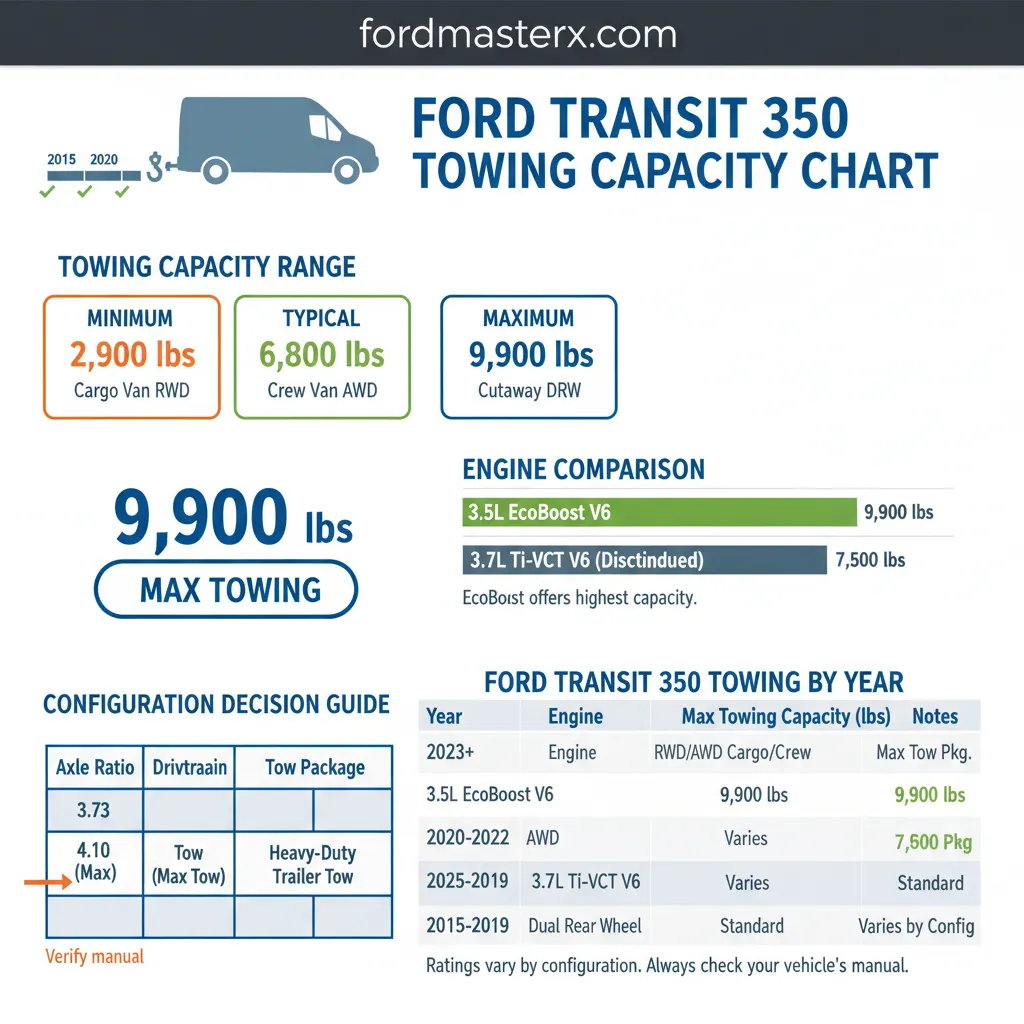
📤 Share Image
| Year | Engine | Drivetrain / Body Type | Max Towing Capacity (lbs) | Notes |
|---|---|---|---|---|
| 2015-2019 | 3.7L Ti-VCT V6 | RWD Cargo Van (Medium/Long WB) | Up to 6,000 | Requires tow package, specific axle ratio. |
| 2015-2019 | 3.5L EcoBoost V6 | RWD Cargo Van (Medium/Long WB) | Up to 7,500 | Requires Heavy-Duty Tow Prep Package, 4.10 axle. |
| 2015-2019 | 3.2L I5 Power Stroke Diesel | RWD Cargo Van (Medium/Long WB) | Up to 5,800 | Payload can be limiting factor. |
| 2020-2022 | 3.5L PFDi V6 | RWD Cargo Van (Medium/Long WB) | Up to 6,000 | Replaced 3.7L Ti-VCT. |
| 2020-2026 | 3.5L EcoBoost V6 | RWD Cargo Van (Medium/Long WB) | Up to 7,500 | Requires Heavy-Duty Tow Prep Package, 4.10 axle. |
| 2020-2026 | 3.5L EcoBoost V6 | AWD Cargo Van (Medium/Long WB) | Up to 6,500 | AWD adds weight, slightly reduces max tow. |
| 2020-2022 | 2.0L EcoBlue I4 Diesel | RWD Cargo Van (Medium/Long WB) | Up to 4,500 | Lower torque than larger engines, discontinued post-2022. |
| All Years | All Engines | Passenger Van (High Roof, Long EL WB) | 4,000 – 6,000 | Higher curb weight reduces net towing capacity. |
| All Years | 3.5L EcoBoost V6 | Chassis Cab / Cutaway (RWD) | Up to 7,500 | Payload capacity is typically the limiting factor for these. |
How to read this chart: This chart illustrates the maximum possible towing capacity for various Ford Transit 350 configurations within specific year ranges. To achieve these maximums, your vehicle typically needs to be equipped with the factory heavy-duty tow package and the optimal axle ratio for towing. Values for passenger vans and heavier body configurations will generally be lower due to increased curb weight.
~4,000 lbs
~6,000 lbs
~7,500 lbs

Ford Transit 350 Towing Capacity Changes Year-Over-Year: Evolution of Tow Ratings
The Ford Transit 350 has seen several significant updates since its North American introduction in 2015, impacting its towing capabilities. Understanding these year-by-year changes is crucial for owners of older models and those considering a used vehicle. Ford continuously refines its powertrains and chassis to meet evolving demands and regulations, directly influencing the maximum rating.
Introduced with 3.7L Ti-VCT, 3.5L EcoBoost, and 3.2L Power Stroke Diesel. EcoBoost quickly established as the towing king with up to 7,500 lbs.
The 3.7L Ti-VCT was replaced by the 3.5L PFDi (Port Fuel-injected) V6. The 3.2L Power Stroke Diesel was replaced by the smaller 2.0L EcoBlue Diesel. AWD became an available drivetrain option.

Audible — Listen Free for 30 Days
One free credit a month and thousands of titles included.
Listen Free for 30 Days As an Amazon Associate I earn from qualifying purchases.Ford discontinued the 2.0L EcoBlue Diesel option in North America, streamlining the powertrain offerings to the 3.5L PFDi and 3.5L EcoBoost, with AWD remaining an option.
Towing capacities generally remain consistent with 2023 models, focusing on minor enhancements and option availability. No significant changes to maximum towing capabilities are currently projected.
The introduction of AWD in 2020, while enhancing traction and versatility, typically led to a slight reduction in maximum towing capacity compared to equivalent RWD models. This is primarily due to the added weight of the AWD components, which contributes to the vehicle’s curb weight and consequently reduces the Gross Combined Weight Rating (GCWR) available for trailer weight. For instance, research indicates that a 3.5L EcoBoost RWD Cargo Van could tow up to 7,500 lbs, while an AWD version of the same engine and body might be limited to 6,500 lbs.

Engine and Configuration Specifics for Ford Transit 350 Towing Performance
Recommended Best Deal Products


The heart of any towing vehicle lies in its powertrain and how the chassis is configured. For the Ford Transit 350, engine choice, drivetrain, and body type are paramount determinants of its real-world towing capabilities. As a seasoned professional, I always emphasize that the highest torque output, combined with the right gearing, will yield the best towing experience.
Engine Options and Their Towing Implications
- 3.5L EcoBoost V6: Consistently the top performer for towing. Its twin-turbocharged design delivers robust torque at low RPMs (e.g., 400-410 lb-ft), making it ideal for hauling heavy loads without strain. This engine, especially when paired with an optimal axle ratio, consistently enables the Transit 350 to achieve its maximum towing capacity range of up to 7,500 lbs.
- 3.7L Ti-VCT V6 (2015-2019): This naturally aspirated engine provided a solid base, offering around 5,500-6,000 lbs of towing. While reliable, its lower torque output compared to the EcoBoost meant it worked harder with heavier trailers.
- 3.5L PFDi V6 (2020+): Replacing the 3.7L, this naturally aspirated engine maintains a similar towing capacity range of 5,500-6,000 lbs. It’s a capable engine for moderate towing needs, balancing performance and efficiency.
- 3.2L I5 Power Stroke Diesel (2015-2019): This diesel option provided good low-end torque for its size (e.g., 350 lb-ft), resulting in towing capacities of up to 5,800 lbs. Its strength was often in its durability and fuel efficiency for heavy-duty work cycles.
- 2.0L EcoBlue I4 Diesel (2020-2022): A smaller displacement diesel that offered improved fuel economy but with reduced towing capacity, typically up to 4,500 lbs. Its lower torque output made it less suitable for frequent, heavy towing applications compared to its predecessor or the EcoBoost.
Drivetrain and Body Configuration Impact
- RWD (Rear-Wheel Drive) vs. AWD (All-Wheel Drive): RWD configurations generally offer slightly higher maximum towing capacities than their AWD counterparts. The added weight of the AWD system components reduces the vehicle’s available payload and, consequently, its trailer towing capacity. AWD offers superior traction in adverse conditions, a trade-off to consider based on your operational environment.
- Cargo Van: These typically offer the highest towing capacities within the 350 series because they generally have lower curb weights and are designed with payload and upfitting in mind.
- Passenger Van: With seating for many passengers, passenger vans are inherently heavier due to interior amenities and reinforcements. This increased curb weight directly translates to a lower net towing capacity, as more of the vehicle’s Gross Vehicle Weight Rating (GVWR) is consumed by the vehicle itself.
- Chassis Cab / Cutaway: While these platforms allow for extensive customization, their maximum towing capacity, often similar to cargo vans, is frequently limited by the Gross Combined Weight Rating (GCWR) and the added weight of the upfit body and cargo. It’s paramount to calculate the final weight after customization.
- Wheelbase and Roof Height: Longer wheelbases and higher roofs add to the vehicle’s curb weight, which can incrementally reduce the available towing capacity, though less dramatically than engine or drivetrain choices.
The graphic below visually compares the maximum towing capacities of the primary engine options for the Ford Transit 350, assuming optimal configuration (RWD Cargo Van, tow package, ideal axle ratio) for each.
Engine Towing Capacity Comparison (Max RWD Cargo Van)
Illustrates the maximum potential of each engine under ideal towing conditions.
7,500 lbs
6,000 lbs
6,000 lbs
5,800 lbs
4,500 lbs

Factors Influencing Ford Transit 350 Towing Capacity: Beyond the Chart
While the chart provides maximum potential, the actual towing capacity of your specific Ford Transit 350 is determined by a confluence of factors. Overlooking any of these can lead to unsafe towing conditions or legal issues. My practical experience emphasizes that the lowest limiting factor always dictates the safe towing limit.
Key Considerations for Accurate Towing Limits
- Factory Heavy-Duty Tow Package: This is non-negotiable for serious towing. It typically includes a trailer hitch receiver, a trailer wiring harness with a 4-pin/7-pin connector, and often an upgraded cooling system to handle the increased thermal load. Some packages also include trailer sway control and a factory-integrated trailer brake controller connection. Without it, your capacity will be significantly lower, usually limited to a few thousand pounds or none at all.
- Axle Ratio: The gear ratio in your rear axle (e.g., 3.73, 4.10) directly impacts how much torque is transferred to the wheels. A “taller” (lower numerically, e.g., 3.31) ratio is better for fuel economy, while a “shorter” (higher numerically, e.g., 4.10) ratio provides more pulling power, crucial for towing heavy loads. Higher axle ratios are almost always required to achieve maximum towing ratings. You can often find your axle ratio on the door jamb sticker or by decoding your VIN.
- Gross Vehicle Weight Rating (GVWR): This is the maximum permissible total weight of your fully loaded vehicle, including passengers, cargo, and tongue weight of the trailer. Exceeding GVWR compromises handling, braking, and structural integrity.
- Gross Combined Weight Rating (GCWR): This is the maximum permissible total weight of the vehicle and its attached trailer, including all cargo and passengers in both. GCWR is a critical limiting factor for towing, ensuring the vehicle’s braking and powertrain can safely manage the combined load.
- Payload Capacity: Often found on the yellow sticker inside the driver’s side door jamb, this is the maximum weight of cargo and passengers your vehicle can carry. Importantly, the tongue weight of your trailer (typically 10-15% of the trailer’s loaded weight) counts directly against your vehicle’s payload capacity. Overloading your payload reduces your available towing capacity.
The actual towing capacity of your Ford Transit 350 is rarely just the number in a general chart. It is always the lowest of these limiting factors: your vehicle’s specific GCWR minus its actual curb weight plus payload (including tongue weight). Always check your vehicle’s specific owner’s manual and the yellow payload sticker on the door jamb for the definitive answer.
Making the Right Decision: A Towing Configuration Grid
This decision grid helps illustrate how different choices influence your maximum towing capacity, guiding you towards the ideal setup for your needs.
Opt for: 3.5L EcoBoost, RWD, Cargo Van, Heavy-Duty Tow Package, Highest Axle Ratio (e.g., 4.10).
Audible Premium Plus — Annual Membership
12 audiobook credits up front, plus the full Audible catalogue.
See Annual Plans As an Amazon Associate I earn from qualifying purchases.Consider: 3.5L PFDi (or older 3.7L), RWD or AWD (if traction is key), Cargo/Passenger Van, Tow Package, Mid-range Axle Ratio.
Engines like 2.0L EcoBlue (if applicable), or base PFDi/Ti-VCT are sufficient. Focus on GVWR and payload limits.
Always verify your specific Transit 350’s owner’s manual and door jamb sticker for the precise GVWR, GCWR, and payload.
By The Numbers: Transit 350 Towing
Max Towing Capacity (EcoBoost RWD)
Common Optimal Axle Ratio
Typical Min Towing (Base Passenger)
Recommended Tongue Weight Range
Frequently Asked Questions about Ford Transit 350 Towing Capacity
Recommended Best Deal Products


Does the Ford Transit 350 require a special tow package for maximum capacity?
Yes, to achieve the maximum advertised towing capacity, the Ford Transit 350 absolutely requires a factory heavy-duty tow package. This package typically includes a robust hitch receiver, wiring harness, and often powertrain enhancements like an upgraded cooling system, all critical for safe and effective heavy towing.
How do I find the exact towing capacity for my specific Transit 350?
The most accurate towing capacity for your specific Ford Transit 350 is found in two places: your vehicle’s owner’s manual (refer to the “Towing” section) and the yellow/white payload sticker located on the driver’s side door jamb. This sticker provides the specific GVWR, GCWR, and actual payload capacity for your unique VIN, factoring in all factory-installed options.
Can I increase my Transit 350’s towing capacity with aftermarket parts?
While aftermarket parts can enhance specific aspects of towing (e.g., air springs for load leveling, upgraded brake controllers), they cannot legally or safely increase your vehicle’s manufacturer-rated towing capacity. The maximum towing capacity is set by the manufacturer based on extensive engineering and testing to ensure safety and durability of the entire vehicle system (chassis, engine, transmission, brakes). Exceeding these limits, even with aftermarket aids, is unsafe and voids warranties.
Is there a difference in towing capacity between a Transit 350 Cargo Van and a Passenger Van?
Yes, typically a Ford Transit 350 Cargo Van will have a higher maximum towing capacity than a Passenger Van with similar engine and drivetrain. This is because the Passenger Van has a higher curb weight due to additional seating, interior finishes, and sound deadening, which reduces its available payload and, consequently, the Gross Combined Weight Rating (GCWR) allocated for trailer weight.
Conclusion
The Ford Transit 350 is engineered to be a versatile and capable vehicle, offering a broad range of towing capacities to suit diverse needs. However, as this comprehensive guide illustrates, its towing capacity varies significantly by year, engine, and configuration, typically ranging from 4,000 lbs to over 7,500 lbs. The 3.5L EcoBoost engine consistently offers the highest towing capabilities when paired with appropriate axle ratios and a heavy-duty tow package. Always consult your vehicle’s specific owner’s manual and door jamb sticker, factoring in payload, GVWR, and GCWR, for safe and accurate towing limits.
Refer to the detailed chart and information provided to determine the specific towing capacity for your Ford Transit 350, ensuring safe and efficient operation. For personalized verification, check your vehicle’s documentation, as it contains the definitive figures for your exact vehicle’s capabilities.
Frequently Asked Questions
What is the maximum towing capacity of a Ford Transit 350?
The maximum towing capacity for a Ford Transit 350 can exceed 7,500 lbs. This top rating is typically achieved with specific configurations, such as a 3.5L EcoBoost engine, Rear-Wheel Drive (RWD), a high axle ratio (e.g., 4.10), and the factory heavy-duty tow package. Actual capacity varies greatly, so always check your specific model’s owner’s manual for precise figures.
Does the engine choice significantly affect Ford Transit 350 towing capacity?
Yes, engine choice is one of the most critical factors. The 3.5L EcoBoost engine, with its higher torque output, consistently provides the highest towing capacities for the Transit 350. Naturally aspirated engines or smaller diesel options (where available) will offer lower maximum tow ratings. Always match your engine to your anticipated towing demands.
How important is the tow package for Ford Transit 350 towing?
The factory heavy-duty tow package is crucial for maximizing the Ford Transit 350’s towing capacity and ensuring safe operation. It typically includes essential components like a robust hitch receiver, upgraded wiring harness, and often provisions for a trailer brake controller. Without this package, even a capable engine may be limited to significantly lower tow ratings for liability and safety reasons.
What is the GCWR for a Ford Transit 350 and why does it matter for towing?
GCWR stands for Gross Combined Weight Rating, which is the maximum permissible total weight of the fully loaded vehicle (including passengers and cargo) plus the fully loaded trailer. For a Ford Transit 350, the GCWR is a non-negotiable limit set by the manufacturer. Exceeding it compromises safety, vehicle performance, and can void warranties. It’s a key factor in determining your effective towing capacity.
Can I increase my Ford Transit 350’s towing capacity after purchase?
While you can add aftermarket hitches, legally increasing your Ford Transit 350’s factory-rated towing capacity is generally not possible. The towing capacity is determined by engineering factors like chassis strength, engine power, transmission, and axle ratio. Modifying these aspects to legitimately increase the manufacturer’s GCWR or GVWR is impractical and not recommended. Focus on optimizing within your vehicle’s existing factory specifications.
Full towing capacity guide: Ford Transit Towing Capacity Chart