

3.5 EcoBoost Cam Phaser Replacement: Ford TSB 23-2143, Years & Steps

Embarking on the journey of replacing the cam phaser on a 3.5 Ecoboost engine can seem daunting, but with this comprehensive guide, it need not be. In the subsequent sections of this article, I shall provide a step-by-step walkthrough of every phase of the process, offering expert insights and invaluable tips that will equip you to successfully carry out the task at hand. As we move forward, information relating to high-quality products related to the process will be shared, all tailored to enhance your understanding and execution of this mechanical undertaking. From in-depth keyword analysis to the provision of real-life examples, this guide serves as a blueprint for both novice and seasoned automobile enthusiasts alike. This way, you will not only gain a clear understanding of the intricacies involved in a 3.5 Ecoboost cam phaser replacement, but also develop a strong foundation to successfully undertake other Ford-related repairs.
📦 In This Article We Recommend
Picked for relevance and reader value — affiliate links below.
As an Amazon Associate, we earn from qualifying purchases at no extra cost to you.
Understanding the Role of Cam Phaser in Your 3.5 Ecoboost



What is a Cam Phaser?
A cam phaser is a sophisticated mechanical component found in certain internal combustion engines. In a modern 3.5 Ecoboost, the cam phaser is part of the variable valve timing (VVT) system. It is designed to adjust the rotation of the camshaft to change valve timing on the fly. By doing so, it helps the car’s engine to deliver optimal performance, fuel efficiency, and emissions.


Why is a Cam Phaser Important?


A cam phaser plays an essential role in your car’s engine management system. It is responsible for adjusting the valve timing based on various engine load and speed conditions. This precise control over valve lift and duration can result in better engine efficiency, lower emissions, and more power when you need it. In other words, your car’s performance, fuel economy, and environmental impact are directly influenced by the effective function of the cam phasers.
How Does a Cam Phaser Work?


A cam phaser works by altering the timing of the camshaft in relation to the crankshaft position. It utilizes engine oil pressure and electronic signals from the engine control module to determine the exact timing requirements at any given moment. As the desired timing changes, the cam phaser adjusts, allowing the valves to open and close at different times.
Identifying the Need for a Cam Phaser Replacement


Signs of a Failing Cam Phaser


Several symptoms can indicate a bad cam phaser, though these can also be caused by other engine components. These include rough idling, reduced engine power, increased fuel consumption, and unusual engine noises. You might also notice that the check engine light on your dashboard is illuminated.
When these symptoms appear, ask a Ford dealer to check your VIN for TSB 23-2143 and the 21B10/21N03 programs before buying parts. The kit below is aftermarket and was out of stock at last check.

How to Diagnose a Bad Cam Phaser


Diagnosing a bad cam phaser can be a complex process. It usually involves checking the trouble codes stored in the engine control module, analyzing engine performance, and physically inspecting the cam phaser and related components. Ford describes the symptom as a rattle on start-up after the truck sits for an extended time, or a knock at warm idle. For these reasons, diagnosis is best left to professional mechanics with access to the relevant diagnostic tools and knowledge.


Dangers of Ignoring a Failing Cam Phaser
Ignoring a failing cam phaser could lead to serious issues. The car could start to run poorly or even fail to start. In certain cases, a faulty cam phaser could lead to catastrophic engine damage. So, it’s always best to address the problem promptly, as soon as symptoms arise.
Ford TSB, Program and Warranty Coverage for 3.5 EcoBoost Cam Phasers


Ford has issued several documents on 3.5L EcoBoost cam phaser noise in 2017–2020 F-150s (including 2018 and 2019 models) and 2018–2020 Expedition and Navigator. Ford describes it as a rattle on start-up after the vehicle sits for an extended period, or a knock at warm idle, and says it does not affect safety, performance or emissions.
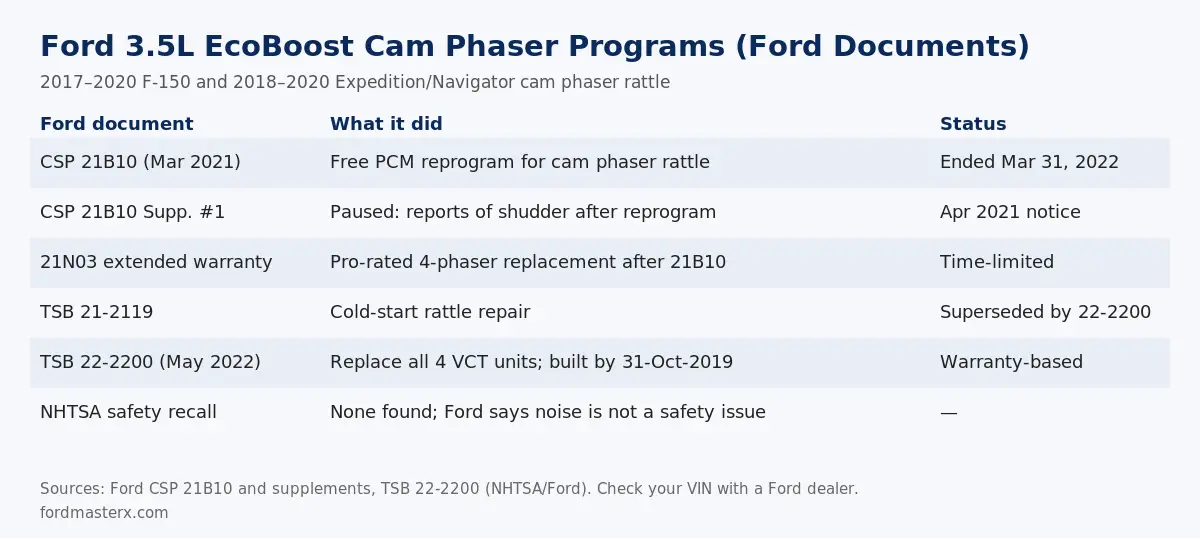
- Customer Satisfaction Program 21B10 (March 2021): free PCM reprogram for 2017–2020 F-150s built March/April 2016 through November 30, 2019, in effect through March 31, 2022. Ford briefly paused it in April 2021 after reports of a shudder (21B10, Supplement 1).
- 21N03 extended warranty: pro-rated replacement of all four cam phasers for owners who got the 21B10 update and still had noise; later expanded to Raptor, Expedition and Navigator (Ford notice). It was time-limited.
- TSB 23-2143 (May 4, 2023): supersedes 22-2200 (May 2022), which superseded 21-2119. Covers 2017–2020 F-150 and 2018–2020 Expedition/Navigator built on or before November 30, 2019 with a cold-start rattle; replace all four VCT units, about 9.6 labor hours on an F-150 (9.7 Raptor, 9.8 Expedition/Navigator), and some parts may now be reused (TSB 23-2143).
- Recall: we found no NHTSA safety recall for 3.5L EcoBoost cam phasers.
Coverage for your truck depends on its VIN and warranty status, so ask a Ford dealer to check it in Ford’s system before paying for the repair. For more on the program history, see our F-150 cam phaser recall guide.


On 2011–2015 F-150s, the cold-start rattle can also involve the primary timing chain. Ford’s TSB 18-2305 replaces all four phasers and the chain on those trucks. See our 3.5 EcoBoost timing chain replacement guide.
Choosing the Right Cam Phaser for Your 3.5 Ecoboost
Factors to Consider When Buying a Cam Phaser
When shopping for a replacement cam phaser for your 3.5 Ecoboost engine, you should consider factors like quality, compatibility, price, and the reputation of the manufacturer. Always opt for a high-quality product from a reputable brand even if it costs a bit more. The longevity and performance of your engine depend on it. Additionally, it’s important to ensure that the cam phaser you choose is compatible with your specific 3.5 Ecoboost engine model. Some aftermarket brands sell lockout kits. Ford’s fix for this concern is the TSB 23-2143 four-phaser replacement, not a lockout, and a lockout changes how the engine runs. For the trade-offs, see our lockout kit article.
This aftermarket kit lists a timing chain, guides, tensioner and phaser sprockets. It was out of stock at last check, so confirm availability and fitment for your truck.


Recommended Cam Phaser Brands
Ford’s TSB 23-2143 repair uses the Ford VCT units in its parts list. If you buy aftermarket, confirm fitment for your engine and build date.
Preparations for 3.5 Ecoboost Cam Phaser Replacement
Tools You Will Need
There are several tools you’ll need to replace your cam phaser. These typically include a wrench set, socket set, screwdrivers, a torx set and possibly a specific cam phaser lock tool. Ensure you also have a torque wrench for precise tightening of bolts.
Safety Precautions
When replacing a cam phaser, safety takes precedence. Always disconnect your car’s battery before you start working on it and wear protective gloves and eyeglasses. Also, ensure that your car is properly supported if you need to raise it for any part of the procedure.
Disassembling Your 3.5 Ecoboost Engine
Disassembling your engine can be complex and time-consuming. Refer to your vehicle’s service manual for guidance about which parts you’ll need to remove. Typically this can include the valve cover, timing cover, timing chain, and more.
Step-By-Step Guide to Replacing Your Cam Phaser
Removing the Old Cam Phaser
To remove the old cam phaser, loosen its mounting bolt, slide it off the end of the camshaft. Always refer to your vehicle’s service manual to understand the exact steps and precautions you should take during removal.
Installing the New Cam Phaser
Installing the new cam phaser means replacing it onto the camshaft, and tightening the mounting bolt to the specified torque. Be sure to lubricate the cam phaser as directed by the manufacturer for smooth operation.
Reassembly Process
Reassembly involves reattaching all the components removed during disassembly. This might include the timing chain, valve cover, engine cover, and others. Always follow the procedures outlined in your service manual to ensure proper reassembly.
Post-Replacement Checklist
What to Check After Replacing Your Cam Phaser
After replacing your cam phaser, there are several key things to check. Make sure that all bolts and components are properly installed and tightened. Also, double-check all connectors and ensure no error codes are present in the engine control module.
Start-Up and Warm-Up Process
Start your engine and let it warm up to operating temperature. Pay close attention to any audible or sensory anomalies. Keep an eye on the dashboard for any warning lights.
Test Drive
After your engine has warmed up, take your car for a test drive. Make sure the engine runs smoothly at different speeds and loads. Also, be vigilant for any changes in fuel consumption or strange noises.
Common Mistakes in Cam Phaser Replacement and How to Avoid Them
Mistake 1: Incorrect Timing
Incorrectly timed cam and crankshaft is a common mistake. Ensure that the timing marks line up as per the manufacturer’s specifications before reassembling the engine.
Mistake 2: Replacing Parts the TSB Doesn’t Call For
Ford’s TSB 23-2143 replaces the four VCT units and says not to replace other timing components not in its parts list; replace the chain only if inspection shows wear.
Mistake 3: Not Lubricating the New Phaser
Many forget to lubricate the new phaser. Always apply assembly lube to the phaser’s working parts to ensure smooth operation and prevent premature failure.
Troubleshooting Common Problems After Replacing Your Cam Phaser
Problem 1: Engine Noise
Should you hear strange noises from the engine after replacing the cam phaser, this could be due to incorrect installation or timing issues. Recheck the installation procedure and the engine timing.
Problem 2: Reduced Power
If you notice a decrease in engine power after the replacement, this might be due to the ECU adapting to the new part. However, if the power loss is substantial, check for installation or component issues.
Problem 3: Check Engine Light
If the check engine light comes on after the replacement, utilize an OBD-II scanner to read the error code. This will give you a starting point to diagnose the problem.
Maintenance Tips to Extend the Life of Your New Cam Phaser
Do Regular Oil Changes
Regular oil changes can significantly increase the lifespan of your cam phaser. Always use the recommended engine oil and change it at the specified intervals.
Use Quality Oil and Filters
Using high-quality engine oil and oil filters can also enhance your cam phaser’s longevity. Look for products that meet or exceed your vehicle manufacturer’s specifications.
Avoid Aggressive Driving
Aggressive driving can contribute to premature cam phaser wear. Try to stick to smooth and steady driving practices to ensure your cam phaser lasts a long time.
FAQs Regarding 3.5 Ecoboost Cam Phaser Replacement
How Much Does a Cam Phaser Replacement Cost?
It depends on the parts, labor rate and whether Ford coverage applies. Ford’s TSB 23-2143 allows about 9.6 labor hours to replace all four VCT units on a 2017–2020 F-150, so get a written dealer or shop quote and ask a Ford dealer to check your VIN for coverage first.
Can I Replace a Cam Phaser Myself?
An experienced DIYer with the Ford workshop manual and timing tools can, but it is a long job. Ford’s own bulletin says its procedures are meant for trained technicians, and the 3.5L EcoBoost needs all four VCT units replaced.
How Long Does a Cam Phaser Last?
Ford doesn’t publish a service life for cam phasers. Follow Ford’s oil change schedule and oil specification, and have any cold-start rattle checked early.
Is there a recall for 3.5 EcoBoost cam phasers?
No safety recall was found. Ford ran Customer Satisfaction Program 21B10 (a free PCM reprogram) and an extended warranty, 21N03, for 2017–2020 F-150s, and says the noise does not affect safety, performance or emissions. Both programs have ended.
Which F-150 years have cam phaser problems?
Ford’s bulletins cover 2017–2020 F-150s with the 3.5L EcoBoost, including 2018 and 2019, and 2018–2020 Expedition and Navigator. TSB 23-2143 applies to vehicles built on or before November 30, 2019 with a cold-start rattle.
How many cam phasers does a 3.5 EcoBoost have?
Four. Ford’s TSB 23-2143 repair replaces all four VCT (cam phaser) units.
Wrapping Up
Learning about cam phaser and its replacement are crucial for every vehicle owner with a 3.5 Ecoboost engine. Sticking to the maintenance tips can extend the life of the cam phaser. However, stay vigilant for early warning signs to anticipate and prevent potential engine damages. With a proper approach and good practices, you can expect a healthy, smoothly running engine.
Kozlira 3.5L timing chain and cam phaser kit (aftermarket, 2017–2023)
Aftermarket kit listing timing chain, guides, tensioner and phaser sprockets.
Check Price on Amazon →Amazon Affiliate Link

5 Comments