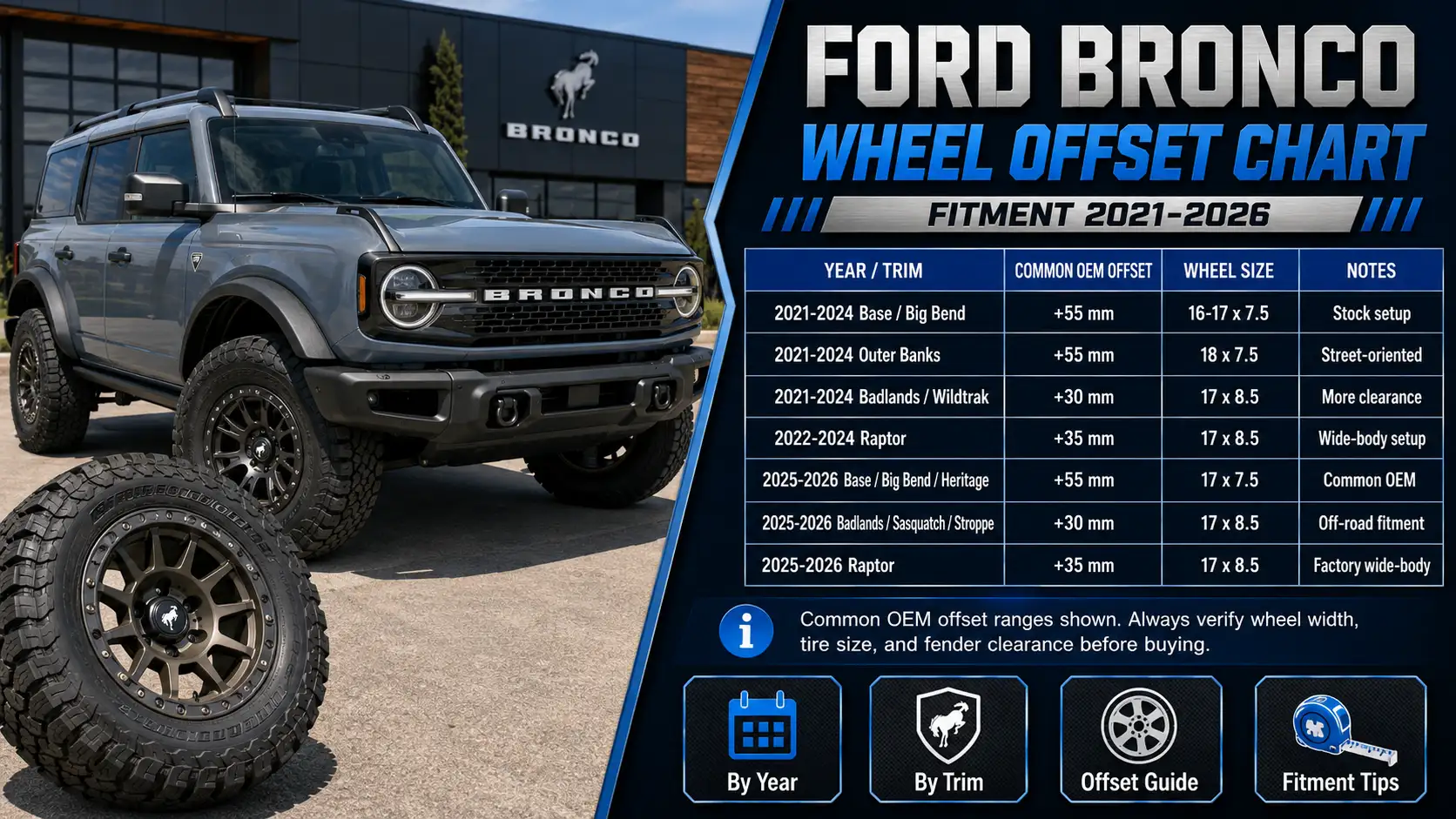
Ford Bronco Wheel Offset Chart: Fitment 2021-2026

Modern wheel fitment requires a precise understanding of suspension geometry, axle track widths, and fender clearances. Installing incorrect wheel specifications can lead to severe mechanical interference and diminished ride quality. Poor fitment also accelerates component wear across the entire drivetrain.
Modern wheel fitment requires a precise understanding of suspension geometry, axle track widths, and fender clearances. Installing incorrect wheel specifications can lead to severe mechanical interference and diminished ride quality. Poor fitment also accelerates component wear across the entire drivetrain.

Prime for Young Adults — 6 Months Free
Students and 18–24s get six months of Prime free, then half price.
Start 6 Months Free As an Amazon Associate I earn from qualifying purchases.For Ford Bronco owners and custom builders, the aftermarket wheel industry offers thousands of potential configurations. Selecting the optimal setup demands analyzing offset, backspacing, and bolt pattern data across distinct vehicle generations. This is not merely an aesthetic choice, but a critical mechanical decision.
For Ford Bronco owners and custom builders, the aftermarket wheel industry offers thousands of potential configurations. Selecting the optimal setup demands analyzing offset, backspacing, and bolt pattern data across distinct vehicle generations. This is not merely an aesthetic choice, but a critical mechanical decision.
This report delivers an exhaustive analysis of Ford Bronco wheel specifications, spanning the original 1966 models to the contemporary 2026 platforms. The data synthesizes factory engineering tolerances with aftermarket modification standards. Every dimension is examined to ensure safe and functional trail performance.
This report delivers an exhaustive analysis of Ford Bronco wheel specifications, spanning the original 1966 models to the contemporary 2026 platforms. The data synthesizes factory engineering tolerances with aftermarket modification standards. Every dimension is examined to ensure safe and functional trail performance.
Ultimate Ford Bronco Wheel Offset Chart & Fitment Guide
Recommended Best Deal Products
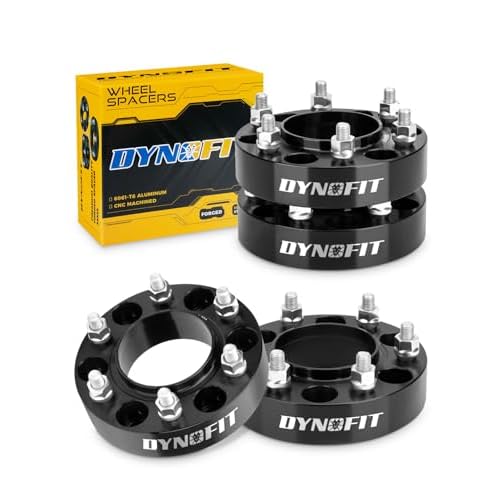

Upgrading your Ford Bronco wheels changes the entire attitude and capability of your rig. The secret to a perfect stance without suspension rubbing lies in understanding wheel offset.
Offset dictates how far the wheel mounting hub sits from the true centerline of the wheel. We have compiled the ultimate data-driven chart to help you nail your fitment.
Whether you are running a Base trim or a fully-loaded Sasquatch package, getting the math right is crucial. Let us dive into the OEM numbers and aftermarket sweet spots.
OEM Ford Bronco Wheel Specs (2021+)
Before venturing into the aftermarket, you must understand your factory baseline. Ford engineers designed the 6th Gen Bronco with high positive offsets to tuck the wheels inside the fenders.
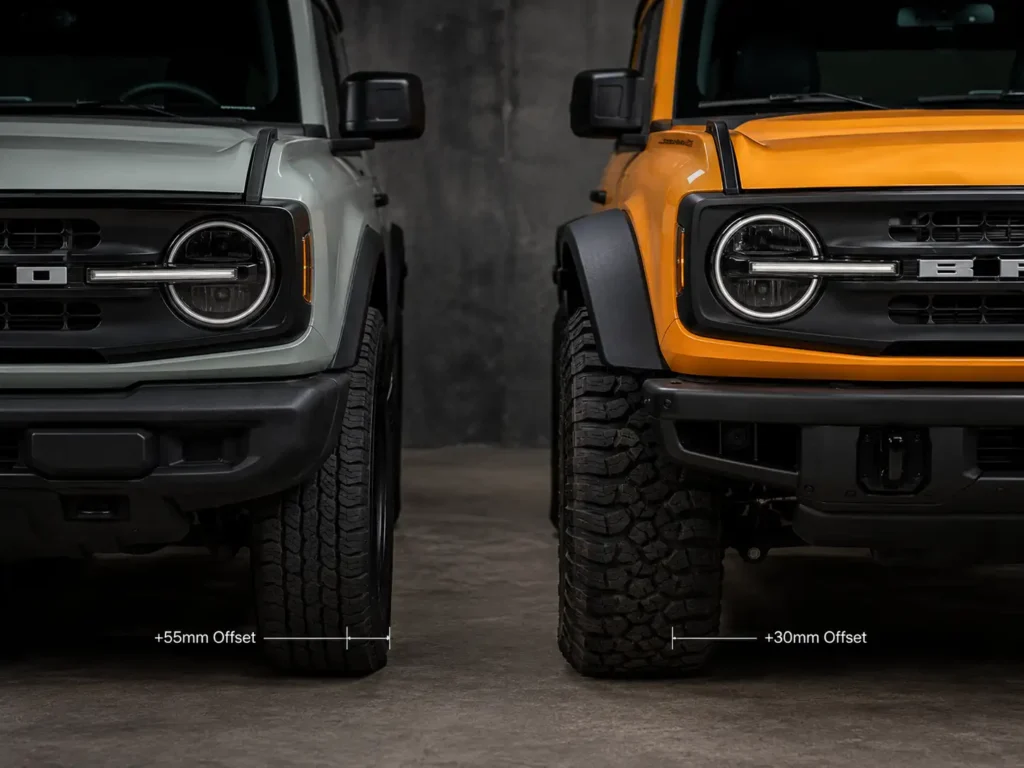
Standard trims utilize a very tucked +55mm offset. The aggressive Sasquatch package drops this to +30mm to accommodate massive 35-inch tires without compromising the scrub radius.

Audible — Listen Free for 30 Days
One free credit a month and thousands of titles included.
Listen Free for 30 Days As an Amazon Associate I earn from qualifying purchases.Below is the comparative breakdown of factory offset data across the most common Bronco trim levels. Notice how the more capable trims push the wheel further out.
▲ Lower numerical offset means the wheel pokes further OUT from the vehicle body.
| Bronco Trim Level | Factory Wheel Size | Standard Offset | Est. Backspacing |
|---|---|---|---|
| Base / Big Bend | 16×7.0 / 17×7.5 | +55mm | 6.0 inches |
| Black Diamond / Outer Banks | 17×7.5 / 18×7.5 | +55mm | 6.0 inches |
| Badlands (Non-Sasquatch) | 17×8.0 | +55mm | 6.2 inches |
| Sasquatch Package / Wildtrak | 17×8.5 | +30mm | 5.9 inches |
| Bronco Raptor | 17×8.5 | +32mm | 6.0 inches |
Visualizing Offset: The Anatomy of Stance
Recommended Best Deal Products


Offset is measured in millimeters from the exact vertical center of the wheel to the hub mounting pad.
A positive offset pulls the wheel inward toward the suspension components.
A negative offset pushes the wheel outward, creating a wider, more aggressive track width.
Positive Offset (+)
Hub mounting surface is toward the front or wheel face. Standard on OEM Broncos.
Zero Offset (0)
Hub mounting surface is exactly in the center. Creates a flush or slight poke stance.
Negative Offset (-)
Hub mounting surface is toward the back. Pushes the wheel out aggressively.
Aftermarket Upgrade Zones: Avoiding the Rub
When upgrading tires on your Ford Bronco, offset becomes your primary tool for avoiding suspension contact. A wider tire requires a lower (or negative) offset to push the rubber away from the upper control arms.
However, pushing the wheel too far out (highly negative offset) introduces extreme scrub radius issues and forces the tire into the crash bars during full-lock turns.
Audible Premium Plus — Annual Membership
12 audiobook credits up front, plus the full Audible catalogue.
See Annual Plans As an Amazon Associate I earn from qualifying purchases.The scatter plot below maps the safest fitment zones based on community data. It correlates desired tire diameter with the optimal aftermarket offset range.
▶ The Sweet Spot (0mm to +20mm)
For standard 35-inch tire upgrades on Non-Sasquatch models, a wheel with a 0mm to +20mm offset is universally recognized as the safest bet. It provides a flush look with minimal risk of crash bar interference.
▶ Aggressive Poke (-12mm to 0mm)
If you desire the tires to stick out past the fender flares, negative offsets are required. Be prepared to remove crash bars or add a lift kit if stepping up to 37-inch tires in this offset range.
Decoding Wheel Geometry Terminology
Recommended Best Deal Products


The Physics of Wheel Offset (ET)
Wheel offset measures the exact distance in millimeters between the wheel’s centerline and its hub mounting surface. This metric dictates how far the wheel protrudes outward or tucks inward relative to the vehicle’s suspension. The origin of the term “ET” comes from the German word Einpresstiefe, translating directly to “insertion depth.”
A positive offset places the mounting pad closer to the street-facing side of the wheel. This configuration tucks the entire wheel assembly deeper into the fender well. Factory engineers use positive offsets to provide clearance for the outer fender lip and improve aerodynamics.
A negative offset pushes the mounting pad closer to the vehicle’s brakes and suspension components. This creates a wider, more aggressive stance and pushes the tire past the fender flares. Negative offsets are heavily favored in the off-road community for increasing track width and lateral stability on uneven terrain.
A zero offset perfectly aligns the hub mounting pad with the exact centerline of the wheel barrel. This setup provides a balanced widening of the vehicle’s track without placing excessive leverage on the hub bearings. It is often considered the ideal baseline for moderate aftermarket suspension lifts.
Understanding Backspacing Mechanics
Backspacing measures the physical distance from the wheel’s inner mounting pad to the extreme inner lip of the wheel barrel. This dimension is typically expressed in inches and is vital for inner clearance. While offset and backspacing describe the same relative positioning, backspacing is critical for verifying clearance.
High backspacing numbers mean the wheel sits closer to vital suspension components like upper control arms and steering knuckles. Low backspacing numbers indicate the wheel is pushed further away from the chassis. Off-road builders must calculate backspacing carefully to ensure inner sidewall clearance when airing down tires.
The mathematical relationship between these two metrics relies on a standard industry formula. Backspacing equals the wheel width plus one inch, divided by two, plus the offset converted into inches. This standard equation allows builders to translate metric offset specifications into tangible physical clearances.
Center Bore (CB) and Hub-Centricity
The center bore is the machined hole in the middle of the wheel that slides directly over the vehicle’s axle hub. This measurement is critical for ensuring a vibration-free ride at highway speeds. Matching this dimension perfectly is non-negotiable for safe vehicle operation.
Hub-centric wheels feature a center bore that perfectly matches the vehicle’s hub diameter. This design transfers the vehicle’s weight directly to the axle hub rather than relying solely on the shear strength of the lug studs. This is the safest method for mounting heavy off-road wheel assemblies.
Lug-centric wheels have center bores larger than the vehicle hub, requiring aftermarket hub-centric rings to fill the void. Without these precision rings, the wheel may sit slightly off-center during installation. This misalignment frequently results in severe steering wheel vibrations at speeds exceeding fifty miles per hour.
Pitch Circle Diameter (PCD) / Bolt Pattern
The pitch circle diameter, universally known as the bolt pattern, identifies the number of lug studs and the diameter of the imaginary circle they form. This metric is expressed in either millimeters or inches depending on the manufacturer.
A wheel with a 6×139.7 bolt pattern features six lug holes arranged evenly around a circle measuring 139.7 millimeters in diameter. A wheel must possess the exact matching PCD to physically bolt onto the vehicle’s hub assembly. Attempting to force incorrect bolt patterns causes catastrophic stud failure.
Sixth-Generation Ford Bronco (2021-2026) Specifications
The U725 platform redefined the modern off-road segment upon its release, offering highly modular suspension and wheel packages. Understanding the baseline specifications is critical before attempting any aftermarket modifications. Ford designed this chassis to accommodate massive tire upgrades.The U725 platform redefined the modern off-road segment upon its release, offering highly modular suspension and wheel packages. Understanding the baseline specifications is critical before attempting any aftermarket modifications. Ford designed this chassis to accommodate massive tire upgrades.
The standard sixth-generation Bronco utilizes a robust 6×139.7mm bolt pattern. This six-lug configuration provides immense shear strength for heavy-duty off-road applications and severe trail impacts. It is a proven pattern shared globally among mid-size trucks.
The factory center bore for the U725 platform is exactly 93.1mm. When sourcing aftermarket wheels, purchasing hub-centric designs measuring exactly 93.1mm ensures optimal ride quality and longevity. Utilizing Wheel-Size.com can help verify these factory specifications against aftermarket offerings.
Factory Trim Level Breakdown
Ford engineered distinct wheel and tire packages across the Bronco’s diverse trim hierarchy to suit different driving environments. The entry-level Base model arrives with 16×7-inch steel wheels featuring a highly positive +55mm offset. This narrow stance prioritizes fuel efficiency and production cost.
The Big Bend and Black Diamond trims upgrade to 17×7.5-inch alloy wheels, but crucially retain the +55mm offset. This geometry keeps the tires securely within the standard fender flares, preventing mud and rock slinging along the doors. These rims are optimal for mild overland builds.
The luxury-focused Outer Banks trim shifts to an 18×7.5-inch wheel, also maintaining the +55mm offset geometry. This larger diameter sacrifices some tire sidewall height in exchange for sharpened on-road steering response. It provides a distinctly urban aesthetic while retaining four-wheel-drive capability.
The Sasquatch Package Paradigm
The Sasquatch package fundamentally alters the Bronco’s factory stance, necessitating highly specialized wheel dimensions. To accommodate massive 315/70R17 Goodyear tires, Ford engineered a wider 17×8.5-inch beadlock-capable wheel. This wheel features a distinct aesthetic and mechanical purpose.
Instead of the standard +55mm offset, Sasquatch wheels utilize a shallower +30mm offset. This 25-millimeter outward shift prevents the oversized 35-inch tires from violently rubbing against the steering knuckles during full-lock turns. The scrub radius is slightly altered, but well within factory safety margins.
These identical wheel dimensions apply universally to all trims equipped with the Sasquatch package. Furthermore, standalone high-performance trims like the Wildtrak, Everglades, and Heritage Edition share this exact +30mm offset architecture.
| Trim Level | Factory Wheel Dimensions | Factory Offset | OEM Tire Size | Bolt Pattern |
| Base | 16×7 | +55mm | 255/70R16 | 6×139.7 |
| Big Bend | 17×7.5 | +55mm | 255/75R17 | 6×139.7 |
| Black Diamond | 17×7.5 | +55mm | LT265/70R17 | 6×139.7 |
| Outer Banks | 18×7.5 | +55mm | 255/70R18 | 6×139.7 |
| Badlands | 17×8 | +55mm | LT285/70R17 | 6×139.7 |
| Sasquatch Package | 17×8.5 | +30mm | 315/70R17 | 6×139.7 |
| Wildtrak / Everglades | 17×8.5 | +30mm | 315/70R17 | 6×139.7 |
The Ford Bronco Raptor Anomaly
The Ford Bronco Raptor represents a severe departure from standard U725 platform engineering. Designed explicitly for high-speed desert running, the Raptor features a drastically widened track and specialized suspension architecture. It is virtually a different vehicle beneath the sheet metal.
To handle increased torsional loads and utilize heavy-duty F-150 components, Ford completely abandoned the 6×139.7mm bolt pattern. The Bronco Raptor exclusively utilizes a 6x135mm bolt pattern. This design choice aligns its wheel inventory with the F-150 Raptor lineage.
The Raptor’s center bore is significantly smaller than the standard Bronco, measuring 87.1mm instead of 93.1mm. This architectural shift prevents standard aftermarket Bronco wheels from safely seating onto the Raptor’s specialized hubs.
Raptor Factory Wheel Specifications
The standard Bronco Raptor wheel measures 17×8.5 inches, wrapped from the factory in massive 37×12.50R17LT all-terrain tires. To accommodate these extreme dimensions without destroying the fenders, the factory wheels feature a +34mm or +35mm offset.
The increased width of the Raptor’s reinforced axles, combined with this specific offset, creates an incredibly aggressive track width. This design maximizes high-speed stability over uneven desert terrain and severe whoops.
Raptor owners seeking aftermarket wheels must strictly filter for 6x135mm fitments. Popular upgrades for this high-performance trim include the flow-formed Vossen HF6-4 or the robust Method Race MR703 series.
Wheel Adapters and Engineering Risks
Standard Bronco owners frequently attempt to mount genuine Raptor wheels onto their vehicles for aesthetic clout. This modification absolutely requires heavy-duty billet wheel adapters to physically convert the 6×139.7 hub to the 6×135 wheel pattern.
Utilizing a standard one-inch (25.4mm) adapter effectively subtracts 25.4mm from the wheel’s original factory offset. A +34mm Raptor wheel mounted on a 25.4mm adapter results in a highly aggressive +8.6mm final offset. This pushes the wheel significantly past the standard fenders.
Automotive suspension engineers severely caution against this practice for extreme off-roading. Thick adapters significantly increase the scrub radius, amplifying the stress and leverage placed on standard ball joints, tie rods, and unit bearings.
Raptor vs. Standard Architecture Comparison Matrix
| Specification | Standard Bronco (Gen 6) | Bronco Raptor (2022+) | Compatibility Notes |
| Bolt Pattern | 6×139.7mm (6×5.5″) | 6x135mm | Completely incompatible without adapters |
| Hub Bore | 93.1mm | 87.1mm | Raptor bore is 6mm smaller |
| Standard Offset | +30mm to +55mm | +34mm to +35mm | Axle lengths differ drastically |
| Lug Thread Pitch | M12x1.5 | M14x1.5 | Raptor uses thicker, heavy-duty studs |
Ford Bronco Sport (CX430) Specifications
While sharing the iconic Bronco nomenclature, the Bronco Sport operates on an entirely different architectural foundation. The CX430 platform is a unibody crossover chassis shared with the Ford Escape and Ford Maverick. It does not feature a traditional ladder frame.
Because it does not utilize a heavy-duty truck frame, the Bronco Sport requires distinct passenger-car wheel specifications. The factory bolt pattern is a metric 5x108mm configuration. This pattern is relatively common among European-inspired Ford models.
The center bore for the Bronco Sport measures precisely 63.4mm, ensuring a tight fit on the unibody’s smaller hubs. Enthusiasts must strictly verify these dimensions, as wheels from a full-size Bronco will absolutely not mount to a Bronco Sport.
Standard Sport Trim Configurations
The Bronco Sport equipped with the 1.5L EcoBoost engine features standard 17×7-inch or 18×7-inch wheels. These factory alloys possess highly positive offsets ranging closely between +35.5mm and +39.5mm. This high offset keeps the narrow unibody aerodynamic.
Models equipped with the more powerful 2.0L EcoBoost engine, such as the Badlands trim, maintain identical wheel geometries. This uniformity ensures suspension clearance remains consistent regardless of the upgraded drivetrain components.
Factory tire sizes vary slightly across the crossover lineup. Standard configurations include 225/65R17 or 235/65R17 options, designed specifically for highway comfort, low road noise, and light trail articulation.
Modifying the Bronco Sport Stance
Owners frequently upgrade Bronco Sport wheels to achieve a more rugged, commanding aesthetic reminiscent of the full-size model. Moving to an aftermarket wheel measuring 17×8 inches with a +38mm offset is a highly popular configuration.
This specific dimension pushes the tire slightly outward, creating a perfectly flush alignment with the crossover’s fenders. Lower offsets, such as +30mm, will induce slight poke past the wheel arches, giving a wider stance.
It is highly recommended to consult visual galleries at resources like Custom Wheel Offset when exploring aggressive fitments. Unibody wheel wells have severely limited clearance for oversized all-terrain tires, often requiring minor plastic trimming.
| Sport Trim / Engine | Wheel Dimensions | Factory Offset | OEM Tire Size |
| 1.5L EcoBoost | 17×7 | +37.5mm | 225/65R17 |
| 1.5L EcoBoost | 18×7 | +37.5mm | 225/60R18 |
| 2.0L EcoBoost | 17×7 | +37.5mm | 235/65R17 |
| 2.0L EcoBoost | 18×7.5 | +38mm | 235/60R18 |
Vintage and Classic Bronco Geometry (1966-1996)
The heritage of the Ford Bronco spans several decades of evolving truck architecture. Restoring or modifying vintage models requires an intimate understanding of historic wheel engineering standards. Tolerances on classic solid axles differ wildly from modern independent suspensions.The heritage of the Ford Bronco spans several decades of evolving truck architecture. Restoring or modifying vintage models requires an intimate understanding of historic wheel engineering standards. Tolerances on classic solid axles differ wildly from modern independent suspensions.
First Generation (1966-1977)
The original Early Bronco defined the foundational geometry for classic Ford off-roaders. Every vehicle produced during this legendary 11-year run utilized a rugged 5×139.7mm bolt pattern. This 5-lug pattern became the industry standard for half-ton Ford trucks.
The vintage solid front Dana axles utilized a massive 87.1mm hub bore. Restorers must source wheels that clear the prominent manual locking hubs protruding from the center of the wheel assembly. Failure to account for hub protrusion prevents the wheel from seating flush.
First-generation Broncos feature notoriously tight rear wheel wells and restrictive front radius arm suspension designs. Optimal aftermarket wheel backspacing falls strictly between 3.5 and 4.25 inches to prevent critical tire rubbing against the frame rails.
Generations Two through Five (1978-1996)
As the Bronco evolved into a full-size SUV based on the F-150 chassis, the legendary 5×139.7mm bolt pattern remained entirely constant. The 87.1mm hub bore also persisted throughout these decades, simplifying wheel sourcing.
Factory wheels during the 1980s and 1990s typically measured 15×7 inches with moderately high positive offsets. Models equipped with the heavy-duty 5.0L or 5.8L V8 engines frequently rolled off the assembly line on 235/75R15 or 31×10.50R15 tires.
When modifying an OBS (Old Body Style) Bronco from 1992-1996, modern enthusiasts frequently upgrade to 17×9-inch wheels. A highly popular aftermarket offset for this era is -12mm, providing a muscular, era-appropriate stance that clears modern brake upgrades.
The Bronco II Anomaly (1984-1990)
The compact Bronco II, developed alongside the original Ford Ranger pickup, deviated completely from the full-size lineage. This smaller SUV utilized a five-lug passenger car configuration to reduce weight and manufacturing costs.
The Bronco II bolt pattern measured exactly 5×114.3mm, known colloquially in America as 5×4.5 inches. This platform required significantly different backspacing and offset metrics compared to its larger full-size counterparts.
Factory Bronco II wheels generally measured 15×6 inches with a +12mm offset. This tight, lightweight configuration supported narrow 205/75R15 tires, maximizing fuel efficiency during the restrictive emissions era of the 1980s.
Classic Bronco Bolt Pattern Evolution
| Generation | Years Produced | Bolt Pattern | Hub Bore | Platform Type |
| First Generation | 1966-1977 | 5×139.7mm | 87.1mm | Original 4×4 Chassis |
| Second Gen | 1978-1979 | 5×139.7mm | 87.1mm | F-150 Based |
| Third Gen | 1980-1986 | 5×139.7mm | 87.1mm | F-150 Based |
| Bronco II | 1984-1990 | 5×114.3mm | ~70.3mm | Ranger Based (Compact) |
| Fourth Gen | 1987-1991 | 5×139.7mm | 87.1mm | F-150 Based |
| Fifth Gen (OBS) | 1992-1996 | 5×139.7mm | 87.1mm | F-150 Based |
Ford Ranger Interchangeability Matrix
Modern automotive manufacturing heavily relies on shared global platforms to reduce production costs. The current sixth-generation Bronco shares its underlying architectural skeleton with the international mid-size Ford Ranger.
Both the P375 (previous) and P703 (current) generations of the Ford Ranger feature the exact same 6×139.7mm bolt pattern as the modern Bronco. They also share the identical 93.1mm hub bore, ensuring hub-centric compatibility.
This shared DNA allows for exceptional cross-compatibility in the aftermarket space. High-performance wheels designed for a 2019+ Ranger will generally bolt flawlessly onto a non-Raptor 2021+ Bronco. Retailers frequently list these wheels under unified SKU numbers.
Enthusiasts must still verify offset clearances, as the Ranger’s sheet metal fender depths differ slightly from the Bronco’s removable plastic flares. An offset of +30mm remains the safest interchangeable baseline for both platforms.
Lug Nut and Mounting Hardware Specifications
Purchasing the correct aftermarket wheels is entirely futile if the vehicle lacks the appropriate mounting hardware. Ford utilizes varying thread pitches across its diverse Bronco portfolio, making lug nut selection critical.Purchasing the correct aftermarket wheels is entirely futile if the vehicle lacks the appropriate mounting hardware. Ford utilizes varying thread pitches across its diverse Bronco portfolio, making lug nut selection critical.
The standard sixth-generation Bronco and the unibody Bronco Sport both require lug nuts with an M12x1.5mm thread pitch. These nuts secure the wheel tightly against the 93.1mm and 63.4mm hubs, respectively.
The heavy-duty Bronco Raptor mandates much larger hardware to manage intense off-road kinetic energy. Raptor owners must procure lug nuts with an M14x1.5mm thread pitch to fit over the thickened wheel studs.
When upgrading to aftermarket alloy wheels, factory acorn lug nuts are often too wide to fit inside the deeply machined lug recesses. Enthusiasts must transition to specialized narrow-diameter splined lug nuts featuring a 60-degree conical seat.
Using incorrect lug nuts, particularly those with a spherical or flat seat on a conical wheel, guarantees catastrophic failure. The wheel will rapidly loosen under driving loads, resulting in severe vehicular damage and extreme safety hazards.
Upgrading to 35-Inch and 37-Inch Tires
The ultimate goal for most off-road enthusiasts is fitting massive terrain-conquering tires. However, the mathematics of wheel offset strictly govern whether a 35-inch or 37-inch tire will physically function within the Bronco’s wheel wells.The ultimate goal for most off-road enthusiasts is fitting massive terrain-conquering tires. However, the mathematics of wheel offset strictly govern whether a 35-inch or 37-inch tire will physically function within the Bronco’s wheel wells.
Installing a 35×12.50R17 tire on a standard, non-Sasquatch Bronco immediately presents severe inner clearance challenges. The inner edge of the massive tire will drastically contact the factory suspension links during suspension compression.
To resolve this, builders select wheels with a lower offset, typically ranging between +18mm and 0mm. This outward shift creates vital space between the inner tire sidewall and the upper control arms.
The Crash Bar Dilemma
Moving the wheel outward with a 0mm offset generates a brand-new mechanical conflict. The outer edge of the tire tread will now violently strike the Bronco’s factory steel crash bars during full-lock steering maneuvers.
Crash bars are heavy tubular steel beams mounted behind the bumper, engineered specifically to protect the cabin during small-overlap frontal collisions. Accommodating wide 35-inch tires on negative offset wheels often requires unbolting and removing these safety devices entirely.
For builders unwilling to remove structural safety components, maintaining a +30mm offset with a slightly narrower 285/70R17 tire provides an optimal compromise. This setup prevents inner suspension rubbing while preserving the vehicle’s structural integrity.
Tackling 37-Inch Tire Fitment
Stepping up to a 37-inch tire dramatically alters the engineering requirements of the standard Bronco chassis. Without substantial modifications, a 37-inch tire will completely crush the inner fender liners and severely restrict up-travel.
A minimum suspension lift of 2.5 to 3.0 inches is absolutely mandatory to clear 37-inch tires vertically. Furthermore, builders must aggressively utilize wheels with offsets between 0mm and -12mm to widen the track width and restore center-of-gravity stability.
Even with substantial lifts, heavy modification or removal of the front plastic bumper caps is frequently required. Buying wheels from distributors like ExtremeTerrain allows users to verify fitment limits before attempting to mount 37-inch rubber.
Popular Aftermarket Wheel Specifications
The aftermarket wheel industry has extensively benchmarked the U725 platform to offer precisely engineered fitments. Leading manufacturers provide specific offsets tailored to achieving distinct visual stances and performance goals.The aftermarket wheel industry has extensively benchmarked the U725 platform to offer precisely engineered fitments. Leading manufacturers provide specific offsets tailored to achieving distinct visual stances and performance goals.
Method Race Wheels, renowned for their patented bead-grip technology, frequently offers the MR703 series in a 17×8.5-inch size with a 0mm offset. This configuration delivers a perfectly flush stance against the factory Sasquatch fender flares.
Vossen Wheels provides the HF6-4, a highly popular hybrid forged option for luxury-oriented urban builds. These wheels often feature a +20mm offset, keeping the tires safely tucked for a clean, aerodynamic highway profile.
For a highly aggressive, muscular poke, brands like Fuel Off-Road produce 17×9-inch wheels with a -12mm offset. This extreme push outward requires careful suspension tuning to mitigate accelerated steering component wear over time.
Mastering Offset-to-Backspacing Math
Accurate measurement conversion prevents costly ordering mistakes and fitment disasters. The relationship between offset and backspacing is mathematically fixed, yet frequently misunderstood by novice builders attempting custom setups.Accurate measurement conversion prevents costly ordering mistakes and fitment disasters. The relationship between offset and backspacing is mathematically fixed, yet frequently misunderstood by novice builders attempting custom setups.
An 8.5-inch wide wheel featuring a 0mm offset possesses exactly 4.75 inches of backspacing. Moving the offset to a negative -12mm reduces the backspacing down to 4.25 inches, pushing the entire wheel assembly significantly outward.
A 9.0-inch wide wheel with a 0mm offset yields a 5.0-inch backspacing measurement. If a driver selects a -12mm offset on this wider 9.0-inch wheel, the backspacing shrinks to 4.5 inches.
Understanding this strict correlation ensures that the wheel clears the brakes internally while sitting perfectly flush externally. Utilizing precision conversion charts guarantees optimal suspension articulation on the trail without rubbing.
Offset to Backspacing Conversion Guide
| Wheel Width | Offset Value | Calculated Backspacing | Stance Profile |
| 8.5 Inches | +30mm | 5.93 Inches | Tucked (Sasquatch Spec) |
| 8.5 Inches | 0mm | 4.75 Inches | Flush |
| 8.5 Inches | -12mm | 4.27 Inches | Moderate Poke |
| 9.0 Inches | +18mm | 5.71 Inches | Slight Tuck |
| 9.0 Inches | 0mm | 5.00 Inches | Flush to Slight Poke |
| 9.0 Inches | -12mm | 4.53 Inches | Aggressive Poke |
Questions and Expert Answers
What is the factory bolt pattern for a modern sixth-generation Ford Bronco?
Standard 2021-2026 Ford Bronco models utilize a 6×139.7mm bolt pattern, which is mathematically identical to the imperial 6×5.5-inch measurement. The factory center bore for this modern truck platform is precisely 93.1mm.
Do Ford Bronco Raptor wheels fit a standard Ford Bronco?
Bronco Raptor wheels will not directly bolt onto a standard Bronco without utilizing specialized aftermarket hub adapters. The Raptor utilizes a unique 6x135mm bolt pattern and an 87.1mm center bore. This F-150 derived architecture is entirely incompatible with standard Bronco trims.
Can 35-inch tires fit on a stock Bronco without a lift kit?
Certain trims, particularly those equipped with the Sasquatch package, comfortably accommodate 35-inch tires straight from the factory. Non-Sasquatch models often require the removal of front steel crash bars to prevent severe tire rubbing. Modifying wheel offsets is also highly recommended when upgrading tire diameters.
What is the precise bolt pattern for the Ford Bronco Sport?
Because the Bronco Sport is built on a unibody crossover platform, it utilizes a much smaller passenger-car bolt pattern measuring 5x108mm. The hub bore for the Bronco Sport is 63.4mm. This makes its wheels entirely distinct from the full-size, body-on-frame Bronco models.
Will Ford Ranger wheels fit a modern Ford Bronco?
Yes, wheels from a 2019-2026 Ford Ranger are generally completely interchangeable with a standard sixth-generation Ford Bronco. Both vehicles share the identical 6×139.7mm bolt pattern and 93.1mm center bore architecture. Offset requirements are also remarkably similar between the two platforms.
What size lug nuts are required for a 2021+ Ford Bronco?
Standard sixth-generation Broncos require lug nuts with an M12x1.5mm thread pitch and a 60-degree conical seat. The Bronco Raptor requires much larger hardware, specifically utilizing an M14x1.5mm thread pitch. Upgrading to aftermarket wheels usually necessitates purchasing slim-profile spline-drive lug nuts.
What was the bolt pattern for vintage first-generation Broncos?
Classic Ford Broncos produced between 1966 and 1977 utilized a 5×139.7mm bolt pattern, commonly referred to as 5×5.5 inches in imperial measurements. The vintage hub bore measured 87.1mm to accommodate large manual locking mechanisms.
How does offset affect suspension geometry?
Installing wheels with an extreme negative offset drastically alters the vehicle’s scrub radius by pushing the pivot point outward. This alteration increases steering effort and accelerates wheel bearing wear. It also makes the vehicle significantly more susceptible to wandering on uneven, rutted pavement.
Why do modern vehicles use positive offset from the factory?
Automotive engineers utilize high positive offsets to tuck the wheels securely under the fenders, which minimizes aerodynamic drag and prevents debris from striking the vehicle’s paint. This setup also centralizes the tire contact patch directly over the wheel bearings. This centralization maximizes bearing lifespan under daily driving conditions.
Conclusion and Setup Recommendations
The exact science of wheel fitment dictates the mechanical safety, off-road capability, and visual dominance of the Ford Bronco. Navigating the complex array of offset geometries is paramount for any successful vehicle build.The exact science of wheel fitment dictates the mechanical safety, off-road capability, and visual dominance of the Ford Bronco. Navigating the complex array of offset geometries is paramount for any successful vehicle build.
For owners of the modern 2021-2026 U725 platform, the fundamental baseline is a 6×139.7mm bolt pattern paired with a 93.1mm hub bore. Deviating from these core metrics requires potentially hazardous structural adapters that compromise bearing integrity.For owners of the modern 2021-2026 U725 platform, the fundamental baseline is a 6×139.7mm bolt pattern paired with a 93.1mm hub bore. Deviating from these core metrics requires potentially hazardous structural adapters that compromise bearing integrity.
Builders targeting a massive 35-inch tire upgrade must carefully balance offset choices against suspension clearance. A +30mm offset offers the safest factory integration, while a 0mm offset provides maximum stance aggression at the cost of crash bar modification.Builders targeting a massive 35-inch tire upgrade must carefully balance offset choices against suspension clearance. A +30mm offset offers the safest factory integration, while a 0mm offset provides maximum stance aggression at the cost of crash bar modification.
Vintage enthusiasts must honor the historic 5×139.7mm bolt patterns of the early generations, keeping backspacing tightly controlled beneath 4.25 inches. Unibody Bronco Sport owners must strictly adhere to their unique 5x108mm architectural confines to avoid unibody damage.Vintage enthusiasts must honor the historic 5×139.7mm bolt patterns of the early generations, keeping backspacing tightly controlled beneath 4.25 inches. Unibody Bronco Sport owners must strictly adhere to their unique 5x108mm architectural confines to avoid unibody damage.
Ultimately, precision engineering guarantees performance on the pavement and in the dirt. Thoroughly verifying offset dimensions ensures the Ford Bronco remains an unstoppable force on both the highway and the harshest off-road trails.Ultimately, precision engineering guarantees performance on the pavement and in the dirt. Thoroughly verifying offset dimensions ensures the Ford Bronco remains an unstoppable force on both the highway and the harshest off-road trails.
Related Ford Guides
Full guide: Ford Bolt Pattern Chart (1953–2026, All Models)