Ford F250 Gear Ratio Chart by Axle Code and Year 1999-2026

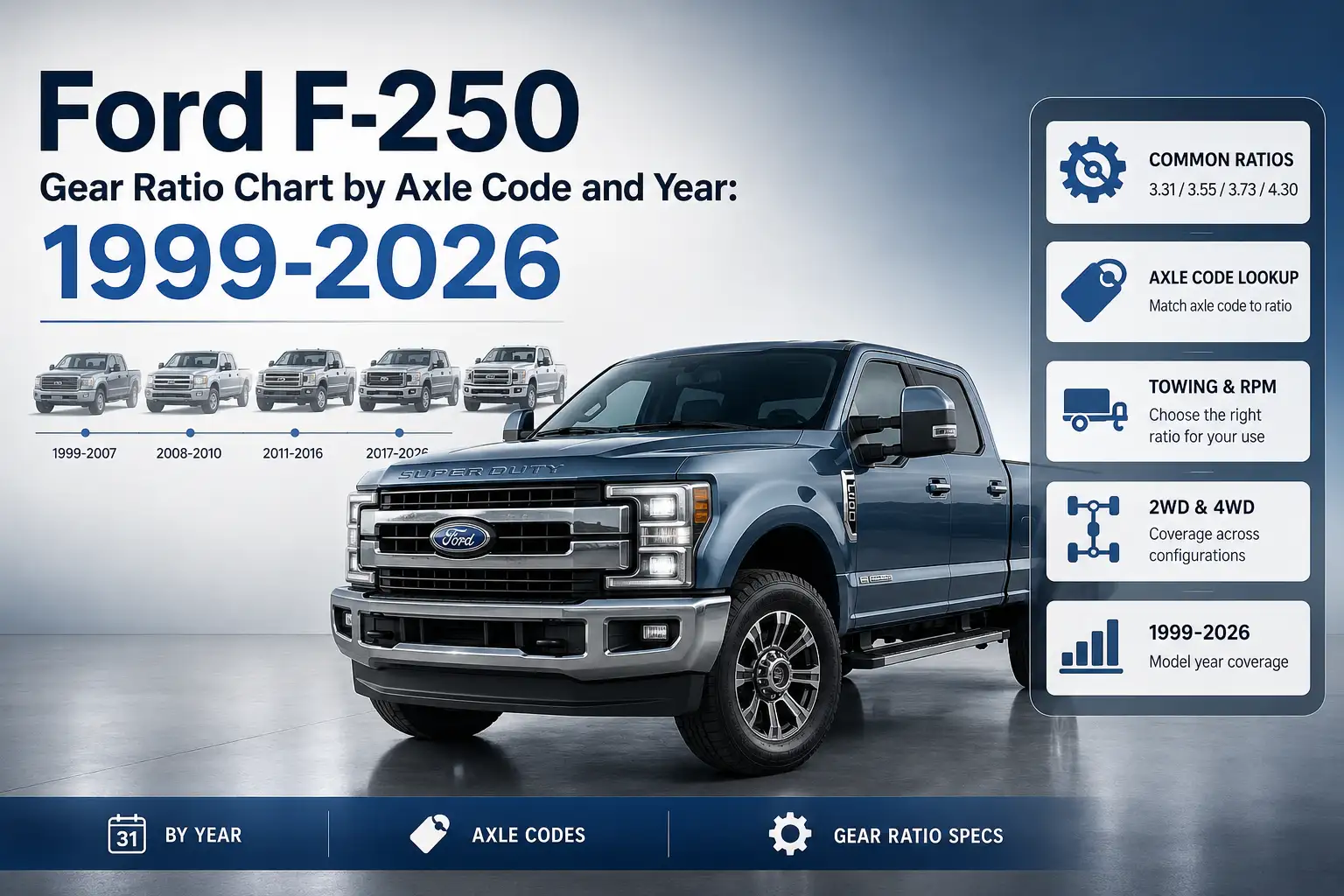
Ford F-250 axle ratios range from 3.31 to 4.30, depending on model year and engine, and are identified by a two-character code on the driver’s door sticker. That code only tells half the story. Your F-250’s total gearing comes from the axle ratio working together with the transmission’s internal gear spread, and both numbers determine how your truck tows, cruises, and gets fuel economy.
This chart covers axle codes by year, the full 6R140 and 10R140 transmission gear ratios, and which combination fits towing versus highway driving.

Prime for Young Adults — 6 Months Free
Students and 18–24s get six months of Prime free, then half price.
Start 6 Months Free As an Amazon Associate I earn from qualifying purchases.FordMasterX Reference Guide
Ford F-250 Gear Ratio at a Glance
Axle codes, transmission ratios, and towing vs MPG in one chart
Decode Your Axle Code in 3 Steps
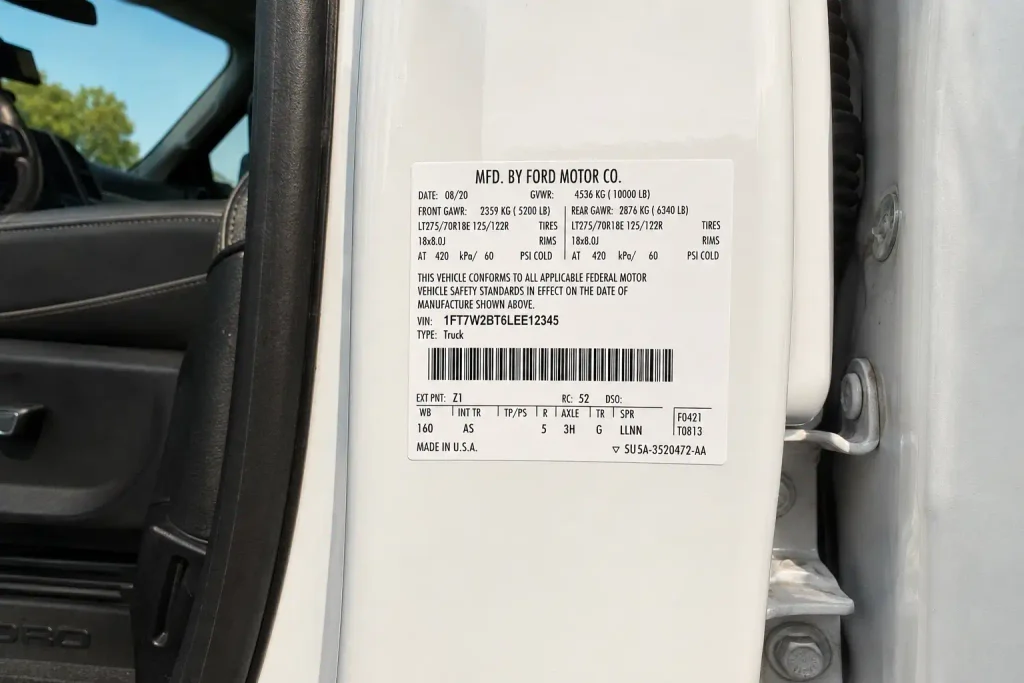
Open the driver door and find the white Safety Compliance Certification Label on the door jamb
Locate the field marked AXLE and read the two-character code
Match that code to the year and ratio in the chart above
F-250 Axle Ratio Range
Transmission First Gear Comparison

Audible — Listen Free for 30 Days
One free credit a month and thousands of titles included.
Listen Free for 30 Days As an Amazon Associate I earn from qualifying purchases.Fuel Economy vs Towing Power
Best MPG
Max Towing
Ford F-250 Axle Ratio Chart by Year and Code
Recommended Best Deal Products


Use the table below to match your door sticker code to your exact gear ratio. Codes are largely consistent across F-250 and F-350 SRW trucks within the same generation, but always confirm against your specific year since Ford has reused codes across different eras.
| Model Year Range | Axle Code | Gear Ratio | Differential Type | Notes |
|---|---|---|---|---|
| Pre-1999 | 27 | 3.31 | Non-limited slip | Common on light-duty F-250 before the Super Duty split |
| Pre-1999 | 26 | 3.73 | Non-limited slip | Common on light-duty F-250 |
| 1999-2016 | 31 | 3.73 | Non-limited slip | Factory standard on most SRW diesel F-250s |
| 1999-2016 | 32 | 4.10 | Non-limited slip | F-250 only |
| 1999-2016 | 33 | 4.30 | Non-limited slip | F-250 only |
| 1999-2016 | C1 | 3.73 | Limited slip | F-250 and Excursion |
| 1999-2016 | C2 | 4.10 | Limited slip | F-250 and Excursion |
| 1999-2016 | C3 | 4.30 | Limited slip | F-250 and Excursion |
| 2011-2019 | H9 | 3.55 | Limited slip | Common on 8.8-inch and 9.75-inch axles |
| 2020-2026 | Varies by trim | 3.31 | Open or locking | Exclusive to the 6.7L Power Stroke paired with the 10R140 transmission |
| 2020-2026 | Varies by trim | 3.55 to 4.30 | Open or locking | Available across 6.2L gas, 7.3L gas, and 6.7L diesel |
2020-2026 axle code letters for each ratio. Ford’s public build sheet data does not consistently list the two-character codes for current-generation trucks. Cross-reference your specific VIN through Ford’s official vehicle lookup or a dealer parts counter for the precise code.
Not sure how to find your code? Here is exactly where to look.
How to Find Your F-250 Axle Code on the Door Sticker
Your F-250’s axle code is printed on the Safety Compliance Certification Label. Follow these steps to locate and read it.
- Open the driver’s door and look at the door jamb or the rear edge of the door itself.
- Find the white Safety Compliance Certification Label, which lists your VIN, GVWR, tire size, and build codes.
- Locate the field labeled “AXLE.” The two-character code listed there is your axle code.
- Cross-reference that code against the year-specific table above.
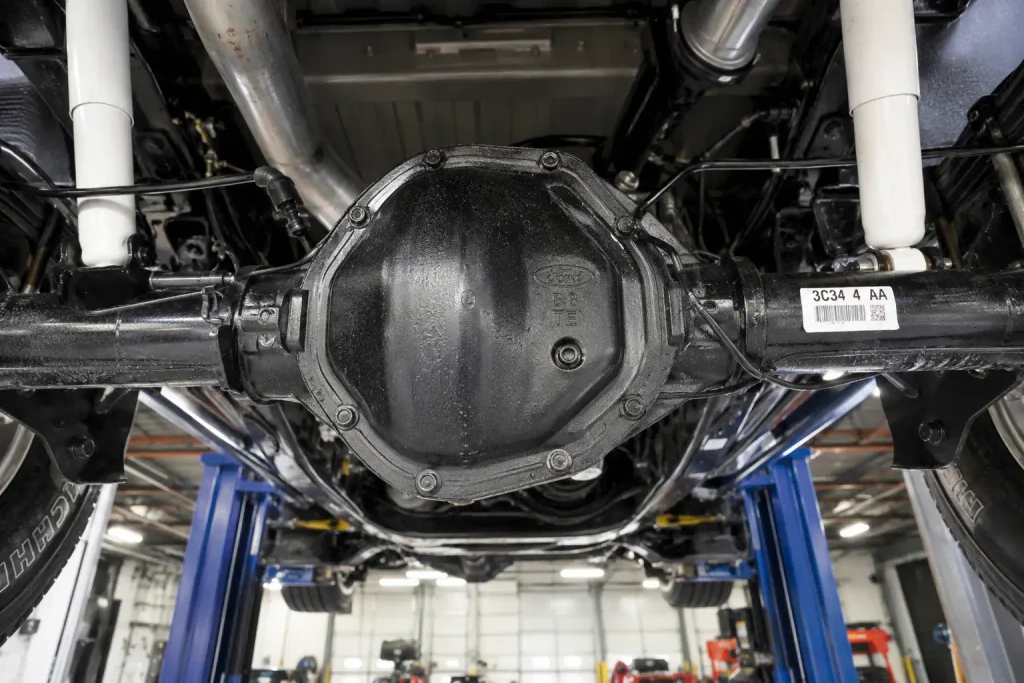
If the sticker is missing or unreadable, a second option exists. Crawl under the truck and look at the metal tag attached to the rear differential cover. This tag lists the ratio directly, though it requires physically accessing the axle housing.
One rule that trips up buyers: the door sticker reflects what the truck was originally built with, not necessarily what is currently installed. If a previous owner regeared the truck or swapped the rear axle, the sticker code no longer matches the hardware. For a full breakdown of how Ford’s axle code system works across every F-Series model, see our Ford axle code chart.
Once you have your code, here is how the ratio changed across F-250 model years.
F-250 Axle Ratio Changes by Generation
Recommended Best Deal Products


Ford’s F-250 axle ratio lineup has shifted with every major powertrain update, expanding the available range as engines and transmissions evolved.
Audible Premium Plus — Annual Membership
12 audiobook credits up front, plus the full Audible catalogue.
See Annual Plans As an Amazon Associate I earn from qualifying purchases.Pre-1999 Light-Duty Era
Before the 1999 Super Duty split, the F-250 shared much of its drivetrain with the F-150. Ratio options were narrower, typically limited to 3.31 and 3.73, with fewer heavy-duty axle choices available.
1999-2016 Super Duty SRW Diesel Era
Once the Super Duty platform launched, diesel-equipped F-250 SRW trucks left the factory with a 3.73 ratio as the standard configuration, according to consistent owner and technician reports across Ford diesel forums. Optional ratios of 4.10 and 4.30 were available for buyers prioritizing towing over fuel economy.
2017-2019 Expanded Range
This generation widened the available ratios, adding 3.31 as a fuel-economy-focused option alongside the existing 3.55, 3.73, and 4.30 choices, paired with the 6R140 six-speed transmission.
2020-2026 Ten-Speed Era
With the introduction of the 10R140 ten-speed transmission in 2020, Ford made the 3.31 ratio exclusive to the 6.7L Power Stroke diesel. The additional gear ratios in the transmission itself compensate for the shorter axle ratio, keeping torque multiplication high even with the numerically lower gearing.
precise year the 4.30 ratio was discontinued or replaced, if applicable, on gas-engine F-250s. Current research found consistent references to 3.31 through 4.30 availability but no single authoritative year-by-year Ford order guide confirming exact cutoffs for every ratio and engine pairing.]
Axle ratio is only half the equation. Here is how it works with your transmission’s internal gearing.
F-250 Transmission Gear Ratios by Model
Your F-250’s transmission multiplies torque before it ever reaches the axle. The two transmissions used across recent F-250 generations, the 6R140 and the 10R140, have significantly different gear spreads.
| Gear | 6R140 Ratio (2011-2019) | 10R140 Ratio (2020-2026) |
|---|---|---|
| 1st | 3.974:1 | 4.615:1 |
| 2nd | 2.318:1 | 2.919:1 |
| 3rd | 1.516:1 | 2.132:1 |
| 4th | 1.149:1 | 1.773:1 |
| 5th | 0.858:1 | 1.519:1 |
| 6th | 0.674:1 | 1.277:1 |
| 7th | Not applicable | 1.000:1 |
| 8th | Not applicable | 0.851:1 |
| 9th | Not applicable | 0.687:1 |
| 10th | Not applicable | 0.632:1 |
| Reverse | 3.12:1 | 4.695:1 |
The 10R140’s deeper first gear at 4.615:1, compared to the 6R140’s 3.974:1, is a major reason Ford could offer the 3.31 axle ratio starting in 2020 without sacrificing off-the-line torque multiplication.
More gears also mean smaller steps between shifts, which keeps the 6.7L Power Stroke closer to its peak torque band under load. For a broader look at how Ford identifies its transmission families across every model, see our Ford transmission identification chart.
With both numbers in hand, here is how to decide which combination actually fits how you drive.
Which F-250 Axle Ratio Is Best for Towing or MPG
Recommended Best Deal Products


The right axle ratio depends entirely on whether you tow heavy loads regularly or drive mostly unloaded.
| Ratio | Best For | Trade-Off |
|---|---|---|
| 3.31 | Highway fuel economy, unloaded or light-duty driving | Lower torque multiplication at the wheels for heavy towing |
| 3.55 | Balanced daily driving with occasional towing | Moderate compromise on both ends |
| 3.73 | Most SRW diesel towing needs | Solid all-around choice, factory standard for years |
| 4.10 to 4.30 | Maximum towing capacity, frequent heavy loads | Noticeably lower highway fuel economy and higher cruising RPM |
A numerically higher ratio, like 4.30, means the engine turns more revolutions per wheel rotation, multiplying torque and improving towing power at the cost of fuel economy. A numerically lower ratio, like 3.31, means fewer engine revolutions per wheel rotation, favoring highway efficiency.
Axle ratio is one of several factors that determine your truck’s rated capacity, alongside cab style, bed length, and tow package. Check our Ford F-250 towing capacity chart to see how your specific configuration affects the maximum rating.
The 3.31 ratio’s exclusivity to the 6.7L diesel and 10-speed combination is not a coincidence. One owner comparing a 2022 F-250 with the 3.31 ratio and 10-speed transmission against a 2016 F-250 with a 3.55 ratio and six-speed transmission reported 3 to 4 mpg better fuel economy on the newer setup,
based on a month of towing across mountain passes. this figure comes from a single owner’s forum report comparing two different truck generations, not a controlled test. Treat as directional, not exact.
Before you consider regearing, here are the mistakes that trip up most F-250 owners.
Mistakes to Avoid When Reading Your F-250 Gear Ratio
Even with the correct code, these mistakes lead to the wrong ratio assumption.
- Assuming the sticker still matches the hardware. A used truck’s differential may have been swapped or regeared since it left the factory. The rotation test, turning the rear tire one full revolution while counting driveshaft rotations, confirms the actual installed ratio.
- Confusing the axle code with the transmission code. Both appear on the same Safety Compliance Certification Label, in different fields. Double-check you are reading the “AXLE” field specifically.
- Skipping the recalibration after a regear. Changing your axle ratio without reprogramming the PCM and speedometer throws off both fuel economy calculations and shift points.
- Overlooking SRW versus DRW code overlap. Some axle codes are shared between F-250 SRW and F-350 DRW configurations with different meanings. Always confirm your truck’s wheel configuration matches the code’s listed application.
With your exact ratio confirmed, here is the bottom line.
Confirm Your F-250 Gear Ratio Before Your Next Tow or Upgrade
Your F-250’s axle code and transmission model work together to define total torque multiplication, and neither number tells the full story alone. A higher axle ratio favors towing power, a lower one favors highway economy, and the 3.31 ratio exists specifically because the 10R140’s deeper first gear makes it viable for the 6.7L diesel.
Check your door sticker, cross-reference the F-250 gear ratio chart above, and verify your actual ratio before towing anywhere near your truck’s rated capacity. If you are still deciding on a truck purchase or a regear, knowing this number in advance saves you from an unpleasant surprise on your first steep grade.
Frequently Asked Questions
What is the most common F-250 axle ratio?
The 3.73 ratio has been the most common factory standard on SRW diesel F-250s from 1999 through the 2010s. It offers a solid balance between towing capability and daily drivability, which is why Ford defaulted to it for most configurations.
How do I find my F-250 axle ratio without the door sticker?
Check the metal tag on the rear differential cover, or perform the rotation test by turning one rear tire a full revolution while counting driveshaft rotations. You can also decode your VIN through Ford’s official vehicle lookup to pull the original build sheet.
Is a 3.73 or 4.10 axle ratio better for towing on an F-250?
The 4.10 ratio provides more torque multiplication and is better suited to frequent heavy towing. The 3.73 ratio is the more balanced factory default, sacrificing a small amount of towing margin for better everyday fuel economy.
Can you change the axle ratio on a Ford F-250?
Yes, regearing an F-250’s axles is a common upgrade, typically done alongside larger tire installations that effectively raise the truck’s gearing. The job requires swapping the ring and pinion gears and recalibrating the speedometer and PCM afterward.
What transmission comes on a 2023 F-250?
The 2023 F-250 comes standard with the 10R140 ten-speed automatic transmission across all engine options, including the 6.2L gas, 7.3L gas, and 6.7L Power Stroke diesel. This transmission replaced the six-speed 6R140 starting with the 2020 model year.