Ford Ignition Lock Cylinder Diagram: Parts and Removal Guide

A Ford ignition lock cylinder sits in a housing on the steering column, right behind the key slot. A spring-loaded pin holds it there. You release it by turning the key to one exact position, then pressing that pin through a small access hole.


That release position is not the same on every Ford. It is ACC on most built since the mid 2000s. It is ON, sometimes written RUN, on many built before that.
This guide covers the real parts list with factory base part numbers. It covers the release position by era and the exact removal steps. If you already lost your key, see this site’s guide to removing a Ford ignition cylinder without a key.


Most ignition lock cylinder pages skip the hardest part


Search “ford ignition lock cylinder” and most results show the same two steps. Pull the trim, press the pin, pull the cylinder out. That only works if your cylinder still turns.
Ford’s own factory manuals draw a hard line most sites never mention. A cylinder that turns but feels worn, sticky, or needs rekeying is functional. A cylinder that will not turn at all is non-functional.
Only the functional case is a simple cylinder swap. Two different Ford platforms, five model years apart, give the same instruction for the non-functional case. Replace the steering column lock module, not just the cylinder.
Worth knowing: if your key will not turn even slightly, ordering a new lock cylinder alone will not fix it. Ford’s own Ranger and Mustang manuals both route a non-functional cylinder to the steering column, not the parts counter.
Where the ignition lock cylinder sits


The cylinder sits on the steering column, directly behind where the key goes in. Two or three screws hold a plastic shroud over it, low on the column near your knee.

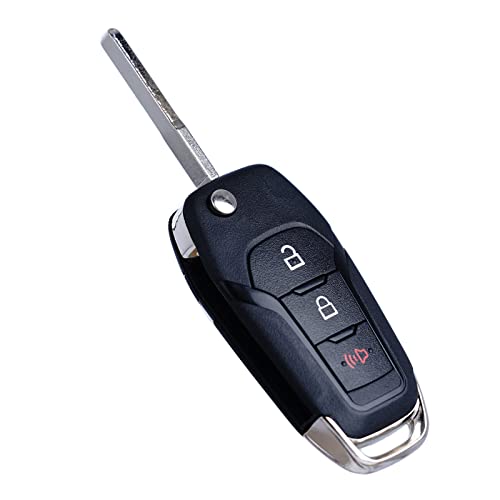

Remove that lower shroud and the cylinder housing is right there. The PATS antenna ring, the wiring loop that reads your key’s chip, wraps around the key slot itself.
Fords with push-button start, most trims built from about 2015 on, have no physical lock cylinder at all. A steering column lock actuator and a key fob do that job instead. This guide does not apply to that system.
Ford ignition lock cylinder parts and base part numbers


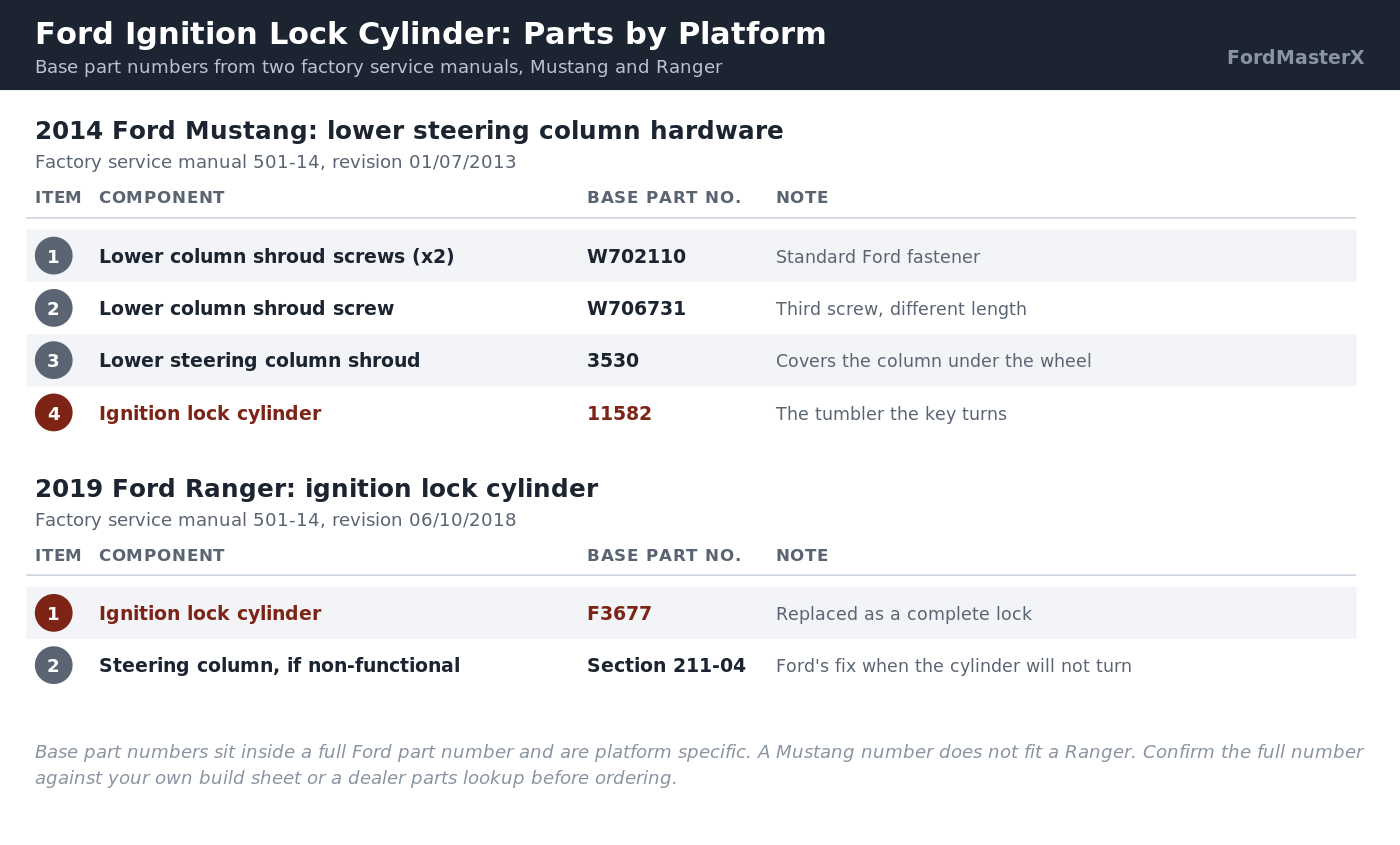
Ford does not use one part number across every model. These two factory manuals cover very different platforms, so this table shows what genuinely carries over and what does not.


| Platform | Component | Base part no. | Note |
|---|---|---|---|
| 2014 Mustang | Lower column shroud screws (x2) | W702110 | Standard Ford fastener |
| 2014 Mustang | Lower column shroud screw | W706731 | Third screw, different length |
| 2014 Mustang | Lower steering column shroud | 3530 | Covers the column under the wheel |
| 2014 Mustang | Ignition lock cylinder | 11582 | The tumbler the key turns |
| 2019 Ranger | Ignition lock cylinder | F3677 | Replaced as a complete lock |
| 2019 Ranger | Steering column, if non-functional | Section 211-04 | Ford’s fix when the cylinder will not turn |
A base part number is the middle digits of a full Ford part number. Those digits identify the part itself, not the finish or revision.
The full number still needs a prefix and suffix specific to your build. Confirm it against your build sheet or a dealer parts lookup before ordering.
If you are ready to order, match the replacement ignition lock cylinder to your VIN and key type first. The base numbers above confirm the right family of part, not a universal fit.


ACC or ON: which position actually releases it
Four independent Ford factory procedures split on this exact point. Two call for ACC. Two call for ON, the position some manuals label RUN.
| Source | Platform and year | Release position |
|---|---|---|
| Ford factory manual, Section 501-14 | 2019 Ranger | ACC |
| Ford factory manual, Section 501-14 | 2014 Mustang | ACC |
| Ford factory manual, Ignition Lock service section | 2004 F-150, 5.4L | ON |
| Ford factory manual, Ignition Lock service section | 2005 Escape, 3.0L | ON |
The pattern looks like an era split. The two older platforms want ON, the two newer ones want ACC.
Four sources across four model lines are not enough to call that a hard rule. Treat it as a strong lead, not a certainty.
Try ACC first. If the release pin will not depress, move the key to ON and try again before you force anything. Pushing a tool against a pin that is not aligned is how pins snap off inside the housing.
How to remove a functional ignition lock cylinder
This procedure is confirmed across all four factory sources above. It applies when the cylinder still turns, just poorly.
| Step | Action | Watch for |
|---|---|---|
| 1 | Disconnect the battery negative terminal. | Prevents an airbag fault code on columns with the clockspring nearby. |
| 2 | Remove the steering column opening trim panel. | Usually clips, not screws. |
| 3 | Remove the two or three lower shroud screws and the shroud. | Set screws aside, they are different lengths. |
| 4 | If equipped, disconnect the PATS transceiver ring from the key slot. | It is a thin wire loop, not a harness plug. |
| 5 | Insert the key and turn it to ACC, or ON if ACC does not release the pin. | See the table above for your platform. |
| 6 | Press the release pin through the access hole with a small punch or pick. | A roll pin punch set fits this hole better than a screwdriver tip. |
| 7 | Pull the cylinder straight out while holding the pin depressed. | It should slide free without force. |
To install, reverse the steps. Keep the new or repaired cylinder in the same position you used for removal.
Align its locking pin with the housing’s access hole. Then rotate the key through every position to confirm it works, before you reinstall the shroud.
A new cylinder cut to a new key needs PATS programming before the truck will start. A Ford diagnostic tool that handles key programming does that step without a separate trip to the dealer.
What if the cylinder will not turn at all?
This is the scenario most pages never address. If the key does not turn even slightly, the problem usually is not the cylinder’s tumblers.
Ford’s procedures for the Ranger and the Mustang both point to the steering column, not a new cylinder. The column’s internal lock module has failed, and a new cylinder will not turn inside a seized housing.
That is a bigger job than the shroud-and-pin procedure above. It usually means removing the whole steering column, which involves the airbag clockspring. Expect a locksmith or dealer visit afterward for the PATS re-pairing.
Before you commit to that, rule out the easy causes first. A worn or bent key sometimes mimics a seized cylinder.
Try a spare key first if you have one. Check the key blade for visible wear before you pull the column apart.
Signs of a failing ignition lock cylinder
Readers usually arrive with a symptom, not a part name. This maps the common ones to what is actually happening.
| What you notice | Likely cause |
|---|---|
| Key is hard to turn, needs jiggling | Worn tumbler pins inside the cylinder, the most common failure |
| Key will not turn at all, in any direction | Non-functional cylinder, see the section above |
| Key turns but the engine will not crank | Likely the ignition switch, not the cylinder, see the switch guide below |
| Key turns, dash lights come on, no start, security light flashing | PATS fault, not the lock cylinder itself |
| Engine stumbles or stalls only when warm, tachometer jumps | Ignition control module, a different part entirely |
| Key stuck in the cylinder, will not pull out | Usually a shift interlock or steering lock issue, not cylinder wear |
Lock cylinder, ignition switch, and ignition module are three different parts
These three get confused constantly, and mixing them up means buying the wrong part. The lock cylinder is the mechanical tumbler your key slides into. It only turns a shaft.
The ignition switch is the electrical component that shaft turns. It sends power to the starter, the fuel system, and your accessories. The cylinder can be perfect while the switch underneath it has worn contacts.
The ignition control module is a separate electronic part that times the spark. It has nothing to do with the key or the column. If the engine stalls once it is hot, see this site’s guide to signs of a bad ignition module.
Electrical symptoms, a no-crank or dead accessories with a key that turns fine, point to the switch, not the cylinder. See this site’s ignition switch wiring color code chart or the full ignition switch wiring and troubleshooting guide. Confirm the switch itself with a multimeter test before you buy a new cylinder for a switch problem.
Ford ignition lock cylinder quick reference
The facts readers look up most, in one place.
| Question | Answer |
|---|---|
| Where is it | Steering column, behind the lower shroud, right behind the key slot |
| Release position | ACC on most Fords since the mid 2000s, ON on many built earlier |
| Tool needed | A small punch or pick, not a screwdriver tip |
| 2014 Mustang cylinder base part no. | 11582 |
| 2019 Ranger cylinder base part no. | F3677 |
| Cylinder turns but is worn | Functional, a direct cylinder swap |
| Cylinder will not turn at all | Non-functional, Ford’s fix is the steering column, not the cylinder |
| Push-button start models | No physical lock cylinder, roughly 2015 and newer trims |
Your exact platform may not match any of the four sources above. Confirm the release position with a light touch before you force a pin. Check your own build sheet before ordering a part by number.