
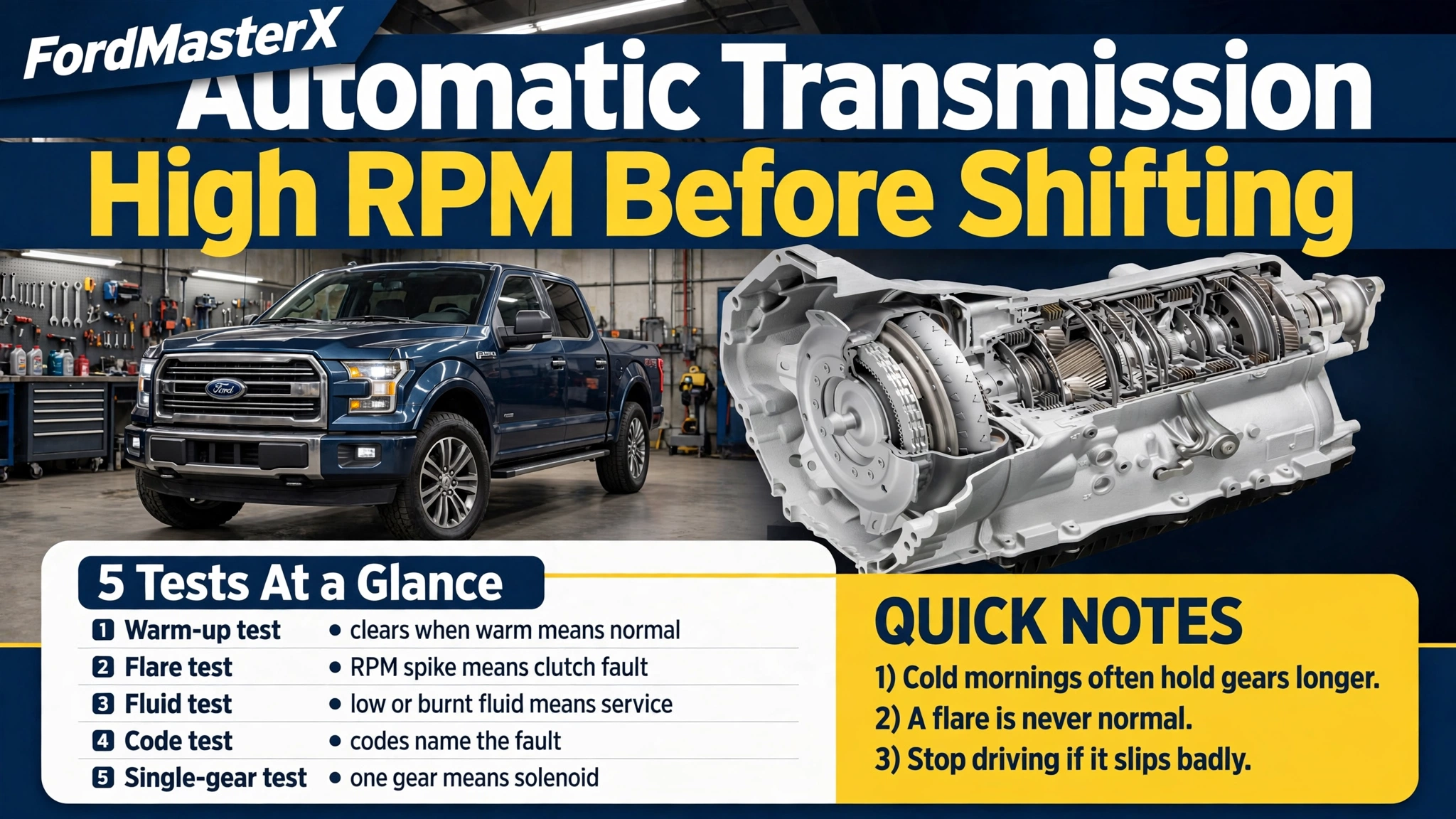
Automatic Transmission High RPM Before Shifting 2026 Complete Diagnosis Guide

Automatic transmission high RPM before shifting means the engine revs higher than usual while the transmission waits to change gear. Sometimes that is normal warm-up behavior. Sometimes it is the first sign of a transmission fault.
This guide tells the two apart in about twenty minutes. It covers the normal causes, the six faults that cause it, a step-by-step diagnosis, Ford 10R80 and 6R80 context, and when to stop driving.
The single most useful test is simple. If the high RPM shifting clears up once the transmission is warm, the cause is usually temperature or programming. If it stays after twenty minutes of driving, it needs diagnosis.
The Short Answer in 5 Tests
Five quick tests separate a normal transmission from a failing one. Run them in order, because each result points at a different section of this guide.
| Test | What to check | What the result means |
|---|---|---|
| Warm-up test | Does it clear up after 20 minutes of driving | Clears up means cold fluid or programming, stays means a fault |
| Flare test | Does RPM spike with no speed gain between gears | A flare means the clutches are not engaging on time |
| Fluid test | Fluid level, color, and smell | Low, dark, or burnt fluid points at service or a leak |
| Code test | Scan for transmission codes | Codes name the circuit, solenoid, or sensor at fault |
| Single-gear test | Does only one gear delay while others shift fine | One gear points at a solenoid or valve body circuit |
High RPM Shifting At a Glance
The five tests that tell a normal warm-up from a transmission fault, as observed in November 2026.
| Test | What to check | What the result means |
|---|---|---|
| Warm-up test | Does it clear up after 20 minutes of driving | Clears up means cold fluid or programming, stays means a fault |
| Flare test | Does RPM spike with no speed gain between gears | A flare means the clutches are not engaging on time |
| Fluid test | Fluid level, color, and smell | Low, dark, or burnt fluid points at service or a leak |
| Code test | Scan for transmission codes | Codes name the circuit, solenoid, or sensor at fault |
| Single-gear test | Does only one gear delay while others shift fine | One gear points at a solenoid or valve body circuit |
Direct answer: High RPM before shifting is normal only when cold, under heavy load, or while the transmission relearns. A flare, a burnt smell, or a delay that stays when warm means the transmission needs diagnosis.
Sources: J and G Transmissions cold weather guide, EngineerFix shift flare guide, VehicleRuns diagnosis guide, and Ford TSB 23-2123. Shift behavior varies by model, load, and temperature.
Most owners find their answer in the first two tests. A transmission that behaves once warm is doing its job. A transmission that flares, slips, or smells burnt is telling you something is wrong.
The rest of this guide explains what high RPM before shifting actually is, then walks through the normal causes, the faults, and the diagnosis in the order a technician would follow.
What High RPM Before Shifting Means
An automatic transmission changes gear by releasing one clutch pack and applying the next one, timed to a fraction of a second. The engine speed should rise smoothly with road speed, dip briefly at the shift, and then climb again in the next gear.
High RPM before shifting breaks that pattern. The engine climbs higher than usual before the shift lands, or it surges upward during the shift itself while the truck barely speeds up. The two patterns have different causes, so telling them apart is the first step.
Your transmission model changes the details. Our guide to the Ford transmission identification chart shows how to work out which automatic your truck has, and that matters because the 10-speed and 6-speed units fail in different ways.
Delayed Shift Defined
A delayed shift is a shift that arrives late. The engine holds a gear longer than it should, the RPM climbs higher than normal, and then the shift finally lands, often with a firm thud.
Delayed shifts come from low hydraulic pressure, a slow solenoid, a worn valve body, or a control module that is waiting for a sensor signal. The gear itself still engages, which is why a delayed shift can feel like a firm shift rather than a slip.
A delay that appears only on the first shift of a cold morning and vanishes within a mile or two is usually temperature. A delay that appears on every drive, warm or cold, is a fault that needs the diagnosis section below.
Shift Flare Defined
A shift flare is a brief RPM spike during the gear change itself. The old gear lets go before the new gear grabs, so the engine spins freely for a moment while the truck stops accelerating.
EngineerFix describes this as a neutral-like state where the engine is temporarily disconnected from the drivetrain, caused by a timing or pressure failure inside the transmission. The flare usually lasts less than a second, but it repeats on the same shift every time.
A flare is never normal. It means the clutches or bands are not clamping down with the right force at the right moment, and every flare adds heat and wear to the friction material inside the transmission.
Transmission Slipping Defined
Slipping is different from both a delay and a flare. The transmission is in gear, but the engine speed rises without a matching rise in road speed, as if the clutch is only half engaged.
Mister Transmission lists the signs as engine RPM climbing without speed gain, a shudder during shifts, and unusual noises such as clicking or whining. Slipping can happen under load, during shifts, or when the vehicle is warm, and it does not fix itself.
Slipping is the most serious of the three patterns. It generates heat fast, and heat is what turns a worn clutch pack into a rebuild. Stop driving if the slip is severe, and use the stop-driving table near the end of this guide.
5 Normal Reasons Your Transmission Holds Gears
Not every high RPM shift is a fault. Automatic transmissions are programmed to hold gears longer in several normal situations, and knowing them stops an owner from paying for a repair they do not need.
Work through these five before you assume the transmission is broken. If one of them matches your situation exactly, and the behavior clears up when the condition ends, the transmission is doing what it was designed to do.
Cold Fluid Warm Up
Cold transmission fluid is thicker than warm fluid, and thicker fluid moves more slowly through the narrow passages of the valve body. Pressure builds a fraction slower, so shifts land later and firmer until the fluid warms up.
J and G Transmissions explains that many modern vehicles deliberately hold gears longer when cold to warm the drivetrain faster. That is programming, not a fault, and the higher shift points clear up as the fluid reaches operating temperature.
The test is distance and time. If the shifts return to normal within the first mile or two, or after about twenty minutes of driving, cold fluid was the cause. If the delay is still there after twenty minutes, cold was never the cause.
Heavy Throttle Response
A hard press on the accelerator tells the transmission control module that you want power, not economy. The module holds each gear longer so the engine stays in its stronger rev range, and the shift points move much higher than during gentle driving.
This is normal behavior on every automatic. A truck that shifts at high RPM under full throttle and shifts early under light throttle is responding to your right foot, not failing.
Compare like with like before you worry. Drive the same road at the same gentle throttle on two different days, and see whether the shift points match. A fault shows up under gentle driving too, while a throttle response does not.
Towing or Steep Grades
Towing a trailer or climbing a steep grade adds load, and the transmission holds lower gears longer to keep the engine in its pulling range. Some Ford trucks also change their shift pattern when Tow Haul mode is on, which is a deliberate choice by the driver.
High RPM before shifting under load is the transmission protecting itself and the engine. Shifting up too early under a heavy load would lug the engine and heat the clutches, so the control module waits.
Check whether Tow Haul mode is on, and whether the behavior stops when you unhook the trailer or reach flat ground. If the high RPM shifting only happens under load, the transmission is working as designed.
Adaptive Learning Reset
Ford automatics learn your driving style and adjust shift pressure and timing over time. That learning lives in the transmission control module, and it resets when the battery is disconnected or the module is reflashed.
After a reset, the transmission relearns its shift timing over the next 50 to 100 miles, according to Gearbox Insider’s transmission relearn guide. Harsh shifts and gear hunting during that period are normal, and they smooth out as the learning completes.
Our guide to the Ford adaptive learning transmission reset explains how the relearn works and what to expect. If the rough shifting started right after a battery change or a software update, give it a hundred miles before you book a diagnosis.
Cold Start High Idle
A cold engine idles higher than a warm one, and that high idle can make the first shift into gear feel firm or delayed. The engine is running richer and faster to warm the catalytic converter, which is an emissions strategy, not a transmission fault.
Wait for the idle to settle before you judge the first shift. Owners who drop a cold truck straight into drive and accelerate hard will feel a clunk that a thirty-second wait would have avoided.
Gentle driving warms the transmission better than long idling, because the transmission warms mainly by doing work. J and G Transmissions recommends about thirty seconds of idle, then normal driving without heavy throttle for the first few minutes.
6 Faults That Cause High RPM Before Shifting
When the normal causes do not fit, the problem is inside the transmission or its controls. These six faults cover almost every case, and they run from a simple fluid service to a full rebuild.
Read them in order, because the cheap causes come first. A low fluid level can look exactly like a worn clutch pack, and checking the fluid costs nothing while a rebuild costs thousands.
Low or Degraded Fluid
Transmission fluid is the hydraulic medium that applies the clutches, and low fluid means low pressure. A pump starved of fluid cannot build the pressure the next gear needs, so the shift arrives late or the engine flares while it waits.
Fluid degrades with heat and age. Old fluid loses viscosity, and a clogged filter restricts flow, so even a full sump can behave like a low one. Burnt fluid, dark brown or black with a scorched smell, is a sign the clutches have already been slipping.
Check the level and condition first, following your owner’s manual for the procedure. Our guide to how to check transmission fluid on a 2016 F-150 shows the dipstick method, but many newer Ford automatics have no dipstick and need a dealer-level check from underneath.
Use only the fluid your manual specifies. The wrong fluid can impair pressure and viscosity, especially at operating temperature, according to EngineerFix. For older Ford units, our guide to the best Mercon V transmission fluid explains the specification and why mixing types causes trouble.
Worn Clutch Packs
Clutch packs are friction discs that lock each gear in place. As the friction material wears thin, the pack cannot grip firmly even when the pressure is correct, so it slips for a moment before it finally holds.
Worn clutches cause flare and slip rather than a clean delay. The RPM spikes during the shift, the truck hesitates, and the shift feels soft instead of firm. The problem gets worse as the transmission warms up, because hot fluid is thinner and grips less.
Clutch wear is internal and cannot be fixed with a fluid change. A scan for codes and a fluid inspection come first, but confirmed clutch wear means the transmission has to come out for a rebuild.
Failing Shift Solenoids
Shift solenoids are small electric valves that direct fluid to the right clutch pack at the right moment. When a solenoid sticks, responds slowly, or fails electrically, the shift it controls arrives late or harsh.
A single solenoid fault usually affects one gear change, not all of them. If the 2-3 shift always flares but the 3-4 shift is perfect, a solenoid or its circuit is the prime suspect. That pattern is the single-gear test in the short-answer table.
Mister Transmission lists P0700, P0730, and P0868 among the common fault codes for slipping and shift problems. A scan tool that reads transmission codes will name the solenoid circuit, and that turns a guess into a targeted repair.
Our guide to how to reset the transmission control module on a Ford F-150 covers the control side of the system. A reset never fixes a failed solenoid, but it is worth knowing the difference before you pay for parts.
Valve Body Wear
The valve body is the hydraulic control center of the transmission. It routes pressurised fluid through narrow passages to the clutches, and its bores wear over time, letting pressure leak past the valves instead of reaching the clutch pack.
Worn valve body bores cause inconsistent behavior. Shifts can be soft and slipping one day and harsh and jarring the next, because the pressure loss changes with temperature and fluid condition. A 6R80 technical guide notes that the control module compensates for small losses until its adaptive range runs out, and then the driver starts feeling flare and harsh shifts.
Ford TSB 23-2123 names the main control valve body directly. For affected 10R80 trucks, the bulletin calls for an overhaul of the main control valve body, a software update, or an adaptive learning drive cycle. That bulletin is covered in detail in the Ford section below.
Torque Converter Trouble
The torque converter connects the engine to the transmission through fluid, and its lock-up clutch engages at cruising speed to stop the slip. A failing converter can cause high RPM without matching speed, shuddering during shifts, and unusual noises.
Converter trouble often shows up as RPM fluctuation at a steady speed rather than a shift problem. The engine speed wanders up and down on the highway while the road speed stays constant, which is the lock-up clutch failing to hold.
A converter repair needs the transmission removed, so the labor cost is the largest part of the bill. The cost table near the end of this guide gives the national planning range for a converter replacement, with its source named.
Faulty Speed Sensors
The transmission control module decides when to shift from vehicle speed, throttle position, and engine load. If a speed sensor sends wrong or missing data, the module cannot time the shift, so it holds the gear too long or shifts at the wrong moment.
On the 6R80, the Output Shaft Speed sensor sits inside the molded lead frame, and its failure is a known pattern covered by Ford Program 19N01 and recall 19V-075. A failing sensor can also cause sudden downshifts, which is a safety issue, not just an annoyance.
Sensor faults usually store a code, so the code scan in the diagnosis section catches them. Our guide to the Ford F-150 transmission range sensor location shows where one of the related sensors lives and how to find it on the truck.
How to Diagnose the Problem in 20 Minutes
Diagnosis follows a fixed order, and the order matters. Check the cheap and easy things first, because a fluid problem and a worn clutch pack can look identical from the driver’s seat.
VehicleRuns gives the best first move for this symptom: check the fluid condition first, then scan for transmission or engine codes before assuming the transmission needs a rebuild. The steps below follow that order.
- Warm the truck up fully. Drive gently for twenty minutes, then repeat the same acceleration that showed the problem. If the high RPM shifting is gone, the cause was cold fluid or programming, and no further diagnosis is needed.
- Park on level ground, set the parking brake, and check for leaks underneath. Look for red or brown fluid near the transmission pan, cooler lines, and seals. A leak explains low fluid, and a leak has to be fixed before anything else.
- Check the fluid level and condition using the procedure in your owner’s manual. Healthy fluid is red or pink and smells slightly sweet. Dark brown or black fluid with a burnt smell means the clutches have been slipping.
- Scan for codes with a scan tool that reads transmission codes, not just engine codes. Write down every code, including pending codes. Codes in the P0700 and P0750 families point at solenoids and shift circuits.
- Test each gear change separately. Accelerate gently and note which shift flares or delays. One bad shift points at a solenoid or valve body circuit, while every shift points at fluid pressure or worn clutches.
- Check the transmission temperature behavior. A delay that gets worse as the truck warms up points at worn clutches or valve body wear, because hot fluid is thinner and leaks past worn parts faster.
- Note any warning lights, limp mode, or sudden downshifts. A truck stuck in one gear with a warning light is in a protection strategy, and that result belongs in the stop-driving section below.
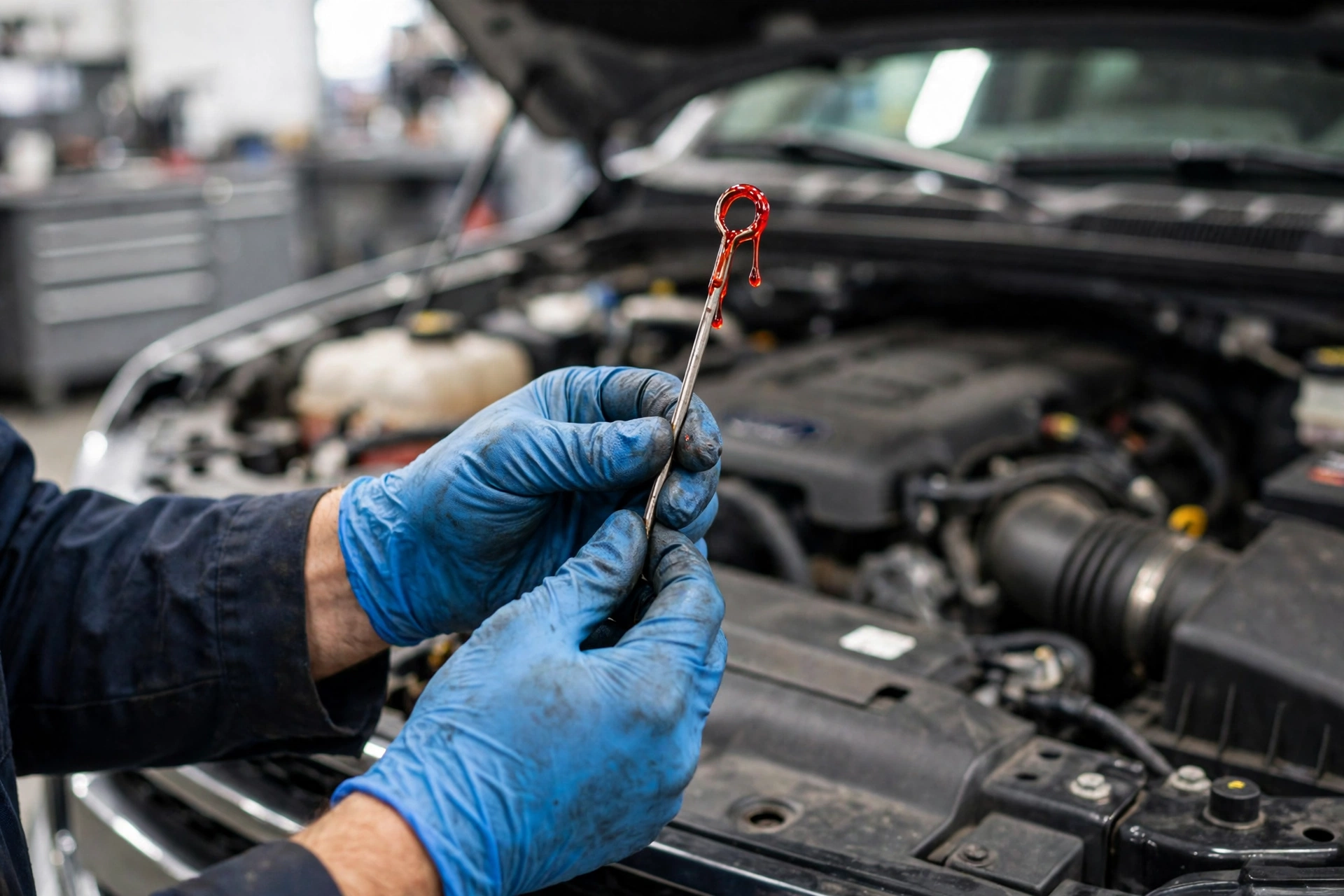
AI-generated illustration: checking transmission fluid level and color on a Ford truck. The fluid color shown is illustrative, not a reading from a real vehicle.
Our guide to how to check transmission fluid on a 2018 F-150 walks through the check on a newer truck. If your model has no dipstick, the level check needs a lift and a scan tool, and a shop should do it.
Bring your notes to the shop. The warm-up result, the fluid condition, the codes, and which gear flares tell a technician more in thirty seconds than a vague complaint ever will, and they stop the shop from starting over at the beginning.
Ford 10R80 and 6R80 Shift Problems Explained
Ford trucks use two automatics that owners ask about most: the 10-speed 10R80 and the 6-speed 6R80. Both can hold high RPM before shifting, but for different reasons, and both have official Ford documents behind them.
Knowing which transmission you have changes the diagnosis. Our guide to what transmission is in an F-150 shows how to identify yours from the door sticker and the VIN.
10R80 Shift Flare Years
The 10R80 is a 10-speed automatic fitted to F-150, Expedition, Mustang, and Ranger models from 2017 onward. Owners of 2017 to 2019 F-150 trucks report a shift flare most often, where the RPM spikes briefly during a gear change and power returns a moment later.
The Healthy Attitude guide on the 10R80 flare says the condition appears less often or is absent in 2020 and newer F-150 models, where Ford applied software updates and refined torque converter calibration. The same guide says the flare is not a transmission failure in the traditional sense, because the truck keeps operating and shifting.
That does not make it harmless. A flare that repeats on every drive adds heat and wear to the clutch packs, and a flare that grows worse over months is a fault progressing, not a quirk settling down. Note whether it is getting worse, and tell the dealer if it is.
TSB 23-2123 Fix
Ford issued Technical Service Bulletin 23-2123 on 13 April 2023, superseding bulletin 22-2139. It covers 2017 to 2020 F-150, 2018 to 2021 Expedition, Navigator, and Mustang, and 2019 to 2023 Ranger vehicles with the 10R80.
The bulletin says some of these vehicles may show harsh engagement, harsh shift, or delayed shift, and may store codes including P0751, P0752, P0756, P0757, P0761, P0762, P0766, P0767, P0771, P0772, P2700 through P2705 and P2707 through P2708, P0729, P0731 through P0736, P076F, P07D9, P07F6, and P07F7. Ford attributes the condition to the adaptive calibration failing to adapt to hardware break-in over time.
The fix in the bulletin is an overhaul of the main control valve body, a software update, or an adaptive learning drive cycle, depending on what the dealer finds. OEMDTC publishes the full text of TSB 23-2123, including the affected models, the code list, and the service procedure.
Ask the dealer to check for open bulletins on your VIN before you authorise any repair. A truck inside the bulletin range with the listed symptoms should get the bulletin fix first, because it is the factory answer to exactly this problem.
6R80 Lead Frame Issue
The 6R80 is the 6-speed automatic in older F-150 trucks, Transits, and other Ford models. Its best-known fault is the molded lead frame, a sealed assembly inside the transmission that carries the Output Shaft Speed sensor and the solenoid wiring.
When the sensor inside the lead frame fails, the control module loses vehicle speed data and can command a sudden downshift to first gear at any speed. Ford covered this with recall 19V-075, which reprograms the control module so it cannot command that downshift when the signal is lost, and with Program 19N01, which extended coverage for the molded lead frame itself.
The software fix stops the dangerous downshift, but it does not repair the lead frame itself. A truck with a failing sensor still needs the lead frame replaced, and the diagnosis section above will show the sensor codes that point at it.
Our guide to what transmission is in a 2004 Ford F-150 covers an older generation of the same truck family. The 6R80 arrived later, but the identification method is the same, and it matters because parts and bulletins are transmission-specific.
6R80 Adaptive Learning
The 6R80 adapts its shift pressure and timing to the driver, and that learning can cause high RPM shifts after a change. A truck shared by two drivers with very different habits can shift harshly, because the learned values suit one driver and not the other.
A software update or an adaptive relearn often smooths these trucks out. A 6R80 technical guide notes that installing the latest control module calibration and resetting the adaptive learning parameters can restore smooth shifts, and no further repair is needed when that works.
After a battery disconnect or a module flash, the transmission needs 50 to 100 miles to relearn. Harsh shifts during that window are normal, and they should fade as the miles add up. If they are still rough after a hundred miles, the problem is mechanical, not learned.
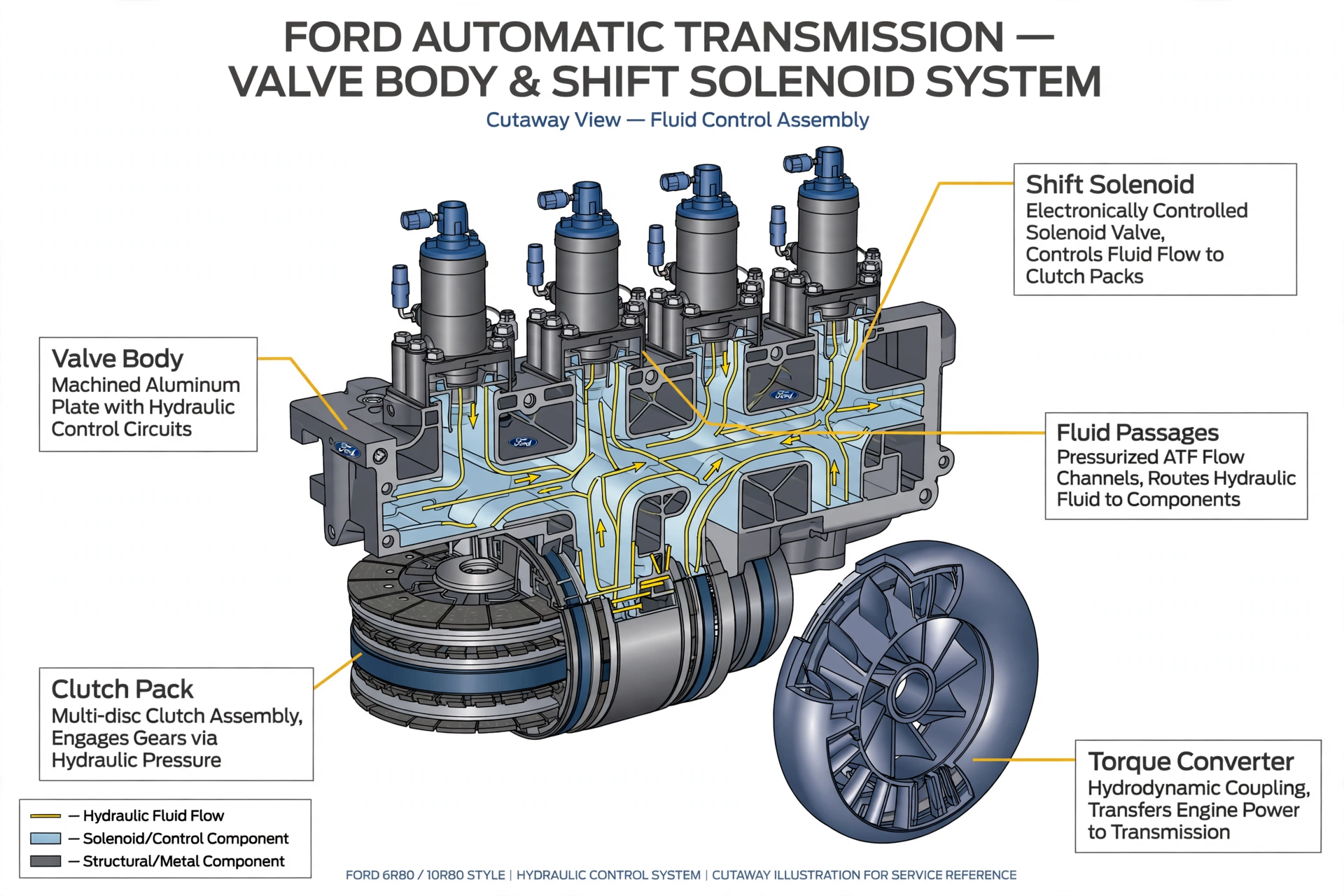
AI-generated illustration: a labeled valve body and solenoid diagram for a Ford automatic transmission. Component positions are illustrative, not a factory service diagram.
When to Stop Driving Right Now
Some symptoms mean the transmission is damaging itself with every mile. The table below is the decision rule: if your symptom is in the stop column, park the truck and call for a tow or a mobile inspection.
| Symptom | Action | Why |
|---|---|---|
| Severe slipping with no speed gain | Stop driving | Clutch heat rises fast and turns wear into a rebuild |
| Burnt fluid smell or smoke | Stop driving | Fluid is overheating and clutches are already slipping |
| Sudden downshift to first gear | Stop driving | Rear wheels can lock and control can be lost |
| Stuck in one gear with a warning light | Drive gently to a shop or stop | Limp mode protects the transmission but limits control |
| Delay only when cold, clears when warm | Safe to drive | Cold fluid and programming, not a fault |
| High RPM only under heavy throttle | Safe to drive | Normal power demand response |
| Rough shifts for 50 to 100 miles after a reset | Safe to drive gently | Adaptive learning is rebuilding its values |
VehicleRuns gives the same safety rule in plain terms: if the transmission slips badly, revs high without moving properly, overheats, or drops into limp mode, avoid continued driving because heat and clutch damage can rise fast. That guidance matches the table above.
Transmission overheating is the hidden risk. Slipping clutches generate heat, heat breaks down the fluid, and broken-down fluid slips more, so the damage feeds on itself. A truck that slips a little today can need a rebuild next month if it keeps being driven.
Never keep driving to finish a trip when the transmission is slipping badly. A tow costs far less than a rebuild, and a sudden loss of drive on a highway is a safety problem, not just a repair bill.
What Repairs Cost in 2026
Repair costs depend on the fault, the model, and the shop, so no guide can give a firm quote. The ranges below are national planning figures from a 2026 transmission cost guide, and they are useful for deciding whether a repair is worth pursuing before you get a written estimate.
| Repair path | Planning range | When it applies |
|---|---|---|
| Fluid service | 100 to 290 dollars | Low or degraded fluid, no internal damage |
| Solenoid or valve body repair | 150 to 800 dollars | Scan data isolates one circuit or valve |
| Torque converter replacement | 600 to 1,800 dollars | Converter slip or shudder confirmed |
| Transmission rebuild | 1,500 to 3,500 dollars | Worn clutches or internal damage |
| Remanufactured replacement | 2,000 to 4,000 dollars | Heavy internal damage, warranty wanted |
| Full or new replacement | 2,900 to 8,000 dollars or more | Late model truck or severe failure |
Rohnert Park Transmission published these 2026 planning ranges, based on national guides from Bumper, Kelley Blue Book, and RepairPal, and notes that they are planning ranges, not that shop’s prices. Labor rates, the vehicle, and internal damage can move the actual quote well outside the range.
The repair path matters more than the symptom. A slipping transmission can be a fluid issue, a solenoid issue, a converter issue, or a full internal failure, and those repairs differ by thousands of dollars. That is why the diagnosis comes before the estimate.
Get a written estimate that names the fault and the parts. A shop that quotes a rebuild without scanning for codes or checking the fluid has skipped the diagnosis, and a targeted solenoid repair can save thousands when the codes point at one circuit.
Check warranty cover before authorising any transmission work. Our guide to what year the F-150 got the 10-speed transmission helps place your truck in the right generation, and the powertrain warranty may still cover a transmission fault on a newer truck.
Questions Owners Ask About High RPM Shifting
Is High RPM Before Shifting Normal
It is normal when cold, under heavy throttle, while towing, or while the transmission relearns. It is not normal when the transmission is warm, under gentle driving, or when the RPM spikes without speed gain. The warm-up test decides it: if it clears up after twenty minutes, it was temperature or programming; if it stays, it is a fault.
What Causes a Transmission to Flare
A flare happens when the old gear releases before the new gear engages, so the engine spins freely for a moment. Low pressure, a slow solenoid, a worn valve body, or worn clutches can cause it. Low or degraded fluid is the most common cause, so check the fluid first, and a repeating flare needs a scan and a diagnosis.
Can Low Transmission Fluid Cause High RPM
Yes, low fluid starves the pump, pressure drops, and the clutches cannot apply firmly or on time. The result is delayed shifts, flare, or slipping, and the symptoms get worse as the fluid heats up. Check the level and condition, look for leaks underneath, and fix any leak instead of only topping up.
Does a Bad Solenoid Cause Delayed Shifting
Yes, a sticking or failed shift solenoid delays fluid delivery to one clutch pack, so that one gear change arrives late or harsh while the others shift normally. The pattern is the clue: one bad shift means a solenoid or valve body circuit, and a scan for codes will usually name the solenoid circuit.
Is It Safe to Drive
It is safe when the cause is cold fluid, heavy throttle, or adaptive learning. It is not safe when the transmission slips badly, smells burnt, overheats, or drops into limp mode. Stop driving if the truck revs high without moving properly or a warning light comes on, because a tow is cheaper than a rebuild.
How Much Does It Cost to Fix
For 2026, a fluid service runs 100 to 290 dollars, a solenoid or valve body repair runs 150 to 800 dollars, and a rebuild runs 1,500 to 3,500 dollars. A full replacement can run 2,900 to 8,000 dollars or more.
Those figures come from Rohnert Park Transmission, based on national guides from Bumper, Kelley Blue Book, and RepairPal.
Your 5 Step High RPM Shift Check
Automatic transmission high RPM before shifting is a symptom with two very different meanings. When it clears up as the truck warms, it is the transmission doing its job. When it flares, slips, or stays after twenty minutes, it is a fault that needs attention.
Run the five step check before your next shop visit. Warm the truck up and test again, check the fluid and look for leaks, scan for transmission codes, note which gear flares, and stop driving if the slip is severe or the fluid smells burnt.
That check costs about twenty minutes. It separates a normal warm-up from a failing transmission, and when it does point at a fault, it hands the technician a clear diagnosis instead of a vague complaint.