
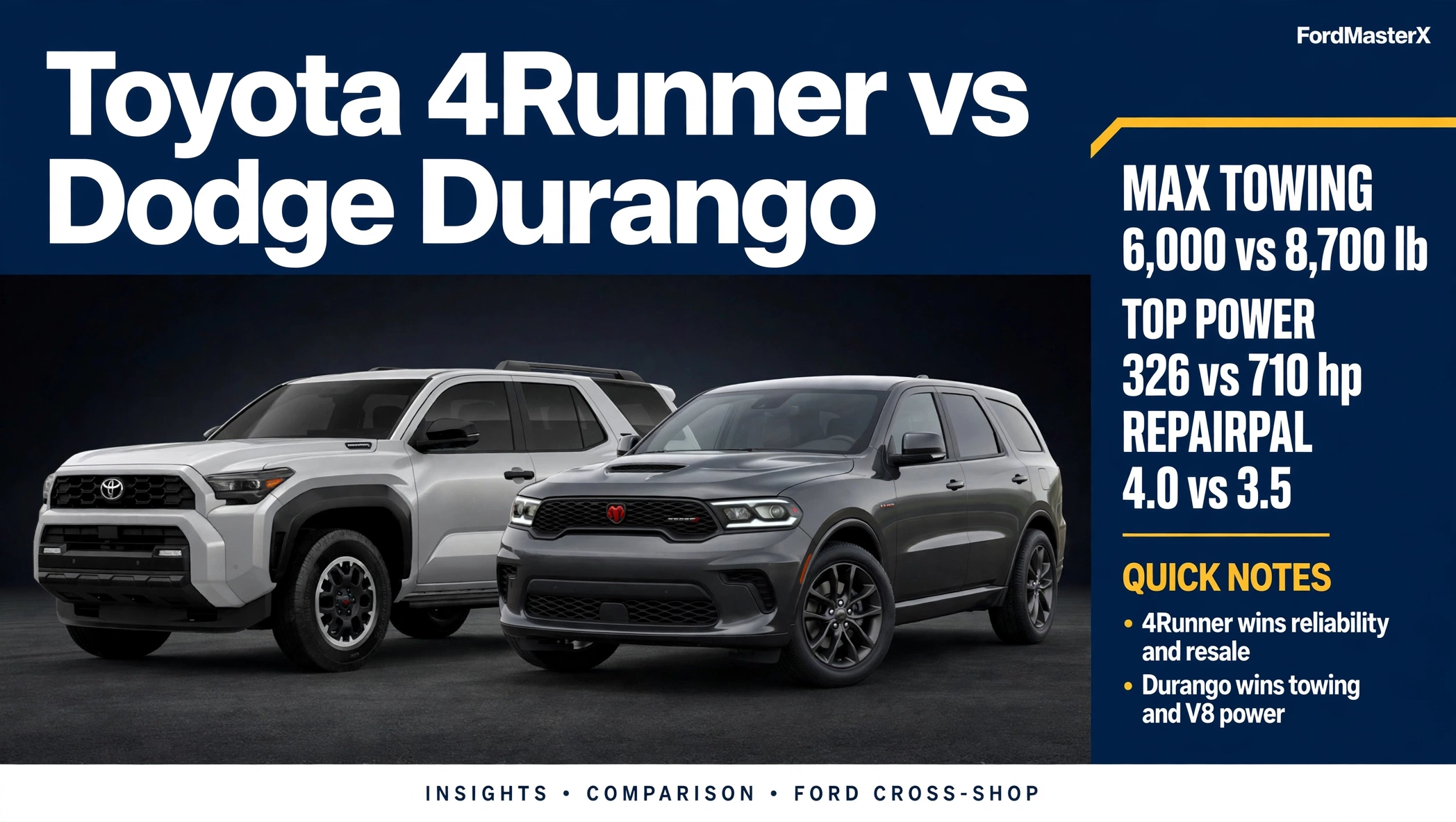
Toyota 4Runner vs. Dodge Durango 2026 Honest Verdict Guide

Toyota 4Runner versus Dodge Durango: which SUV should you buy in 2026? The honest answer is that they solve different problems, and the right pick depends on what you tow, where you drive, and how long you plan to keep the truck.
The 4Runner wins on reliability, resale value, and off-road credibility. The Durango wins on power, towing, and third-row family space, with a V8 lineup no other SUV in this class still offers.
This guide compares the two SUVs on the numbers that matter, then shows the Ford Explorer, Bronco, and Expedition for readers who started here and end up buying a Ford instead.
The Short Answer in 6 Numbers
Six numbers decide most purchases between these two SUVs. The table below holds them, and the infographic after it gives you the key facts to save or share.
| Number | What it is | What it means for you |
|---|---|---|
| 6,000 lb | 4Runner max towing | Enough for a small boat or pop-up camper |
| 8,700 lb | Durango max towing with Tow N Go | Best in its class, enough for a full travel trailer |
| 4.0 out of 5 | RepairPal rating for the 4Runner | Above average, 9th of 26 midsize SUVs |
| 3.5 out of 5 | RepairPal rating for the Durango | Above average, 3rd of 14 full-size SUVs |
| 30.1 percent | 4Runner five-year depreciation per iSeeCars | It keeps about 69.9 percent of its value |
| 49.3 percent | Durango five-year depreciation per iSeeCars | It keeps about half its value, so buy used with care |
4Runner Versus Durango At a Glance
The key numbers that decide a 4Runner or Durango purchase, as observed in November 2026.
| Measure | Toyota 4Runner | Dodge Durango |
|---|---|---|
| Max towing | 6,000 lb | 8,700 lb with Tow N Go |
| Top horsepower | 326 hp, i-FORCE MAX hybrid | 710 hp, Hellcat supercharged V8 |
| RepairPal reliability | 4.0 out of 5, 9th of 26 midsize SUVs | 3.5 out of 5, 3rd of 14 full-size SUVs |
| Five-year depreciation | 30.1 percent, per iSeeCars | 49.3 percent, per iSeeCars |
| Starting price | $41,570 for the SR5 | $38,995 for the GT |
Direct answer: Buy the 4Runner if you want reliability, resale value, and real off-road ability. Buy the Durango if you need three rows, V8 power, and the strongest towing in the class, and accept that it will lose value faster.
Sources: Toyota published specifications via dealer spec guides; Dodge 2026 Durango R/T 392 press release; RepairPal reliability ratings for the Toyota 4Runner and Dodge Durango; iSeeCars head-to-head comparison of the two models. Prices are published starting MSRPs and exclude destination, tax, title, license, and dealer fees.
The verdict changes with the buyer. A family that tows a travel trailer gets a different answer than a buyer who wants an SUV to last 200,000 miles with no surprises.
The rest of this guide works through each difference in turn. It starts with what each SUV is, and why they feel so different to drive.
What Each SUV Is Built For
These two SUVs look like rivals on a spec sheet, but they were built for different jobs. The 4Runner is a body-on-frame off-roader that happens to carry a family, while the Durango is a three-row family SUV that happens to offer muscle car engines.
That difference explains almost every number that follows. The 4Runner trades interior space and power for durability and trail ability, and the Durango trades fuel economy and resale for space and towing.
The 2026 Toyota 4Runner Fresh Start
The 2026 4Runner is in the second year of its sixth generation, after a full redesign for 2025. It rides on the TNGA-F body-on-frame platform shared with the Tacoma and the Land Cruiser, and it drops the old V6 for a turbocharged four-cylinder with an available hybrid.
That redesign matters because the old 4Runner was famous for lasting forever and equally famous for feeling old. The new truck keeps the tough frame and adds modern power, modern safety tech, and a hybrid option for the first time.
The catch is that the new turbo four has no long track record yet. Its reliability scores rest on the 4Runner nameplate, not on ten years of this engine, so a buyer is trusting Toyota’s record rather than this specific powertrain’s history.
2026 Dodge Durango Last of Its Kind
The 2026 Durango is the opposite story: an aging platform in what dealer guides expect to be the final year of this generation. Dodge has kept it alive by giving it the engines nobody else still offers in a three-row SUV, including a 475 horsepower V8 in the R/T and a 710 horsepower supercharged V8 in the Hellcat.
That makes the Durango one of the last midsize three-row SUVs you can still buy with a proper V8 rumble. It also means the cabin, the tech, and the safety equipment are older than what Toyota, Ford, and most rivals now sell.
The Durango is a known quantity, and that cuts both ways. Its strengths and its weak spots are well documented after years on sale, so a careful buyer knows exactly what to check before signing.
What Each SUV Costs in 2026
Price is the Durango’s first win. The Durango GT starts at $38,995, which is $2,575 less than the 4Runner SR5 at $41,570, and the gap grows when you compare the V8 Durango against a well-equipped 4Runner.
Both starting prices exclude destination charges, tax, title, license, and dealer fees. The 4Runner adds about $1,495 in destination, and the Durango adds about $1,995, so the real gap at the dealer is closer to $2,000.
| Trim | 2026 4Runner starting MSRP | 2026 Durango starting MSRP |
|---|---|---|
| Base | SR5, $41,570 | GT V6, $38,995 |
| Mid-range | TRD Off-Road, about $50,290 | GT HEMI V8, about $43,675 |
| Performance | TRD Pro hybrid, about $68,200 | R/T 392 V8, $49,995 |
| Top trim | Platinum hybrid, about $63,960 | SRT Hellcat, about $79,995 |
The mid-range comparison is where the Durango pulls away on value. A V8 Durango with all-wheel drive costs less than a mid-trim 4Runner, and it tows more while it does it.
The top end flips the story. The 4Runner TRD Pro costs about $68,200, while the Durango Hellcat costs about $79,995, and the Hellcat is a different kind of vehicle entirely: a 710 horsepower family SUV that runs an 11.5-second quarter mile.
Trim prices in the table above are published starting MSRPs from dealer spec guides, and the 4Runner figures moved during the model year. Toyota lists the 2026 4Runner from $41,570, while later guides list the SR5 up to $42,270, so confirm the price on the exact truck in front of you.
Engines and Power Compared Head to Head
Power is the clearest split between these two SUVs. The 4Runner offers two versions of one smart turbo four, while the Durango offers four engines that run from sensible to outrageous.
Neither approach is wrong. The 4Runner gives you enough power with better fuel economy, and the Durango gives you as much power as you are willing to pay for.
Toyota 4Runner Turbo Four Engines
Toyota’s standard 4Runner engine is a turbocharged 2.4-liter four-cylinder called i-FORCE, with 278 horsepower and 317 lb-ft of torque. It runs on regular fuel, and it pairs with an eight-speed automatic in every trim.
The hybrid version, called i-FORCE MAX, adds a 48 horsepower electric motor between the engine and the transmission. Total output rises to 326 horsepower and 465 lb-ft of torque, which is the most power any 4Runner has ever offered.
That hybrid torque is the number to remember. At 465 lb-ft it beats every Durango except the V8 models, and it arrives low in the rev range where towing and trail driving need it most.
The hybrid costs about $2,800 extra where it is optional, and it is standard on the Platinum, Trailhunter, and TRD Pro trims. Fuel economy rises to 23 mpg combined, against 22 combined for the gas two-wheel drive truck.
Dodge Durango Four Engine Choices
Dodge’s base Durango engine is a 3.6-liter Pentastar V6 with 295 horsepower and 260 lb-ft of torque. It is the sensible choice, and it already makes 17 more horsepower than the base 4Runner engine.
The 5.7-liter HEMI V8 makes 360 horsepower and 390 lb-ft of torque, and it comes with standard all-wheel drive. That engine turns the Durango from a family SUV into a proper tow vehicle, and it is the sweet spot for most buyers.
The 6.4-liter HEMI V8 makes 475 horsepower and 470 lb-ft of torque. Dodge made the 392 V8 standard on the R/T for 2026, and the R/T 392 Launch Edition covers 0 to 60 mph in 4.4 seconds with an NHRA-certified 12.9-second quarter mile time.
The supercharged 6.2-liter Hellcat V8 makes 710 horsepower and 645 lb-ft of torque. It is the fastest three-row SUV on sale, and it is also the thirstiest, so it suits a buyer who wants the performance and accepts the fuel bill.
Which Engine Should You Choose
Choose the 4Runner hybrid if you want the strongest 4Runner ever built without giving up fuel economy. The 465 lb-ft of torque makes it the best all-rounder in the Toyota lineup, and it holds the 6,000-pound tow rating.
Choose the Durango 5.7-liter HEMI if you tow regularly and want V8 power at a fair price. It is the engine that makes the Durango make sense, and it costs far less than the 392 or the Hellcat.
Choose the Durango 392 if you want the most horsepower under $50,000 in any three-row SUV. Dodge says the R/T 392 Launch Edition starts at $49,995, and no rival offers that much power for that money.
Towing and Cargo Space Compared
Towing is the Durango’s biggest win, and it is not close. The Durango tows up to 8,700 pounds, which is 2,700 pounds more than the 4Runner, and that gap covers the difference between a small boat and a full travel trailer.
The 4Runner tows 6,000 pounds on most trims, including the SR5, TRD Off-Road, and Limited. The Platinum, Trailhunter, and TRD Pro are rated slightly lower at 5,800 pounds, so the rating does not climb with the price.
That 4Runner number is still 1,000 pounds more than the previous generation could tow. It covers a pop-up camper, a pair of snowmobiles, or a small boat, and the hybrid holds the same rating as the gas truck.
| Measure | Toyota 4Runner | Dodge Durango |
|---|---|---|
| Max towing | 6,000 lb, 5,800 on top trims | 8,700 lb with Tow N Go |
| Base engine towing | 6,000 lb | 6,200 lb, V6 |
| V8 towing | No V8 offered | 7,200 lb AWD, 7,400 RWD, 5.7-liter HEMI |
| Cargo behind second row | 48.4 cu ft gas, 42.6 hybrid | 47.7 cu ft |
| Max cargo | 90.2 cu ft gas, 82.6 hybrid | 85.1 cu ft |
| Cargo behind third row | Third row is optional | 17.2 cu ft |
The Durango needs the Tow N Go package to reach 8,700 pounds, except the R/T 392, which tows 8,700 pounds as standard. The 5.7-liter HEMI tows 7,200 pounds with all-wheel drive, or 7,400 with rear-wheel drive, without the package, and the V6 tows 6,200 pounds, so check the window sticker before you buy a Durango for towing.
Cargo space is closer than the towing gap suggests. The gas 4Runner holds 48.4 cubic feet behind the second row and 90.2 maximum, against 47.7 and 85.1 for the Durango, so the Toyota actually carries more gear when the third row is not in use.
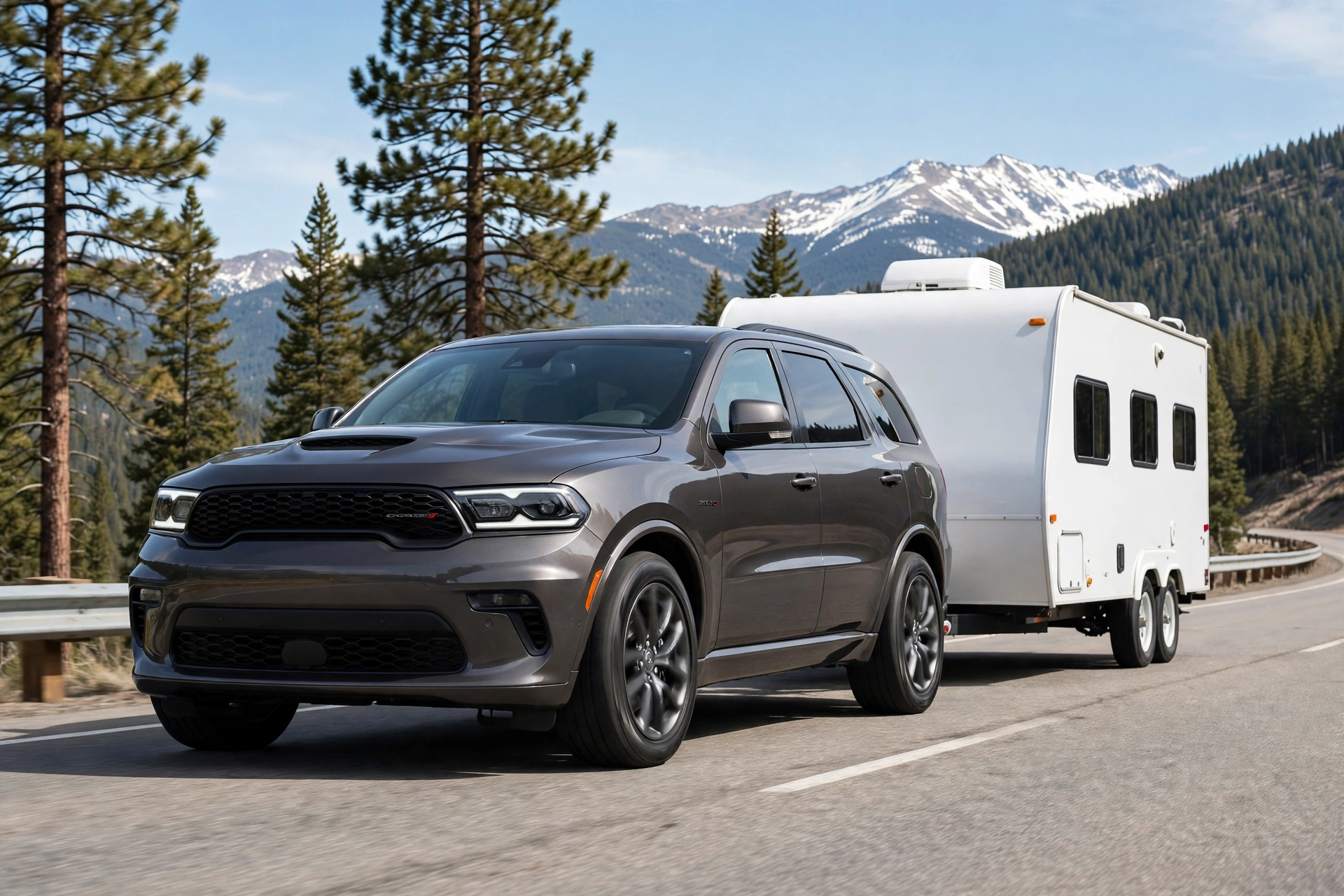
AI-generated illustration: a Dodge Durango towing a travel trailer.
The Durango wins the family cargo test because it has a real third row. With all three rows up it still holds 17.2 cubic feet behind the third row, which is enough for groceries and school bags, while the 4Runner only offers a third row on the SR5 and Limited trims.
A good rule is to tow no more than 80 percent of the maximum rating on a regular basis. That puts a comfortable 4Runner trailer at about 4,800 pounds and a comfortable Durango trailer at about 6,960 pounds with Tow N Go.
Fuel Economy and Running Costs
Fuel economy favors the 4Runner at every step. The gas 4Runner earns 22 mpg combined with two-wheel drive and 21 combined with four-wheel drive, while the hybrid earns 23 combined.
The Durango V6 earns 18 mpg city and 25 highway, which is respectable for a big SUV. The 5.7-liter HEMI drops to 14 city and 22 highway, and the 392 and Hellcat drink far more than that in real driving.
That gap adds up over a year of driving. A buyer who drives 12,000 miles a year will use roughly 180 fewer gallons in a 4Runner hybrid than in a HEMI Durango, and the savings grow if fuel prices rise.
Repair costs favor the 4Runner too, though the gap is smaller than the fuel gap. RepairPal lists the 4Runner at $514 a year in average repair and maintenance costs, against $573 for midsize SUVs and $652 for all vehicles.
RepairPal lists the Durango at $675 a year, against $784 for full-size SUVs and $652 for all vehicles. The Durango costs $161 more a year to keep running than the 4Runner, and it is still cheaper than the average full-size SUV.
Both SUVs need regular maintenance on schedule, and both reward a buyer who keeps records. The 4Runner’s turbo four needs clean oil and proper cooling, and the Durango’s HEMI engines need the same care plus attention to the eight-speed automatic.
Reliability and Resale Value Compared
Reliability is where the 4Runner earns its reputation. RepairPal rates the 4Runner 4.0 out of 5, ranking it 9th out of 26 midsize SUVs, with unscheduled shop visits averaging 0.4 times per year and a 13 percent chance that any given repair is severe.
The Durango earns 3.5 out of 5 from RepairPal, ranking it 3rd out of 14 full-size SUVs. Its owners visit the shop for unscheduled repairs 0.2 times per year on average, and the chance a repair is severe is also 13 percent.
Those numbers look close, and the difference is in the details. The 4Runner’s score comes from a nameplate with a long record of lasting past 200,000 miles, while the Durango’s score covers a truck that is cheaper to fix but less likely to hold its value.
iSeeCars rates the 4Runner 8.3 out of 10 for reliability and 8.1 out of 10 for overall quality, ranking it 7 out of 31 midsize SUVs. The same comparison rates the Durango 7.7 out of 10 for reliability and 7.5 out of 10 for quality, ranking it 17 out of 31.
Resale value is the biggest ownership gap between these two SUVs. iSeeCars puts five-year depreciation at 30.1 percent for the 4Runner, so it keeps about 69.9 percent of its value, against 49.3 percent depreciation for the Durango.
That 19.2 percentage point gap is worth thousands of dollars on a $45,000 purchase. A buyer who keeps the truck five years and trades it in will get far more back from the 4Runner, and that should be part of the price comparison.
The 4Runner’s long-term record has one honest caveat. The sixth generation arrived for 2025, so the new turbo four has no ten-year history yet, and its scores rest on the nameplate rather than on this engine. The Durango’s engines are proven, and its weak spots are known.
Safety Ratings and Warranty Cover
Safety ratings are even between the two SUVs. iSeeCars reports that both the 4Runner and the Durango earn the same average NHTSA safety rating of 4 out of 5 stars.
The 4Runner carries newer safety equipment as standard, including Toyota Safety Sense 3.0 on every trim. Its standard kit includes lane departure warning with steering assist, a rear seat reminder, knee airbags, and a secondary collision brake that applies the brakes after a crash to help prevent a second impact.
The Durango offers lane departure warning as an extra-cost option on some trims, and it does not offer a rear seat reminder, a front passenger knee airbag, or a post-collision braking system. That gap reflects the age of its platform, not a lack of care, and it is worth knowing before you buy.
Both SUVs carry a 3-year or 36,000-mile basic warranty and a 5-year or 60,000-mile powertrain warranty, per the manufacturers’ published warranty terms. Toyota adds 2 years of scheduled maintenance, while Dodge adds 5 years of rust-through cover with no mileage limit on the outer body panels.
Our guide to the Ford factory warranty explains how Ford’s cover compares, and our guide to how to check your Ford warranty shows how to confirm the cover on any used truck by VIN before you pay.
Off-Road Ability and Daily Driving
Off-road ability belongs to the 4Runner by a wide margin. Its body-on-frame build, available locking rear differential, crawl control, and TRD Off-Road and TRD Pro trims make it a genuine trail SUV, not just a truck that looks the part.
The Durango offers all-wheel drive and a capable chassis, but it is built for roads, not rocks. It has no low-range transfer case, no locking differentials, and no factory trail hardware, so it handles snow and gravel well and stops there.
Daily driving flips the advantage. The Durango rides softer, steers lighter, and feels more like a car on the highway, with a quieter cabin and easier parking than the taller, stiffer 4Runner.
The 4Runner is the better second vehicle for a household that already owns a car. It covers the weekends, the trails, and the bad weather, while the Durango is the better only vehicle for a family that needs three rows every day.
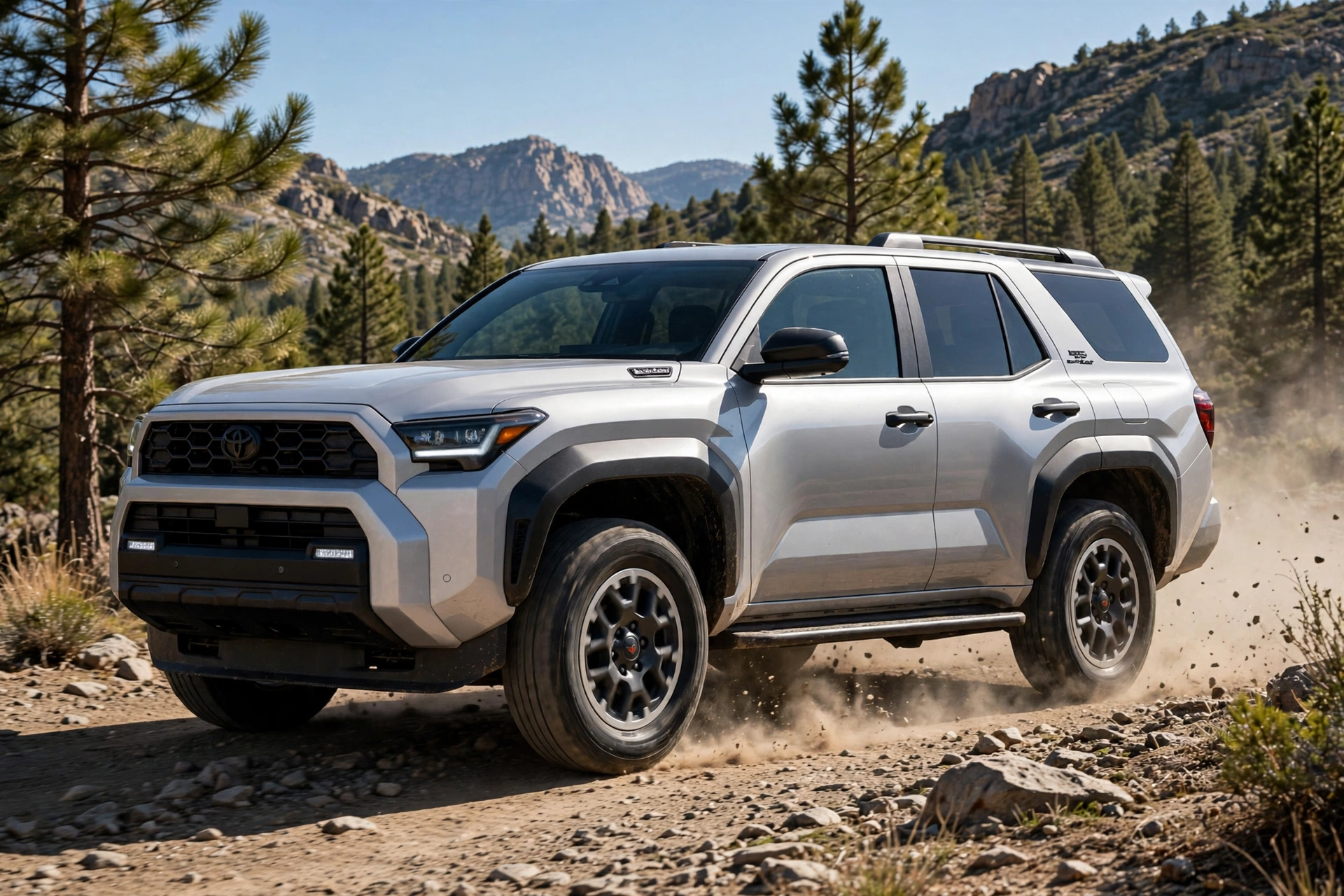
AI-generated illustration: a Toyota 4Runner on a rocky trail.
Ford Explorer Bronco Expedition Cross-Shop
Many readers who compare the 4Runner and the Durango end up buying a Ford instead. The Explorer covers the Durango buyer, the Bronco covers the 4Runner buyer, and the Expedition covers the buyer who outgrows both.
That is why this section exists. Every Ford figure below comes from Ford published specs and dealer spec guides, and no Ford number here is estimated or invented.
| Measure | Ford Explorer | Ford Bronco | Ford Expedition |
|---|---|---|---|
| Starting price | $38,465 | $40,495 | $62,700 |
| Top horsepower | 400 hp (385 from mid-2026), 3.0L V6 | 418 hp, Raptor V6 | 440 hp, high-output V6 |
| Max towing | 5,000 lb | 3,500 lb, 4,500 Raptor | 9,600 lb |
| Seats | Seven, six with captain’s chairs | Five | Up to eight |
| Best for | Three-row family value | Removable top off-roading | Heavy towing and big families |
Ford Explorer for Durango Buyers
The 2026 Ford Explorer starts at $38,465, which undercuts both the 4Runner and the Durango GT. Its 2.3-liter EcoBoost four-cylinder makes 300 horsepower and 310 lb-ft of torque, and the 3.0-liter twin-turbo V6 in the ST makes 400 horsepower and 415 lb-ft at launch, or 385 horsepower from mid-2026 production.
Every Explorer tows up to 5,000 pounds when properly equipped, which covers most small boats and utility trailers. It seats seven, or six with second-row captain’s chairs, and it holds 16.3 cubic feet behind the third row and 85.8 maximum.
The Explorer cannot match the Durango’s 8,700-pound tow rating or its V8 sound. It beats the Durango on price, fuel economy, and modern tech, and the new Tremor trim adds real trail hardware for 2026.
Our Ford Explorer towing capacity chart breaks the 5,000-pound rating down by trim and equipment. Our guide to the Ford Explorer years to avoid is worth reading before you shop for a used one.
Ford Bronco for 4Runner Buyers
The 2026 Ford Bronco starts at $40,495, which sits between the Durango GT and the 4Runner SR5. Its 2.3-liter EcoBoost makes up to 300 horsepower and 325 lb-ft of torque, the 2.7-liter V6 makes 330 horsepower and 415 lb-ft, and the Raptor makes 418 horsepower and 440 lb-ft.
The Bronco tows 3,500 pounds on most trims and 4,500 pounds on the Raptor, which is well short of the 4Runner’s 6,000 pounds. That is the Bronco’s real weakness in this comparison, and a buyer who tows a camper should know it before falling in love with the removable roof.
What the Bronco offers instead is the most fun off-roader in the class, with removable doors and roof, standard four-wheel drive, and trail hardware the 4Runner cannot match for open-air driving. Our Bronco versus 4Runner guide covers that head-to-head in full detail.
Our Ford Bronco towing capacity page lists the exact rating by trim, so you can check the truck in front of you. The Bronco is the right pick if trails and open air matter more than towing.
Ford Expedition for Big Families
The 2026 Ford Expedition starts at $62,700 and tows up to 9,600 pounds, which beats the Durango’s best rating by 900 pounds. Its 3.5-liter EcoBoost V6 makes 400 horsepower and 480 lb-ft of torque, with a high-output version at 440 horsepower and 510 lb-ft.
The Expedition seats up to eight and holds 22.9 cubic feet behind the third row, 69.9 behind the second, and 108.5 maximum. That is more space in every row than either the 4Runner or the Durango offers, and it is the only Ford here that tows a full-size travel trailer with ease.
The price is the trade. The Expedition costs about $24,000 more than a Durango GT and about $21,000 more than a 4Runner SR5, so it suits a buyer who needs the space and the towing and can pay for both.
Our Ford Expedition towing capacity chart shows the 9,600-pound rating by trim and package. Our F-150 towing capacity chart is the next step if even the Expedition is not enough truck.
Who Should Buy Which SUV
The right SUV depends on the buyer, not the badge. These four profiles cover most shoppers, and each one gets a different recommendation.
Buy the 4Runner for a Decade
Buy the 4Runner if you want the SUV most likely to still be on the road in ten years. Its RepairPal score of 4.0 out of 5, its 30.1 percent five-year depreciation, and its body-on-frame build all point the same way.
Pick the TRD Off-Road with the hybrid if you can afford it. The 465 lb-ft of torque, the locking rear differential, and the 6,000-pound tow rating make it the most capable 4Runner ever built.
Buy the Durango to Tow Seven
Buy the Durango if you need three rows every day and a trailer on the weekend. The 5.7-liter HEMI tows 7,200 pounds with all-wheel drive, the Tow N Go package raises that to 8,700, and no 4Runner can match either number.
Pick the GT HEMI V8 if you want the sweet spot, or the R/T 392 if you want 475 horsepower for $49,995. The V6 is fine for town driving, but the HEMI is the engine that makes the Durango worth buying.
Buy the Explorer for Ford Value
Buy the Explorer if you want three rows, modern tech, and the lowest starting price of the group. It starts at $38,465, it seats seven, and it tows 5,000 pounds, which covers most family trailers.
Our best Ford SUV guide ranks the whole Ford lineup side by side. Our Ford SUV size chart shows how the Explorer, Bronco, and Expedition fit next to each other.
Buy Used With Your Eyes Open
Buy a used 4Runner from 2017 to 2020 if you want the proven V6 truck. The old 4.0-liter V6 is famous for passing 200,000 miles with basic care.
Buy a used Durango only after a pre-purchase inspection and a VIN recall check. The Durango loses value fast, which makes a two-year-old truck a bargain, but only if the previous owner kept up with maintenance and the HEMI engine is healthy.
Questions Buyers Ask About These Two SUVs
Which SUV Is Better Overall
The 4Runner is better for reliability, resale value, and off-road driving. The Durango is better for towing, third-row space, and V8 power, so the winner depends on which of those you need more.
Which SUV Tows More
The Durango tows more, at up to 8,700 pounds with the Tow N Go package, against 6,000 pounds for the 4Runner. The Durango V6 alone tows 6,200 pounds, which already beats the 4Runner’s best rating.
Is the Durango Reliable
The Durango is reasonably reliable, with a RepairPal rating of 3.5 out of 5 and an average repair cost of $675 a year. It ranks 3rd out of 14 full-size SUVs on RepairPal, though its resale value falls faster than the 4Runner’s.
Is the 4Runner Worth the Price
The 4Runner is worth its price if you keep it for a long time, because it loses only 30.1 percent of its value in five years per iSeeCars. A buyer who trades every three years will pay more for that resale strength than a buyer who keeps the truck for ten years.
Does the 4Runner Have a Third Row
The 4Runner offers an optional third row on the SR5 and Limited trims, seating seven in total. Most 4Runners seat five, while every Durango seats seven across three rows as standard.
Which Ford SUV Matches the Durango
The Ford Explorer is the closest match to the Durango, with three rows, a $38,465 starting price, and 5,000 pounds of towing. The Expedition matches the Durango’s towing and beats it, at up to 9,600 pounds, but it costs far more.
Your 5 Step Check Before You Buy
Toyota 4Runner versus Dodge Durango: the 4Runner wins on reliability and resale, the Durango wins on power and towing, and the Ford Explorer wins on value for buyers who want three rows for less money.
Run the five step check before you buy. Confirm the tow rating on the window sticker, test drive both SUVs on the same day, check the VIN for open recalls, get an insurance quote for the V8, and price the truck you will trade in five years from now.
That check costs you an afternoon. It can save you from buying the wrong SUV for your trailer, your family, or your budget, and it leaves you with the truck that fits the life you actually live.