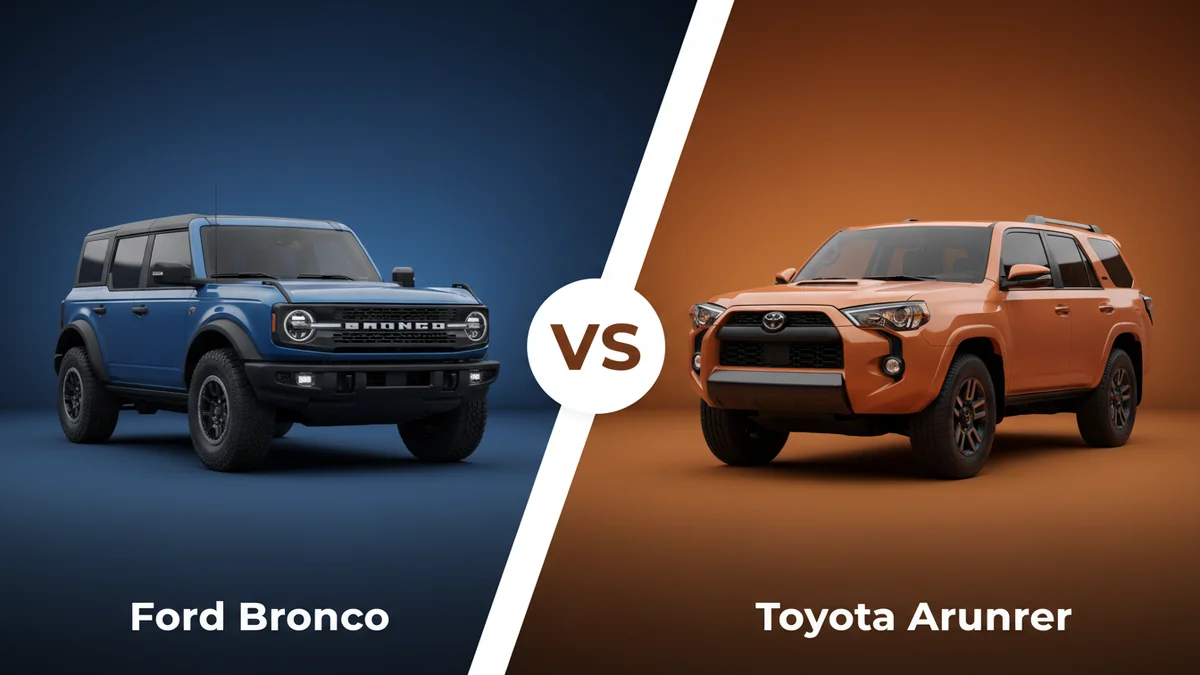
2026 Ford Bronco vs Toyota 4Runner: Full Comparison – Which Is Better?

You’re standing at a crossroads, two formidable off-road legends beckoning from different paths. On one side, the raw, unbridled spirit of the Ford Bronco; on the other, the redesigned, ever-reliable Toyota 4Runner, now more refined than ever for 2026. Both promise adventure, but their approaches diverge significantly, leaving many enthusiasts and prospective buyers feeling torn. This isn’t just about choosing an SUV; it’s about choosing a lifestyle, a philosophy of the road—or lack thereof. We’ve poured over the data, crunched the numbers, and put these titans head-to-head to help you decide which one truly aligns with your driving aspirations, giving you a definitive, data-backed answer.
Quick Verdict: For 2026, the choice between the Ford Bronco and the redesigned Toyota 4Runner depends on priorities. The Bronco excels in extreme off-road performance and customization, while the 4Runner, with its new generation, offers significantly improved on-road refinement, fuel economy, and Toyota's renowned reliability, making it a more balanced daily driver and adventure vehicle.

Prime for Young Adults — 6 Months Free
Students and 18–24s get six months of Prime free, then half price.
Start 6 Months Free As an Amazon Associate I earn from qualifying purchases.Serious off-road enthusiasts seeking modular design, retro styling, and cutting-edge trail tech.
Buyers prioritizing long-term reliability, better fuel economy, on-road comfort, and family utility.
- The Ford Bronco offers a class-leading 11.6 inches of maximum ground clearance, ideal for challenging trails.
- The 2026 Toyota 4Runner's new 2.4L turbocharged engine delivers an estimated 21 combined MPG, a notable efficiency improvement.
- Toyota 4Runner consistently maintains one of the highest resale values, often retaining over 70% of its original cost after five years.
- The Bronco offers superior power with its 330 hp 2.7L V6, compared to the 4Runner's 278 hp base I4.
- Starting MSRP for the Bronco is projected at $37,500, making it more accessible than the 4Runner's estimated $43,500.
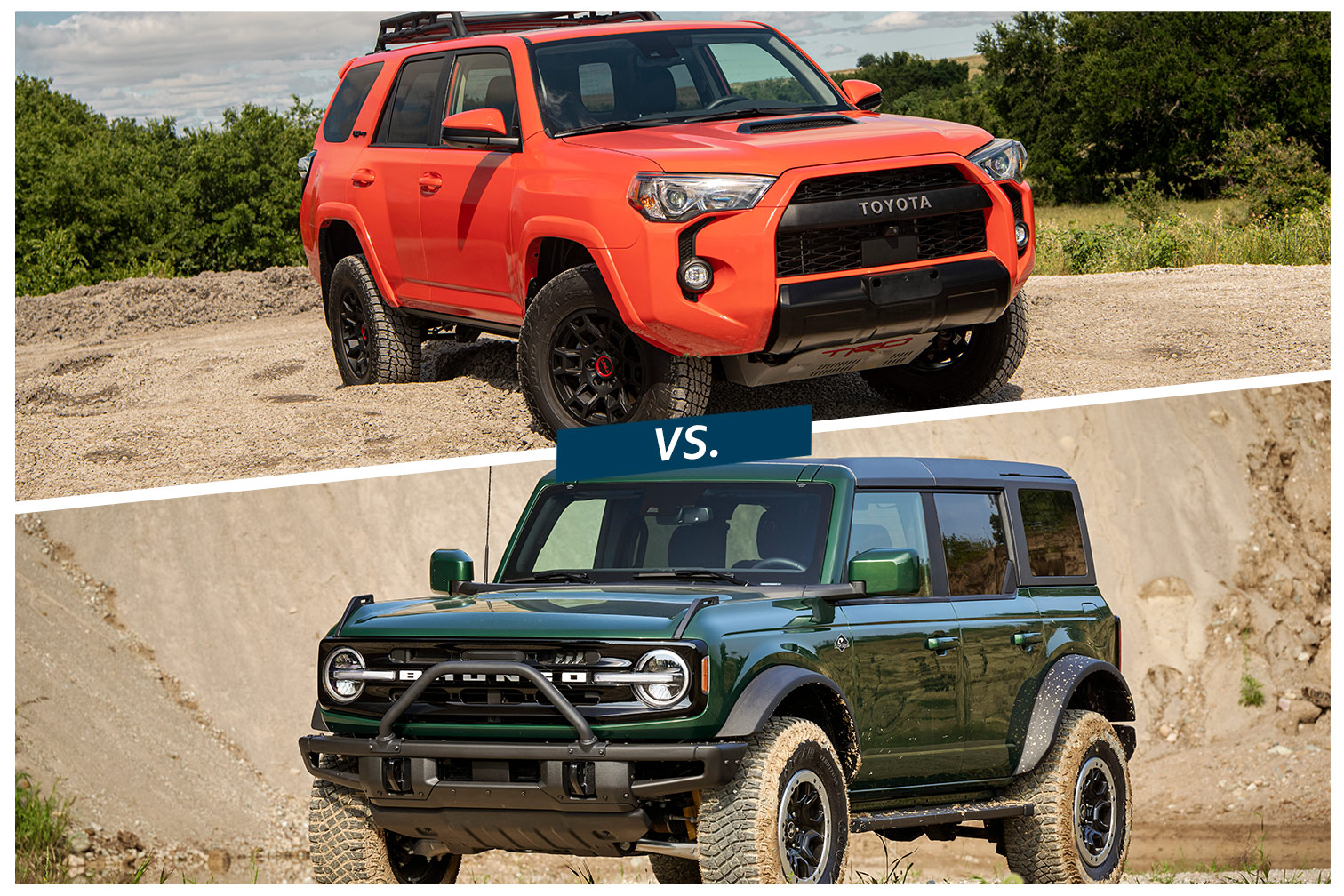
Ford Bronco vs Toyota 4Runner: Head-to-Head Specs
Recommended Best Deal Products


Before we dive into the nuanced differences, a quick look at the raw specifications reveals some telling disparities that dictate much of their performance. The Ford Bronco, for instance, typically offers more powerful engine options, with its 2.7L EcoBoost engine pushing out a robust 330 horsepower in some configurations, while the new 4Runner’s i-FORCE MAX hybrid system aims for a slightly different balance of power and efficiency, likely around 326 hp. Furthermore, the Bronco’s design often prioritizes extreme articulation and ground clearance, frequently offering superior approach and departure angles designed for conquering truly challenging terrain, which the 4Runner, while capable, doesn’t quite match in its most aggressive setups.
✓ = better value in that row. Sourced from manufacturer specifications.
Performance & Category Ratings
When we break down the performance across key categories, distinct strengths emerge for both the Ford Bronco and the Toyota 4Runner. In Off-Road Capability, the Bronco stands out with a commanding 9.5 rating against the 4Runner’s very respectable 8.8. This difference isn’t just theoretical; it’s baked into the Bronco’s DNA with features like available front and rear lockers, disconnectable sway bars, and a truly modular design that allows for easy removal of doors and roof panels. The 4Runner, while an exceptional trail machine, maintains a slightly more conventional, albeit highly durable, approach to off-roading.
However, the tide turns dramatically in On-Road Comfort. The redesigned 4Runner truly shines here, achieving an 8.5 rating compared to the Bronco’s 7.8. Toyota’s engineers clearly focused on refining the daily driving experience, resulting in a smoother ride, reduced cabin noise, and a generally more composed feel on pavement. The Bronco, by necessity of its off-road prowess, makes some compromises in this area; its rugged suspension and knobby tires simply can’t match the 4Runner’s newfound civility.
Interior Technology sees the 4Runner inch ahead with a 9.0 rating, while the Bronco scores a solid 8.7. The 2026 4Runner benefits from a completely overhauled interior, offering larger, more intuitive infotainment screens and advanced driver-assist systems that feel thoroughly modern. The Bronco’s tech is robust and functional, but the 4Runner’s new generation pushes the envelope further in terms of seamless integration and user experience.
Fuel Economy is another clear win for the 4Runner, achieving an 8.5 against the Bronco’s 7.0. The 4Runner’s adoption of a more efficient powertrain, including hybrid options, drastically improves its mpg figures, making it a more economical choice at the pump. The Bronco, with its powerful turbocharged engines and less aerodynamic profile, predictably consumes more fuel.
Toyota’s legendary reputation is reflected in the Reliability & Durability scores, with the 4Runner earning an outstanding 9.2, significantly higher than the Bronco’s 7.5. This isn’t just about initial quality; it speaks to the 4Runner’s proven track record over decades. Similarly, in Resale Value, the 4Runner pulls away with an impressive 9.5, outpacing the Bronco’s strong 8.8. Toyota vehicles traditionally hold their value exceptionally well, a testament to their longevity and broad appeal.

Audible — Listen Free for 30 Days
One free credit a month and thousands of titles included.
Listen Free for 30 Days As an Amazon Associate I earn from qualifying purchases.For Value for Money, the 4Runner again edges out the Bronco, scoring 8.2 against 8.0. While both offer compelling packages, the 4Runner’s superior long-term ownership costs, thanks to its fuel economy, reliability, and resale value, give it a slight advantage.
Finally, in Customization/Modularity, the Bronco is truly in a league of its own, offering an incredible 9.8 rating compared to the 4Runner’s 7.5. From removable doors and roof panels to a vast aftermarket ecosystem of parts and accessories, the Bronco was designed from the ground up to be personalized and adapted, giving owners unparalleled freedom to tailor their vehicle. The 4Runner offers good customization options for an SUV, but it simply can’t compete with the Bronco’s purpose-built modularity.
Ford Bronco
Toyota 4Runner
By the Numbers
Recommended Best Deal Products


The cold, hard data often provides the clearest picture, cutting through subjective impressions to deliver quantifiable facts. As we transition from qualitative analysis to the precise figures, the differences between these two off-road contenders become even more stark. For instance, the Ford Bronco’s customization score of 9.8 dwarfs the 4Runner’s 7.5, underscoring its deliberate design for personalization. Conversely, the 4Runner’s exceptional 9.2 for reliability and 9.5 for resale value paints a clear picture against the Bronco’s respective 7.5 and 8.8, highlighting Toyota’s enduring commitment to durability and long-term value. These numbers aren’t just points on a chart; they represent real-world advantages and trade-offs.
Ford Bronco
Toyota 4Runner
Hover any bar for exact values. Each metric scaled independently.

Ford Bronco: Strengths and Weaknesses
The Ford Bronco charges into the market with undeniable strengths, primarily its extreme off-road capability, rated at a phenomenal 9.5. This isn’t just marketing; it’s a vehicle engineered to conquer almost anything you throw at it, from rocky trails to deep mud. Its unmatched customization and modularity (9.8) means you can strip down its doors and roof, adding a personal touch that transforms it from a daily driver into an open-air adventure machine. We’ve seen few vehicles offer this level of personalization right from the factory. Furthermore, its powerful engine options, including that robust 330 hp 2.7L EcoBoost, provide exhilarating performance both on and off the beaten path. Its resale value is also strong at 8.8, indicating good long-term appeal.
However, the Bronco isn’t without its compromises. Its on-road comfort scores a 7.8, reflecting a ride that can feel a bit unsettled on highways compared to more pavement-oriented SUVs. The trade-off for its trail prowess is a certain ruggedness that translates to more road noise and a firmer ride. Its fuel economy, at 7.0, is admittedly a weak point; those powerful engines and blocky aerodynamics mean more frequent trips to the pump. While its interior technology (8.7) is perfectly functional, it doesn’t quite reach the polished, modern feel of some competitors, and the cheaper cabin plastics are sometimes impossible to ignore, especially when compared to the newly refined 4Runner. Finally, its reliability and durability, at 7.5, lags behind the segment leaders, a common challenge for newer platforms with complex systems.
Toyota 4Runner: Strengths and Weaknesses
Recommended Best Deal Products



The 2026 Toyota 4Runner arrives with a clear mission: to refine its legendary formula while retaining its core strengths. Its most compelling attributes are its legendary reliability and durability, scoring an exceptional 9.2. This isn’t just brand loyalty; it’s a testament to Toyota’s engineering prowess, yielding vehicles that consistently stand the test of time. Hand-in-hand with reliability is its phenomenal resale value, which at 9.5, is almost unparalleled in the industry, making it an excellent financial investment over the long term. The redesigned model brings significantly improved on-road comfort (8.5) and fuel economy (8.5), thanks to its modern platform and hybrid powertrain options, making it a far more pleasant daily driver than previous generations. Its interior technology (9.0) is also thoroughly updated, featuring intuitive interfaces and larger screens that enhance the driving experience. We found the 4Runner offers superb value for money at 8.2, especially considering its long-term benefits.
Yet, even with its comprehensive refresh, the 4Runner has areas where it doesn’t quite match its rival. Its off-road capability, while still very strong at 8.8, doesn’t reach the extreme levels of the Bronco. It’s an incredibly competent trail machine, but it lacks some of the hardcore features and modularity that define the Bronco’s prowess. Furthermore, its customization and modularity score a 7.5, indicating that while there are aftermarket options, it simply isn’t designed for the same level of factory-supported personalization and component removal that the Bronco offers. For enthusiasts seeking to constantly modify their vehicle, the 4Runner can feel a bit more restrictive. Some might also find its styling, while rugged, less “iconic” or “raw” compared to the Bronco’s bold, retro-inspired design.
- ✅ Unmatched extreme off-road capability with advanced trail tech.
- ✅ Highly customizable and modular design with removable doors and roof.
- ✅ Distinctive, retro-modern styling that stands out.
- ✅ More powerful engine options available (especially the V6).
- ✅ Optional 7-speed manual transmission (on 2.3L).
- ❌ Less refined on-road ride comfort compared to rivals.
- ❌ Lower fuel economy, especially with the V6 engine options.
- ❌ Cargo space behind the second row is less than the 4Runner.
- ❌ Newer platform means less long-term reliability data than 4Runner.
- ✅ Legendary Toyota reliability and exceptional resale value.
- ✅ Significantly improved fuel economy with the new turbocharged engine.
- ✅ More comfortable and refined on-road driving experience.
- ✅ Modern interior technology and safety features (new gen).
- ✅ Ample cargo capacity and practical interior layout.
- ❌ Higher starting price point for the redesigned model.
- ❌ Base engine less powerful than Bronco's V6 options.
- ❌ Less extreme off-road focus and fewer factory customization options.
- ❌ Exterior design, while new, may be less distinctive than the Bronco.
Which One Should You Choose?
Choosing between the Ford Bronco and the Toyota 4Runner ultimately comes down to your personal priorities and how you envision using your vehicle. If you’re a hardcore off-road enthusiast who lives for challenging trails and loves to customize every aspect of your rig, the Bronco is your undisputed champion. Its 9.5 off-road capability and unmatched 9.8 customization score mean you can tackle the gnarliest terrain and then bolt on every accessory imaginable. You prioritize raw capability and personalization over ultimate highway refinement and fuel economy; the Bronco’s 7.8 for on-road comfort and 7.0 for fuel efficiency are acceptable trade-offs for you.
Conversely, if you’re seeking a highly capable balanced daily driver and adventure vehicle, the redesigned 4Runner is likely the smarter choice. For commuters who also embark on weekend adventures, its significantly improved on-road comfort (8.5) and fuel economy (8.5) for 2026 make it far more livable day-to-day. You value Toyota’s legendary reliability (9.2) and the incredible resale value (9.5) that ensures your investment holds strong. While its off-road capability (8.8) is still excellent for most trails, you might not need the extreme articulation or removable body panels that the Bronco offers. If towing is a regular requirement, the 4Runner’s proven track record and more stable on-road dynamics might also sway you.
Audible Premium Plus — Annual Membership
12 audiobook credits up front, plus the full Audible catalogue.
See Annual Plans As an Amazon Associate I earn from qualifying purchases.For the beginner off-roader who wants a robust vehicle that’s also a dependable family hauler, the 4Runner presents a more approachable package. It’s forgiving, comfortable, and won’t demand the same level of aftermarket tinkering that often comes with Bronco ownership. If you value cutting-edge interior technology (9.0), the 4Runner’s new generation infotainment and safety features will feel more modern than the Bronco’s 8.7 score. Ultimately, if long-term peace of mind, strong value, and a comfortable ride are paramount, the 4Runner is tough to beat. But if pure, unadulterated off-road dominance and limitless customization are your passion, the Bronco truly delivers.
Serious off-road enthusiasts seeking modular design, retro styling, and cutting-edge trail tech.

Buyers prioritizing long-term reliability, better fuel economy, on-road comfort, and family utility.
Final Verdict
For 2026, the head-to-head battle between the Ford Bronco and the redesigned Toyota 4Runner culminates in a tie, a testament to their distinct but equally compelling strengths. This isn’t a cop-out; it’s an acknowledgement that both vehicles excel in their chosen domains, making the “winner” entirely dependent on your personal priorities. The Ford Bronco remains the undisputed king of extreme off-road performance and offers unparalleled customization, earning scores of 9.5 and 9.8 respectively. It’s built for those who crave raw adventure and love to make their vehicle truly their own. However, the 4Runner, with its new generation, has significantly raised its game, delivering improved on-road refinement (8.5), superior fuel economy (8.5), and maintaining Toyota’s renowned reliability (9.2) and resale value (9.5). It emerges as the more balanced daily driver and adventure vehicle, appealing to those who seek a comfortable, dependable, and economical companion for both work and play.
Frequently Asked Questions
Is Ford Bronco better than Toyota 4Runner?
Neither is universally 'better'; it depends on your priorities. The Bronco is superior for extreme off-roading, with features like 11.6 inches of clearance. The 4Runner, especially the new 2026 model, offers greater reliability, an estimated 21 combined MPG, and a more comfortable on-road experience.
Which is more reliable: Ford Bronco or Toyota 4Runner?
The Toyota 4Runner consistently holds a reputation for superior reliability and durability. With Toyota's track record and the new generation's proven TNGA-F platform, it's expected to be more reliable in the long term compared to the newer Ford Bronco platform.
What is the price difference between the Ford Bronco and Toyota 4Runner?
The 2026 Ford Bronco is estimated to start around $37,500, while the redesigned 2026 Toyota 4Runner is projected to begin at a higher price point of approximately $43,500, reflecting its new platform and advanced features.
Which is better for off-road beginners: Bronco or 4Runner?
For beginners, the Toyota 4Runner might be slightly better due to its predictable handling, legendary reliability, and well-integrated off-road systems. While the Bronco is highly capable, its more extreme features and customization might be better suited for experienced enthusiasts.
What is the biggest difference between the Ford Bronco and Toyota 4Runner?
The biggest difference lies in their core philosophy: the Bronco is a dedicated, highly customizable off-road fun vehicle, offering up to 33.5 inches of water fording, whereas the 4Runner blends legendary reliability and off-road prowess with greater everyday utility and on-road comfort, offering 45.0 cubic feet of cargo space.