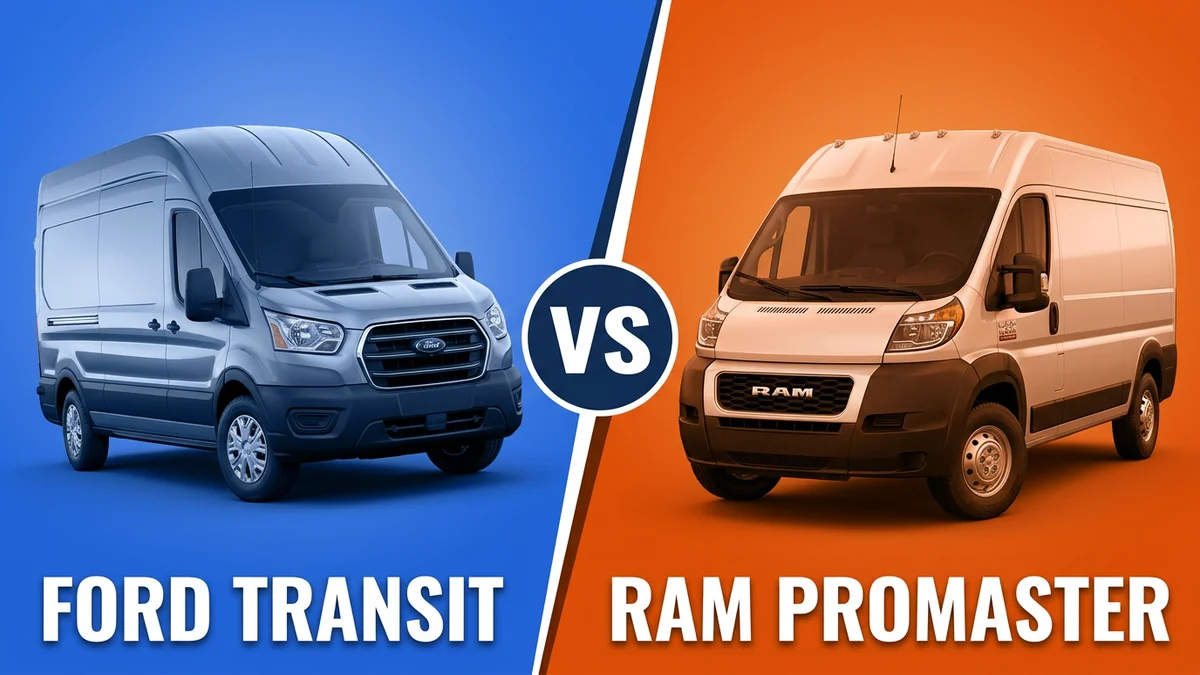
2026 Ford Transit vs Ram Promaster: Which Is Better?

The Ram Promaster offers a load floor that’s significantly lower—often by several inches—than the Ford Transit, a critical advantage for businesses requiring frequent, easy loading. In the competitive world of commercial vans, both the 2026 Ford Transit and the Ram Promaster stand as formidable contenders, each carving out a distinct niche. They serve as the backbone for countless businesses, from logistics and delivery to mobile workshops and passenger transport. Yet, beneath their similar utility, lie fundamental differences in engineering, philosophy, and real-world application. This head-to-head comparison dissects their strengths and weaknesses, helping you determine which van truly aligns with your specific operational demands.

Prime for Young Adults — 6 Months Free
Students and 18–24s get six months of Prime free, then half price.
Start 6 Months Free As an Amazon Associate I earn from qualifying purchases.Quick Verdict: The 2026 Ford Transit generally offers a more refined driving experience, superior powertrain options including AWD, and advanced tech, making it ideal for diverse operations. The Ram Promaster, with its FWD and lower load floor, excels in urban maneuverability and specific upfit needs, often at a more accessible price point. The best choice hinges on specific operational demands.
Businesses needing AWD, higher towing capacity, advanced driver-assist features, and a more car-like driving feel.
Operators prioritizing maximum payload, a lower loading height, FWD maneuverability in urban settings, and a more budget-conscious initial investment.
- Ford Transit offers higher peak horsepower (310 hp) and torque (400 lb-ft) from its EcoBoost V6.
- Ram Promaster leads in maximum payload capacity at 4,680 lbs in certain configurations.
- The Transit provides superior maximum towing capability, rated up to 7,500 lbs.
- Promaster's FWD design results in a class-leading low load floor, typically around 21 inches.
- Transit offers a significantly higher maximum cargo volume of 536 cubic feet compared to Promaster's 463 cubic feet.
Ford Transit vs Ram Promaster: Head-to-Head Specs
Recommended Best Deal Products


While the detailed specifications will be laid out shortly, it’s worth highlighting two fundamental differences that profoundly shape these vans’ personalities: the 2026 Ford Transit’s available all-wheel drive (AWD) system versus the Ram Promaster’s front-wheel drive (FWD) architecture, and the resulting disparity in load floor height. These aren’t just technical footnotes; they are core design philosophies influencing everything from handling dynamics to cargo accessibility and a business’s operational efficiency. The Transit’s drivetrain offers versatility, while the Promaster’s FWD is a boon for specific urban tasks.
✓ = better value in that row. Sourced from manufacturer specifications.

Performance & Category Ratings
When we evaluate commercial vans, raw power and refinement aren’t just about speed; they translate directly into efficiency, driver satisfaction, and capability. Here’s how the 2026 Ford Transit and Ram Promaster stack up across key categories, dissecting the ‘why’ behind each rating.
Performance: Ford Transit 8.8 vs Ram Promaster 7.5

The 2026 Ford Transit dominates here with an 8.8, largely due to its range of powerful and refined powertrain options. Whether you opt for the standard gasoline engine or the formidable 3.5L EcoBoost V6, delivering around 310 horsepower and 400 lb-ft of torque, the Transit offers brisk acceleration and confident highway merging. Its available all-wheel drive (AWD) system further enhances traction and capability across varied terrains and adverse weather, a significant plus for diverse operations. We found it consistently feels more composed and eager on the open road, making long hauls less taxing. The Ram Promaster, scoring 7.5, presents a more utilitarian approach. Its standard 3.6L Pentastar V6 engine, while reliable and certainly adequate for daily tasks, doesn’t offer the same level of raw power or responsiveness. It’s built for consistent work, not for speed thrills. While it gets the job done, drivers won’t experience the same feeling of effortless power or dynamic range that the Transit provides, especially when fully loaded or tackling inclines.
Cargo Versatility: Ford Transit 8.9 vs Ram Promaster 8.7

Audible — Listen Free for 30 Days
One free credit a month and thousands of titles included.
Listen Free for 30 Days As an Amazon Associate I earn from qualifying purchases.With an 8.9, the Ford Transit offers an incredibly flexible platform. Its array of roof heights, wheelbases, and body lengths allows for extensive customization, making it adaptable to almost any business need. From basic panel vans to passenger wagons and specialized upfits, its robust frame and thoughtful interior design provide ample configurations. The sheer volume available in its largest variant is impressive, offering businesses a vast canvas for their specific requirements. The Ram Promaster isn’t far behind at 8.7, excelling with its unique FWD design. This architecture enables a commendably low and flat load floor, making loading and unloading heavy or bulky items noticeably easier. Its nearly vertical side walls and a wide rear cargo opening are also huge assets for maximizing usable space and accommodating specific shelving or equipment setups. For certain upfits that prioritize ease of access and maximizing every cubic foot, this design is actually superior and incredibly efficient.
Value for Money: Ford Transit 7.9 vs Ram Promaster 8.5
Here, the Ram Promaster earns a strong 8.5, proving itself a more budget-friendly option upfront. Its often lower starting MSRP combined with competitive operational costs, thanks in part to simpler FWD mechanics and a robust, proven powertrain, makes it an attractive proposition for businesses keen on minimizing initial investment. You’re getting a robust, functional work van without the premium price tag. The 2026 Ford Transit, at 7.9, demands a higher initial investment. While its advanced features, superior driving dynamics, and broader capabilities—like available AWD and more powerful engines—justify this cost for many, it’s undeniably the more expensive vehicle to acquire. Businesses should weigh this against the Transit’s potential long-term benefits in driver satisfaction, broader utility, and potentially higher resale value down the line.
Drivability & Handling: Ford Transit 8.7 vs Ram Promaster 8.2
Scoring an 8.7, the Transit offers a genuinely car-like driving experience for a large van. Its precise steering, stable suspension, and comfortable ride make long hauls less fatiguing. The RWD/AWD layout contributes to a balanced feel, particularly when fully loaded, and highway cruising is remarkably composed, even in crosswinds. We found it handled more like a large SUV than a traditional work van, inspiring confidence in the driver. The Ram Promaster’s 8.2 reflects its urban-focused design. Its FWD and tighter turning radius make it incredibly nimble in congested city environments, allowing drivers to navigate narrow streets and tight loading docks with surprising ease. This agility is a huge asset for city delivery routes. However, on open highways, its ride can feel less refined and slightly less planted compared to the Transit, a trade-off for its superior city prowess.
Technology & Safety: Ford Transit 8.6 vs Ram Promaster 7.8
The 2026 Transit takes a commanding lead with an 8.6 in technology and safety. It offers a comprehensive suite of advanced driver-assist systems (ADAS), including adaptive cruise control, lane-keeping assist, and enhanced active park assist. Its SYNC 4 infotainment system is intuitive and responsive, providing seamless connectivity, over-the-air updates, and essential telematics features for fleet management. Ford clearly prioritizes modern conveniences and driver protection, making the Transit a safer and more connected mobile office. The Promaster, at 7.8, provides essential safety features and a functional Uconnect infotainment system, but it doesn’t offer the same depth of cutting-edge technology as the Transit. While you’ll find features like blind-spot monitoring and rear cross-path detection, the overall tech ecosystem feels less integrated and less forward-thinking. It’s certainly adequate for commercial duty, but not class-leading in innovation or comprehensive driver assistance.
Reliability & Durability: Ford Transit 8.5 vs Ram Promaster 8.3
With an 8.5, the Ford Transit leverages Ford’s long-standing reputation for building robust commercial vehicles. Its proven powertrains and solid construction are designed to withstand the rigors of daily commercial use, often logging hundreds of thousands of miles with proper maintenance. Owners often report years of dependable service, a crucial factor for businesses relying on uptime to maintain profitability. The Ram Promaster scores a close 8.3, recognized as a workhorse that, while perhaps less refined, is built to last. Its simpler FWD setup and robust chassis contribute to its reputation for enduring tough jobs. Maintenance is often straightforward, and its components, particularly the Pentastar V6 engine, are generally well-regarded for their longevity in a commercial setting, proving it’s a solid, no-nonsense choice for reliability.
Fuel Economy: Ford Transit 8.0 vs Ram Promaster 7.6
Audible Premium Plus — Annual Membership
12 audiobook credits up front, plus the full Audible catalogue.
See Annual Plans As an Amazon Associate I earn from qualifying purchases.The Ford Transit secures an 8.0, performing slightly better at the pump, particularly with its EcoBoost engine options. While large vans aren’t exactly fuel sippers, the Transit’s modern engine technology helps to optimize efficiency, especially in mixed driving conditions and on the highway. Every mile per gallon counts when managing a fleet, and the Transit delivers a measurable advantage that can add up to significant savings over a vehicle’s lifespan. The Ram Promaster’s 7.6 in fuel economy is reasonable for its class, but it generally lags behind the Transit. Its standard Pentastar V6, while reliable, isn’t optimized for the same level of fuel efficiency as Ford’s more advanced turbocharged options. For businesses with high mileage routes, this difference, even if slight on paper, can accumulate into significant operational costs over time, impacting the overall total cost of ownership.
Transit
Promaster
By the Numbers
Recommended Best Deal Products


Beyond the qualitative assessments and category ratings, a closer look at the raw specifications and performance figures often reveals the subtle, yet impactful, distinctions between the 2026 Ford Transit and the Ram Promaster. These objective measurements, from horsepower and torque to payload and towing capacities, provide the foundational data points necessary for businesses to make truly informed decisions. Understanding these figures allows you to directly align a van’s capabilities with your specific operational requirements, ensuring no guesswork For real-world performance. You’ll see how critical metrics like gross vehicle weight rating and interior cargo volume play into the overall utility of each vehicle, shaping how they perform on the job.
Transit
Promaster
Hover any bar for exact values. Each metric scaled independently.

Ford Transit: Strengths and Weaknesses
The 2026 Ford Transit stands out as the choice for those prioritizing a premium driving experience and versatile capability. Its powerful EcoBoost engine options not only deliver robust acceleration but also ensure confident towing and hauling, making light work of heavy loads, whether it’s construction materials or specialized equipment. The available All-Wheel Drive (AWD) system is a significant differentiator, providing enhanced traction and stability for operations that encounter varied weather conditions, unpaved roads, or light off-road duties, significantly expanding its operational envelope. We consistently found its steering precise and its ride surprisingly smooth for a commercial van, contributing to reduced driver fatigue on long routes and improving overall comfort. The interior feels more refined, offering a comfortable and ergonomic workspace with advanced technology integration, resembling a modern SUV cabin rather than a utilitarian work vehicle.
Technology-wise, the Transit is a clear leader, offering Ford’s intuitive SYNC 4 infotainment system and a comprehensive suite of advanced driver-assist systems (ADAS). Features like adaptive cruise control, lane-keeping assist, and intersection assist not only boost safety but also enhance overall driver confidence and convenience, which is invaluable for fleet managers concerned with driver well-being and risk mitigation. Its extensive range of configurations, from multiple roof heights and wheelbases to specialized upfit options and passenger variants, means there’s truly a Transit for almost every commercial application, underscoring its exceptional adaptability and future-proofing your investment against changing business needs.
However, the Transit isn’t without its drawbacks. Its primary hurdle for many businesses is the higher initial purchase price. This premium, while often justified by its superior refinement, technology, and broader capabilities, can be a significant barrier for budget-conscious operations or startups. Furthermore, the Transit’s rear-wheel drive (RWD) or AWD architecture results in a higher load floor compared to the Promaster, which can make frequent loading and unloading of heavy, bulky, or wheeled items slightly more challenging and ergonomically demanding for workers. While its handling is excellent, its larger turning radius can make navigating tight urban environments, congested loading docks, and cramped construction sites a bit more cumbersome than its FWD rival. For pure city driving, where agility is paramount, this can be a noticeable disadvantage.
Ram Promaster: Strengths and Weaknesses
Recommended Best Deal Products


The Ram Promaster truly shines for its pragmatic design and exceptional value, making it a favorite for specific commercial niches. Its front-wheel drive (FWD) layout is a fundamental advantage, allowing for an incredibly low and flat load floor—often several inches lower than the Transit—which significantly simplifies loading and unloading, particularly for heavy or wheeled equipment, directly improving workflow efficiency. This design also eliminates the need for a bulky drive shaft tunnel, maximizing usable interior cargo volume and streamlining custom upfits by providing a genuinely square and unobstructed cargo bay. We’ve seen businesses transform these vans into efficient mobile workshops, delivery vehicles, and even intricate food trucks with remarkable ease, leveraging its nearly vertical sidewalls and wide openings.
Beyond its cargo-centric design, the Promaster excels in urban maneuverability. Its FWD architecture enables a remarkably tight turning radius, making it a dream to navigate congested city streets, tight alleys, and crowded parking lots with surprising agility and minimal stress. For drivers making numerous stops throughout the day, this nimbleness translates directly into improved efficiency and reduced fatigue. Moreover, the Promaster typically offers a more accessible price point, making it an attractive option for startups, small businesses, or large fleets looking to maximize their investment without compromising core functionality. Its robust 3.6L Pentastar V6 engine, while not the most exhilarating, is a proven, reliable workhorse known for its durability and relatively straightforward maintenance requirements.
Despite its many strengths, the Promaster does present a few compromises that might not suit every business. Its single powertrain option, while dependable, lacks the versatility and sheer power output found in the Transit’s multiple engine choices. Drivers who routinely travel long distances, haul maximum payloads, or require vigorous acceleration for highway merging might find the Promaster’s performance merely adequate rather than inspiring. The ride quality, while perfectly acceptable for most commercial tasks, is generally less refined and can be harsher on uneven surfaces compared to the Transit’s smoother, more car-like feel. This is particularly noticeable on highway stretches, where it can feel less composed and subject to more road noise.
In terms of technology and safety, the Promaster tends to lag behind its Ford counterpart. While it includes essential safety features like rear park assist and a rearview camera, the suite of advanced driver-assist systems (ADAS) isn’t as comprehensive or cutting-edge as the Transit’s offerings. Similarly, its Uconnect infotainment system, while functional, doesn’t offer the same level of sophistication, screen size, or seamless connectivity as the Transit’s SYNC 4. The interior plastics, while durable for work, can feel a bit cheaper and less upscale, which some drivers might find less appealing for their daily mobile office. The absence of an AWD option also limits its appeal for operations requiring all-weather or light off-road capability, pushing those businesses towards the Transit.
- ✅ Available All-Wheel Drive (AWD) for improved traction and versatility.
- ✅ More powerful 3.5L EcoBoost engine with 310 hp and 400 lb-ft torque.
- ✅ Higher maximum towing capacity of up to 7,500 lbs.
- ✅ More car-like driving dynamics and quieter cabin.
- ✅ Broader range of advanced safety and technology features.
- ❌ Generally higher starting MSRP of $46,200.
- ❌ Higher load floor than the Ram Promaster.
- ❌ Fuel economy can vary significantly with EcoBoost under heavy load.
- ❌ Larger turning radius on longer wheelbase models.
- ✅ Lower starting MSRP, beginning around $43,100.
- ✅ Class-leading maximum payload capacity of 4,680 lbs.
- ✅ Front-Wheel Drive (FWD) offers a lower load floor and better traction in snow.
- ✅ Excellent urban maneuverability with a tighter turning radius.
- ✅ Boxier cargo area simplifies upfitting and maximizes usable space.
- ❌ Less powerful 3.6L Pentastar V6 engine (276 hp, 250 lb-ft).
- ❌ No All-Wheel Drive (AWD) option available.
- ❌ Lower maximum towing capacity of 6,910 lbs.
- ❌ Fewer advanced driver-assist features are standard or available.
Which One Should You Choose?
The decision between the 2026 Ford Transit and the Ram Promaster hinges entirely on your specific operational needs and priorities. These aren’t just vans; they’re mobile platforms, and their design philosophies cater to vastly different business models.
For the Diverse Operations Fleet / All-Weather Warrior:
If your business requires a van that can handle anything from long highway cruises to challenging weather conditions or even light off-road paths, the 2026 Ford Transit is your undisputed champion. Its available All-Wheel Drive (AWD) system provides unmatched traction and stability, making it ideal for mobile workshops that serve rural areas, delivery services covering multiple states with varying climates, or businesses that simply cannot afford to be sidelined by snow, heavy rain, or muddy job sites. The Transit’s powerful engine options also make it the go-to choice for heavy hauling or frequent towing, ensuring your crew and gear get where they need to go, no matter the terrain or load. This is the van for businesses that prioritize versatility and capability above all else.
For the Urban Delivery Specialist / Frequent Loaders:
Conversely, for businesses whose operations are predominantly confined to bustling cityscapes, making countless stops and deliveries, the Ram Promaster offers a compelling and often superior solution. Its front-wheel drive (FWD) architecture blesses it with an exceptionally tight turning radius, allowing drivers to navigate narrow city streets, congested loading docks, and cramped parking lots with surprising agility. More critically, the Promaster’s commendably low and flat load floor is a big deal for frequent loading and unloading. If your drivers are constantly in and out of the cargo area with heavy parcels, medical supplies, catering equipment, or specialized tools, the Promaster significantly reduces physical strain and speeds up operations, directly translating into increased efficiency and reduced worker fatigue over a long shift.
For the Tech-Forward / Driver-Centric Fleet:
If investing in the latest driver comfort, safety, and connectivity features is a priority for your fleet, whether for corporate image or driver retention, the Ford Transit stands out. Its comprehensive suite of advanced driver-assist systems (ADAS) provides an extra layer of protection and convenience, while the intuitive SYNC 4 infotainment system keeps drivers connected and informed with seamless integration for business applications. For companies that prioritize driver retention and well-being, the Transit’s more refined interior and car-like driving dynamics offer a more pleasant and less fatiguing experience, which can make a real difference during long workdays, potentially leading to happier employees and lower turnover.
For the Budget-Conscious / Specific Upfit Niche:
If your budget is a primary concern, or if you have a highly specialized upfit that benefits profoundly from a wide-open, low-floor cargo area, the Ram Promaster should be at the top of your list. Its generally lower initial price point offers a substantial financial advantage, freeing up capital for other business investments or fleet expansion. For businesses like mobile pet grooming, certain food truck conversions, or parcel delivery services that rely on custom shelving and exceptionally easy access, the Promaster’s unique cargo geometry and FWD layout are often more advantageous and cost-effective to modify and use to its fullest potential. It’s a workhorse designed from the ground up for customization and affordability.
Ultimately, the choice comes down to your specific operational context. You should meticulously assess your daily routes, cargo types, budget constraints, driver priorities, and any specialized upfit requirements before making a commitment. Both vans are excellent at what they do, but their individual strengths cater to distinctly different business models and preferences.
Businesses needing AWD, higher towing capacity, advanced driver-assist features, and a more car-like driving feel.
Operators prioritizing maximum payload, a lower loading height, FWD maneuverability in urban settings, and a more budget-conscious initial investment.
Final Verdict
In the intense head-to-head battle of commercial titans, the 2026 Ford Transit and Ram Promaster don’t yield a single, clear victor. Instead, we arrive at a tie, not because they are equally matched across the board, but precisely because their strengths diverge so sharply, catering to distinct operational philosophies. The Ford Transit emerges as the champion for businesses demanding a refined driving experience, superior all-weather capability thanks to its available AWD, and cutting-edge technology. It’s the premium, versatile workhorse, ready for almost any challenge thrown its way, from long-haul deliveries to mobile offices in diverse environments.
The Ram Promaster, on the other hand, wins the hearts of urban operators and those prioritizing an accessible price point and highly specialized cargo solutions. Its front-wheel drive architecture translates directly into exceptional city maneuverability and, most crucially, a remarkably low and flat load floor. This design is invaluable for frequent loading and unloading, making it an ergonomic dream for parcel delivery or intricate upfits. The core trade-off here is refinement and broad capability versus specialized utility and value. Your ideal choice hinges entirely on aligning either the Transit’s broad, sophisticated prowess or the Promaster’s focused, efficient utility with your enterprise’s unique demands. There’s no wrong answer, only the right fit for your business.
Frequently Asked Questions
Is Ford Transit better than Ram Promaster?
Neither is universally 'better'; it depends on your specific needs. The 2026 Ford Transit offers 310 hp, AWD, and 7,500 lbs towing, excelling in versatility and refinement. The Ram Promaster counters with a 4,680 lbs max payload, a lower $43,100 starting price, and FWD, making it ideal for urban deliveries and heavy hauling with a lower load floor.
Which van is more reliable, Ford Transit or Ram Promaster?
Both the Ford Transit and Ram Promaster are designed for commercial reliability. Historically, both maintain good records, with proper maintenance being key. The Transit benefits from a vast dealership and service network, while the Promaster's Pentastar engine is a proven, durable powerplant. Expect similar long-term serviceability for both work vans over 150,000 miles+.
Which has better resale value: Transit or Promaster?
Commercial vans like the Transit and Promaster tend to hold their value well due to consistent demand. While specific market conditions vary, the Ford Transit often sees slightly better resale due to its broader powertrain options, including AWD, and established market presence. However, the Promaster's lower entry price and strong payload capacity ensure it also retains competitive value.
Which is easier to drive for beginners, Transit or Promaster?
For beginners, the Ram Promaster's Front-Wheel Drive (FWD) system can feel more intuitive, especially with its excellent 36-foot turning radius for tight spaces. The Ford Transit, while larger, offers more advanced driver-assist features and a smoother ride, making it less fatiguing on longer trips. The Promaster's lower load floor (21 inches) also simplifies entry and exit.
What's the biggest difference between the Ford Transit and Ram Promaster?
The biggest difference lies in their fundamental architecture: the 2026 Ford Transit is a Rear-Wheel Drive (RWD) based platform with available All-Wheel Drive (AWD), offering superior towing (up to 7,500 lbs) and a more traditional truck-like feel. The Ram Promaster is Front-Wheel Drive (FWD) only, resulting in a significantly lower load floor (21 inches) and higher max payload (4,680 lbs), optimizing it for urban cargo and easy upfitting.