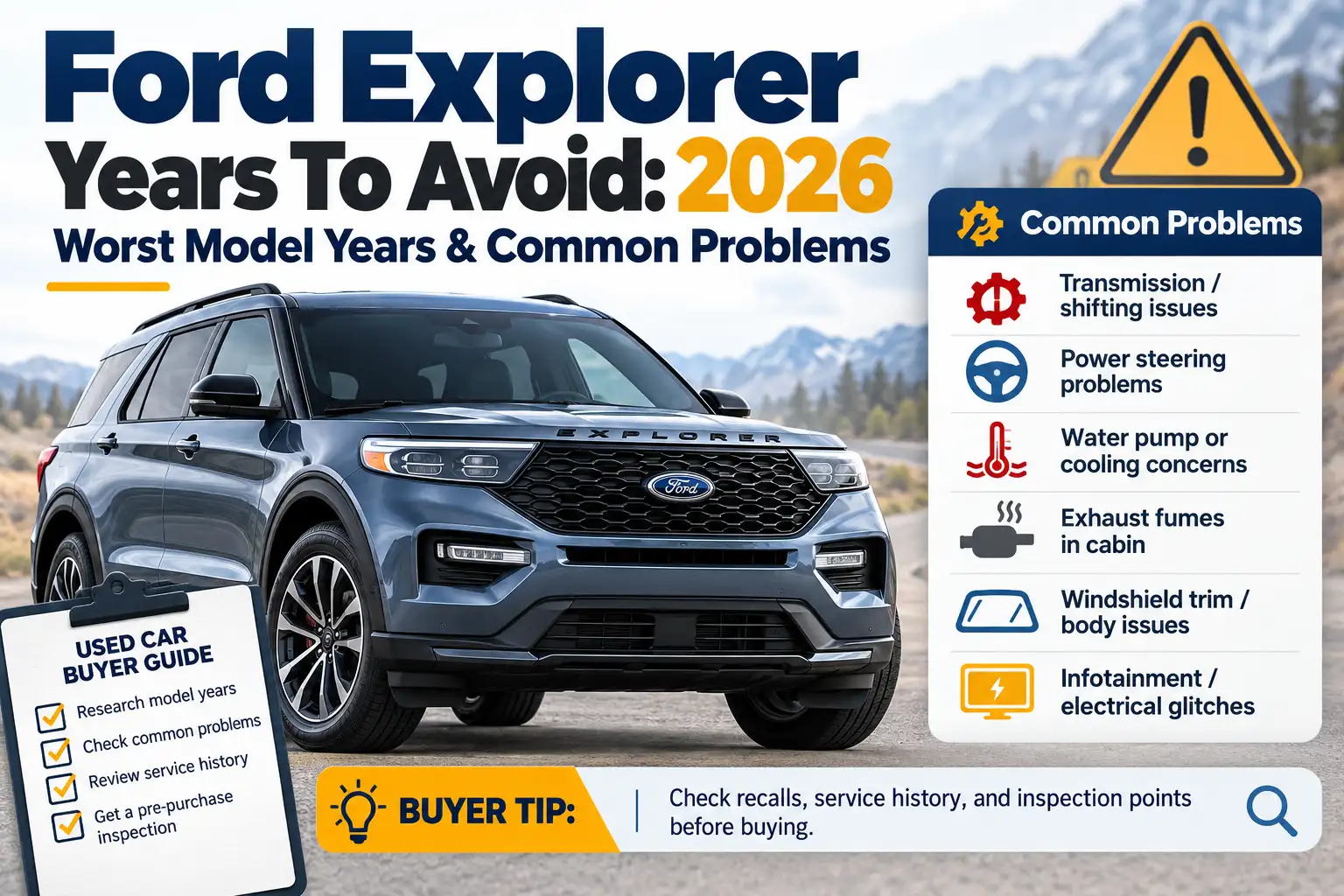
Ford Explorer Years To Avoid: 2026 Worst Model Years & Common Problems

The Ford Explorer years to avoid most cautiously are 2002–2005, because of their transmission-failure history, and 2020, because of early redesigned-model powertrain concerns. 2006 and many 2013–2017 Explorers also deserve extra scrutiny. Not every example from those years will fail.
Engine configuration, recalls, service records, and inspection findings should shape the final purchase decision.

FordMasterX / Used SUV buying guide
Ford Explorer Year-by-Year Buyer Screen
Start with the year, then check the actual vehicle. A model-year reputation is a filter, not a prediction of failure.
| Model years | Initial screen | What to verify | Buyer action |
|---|---|---|---|
|
2002–2005
Older generation
|
Usually skip | Transmission shifting, repair invoices, diagnosis | Avoid if history is unclear |
2006 |
High scrutiny | Cold/warm shifts, drivetrain, rust and wear | Consider only after inspection |
2009–2010 |
Older shortlist | Age-related wear, rust, service records | Shortlist if mechanically sound |
2013–2017 |
High scrutiny | Steering, toe-link recalls, V6 pump where fitted | Verify engine and inspect |
2018–2019 |
VIN-dependent | 2026 toe-link recall 26S08, completed remedy | Verify recalls before delivery |
|
2020
First redesign year
|
High scrutiny | Harsh shifts, rear axle and park recalls if applicable | Investigate unresolved symptoms |
2021–2022 |
VIN-dependent | Applicable axle recall, transmission operation | Consider after verified repairs |
2023 |
Newer shortlist | Service history, recalls, independent inspection | Shortlist if checks are clean |
This is a qualitative buying screen, not a failure-rate score. Check recalls by VIN and request a qualified pre-purchase inspection. Scroll the table sideways on small screens.
Which Ford Explorer Years Should You Avoid First


| Model years | Initial buying verdict | Main reason to investigate |
|---|---|---|
| 2002–2005 | Generally avoid unless exceptionally well documented | Expensive automatic transmission complaints |
| 2006 | High scrutiny | Transmission behavior and aging drivetrain components |
| 2011–2012 | Inspect carefully | Steering complaints and engine-specific maintenance risks |
| 2013–2017 | High scrutiny | Steering or suspension concerns, recalls, certain V6 water pumps |
| 2018–2019 | Conditional alternatives | Generally improved complaint picture, but a major 2026 suspension recall |
| 2020 | High scrutiny | First-year redesign, shifting complaints, rear-axle and park-system recalls |
| 2021–2022 | VIN and inspection dependent | Recall history and possible transmission concerns |
| 2023 | Promising newer candidate | Less long-term evidence; inspect and check recalls |
| 2024–2026 | Too new for a firm long-term ranking | Limited aging history, not proof of superior durability |
This is a buyer-screening guide, not a measured failure-rate ranking. Complaint totals reflect age, sales volume, and reporting patterns.
What 4 Factors Determine a Used Explorer Verdict
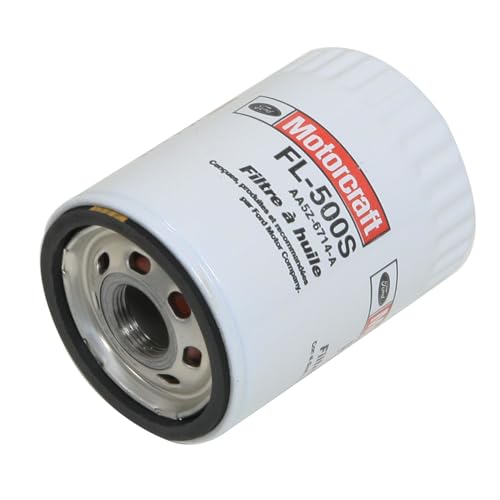


Model Year and Generation
The 2002–2005 Explorer belongs to the third generation, while the 2006–2010 generation brought revisions to its body-on-frame design. The 2011–2019 Explorer changed to a unibody crossover layout; the 2020 redesign returned to a rear-wheel-drive-based platform.
Their engines, transmissions, and suspension designs differ, so model-year advice needs mechanical context.
Engine and Drivetrain
A 2016 Explorer with the naturally aspirated 3.5L V6 has different cooling-system considerations from one with a four-cylinder EcoBoost. A 2020 Explorer has a different powertrain arrangement again.
Check our Ford Explorer engine options chart, then confirm the exact equipment using the VIN and factory records.
Mileage and Service History
Demand dated repair invoices rather than accepting a seller’s claim that the SUV has ‘never had problems.’
Mileage is not maintenance history; a well-documented higher-mileage SUV can be the stronger purchase.
Recalls and Current Condition
Recalls are VIN-specific. Check applicability and confirm completed repairs.
An older recall repair does not prove a later campaign is complete.
When to Reject an Explorer Before Buying


Do not let a desirable trim or low asking price override major warning signs. Use these conditional rules before making an offer:
- If the transmission slips, bangs into gear, or hesitates repeatedly, request a qualified diagnosis before considering the SUV. Walk away when the seller will not allow one.
- If coolant is disappearing or the engine overheats, stop the test and determine the cause. Do not accept ‘it just needs coolant’ as an explanation.
- If steering feels loose, a rear wheel looks misaligned, or the rear suspension makes alarming clunks, do not drive further until a professional checks the suspension.
- If an applicable safety recall remains open, establish the required remedy and confirm how it will be completed before delivery.
These symptoms require diagnosis, not guesswork.
When to Avoid a 2002 to 2006 Explorer
Transmission Failure Is the Main Concern
The 2002–2005 Explorer has one of the model’s clearest histories of expensive owner-reported transmission trouble. For the 2002 Explorer transmission-failure complaint, CarComplaints lists 441 reports, an average reported mileage of 94,800, and a typical reported repair cost of $2,840. Those figures describe reports of that problem, not every 2002 Explorer on the road. See the 2002 Explorer transmission-failure records.
Watch for slipping, delayed Drive or Reverse engagement, harsh shifts, or symptoms that worsen when warm. Do not assume a fluid change is the cure.
The 2002–2003 models also accumulated wheel-bearing complaints. Include wheel-end checks in the inspection.
When Is a 2006 Explorer Worth Considering
The 2006 Explorer started a new generation, but reported shifting complaints and its age still warrant caution.
Our buying rule: Skip a 2002–2005 Explorer with uncertain transmission history. Consider a 2006 only when it shifts correctly hot and cold, passes an independent inspection, and has convincing maintenance and repair records. A low price is not a substitute for those checks.
Which 2013 to 2017 Explorer Problems Matter Most
Steering and Rear Suspension
Steering and rear-suspension complaints matter in this generation, including problems involving the rear toe link, which controls rear-wheel alignment.
Ford’s 20S62 action covered certain 2013–2017 Explorers in specified corrosion-related circumstances. Ford described approximately 350,000 affected US vehicles and warned that a fractured toe link could reduce steering control. Its official 20S62 safety recall announcement explains the concern.
Other suspension actions also applied to certain vehicles, so check the VIN.
Internal Water Pump on Certain V6 Engines
The naturally aspirated 3.5L Ti-VCT V6 used in the 2011–2019 Explorer has a timing-chain-driven water pump inside the engine’s front cover. Replacement requires major disassembly; severe internal leakage can contaminate engine oil.
This warning does not automatically apply to every Explorer EcoBoost engine. Confirm the precise engine before discussing pump design or repair costs.
Check for coolant loss, overheating, contaminated oil, and pump repair records. A mechanic must diagnose the cause; these complaints are not one universal safety recall.
Exhaust Odor and Other Concerns
Owners have reported cabin exhaust odors, and Ford issued service guidance. A service bulletin is not a safety recall.
Persistent exhaust odor warrants professional inspection.
Our buying rule: Put 2013–2017 vehicles on a conditional shortlist only when the engine-specific checks, suspension inspection, recall history, and maintenance records are satisfactory.
What 2020 to 2022 Explorer Buyers Must Verify
The 2020 Redesign and Transmission Behavior
The 2020 Explorer introduced a redesigned rear-wheel-drive-based platform and new powertrain combinations. Early-redesign complaints justify closer inspection.
Ford’s service information for certain 2020–2023 Explorers with the 10R60 transmission addresses possible harsh or delayed shifts. That guidance does not mean every transmission needs replacement.
Test cold and warm shifts, checking for delayed engagement, jolts, and warnings. Review prior repairs.
Rear Axle and Park-System Recalls
Ford’s 23S55 / NHTSA 23V675 recall addressed possible rear axle bolt fractures in certain 2020–2022 Explorers. Fracture could cause loss of power or rollaway; verify the physical repair, not just earlier software work.
A separate 2026 transmission park-system recall, NHTSA 26V402, includes certain 2020–2021 Explorers. Potential parking-mechanism damage creates rollaway risk; the remedy involves software and, if needed, component replacement.
Our buying rule: Investigate 2020 examples particularly closely. A 2021 or 2022 Explorer can remain a candidate when its VIN-specific recalls are resolved, shifting is normal, and inspection records are sound. Neither year receives an automatic pass.
Which Explorer Years Are Better Used Alternatives
2009 and 2010 for Older SUV Budgets
The 2009–2010 Explorer is a sensible starting point for buyers who prefer the later years of the older body-on-frame generation. Their reported complaint history is lighter than the early-2000s models.
Age-related rust, worn suspension, and neglected maintenance still matter, especially in road-salt regions.
2018 and 2019 With a Recall Warning
The 2018–2019 Explorer can be a better fifth-generation candidate than several earlier years, but the latest recall history changes the recommendation.
In February 2026, Ford filed 26S08 / NHTSA 26V101 for certain 2017–2019 Explorers with potentially fracturing rear suspension toe links. The filing identifies 412,774 potentially involved US vehicles. Consult the official 2026 Explorer rear suspension recall report.
Confirm VIN applicability, completed toe-link work, and engine-specific maintenance, including the naturally aspirated V6 water pump.
2023 for Buyers Wanting a Newer Explorer
A 2023 Explorer is a reasonable newer-generation shortlist candidate after comparing individual vehicles. It avoids the first model year of the 2020 redesign, although some later production vehicles can still exhibit transmission behavior requiring diagnosis.
Fewer years on the road mean less long-term failure evidence. Check engine and trim configuration through our Ford Explorer trim comparison chart and confirm equipment using the VIN.
How to Check a Used Explorer in 7 Steps
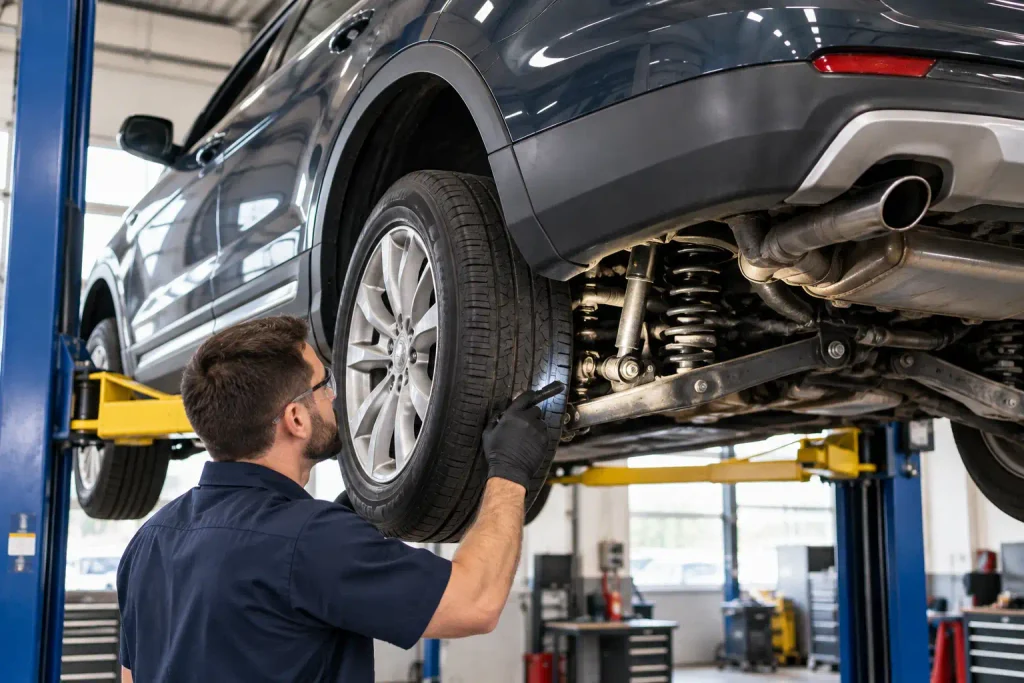
- Confirm the identity. Match the VIN on the dashboard, door label, title, and vehicle history. Verify the engine, transmission, drive layout, and exact model year.
- Check recall status. Enter the VIN into the NHTSA recall lookup. Ask the Ford dealer to confirm completed actions and any newly issued or superseding campaigns. An open-recall search alone does not validate prior repair quality.
- Review repair invoices. Look for dates, odometer readings, work descriptions, and parts used. For older models, focus on transmission work; for applicable V6 models, look for cooling-system diagnosis and pump repairs.
- Inspect fluids and cooling behavior. Ask a technician to check for coolant loss, leaks, fluid contamination, and evidence of overheating. Do not open a hot cooling system.
- Test the transmission safely. During a permitted test drive, observe engagements and shifts when cold and warm. Repeated harsh shifting deserves diagnosis even if the dashboard shows no warning.
- Inspect suspension, steering, and AWD. Have a qualified mechanic examine wheel-end play, toe links, alignment concerns, tire wear, and drivetrain noises. Include corrosion and underbody condition.
- Get a written pre-purchase inspection. Ask the shop to separate urgent safety repairs, likely near-term mechanical work, and routine maintenance. Compare those findings with the asking price before making a final decision.
If you need to tow, also verify the installed tow package and the vehicle-specific rating. Our Explorer towing capacity by year guide provides general context, but the owner’s manual and vehicle configuration determine the applicable limit.
When a Risky Model Year Is Worth Considering
A higher-risk Explorer year is not an automatic rejection. The condition and evidence must justify taking that risk.
Consider it conditionally if an independent inspection is clean, major repairs are documented with invoices, and all applicable recall remedies are verified.
Investigate further if a seller reports a rebuilt transmission or replaced water pump but cannot identify the shop, repair date, or warranty. Ask to inspect the invoice and have the affected system evaluated.
Walk away if serious symptoms remain unexplained, the seller refuses a professional inspection, or an unsafe condition is dismissed without diagnosis. A discount cannot resolve a safety defect.
Ford Explorer Years to Avoid Decision Matrix
Use this table for the purchase decision, not as a prediction of exactly when a part will fail.
| Used Explorer candidate | Evidence to look for | Buyer action |
|---|---|---|
| 2002–2005 with unknown transmission history | Shifting behavior, service invoices, diagnostic findings | Usually skip |
| 2006 with clean records | Warm and cold test, full mechanical inspection | Consider cautiously |
| 2013–2017 with V6 cooling concerns | Engine identification, coolant testing, pump service records | Inspect before offer |
| 2018–2019 with 26S08 applicability | VIN check and completed toe-link remedy | Verify before delivery |
| 2020 with harsh shifting | Diagnostic results, transmission repair history | Investigate or reject |
| 2021–2022 with applicable axle recalls | Completed recall repairs and suspension/driveline inspection | Consider conditionally |
| 2023 with clean history | Inspection, maintenance and applicable recalls | Shortlist |
Decision shortcut: If the SUV has unresolved serious symptoms, do not buy it on reputation alone. If the vehicle is mechanically sound and its repairs are verified, compare its price and equipment with better-year alternatives.
When to Call a Mechanic or Walk Away
Stop driving and request a professional assessment if the engine overheats, the steering becomes unpredictable, a wheel appears abnormally positioned, or there are indications of serious drivetrain damage.
An independent mechanic should inspect any Explorer with repeated transmission slipping, unexplained coolant loss, unusual suspension noises, or evidence of collision damage. Avoid promising yourself that a repair will be inexpensive until the cause is known.
If a recall applies to the VIN, confirm the official repair instructions with a Ford dealer. For a vehicle you have not purchased, require a clear plan for resolving the issue before taking delivery.
Which Used Ford Explorer Should You Choose
The Ford Explorer years to avoid most cautiously remain 2002–2005 and the 2020 redesign, while 2006 and 2013–2017 deserve special attention to their known mechanical and safety concerns. The 2009–2010, 2018–2019, and 2023 model years can provide better starting points for particular budgets, but none is universally problem-free.
Recent recalls are especially important. Certain 2017–2019 Explorers were included in a 2026 suspension recall, and some 2020–2022 vehicles have additional rear-axle or park-related issues to verify. The deciding factors are the exact VIN, engine, maintenance history, current condition, and inspection results. Before paying for a used Explorer, verify its recalls and get an independent mechanic’s written assessment.
Ford Explorer Years to Avoid FAQs
What Is the Worst Ford Explorer Year?
2002 is one of the strongest years to avoid, particularly because of its well-documented transmission-failure complaints. Reported repair expense and failure mileage make an example with uncertain transmission history a difficult used-car gamble.
Is the 2016 Ford Explorer Reliable?
A 2016 Explorer needs careful screening rather than an automatic yes or no. Examine engine-specific cooling concerns, steering and suspension condition, outstanding recalls, and service history. A clean inspection and verified repairs can change the decision for an individual SUV.
Which Ford Explorer Years Have Water Pump Problems?
The 2011–2019 Explorer with the naturally aspirated 3.5L V6 is associated with the labor-intensive internal, timing-chain-driven water pump design. Do not assume the same layout applies to every EcoBoost engine; identify the powertrain before assessing repair risk.
Is a 2020 Ford Explorer Worth Buying Used?
Only after a careful powertrain inspection and VIN recall check. The 2020 Explorer is the first year of a redesign, and certain vehicles have transmission or rear-axle recall considerations. Repeated rough shifting or unresolved safety work warrants further investigation or rejection.
Which Ford Explorer Years Are Most Reliable?
2009–2010, 2018–2019, and 2023 are reasonable shortlists for different budgets, not guaranteed winners. The older vehicles require age-related inspection, certain 2017–2019 Explorers need 2026 toe-link recall verification, and newer models have less long-term ownership history.