1967 Mustang S-Code Restoration Project: What The 390 GT Needs

A 1967 Mustang S-code is any Mustang built with Ford’s 390 cubic inch FE V8, the GT’s only big block. Ford rated it at 320 hp and 427 lb-ft of torque. It used a Holley four-barrel carburetor, not the Autolite some references list.
This guide covers the full data plate and VIN breakdown. It covers the exact casting numbers and carburetor a correct engine carries. It also covers the structural rust points to check first, and where sources disagree on horsepower.


Most S-code pages get two things wrong

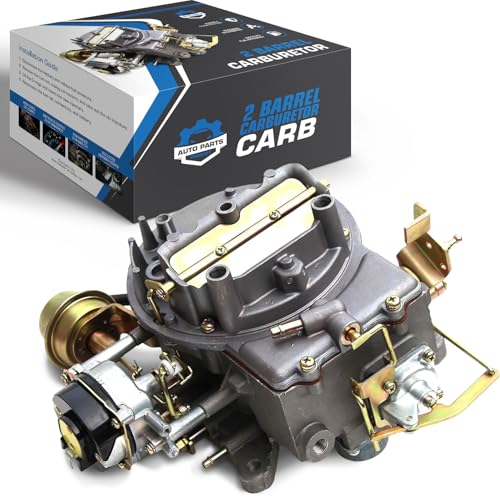

Search “1967 Mustang S-code” and several results list an Autolite carburetor as factory original. That is not what the parts record shows.
The correct S-code 390 GT carburetor is a Holley 4150, a four-barrel unit rated at 600 CFM. Ford’s own list numbers confirm it: C70F-9510-C for manual transmission cars, C70F-9510-D for automatics. An Autolite 4100 appears on some 390s, but specialists say it belongs on the standard engine, not the GT package.
The second myth is that a 1967 block needs a VIN stamp to prove it is original. FE engine forums agree: Ford did not stamp partial VINs on blocks until partway into the 1968 model year. A bare, unstamped pad on a 1967 block is normal, not evidence of a replacement engine.
Worth knowing: a 1967 S-code with an Autolite carburetor and no VIN on the block is not automatically a fake. Check the date codes and casting numbers together, not any single part by itself.
Where the VIN and data codes actually live



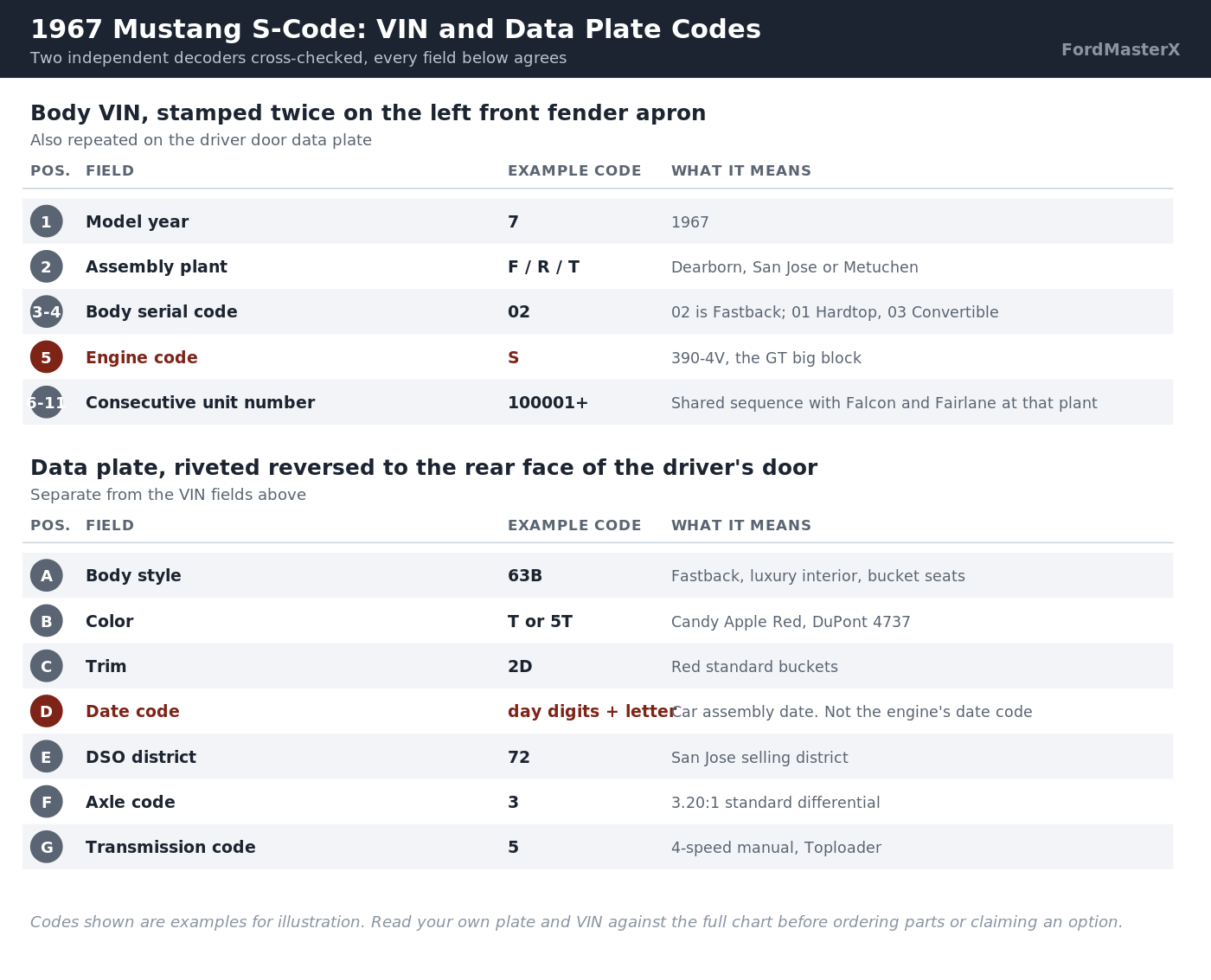
The body VIN is stamped twice on the top flange of the left front fender apron. Only one stamp is usually visible unless the fender comes off.
A separate data plate is riveted, reversed, to the rear face of the driver’s door. It repeats the VIN and adds the color, trim, date, district and axle codes the VIN alone does not carry.


| Position | Field | What to look for |
|---|---|---|
| VIN position 1 | Model year | 7 for 1967 |
| VIN position 2 | Assembly plant | F Dearborn, R San Jose, T Metuchen |
| VIN positions 3-4 | Body serial code | 01 hardtop, 02 fastback, 03 convertible |
| VIN position 5 | Engine code | S for the 390-4V GT engine |
| VIN positions 6-11 | Consecutive unit number | Shared sequence with Falcon and Fairlane at that plant, starting at 100001 |
| Data plate, date code | Car assembly date | Day digits plus a month letter, separate from the engine’s own date code |
| Data plate, DSO code | Selling district | Two digits, for example 72 is San Jose |
Two independent decoders agree on every field above. Read your own plate against the full chart before you claim an option the car may not actually have.
1967 S-code 390 GT: the full spec sheet


These are the numbers Ford published for the 390-4V GT engine in the 1967 model year.
| Spec | Value |
|---|---|
| Displacement | 390 cu in (6.4 L), FE series |
| Bore x stroke | 4.05 in x 3.78 in |
| Compression ratio | 10.5:1 |
| Carburetor | Holley 4150, 4-barrel, 600 CFM |
| Advertised horsepower | 320 hp |
| Advertised torque | 427 lb-ft |
| Transmissions offered | 3-speed manual, 4-speed manual (Toploader), C6 automatic (GTA) |
| Clutch, manual cars | 11.5 in pressure plate, 12 springs; 11.5 in disc, 8 springs |
Sources genuinely disagree on the exact horsepower figure. Some parts catalogs group the 1966 through 1968 390 GT together at 335 hp. Owners quoting their original 1967 owner’s manual confirm 320 hp, and most 1967-specific references agree.
The likely explanation is not a mechanical change. Ford adjusted published horsepower figures industry-wide in 1967 to better match how NHRA classed cars at the strip. The engine itself did not necessarily change between 1966 and 1967.



If you are rebuilding to stock, match a Holley 4150 rebuild kit to the C70F-9510 list number on your carburetor.
What a correct S-code engine carries
An FE block gives you almost nothing to look at from the outside. The 352, 390, 406, 427 and 428 all share the same external casting shape.
The only way to confirm displacement is to rotate the crank to top dead center. Then measure stroke with a dowel through the spark plug hole. Casting numbers alone do not prove cubic inches.
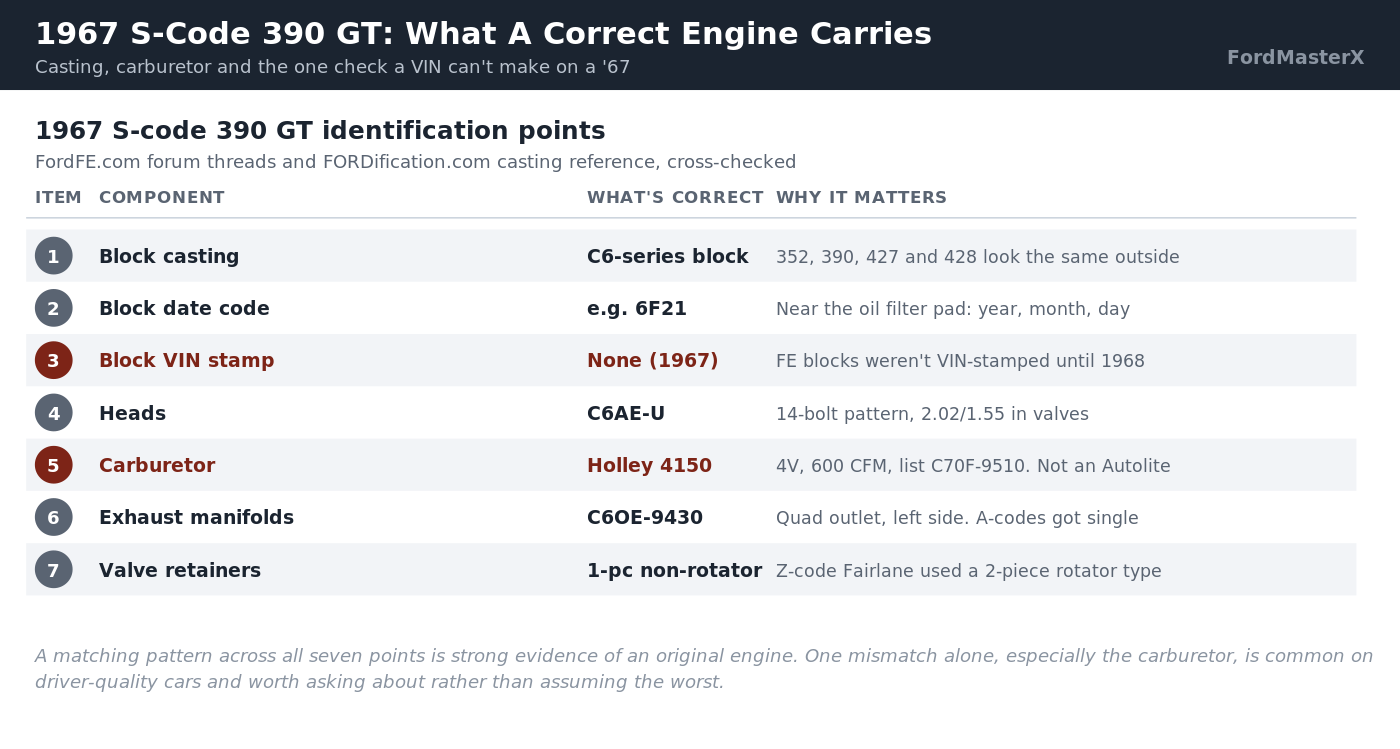
| Component | What’s correct | Why it matters |
|---|---|---|
| Block casting family | C6-series | Correct for a 1966-67 GT 390, confirm displacement by stroke, not casting alone |
| Block date code | Letter plus number near the oil filter pad | Example: 6F21 reads as 1966, June, the 21st |
| Block VIN stamp | None on a genuine 1967 block | VIN stamping on FE blocks was not standard until 1968 |
| Cylinder heads | C6AE-U | 14-bolt exhaust pattern, 2.02 in intake and 1.55 in exhaust valves |
| Carburetor | Holley 4150, list C70F-9510 | Not an Autolite. A swapped carburetor is the most common authenticity question |
| Exhaust manifolds | C6OE-9430 on the left side | Quad-outlet dual exhaust, larger outlets than a standard 390 |
| Valve spring retainers | One-piece, non-rotator | The related Z-code Fairlane 390 used a two-piece rotator retainer instead |
No single mismatch proves a fake. A swapped carburetor or mixed heads happens on driver-quality cars never meant to be concours original.


A matching pattern across most of these seven points is strong evidence the engine is correct. Casting dates should fall within a few weeks of the build date on the data plate.
GT package: what came with an S-code, and what did not
The GT Group was an options package available on any 1967 Mustang V8. It was mandatory with the 289 Hi-Po, Ford’s K-code engine.
GT equipment included power front disc brakes, grille-mounted fog lamps, and a pop-open GT gas cap. It also included F70x14 tires, rocker stripes, and GT or GTA badging. A Mustang GTA is simply a GT with the automatic transmission.
Dual exhaust with quad outlets was part of the GT package, but not on every GT engine. Owners of original A-code 289 GT cars confirm single exhaust from the factory. Only the K-code 289 Hi-Po and the S-code 390 actually received true dual exhaust with the quad-outlet rear valance cutouts.
If you are weighing an S-code against a K-code, this site’s 1967 Mustang K-code guide has the full comparison.
The Competition Handling Package stacked on top of the GT Group for an extra $388. It added firmer suspension, a limited-slip rear axle, and 15-inch wheels with wire wheel covers.
Where this body rusts first
A 1967 Mustang is a unibody car with minimal factory rustproofing. Structural rust hides in a handful of predictable places.
Check the torque boxes first, especially on a convertible. They brace the front frame rails to the floor pan. They often rust from the inside out while looking solid.
Also probe the shock towers, floor pans, inner rockers, cowl panels, and rear trunk drop-offs. Cowl vents trap water and will soak a restored interior within weeks if left unrepaired.
1967 also introduced two safety features worth knowing before you order parts. Both are standard: a dual-reservoir brake master cylinder and a collapsible steering column. Neither is optional on a 1967 Mustang.
Symptom to answer: common S-code buyer questions
Readers usually arrive with one specific worry, not a general question. This maps the common ones to what is actually going on.
| What you’re seeing | What it actually means |
|---|---|
| Data plate shows S, but the carb is an Autolite | Possibly a later swap, but not proof of a fake. Check the casting dates as a set |
| Block has no VIN stamped anywhere | Normal for 1967. VIN stamping on FE blocks began in 1968 |
| GT has single exhaust, not dual | Correct if it’s an A-code 289. Only K-code and S-code GTs got true duals |
| Casting number starts with C7AE | That prefix was cast for the 352 in 1967, not the 390. Measure the stroke |
| Floor feels soft near the rear seat | Likely a trunk drop-off or torque box starting to rust through |
| Car has a single brake fluid reservoir | Not correct for a 1967. Every 1967 Mustang shipped with a dual-reservoir master cylinder |
A full engine detail should use correct era-appropriate FE engine correct-color paint, not generic Ford blue. FE paint shades shifted across these model years.
Confirming the car is what the data plate says
A data plate and a VIN only prove what the car left the factory with on paper. They do not prove the engine under the hood today is the one it left with.
A Marti Report, built from Ford’s own production records, confirms the factory-original color, trim, engine and options. It is the starting point for any numbers-matching claim, not the casting numbers alone.
Cross-check the data plate’s color code against this site’s Ford color code by VIN guide if the paint looks wrong. A repaint under the wrong code is common and easy to miss.
1967 S-code 390 GT quick reference
The facts this page gets searched for most, in one place.
| Question | Answer |
|---|---|
| What does S-code mean | 390 cubic inch FE V8, the only 1967 GT big block |
| Horsepower | 320 hp advertised, some catalogs still list 1966-68 together at 335 hp |
| Torque | 427 lb-ft |
| Compression ratio | 10.5:1 |
| Correct carburetor | Holley 4150, 4V, 600 CFM, list C70F-9510 |
| Block VIN stamp | None on a genuine 1967 block, normal until 1968 |
| Correct cylinder heads | C6AE-U, 14-bolt pattern |
| GT exhaust | Dual, quad outlet, only on K-code and S-code engines |
| Worst rust spots | Torque boxes, shock towers, floor pans, cowl, trunk drop-offs |
| Ownership proof | A Marti Report, cross-checked against the data plate and casting dates |
Your own car may not match every figure above exactly. Read your data plate and casting numbers as a set before you order parts or make a numbers-matching claim.