Ford color code by VIN: Decoded & Verified

Ever wondered why your touch-up paint looks slightly “off” compared to your factory finish? Many vehicle owners mistakenly believe the Vehicle Identification Number (VIN) contains the secret to their exact paint color, only to find themselves frustrated by mismatched repair results. In reality, while the VIN is a critical tool for database queries, it does not encode the paint formula directly. In this guide, we provide the expert information you need to locate the “EXT PNT” code, verify its accuracy, and understand why environmental factors—not just the code itself—determine the quality of your paint match.


Understanding the Ford Color Code By VIN Connection
📤 Share Image

Why the VIN is Not a Direct Paint Key
For the uninitiated, the VIN is often viewed as a master key containing every specification of a vehicle. However, from a professional technical perspective, the VIN is an identification sequence—not a data storage device for color. Think of the VIN like an ISBN for a book: the number identifies the specific edition and title, but it does not tell you the exact batch of ink used to print a specific page.
Research indicates that while the VIN is the most reliable way for a dealer to pull a factory build sheet, the characters themselves are locked to safety, engine, and manufacturing plant data. Assuming the VIN contains the paint code directly often leads to purchasing the wrong product, as it fails to account for mid-year production changes or plant-specific variations.

The Role of the Safety Compliance Certification Label
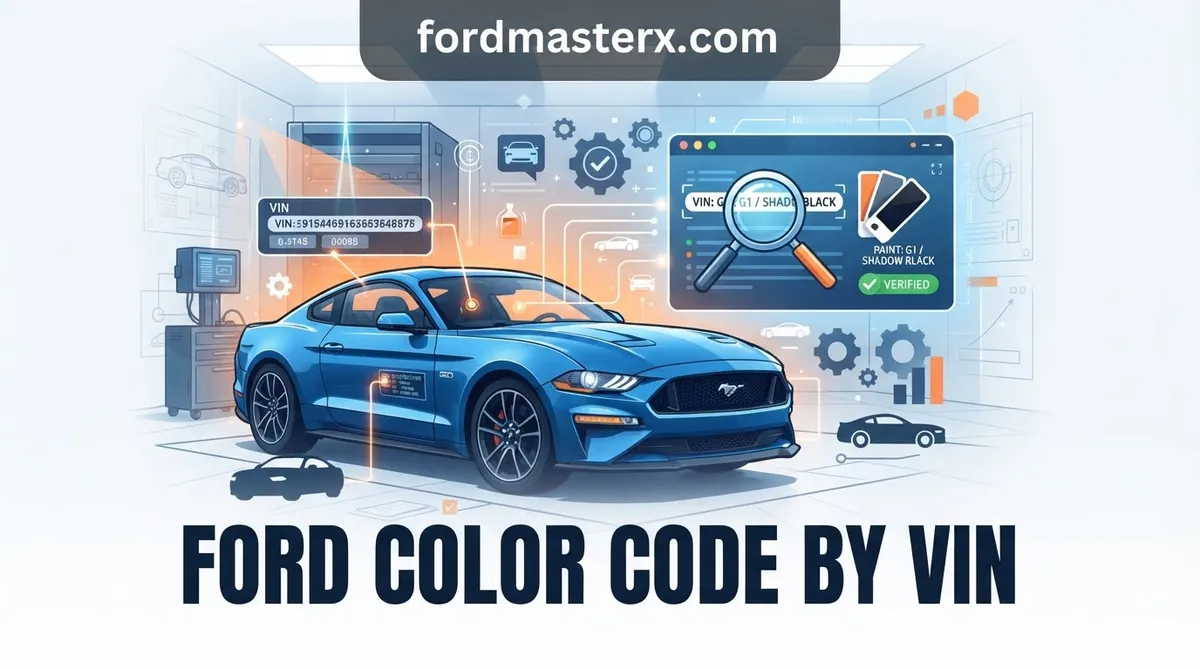
The definitive, trusted source for your vehicle’s finish is the Safety Compliance Certification Label, located on the driver’s side door jamb. This label is the professional standard for identifying your specific exterior paint. While the VIN helps parts departments look up information, the sticker is the factory-verified document that informs paint mixing machines. Relying on an online “VIN decoder” website can be hit-or-miss; relying on the physical label attached to your vehicle is the only way to ensure professional-grade accuracy.
By The Numbers
Alphanumeric Paint Code Length
Accuracy of Door Jamb Label
How to Find Your Ford Factory Paint Code Step by Step
📋
Step-by-Step Retrieval Guide
Open the driver’s side door and inspect the B-pillar or the door edge itself. You will see a rectangular sticker, often silver or white, featuring the VIN, tire pressure info, and date of manufacture.
Scan the label for the letters “EXT PNT.” This header specifically denotes your exterior paint color. It is typically followed by a two or three-character alphanumeric code, such as “UX” or “PQ.”
Be careful not to confuse the exterior paint code with trim or accent codes that may appear nearby. If the vehicle is two-toned, there may be multiple entries; always confirm with a professional automotive paint supplier.
Distinguishing Between Body and Trim Codes
A common pitfall is misidentifying the trim or interior color code as the body paint code. Some Ford labels contain secondary codes for accent strips, moldings, or interior dash components. Always look for the primary “EXT PNT” designation to avoid the mistake of buying color-matched paint that is meant for a bumper insert rather than the main body panel.
Professional Strategies for Perfect Paint Formulation Matching
The Impact of Sun Fade on Color Accuracy
Even with the exact factory paint code, a fresh touch-up pen or spray may not look identical to your vehicle’s existing panels. Ultraviolet (UV) radiation breaks down pigments in automotive paint over time, causing a shift in hue and reflectivity. This is why expert body shops often perform a “spray-out card” test. By spraying a sample and comparing it to the actual panel, they can adjust the tint to account for the age of your specific vehicle.
Factory Finish vs. Custom Paint Shop Formulations
Automotive paint suppliers work with a massive library of “variants.” A single paint code might have five or ten slightly different shades depending on which factory applied the paint, the date of manufacturing, and the specific clear coat thickness. When you provide your paint code to a professional supplier, they aren’t just looking up a single color; they are accessing a database of shades that account for the factory finish’s unique aging characteristics.


Before applying paint directly to your car, always test the formulation on a disposable spray-out card first. Compare the dried result against the vehicle in direct sunlight to ensure the match is acceptable before committing to the repair.
Troubleshooting Missing Labels and Ford Build Sheets
If you are dealing with a classic vehicle or a damaged door jamb where the label is illegible or missing, do not panic. The VIN is still your most powerful tool when used correctly.
- ✅ Contact a Dealership Parts Department: Provide the VIN to the parts specialist. They can pull the original “Vehicle Build Sheet” from Ford’s internal systems, which lists the exact paint code applied during assembly.
- ✅ Visual Inspection Tools: Many professional paint supply stores use a spectrophotometer—a handheld tool that measures the color wavelength of a panel—to create a custom match if documentation is unavailable.
- ✅ Beware of Web Databases: Online VIN decoders often pull from general trim levels rather than the specific, individual build data for your car. Use these as a reference, not a source of truth.
Never guess your color code based on visual appearance. Many Ford colors, such as “Shadow Black” and “Agate Black,” appear nearly identical to the naked eye but have entirely different pigment formulas. Using the wrong code will result in an obvious patch that is difficult to fix later.
Final Guidance on Reliable Color Matching
The process of finding a paint match is an exercise in data verification. While the VIN is an essential identifier for dealership records, the “EXT PNT” label on the door jamb remains the most reliable source for your vehicle’s factory color. When purchasing paint, always acknowledge that environmental factors like sun fade are variables that no database can account for perfectly. By using the official code from your door jamb, consulting with professional paint suppliers, and testing your formulation before application, you can achieve a factory-quality finish that honors your vehicle’s history.
Bookmark this guide for your next repair, and remember: verify the code, test on a hidden surface, and account for your car’s unique environmental history.
Ford Color Code by Vin: Frequently Asked Questions
Can I get the color code from the VIN alone?
No. While a Ford dealership can use your VIN to pull your vehicle’s official ‘As-Built’ data—which includes the factory paint code—the VIN sequence itself does not contain the color information. Do not rely on third-party ‘VIN decoders’ found online, as they often lack access to Ford’s internal manufacturing databases and frequently provide incorrect or generic paint information.
Why does my touch-up paint look slightly different than my car?
Differences in appearance occur because of sun exposure, oxidation, and the specific application method. Factory paint undergoes thousands of hours of UV testing, while touch-up paint is formulated for repair. Additionally, metallic and pearlescent finishes require expert blending; if the flakes aren’t oriented exactly like the factory spray, the color will appear darker or lighter despite being the correct code.
Is the paint code the same as the color name?
No. The paint code is a unique identifier (e.g., ‘UX’ for Ingot Silver), whereas the marketing name is used for consumer branding. Multiple color names may exist for the same code, or one name may be used for different codes across model years. Always rely on the alphanumeric code found on your vehicle label rather than the descriptive marketing name to ensure a professional match.
Does Ford change paint codes mid-year?
Yes, Ford occasionally updates paint formulations or switches suppliers during a production cycle. This is why using the specific code from your vehicle’s door label is mandatory. If you only look up a code based on your model year, you might receive a version of the color that does not match the specific chemical batch used on your vehicle’s assembly line.


Where should I look if my door sticker is completely missing?
If the door label is missing or illegible, your best professional recourse is to contact a Ford dealership parts department with your VIN. They can generate a build sheet that confirms the exact factory-shipped exterior color. Alternatively, take your vehicle to a high-end automotive paint supply store; they can use a spectrophotometer to scan your panel and create a custom-mixed paint that matches your car’s current state.
Master list: Ford Paint Code List & Color Chart (1964–2026)