Ford Transit Payload Capacity Chart By Roof, Length & Year (2015–2026)

The Ford Transit payload capacity chart runs from a factory maximum of 4,650 pounds for the 2015 Cargo Van to 5,103 pounds for a properly configured 2026 T-350HD. Those figures are not the capacity of every Transit. Your van’s actual allowance depends on its year, series, gross vehicle weight rating (GVWR), roof, body length, engine, drivetrain, and installed equipment.


If you carry tools, build campervans, or operate a delivery fleet, start with the charts below. Then check the driver-side door-jamb labels before loading. A published maximum is a comparison figure, not permission to load that amount into an individual van.
Ford Transit Payload by Model Year
US-market full-size Cargo Van. Highest published rating per year, not the rating of every van.
Bar lengths share a zero baseline. Read exact pound ratings in the middle column.
| Year | Payload | Relative Capacity |
|---|---|---|
| 2015 | 4,650 lb | |
| 2016 | 4,560 lb | |
| 2017 | 4,650 lb | |
| 2018 | 4,650 lb | |
| 2019 | 4,640 lb | |
| 2020 | 4,550 lb | |
| 2021 | 5,110 lb | |
| 2022 | 5,110 lb | |
| 2023 | 5,174 lb | |
| 2024 | 5,174 lb | |
| 2025 | 5,052 lb | |
| 2026 | 5,103 lb |
How to interpret: These figures represent different maximum-rated factory configurations across model years. They are not an identical trim, engine, roof, or drivetrain comparison. See the article’s Ford specification references.


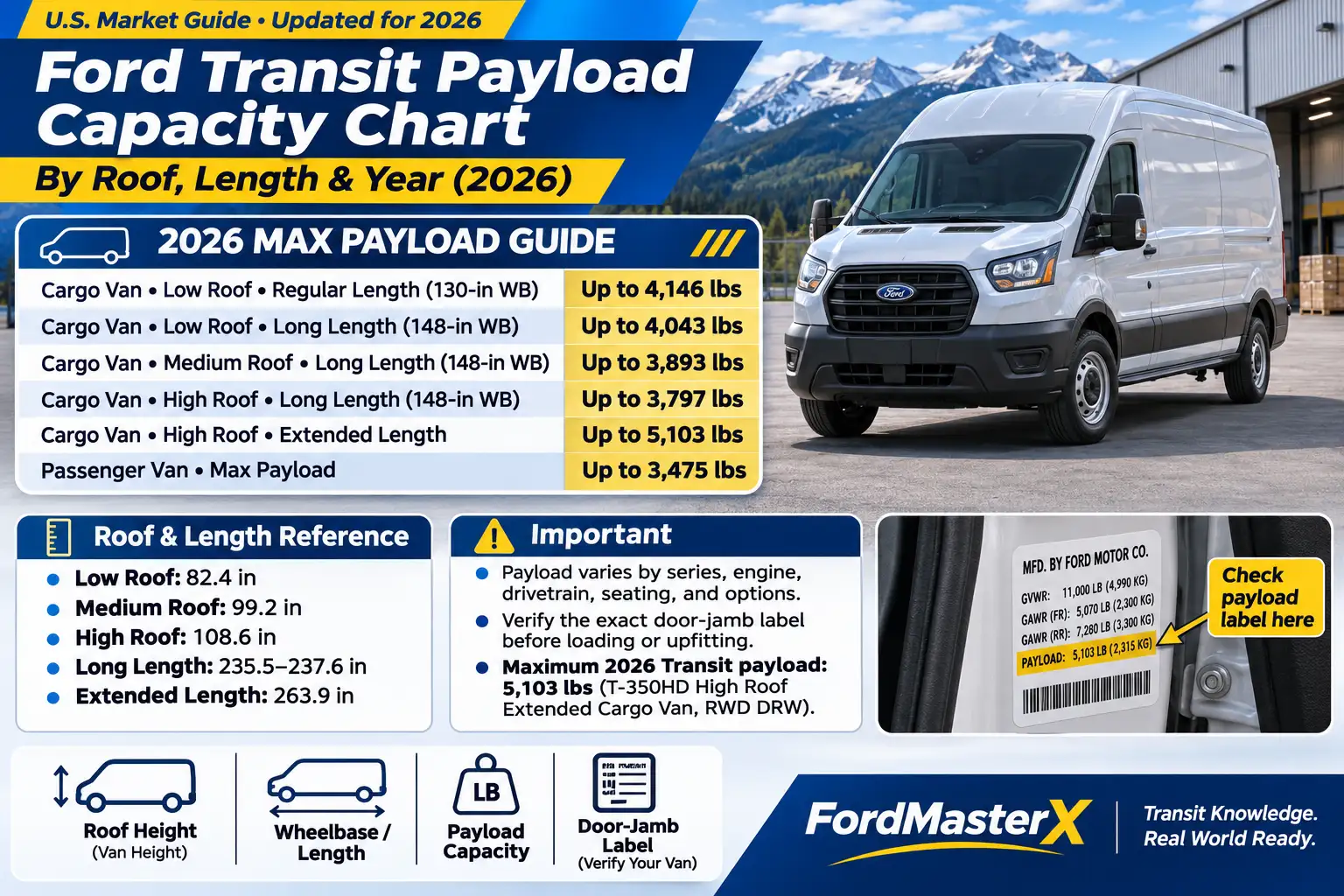
2026 Ford Transit Payload Capacity by Series


Ford’s 2026 Cargo Van specifications list these maximum ratings for the named configurations. T-350HD models are split by single rear wheel (SRW) and dual rear wheel (DRW) because the distinction matters when you are comparing loads.
| Transit series | Maximum payload | Configuration producing that rating |
|---|---|---|
| T-150 | 3,796 lb | 3.5L PFDI, RWD, regular length, low roof, 8,800-lb GVWR |
| T-250 | 4,146 lb | 3.5L PFDI, RWD, regular length, low roof, 9,150-lb GVWR |
| T-350 | 4,496 lb | 3.5L PFDI, RWD, regular length, low roof, 9,500-lb GVWR |
| T-350HD SRW | 4,843 lb | 3.5L PFDI, RWD, long length, low roof, 9,950-lb GVWR |
| T-350HD DRW | 5,103 lb | 3.5L EcoBoost, RWD, extended length, high roof, 11,000-lb GVWR |
These are the highest Cargo Van values shown for each series in Ford’s 2026 Transit technical specifications. A T-250 high-roof AWD van, for example, cannot be assigned the 4,146-pound rating simply because it wears a T-250 badge.
The most useful next step is to identify the model year and configuration rather than rely on the series number alone.
Ford Transit Payload Capacity Chart for 2015 to 2026

The following figures represent the highest advertised payload for a US-market, full-size Transit Cargo Van in each model year, not the payload of a standard T-150 or a specific used van. The highest-rated configurations differ across years, so the table should not be treated as a controlled year-over-year comparison of identical vehicles.
| Model year | Maximum Cargo Van payload | Historical context |
|---|---|---|
| 2015 | 4,650 lb | Early Transit lineup; RWD |
| 2016 | 4,560 lb | Early Transit lineup; RWD |
| 2017 | 4,650 lb | Early Transit lineup; RWD |
| 2018 | 4,650 lb | Early Transit lineup; RWD |
| 2019 | 4,640 lb | Final pre-refresh model year |
| 2020 | 4,550 lb | New 3.5L PFDI and available AWD |
| 2021 | 5,110 lb | Higher-GVWR T-350HD Cargo Van |
| 2022 | 5,110 lb | T-350HD high-capacity configuration |
| 2023 | 5,174 lb | 11,000-lb GVWR T-350HD DRW RWD |
| 2024 | 5,174 lb | 11,000-lb GVWR T-350HD DRW RWD |
| 2025 | 5,052 lb | T-350HD DRW EcoBoost RWD |
| 2026 | 5,103 lb | T-350HD DRW EcoBoost RWD |
How to read the chart: These are model-year maxima drawn from Ford-published brochures and specifications, supplemented by configuration-specific factory listings for 2023–2024. They are not every available trim’s payload. The lower 2025 figure should not be interpreted as a measured reduction in carrying ability for all Transit vans; the maximum-rated configurations and Ford’s published specifications need to be compared individually.


Ford’s historic publications show why the year matters. Its 2017–2018 vehicle guide lists a 4,650-pound maximum for the Transit Cargo Van, while the 2020 Transit technical sheet gives a 4,550-pound maximum for the T-350HD DRW at 10,360 pounds GVWR. The 2020 redesign also brought available AWD and a different gas-engine lineup. Ford’s 2025 Transit specifications document the later 5,052-pound T-350HD DRW EcoBoost RWD maximum.
If a used-van listing supplies only a model year and a payload figure, you still need its roof, engine, drive layout, and GVWR before comparing it with a chart row.
How Transit Roof Height and AWD Change Payload


Two vans with the same T-350 badge can have different payload ratings even when their GVWR is identical. Roof height and body length change the base vehicle weight; drivetrain and engine choice change it again.


These matched examples come from the 2026 Cargo Van specification table:
| 2026 T-350 configuration | GVWR | Maximum payload |
|---|---|---|
| PFDI, RWD, low roof, long length | 9,500 lb | 4,393 lb |
| PFDI, RWD, high roof, long length | 9,500 lb | 4,147 lb |
| PFDI, AWD, low roof, regular length | 9,500 lb | 4,298 lb |
| PFDI, RWD, low roof, regular length | 9,500 lb | 4,496 lb |
At the same GVWR, engine, drive layout, and long body length, changing from the low roof to the high roof reduces the published payload by 246 pounds in this example. With a regular low-roof T-350 using the PFDI V6, the RWD configuration has 198 pounds more rated payload than the comparable AWD configuration.
These are comparisons of specific factory configurations, not universal deductions for every model year. The 2026 T-350 high-roof, long-length PFDI RWD is rated at 4,147 pounds; its EcoBoost RWD counterpart is rated at 4,095 pounds. Engine selection therefore matters too.
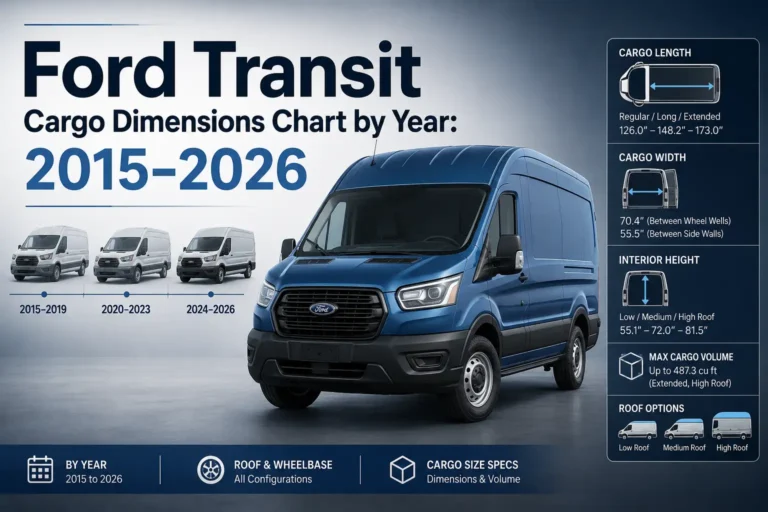
Choose roof height for the cargo you need to fit, then confirm that the chosen van still has enough weight allowance. For interior measurements and clearance, use our Ford Transit cargo dimensions chart by roof and length. Cubic feet measure space, not permitted cargo weight.


Ford Transit Cargo Van vs Passenger Van Payload
The Cargo Van and Passenger Van do not use interchangeable payload ratings. Passenger Vans have more factory-installed seating and interior equipment, and their ratings depend on seating layout as well as the usual mechanical specifications.
For example, Ford lists 3,199 pounds for a 2026 T-350 Passenger Van with 12 seats, low roof, long length, 3.5L PFDI, RWD, and 9,250-pound GVWR. Compare that with the 2026 Cargo Van chart only after accounting for the different GVWR, body configuration, and equipment.
A Crew Van also has its own seating and payload figures. Chassis Cabs and Cutaways require separate treatment because the completed body or upfit can change their usable carrying capacity. The electric E-Transit and smaller Transit Connect should not be mixed into this gasoline full-size Cargo Van chart.
For an individual Passenger Van, count every passenger and all their luggage against the vehicle-specific capacity. The number of available seats does not mean you can fill every seat and then add the advertised maximum cargo load.
Why Ford Transit GVWR Is Not Payload Capacity
GVWR is the maximum allowed weight of the loaded van itself. It includes the van, its occupants, cargo, and weight imposed on the van by a trailer hitch. Payload is the remaining weight allowance once the van’s specified empty weight is accounted for.
For a consistent weight basis, the simplified relationship is:
Payload = GVWR − curb weight
Suppose a hypothetical Transit has a 9,500-pound GVWR and a 5,300-pound curb weight. The resulting payload allowance is 4,200 pounds before considering how its factory rating is defined and what equipment has since been added. This is an arithmetic example, not the published specification of a particular Transit.
Payload and axle limits are different checks. A van can be within GVWR yet exceed a rear Gross Axle Weight Rating (GAWR) if heavy material is concentrated behind the axle. Tire load ratings also matter. Our guide to what gross vehicle weight rating means explains the broader weight-rating terms.
The vehicle’s label, rather than a general formula calculated from an online curb-weight figure, is the right starting point for a real loading decision.
How to Find Your Transit Door Jamb Payload Rating
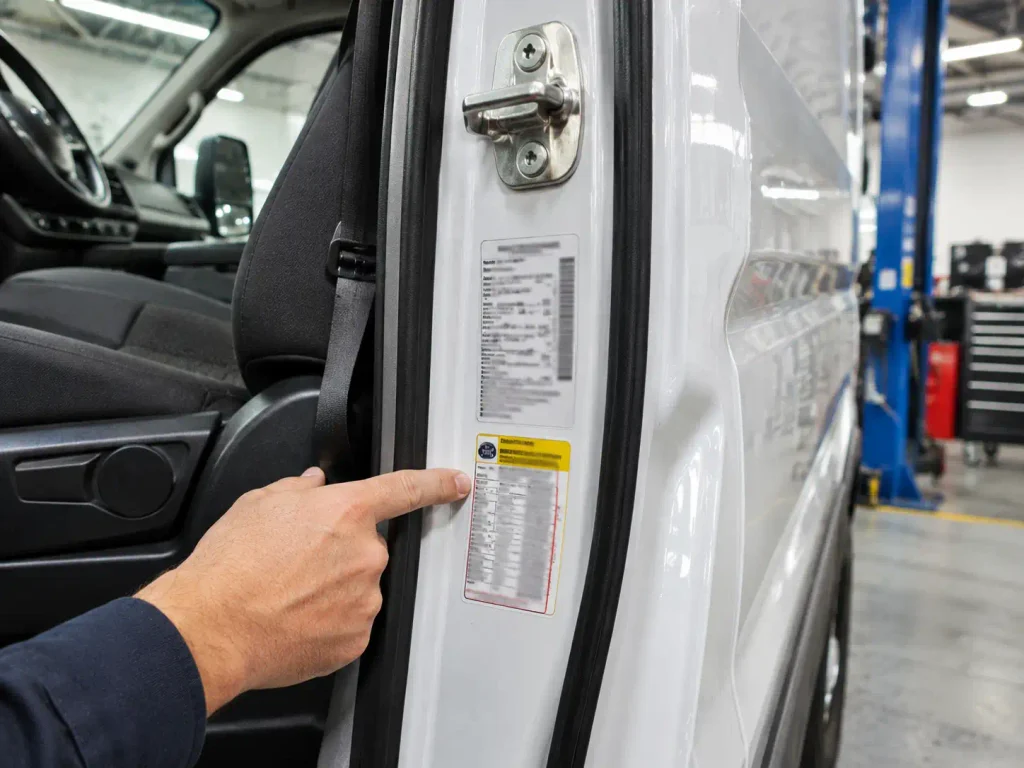
Ford directs owners to the door-jamb label for the carrying capacity of a specific vehicle. Use this procedure before loading your van close to its limit.
- Open the driver-side door. Find the certification label and the tire-and-loading information label, typically on the door opening or pillar.
- Read the combined occupant-and-cargo allowance. Look for the statement indicating the maximum combined weight of occupants and cargo. Record that number in pounds.
- Record the GVWR and axle ratings. These appear on the certification label. They tell you the total loaded-vehicle limit and the separate axle limits.
- Identify the exact van. Match the model year, T-series, wheel arrangement, roof, body length, engine, and RWD or AWD configuration to the factory specification.
- Account for later changes. Shelving, floor systems, additional batteries, camper furniture, water tanks, and other installed equipment consume available carrying capacity. Weigh a substantially modified van if the final weight is uncertain.
The combined occupant-and-cargo number is especially useful because it is assigned to that van as originally equipped. If a commercial upfitter has added substantial permanent equipment, do not assume the original sticker still represents all of the weight available for new cargo.
For a heavily modified van, obtain a measured loaded or empty weight at a suitable scale and check the front and rear axles separately. A VIN-based model description alone does not replace those checks.
How to Calculate Usable Payload After Van Upfitting
A payload chart tells you what a factory configuration could carry. A loading budget tells you what is left after occupants and installed equipment are counted.
Consider a hypothetical Transit with a door-label occupant-and-cargo allowance of 3,600 pounds. You are planning a contractor setup with two people and permanently mounted storage.
| Weight item | Amount |
|---|---|
| Door-label occupant-and-cargo allowance | 3,600 lb |
| Driver | −180 lb |
| Passenger | −150 lb |
| Added shelving and partitions | −500 lb |
| Tools already loaded | −350 lb |
| Remaining for additional cargo | 2,420 lb |
The calculation is 3,600 − 180 − 150 − 500 − 350 = 2,420 pounds. The example begins with the door-label allowance, so the passengers are counted once; do not also subtract an arbitrary driver weight from a separate factory-brochure number without checking Ford’s stated measurement convention.
Camper conversions need the same discipline. Include flooring, insulation, beds, solar equipment, batteries, passengers, luggage, and the contents of fresh-water and waste-water tanks. If you already weighed the van with an item installed, do not deduct that item a second time from the weight-based calculation.
For the most reliable result, weigh the van as it will actually travel and subtract its measured weight from GVWR. Then verify both axle loads, tire limits, and any hitch-related restrictions. The smallest remaining limit governs.
When Ford Transit Payload and Towing Limits Interact
Payload is the weight supported by the Transit. Towing capacity is the rating for pulling a trailer. A van can be within its trailer-weight limit and still exceed its vehicle payload or rear-axle limit.
The downward load from a trailer’s tongue is supported by the Transit, so it must be included when checking the van’s vehicle weight and axle ratings. A trailer also creates a combined-weight requirement, expressed as GCWR. Meeting GVWR alone does not prove that the van-and-trailer combination is within its approved limits.
Use the dedicated Ford Transit towing capacity chart by year when you need trailer ratings. Do not substitute those numbers for the payload ratings in this guide.
Which Ford Transit Payload Figure Should You Trust
Use the Ford Transit payload capacity chart to identify a model-year maximum and narrow down the configurations worth considering. For 2026, the largest factory Cargo Van figure is 5,103 pounds on a specified T-350HD DRW RWD model. A smaller van, high-roof configuration, AWD drivetrain, or different GVWR can carry considerably less.
The figure that matters before a real trip is the allowance for your individual van. Read its door-jamb labels, account for all occupants and aftermarket equipment, and verify axle and tire loading. If the van has been substantially converted or upfitted, get actual scale weights. That process is more useful than relying on an advertised maximum taken from a different Transit configuration.
Ford Transit Payload Capacity Questions by Model
How Much Weight Can a Ford Transit 150 Carry?


A properly configured 2026 Transit T-150 Cargo Van has a maximum published payload of 3,796 pounds. That figure applies to the PFDI RWD, regular-length, low-roof configuration with an 8,800-pound GVWR; other T-150 versions are rated differently. Check your door-jamb label for the actual van’s limit.
What Is the Payload Capacity of a Transit 250?


The maximum published 2026 T-250 Cargo Van payload is 4,146 pounds with the specified low-roof, regular-length, PFDI RWD configuration and 9,150-pound GVWR. A higher roof, longer body, AWD, or a different GVWR changes the figure. The series badge alone is not enough to determine capacity.
How Much Payload Can a Transit 350HD Carry?



The 2026 T-350HD DRW Cargo Van reaches 5,103 pounds in the EcoBoost RWD, extended high-roof configuration with an 11,000-pound GVWR. The highest listed T-350HD single-rear-wheel version carries 4,843 pounds. Neither maximum should be applied to every 350HD without checking its configuration and label.
Does AWD Reduce Ford Transit Payload Capacity?


For otherwise matched 2026 configurations examined here, AWD has a lower factory payload rating than RWD. One regular-length, low-roof T-350 with a PFDI engine and 9,500-pound GVWR is rated at 4,298 pounds with AWD versus 4,496 pounds with RWD. Compare identical body and GVWR setups before drawing a conclusion.
Does a Camper Conversion Reduce Transit Payload?
Yes. Permanently installed camper equipment adds weight and reduces the remaining carrying allowance for occupants, water, supplies, and luggage. Use the vehicle-specific payload label as the starting point, deduct equipment not already reflected in that allowance, and weigh the completed conversion to verify the true remaining capacity.