
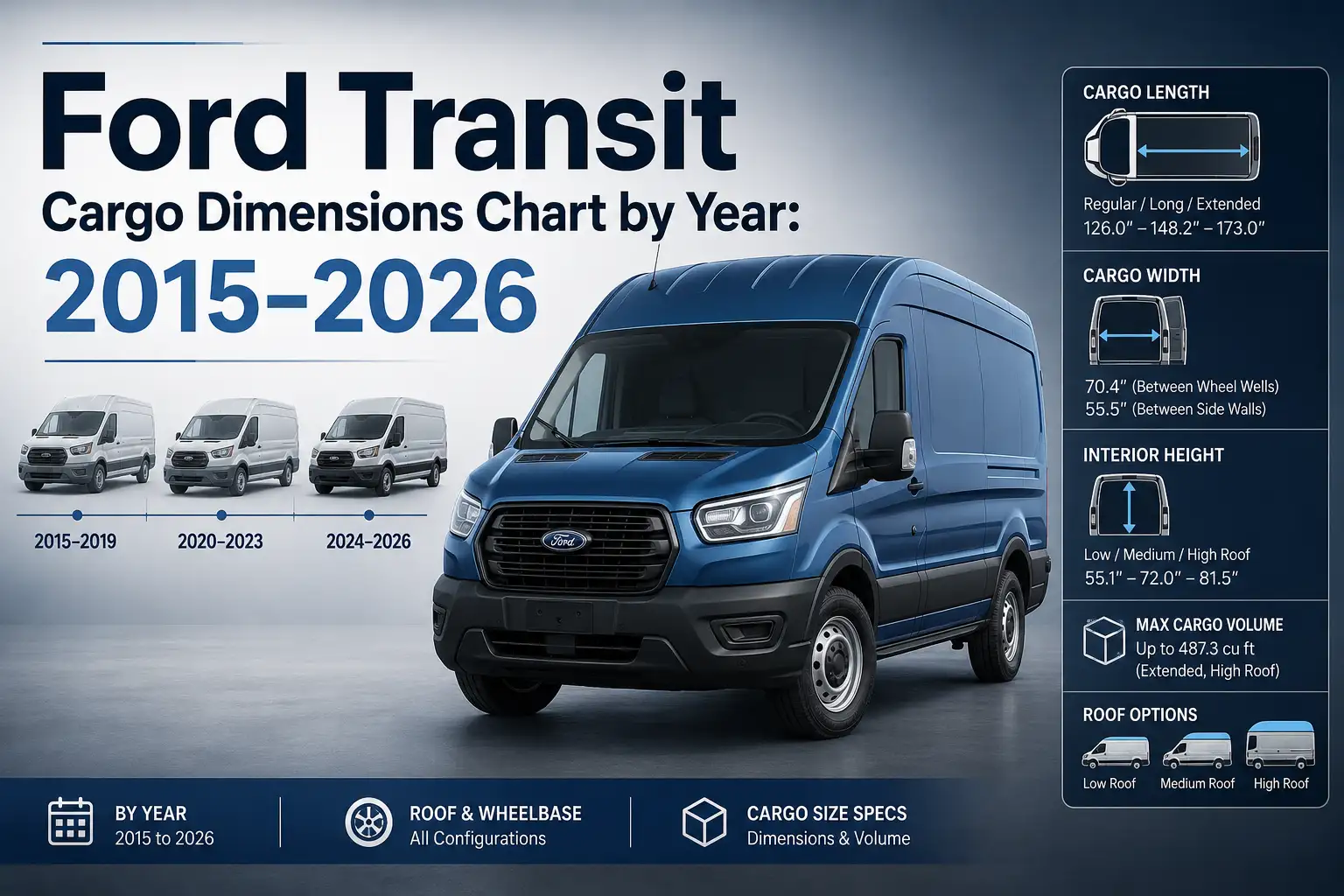
Ford Transit Cargo Dimensions Chart by Year 2015 to 2026

The Ford Transit cargo dimensions chart is remarkably consistent from 2015 through 2026. The main full-size Transit cargo floor lengths are 126.0 inches for Regular, 143.7 inches for Long, and 172.2 inches for Long-EL configurations.
Roof choice changes usable height much more than body length. Low Roof vans provide 56.9 inches of maximum cargo height, Medium Roof vans provide 72.0 inches, and High Roof vans provide 81.5 inches.

Prime for Young Adults — 6 Months Free
Students and 18–24s get six months of Prime free, then half price.
Start 6 Months Free As an Amazon Associate I earn from qualifying purchases.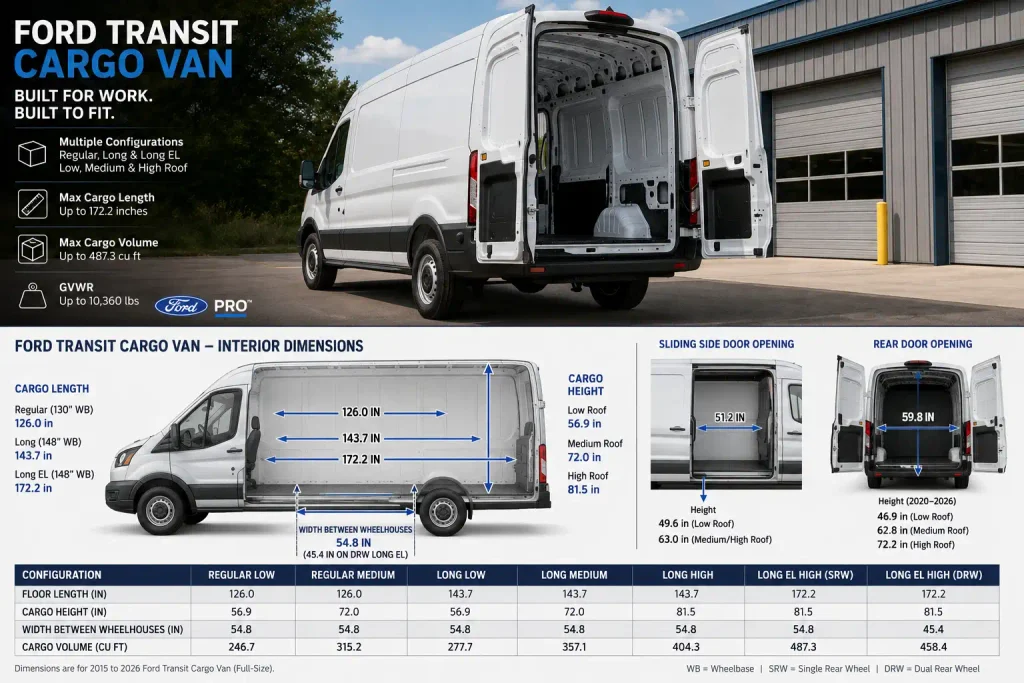
The measurements below cover the full-size North American Transit Cargo Van, not the smaller Transit Connect.
Ford Transit Cargo Dimensions at a Glance
Quick visual comparison for Regular, Long, and Long EL Transit Cargo Vans.
Low Roof
Maximum cargo height
Medium Roof
Maximum cargo height
High Roof
Maximum cargo height
Regular
Long
Long EL
Door Opening Reference
Factory dimensions describe the bare cargo area. Flooring, wall panels, insulation, partitions, shelving, and camper conversions reduce usable space. Long EL dual-rear-wheel models narrow wheelhouse clearance to about 45.4 inches.
Ford Transit Cargo Dimensions Chart for 2015 to 2026
Recommended Best Deal Products


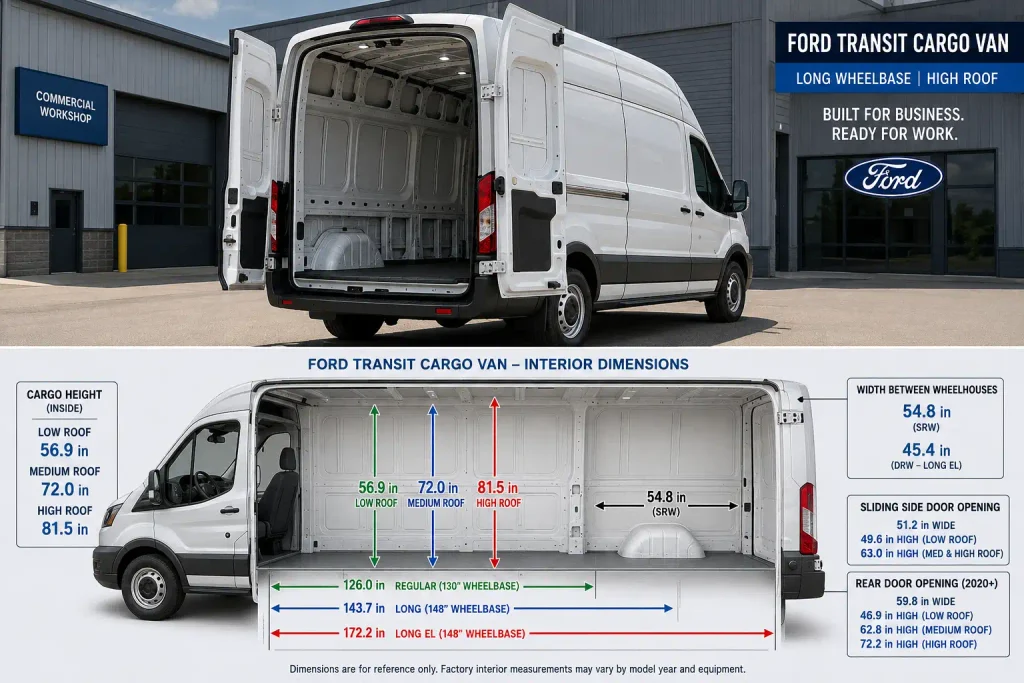
Ford kept the core cargo-box dimensions largely unchanged across the 2015 to 2026 full-size Transit generation. What changed more often was configuration availability, drivetrain choice, exterior height, and some door-opening dimensions.
| Transit Configuration | Wheelbase | Cargo Floor Length | Beltline Length | Width Between Wheelhouses | Max Cargo Height | Cargo Volume Behind First Row |
|---|---|---|---|---|---|---|
| Regular Low Roof | 129.9 in | 126.0 in | 115.9 in | 54.8 in | 56.9 in | 246.7 cu ft |
| Regular Medium Roof* | 129.9 in | 126.0 in | 115.9 in | 54.8 in | 72.0 in | 315.2 cu ft |
| Long Low Roof | 147.6 in | 143.7 in | 133.6 in | 54.8 in | 56.9 in | 277.7 cu ft |
| Long Medium Roof | 147.6 in | 143.7 in | 133.6 in | 54.8 in | 72.0 in | 357.1 cu ft |
| Long High Roof | 147.6 in | 143.7 in | 133.6 in | 54.8 in | 81.5 in | 404.3 cu ft |
| Long-EL High Roof SRW | 147.6 in | 172.2 in | 162.0 in | 54.8 in | 81.5 in | 487.3 cu ft |
| Long-EL High Roof DRW | 147.6 in | 172.2 in | 162.0 in | 45.4 in | 81.5 in | 487.3 cu ft |
Ford’s 2015 body data, 2016 specifications, 2019 Cargo Van specifications, 2025 specifications, and 2026 technical data all support these basic cargo-box measurements.
*The Regular Medium Roof appears in earlier model-year specifications and the 2025 lineup. Ford’s published 2026 specification table lists Regular Low, Long Low, Long Medium, Long High, and Long-EL High configurations, so availability must be checked for the exact model year.

Audible — Listen Free for 30 Days
One free credit a month and thousands of titles included.
Listen Free for 30 Days As an Amazon Associate I earn from qualifying purchases.Regular 130 Inch Wheelbase
The Regular Transit uses a 129.9-inch wheelbase, commonly rounded to 130 inches. Its cargo floor is 126 inches long, or 10.5 feet.
Regular vans are the easiest full-size Transit configuration to maneuver in tighter work areas. Low Roof versions provide 56.9 inches of cargo height, while model years offering the Medium Roof increase that figure to 72 inches.
Long 148 Inch Wheelbase
The Long Transit uses a 147.6-inch wheelbase, normally advertised as 148 inches.
Cargo floor length increases to 143.7 inches, or just under 12 feet. Depending on model year, Ford offered Low, Medium, and High Roof versions with the same basic floor length.
Long EL 148 Inch Wheelbase
Long-EL can be confusing because it still uses the 147.6-inch wheelbase.
Ford adds rear body length behind the axle rather than stretching the wheelbase. That increases cargo floor length from 143.7 to 172.2 inches, a gain of 28.5 inches.
For a closer look at one late-model work-van configuration, FordMasterX also covers the 2024 Ford Transit 150 Cargo.
What 6 Ford Transit Interior Measurements Actually Mean
A Transit may have 172.2 inches of floor length without providing that same length higher up the cargo wall. The measurement location matters.
Cargo Floor Length
This is the maximum longitudinal measurement near the cargo floor behind the front seats.
The three key figures are 126.0 inches for Regular, 143.7 inches for Long, and 172.2 inches for Long-EL.
Audible Premium Plus — Annual Membership
12 audiobook credits up front, plus the full Audible catalogue.
See Annual Plans As an Amazon Associate I earn from qualifying purchases.Cargo Beltline Length
Ford also measures the space at beltline height.
Regular vans provide 115.9 inches, Long vans 133.6 inches, and Long-EL vans 162.0 inches. The difference matters for cabinets, partitions, and tall rectangular cargo.
Wheelhouse Width
Single-rear-wheel Transit Cargo Vans provide 54.8 inches between the wheelhouses.
The Long-EL dual-rear-wheel configuration narrows this dimension to 45.4 inches because of the rear axle and wheel arrangement.
Maximum Cargo Height
Maximum factory cargo height is 56.9 inches for Low Roof, 72.0 inches for Medium Roof, and 81.5 inches for High Roof.
Flooring, insulation, ceiling panels, and wiring channels reduce those dimensions in a finished work van or camper.
Cargo Volume
Cargo volume behind the first row is the cleaner number for comparing configurations across model years.
Ford has also published a separate maximum-volume figure with the front passenger seat removed. That methodology and resulting figures have changed over time, so the two measurements should not be mixed in one historical comparison.
Exterior Dimensions
Exterior height is separate from cargo height.
Drivetrain, model year, body length, roof configuration, tires, and equipment can affect the van’s overall height. Measure the actual van before relying on a garage or parking-structure clearance.
How Low Medium and High Roof Dimensions Compare
Recommended Best Deal Products


Roof height determines whether the Transit works better as a low-clearance service van, standing-height workspace, or high-volume cargo van.
| Roof Type | Maximum Cargo Height | Difference From Low Roof | Typical Fit |
|---|---|---|---|
| Low Roof | 56.9 in | Base | Urban delivery, tools, lower clearance |
| Medium Roof | 72.0 in | +15.1 in | Contractor shelving, mobile workspace |
| High Roof | 81.5 in | +24.6 in | Tall equipment, conversion builds |
Ford published the same 56.9, 72.0, and 81.5-inch maximum cargo heights in 2016, 2019, 2025, and 2026 specifications.
Low Roof Clearance
A 56.9-inch cargo area does not provide adult standing height for most users.
Its advantage is a lower exterior profile, which can make parking, loading areas, and urban routes easier.
Medium Roof Standing Height
The 72-inch maximum interior height equals 6 feet before flooring or ceiling materials are installed.
A finished conversion will have less headroom, so camper builders should calculate the thickness of the floor, insulation, roof liner, and ceiling before planning around the factory figure.
High Roof Maximum Space
The High Roof increases maximum cargo height to 81.5 inches, or about 6 feet 9.5 inches.
It is the most useful factory configuration when vertical shelving, tall cargo, standing workspace, or a camper interior is the priority.
Ford Transit Door Dimensions Changed After 2019
Door openings deserve their own chart because the cargo box can be larger than the opening used to load it.
Ford’s 2015 to 2019 Cargo Van specifications list larger published rear-door openings than the refreshed 2020 and later specifications.
| Model Years | Roof | Side Door Height | Sliding Door Width | Rear Door Height | Rear Door Width |
|---|---|---|---|---|---|
| 2015 to 2019 | Low | 49.6 in | 51.2 in | 49.5 in | 61.7 in |
| 2015 to 2019 | Medium | 63.0 in | 51.2 in | 64.9 in | 61.7 in |
| 2015 to 2019 | High | 63.0 in | 51.2 in | 74.3 in | 61.7 in |
| 2020 to 2026 | Low | 49.6 in | 51.2 in | 46.9 in | 59.8 in |
| 2020 to 2026 | Medium | 63.0 in | 51.2 in | 62.8 in | 59.8 in |
| 2020 to 2026 | High | 63.0 in | 51.2 in | 72.2 in | 59.8 in |
Ford’s 2019 Cargo Van specification lists rear openings of 49.5 by 61.7 inches for Low Roof, 64.9 by 61.7 inches for Medium Roof, and 74.3 by 61.7 inches for High Roof.
The 2020 technical specifications list 46.9 by 59.8, 62.8 by 59.8, and 72.2 by 59.8 inches. Ford’s 2026 specifications continue to publish those later dimensions.
This is why checking only interior height can result in a loading problem. A High Roof cargo compartment may be 81.5 inches tall, but its rear opening is lower.
How Ford Transit Cargo Volume Changes by Configuration
Recommended Best Deal Products



Cargo volume increases sharply as you combine a longer body with a taller roof.
| Configuration | Cargo Volume Behind First Row |
|---|---|
| Regular Low Roof | 246.7 cu ft |
| Regular Medium Roof | 315.2 cu ft |
| Long Low Roof | 277.7 cu ft |
| Long Medium Roof | 357.1 cu ft |
| Long High Roof | 404.3 cu ft |
| Long-EL High Roof | 487.3 cu ft |
A Long High Roof provides about 126.6 cubic feet more space than a Long Low Roof while keeping the same 147.6-inch wheelbase and 143.7-inch cargo floor length.
The Long-EL High Roof reaches 487.3 cubic feet behind the first row in current Ford specifications.
Ford’s current 2026 specification also lists maximum cargo volume with the passenger seat removed at 280.9 cubic feet for Regular Low and up to 536.4 cubic feet for Extended High. Because Ford previously published different seat-removed volume figures, use the behind-first-row measurement when comparing years.
Which 7 Transit Dimensions Matter for Real Cargo
Different loads make different measurements important.
| What You Carry or Build | Measurement to Check First |
|---|---|
| Ladders, conduit, pipe | Cargo floor length |
| Pallets and wide cabinets | Wheelhouse and door width |
| Tall equipment | Rear and side door height |
| Contractor shelving | Floor length and interior height |
| Camper bed | Usable interior width |
| Standing workspace | Finished interior height |
| Parking garage entry | Actual exterior height |
A ladder rack can move long items outside the cargo box when interior length is the limiting factor. If that is part of your work-van setup, see our best ladder racks for Ford Transit for Transit-specific options.
Contractor and Delivery Loads
For shelves and tool storage, floor length alone is not enough.
Measure where the shelving will actually sit. Wheel arches, wall ribs, factory trim, partitions, and door hardware can reduce the usable area from Ford’s maximum body dimensions.
Camper and Conversion Layouts
Factory dimensions describe the bare van, not a completed conversion.
A raised subfloor and insulated ceiling reduce standing height. Wall insulation also reduces finished width, which is especially important if you plan a bed across the van.
Garage and Parking Clearance
Do not use “Low,” “Medium,” or “High” as a substitute for actual exterior height.
For example, Ford lists a 2026 Regular Low Roof at 82.2 inches tall, while the Long High Roof is 109.6 inches and Long-EL High Roof is 110.4 inches.
Measure your actual loaded van before entering a structure with tight overhead clearance.
How to Identify Your Transit Size in 4 Steps
Using the wrong configuration row can create a two-foot error in cargo length.
- Confirm the model year. Door-opening and availability data differ across the 2015 to 2026 period.
- Check the wheelbase. Full-size Cargo Vans use roughly 130-inch or 148-inch wheelbases.
- Identify the body length. The choices are Regular, Long, and Long-EL.
- Identify the roof. Depending on year and body, it may be Low, Medium, or High.
Ford’s current body decoder confirms that Transit 150, 250, and 350 series designations can share body lengths and roof configurations. The number badge alone does not identify cargo-box size.
Also make sure you are looking at the full-size Transit. The smaller Transit Connect uses completely different dimensions. FordMasterX has a separate Ford Transit Connect lengths guide for that model.
What the Ford Transit Cargo Dimensions Tell You
The full-size Ford Transit gives you three main cargo lengths. Regular provides 126 inches at the floor, Long provides 143.7 inches, and Long-EL reaches 172.2 inches.
Roof height changes vertical space from 56.9 inches to 81.5 inches, while most single-rear-wheel versions retain 54.8 inches between the wheelhouses.
For a real fitment check, match the year, body, roof, wheel configuration, and door opening first. Then subtract space for any partition, shelving, flooring, insulation, or camper build before ordering parts.
5 Common Ford Transit Cargo Dimension Questions
How Long Is the Cargo Area in a Ford Transit?
A Ford Transit Cargo Van has 126.0 inches of floor length in Regular models, 143.7 inches in Long models, and 172.2 inches in Long-EL models. These core measurements appear across Ford data from the early Transit years through current 2026 specifications.
How Wide Is a Ford Transit Between the Wheel Wells?
Most single-rear-wheel Ford Transit Cargo Vans provide 54.8 inches between the wheelhouses. Long-EL dual-rear-wheel versions reduce that clearance to about 45.4 inches, so DRW buyers need to account for the narrower floor area.
How Tall Is a High Roof Ford Transit Inside?
The High Roof Ford Transit Cargo Van provides 81.5 inches of maximum factory cargo height, or about 6 feet 9.5 inches. Finished standing height will be lower after adding flooring, insulation, wiring channels, and a ceiling liner.
What Is the Difference Between Long and Long EL Transit?
Both use approximately a 148-inch wheelbase, but Long-EL has extra body length behind the rear axle. Cargo floor length increases from 143.7 inches in Long vans to 172.2 inches in Long-EL vans, adding 28.5 inches of usable floor length.
How Much Cargo Space Does a Ford Transit Have?
Current Ford Transit Cargo Vans provide about 246.7 to 487.3 cubic feet behind the first row, depending on body length and roof height. Ford also publishes a larger maximum-volume measurement with the front passenger seat removed, so check which volume definition a specification uses.