Truck Cab to Axle Body Length Chart: Fitment Guide

The Cab-to-Axle (CA) measurement is the critical distance from the rear of the cab to the center of the rear axle, determining which truck body length will fit safely. Matching your CA to the correct bed length ensures optimal weight distribution and proper clearance for towing and equipment.
🎯 Key Takeaways
Recommended Best Deal Products


- Measure from the rear-most part of the cab to the center of the rear axle.
- A 60-inch CA typically requires an 8.5 to 9-foot body length.
- 84-inch CA measurements are standard for 11 to 12-foot truck bodies.
- Verify After-Frame (AF) length to ensure proper rear bumper and hitch clearance.
- Tandem axle trucks measure CA to the center point of the trunnion.
Choosing the correct body for your chassis cab begins and ends with the Cab-to-Axle (CA) measurement. This distance is the industry-standard metric that determines which vocational bodies—whether flatbeds, service bodies, or dump beds—will physically fit on your truck frame. If the CA measurement and the body length do not align, you risk improper weight distribution, poor handling, and structural failure of the frame or the body itself.

Prime for Young Adults — 6 Months Free
Students and 18–24s get six months of Prime free, then half price.
Start 6 Months Free As an Amazon Associate I earn from qualifying purchases.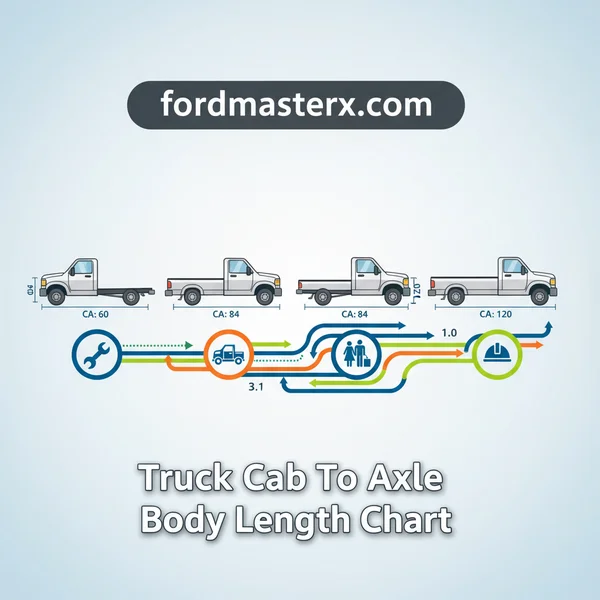
Getting this measurement right is critical for safety and legal compliance. Professional body builders and upfitters rely on standardized CA increments to manufacture equipment that integrates seamlessly with major truck brands like Ford, Ram, Chevrolet, and Isuzu. This guide provides the specific data you need to match your truck’s chassis dimensions to the ideal body length, ensuring your build is efficient and durable from day one.
Standard Cab-to-Axle (CA) and Body Length Correlation Chart
The relationship between your truck’s CA and the body length is not a 1:1 ratio. Typically, the body is several feet longer than the CA measurement to allow for proper overhang behind the rear axle. For example, a standard 60-inch CA chassis is almost always paired with an 8.5-foot to 9-foot body. The additional length extends past the axle, which is vital for balancing the load and providing enough space for rear-mounted accessories like hitch plates or liftgates.

Use the following chart to identify the standard body lengths compatible with common industry Cab-to-Axle measurements:
| Cab-to-Axle (CA) Measurement | Compatible Body Length | Typical Chassis Class |
|---|---|---|
| 60 Inches | 8.5 ft – 9.5 ft | Class 3–5 (Ford F-350/450, Ram 3500) |
| 84 Inches | 11 ft – 12 ft | Class 4–6 (Medium Duty Work Trucks) |
| 102–108 Inches | 14 ft | Class 5–7 (Delivery/Box Trucks) |
| 120 Inches | 16 ft | Class 6–7 (Large Flatbeds/Stakes) |
| 138–150 Inches | 18 ft – 20 ft | Class 7–8 (Heavy Duty Vocational) |
| 186 Inches and Above | 24 ft – 26 ft | Class 8 (Multi-Axle Heavy Haulers) |
Common Body Applications for Standard CA Sizes
While the chart provides the mathematical fitment, the type of body you install can slightly shift your needs. Here is how specific industries utilize these standard measurements:
- 60-inch CA: This is the “Goldilocks” size for residential contractors. It is the most common size for 9-foot service bodies or “Western style” hauler beds used for gooseneck towing.
- 84-inch CA: This size is the standard for 11-foot to 12-foot flatbeds. It provides the necessary frame strength for landscape dump bodies and larger utility service setups that require significant tool storage.
- 108-inch to 120-inch CA: These longer frames are primarily reserved for dry freight box bodies or specialized “stake” beds used for hauling lumber or palletized goods where volume is more important than extreme weight density.
Technical Differences Between CA, AF, and Wheelbase Measurements
To use the chart above effectively, you must understand that the Cab-to-Axle (CA) measurement is only one part of the equation. When you look at a manufacturer’s spec sheet, you will also see “Wheelbase” (WB) and “After-Frame” (AF). While the CA tells you how much space you have between the driver and the axle, these other numbers dictate the truck’s overall footprint and how the body will sit over the rear of the frame.
Body builders focus on CA because it determines the center of gravity. If you put a body that is too long on a short CA, the “leverage” of the load will pull weight off the front steering axle, making the truck dangerous to drive. Conversely, a body that is too short for the CA will leave too much frame exposed, requiring expensive modifications to the chassis.
How to Measure CA and AF Accurately
When measuring your truck, do not rely solely on the VIN or the dealer’s general description. Always take physical measurements to confirm fitment before ordering a body. Follow these steps to get the data required by upfitters:
- Cab-to-Axle (CA): Measure from the rearmost part of the cab (excluding any external accessories like exhaust stacks) to the centerline of the rear axle. For trucks with tandem rear axles, measure to the center point between the two axles.
- After-Frame (AF): Measure from the centerline of the rear axle to the very end of the frame rails. This tells you how much support the frame provides for the rear of the body. If your AF is too long for the body you want, the frame may need to be cut. If it is too short, the body manufacturer may require a frame extension.
- Wheelbase (WB): Measure from the center of the front axle to the center of the rear axle. While not as important for body fitment as CA, the wheelbase is used to calculate your truck’s turning radius and bridge-formula weight limits.
The 2-Inch Clearance Rule
When calculating your body fitment, always account for the “air gap” or clearance rule. Industry standards suggest leaving at least 2 to 3 inches of space between the back of the cab and the front of the body. This prevents the body from rubbing against the cab as the truck frame flexes during travel. If you have a 60-inch CA, you effectively have 57 to 58 inches of usable frame space before you reach the axle centerline. Most professional body builders already factor this into their “standard” 9-foot or 11-foot designs, but it is a vital detail if you are commissioning a custom-built bed.
Chassis Cab Industry Standards: Ford, RAM, and GM Comparisons
While every truck manufacturer has its own engineering quirks, the medium-duty chassis cab market follows surprisingly consistent industry standards. This standardization allows body manufacturers to build “off-the-shelf” service bodies and flatbeds that fit multiple brands without massive modifications. Typically, you will see CA measurements in increments of 24 inches for larger trucks, though the most common light-to-medium-duty lengths are 60 inches and 84 inches.

Audible — Listen Free for 30 Days
One free credit a month and thousands of titles included.
Listen Free for 30 Days As an Amazon Associate I earn from qualifying purchases.
The “Big Three” CA Landscape
If you are looking at a Ford F-350 through F-550, a RAM 3500/4500/5500, or a GM Silverado 4500HD/5500HD, you will find they generally adhere to the following configurations:
- 60-inch CA: This is the industry “sweet spot.” It is the go-to for standard 9-foot service bodies and flatbeds. It offers a tight turning radius while providing enough frame for significant utility.
- 84-inch CA: Frequently used for 11-foot to 12-foot bodies. This is ideal for contractors who need more storage or specialized equipment like small cranes.
- 108-inch to 120-inch CA: These are reserved for larger vocational applications, such as specialized beverage trucks or heavy-duty dump bodies that require longer platforms.
Pro Tip: Even if the CA measurement is identical between a Ford and a RAM, the frame width or the location of the fuel tank might differ. Always verify the “clean-of-chassis” requirements with your body builder to ensure no components interfere with the body mounting brackets.
Impact of Body Type Selection on Effective CA Requirements
Choosing the right CA length isn’t just about making sure the truck looks balanced; it is about weight distribution and functionality. The type of body you plan to mount will dictate whether you can stick with a standard CA or if you need a specialized wheelbase. If the body is too long for the CA, you risk “light-heading,” where the front wheels don’t have enough pressure for safe steering.
Matching Body Style to Frame Length
Different vocational bodies interact with the rear axle in unique ways. Here are a few practical examples of how body selection shifts your requirements:
- Service and Utility Bodies: These are usually designed to be “flush” with the end of the frame. Because they often carry heavy tools in side compartments, a standard 60-inch or 84-inch CA works perfectly to keep the center of gravity just ahead of the rear axle.
- Dump Bodies: These require a specific CA to account for the hoist mechanism. Most 2-3 yard dump bodies are designed for a 60-inch CA. However, if you add a “backpack” tool box between the cab and the dump body, you will need to jump to an 84-inch CA to accommodate the extra length.
- Flatbeds and Platforms: These are the most forgiving. A flatbed can often have a bit more rear overhang than a service body. However, if you plan to tow a heavy gooseneck trailer, the ball placement must be precisely centered or slightly ahead of the rear axle to avoid swaying.
Example: A landscape contractor might think a 60-inch CA is enough for a dump body, but once they realize they need a 24-inch “I-pack” box for shovels and rakes, they actually need an 84-inch CA. Failure to account for that extra box means the dump body will overhang the rear axle too far, causing the truck to be dangerously unbalanced when loaded.
Conclusion: Getting the Perfect Fit
Understanding the truck cab to axle body length chart is the difference between a truck that works for you and a truck that creates constant headaches. By identifying your Cab-to-Axle measurement and matching it to the industry standards of Ford, RAM, or GM, you ensure that your vehicle remains safe, legal, and efficient. Remember that the body type—whether it is a simple flatbed or a complex crane body—will ultimately dictate your final CA needs.
Next Steps:
- Physically measure your chassis from the back of the cab to the centerline of the rear axle.
- Consult with a professional body upfitter to confirm weight distribution for your specific cargo.
Selecting the right foundation is the most important part of any custom build. Take your time, double-check your measurements, and you will have a powerhouse of a work truck that is ready for any job you throw its way!
❓ Frequently Asked Questions
Why is the Cab-to-Axle measurement so important for flatbed installation?
The CA measurement determines the truck’s center of gravity and ensures the rear wheels are centered within the body’s wheel wells for proper weight distribution.
What are the standard CA lengths for Class 3 through Class 5 chassis cabs?
Industry standards for these classes are typically 60 inches, 84 inches, 108 inches, and 120 inches depending on the frame length.
Audible Premium Plus — Annual Membership
12 audiobook credits up front, plus the full Audible catalogue.
See Annual Plans As an Amazon Associate I earn from qualifying purchases.How does the CA measurement differ from the truck’s wheelbase?
Wheelbase is the distance between the centers of the front and rear axles, while CA only measures from the cab to the rear axle.
What happens if I install a body that is too long for my truck’s CA?
An oversized body creates excessive rear overhang, which can lead to frame cracking, light steering, and illegal tailswing during turns.
Is the CA measurement the same across all major truck manufacturers?
While measurements like 60″ and 84″ are industry standards, the actual clearance can vary slightly based on cab thickness and fuel tank placement.
How do you calculate the CA for a tandem axle truck?
For tandem axles, the CA is measured from the back of the cab to the theoretical centerline between the two rear axles, known as the trunnion.