Ford F-350 vs. F-450: Key Differences for Towing & Hauling

The primary difference is that the F-450 is a specialized towing machine featuring a wide-track front axle for a tighter turning radius and commercial 19.5-inch tires. Conversely, the F-350 DRW often provides higher payload capacity due to its lower curb weight while offering a more comfortable ride for daily driving.
🎯 Key Takeaways
- F-450’s wide-track axle allows for a significantly tighter turning radius than the F-350.
- F-350 DRW typically offers higher payload capacity because the truck weighs less.
- F-450 utilizes 19.5-inch commercial tires which are speed-limited and ride stiffer.
- F-450 features larger brakes and heavier-duty knuckles for superior stopping power.
- F-350 offers more versatility with both Single Rear Wheel (SRW) and Dual Rear Wheel (DRW) options.
The choice between a Ford F-350 and an F-450 boils down to how you plan to manage weight and movement. While both trucks share the same high-output diesel engine options, the F-450 is a specialized towing platform built on a heavier chassis, whereas the F-350 is a versatile workhorse optimized for maximum payload. Understanding these mechanical distinctions is critical because “upgrading” to an F-450 actually results in a lower legal payload capacity in many configurations due to the truck’s own massive curb weight.

Prime for Young Adults — 6 Months Free
Students and 18–24s get six months of Prime free, then half price.
Start 6 Months Free As an Amazon Associate I earn from qualifying purchases.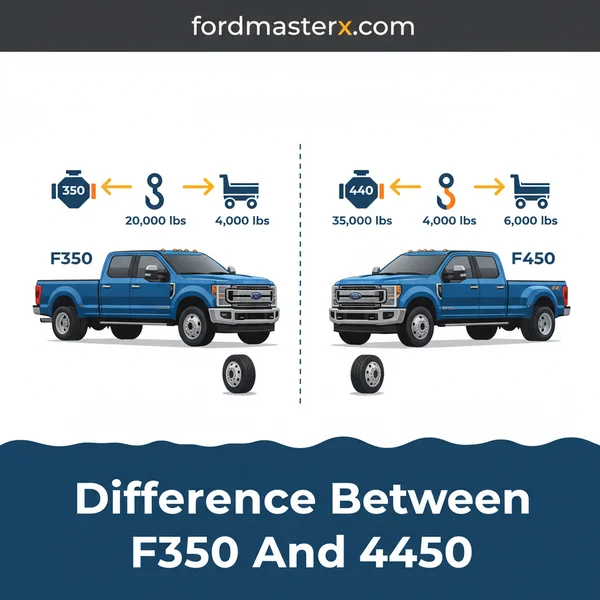
Getting this decision right impacts your daily driving experience, especially when navigating tight campsites or job sites. The F-450 offers a significantly tighter turning radius and superior stopping power, but the F-350 provides the flexibility of single rear wheel (SRW) or dual rear wheel (DRW) setups that may better suit your specific hauling needs. If you choose wrong, you may end up with a truck that is legally overloaded or one that is unnecessarily difficult to maintain.
Mechanical Hardware: Wide-Track Axles, Brakes, and Chassis
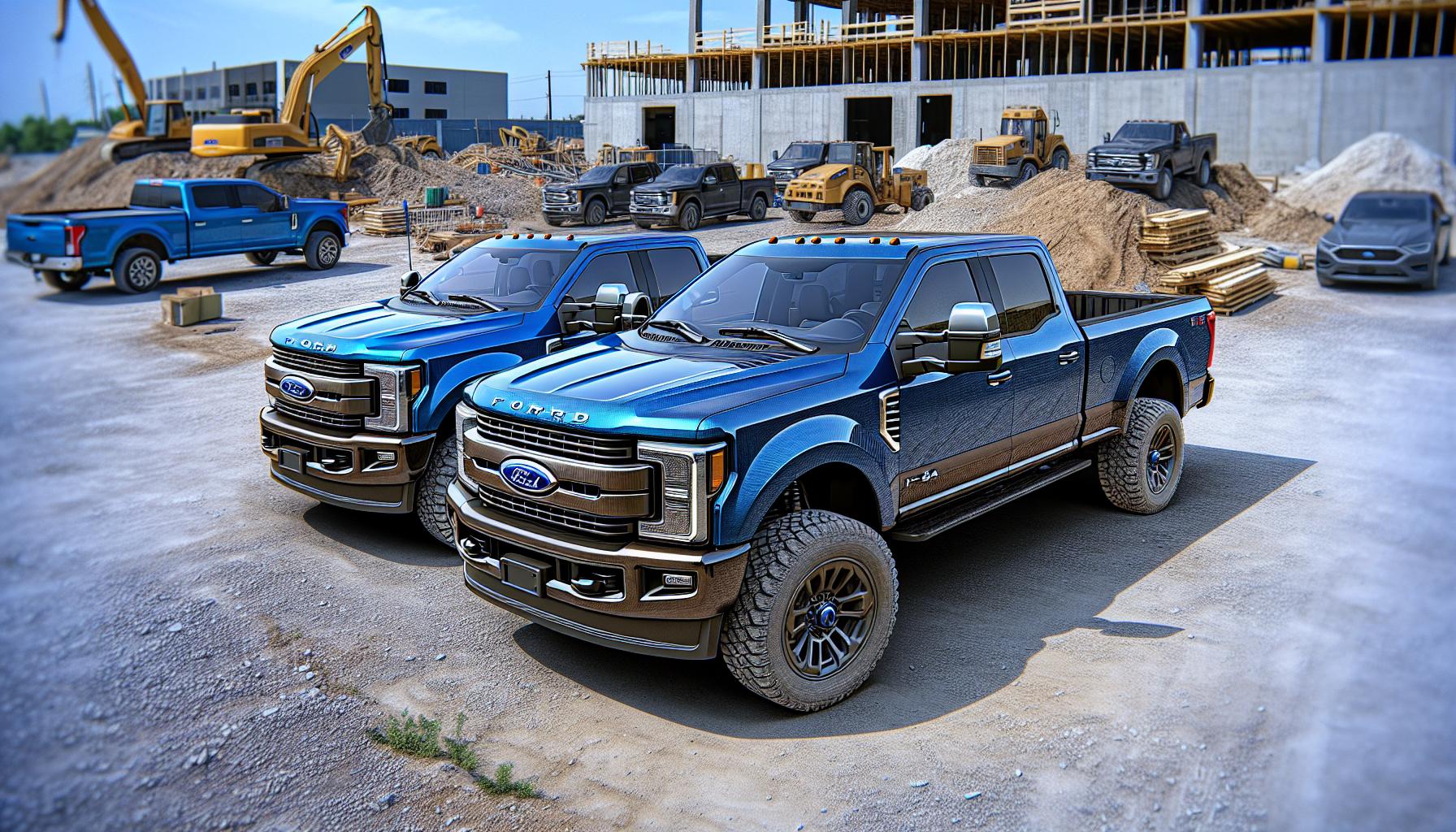
The most significant physical difference between these two trucks is the front axle assembly. The F-450 utilizes a Wide-Track front axle, which pushes the wheels further out from the frame. This design allows the front wheels to turn at a much sharper angle—up to 45 degrees—without the tires making contact with the frame or radius arms. In contrast, the F-350 uses a standard width axle that limits your steering sweep significantly.
The Turning Radius Advantage
If you have ever tried to navigate a 40-foot fifth wheel through a cramped fuel station, you know that every inch of turning room matters. The F-450’s wide-track front end gives it a turning diameter that is roughly 7 feet tighter than an F-350 DRW. This mechanical change makes the F-450—despite its massive size—noticeably easier to maneuver in parking lots and residential streets than its smaller sibling. You can often make a U-turn in an F-450 that would require a three-point turn in an F-350.
Commercial-Grade Braking and Suspension
To handle the stresses of heavy-duty commercial towing, Ford equips the F-450 with hardware designed for high-cycle use. While the F-350 has impressive brakes for a consumer-grade truck, the F-450 moves into a different tier of stopping power. Key hardware differences include:
- Brake Rotor Size: The F-450 features 15.39-inch front rotors and 15.75-inch rear rotors. These are significantly larger than the F-350’s 14.29-inch rotors, providing more surface area to dissipate heat during long descents.
- Wheels and Tires: The F-450 comes standard with 19.5-inch forged aluminum wheels and commercial G-rated tires. These tires are much stiffer and have less sidewall flex than the 17-inch or 18-inch tires found on the F-350, providing better stability under heavy loads.
- Rear Axle: The F-450 features the Dana M300 rear axle with a standard 4.30 gear ratio. While the F-350 DRW also uses the M300, it is typically paired with 3.55 or 4.10 gears, which are better for fuel economy but less effective for low-end pulling power.
Towing vs. Payload: Why the F-350 DRW Often Wins on Paper
It sounds counterintuitive, but the “smaller” F-350 often has a higher legal payload capacity than the F-450. This is primarily due to Gross Vehicle Weight Rating (GVWR) regulations. In the United States, many F-450 configurations are capped at a 14,000-pound GVWR to keep the truck in the “Class 3” category. This is done to help owners avoid the stricter insurance requirements and registration fees associated with Class 4 commercial vehicles.
The Weight Penalty of Heavy Hardware
Because the F-450 is built with heavier axles, larger brake calipers, and cast-iron components, the truck itself weighs significantly more than an F-350. When both trucks are restricted to the same 14,000-pound GVWR limit, that extra “curb weight” on the F-450 is subtracted directly from your available payload. If you are hauling a heavy truck camper or a gooseneck trailer with high pin weight, the F-350 DRW is often the only way to stay within your legal weight limits.
- F-350 DRW Payload: Depending on the cab configuration, an F-350 can offer a payload capacity exceeding 7,500 lbs.
- F-450 Payload: Often tops out between 5,000 and 6,000 lbs because the truck’s own weight is roughly 8,500 to 9,000 lbs.
Towing Limits and Gearing
Where the F-450 justifies its existence is in maximum gooseneck towing. While the F-350 is a powerhouse, the F-450 is engineered to pull trailers exceeding 37,000 pounds. This is made possible by the 4.30 rear gear ratio, which provides superior torque multiplication to get massive loads moving from a dead stop. If your primary goal is pulling a massive triple-axle toy hauler or a heavy horse trailer, the F-450’s stability, commercial tires, and aggressive gearing make it the superior choice, even if the payload sticker on the door jamb is lower than the F-350’s.
Furthermore, the F-450’s commercial tires are designed for high-mileage towing. They are built with steel casings that allow for higher pressures and less heat buildup. However, keep in mind that these tires cannot be aired down for off-road traction like the LT tires on an F-350, making the F-450 a dedicated pavement king.
Commercial Tires and Ride Quality: The 19.5-Inch Factor
One of the most overlooked differences between these two powerhouses is what connects them to the road. The Ford F-450 comes standard with 19.5-inch commercial-grade tires. These are significantly different from the LT (Light Truck) tires found on the F-350. Because these tires are designed for medium-duty trucks, they feature much stiffer sidewalls to handle extreme vertical loads without flexing.

Audible — Listen Free for 30 Days
One free credit a month and thousands of titles included.
Listen Free for 30 Days As an Amazon Associate I earn from qualifying purchases.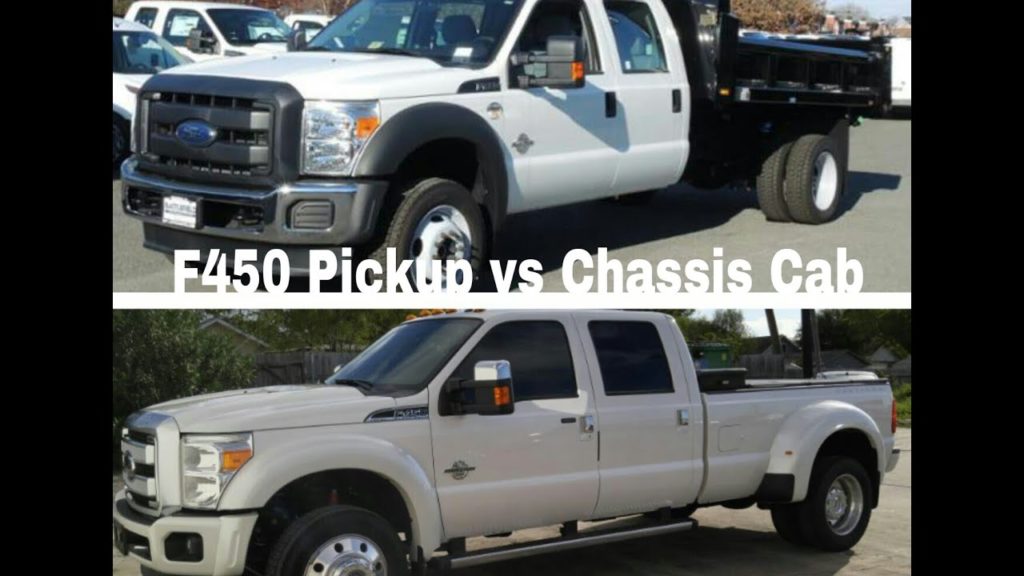
Commercial Rubber vs. Light Truck Versatility
While the F-450’s tires are built for the long haul, they come with specific characteristics that might catch a first-time buyer off guard. These commercial tires are designed for longevity and heavy weight, but they lack the traction variety seen in F-350 tire options.
- Durability: F-450 tires are designed to last for tens of thousands of miles under heavy loads, but they are generally capped at a speed rating of 87 mph.
- Off-Road Performance: The F-350’s LT tires are far superior if you plan to take your truck onto sand, mud, or loose gravel. Commercial tires on the F-450 have very little “give,” making them prone to spinning on soft surfaces.
- Replacement Logistics: Finding a 19.5-inch tire at a standard local tire shop can sometimes be harder than finding a common 17, 18, or 20-inch LT tire.
The Comfort Trade-Off
Ride quality is where you will feel the biggest difference. Because the F-450’s tires and suspension are tuned for maximum capacity, the truck can feel very stiff when it isn’t loaded down. If you are driving “bobtail” (without a trailer), every pothole and expansion joint will be felt in the cabin. The F-350, particularly in a Single Rear Wheel (SRW) configuration, offers a much more compliant, car-like ride that is easier on your back during daily commutes.
Daily Drivability and Ownership: Turning Radius, Insurance, and Costs
You might assume that because the F-450 is the “bigger” truck, it is harder to drive. Surprisingly, the opposite is often true in tight spaces. This is due to the F-450’s Wide Track front axle, which allows the front wheels to tilt at a much sharper angle than the F-350.
Maneuverability: The F-450’s Secret Weapon
The F-450 has a significantly tighter turning radius than a Dual Rear Wheel (DRW) F-350. If you have ever tried to navigate a crowded gas station or a tight campground with a massive trailer, those few extra feet of clearance are a game-changer. Practical benefits include:
- Easier U-Turns: The F-450 can often complete a U-turn in spaces where an F-350 would require a three-point turn.
- Precision Backing: The wider front stance makes it easier to “aim” the front of the truck when pushing a trailer into a narrow driveway.
- Parking Lot Navigation: Despite its width, the F-450 feels more nimble in urban environments than its smaller sibling.
Hidden Costs of Ownership
Before signing the paperwork, you must consider the “paperwork” side of ownership. The F-450 is technically a Class 4 truck, whereas the F-350 is a Class 3. This distinction can lead to higher insurance premiums depending on your provider. Some personal auto insurance companies may even require you to switch to a commercial policy.
Additionally, check your local registration laws. In some states, the F-450 requires “weighted” tags or commercial plates, which are more expensive annually. Maintenance costs are also slightly higher; for example, commercial tires are more expensive to replace, and the F-450 features larger, more expensive brake rotors to help stop those heavy loads.
Conclusion: Which Super Duty is Right for You?
Choosing between the Ford F-350 and F-450 ultimately comes down to your primary use case. The F-350 is the “Goldilocks” truck for those who want a versatile daily driver that can still pull a massive fifth-wheel on the weekends. It offers a smoother ride, better off-road capability, and lower registration costs. However, if you are towing 30,000+ pounds frequently, the F-450’s superior turning radius, massive brakes, and commercial-grade stability make it the undisputed king of the highway.
Next Steps: First, check your state’s DMV website to see how registration fees differ for Class 3 vs. Class 4 trucks. Second, visit a dealership and test drive both models—specifically paying attention to the turning radius of the F-450. Once you feel the difference in maneuverability, your decision will likely be much easier. Happy hauling!
❓ Frequently Asked Questions
Why would I choose an F-350 DRW over an F-450?
You should choose an F-350 DRW if your primary concern is maximum legal payload for a heavy truck camper or if you want a softer ride. It also avoids the commercial tire requirements and insurance complexities often associated with the F-450.
How much better is the F-450’s turning radius?
The F-450’s wide-track front axle allows the wheels to cut at a sharper angle, making it much easier to maneuver in tight spots. Despite being a larger truck, it can often out-turn an F-350 Single Rear Wheel (SRW) crew cab.
Audible Premium Plus — Annual Membership
12 audiobook credits up front, plus the full Audible catalogue.
See Annual Plans As an Amazon Associate I earn from qualifying purchases.Do both trucks require a CDL for personal use?
Generally, no, but it depends on your state and the GVWR of your trailer. Since both trucks can exceed a 26,001 lb Combined Gross Vehicle Weight Rating (GCWR) when towing, you must check local licensing regulations.
What makes the F-450 brakes different from the F-350?
The F-450 is equipped with larger diameter rotors and more robust calipers designed specifically for the heat generated by constant heavy-duty hauling. This provides more confidence and shorter stopping distances when pulling maximum loads near 40,000 lbs.
Can I get an F-450 with a gasoline engine?
No, the Ford F-450 pickup is strictly available with the 6.7L Power Stroke Diesel engine to handle its high-capacity towing mission. The F-350 offers both gasoline (7.3L V8) and diesel options.
Is the F-450 ride quality worse than the F-350?
Yes, the F-450 generally has a stiffer, harsher ride because of its commercial-grade 19.5-inch tires and heavier suspension tuning. These tires have very stiff sidewalls that do not absorb road imperfections as well as the 17-inch tires on the F-350.