Ford 3.5 V6 Cylinder Numbering: Bank 1 & 2 Layout Guide

Cylinder 1 is located on the passenger side at the front of the engine, closest to the accessory belts. On the Ford 3.5L V6, Bank 1 consists of cylinders 1, 2, and 3, while Bank 2 consists of cylinders 4, 5, and 6 on the driver’s side.
🎯 Key Takeaways
- Cylinder 1 is always at the front of the passenger side bank.
- Bank 1 includes cylinders 1-2-3; Bank 2 includes cylinders 4-5-6.
- In transverse (FWD) layouts, Bank 1 is located near the firewall.
- The standard firing order for this engine is 1-4-2-5-3-6.
- Identifying the correct bank is essential for resolving P030x misfire codes.
On the Ford 3.5L V6 engine, Bank 1 is always located on the passenger side of the vehicle, containing cylinders 1, 2, and 3. Bank 2 is located on the driver side, housing cylinders 4, 5, and 6. Cylinder 1 is the cylinder closest to the front of the engine, which is the side with the accessory drive belts and the water pump. Whether you are driving an F-150 with a longitudinal setup or an Explorer with a transverse layout, these numbering rules remain the constant foundation for your engine’s architecture.
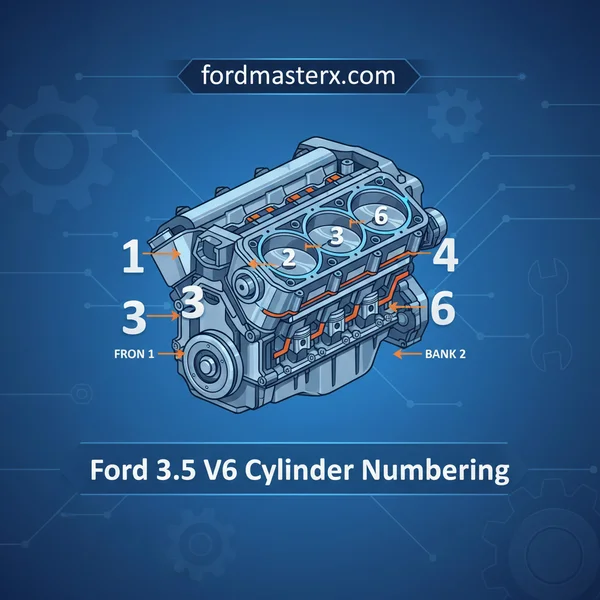
Understanding this layout is vital for troubleshooting common “Check Engine” lights. If your scanner reveals a P0301 code, you need to know exactly which spark plug or coil pack to pull. Without this map, you risk replacing parts on the wrong side of the engine, wasting both time and money. This guide provides the definitive visual map to ensure you identify the correct cylinder or oxygen sensor on the first attempt.

Prime for Young Adults — 6 Months Free
Students and 18–24s get six months of Prime free, then half price.
Start 6 Months Free As an Amazon Associate I earn from qualifying purchases.Identifying Bank 1 vs. Bank 2 on the Ford 3.5L V6
To identify the banks correctly, you must first locate the “front” of the engine. On the Ford 3.5L (including both the naturally aspirated Duratec and the twin-turbo EcoBoost versions), the front is the side with the timing cover and accessory belts. Bank 1 is the bank of cylinders that is slightly offset toward the front of the engine compared to the other side. On this specific Ford engine, Bank 1 is always the right-hand side when standing at the flywheel looking toward the belts, which translates to the passenger side in North American vehicles.

The Cylinder 1 Rule
The simplest way to remember the layout is to find Cylinder 1. On the Ford 3.5L V6, Cylinder 1 is the most forward cylinder on the passenger side bank. Once you find Cylinder 1, the rest of the bank follows in sequence toward the back of the engine. This is a standard Ford convention that prevents confusion when switching between different vehicle models using the same 3.5L platform.
- Bank 1: Contains cylinders 1, 2, and 3.
- Bank 2: Contains cylinders 4, 5, and 6.
- Cylinder 1 Location: Front-most position on the passenger side.
- Cylinder 4 Location: Front-most position on the driver side.
Locating Oxygen (O2) Sensors by Bank
Identifying the banks is the only way to resolve O2 sensor circuit codes like P0130 or P0150. If your code reader specifies “Bank 1, Sensor 1,” you are looking for the oxygen sensor located in the exhaust manifold on the passenger side, before the catalytic converter. “Bank 2, Sensor 2” would be the downstream sensor on the driver side, located after the catalytic converter. Mistaking these banks is one of the most common errors made during DIY exhaust repairs.
Visual Cylinder Mapping for Transverse vs. Longitudinal Layouts
The Ford 3.5L V6 is a versatile engine used in two different orientations. In trucks like the F-150, it is mounted “longitudinally” (front-to-back). In SUVs and sedans like the Explorer, Edge, or Taurus, it is mounted “transversely” (side-to-side). While the engine block itself does not change, your perspective of it does. You must adjust your visual map based on how the engine sits in your engine bay to find the right cylinder.
F-150 and Transit (Longitudinal Setup)
In a longitudinal setup, the engine’s belts face the radiator at the very front of the truck. This makes cylinder identification very straightforward. When you stand at the front bumper and look at the engine, the cylinders are arranged in two columns of three. The column on your left (the passenger side) is Bank 1. The column on your right (the driver side) is Bank 2.
- Passenger Side (Bank 1): Cylinder 1 is closest to the radiator, 2 is in the middle, and 3 is closest to the firewall.
- Driver Side (Bank 2): Cylinder 4 is closest to the radiator, 5 is in the middle, and 6 is closest to the firewall.
Explorer, Edge, and Flex (Transverse Setup)
In a transverse setup, the engine is rotated 90 degrees. The “front” of the engine (the belt side) now faces the passenger side wheel well. This means Bank 1 is pushed back against the firewall, making it harder to access. Bank 2 is now the bank closest to the radiator at the front of the car. Many owners struggle with this because they assume the “front” bank is Bank 1, but on the 3.5L V6, the bank closest to the radiator is actually Bank 2.
- Bank 1 (Rear/Firewall Side): Contains Cylinders 1, 2, and 3. Cylinder 1 is on the far left (belt side).
- Bank 2 (Front/Radiator Side): Contains Cylinders 4, 5, and 6. Cylinder 4 is on the far left (belt side).
- Access Tip: To reach Cylinder 1 on a transverse 3.5L, you usually have to remove the upper intake manifold plenum.
Regardless of the vehicle model, the firing order for the Ford 3.5L V6 remains 1-4-2-5-3-6. This sequence is important for diagnosing timing issues, but for simple component replacement, focusing on the 1-2-3 (Bank 1) and 4-5-6 (Bank 2) physical layout is your most effective strategy.
The Role of Firing Order (1-4-2-5-3-6) in Engine Diagnostics
Understanding the physical location of the cylinders is only half the battle; knowing the sequence in which they “fire” is the key to mastering engine diagnostics. For the Ford 3.5L V6, the firing order is 1-4-2-5-3-6. If you notice a pattern here, the engine is designed to alternate between Bank 1 and Bank 2. This rhythmic jumping back and forth balances the internal forces, ensuring the engine runs smoothly rather than vibrating itself off its mounts.
Decoding Sequential Issues
When you are troubleshooting a rough idle or a hesitation during acceleration, the firing order helps you see the “rhythm” of the failure. For example, if you have a mechanical issue affecting the crankshaft, you might notice that misfires occur in a specific sequence. Because the firing order skips between the rear bank (Bank 1) and the front bank (Bank 2), a problem that feels like a consistent “thump” often involves cylinders that are neighbors in the firing sequence, even if they aren’t neighbors on the engine block.

Audible — Listen Free for 30 Days
One free credit a month and thousands of titles included.
Listen Free for 30 Days As an Amazon Associate I earn from qualifying purchases.Practical Diagnostic Tips
- Harmonic Balancing: If cylinders 1 and 4 are both struggling, the engine will feel significantly more unbalanced than if 1 and 2 were struggling, because 1 and 4 are consecutive in the firing order.
- Shared Resources: While each cylinder has its own coil-on-plug, they often share grounding points or wiring harness pathways based on their firing proximity.
- Fuel Rail Pulse: Sometimes, a lean condition can be traced back to how the fuel pressure drops across the rail as the injectors fire in their 1-4-2-5-3-6 sequence.
Common Diagnostic Codes Related to Cylinder Positioning
Your Ford’s On-Board Diagnostics (OBD-II) system is incredibly precise, but it speaks in codes that require you to know your Bank 1 from your Bank 2. If you plug in a scanner and see a P0305, the computer isn’t just saying there is a misfire; it is pointing directly at the middle cylinder on the front bank (the radiator side). Without knowing the layout, you might spend hours testing perfectly good spark plugs on the wrong side of the engine.
Interpreting Misfire and Circuit Codes
The most common codes you will encounter are the P030X series. The last digit tells you exactly which cylinder is unhappy. However, the complexity increases when you deal with Bank-specific codes. If your scanner throws a P0011 (Bank 1) or a P0021 (Bank 2), it is talking about the Variable Camshaft Timing (VCT). Knowing that Bank 1 is against the firewall tells you immediately that you’ll be reaching into the tighter space to inspect the solenoids.
Common Codes to Watch For
- P0301–P0306: Indicates a misfire in a specific cylinder (1 through 6).
- P0351–P0356: Indicates an ignition coil primary/secondary circuit malfunction for that specific cylinder.
- P0171 / P0174: System Too Lean (Bank 1 or Bank 2). This helps you narrow down vacuum leaks or O2 sensor issues to one side of the V6.
- P0010 / P0020: Intake Camshaft Position Actuator Circuit (Bank 1 or Bank 2).
By correlating these codes with the physical layout—remembering that 1-2-3 is the rear and 4-5-6 is the front—you eliminate the guesswork. This is especially critical on the 3.5L EcoBoost engines, where turbocharger components and cooling pipes can make accessing Bank 1 a much more involved task than Bank 2.
Conclusion
Mastering the Ford 3.5 V6 cylinder numbering is a fundamental skill for any owner or DIY mechanic. By remembering that Bank 1 (Cylinders 1, 2, 3) sits against the firewall and Bank 2 (Cylinders 4, 5, 6) faces the radiator, you can navigate repairs with total precision. Combined with the 1-4-2-5-3-6 firing order, this knowledge allows you to translate cryptic diagnostic codes into actionable repairs, saving you both time and frustration.
Your next step is to grab your scan tool and cross-reference any stored codes with the layout we’ve discussed today. Whether you are swapping out a faulty coil or hunting down a vacuum leak, knowing exactly where to look is half the battle. Get under the hood, identify your banks, and take control of your engine’s performance!
❓ Frequently Asked Questions
How do I identify Bank 1 on a Ford F-150 with a 3.5L EcoBoost?
On the longitudinal (RWD) layout of the F-150, Bank 1 is on the passenger side. Cylinder 1 is at the very front of that bank, followed by 2 and 3 toward the transmission.
Is the cylinder numbering different between the 3.5L Duratec and 3.5L EcoBoost?
No, the physical block architecture is the same for both the naturally aspirated Duratec and the turbocharged EcoBoost versions, so the cylinder numbering and bank locations are identical.
What does ‘Bank 1 Sensor 1’ refer to in diagnostic terms?
Bank 1 Sensor 1 refers to the upstream oxygen (O2) sensor located on the exhaust manifold of the passenger side (or firewall side in FWD) before the catalytic converter.
How are the cylinders numbered on the driver’s side bank?
The driver’s side bank is Bank 2 and contains cylinders 4, 5, and 6. Cylinder 4 is at the front (belt side), cylinder 5 is in the middle, and cylinder 6 is at the back (transmission side).
Why is it important to know the cylinder layout for a P0300 code?
While P0300 is a random misfire, specific codes like P0302 or P0305 point to a single cylinder; knowing the layout allows you to pinpoint exactly which spark plug or coil pack needs inspection.
Audible Premium Plus — Annual Membership
12 audiobook credits up front, plus the full Audible catalogue.
See Annual Plans As an Amazon Associate I earn from qualifying purchases.Does the 3.7L Ford V6 use the same numbering system?
Yes, the 3.7L engine is part of the same ‘Cyclone’ engine family as the 3.5L and shares the exact same cylinder numbering and bank orientation.