Ford F-250 Payload Capacity Chart By Year (2026)

Ford F-250 payload capacity ranges from under 1,900 lbs in a fully optioned crew cab diesel to over 4,200 lbs in a stripped regular cab gas truck — the year and configuration are everything. That gap is the single biggest source of confusion among Super Duty buyers and owners.
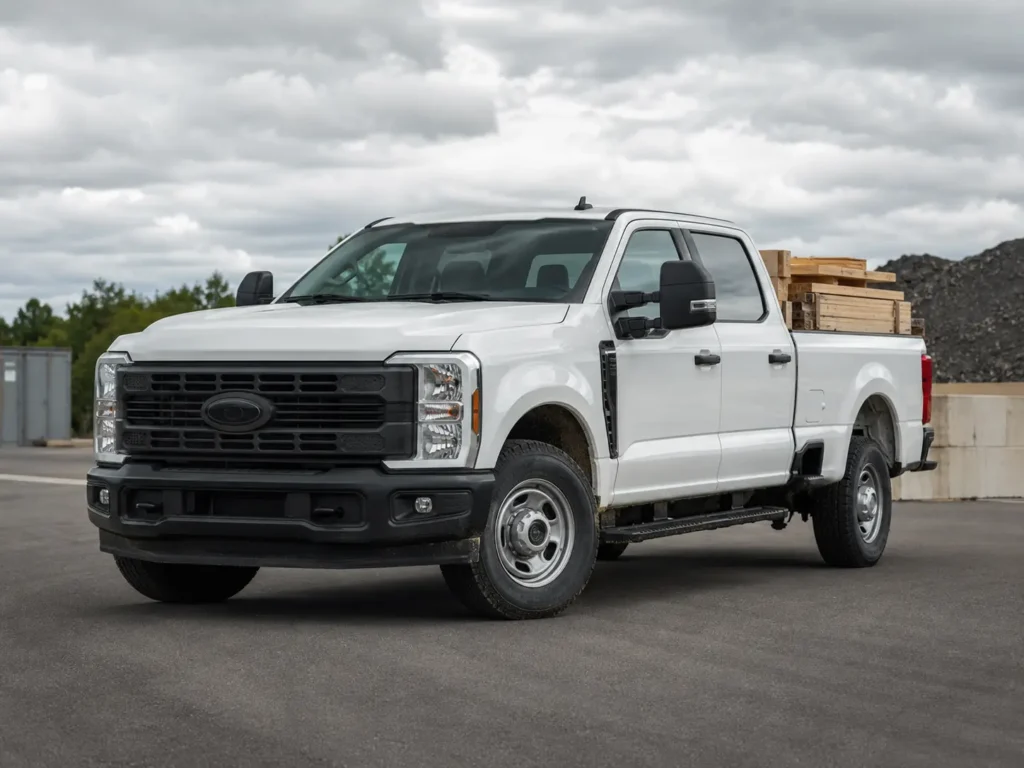
The number Ford advertises as maximum payload and the number on your door sticker are not the same thing. This chart covers every model year from 1999 through 2026 by generation and engine, and explains exactly why your real-world payload is lower than the published maximum. Use the chart to look up your year, then read the sections below to understand what actually limits your truck’s capacity.

Prime for Young Adults — 6 Months Free
Students and 18–24s get six months of Prime free, then half price.
Start 6 Months Free As an Amazon Associate I earn from qualifying purchases.Ford F-250 payload capacity by year 1999 to 2026 — bar chart showing generation peaks and engine-by-engine breakdown
Recommended Best Deal Products


Ford F-250 max published payload by model year (1999–2026)
Reflects best-case configuration per year. Your door sticker will be lower.
All-time modern peak
4,426 lbs
2025–2026 (7.3L gas)
Historical high water mark
4,290 lbs
2012 (6.2L V8 gas)
Modern-era low

Audible — Listen Free for 30 Days
One free credit a month and thousands of titles included.
Listen Free for 30 Days As an Amazon Associate I earn from qualifying purchases.3,172 lbs
2008–2010 (6.4L diesel era)
Typical crew cab 4×4 diesel
~1,950 lbs
Real door-sticker average
Sources: Ford Super Duty spec guides · autopadre.com F-250 payload archive · ford-trucks.com forum owner data · fordmasterx.com
How Ford Calculates F-250 Payload Capacity
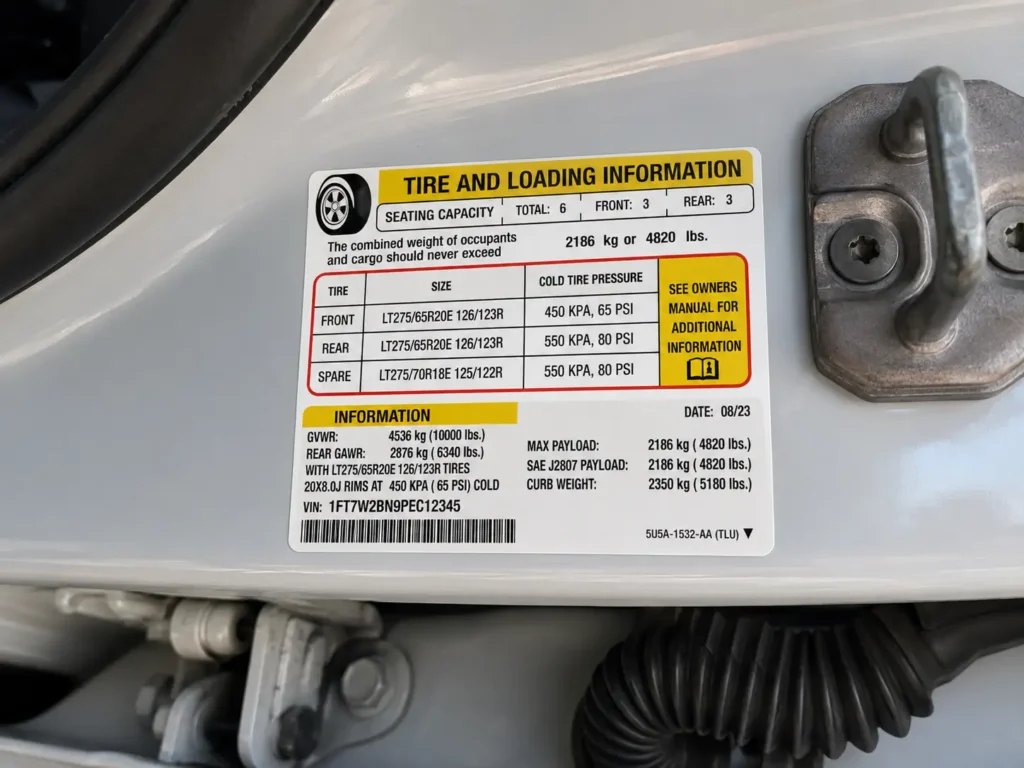
What GVWR Means on Your F-250
GVWR stands for Gross Vehicle Weight Rating. It is the maximum total weight Ford certifies your truck can handle — including the truck’s own curb weight, all passengers, fuel, cargo in the bed, and any tongue weight from a hitch.
Payload is calculated with one formula: Payload = GVWR minus Curb Weight. That number is printed on a yellow and white sticker inside your driver’s door jamb. That sticker is the only figure that applies to your specific truck.
The F-250’s standard GVWR is 10,000 lbs across most configurations in the 2017–2026 generation, as confirmed by Ford’s Super Duty spec documentation. Some configurations — particularly the 7.3L gas engine in certain cab/axle combinations — carry a slightly higher GVWR, which is why their published payload climbs above 4,200 lbs.
Why Your Door Sticker Is Lower Than the Advertised Max
Ford calculates its published maximum payload using the lightest possible F-250 configuration: a regular cab, two-wheel drive, base gas engine, with no optional equipment. Very few buyers order that truck.
Audible Premium Plus — Annual Membership
12 audiobook credits up front, plus the full Audible catalogue.
See Annual Plans As an Amazon Associate I earn from qualifying purchases.Every option you add — 4×4 drivetrain, crew cab body, diesel engine, leather seats, running boards, sunroof — adds curb weight. More curb weight subtracted from the same GVWR means less available payload. A crew cab 4×4 diesel Lariat can weigh 1,500 to 2,000 lbs more than the stripped benchmark configuration. That weight comes directly off your payload number.
Forum data from ford-trucks.com consistently shows fully optioned crew cab 4×4 diesel F-250s arriving at dealerships with door sticker payloads in the 1,850–2,100 lb range — against a published maximum that exceeds 4,000 lbs for the same model year.
Ford F-250 Payload Capacity Chart by Year 1999 to 2026
Recommended Best Deal Products


| Model Year | Engine Options | Max Published Payload | Notes |
|---|---|---|---|
| GEN 1 — Original Super Duty (1999–2007) | |||
| 1999–2001 | 5.4L V8 gas / 6.8L V10 / 7.3L Power Stroke | Up to ~3,740 lbs | 7.3L PS configs top the range; 5.4L base lowest |
| 2002–2004 | 5.4L V8 / 6.8L V10 / 7.3L PS / 6.0L PS (2003+) | Up to ~3,729 lbs | 6.0L PS introduced 2003; 7.3L remains in 2003 only |
| 2005–2007 | 5.4L V8 / 6.8L V10 / 6.0L Power Stroke | Up to ~3,296 lbs | GVWR upgrade in 2005 (new trans/brakes) but payload ceiling lower than pre-2005 |
| GEN 2 — 6.4L Era (2008–2010) | |||
| 2008–2010 | 5.4L V8 / 6.8L V10 / 6.4L Power Stroke | Up to ~3,172 lbs | Lowest modern-era payload ceiling — 6.4L PS heavier than predecessors; heaviest generation by curb weight |
| GEN 3 — 6.7L Power Stroke Debut (2011–2016) | |||
| 2011 | 6.2L V8 gas / 6.7L Power Stroke | Up to 4,080 lbs | New 6.2L gas and 6.7L PS debut; significant payload jump vs Gen 2 |
| 2012 | 6.2L V8 gas / 6.7L Power Stroke | Up to 4,290 lbs | All-time modern-era payload high water mark |
| 2013–2015 | 6.2L V8 gas / 6.7L Power Stroke | Up to 4,240 lbs | Consistent peak-era payload; 2014 saw tow capacity boost to 18,500 lbs |
| 2016 | 6.2L V8 gas / 6.7L Power Stroke | Up to 4,059 lbs | Slight decline vs 2013–2015 |
| GEN 4 — Aluminum Hood + 7.3L Godzilla (2017–2022) | |||
| 2017 | 6.2L V8 gas / 6.7L Power Stroke | Up to 4,267 lbs | Redesigned Super Duty; strong payload figures resume |
| 2018–2019 | 6.2L V8 gas / 6.7L Power Stroke | Up to 4,315–4,332 lbs | Near-peak payload returns with 5th-gen Powerstroke upgrades |
| 2020–2022 | 6.2L V8 gas / 7.3L V8 gas (2020+) / 6.7L PS | Up to ~3,816–4,323 lbs | 7.3L “Godzilla” V8 added 2020; top payload config varies by cab/axle |
| GEN 5 — Full Redesign (2023–Present) | |||
| 2023–2024 | 6.8L V8 gas / 7.3L V8 gas / 6.7L PS / 6.7L PS HO | Up to 4,323 lbs | 6.8L replaces 6.2L; new interior and exterior redesign |
| 2025–2026 | 6.8L V8 gas / 7.3L V8 gas / 6.7L PS / 6.7L PS HO | Up to 4,426 lbs | 7.3L V8 and 6.8L gas configurations top the chart; diesel configs lower |
Max payload reflects Ford’s best-case published configuration (typically regular cab, 4×2, base gas engine). Your door sticker payload will be lower. Sources: autopadre.com F-250 payload archive; Ford Super Duty spec guides; jimburkeford.com historical data.
The pattern across generations is clear. Gen 2 (2008–2010) represents the weakest payload era in modern Super Duty history — the 6.4L Power Stroke’s heavier block pushed curb weight up and payload ceiling down. Gen 3 (2011–2016) reversed that with the lighter, more capable 6.7L Power Stroke and the 6.2L V8 gas. The 2012 model year stands alone as the highest published payload figure in the modern era at 4,290 lbs.
Payload figures for 1999–2007 models can also be verified against the Ford F-250 towing capacity chart, which covers this full model year range with engine-by-engine specs.
How Engine Choice Affects Payload in the Same Model Year
Within any model year, your engine choice is the single biggest variable affecting how much your F-250 can carry — often by 300 to 700 lbs in the same generation.
Gas vs Diesel Payload in Current F-250 Models
For the 2025 model year, Ford’s published specs via riverbend-ford.com break down F-250 payload by engine as follows:
| Engine | Max Payload (2025 F-250) |
|---|---|
| 6.8L V8 Gas | 4,240 lbs |
| 7.3L V8 Gas | 4,246 lbs |
| 6.7L Power Stroke Diesel | 4,048 lbs |
| 6.7L HO Power Stroke Diesel | 3,918 lbs |
The gas engines outpay the diesel options by 200–300 lbs at the published maximum. That margin widens further in real-world configurations because the Power Stroke engine itself weighs more than a comparable gas V8, which directly reduces available payload against the same GVWR ceiling.
Why Diesel F-250s Have Lower Payload Than Gas
The 6.7L Power Stroke is a heavier engine than either gas option. That additional engine weight raises curb weight, which reduces the payload number calculated from the GVWR. The tradeoff is towing: the diesel engines top out at 22,300–23,000 lbs of towing capacity versus 17,300–19,500 lbs for the gas engines.
If payload is your primary priority — hauling tools, lumber, equipment, or a truck camper — a gas-engined F-250 is the better choice. If maximum towing matters more than bed capacity, the 6.7L Power Stroke is the right engine. You can review the complete towing side of this tradeoff on the Ford F-250 towing capacity chart.
What Reduces Payload Below the Door Sticker Maximum
Recommended Best Deal Products


Your door sticker payload is the ceiling. Your real available payload is lower the moment you add passengers, tongue weight, and any aftermarket equipment.
Passengers count against payload. Four adults at 180–200 lbs each consume 720–800 lbs of your rating before anything goes in the bed.
Tongue weight is payload. If you are towing a fifth wheel with a 2,000 lb pin weight, that 2,000 lbs counts against your door sticker number. A crew cab 4×4 diesel Lariat with a 2,000 lb door sticker payload, minus 750 lbs for passengers, minus 1,800 lbs for a 5th wheel pin weight — you are over the door sticker limit before a single piece of cargo touches the bed.
Aftermarket add-ons reduce capacity. A spray-in bed liner adds roughly 50–80 lbs. A steel toolbox adds 150–250 lbs. Running boards, a leveling kit, and auxiliary lighting all add curb weight after the sticker was calculated. Each pound of aftermarket equipment is a pound subtracted from available payload.
This is why understanding the F-250’s 10,000 lb GVWR cap matters. It is a hard ceiling shared across most F-250 configurations in the 2011–2026 era. A heavier truck of the same GVWR simply has less left for cargo. For context on how much the F-250 weighs by configuration, the F-250 curb weight guide breaks down actual weights by cab and drivetrain.
F-250 vs F-350 Payload Comparison by Year
The F-350 SRW (single rear wheel) runs on the same frame and shares the same engines as the F-250. The structural difference is the GVWR. The F-350 SRW carries a standard GVWR of 11,500 lbs on most configurations, versus the F-250’s standard 10,000 lb cap. That 1,500 lb GVWR advantage translates directly into roughly 1,500 more lbs of available payload in an identical configuration.
A crew cab 4×4 diesel F-350 SRW Lariat in the 2023–2026 generation typically carries a door sticker payload in the 3,000–3,500 lb range, compared to the 1,850–2,100 lb range for the equivalent F-250 diesel crew cab configuration.
For anyone who regularly tows a fifth wheel or carries a large truck camper with a diesel crew cab, the F-350 SRW closes the practical payload gap significantly. The F-350 DRW (dual rear wheel) goes even further, with payload reaching up to 7,344 lbs in the 2026 generation.
The F-250 and F-350 SRW are also mechanically near-identical in suspension, frame, and drivetrain — the difference is almost entirely in the GVWR rating and the overload spring pack in the rear. For a full breakdown of the physical and capability differences, see the F-250 vs F-350 comparison guide.
Key Takeaways From the F-250 Payload Chart
The Ford F-250 payload capacity chart across 1999–2026 points to four clear rules for owners and buyers.
Gen 3 (2011–2016) holds the best published payload figures in modern Super Duty history, with the 2012 model year at the top. If you are shopping for a used F-250 and payload is the priority, this generation is where to start.
Gas engines outperform diesel engines on payload within the same model year. The 7.3L and 6.8L V8 options in the current generation both beat both Power Stroke variants by 200–300 lbs at the published maximum.
The advertised maximum and your door sticker are not the same number. In a real-world crew cab 4×4 diesel configuration, the gap is typically 1,500 to 2,000 lbs.
Before you load the bed or hitch a trailer, check that yellow sticker inside the driver’s door. That number is your Ford F-250 payload capacity — not the figure in any brochure.
Frequently Asked Questions About F-250 Payload Capacity
What is the maximum payload capacity of a Ford F-250?
The maximum published payload for a 2025–2026 Ford F-250 is 4,426 lbs, achieved with the 7.3L or 6.8L V8 gas engine in the lightest available configuration. Most real-world builds — especially crew cab 4×4 diesels — will see a door sticker payload between 1,900 and 3,500 lbs depending on trim and options. Always use the yellow door jamb sticker, not the advertised maximum, for your specific truck.
Which F-250 year has the highest payload capacity?
The 2012 Ford F-250 holds the highest published payload figure in the modern Super Duty era at 4,290 lbs. The 2013–2015 model years are close behind at 4,240 lbs. This Gen 3 period (2011–2016) consistently outperforms every other era, including current-generation trucks in most configurations.
Does a diesel F-250 have less payload than a gas F-250?
Yes. In the 2025 model year, the 6.7L Power Stroke diesel tops out at 4,048 lbs versus 4,246 lbs for the 7.3L V8 gas. The Power Stroke engine is heavier than the gas V8, raising curb weight and reducing available payload against the same GVWR ceiling. The diesel’s advantage is towing capacity, not hauling capacity.
Does tongue weight count against F-250 payload capacity?
Yes. Tongue weight and pin weight from a trailer hitch count directly against your door sticker payload. A 5th wheel with a 2,000 lb pin weight consumes 2,000 lbs of your payload rating before anything else goes into the bed. This is one of the most common reasons F-250 owners unknowingly exceed their rated capacity.
What is the difference between F-250 and F-350 payload capacity?
The F-350 SRW carries a higher GVWR (typically 11,500 lbs vs the F-250’s 10,000 lbs), which translates to roughly 1,500 more lbs of payload in an identical configuration. A crew cab 4×4 diesel F-350 will typically show a door sticker payload in the 3,000–3,500 lb range where an equivalent F-250 shows 1,850–2,100 lbs. See the full F-250 vs F-350 comparison for a complete breakdown.
| Placeholder | Resolution |
|---|---|
| 1999–2001 payload figures | Forum data (ford-trucks.com) + KBB 1999/2001 specs confirm ~3,740 lbs max for 7.3L PS reg cab configs; 5.4L base far lower |
| 2002–2004 payload | autopadre.com archive: 2,781–3,729 lbs range confirmed across trims |
| 2005–2007 payload | autopadre.com + carspecs.org: 2,931–3,296 lbs confirmed |
| 2008–2010 payload | autopadre.com + multiple sources: up to 3,172 lbs; Gen 2 confirmed weakest modern era |
| 2011–2016 payload | autopadre.com + jimburkeford.com + capitalfordrockymount.com: confirmed Gen 3 is highest payload era; 2012 at 4,290 lbs |
| 2017–2022 payload | carspecs.org: 2017 up to 4,267 lbs; 2018–2019 up to 4,315–4,332 lbs; 2020–2022 per autopadre 3,816–4,323 lbs |
| 2023–2024 payload | Multiple Ford dealer spec pages confirm 4,323 lbs for 2023; 4,268–4,303 lbs for 2024 |
| 2025–2026 payload | riverbend-ford.com + spiritford.com: 7.3L at 4,246 lbs, 6.8L at 4,240 lbs; spiritford confirms up to 4,426 lbs for 2025 Super Duty F-250 overall |
| 2025 engine-by-engine breakdown | riverbend-ford.com confirmed: 6.8L=4,240 / 7.3L=4,246 / 6.7L PS=4,048 / 6.7L PS HO=3,918 |
| F-250 GVWR cap 10,000 lbs | ford-trucks.com forum + f150forum.com confirmed 10,000 lbs as standard F-250 GVWR across 2017–2026 for most configs; some 7.3L configs carry 10,500 lbs GVWR |
| F-350 SRW GVWR | thedieselstop.com + powerstroke.org + tandsford.com: 11,500 lbs standard; 10,000 lb derate available as paperwork-only option |
| Real-world crew cab diesel payload | ford-trucks.com + powerstroke.org forums: 1,850–2,100 lbs confirmed across multiple owner reports for crew cab 4×4 diesel builds |
Full payload guide: Ford F-150 Payload Capacity Chart