2023 Ford F-150 Towing Capacity Chart By Year – 2026

Looking for another year? See the full Ford F-150 Towing Capacity Chart (all years, 2004–2026).
Quick Answer
The 2023 Ford F-150 offers a maximum towing capacity ranging from approximately 5,000 lbs to an impressive 14,000 lbs, depending significantly on the engine choice, drivetrain configuration, axle ratio, and the presence of an appropriate tow package. For precise figures, always consult your specific vehicle’s owner’s manual and the payload sticker located on the driver’s side door jamb.

Prime for Young Adults — 6 Months Free
Students and 18–24s get six months of Prime free, then half price.
Start 6 Months Free As an Amazon Associate I earn from qualifying purchases.2023 Ford F-150 Towing Capacity Chart By Year (2004–2026): 2023
The Ford F-150 has long been synonymous with robust capability, particularly when it comes to towing. However, deciphering the exact towing capacity for your specific F-150, especially across different model years and countless configurations, can be a complex task for owners and prospective buyers alike. This expert-level content provides a detailed chart and comprehensive analysis of the 2023 Ford F-150’s towing capacities, contextualized with historical data from 2004 through 2026, alongside critical factors influencing real-world performance. The 2023 Ford F-150, when optimally configured, can tow a maximum of 14,000 pounds, a figure achieved with the 3.5L EcoBoost engine and the Max Trailer Tow Package.
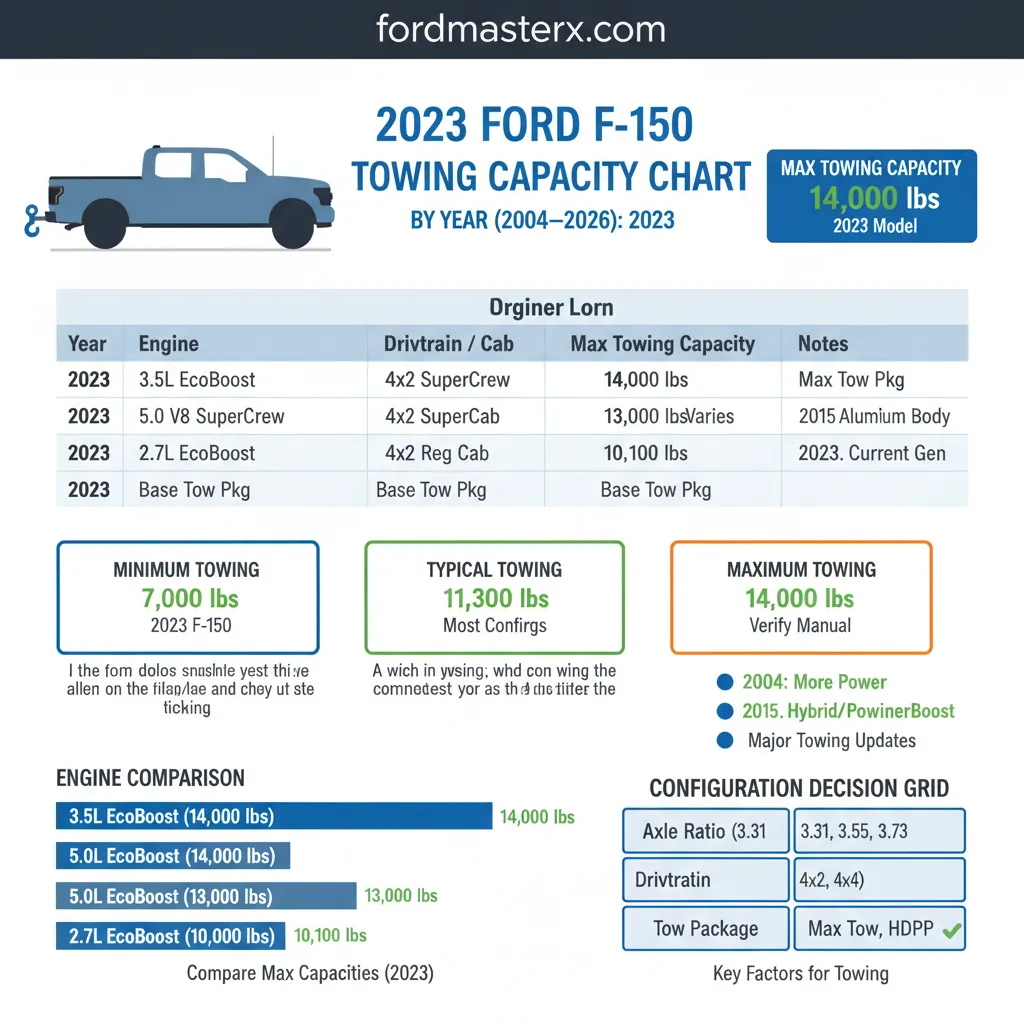
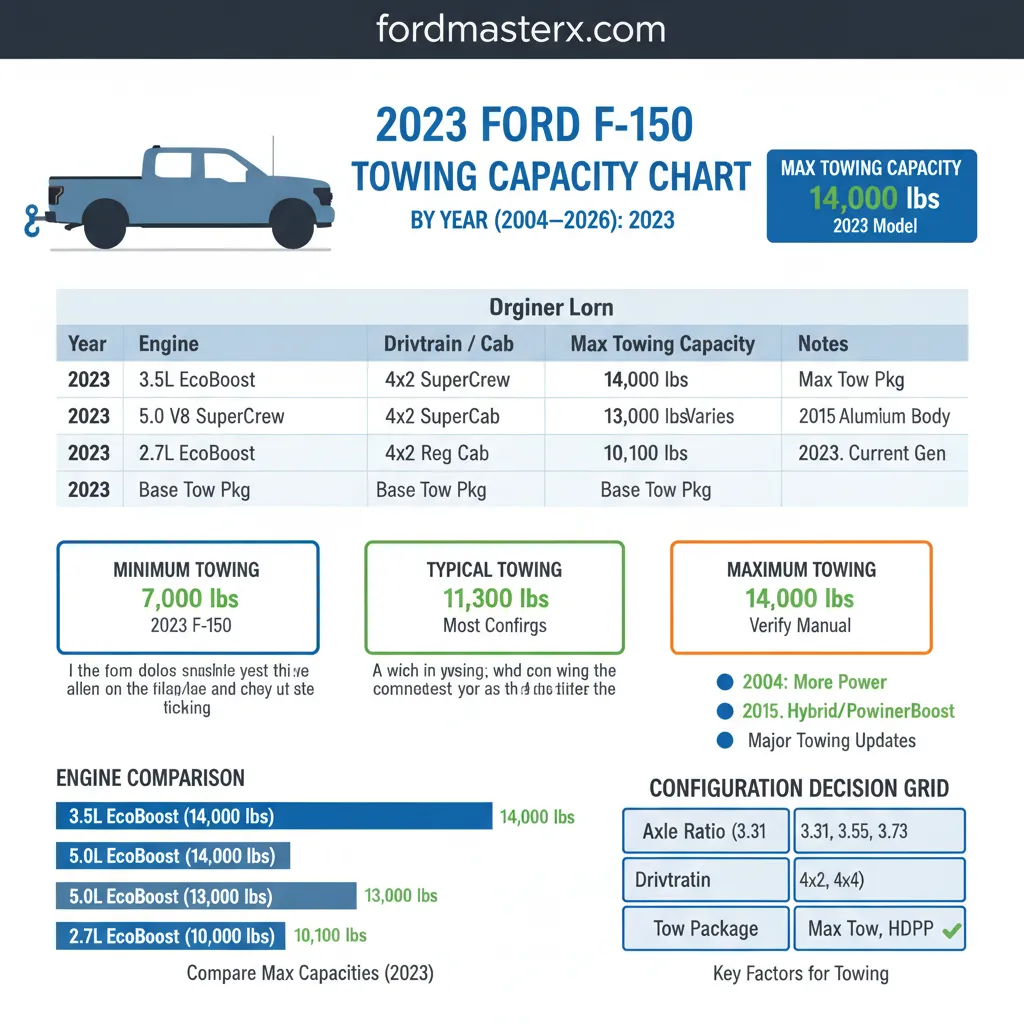
2023 Ford F-150 Maximum Towing Capacity Chart (Factory Specifications)
Recommended Best Deal Products


📤 Share Image
This chart details the maximum available towing capacities for the 2023 Ford F-150 across various engine and drivetrain configurations. While efforts have been made to compile accurate data from manufacturer specifications, actual capacities can vary based on specific options, axle ratios, wheel sizes, and payload packages. Always refer to your vehicle’s owner’s manual and the payload sticker on the driver’s side door jamb for the definitive, VIN-specific towing and payload limits. This information was last reviewed: May 2026.
This table presents a comprehensive overview of the 2023 Ford F-150’s maximum towing capabilities. To interpret the data accurately, understand that the ‘Max Towing Capacity’ figures represent the absolute highest ratings achievable for that specific engine and drivetrain, often requiring the Max Trailer Tow Package and the most aggressive axle ratio available for that configuration. Lower axle ratios or the absence of the Max Trailer Tow Package will result in reduced capacities.
| Year | Engine | Drivetrain / Cab | Max Towing Capacity | Notes |
|---|---|---|---|---|
| 2023 | 3.3L Ti-VCT V6 | 4×2 (Reg Cab, SuperCab, SuperCrew) | 8,200 lbs | Requires Max Trailer Tow Package; 3.73 Axle |
| 2023 | 3.3L Ti-VCT V6 | 4×4 (Reg Cab, SuperCab, SuperCrew) | 7,900 lbs | Requires Max Trailer Tow Package; 3.73 Axle |
| 2023 | 2.7L EcoBoost V6 | 4×2 (Reg Cab, SuperCab, SuperCrew) | 10,100 lbs | Requires 2.7L EcoBoost Payload Package; 3.73 Axle |
| 2023 | 2.7L EcoBoost V6 | 4×4 (Reg Cab, SuperCab, SuperCrew) | 9,900 lbs | Requires 2.7L EcoBoost Payload Package; 3.73 Axle |
| 2023 | 5.0L Ti-VCT V8 | 4×2 (Reg Cab, SuperCab, SuperCrew) | 13,000 lbs | Requires Max Trailer Tow Package; 3.73 Axle; Heavy-Duty Payload Package |
| 2023 | 5.0L Ti-VCT V8 | 4×4 (Reg Cab, SuperCab, SuperCrew) | 12,900 lbs | Requires Max Trailer Tow Package; 3.73 Axle; Heavy-Duty Payload Package |
| 2023 | 3.5L EcoBoost V6 | 4×2 (SuperCrew) | 14,000 lbs | Requires Max Trailer Tow Package; 3.55 or 3.73 Axle |
| 2023 | 3.5L EcoBoost V6 | 4×4 (SuperCrew) | 13,900 lbs | Requires Max Trailer Tow Package; 3.55 or 3.73 Axle |
| 2023 | 3.5L PowerBoost Full Hybrid V6 | 4×2 (SuperCrew) | 12,700 lbs | Requires Max Trailer Tow Package; 3.73 Axle |
| 2023 | 3.5L PowerBoost Full Hybrid V6 | 4×4 (SuperCrew) | 12,700 lbs | Requires Max Trailer Tow Package; 3.73 Axle |
| 2023 | 3.5L High-Output EcoBoost V6 (Raptor/Tremor) | 4×4 (SuperCrew) | 8,700 lbs | Specific off-road suspension reduces tow capacity. |
The “Max Towing Capacity” figures above are generally achieved with the optimal configuration for towing, which often includes a 4×2 drivetrain, Regular Cab or SuperCab, a long bed, the Max Trailer Tow Package, and the highest numerical axle ratio available (e.g., 3.73). Any deviation from these configurations will likely result in a lower maximum towing capacity.

Historical Ford F-150 Towing Capacity Evolution (2004-2026)
The Ford F-150’s towing capabilities have undergone a remarkable evolution over the past two decades, driven by significant engineering advancements and changing market demands. Since 2004, Ford has consistently pushed the boundaries of what a half-ton pickup can achieve, leveraging new engine technologies, chassis designs, and sophisticated towing assistance features.
Key milestones have shaped this journey:
- Early 2000s (e.g., 2004-2008): Max towing typically hovered around 10,000-10,500 lbs, primarily driven by V8 engines like the 5.4L Triton.
- Introduction of EcoBoost (c. 2011): The 3.5L EcoBoost V6 was a game-changer. Initially matching or exceeding the V8’s towing capacity (around 11,300 lbs), it demonstrated that smaller displacement, turbocharged engines could deliver impressive torque and towing performance, fundamentally altering expectations for truck powertrains.
- Aluminum-Alloy Body (c. 2015): The shift to an aluminum-intensive body for the 2015 model year significantly reduced the truck’s curb weight by up to 700 pounds. This weight savings directly translated to increased payload and towing capacities, allowing the F-150 to reach 12,200 lbs. Research indicates this lightweighting strategy was crucial for enhancing capability without increasing vehicle footprint.
- Second-Gen EcoBoost & 10-Speed Transmission (c. 2017): Further refinements to the EcoBoost engines and the introduction of the 10-speed automatic transmission optimized power delivery and efficiency, pushing maximum conventional towing to 13,200 lbs.
- PowerBoost Full Hybrid (c. 2021): The launch of the 3.5L PowerBoost hybrid engine, offering a blend of power, efficiency, and integrated Pro Power Onboard generator, still maintained impressive towing figures, reaching up to 12,700 lbs, proving hybrid technology could coexist with heavy-duty work.
- Current Max Capacity (2023-2026): With continuous powertrain and chassis improvements, the 3.5L EcoBoost continues to lead, hitting 14,000 lbs for 2023, showcasing Ford’s commitment to class-leading performance.
Ford has also advanced towing support features, making towing safer and easier. Features like Trailer Sway Control, Pro Trailer Backup Assist, and Smart Trailer Tow Connector have become standard or widely available, demonstrating a holistic approach to towing capability beyond just the numbers.
Max towing around 10,000-10,500 lbs with 5.4L V8 engines.

Audible — Listen Free for 30 Days
One free credit a month and thousands of titles included.
Listen Free for 30 Days As an Amazon Associate I earn from qualifying purchases.3.5L EcoBoost V6 introduced, challenging V8 supremacy, maxing at ~11,300 lbs.
Significant weight savings led to increased payload and max towing up to 12,200 lbs.
Optimized powertrains pushed conventional towing to 13,200 lbs.
Hybrid option introduced, maintaining strong towing (up to 12,700 lbs) with added efficiency.
Max towing hits 14,000 lbs, solidifying F-150’s leadership in the half-ton segment.
Dissecting F-150 Towing: Engine, Drivetrain, and Configuration Impact
Understanding the F-150’s towing capacity requires a deep dive into its core components. The interplay of engine choice, drivetrain, cab style, and critically, the axle ratio, determines the final, verifiable towing rating.
Engine Options and Their Towing Prowess
Each engine option in the 2023 F-150 lineup is engineered with distinct characteristics that influence its towing capability:
- 3.3L Ti-VCT V6: This naturally aspirated V6 serves as the entry-level engine, ideal for lighter tasks. With sufficient horsepower and torque, it can comfortably handle smaller boats or utility trailers, maxing out at 8,200 lbs. It’s a reliable workhorse for everyday needs.
- 2.7L EcoBoost V6: A remarkably capable smaller displacement engine. Its twin-turbochargers provide excellent low-end torque, making it feel more potent than its size suggests. It can pull up to 10,100 lbs, making it a popular choice for those balancing fuel economy with respectable towing.
- 5.0L Ti-VCT V8: The traditionalist’s choice, offering classic V8 rumble and strong, linear power delivery. With a maximum rating of 13,000 lbs, the 5.0L is a highly capable towing engine, especially when paired with the Heavy-Duty Payload Package, which often unlocks higher V8 tow ratings.
- 3.5L EcoBoost V6: This is the towing king of the F-150 lineup. Its twin-turbo design delivers a massive 500 lb-ft of torque, peaking at 14,000 lbs of towing capacity. This engine’s wide, flat torque curve makes it exceptionally well-suited for heavy trailers, providing confident acceleration and sustained pulling power.
- 3.5L PowerBoost Full Hybrid V6: Combining the powerful 3.5L EcoBoost with an electric motor, the PowerBoost offers excellent fuel economy alongside 12,700 lbs of towing capacity. Its instant electric torque is beneficial for smooth starts under load.
- 3.5L High-Output EcoBoost V6: Found in the Raptor and Tremor, this engine prioritizes off-road performance. While powerful, its specialized suspension setup (designed for high-speed desert running) means a lower towing capacity of 8,700 lbs compared to the standard 3.5L EcoBoost.
Drivetrain, Cab & Bed Configurations
- Drivetrain (4×2 vs. 4×4): Generally, 4×2 (two-wheel drive) models offer slightly higher maximum towing capacities than their 4×4 counterparts. This is due to the lower curb weight of the 4×2 system, which directly translates to a higher available payload and thus a higher GCWR before exceeding limits.
- Cab Styles (Regular Cab, SuperCab, SuperCrew): Longer wheelbases and lighter vehicle curb weights typically yield higher towing capacities. A Regular Cab with a long bed (8 ft) in 4×2 configuration often provides the highest towing and payload ratings for a given engine, as it’s the lightest and most rigid platform. SuperCab and SuperCrew configurations, while more spacious, are heavier and have longer wheelbases, which can sometimes reduce maximum tow ratings, though they excel in stability.
- Bed Lengths (5.5′, 6.5′, 8′): A longer bed often contributes to a longer wheelbase, which can enhance stability when towing. However, the overall vehicle length and weight also play a role.
The Critical Role of Axle Ratio
The axle ratio is arguably one of the most significant factors, after the engine, determining towing capacity. Expressed as a ratio (e.g., 3.31, 3.55, 3.73), it dictates how many times the drive shaft rotates for each rotation of the wheel. A higher numerical ratio (e.g., 3.73) provides greater mechanical advantage, allowing the engine to turn the wheels with more force for heavy pulling, though it typically comes at the expense of fuel economy. Conversely, a lower numerical ratio (e.g., 3.31) is better for highway cruising efficiency but reduces towing prowess.
Higher torque engines (EcoBoost, V8) unlock higher potential. PowerBoost balances power with efficiency.
Audible Premium Plus — Annual Membership
12 audiobook credits up front, plus the full Audible catalogue.
See Annual Plans As an Amazon Associate I earn from qualifying purchases.4×2 often yields slightly higher max tow. Regular Cab/Long Bed generally offers best base for capacity.
For maximum towing, opt for the highest available numerical axle ratio (e.g., 3.73). This is crucial.
The Max Trailer Tow Package (e.g., Class IV hitch, upgraded receiver, integrated brake controller) is almost always required for top ratings.
Key Factors Affecting Your Ford F-150’s Real-World Towing Performance
While the charts provide maximum ratings, real-world towing performance and safety involve several critical factors beyond just the advertised tow capacity. Neglecting these can lead to unsafe conditions, accelerated wear, or even legal issues.
Understanding Weight Ratings: GVWR, GCWR, and Payload
- Gross Vehicle Weight Rating (GVWR): This is the maximum permissible weight of the fully loaded truck, including its own weight, passengers, cargo, and the tongue weight of any attached trailer. Exceeding GVWR can compromise handling, braking, and structural integrity.
- Gross Combined Weight Rating (GCWR): This is the maximum permissible weight of the fully loaded truck and the fully loaded trailer combined. It’s the ultimate limit for the entire towing system, including engine, transmission, and brakes. Exceeding GCWR is a common and dangerous oversight.
- Payload Capacity: Often overlooked, this is the maximum amount of weight your truck can carry, including occupants, cargo in the bed/cab, and the trailer’s tongue weight. Your available payload directly impacts the size of the trailer you can safely tow, as every pound of tongue weight reduces your remaining payload.
By The Numbers: Key Weight Capacities
Understanding these general ranges helps contextualize your F-150’s capabilities. Always refer to your specific truck’s door jamb sticker for precise figures.
Tongue Weight and Hitch Type
The tongue weight (the downward force exerted by the trailer on the hitch) is crucial. It should ideally be 10-15% of the total loaded trailer weight. Too little tongue weight can cause dangerous trailer sway, while too much can overload your truck’s rear axle and reduce steering control. For trailers exceeding 5,000 lbs, a weight-distributing hitch is highly recommended, and often required, to distribute the tongue weight more evenly across the truck’s axles and the trailer’s axles, significantly improving stability.
Essential Towing Equipment and Tires
- Trailer Brakes: For trailers above a certain weight (typically 1,500 lbs, check local laws), independent trailer brakes are mandatory. An integrated trailer brake controller (often part of a tow package) allows you to control these brakes from the F-150’s cabin.
- Tires: Ensure your F-150 is equipped with tires rated for the load. Light Truck (LT) tires generally offer higher load capacities and stiffer sidewalls compared to Passenger (P-metric) tires, providing better stability for heavy towing.
- Cooling Systems: Heavy towing demands more from your engine and transmission. Most F-150s configured for maximum towing will have enhanced cooling systems as part of the Max Trailer Tow Package.
Environmental and Operational Factors
Even with the perfect setup, external factors impact towing:
- Elevation and Grade: High altitudes reduce engine power. Steep inclines and declines put extra strain on the powertrain and brakes.
- Weather Conditions: Strong winds, rain, or snow significantly impact stability and braking distances.
- Maintenance: A properly maintained vehicle with fresh fluids, good brakes, and correctly inflated tires will always perform better and safer when towing.
Confirming Your F-150’s Specific Towing Capacity: Owner’s Manual & Door Sticker
While general charts provide a valuable overview, the precise, legally binding towing and payload limits for your specific Ford F-150 are unique to that vehicle. Relying solely on general figures can lead to overloading, which is dangerous and can void warranties or lead to fines.
The Owner’s Manual: Your Primary Authority
Every F-150 comes with an owner’s manual that contains detailed towing tables. These tables break down capacities by engine, axle ratio, drivetrain, and cab/bed configuration. It is the most comprehensive guide to your truck’s capabilities and should be your first point of reference. Ford’s official factory towing guide, often available online, also provides similar detailed charts.
The Door Jamb Sticker: Your VIN-Specific Payload Data
The yellow and white tire and loading information sticker, typically located on the driver’s side door jamb, is paramount. This sticker provides the specific payload capacity (Occupant and Cargo Carrying Capacity) for your exact VIN. This figure accounts for all factory-installed options and accessories, which add weight to the vehicle and reduce the available payload. For instance, a truck with more luxury features will have a lower payload capacity than a base model with the same engine and axle, simply due to the added weight of those features.
Before calculating anything, always check the “The combined weight of occupants and cargo should never exceed XXXX lbs” figure on your door jamb sticker. This is your truck’s actual, verified payload capacity, and it directly dictates how much tongue weight your F-150 can handle.
Verifying Options and Packages
For used vehicles, or if you’re unsure about specific factory options, using an online VIN decoder or contacting a Ford dealership with your VIN can help confirm installed packages like the Max Trailer Tow Package or Heavy-Duty Payload Package. These packages are critical for achieving the highest towing ratings.
Frequently Asked Questions (FAQs) About F-150 Towing Capacity
What is the highest towing capacity for a 2023 Ford F-150?
The highest towing capacity for a 2023 Ford F-150 is 14,000 lbs. This is achieved with the 3.5L EcoBoost V6 engine, 4×2 drivetrain, and the Max Trailer Tow Package, typically with a 3.55 or 3.73 axle ratio.
Does the F-150 PowerBoost Hybrid have good towing capacity?
Yes, the 2023 Ford F-150 PowerBoost Full Hybrid V6 offers a robust towing capacity of up to 12,700 lbs when properly equipped. This makes it an excellent option for those seeking both strong towing capability and improved fuel efficiency.
How does the axle ratio affect F-150 towing?
The axle ratio significantly impacts towing. A higher numerical axle ratio (e.g., 3.73) provides more mechanical advantage, allowing the engine to generate greater torque at the wheels, thus increasing towing capacity. Conversely, a lower numerical ratio (e.g., 3.31) prioritizes fuel economy but reduces towing capability.
Is the Max Trailer Tow Package required for maximum towing on a 2023 F-150?
For most configurations, particularly those aiming for the highest advertised towing capacities, the Max Trailer Tow Package is absolutely essential. This package typically includes an upgraded hitch receiver, integrated trailer brake controller, enhanced cooling, and other necessary components to safely handle heavier loads.
Where can I find the exact payload capacity for my specific F-150?
You can find the exact payload capacity for your specific F-150 on the yellow and white tire and loading information sticker located on the driver’s side door jamb. This sticker provides the “Occupant and Cargo Carrying Capacity” which is unique to your vehicle’s VIN and factory options.
Conclusion
The 2023 Ford F-150 continues its legacy as a formidable towing machine, offering a wide range of capabilities peaking at an impressive 14,000 lbs. This maximum capacity is critically dependent on the careful selection of engine, drivetrain, axle ratio, and the inclusion of the Max Trailer Tow Package. Historical trends demonstrate significant advancements in F-150 towing, driven by continuous engine innovation, structural improvements like the aluminum body, and advanced towing technologies.
However, understanding the chart is only part of the equation. Always consult your vehicle’s specific owner’s manual and the payload sticker on the door jamb for the definitive and legally binding towing and payload limits, as these account for your F-150’s unique configuration. Before hitching up, refer to your Ford F-150’s owner’s manual and door jamb sticker, and utilize our comprehensive chart to ensure safe and efficient towing. Consult a certified Ford dealership for personalized configuration advice to match your specific towing needs.
Frequently Asked Questions
What is the maximum towing capacity for a 2023 Ford F-150?
The maximum towing capacity for a 2023 Ford F-150 can reach up to 14,000 lbs. This top rating is typically achieved with specific configurations, including the 3.5L EcoBoost V6 engine, a SuperCab or SuperCrew 4×2, an appropriate axle ratio (often 3.73), and the Max Trailer Tow Package. Consult your door jamb sticker and owner’s manual for your vehicle’s precise rating.
How does the axle ratio affect F-150 towing capacity?
The axle ratio significantly impacts towing capacity by altering the mechanical advantage applied to the wheels. A ‘higher’ numerical axle ratio (e.g., 3.73 compared to 3.31) means the engine spins more for each wheel rotation, providing more torque at the wheels for pulling heavy loads, thus increasing towing capacity. Conversely, lower ratios generally improve fuel economy.
Does the F-150’s cab and bed configuration change towing capacity?
Yes, the F-150’s cab style (Regular Cab, SuperCab, SuperCrew) and bed length (5.5′, 6.5′, 8′) impact towing capacity. Different configurations lead to variations in the truck’s curb weight, wheelbase, and GVWR. Generally, lighter configurations with shorter wheelbases or specific weight distribution can sometimes achieve slightly higher maximum towing ratings, though stability is also a key consideration.
What is the importance of a ‘tow package’ for F-150 towing?
A factory ‘tow package’ (like the Max Trailer Tow Package) is crucial because it includes essential components engineered to support high towing capacities. These often include an upgraded hitch receiver, a trailer brake controller, enhanced engine cooling, a larger radiator, specific wiring harnesses, and reinforced frames or suspensions. Without it, your F-150’s towing capacity will be significantly lower.
Where can I find the precise towing and payload capacity for my specific F-150?
For the most accurate and legally binding towing and payload information for your specific Ford F-150, always refer to the yellow tire and loading information sticker located on the driver’s side door jamb. This sticker details your vehicle’s Gross Vehicle Weight Rating (GVWR), Gross Axle Weight Ratings (GAWR), and maximum payload capacity, which directly influences how much tongue weight you can carry.