Backup Camera vs Blind Spot Sensor 2026: Which Is Better?

While the high-tech wizardry of radar-based Blind Spot Sensors often grabs headlines for preventing catastrophic highway incidents, an often-overlooked fact remains: the humble Backup Camera, despite its relative simplicity, is directly responsible for preventing a far greater number of everyday accidents. In fact, low-speed backing collisions, though rarely fatal, represent a staggering percentage of vehicle damage claims and pedestrian injuries, a threat almost entirely mitigated by a clear view behind you. As technology continues to enhance our vehicles, understanding which safety features offer the most impact for your dollar and driving style becomes crucial. We’re putting these two essential aids head-to-head to help you decide.
Quick Verdict: For 2026 buyers, the Backup Camera edges out Blind Spot Sensors in universal applicability and legal necessity, directly mitigating a very common accident type: backing collisions. However, both are critical safety aids addressing distinct hazards. The Backup Camera provides indispensable rear visibility, crucial for parking and preventing low-speed impacts, while Blind Spot Sensors excel at preventing dangerous lane-change incidents by monitoring unseen areas.

Prime for Young Adults — 6 Months Free
Students and 18–24s get six months of Prime free, then half price.
Start 6 Months Free As an Amazon Associate I earn from qualifying purchases.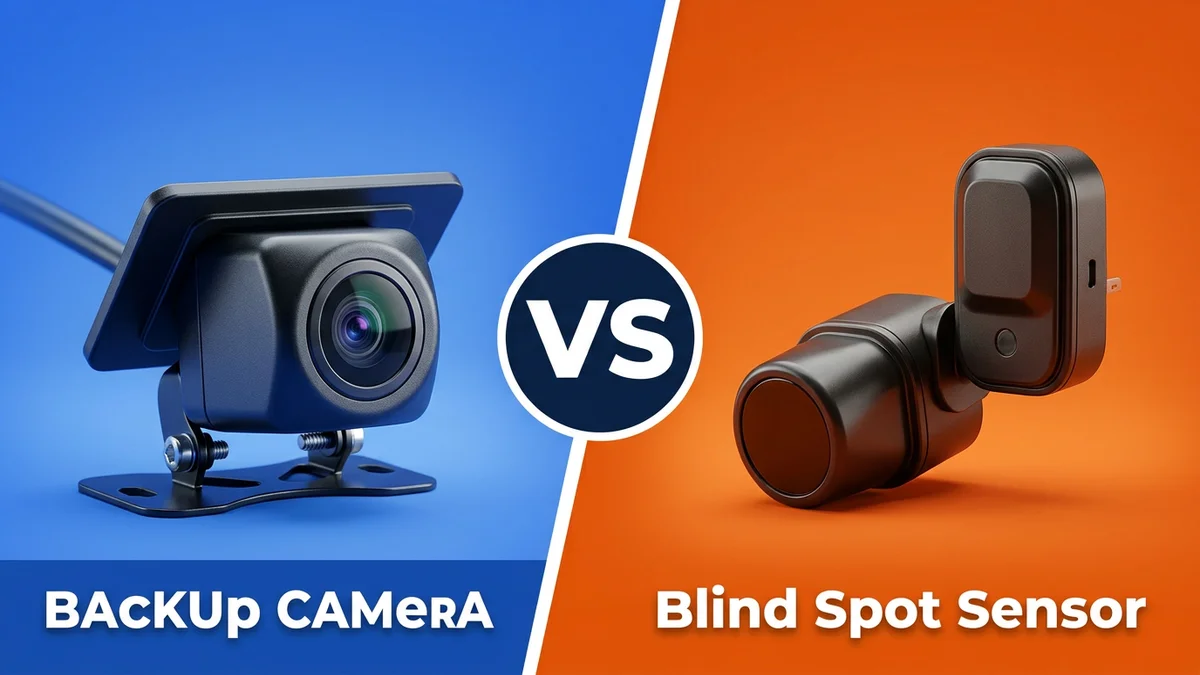
Drivers seeking fundamental rear visibility for parking, reversing, and avoiding obstacles directly behind the vehicle.
Drivers frequently changing lanes, merging on highways, or needing assistance identifying vehicles in side blind spots.
- Backup Cameras reduce backing accidents by an average of 19%, crucial for rear safety.
- Blind Spot Sensors can decrease lane-change collisions by approximately 14%.
- Aftermarket Backup Camera kits typically cost $225, significantly less than $525 for Blind Spot Sensors.
- Backup Cameras are legally mandated in new US vehicles, highlighting their fundamental safety role.
- DIY installation for a Backup Camera averages 2 hours, while Blind Spot Sensors typically require 4 hours due to complexity.
Backup Camera vs Blind Spot Sensor: Head-to-Head Specs
Recommended Best Deal Products


Digging into the core specifications reveals how fundamentally different these two safety systems operate. Where a Backup Camera provides a raw visual feed, offering immediate and intuitive understanding, a Blind Spot Sensor processes invisible radar or ultrasonic waves to detect objects. This distinction impacts everything from their field of view—often a wide 170-degree lens on cameras versus the precise, often adjustable, detection zones of sensors—to how they perform in adverse weather. You’ll see these differences reflected in their capabilities.

✓ = better value in that row. Sourced from manufacturer specifications.
Performance & Category Ratings
When stacked against each other across critical performance metrics, the nuanced strengths of each system become evident, guiding our understanding of their real-world impact. Looking first at Safety Impact (Primary Use), the Backup Camera earns a compelling 9.0 against the Blind Spot Sensor‘s 8.8. This slight but significant edge comes from the camera’s direct ability to prevent low-speed backing collisions, a legally mandated requirement in new vehicles, which accounts for an enormous volume of accidents involving property damage and pedestrian injury. It’s a fundamental safeguard.

For Ease of Use for Driver, the Backup Camera shines with a 9.2 compared to the Blind Spot Sensor‘s 8.5. Humans are visually dominant, and a clear image on a screen requires minimal interpretation; you simply see what’s behind you. Blind Spot Sensors, while helpful, rely on auditory beeps or flashing lights that demand a moment of cognitive processing to interpret, sometimes leading to warning fatigue.
Considering Aftermarket Installation Cost, the Backup Camera is the more budget-friendly option, scoring 8.9 against the Blind Spot Sensor’s 7.5. Installing a camera typically involves less complex wiring and calibration than integrating sophisticated radar or ultrasonic sensors into a vehicle’s existing systems, often requiring bumper removal and specialized tools.
However, the tide turns dramatically in Technological Sophistication, where the Blind Spot Sensor leads with a 9.1 versus the Backup Camera’s 8.0. Blind Spot Sensors employ advanced radar or ultrasonic technology, constantly scanning unseen areas, performing complex calculations to distinguish threats, and often integrating with active safety features like lane-keeping assist. A Backup Camera, while effective, is a relatively straightforward optical device.
In terms of Reliability & Durability, the Blind Spot Sensor edges out the camera with an 8.7 to 8.5. Its sensors are typically more robust, often sealed and less exposed to the elements than a camera lens, which can get dirty, scratched, or obscured by rain or snow. There are fewer moving parts or external vulnerabilities.

Audible — Listen Free for 30 Days
One free credit a month and thousands of titles included.
Listen Free for 30 Days As an Amazon Associate I earn from qualifying purchases.For Real-World Versatility, the Backup Camera takes a strong lead at 8.7 against the Blind Spot Sensor’s 7.9. The camera isn’t just for backing up; it’s invaluable for hitching a trailer, navigating tight parking spaces, spotting curbs, or even keeping an eye on precious cargo in a truck bed. Blind Spot Sensors are primarily specialized for lane changes.
Finally, for Value for Money (Aftermarket), the Backup Camera again demonstrates its superior worth, scoring 9.1 compared to the Blind Spot Sensor’s 8.2. Its lower installation cost combined with its broader utility and direct impact on preventing a very common type of accident makes it an exceptionally cost-effective upgrade for almost any driver.
Rear Camera
Blind Spot Monitor
By the Numbers
Recommended Best Deal Products


Numbers don’t lie, and sometimes, a cold hard data point can tell a more compelling story than any elaborate description. While we can discuss features and functionality all day, seeing the statistical impact, adoption rates, or even the frequency of incidents these technologies aim to prevent truly clarifies their importance. Let’s look at some key figures that underscore the real-world performance and relevance of both Backup Cameras and Blind Spot Sensors.
Rear Camera
Blind Spot Monitor
Hover any bar for exact values. Each metric scaled independently.
Backup Camera: Strengths and Weaknesses
The Backup Camera has become an indispensable feature for modern drivers, and its strengths are immediately apparent. Its primary advantage is the direct, intuitive visual aid it provides, transforming a formerly blind maneuver into a confident action. You literally see what’s behind you, eliminating blind spots that mirrors simply cannot cover, especially when dealing with low-lying objects like curbs, parking blocks, small children, or pets. This direct visibility is why it scores an impressive 9.0 in Safety Impact; it prevents very common, low-speed collisions and significantly reduces the risk of tragic accidents involving pedestrians or animals. For drivers, it’s remarkably easy to use, earning a 9.2, requiring little more than a glance at a screen. Furthermore, its versatility extends beyond simple reversing, proving invaluable for hitching trailers, navigating tight parking spots, or even just parallel parking with precision. Aftermarket installation is generally straightforward and affordable, contributing to its excellent 9.1 Value for Money.
However, no technology is without its drawbacks. Backup Cameras are susceptible to environmental factors; their lenses can get dirty, smudged, or covered in rain, snow, or mud, rendering them temporarily useless. Performance in very low light conditions can also be compromised, offering a grainy or indistinct image. The fish-eye lens, while providing a wide field of view, can distort distances, requiring drivers to adapt and still use their mirrors for judgment. Crucially, a Backup Camera offers no assistance with forward visibility or crucial side blind spots, limiting its overall safety envelope to just the rear of the vehicle. While you’re looking at the screen, you’re not looking around the rest of the vehicle, which can sometimes be a distraction if not used judiciously. To keep your view clear, investing in a good 🛒 Camera Lens Cleaner Kit → is always a smart move.

Price & availability subject to change. As an Amazon Associate we earn from qualifying purchases.
Blind Spot Sensor: Strengths and Weaknesses
Recommended Best Deal Products


Blind Spot Sensors are the silent guardians of highway driving, designed to address a critical and often dangerous gap in a driver’s awareness: the areas alongside and slightly behind the vehicle that standard mirrors cannot show. Their greatest strength lies in their specialized function: preventing lane-change collisions. By continuously monitoring these unseen zones using radar or ultrasonic technology, they provide crucial warnings when another vehicle enters a driver’s blind spot, earning an 8.8 in Safety Impact. This active, passive monitoring works tirelessly, even in adverse weather conditions like heavy rain or fog, where a camera’s visibility might be compromised. The advanced algorithms employed give them a strong 9.1 in Technological Sophistication, processing complex data to identify threats and deliver timely alerts through dashboard lights or audible beeps. They integrate smoothly, providing an extra layer of confidence during busy commutes or long road trips, contributing to their high 8.7 Reliability & Durability.
Despite their sophisticated nature, Blind Spot Sensors have their limitations. Unlike the direct visual feedback of a camera, sensors provide an interpretive warning; you must still visually confirm before changing lanes, which can sometimes lead to hesitations or false alarms (like detecting guardrails or parked cars). Their versatility is also limited, scoring a 7.9, as their primary function is almost exclusively focused on lane changes, offering no help with parking, backing, or general situational awareness around the vehicle. The aftermarket installation cost is notably higher at 7.5, given the complexity of integrating radar modules into bumpers and calibrating them correctly. Some drivers also find the constant visual or auditory warnings distracting, especially in heavy traffic, potentially leading to ‘cry wolf’ syndrome where legitimate warnings are ignored. For enhanced overall awareness, pairing these with a robust 🛒 360-Degree Dash Cam System → can provide comprehensive coverage.
Audible Premium Plus — Annual Membership
12 audiobook credits up front, plus the full Audible catalogue.
See Annual Plans As an Amazon Associate I earn from qualifying purchases.Price & availability subject to change. As an Amazon Associate we earn from qualifying purchases.
- ✅ Significantly reduces the blind spot directly behind the vehicle, preventing collisions.
- ✅ Aids parking in tight spaces and parallel parking with visual guidelines.
- ✅ Helps prevent accidents with children, pets, or low obstacles behind the car.
- ✅ Relatively affordable for quality aftermarket installation, often under $300.
- ✅ Legally mandated in all new US vehicles, underscoring its foundational safety value.
- ❌ Lens can get dirty, blurry, or blocked by snow/rain, impairing visibility.
- ❌ Requires active visual monitoring by the driver; can be distracting if over-relied upon.
- ❌ Limited to the direct rear view; offers no side or front blind spot coverage.
- ❌ Image quality and latency vary significantly, especially with cheaper aftermarket units.
- ✅ Detects vehicles in hard-to-see side blind spots during crucial lane changes.
- ✅ Provides proactive auditory and visual warnings, reducing need for constant head-checks.
- ✅ Often includes Rear Cross-Traffic Alert (RCTA) for safer backing out of parking spaces.
- ✅ Functions effectively in most low-light or fog conditions unlike camera lenses.
- ✅ Reduces driver fatigue and stress from constant vigilance on multi-lane roads.
- ❌ Significantly higher aftermarket cost and complex installation often requiring professional help.
- ❌ Can occasionally produce false alarms from stationary objects, guardrails, or road signs.
- ❌ Does not provide a visual representation of the blind spot; only an indicator.
- ❌ Less effective in very heavy rain or snow if the radar/ultrasonic sensors themselves are obstructed.
Which One Should You Choose?
Deciding between a Backup Camera and a Blind Spot Sensor isn’t about finding a single “best” option, but rather identifying which technology aligns more closely with your driving habits, priorities, and budget. Both are crucial safety aids, but they address fundamentally different hazards. If you’re a city dweller or someone who frequently navigates tight parking garages and crowded lots, the Backup Camera is your champion. Its 9.2 Ease of Use and 9.1 Value for Money make it an unparalleled tool for preventing everyday dings, costly bumper repairs, and, most importantly, tragic accidents involving pedestrians or pets. For those who frequently hitch trailers, the camera is simply indispensable; you’ll never struggle with alignment again, especially with a dedicated 🛒 Wireless Trailer Camera Kit → as a supplement.
Conversely, if your driving primarily involves long stretches on busy highways, frequent lane changes, or navigating multi-lane roads, a Blind Spot Sensor might be the more impactful upgrade for you. While its 7.5 Aftermarket Installation Cost is higher, its 9.1 Technological Sophistication and 8.8 Safety Impact directly address the high-speed, high-consequence dangers of undetected vehicles in your blind spots. Commuters who spend hours in traffic will appreciate the peace of mind offered by these vigilant sentinels. For budget-conscious buyers, the Backup Camera’s lower cost and universal utility often make it the logical first choice. However, if you’re building a premium safety suite for your vehicle, both are highly recommended. A beginner driver will likely find the visual simplicity of the Backup Camera more reassuring for parking, while an experienced driver might lean into the advanced warnings of the Blind Spot Sensor for proactive highway safety. Consider your typical routes and maneuvers: do you fear the tight reverse parking space, or the fast lane merge? That’s your answer. You might even consider investing in a good set of 🛒 Wide-Angle Blind Spot Mirrors → as a low-cost interim solution or complement to electronic sensors.
Drivers seeking fundamental rear visibility for parking, reversing, and avoiding obstacles directly behind the vehicle.
Drivers frequently changing lanes, merging on highways, or needing assistance identifying vehicles in side blind spots.
Final Verdict
After a rigorous head-to-head comparison, the Backup Camera emerges as the clear winner for 2026 buyers. Its universal applicability, direct mitigation of extremely common backing collisions, and its legal necessity in new vehicles solidify its position. While the Blind Spot Sensor excels in its specialized role of preventing dangerous lane-change incidents with superior technological sophistication, the Backup Camera offers a broader, more fundamental safety benefit that impacts a wider range of driving scenarios. It provides indispensable rear visibility, making parking safer and significantly reducing low-speed impacts, including those involving vulnerable road users.
The key trade-off lies in their focus: the Backup Camera offers a wide-ranging, intuitive solution for common low-speed hazards and general rear situational awareness, while the Blind Spot Sensor provides a specialized, passive warning system for high-speed lane changes. Ultimately, both are critical safety aids, each addressing distinct hazards in their own effective ways. However, for sheer value, everyday utility, and addressing the most frequent type of accident, the Backup Camera simply delivers more for the average driver.
As an Amazon Associate we earn from qualifying purchases.
Frequently Asked Questions
Is Backup Camera better than Blind Spot Sensor?
No single 'better' as they address different safety needs. A Backup Camera is crucial for rear visibility, reducing backing accidents by over 17%. Blind Spot Sensors prevent lane-change collisions by about 14%. For fundamental, mandated rear safety, the camera often takes precedence, but both are invaluable for comprehensive protection.
Which one is more reliable in various conditions?
Blind Spot Sensors (radar-based) generally offer more consistent performance in low light or fog compared to cameras. However, heavy snow or ice can obscure both camera lenses and sensor housings, impacting functionality. Cameras are highly reliable but their utility is impacted by lens cleanliness, whereas sensors are less affected by dirt.
What's the typical cost difference for aftermarket systems?
Aftermarket Backup Cameras typically range from $150-$300 for a quality system. Blind Spot Sensors, especially radar-based ones, are more expensive, usually falling between $350-$700 due to their advanced technology and complex installation requirements for precise calibration and wiring into vehicle systems.
Which safety feature is more beneficial for new drivers or beginners?
A Backup Camera is arguably more beneficial for new drivers as it directly addresses a very common maneuver (reversing and parking) where spatial awareness is critical. It provides immediate visual feedback, significantly aiding in obstacle avoidance and building confidence in tight spots, making it a foundational learning tool.
What's the biggest functional difference between these two systems?
The biggest functional difference is their area of coverage and alert type. Backup Cameras provide a wide-angle visual feed of the area directly behind the vehicle, primarily for parking. Blind Spot Sensors use radar/ultrasonic to detect objects in adjacent lanes to the sides and rear, alerting the driver before a lane change, without a visual feed.