What Does GVWR Mean? Gross Vehicle Weight Rating Explained

Gross Vehicle Weight Rating (GVWR) is the maximum weight a vehicle is legally and mechanically rated to carry, including the vehicle itself, fuel, passengers, and cargo. It is a fixed limit set by the manufacturer to ensure the brakes, suspension, and frame are not overloaded during operation.
🎯 Key Takeaways
Recommended Best Deal Products


- GVWR is the maximum safe operating weight of a fully loaded vehicle.
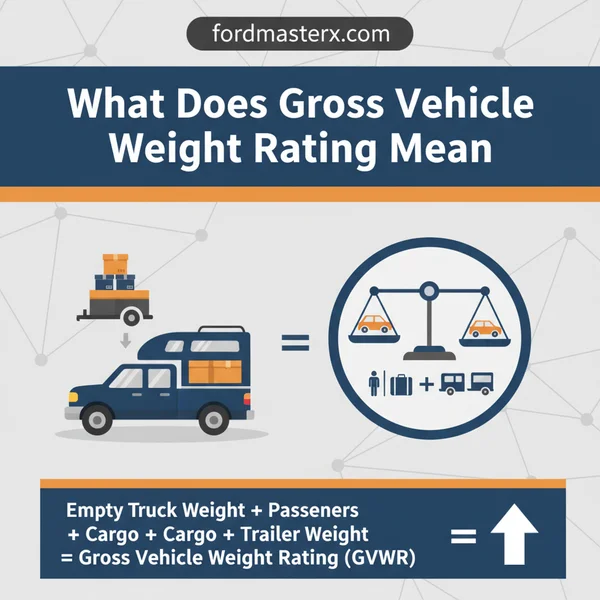
- The formula is:Curb Weight + Payload Capacity = GVWR.
- Locate your GVWR on the VIN sticker inside the driver’s door jamb.
- Exceeding GVWR compromises braking, handling, and structural integrity.
- GVWR is a permanent rating and cannot be legally increased with modifications.
Gross Vehicle Weight Rating (GVWR) is the absolute maximum weight your vehicle is legally and mechanically rated to carry when fully loaded. This is not a “suggested” weight or an estimate based on your driving style; it is a hard limit set by the manufacturer. It represents the total mass of the vehicle itself plus everything inside it, including the driver, passengers, fuel, accessories, and any cargo you have packed for the trip.
Understanding this number is critical for your safety and the longevity of your vehicle. If you exceed this rating, you put excessive stress on the engine, transmission, and frame. More importantly, you compromise your ability to stop quickly or steer during an emergency. Whether you are loading up a pickup truck for a construction job or packing an SUV for a family vacation, knowing your GVWR ensures you stay within the engineering limits that keep you and your passengers safe on the road.

Prime for Young Adults — 6 Months Free
Students and 18–24s get six months of Prime free, then half price.
Start 6 Months Free As an Amazon Associate I earn from qualifying purchases.Understanding GVWR: The Definition and Core Formula
The Gross Vehicle Weight Rating is the ceiling for your vehicle’s weight. It is determined during the manufacturing process by testing the weakest links in the vehicle’s structural chain. Engineers look at the capacity of the axles, the strength of the suspension system, the braking power, and the structural integrity of the frame. The lowest common denominator among these parts defines the GVWR. Once this rating is set and printed on your vehicle’s door jamb sticker, it remains constant for the life of the vehicle, regardless of any aftermarket upgrades you might install.
📤 Share
💾 Download
What Components Make Up Your Total Weight?
To stay within your GVWR, you must account for every pound that sits on the vehicle’s tires. Many drivers mistakenly believe that if they aren’t pulling a trailer, they don’t need to worry about weight. However, the GVWR accounts for the “static” weight that the vehicle supports directly. To understand how close you are to your limit, you must consider these four primary factors:
- Curb Weight: This is the weight of the vehicle with a full tank of fuel and all standard equipment, but without any passengers or cargo.
- Passenger Weight: The combined weight of every person in the vehicle. Manufacturers often use an average of 150 pounds per seat, but your actual passenger load may be much higher.
- Cargo and Accessories: This includes everything from luggage and tools to aftermarket additions like heavy steel bumpers, winches, or roof racks.
- Tongue Weight: If you are towing, the downward pressure that the trailer hitch exerts on the rear of your vehicle counts toward your GVWR.
The formula is simple: Curb Weight + Passengers + Cargo + Tongue Weight = Gross Vehicle Weight (GVW). As long as your GVW is equal to or less than your GVWR, you are operating within the manufacturer’s safety parameters. If the GVW exceeds the GVWR, you are technically overloaded, which can lead to legal penalties and mechanical failure.
GVWR vs. GCWR and Curb Weight: Key Distinctions
One of the most common points of confusion for vehicle owners is the alphabet soup of weight acronyms. It is easy to confuse GVWR with Curb Weight or Gross Combined Weight Rating (GCWR), but mixing these up can lead to dangerous loading errors. Each of these numbers serves a specific purpose in determining how much your vehicle can handle under different circumstances.
Curb Weight vs. GVWR: The Starting Point vs. The Limit
Curb weight is your vehicle’s baseline. Think of it as the weight of the car as it sits empty on the dealership lot. It includes all the fluids necessary for operation—like oil, coolant, and a full tank of gas—but nothing else. The difference between your GVWR and your Curb Weight is your Payload Capacity. For example, if your truck has a GVWR of 7,000 pounds and a Curb Weight of 5,000 pounds, you have a payload capacity of 2,000 pounds. This 2,000 pounds is the maximum “extra” weight you can add before hitting your limit.
GCWR: The Total Combined Limit
While GVWR focuses solely on the vehicle itself, the Gross Combined Weight Rating (GCWR) looks at the entire “train” on the road. This rating includes the weight of the vehicle, everything inside it, and the weight of a trailer and its contents. You can think of GCWR as the maximum weight the engine and transmission can effectively move and the brakes can effectively stop. It is possible to be under your GVWR (your truck isn’t overloaded) but over your GCWR (your trailer is too heavy for the engine to pull). Both limits must be respected simultaneously to ensure a safe driving experience.
- GVWR: Maximum weight of the vehicle alone (including what’s inside).
- GCWR: Maximum weight of the vehicle AND the trailer combined.
- Dry Weight: The weight of the vehicle without any fluids (fuel, oil, etc.); rarely used for daily loading calculations.
- Payload: The specific amount of weight you can add to the Curb Weight to reach the GVWR.
By keeping these distinctions clear, you can avoid the “overloading trap.” A common mistake is assuming that a high towing capacity means you can also fill the truck bed to the brim. In reality, the tongue weight of a heavy trailer often eats up so much of your GVWR that you have very little payload left for passengers or gear inside the truck. Always check your GVWR first, as it is usually the first limit you will hit when preparing for a trip.
Why GVWR Matters: Safety, Performance, and Legal Compliance
Understanding your vehicle’s GVWR isn’t just about following the rules; it is about ensuring that every trip you take is safe. When you exceed this rating, you are pushing the vehicle beyond its engineered limits. This leads to a domino effect of mechanical stress that can result in catastrophic failure at the worst possible moment.

Safety and Vehicle Performance
Overloading a vehicle directly impacts how it handles on the road. When you carry too much weight, your braking distance increases significantly. The brakes have to work much harder to stop the extra mass, which can lead to brake fade or complete failure during a long descent. Furthermore, an overloaded vehicle becomes “top-heavy” or unbalanced, making it much more likely to roll over during sharp turns or emergency maneuvers.

Audible — Listen Free for 30 Days
One free credit a month and thousands of titles included.
Listen Free for 30 Days As an Amazon Associate I earn from qualifying purchases.Legal and Financial Implications
Ignoring the GVWR can have serious consequences beyond the mechanics of the car. If you are pulled over and a law enforcement officer suspects you are overweight, you could face hefty fines and penalties. More importantly, in the event of an accident, being over your GVWR can be seen as negligence. This often gives insurance companies a reason to deny your claim, leaving you responsible for thousands of dollars in damages or legal fees.
- Increased Wear and Tear: Overloading leads to blown tires, cracked leaf springs, and premature transmission failure.
- Safety Hazards: Excess weight compromises steering response and stability in high winds.
- Warranty Issues: Most manufacturers will void your warranty if they find the vehicle was operated above its rated capacity.
Factors That Determine a Manufacturer’s Weight Rating
You might wonder why two trucks that look nearly identical have different GVWRs. The manufacturer determines these numbers based on a “weakest link” philosophy. They test every single component to see how much stress it can take before it fails, and the GVWR is set to protect the most vulnerable part of that system.
The Strength of the Foundation
The chassis and frame are the backbone of the vehicle. Engineers design these structures to handle specific loads without bending or snapping. A vehicle rated for a higher GVWR typically features a fully boxed steel frame or thicker gauges of metal. If the frame isn’t built to support 10,000 pounds, the vehicle will never be rated for that amount, regardless of how powerful the engine is.
Component Ratings: Axles, Tires, and Suspension
Manufacturers also look closely at the Gross Axle Weight Rating (GAWR). This is the maximum weight that can be placed on the front or rear axles specifically. Other critical factors include:
- Suspension Systems: The stiffness and travel of the springs and shocks determine how well the vehicle can support a load while maintaining contact with the road.
- Tire Load Index: Tires have specific weight limits. A GVWR will never exceed the combined load capacity of the tires installed at the factory.
- Braking Capacity: The size of the rotors and the strength of the calipers must be able to generate enough friction to stop the maximum rated weight repeatedly without overheating.
- Cooling Systems: Hauling heavy loads generates immense heat in the engine and transmission; the radiator and oil coolers must be able to dissipate that heat effectively.
Final Thoughts on Understanding Your GVWR
Gross Vehicle Weight Rating is more than just a number on a sticker; it is the definitive guide to your vehicle’s capabilities. By staying within this limit, you ensure that your brakes, tires, and frame can perform exactly as they were designed to. It protects your investment from unnecessary wear and, most importantly, keeps you and your passengers safe on the highway.
Before you load up for your next big project or vacation, take thirty seconds to check the compliance sticker on your driver-side door jamb. Know your limit, stay within it, and enjoy the peace of mind that comes with safe hauling!
❓ Frequently Asked Questions
What is the difference between GVWR and GCWR?
GVWR is the maximum weight of the individual vehicle and its internal load, while GCWR (Gross Combined Weight Rating) is the maximum weight of the vehicle plus a hitched trailer. Drivers must monitor both to ensure neither the vehicle’s chassis nor the combined towing capacity is exceeded.
Does GVWR include the weight of passengers and fuel?
Yes, GVWR accounts for every pound added to the vehicle, including a full tank of fuel, the driver, all passengers, and any cargo. It represents the total mass the vehicle’s brakes and suspension were engineered to manage safely.
How does tongue weight affect my GVWR calculation?
When towing, the downward pressure exerted by the trailer onto the hitch (tongue weight) is considered part of the vehicle’s payload. This weight must be added to the vehicle’s contents to ensure the total does not exceed the GVWR.
Why is GVWR important for DOT regulations?
The Department of Transportation uses GVWR to classify vehicles; for example, vehicles with a GVWR over 10,001 lbs are subject to different safety regulations and commercial requirements. Staying within this rating ensures legal compliance on public highways.
Audible Premium Plus — Annual Membership
12 audiobook credits up front, plus the full Audible catalogue.
See Annual Plans As an Amazon Associate I earn from qualifying purchases.Why can’t I change my GVWR with aftermarket parts?
GVWR is determined by the weakest component in the vehicle’s assembly, which could be the frame, axles, or braking system. Because a manufacturer certifies the entire system, adding air bags or heavier springs does not legally re-certify the vehicle for more weight.
How do I calculate my available payload using GVWR?
To find your payload capacity, subtract the vehicle’s Curb Weight (empty weight) from the GVWR listed on the door sticker. The resulting number is the maximum weight you can safely add in terms of people, gear, and tongue weight.