6.7 Powerstroke High Output Specs: 500 HP & 1,200 LB-FT Torque

The 6.7L High Output (HO) Powerstroke V8 diesel delivers a class-leading 500 horsepower and 1,200 lb-ft of torque, setting a new benchmark for heavy-duty trucks. Introduced for the 2023 Ford Super Duty, this engine features mechanical upgrades like a water-cooled turbocharger and stainless steel exhaust manifolds to manage increased heat and pressure.
🎯 Key Takeaways
Recommended Best Deal Products


- The HO variant delivers a massive 500 horsepower and 1,200 lb-ft of torque.
- A unique water-cooled turbocharger improves thermal management under heavy loads.
- Stainless steel exhaust manifolds replace cast iron for enhanced durability.
- The HO engine debuted as an option for the 2023 Ford Super Duty.
- Visual identifiers include a specific engine cover and ‘High Output’ badging.
The Ford 6.7L High Output (HO) Powerstroke diesel engine is the current king of the Super Duty lineup, delivering a massive 500 horsepower and 1,200 lb-ft of torque. These figures represent a significant jump over the standard Powerstroke, making it the most powerful diesel engine Ford has ever put into a consumer truck. If you are looking for the absolute maximum towing capacity and quickest acceleration under load, the HO variant is the specific engine designed to handle those extreme demands.

Prime for Young Adults — 6 Months Free
Students and 18–24s get six months of Prime free, then half price.
Start 6 Months Free As an Amazon Associate I earn from qualifying purchases.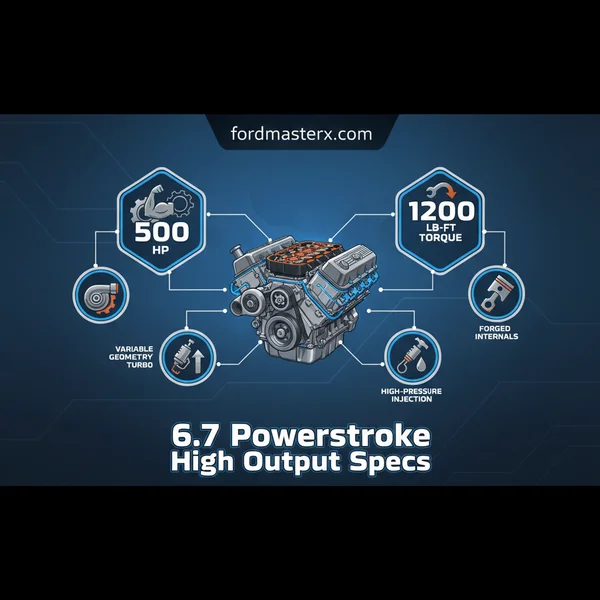
Understanding these specs matters practically because they change how your truck handles a trailer on a steep grade. With 1,200 lb-ft of torque available low in the RPM range, you experience less downshifting and more consistent pulling power. This engine isn’t just about bragging rights at the diesel pump; it is about having the mechanical headroom to move 30,000+ pounds without the engine breaking a sweat. Whether you are hauling heavy equipment or a massive fifth-wheel, the HO specs provide a buffer of performance that standard engines simply cannot match.
6.7L High Output vs. Standard Powerstroke: Performance Comparison
When you look at the 2023 and newer Super Duty spec sheets, the distinction between the standard 6.7L and the High Output version is clear. While the standard engine is certainly no slouch, the HO version pushes the envelope of what is possible with factory diesel performance. The 25-horsepower increase might seem modest on paper, but the 150 lb-ft jump in torque is what truly transforms the driving dynamics of the truck.
The 1,200 lb-ft Torque Milestone
The most critical figure for any diesel enthusiast is the torque peak. The 6.7L HO hits its 1,200 lb-ft peak remarkably early, allowing you to get heavy loads moving from a dead stop with minimal effort. This massive torque output is managed by a specifically tuned 10-speed TorqShift automatic transmission that can handle the increased input torque without slipping.
- Horsepower: 500 hp @ 2,600 RPM
- Torque: 1,200 lb-ft @ 1,600 RPM
- Compression Ratio: 15.2:1 (Optimized for high-boost applications)
- Standard Engine Comparison: 475 hp / 1,050 lb-ft torque
Because the torque peaks at just 1,600 RPM, the engine operates in its “sweet spot” during most highway cruising scenarios. You will find that the truck maintains speed on inclines without needing to hunt for gears. This efficiency in power delivery not only improves the driving experience but also reduces the wear and tear associated with frequent gear hunting under load.
Power Delivery and Boost Pressure
The HO variant utilizes a more aggressive fuel mapping and boost profile than the standard 6.7L. To reach that 500 hp mark, the engine relies on higher sustained boost levels from the turbocharger. This results in a power curve that feels much “fresher” at the top end. While standard diesels often feel like they run out of breath at higher RPMs, the High Output continues to pull hard until you reach the redline. This is particularly noticeable when you are merging onto a highway with a heavy trailer, where that extra 25 horsepower helps you reach cruising speed significantly faster.
Mechanical Upgrades: Inside the Water-Cooled Turbo and Manifold System
Recommended Best Deal Products


You cannot simply “tune” a standard 6.7L Powerstroke to reliably produce 1,200 lb-ft of torque without making significant hardware changes. Ford engineers focused heavily on thermal management to ensure the HO engine could survive the heat generated by such high performance. The most notable upgrade is the move to a sophisticated cooling system for the turbocharger and exhaust components.
The Water-Cooled Turbocharger
The heart of the 6.7L HO is its unique turbocharger. While standard diesel turbos are primarily cooled by engine oil, the High Output version features a water-cooled center housing. This is a game-changer for longevity and performance. By plumbing engine coolant directly into the turbocharger, Ford ensures that the bearings stay cool even during “hot shutdowns”—those moments when you pull off the highway after a heavy haul and turn the truck off immediately.
- Reduced Heat Soak: Coolant keeps the turbo internals within safe operating temperatures during peak boost.
- Increased Bearing Life: Prevents oil coking, which occurs when oil “cooks” inside a hot turbo after the engine stops.
- Faster Response: The cooling allows for tighter tolerances and more aggressive blade geometry.
This water-cooling system allows the turbo to handle the increased boost pressures required to hit the 1,200 lb-ft torque figure without risking a catastrophic failure. For you, this means more peace of mind when pushing the truck to its limits in hot climates or high-altitude environments.
Stainless Steel Exhaust Manifolds
Another critical mechanical difference in the HO engine is the use of stainless steel exhaust manifolds. Standard diesel engines often use cast iron manifolds, which are prone to cracking or warping under the extreme heat cycles of high-output performance. Stainless steel is much better at handling the rapid expansion and contraction that occurs when you go from an idle to a full-throttle pull.

Audible — Listen Free for 30 Days
One free credit a month and thousands of titles included.
Listen Free for 30 Days As an Amazon Associate I earn from qualifying purchases.The stainless steel construction also provides a smoother internal surface, which improves exhaust flow velocity. This helps spool the turbo faster, reducing “turbo lag” and making the engine feel more responsive when you step on the gas. By upgrading the manifolds, Ford ensured that the entire exhaust side of the engine could handle the increased volume of hot gases being pushed out by the 500-horsepower combustion process. These aren’t just cosmetic changes; they are essential structural reinforcements designed to make 1,200 lb-ft of torque a reliable, everyday reality for truck owners.
Vehicle Availability and Trim Level Requirements
The 500-horsepower High Output (HO) engine isn’t just a specialty item for showcase trucks; it is widely available across the Ford Super Duty lineup. However, depending on which trim level you choose, this engine might come as a standard feature or a significant optional upgrade. Understanding these configurations is key to ensuring you get the performance you expect without overspending on features you don’t need.

Where to Find the High Output Engine
Starting with the 2023 model year, Ford integrated the HO Powerstroke into the F-250, F-350, and F-450 series. While the standard 6.7L diesel remains a powerhouse, the HO version is the crown jewel of the lineup. You can easily spot these engines under the hood by their unique water-jacketed turbocharger and distinct branding.
- Standard on Premium Trims: If you opt for the Limited trim, the High Output engine usually comes standard, justifying its position as the ultimate luxury workhorse.
- Optional Upgrades: For the Lariat, King Ranch, and Platinum trims, the HO engine is typically an available option. This allows buyers to pair high-end interior features with the highest torque ratings available.
- Fleet and Base Models: Even on the XL and XLT trims, Ford often allows the HO engine as an add-on, making it a favorite for hot-shot haulers who need maximum power in a no-frills truck.
Matching the Transmission and Axle
To handle that massive 1,200 lb-ft of torque, Ford pairs the HO engine exclusively with the TorqShift 10-speed automatic transmission. This isn’t just any gearbox; it features reinforced internals specifically designed to manage the increased heat and pressure. When spec’ing your truck, pay close attention to the rear axle ratio. A 3.55 or 4.10 limited-slip axle is often recommended to fully leverage the engine’s low-end grunt for heavy-duty applications.
Towing and Payload Implications of the 1,200 LB-FT Torque Rating
Recommended Best Deal Products


The real magic of the High Output Powerstroke happens when you hit the highway with a massive trailer in tow. While 500 horsepower gets you up to speed, it is the 1,200 lb-ft of torque that keeps you there. This engine was built for “effortless” towing, meaning it doesn’t have to work nearly as hard as its predecessors to maintain speed on steep inclines.
Real-World Towing Performance
With this much torque on tap, the driving experience changes significantly. Instead of the transmission constantly hunting for gears when you hit a headwind or a grade, the HO engine stays in its power band longer. This results in a much smoother, quieter, and more confident ride for the driver. It’s the difference between “managing” a load and “mastering” it.
- Maximum Gooseneck Towing: When properly equipped, specifically in the F-450 configuration, this engine helps achieve a staggering towing capacity of up to 40,000 pounds.
- Improved Exhaust Braking: The High Output variant features an enhanced engine braking system, which is vital for maintaining control when descending long mountain passes with heavy cargo.
- Lower Operating Stress: Because the engine produces peak torque at low RPMs, it experiences less thermal stress during heavy hauls compared to smaller displacement engines.
Practical Payload Considerations
It is important to remember that while the HO engine increases towing confidence, it does add weight to the front end of the truck. This can slightly impact your overall payload capacity compared to a gas-powered truck. If you are hauling heavy equipment in the bed rather than pulling a trailer, always check the door jamb sticker for your specific vehicle’s weight limits. For most owners, the trade-off is well worth it for the sheer capability and longevity that the diesel platform provides.
Conclusion: Is the 6.7 High Output Right for You?
The 6.7L High Output Powerstroke is a feat of modern engineering, delivering a class-leading 500 horsepower and 1,200 lb-ft of torque. It is designed for those who refuse to compromise on capability, whether you are hauling heavy machinery to a job site or pulling a luxury fifth-wheel across the country. By choosing the HO variant, you aren’t just getting more power—you’re getting a truck that handles the toughest tasks with unmatched ease and durability.
Ready to experience the difference for yourself? Start by calculating your maximum trailer weight and visiting a local dealer to see how the High Output compares to the standard diesel in a test drive. Upgrade your towing game today and feel the power of 1,200 lb-ft of torque!
❓ Frequently Asked Questions
What is the primary difference between the standard and High Output 6.7L Powerstroke?
While both share a 6.7L displacement, the High Output version uses a unique water-cooled turbocharger and stainless steel exhaust manifolds. These upgrades allow for a peak output of 500 hp and 1,200 lb-ft of torque, compared to 475 hp and 1,050 lb-ft in the standard engine.
Audible Premium Plus — Annual Membership
12 audiobook credits up front, plus the full Audible catalogue.
See Annual Plans As an Amazon Associate I earn from qualifying purchases.Does the High Output Powerstroke require more frequent maintenance?
The maintenance schedule is largely the same as the standard 6.7L, though heavy towers should strictly follow ‘Severe Duty’ intervals. Using high-quality oil and filters is critical due to the increased heat generated by the 1,200 lb-ft torque output.
Which Ford Super Duty models offer the 6.7L HO engine?
The HO variant is available as an option on the 2023 and newer F-250, F-350, and F-450 models. It is often standard on premium trims like the Limited or Platinum and optional on the XL, XLT, and Lariat.
How does the HO engine improve towing performance?
The extra 150 lb-ft of torque provides significantly better low-end grunt, allowing for easier acceleration when pulling max-capacity trailers. It is designed to maintain peak performance longer during steep uphill climbs without heat-soaking the turbocharger.
Why did Ford switch to stainless steel exhaust manifolds for the HO?
Stainless steel offers superior resistance to warping and cracking under the extreme exhaust gas temperatures (EGTs) produced by a 500 hp diesel. This ensures better long-term reliability and seal integrity than traditional cast iron manifolds.
Is there a fuel economy difference between the HO and standard 6.7L?
In empty, highway cruising conditions, the fuel economy is virtually identical. However, when the driver utilizes the extra power for heavy hauling, fuel consumption will increase proportionally to the higher work being performed.