
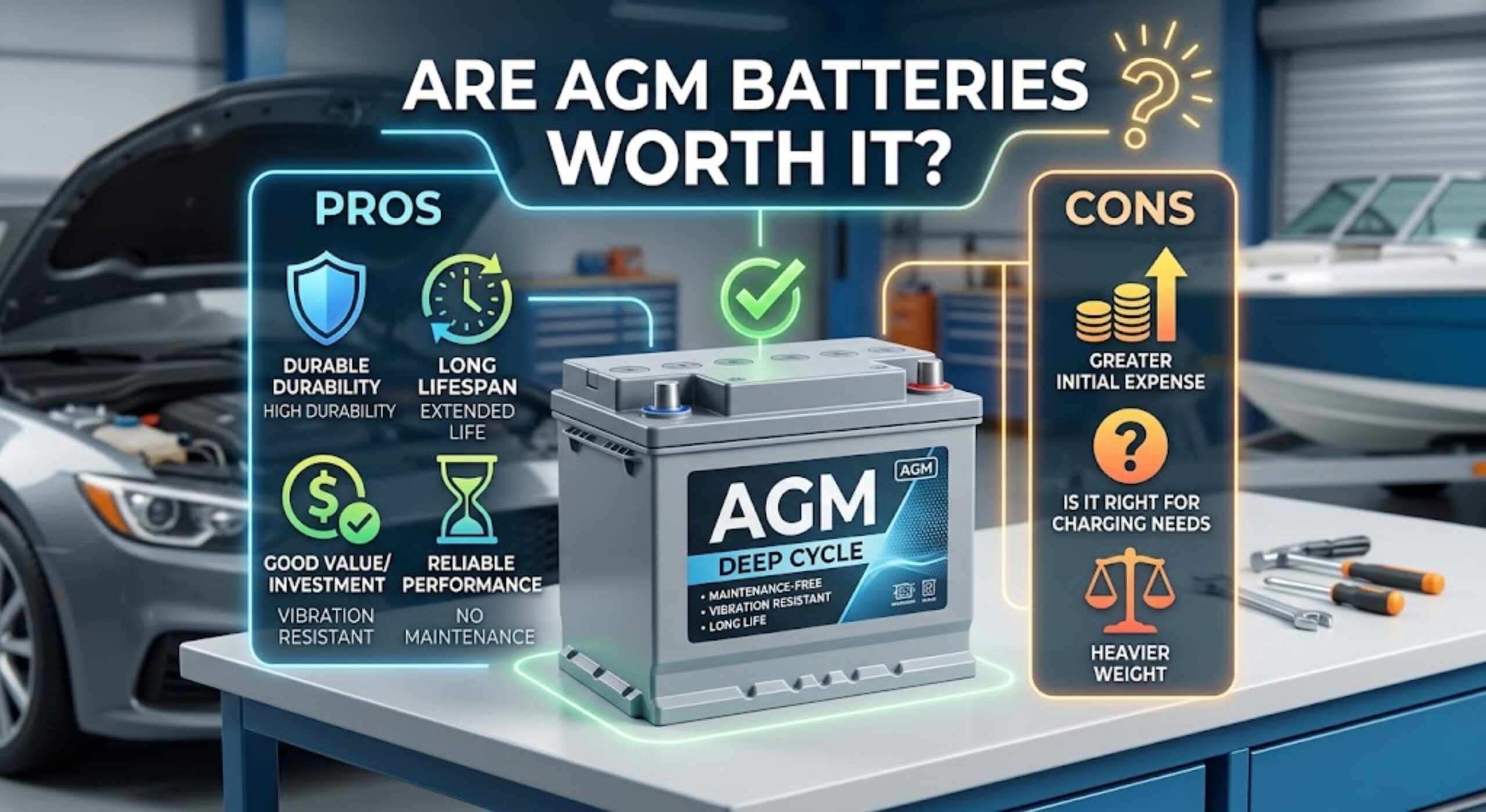
Are AGM Batteries Worth It for Your Truck – Full Guide in 2026

You’re standing at the auto parts counter. Two Group 65 batteries, same shelf, same size. One standard flooded lead-acid at around $120. One AGM at $200 or more. The counter guy says “AGM is better” — but better enough to justify an $80 gap?
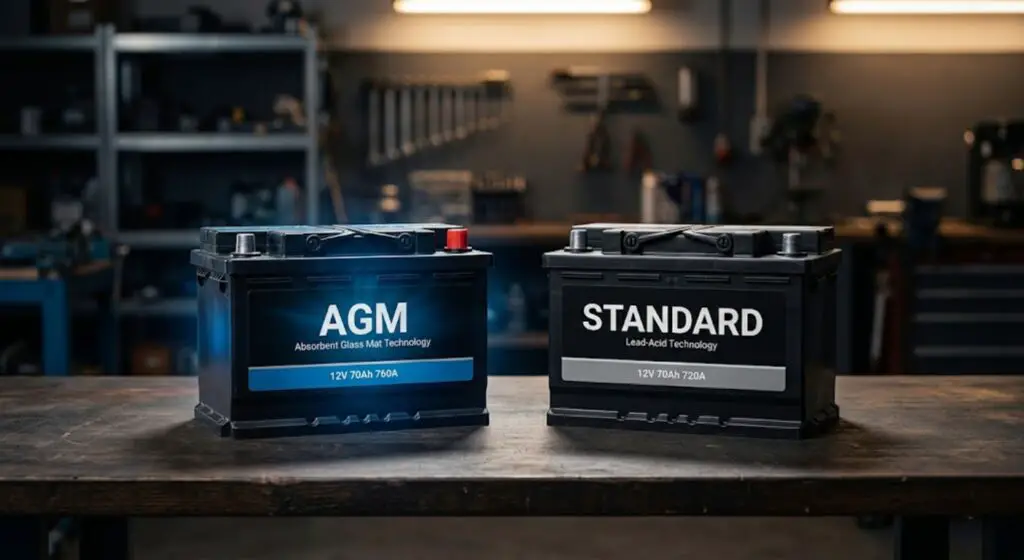
The answer depends on four conditions specific to your truck. Get them right and AGM pays back every dollar. Get them wrong and you’ve overpaid for a battery that gives you nothing extra.

Prime for Young Adults — 6 Months Free
Students and 18–24s get six months of Prime free, then half price.
Start 6 Months Free As an Amazon Associate I earn from qualifying purchases.Why This Question Has No Single Answer
Recommended Best Deal Products


The honest answer is: AGM batteries are worth it for some Ford owners and a waste of money for others.
AGM technology is genuinely superior in specific conditions — it handles deeper discharge, withstands more start cycles, and holds its cold cranking amps better in freezing temps. But none of that matters if your truck doesn’t push those limits.
The “worth it” calculation shifts based on what your truck is, what you run on it, and where you drive it. Four variables determine the outcome — and we’ll map each one before giving you a verdict.
4 Conditions That Determine Whether AGM Is Worth It
Before you can answer whether AGM is worth it for your truck, check these four conditions:
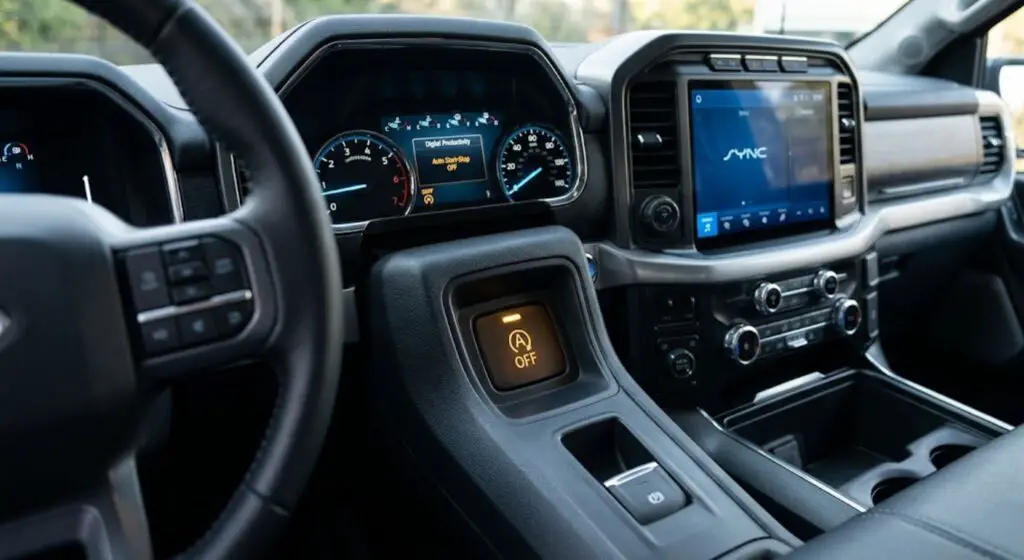
- Does your Ford have auto start-stop? This system shuts the engine off at red lights and restarts it when you lift off the brake. Every restart cycle hammers the battery hard. If your F-150, Explorer, Escape, or Maverick has this system, AGM isn’t optional — it is the OEM-specified battery type.
- What is your electrical accessory load? A factory-spec truck with nothing added draws modest current. A truck with a winch, upfitter lighting, inverter, aftermarket audio, or dual battery demands pulls far more. Heavy electrical loads repeatedly deep-discharge the battery — exactly where AGM outperforms flooded.
- What climate do you drive in? According to Battery Council International data, AGM batteries maintain around 90% CCA efficiency at 0°F versus roughly 70% for standard flooded types. If you regularly see temps below 20°F, the CCA gap matters on every cold start.
- How long are you keeping the truck? If you’re selling in under 18 months, the ROI math doesn’t work no matter how good the battery is. AGM’s advantage compounds over years, not months.
If you answered yes to Condition 1 or 2, the next section is your answer.
Check These 4 Conditions Before You Buy
Condition 1 — Auto Start-Stop
Does your Ford shut the engine off at red lights? 2015+ F-150, Explorer, Escape, Maverick, and Edge models with this system require AGM by OEM spec.
AGM RequiredCondition 2 — Heavy Accessories

Audible — Listen Free for 30 Days
One free credit a month and thousands of titles included.
Listen Free for 30 Days As an Amazon Associate I earn from qualifying purchases.Running a winch, inverter, upfitter lights, camp power, or serious audio? High electrical draw repeatedly deep-discharges batteries — AGM territory.
AGM Strongly RecommendedCondition 3 — Cold Climate
Do you regularly see temperatures below 20°F? AGM holds ~90% CCA efficiency at 0°F vs ~65–70% for flooded. That gap matters most on your coldest starts.
AGM Preferred in ColdCondition 4 — Ownership Timeline
Keeping the truck 5+ years? AGM’s longer lifespan (up to 6–10 yrs vs 3–5 yrs flooded) pays back the $60–90 premium. Selling in 18 months? Save your money.
ROI Threshold: 3+ YearsWhen AGM Batteries Are Absolutely Worth the Price
Recommended Best Deal Products


If your Ford checks any of the boxes below, AGM batteries are worth every dollar of the premium.
If Your Ford Has Auto Start-Stop
Ford F-150s from the 2015 model year onward — along with the Explorer, Escape, Edge, and Maverick across various trim levels — came equipped with auto start-stop systems that demand AGM from the factory. The charging system in these trucks is calibrated for AGM’s lower internal resistance (as low as 2%, versus 10–15% for flooded batteries). Putting a standard flooded battery in a BMS-equipped truck means the charging system either overcharges or undercharges it consistently. The result is shortened battery life and electrical gremlins — not from the battery being bad, but from the system fighting a battery it wasn’t built for.
If You Run Heavy Accessories
Standard flooded batteries begin to suffer real damage when discharged below around 50% state of charge. AGM batteries tolerate discharge down to roughly 40% without the sulfation damage that kills flooded cells early. If you’re running a winch, upfitter lights, inverter, camp power setup, or a serious audio system, you’re regularly pulling your battery into territory that destroys flooded units in 12–18 months. For this use case, check out our guide on the best battery for Ford F350 diesel for high-demand application options.
If You’re Keeping the Truck Long-Term
According to Optima Batteries, a quality AGM in a commuter application can last 6–10 years versus 3–5 years for a comparable flooded battery. At a price difference of roughly $80, a battery that lasts twice as long pays for itself — and then some. If you’re holding the truck for 5 years or more, the cost-per-year math strongly favors AGM.
Audible Premium Plus — Annual Membership
12 audiobook credits up front, plus the full Audible catalogue.
See Annual Plans As an Amazon Associate I earn from qualifying purchases.When a Standard Lead Acid Battery Is the Smarter Buy
However, if your situation looks different, a standard lead-acid battery is the smarter financial decision.
- If your Ford has no start-stop and runs factory electrical only → a quality flooded battery from Interstate, Motorcraft, or Duracell performs identically for daily driving. You’re not stressing it beyond design limits.
- If your truck is high-mileage and you’re selling in under 2 years → AGM’s long-term payback never materializes. Save the $80.
- If you’re in a mild climate — Southeast, Pacific Coast, or similar → cold weather performance isn’t a deciding factor. Standard flooded is fine.
- If your truck is pre-2015 without a BMS → older Ford trucks without battery management systems work fine with flooded batteries. The charging system doesn’t discriminate.
A 2014 F-150 XL with no accessories, a moderate climate, and an 18-month ownership window left — standard lead-acid is the correct call. Spending more gains you nothing.
What Happens in Extreme Cold and High Heat
Recommended Best Deal Products


If you live somewhere that regularly hits below 20°F in winter, cold weather changes the AGM calculation significantly.
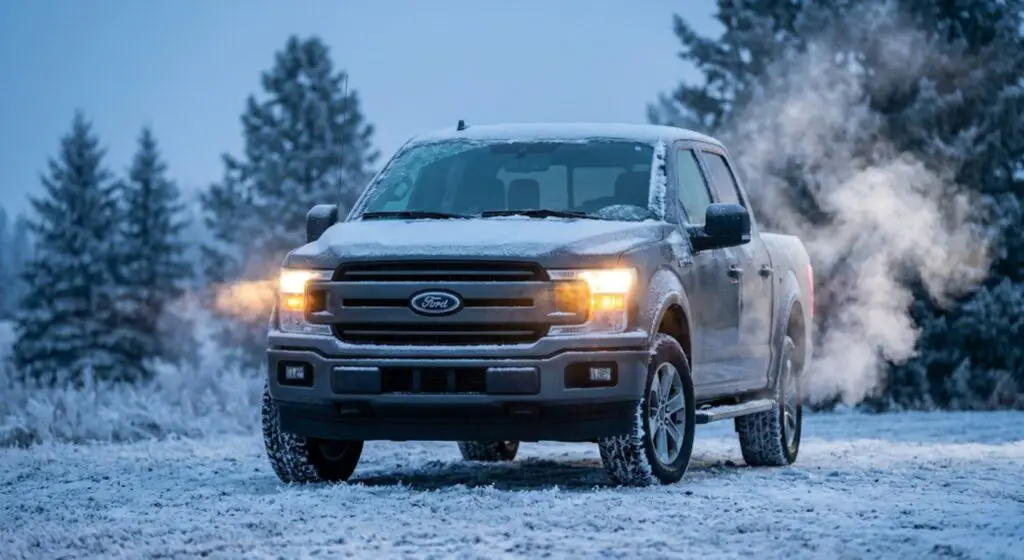
According to data from the Battery Council International, a flooded lead-acid battery delivers approximately 65–70% of its rated CCA at 0°F. An AGM in the same conditions maintains closer to 90%. On a Ford F-150 spec’d for 650–750 CCA, that gap translates to roughly 100–130 fewer cranking amps available on your coldest mornings — exactly when your engine oil is at its thickest and starting load is highest.
CCA Efficiency Retained at 0°F — AGM vs Standard Flooded
How much of your rated cold cranking amps are actually available on your coldest start
Source: Battery Council International cold-temperature performance data
In extreme heat — Phoenix, Texas summers, desert Southwest — AGM’s sealed construction eliminates electrolyte evaporation, which is a real failure mechanism in flooded batteries kept in engine bays exceeding 80°F consistently.
If you’re in a mild climate, neither of these factors tips the scales. The cold and heat advantage is real but only matters where temperatures are genuinely extreme.
AGM Battery Decision Matrix for Ford Truck Owners
Use this table to find your combination and match it to the right battery type.
AGM Battery Decision Matrix — Find Your Row
| Vehicle Condition | Electrical Load | Climate | Recommended Battery |
|---|---|---|---|
| Auto start-stop equipped (2015+) | Any | Any | AGM — Required |
| No start-stop | Heavy (winch, inverter, upfitter) | Any | AGM |
| No start-stop | Light / factory only | Cold (below 20°F regularly) | AGM Preferred |
| No start-stop | Light / factory only | Mild or warm | Standard Flooded |
| High-mileage, selling within 18 months | Any | Any | Standard Flooded |
| Pre-2015, no BMS | Light / factory only | Any | Standard Flooded |
Red = OEM requirement. Blue = AGM recommended. Green = Standard flooded is the right call.
When to Ask a Shop Before You Buy Any Battery
Before you buy any battery for a 2015 or newer Ford, check one more thing.
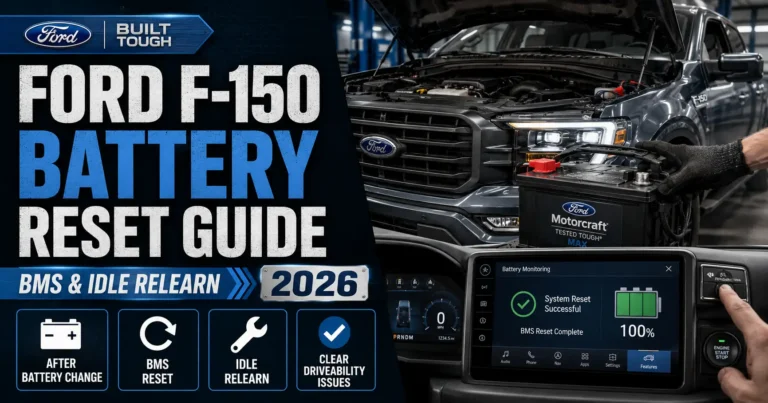
Ford trucks from the 2015 F-150 generation onward — along with many Explorer, Escape, Maverick, and Edge models — come equipped with a Battery Management System (BMS). This system tracks your battery’s age, state of charge, and temperature history to optimize the charging rate and protect battery life. When you replace the battery, the BMS still thinks it’s managing the old worn-out unit. Without a reset, it can undercharge your new battery, cut accessory power earlier than it should, and cause warning lights or odd electrical behavior.
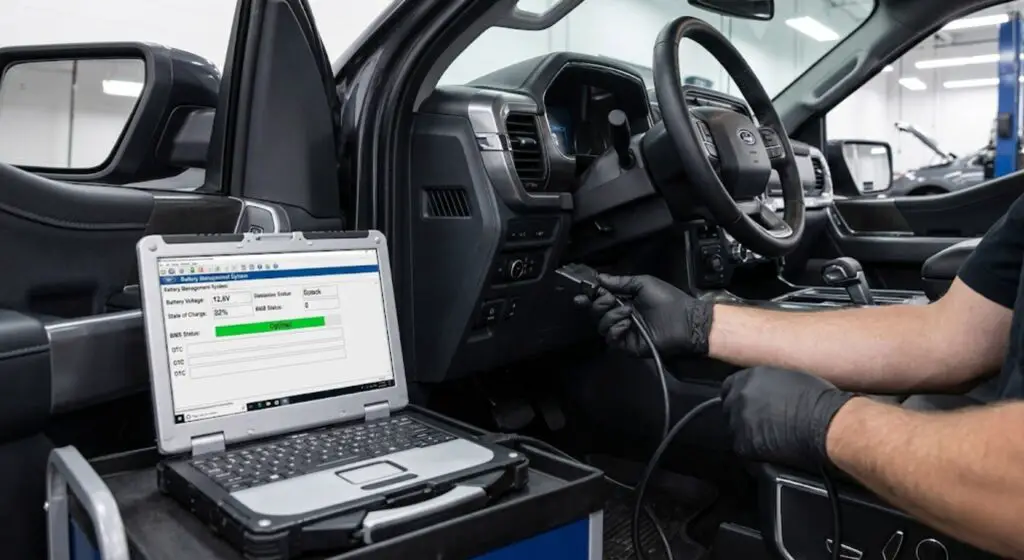
The proper reset requires either FORScan software with an OBD-II adapter, or a Ford dealer scan tool. According to Ford’s own service documentation, the BMS needs to relearn the new battery’s characteristics — and the most reliable method involves a proper service reset, not just letting the truck sit overnight. If you’re seeing an unexpected check engine light after a battery swap, a missed BMS reset is a common cause.
For DIY installs: FORScan is a free tool that handles BMS resets on most 2011+ Ford vehicles with an inexpensive OBD-II Bluetooth adapter. It’s worth the 20-minute setup to protect a $200 battery investment.
Frequently Asked Questions
Do AGM batteries last longer than regular batteries?
In most automotive applications, yes. Optima’s published data shows quality AGM batteries lasting 6–10 years in commuter use versus 3–5 years for flooded equivalents. In start-stop vehicle applications, the gap widens further — AGM handles the extra restart cycles that destroy standard batteries within 2–3 years.
Can I replace an AGM battery with a regular battery in my Ford?
It depends on your model. If your Ford has auto start-stop or a BMS (2015 and newer), Ford specifically calls for AGM replacement. Installing a standard flooded battery in a BMS-equipped truck mismatches the charging calibration and shortens the battery’s life significantly. For older trucks without these systems, a quality flooded replacement is fine. For any battery swap on a modern Ford, also see our guide on how to replace a Ford key fob battery for related electrical maintenance tips.
How much more do AGM batteries cost than standard?
For the Group 65 and Group 94R sizes common on F-150s and F-250s, expect to pay roughly $160–$220 for a quality AGM versus $100–$140 for a comparable flooded battery at AutoZone or O’Reilly. The gap is typically $60–$90 depending on brand and group size.
What happens if I put a regular battery in a start-stop Ford?
The BMS is calibrated for AGM’s lower internal resistance. A flooded battery’s higher resistance causes the system to apply incorrect charging voltages — too high for flooded chemistry when the system is in AGM mode. This leads to overcharging, shortened battery life, and potential charging system faults. Some owners also report the start-stop system disabling itself when it detects a non-AGM battery.
Are AGM batteries worth it for cold weather?
Yes, if you regularly see temperatures below 20°F. AGM maintains roughly 90% of its rated cold cranking amps at 0°F versus about 65–70% for a flooded battery. On a Ford F-150 needing 650–750 CCA, that difference is 100+ cranking amps on your hardest mornings. In mild climates, the cold weather advantage does not justify the premium on its own.
Conclusion
AGM batteries are worth it for your Ford truck when the conditions match: your truck has auto start-stop, you run heavy accessories, you’re in a cold climate and holding the truck long-term, or you have a 2015+ Ford with a BMS that requires an AGM replacement spec. Standard lead-acid wins when none of those conditions apply — older trucks, light electrical load, mild climate, short ownership timeline.
Run your situation through the decision matrix above. That table gives you the answer in under a minute. Whether AGM batteries are worth it comes down to your truck’s systems, not the badge on the battery box.
One Comment