Average Engine Hours for 100,000 Miles Ford Truck Guide in 2026

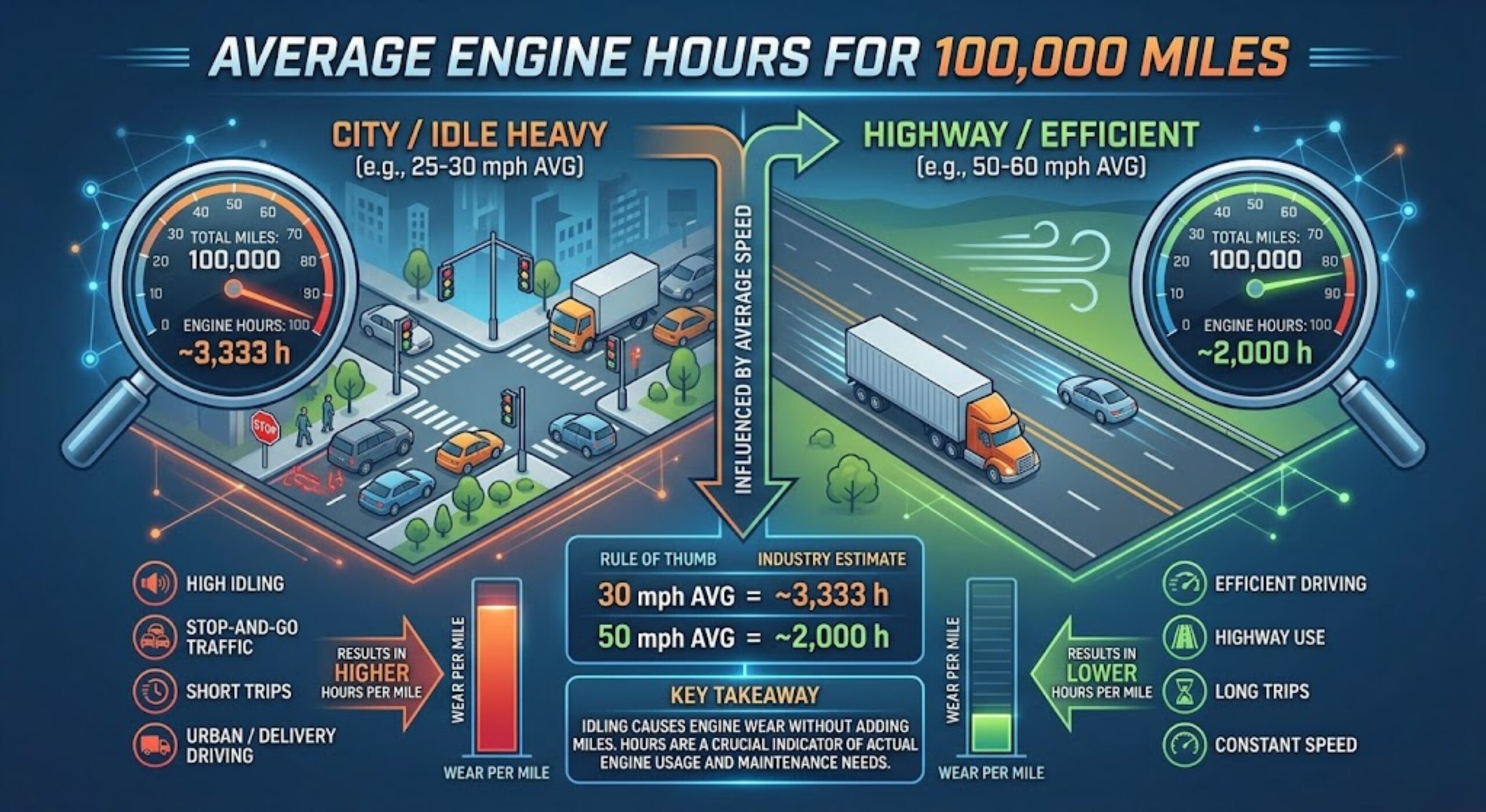
The average engine hours for 100,000 miles is not one fixed number. It shifts based on your engine type, how much your truck idled, and how it was actually used. A highway-driven Ford F-150 and a diesel F-250 that spent years on a job site can both show 100,000 miles on the odometer — and have engine hour readings that are 2,000 hours apart.
That gap tells the real story of engine wear.

Prime for Young Adults — 6 Months Free
Students and 18–24s get six months of Prime free, then half price.
Start 6 Months Free As an Amazon Associate I earn from qualifying purchases.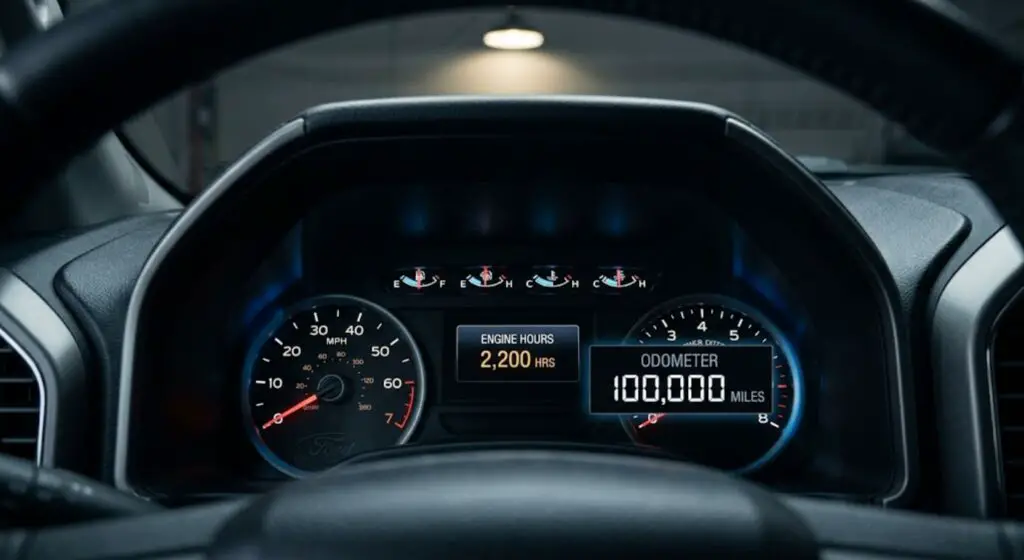
In this guide, you will get a condition-based framework built specifically for Ford trucks. We cover diesel vs gas, highway vs idle-heavy use, and give you a decision matrix you can use right now to evaluate any Ford truck’s engine hours reading.
Why Engine Hours and Miles Tell Different Stories
Recommended Best Deal Products


Your odometer only counts how far the truck moved. It records nothing about how long the engine ran while the wheels were standing still.
Engine hours count every minute the engine is running — including idle time at job sites, long warm-ups in cold weather, running accessories with the engine on, and sitting in stop-and-go traffic. For trucks that spend significant time idling, the odometer becomes a misleading indicator of actual engine wear.
Here is a real-world example from the Ford-Trucks.com community: a 6.0L Power Stroke owner reported 4,500 engine hours at 176,000 miles — an average speed of about 39 mph over the truck’s life, consistent with a mix of highway and moderate idle time. A work truck averaging only 20 mph over the same 100,000 miles would clock around 5,000 hours before reaching that mileage. Both trucks show the same odometer number. The engines have lived very different lives.
The formula is simple: divide your odometer miles by total engine hours. That gives you the truck’s lifetime average speed — and that number reveals its history more honestly than miles alone.
3 Variables That Change Your Normal Engine Hours Range
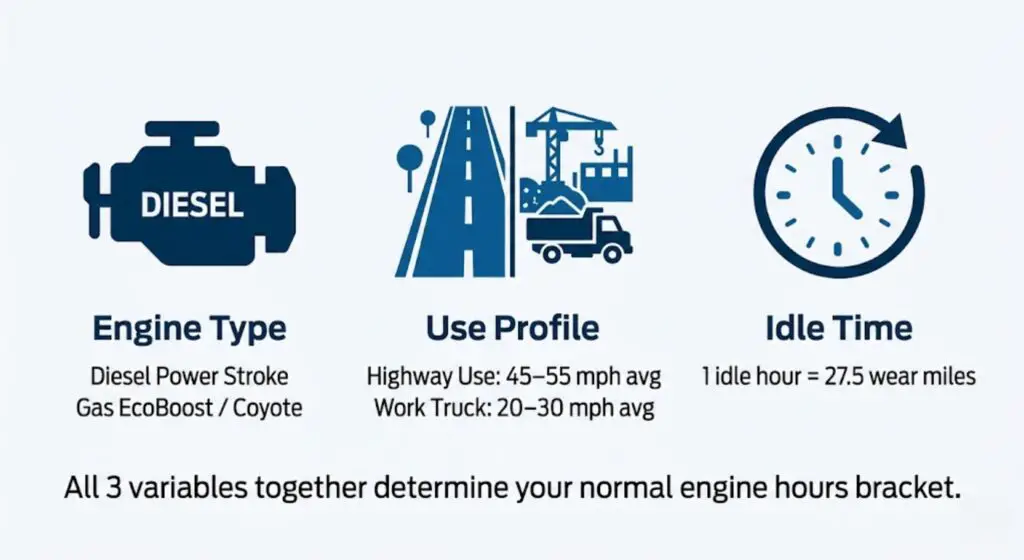
Three inputs determine which bracket your Ford truck falls into. Get these right before you compare any number.
Variable 1 — Engine type. Diesel Power Stroke engines are built for sustained operation under load. They idle longer, run auxiliary equipment, and are used in heavy-duty contexts. Gas engines in personal trucks — the 5.0 Coyote, 3.5 EcoBoost, 2.7 EcoBoost — accumulate hours differently because most owners don’t idle them for hours at a stretch.
Variable 2 — Use profile. A highway-dominant truck averages 45–55 mph over its life. A work truck or fleet vehicle used on construction sites or in emergency services may average only 20–30 mph — meaning the engine ran far longer for every mile it moved.
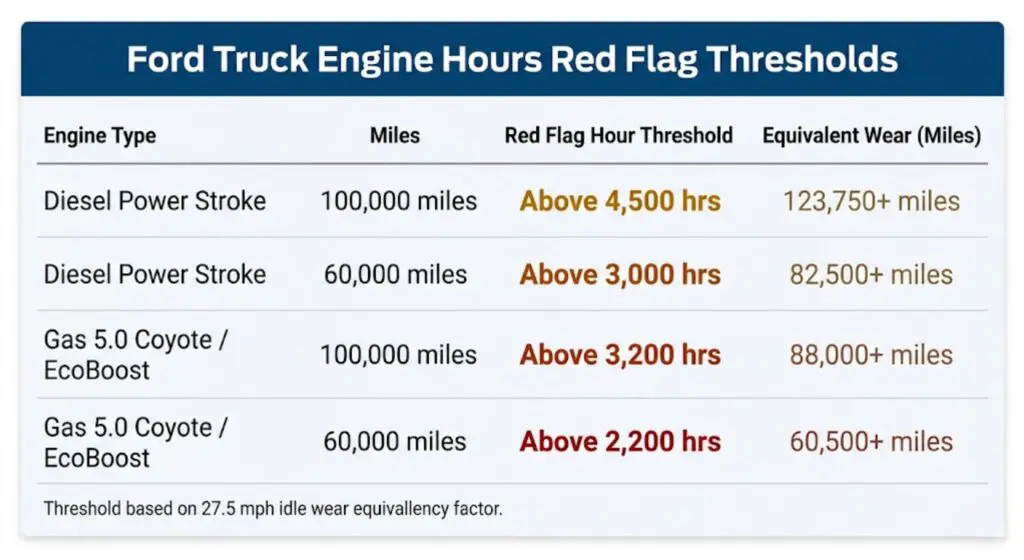
Variable 3 — Idle time. According to OEM durability testing standards documented by Calculator Academy, one hour of engine idle accumulates wear equivalent to approximately 27.5 miles of driving. Fleet trucks and emergency vehicles can accumulate thousands of idle hours that never appear on the odometer.

Audible — Listen Free for 30 Days
One free credit a month and thousands of titles included.
Listen Free for 30 Days As an Amazon Associate I earn from qualifying purchases.How to Find Engine Hours on Your Ford Truck
- Start the truck and let the dash initialize fully.
- Press the OK or arrow button on your steering wheel to enter the trip computer menu.
- Scroll through the display options until you find “Engine Hours” or “Hour Meter.”
- On F-250 and F-350 Super Duty models (2008+), this is typically accessible through the information display behind the steering wheel.
- If your truck does not show engine hours on the dash, a mechanic can pull the figure directly from the ECM using an OBD-II scan tool.
Once you have the number, divide your odometer miles by engine hours. That average MPH figure is your starting point for every branch below.
Normal Engine Hours for Highway Driven Ford Trucks
If your Ford truck is primarily highway-driven with minimal job site idling, the baseline math is straightforward.
At a lifetime average of 45 mph — consistent with a mix of highway commuting and road trips — 100,000 miles works out to approximately 2,222 engine hours. If your truck averages closer to 50 mph, that figure drops to around 2,000 hours. These are healthy, expected readings for a personal-use Ford truck.
What the Miles Per Hour Average Tells You
| Lifetime Average MPH | What It Indicates |
|---|---|
| 50 mph and above | Highway-heavy use, minimal idle time |
| 40–50 mph | Normal mixed use — highway and city |
| 30–40 mph | More city driving or moderate idle time |
| Below 30 mph | Significant idle time — investigate further |
A forum member on Ford-Trucks.com with a 6.0L Power Stroke reported an average of 46 mph after 88,000 miles — right in the normal range for a truck used primarily for personal hauling and some towing. That is the benchmark profile for this branch.
If your Ford F-150 with a 5.0 Coyote or 3.5 EcoBoost shows 1,800–2,300 hours at 100,000 miles and your average MPH sits between 40 and 50 — you are in normal territory. No further investigation needed beyond standard maintenance.
Engine Hours for Diesel Work Trucks With Heavy Idle Time
If your truck is a diesel Power Stroke — a 6.7, 6.0, 7.3, or earlier generation — used for construction, fleet service, emergency response, or any job that keeps the engine running while the truck sits still, a higher hours-to-miles ratio is expected. It is not automatically a problem, but it requires closer evaluation.
At a lifetime average of 25 mph — typical for a work truck that idles heavily on job sites — 100,000 miles produces approximately 4,000 engine hours. Using the 27.5 mph idle wear equivalency factor, that truck has accumulated wear closer to 110,000 equivalent miles. The engine has worked harder than the odometer suggests, but a well-maintained Power Stroke diesel is built to handle it.
The concern starts when engine hours are high and maintenance history is thin. Diesel engines that idle heavily accumulate combustion byproducts in the oil faster than highway-driven trucks. The Ford exhaust filter overloaded warning is one of the most common consequences — excessive idling prevents the DPF from completing its regeneration cycle, leading to soot buildup.
Maintenance Schedule by Engine Hours for Diesel Power Stroke Trucks
The standard mileage-based oil change interval misses the reality of idle-heavy diesel use. For Power Stroke trucks with significant idle time, use engine hours as the trigger:
- Oil and filter change: every 250–300 engine hours
- Fuel filter replacement: every 300–400 engine hours (or per Ford service interval — whichever comes first)
- Check the Ford engine oil recommendation chart to confirm the correct oil spec for your Power Stroke generation before every change
A diesel work truck at 100,000 miles with 4,000 hours should have completed approximately 13–16 oil changes by hours — not the 10–12 you would count by miles alone. If the service records show only mileage-based changes, the oil may have been run beyond its effective life repeatedly.
Audible Premium Plus — Annual Membership
12 audiobook credits up front, plus the full Audible catalogue.
See Annual Plans As an Amazon Associate I earn from qualifying purchases.Engine Hours for Gas Engine Ford Trucks at 100K Miles
Gas-powered Ford trucks — the F-150 with the 5.0 Coyote, 3.5 EcoBoost, or 2.7 EcoBoost — follow a different pattern than their diesel counterparts.
Most gas-engine F-150 owners use their trucks for personal transportation, occasional towing, and daily commuting. Long idle periods are less common. At a typical lifetime average of 42–48 mph, a gas F-150 at 100,000 miles will show approximately 2,000–2,400 engine hours.
If your gas-engine Ford shows above 3,000 hours at 100,000 miles, that is worth investigating. It means the engine averaged below 33 mph over its life — either heavy city use, extended idling, or a combination of both.
Gas engines are less forgiving of idle-heavy use than diesels in one specific way: oil degrades faster per hour at low RPM in a gasoline engine. The SAE International research on gasoline engine oil degradation confirms that time-at-temperature is a primary degradation driver, independent of distance. For a gas truck with elevated hours, the oil change interval should shift from mileage-based to hours-based — every 200–250 engine hours.
The practical threshold for a gas Ford truck: if hours divided by miles gives you an average below 33 mph, treat the maintenance history with the same scrutiny you would apply to a diesel work truck.
When High Engine Hours at Low Miles Is a Red Flag
The ratio between hours and miles becomes a red flag when it cannot be explained by a normal use pattern.
A truck with 60,000 miles and 4,000+ engine hours has averaged only 15 mph over its life. No plausible personal or even moderate fleet use explains that ratio — the engine has seen sustained, heavy idling for reasons you need to understand before buying or driving that truck further.
Red Flag Thresholds by Engine Type
How to Check ECM Hours vs Odometer on a Ford
The ECM records engine hours independently of the odometer. Odometer readings can be rolled back with criminal intent — engine hours stored in the ECM are significantly harder to falsify.
If you are evaluating a used Ford truck and the hours-to-miles ratio produces an implausibly high average MPH — say, 65+ mph over the truck’s entire life — that mismatch warrants investigation. Either the truck was genuinely highway-driven its entire life (possible but rare), or the odometer has been tampered withAsk the seller to allow a pre-purchase scan with an OBD-II tool that reads ECM hours. If they refuse, treat that refusal as a red flag on its own. Unresolved engine wear from excessive hours can also surface as issues like a Ford P0300 random misfire — a symptom that often traces back to injector wear or cylinder condition degraded by prolonged high-hour operation.
Engine Hours Decision Matrix for Ford Truck Owners
Use this matrix to evaluate any Ford truck’s engine hours reading at 100,000 miles. Find your engine type and use profile — then cross-reference your actual hours reading.
| Engine Type | Use Profile | Normal Range | Caution Zone | Red Flag Zone |
|---|---|---|---|---|
| Diesel Power Stroke | Highway-dominant | 2,000–2,500 hrs | 2,500–3,500 hrs | Above 3,500 hrs |
| Diesel Power Stroke | Mixed city/highway | 2,500–3,300 hrs | 3,300–4,500 hrs | Above 4,500 hrs |
| Diesel Power Stroke | Work truck / heavy idle | 3,300–5,000 hrs | 5,000–6,000 hrs | Above 6,000 hrs |
| Gas — 5.0 Coyote | Highway-dominant | 1,600–2,000 hrs | 2,000–2,800 hrs | Above 2,800 hrs |
| Gas — 5.0 Coyote | Mixed city/highway | 2,000–2,500 hrs | 2,500–3,200 hrs | Above 3,200 hrs |
| Gas — 3.5 EcoBoost | Highway-dominant | 1,800–2,200 hrs | 2,200–3,000 hrs | Above 3,000 hrs |
| Gas — 3.5 EcoBoost | Mixed city/highway | 2,200–2,700 hrs | 2,700–3,500 hrs | Above 3,500 hrs |
| Engine Type | Use Profile | Normal Range at 100K Miles | Caution Zone | Red Flag Zone |
|---|---|---|---|---|
| Diesel Power Stroke | Highway-dominant | 2,000–2,500 hrs | 2,500–3,500 hrs | Above 3,500 hrs |
| Diesel Power Stroke | Mixed city/highway | 2,500–3,300 hrs | 3,300–4,500 hrs | Above 4,500 hrs |
| Diesel Power Stroke | Work truck / heavy idle | 3,300–5,000 hrs | 5,000–6,000 hrs | Above 6,000 hrs |
| Gas 5.0 Coyote | Highway-dominant | 1,600–2,000 hrs | 2,000–2,800 hrs | Above 2,800 hrs |
| Gas 5.0 Coyote | Mixed city/highway | 2,000–2,500 hrs | 2,500–3,200 hrs | Above 3,200 hrs |
| Gas 3.5 / 2.7 EcoBoost | Highway-dominant | 1,800–2,200 hrs | 2,200–3,000 hrs | Above 3,000 hrs |
| Gas 3.5 / 2.7 EcoBoost | Mixed city/highway | 2,200–2,700 hrs | 2,700–3,500 hrs | Above 3,500 hrs |
If your truck falls in the caution zone, increase maintenance frequency and get a compression test or oil analysis before your next major service interval. If it falls in the red flag zone, move to the next section.
When to Get a Pre-Purchase Inspection Based on Hours
If your truck falls in the red flag column of the matrix above, more research is not the next step. A mechanic is.
A pre-purchase inspection from a Ford-experienced shop or dealership technician should specifically cover:
- Compression test across all cylinders — uneven compression after high hours signals ring or bore wear
- Oil analysis — look for elevated iron and aluminum particles, which indicate bearing and cylinder wear
- Injector condition check (diesel) — high idle hours accelerate injector tip coking and spray pattern degradation
- Turbo shaft play check (Power Stroke and EcoBoost) — high hours with idle-heavy use increases bearing wear
- DPF and EGR condition (diesel) — work trucks with excessive idle hours frequently have partially blocked DPF systems
For F-250 and F-350 Super Duty trucks specifically, also check the Ford F-250 towing capacity chart to assess whether the truck’s use profile matches its rated capacity — a truck run consistently beyond its tow rating accumulates stress faster than hours alone reveal.
If the seller will not allow an independent inspection — walk away. A truck in good condition has nothing to hide from a scan tool and a compression gauge.
For current owners who find their hours in the caution or red flag zone: shift your maintenance triggers from miles to hours immediately. Service your oil by engine hours, not the sticker on the windshield. That single change extends engine life more than any other adjustment you can make.
Frequently Asked Questions
How many engine hours is a lot for a diesel truck?
For a diesel truck in personal use, above 3,500 hours at 100,000 miles is worth investigating. For a work truck or fleet vehicle, context matters more — a Power Stroke at 5,000 hours with a full service history by hours, not just miles, can still have significant life remaining.
How do I find engine hours on my Ford F-250?
Press the OK or arrow button on your steering wheel to scroll through the trip computer display on the instrument cluster. On most 2008+ Super Duty trucks, engine hours appear as a listed display mode. If the option is not visible, an OBD-II scan tool connected to the diagnostic port under the dash will retrieve it from the ECM.
Is 3,000 engine hours too much for 100,000 miles?
It depends on engine type and use. For a gas-engine F-150, 3,000 hours at 100,000 miles means an average of 33 mph — on the low end, indicating more city or idle time than average. For a diesel work truck, 3,000 hours at 100,000 miles is within normal range. Check the decision matrix above for your specific combination.
Do engine hours matter more than miles when buying a used truck?
For personal-use vehicles with normal driving patterns, miles are a reliable guide. For trucks that have done fleet, construction, or emergency service work, engine hours tell a more accurate story. When both figures are available, always use the ratio — miles divided by hours — to assess the truck’s real history.
How do I convert engine hours to equivalent miles on a Ford truck?
Multiply your total engine hours by 27.5. That gives you the equivalent mileage based on OEM wear testing standards. For example, 3,000 hours multiplied by 27.5 equals 82,500 equivalent miles. Compare that figure to your odometer — if the equivalent mileage is significantly higher, the engine has worked harder than the odometer shows.
Conclusion
The average engine hours for 100,000 miles on a Ford truck comes down to three things: engine type, use profile, and idle time. A highway-driven F-150 and a diesel work truck can both show the same odometer reading with engine hour counts that are thousands of hours apart.
Use the decision matrix in this guide to find your specific bracket. If your truck falls in the normal zone, maintain by hours going forward. If it lands in the caution or red flag zone, get a compression test and oil analysis before your next major decision — buying, selling, or servicing.
Check your engine hours today using the steps in the “How to Find Engine Hours” section. Run your numbers. The math takes two minutes and tells you more about your Ford’s real condition than the odometer ever will.