
Is the Ford Ranger a Good Truck? 2026 Honest Verdict Guide

Is the Ford Ranger a good truck? Yes, for most buyers, if you pick the right year and trim.
The Ranger tows 7,500 pounds, carries up to 1,767 pounds of payload, and costs less to repair than the average vehicle, with a RepairPal score of 4.0 out of 5. Its weak spots are real too, with predicted reliability below the Tacoma and a 10-speed transmission that needs a close look on used trucks.
That split is the whole story. The Ranger is the most capable all-rounder in its class on paper, and it is also the truck in its class most likely to need a careful pre-purchase check.
This guide gives you the verdict first, then the numbers behind it, the problems to check, the best years to buy, and a head-to-head table against the Toyota Tacoma and Chevrolet Colorado.
The Short Answer in 5 Numbers
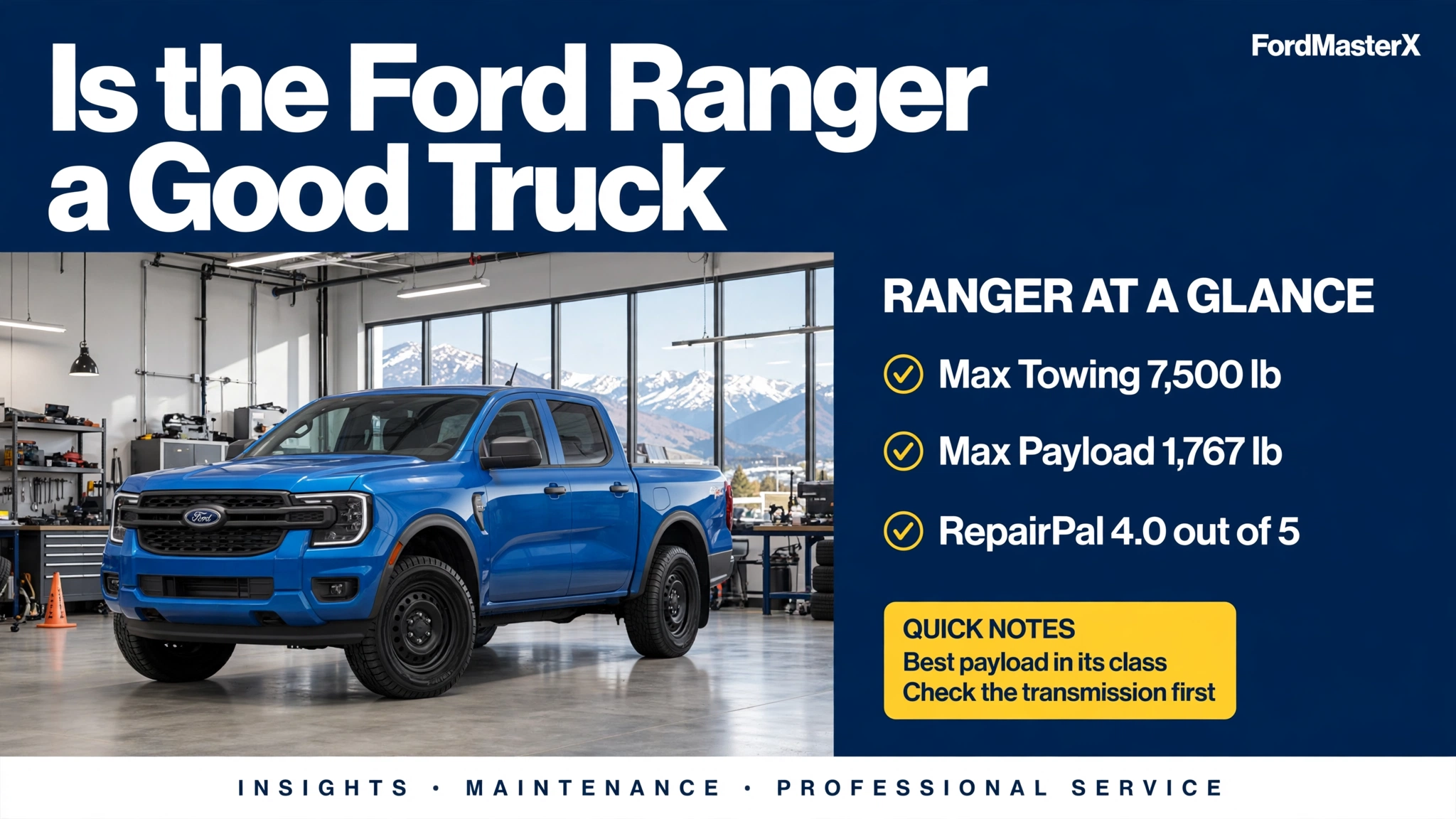
Five numbers decide most Ranger purchases. The table below holds them, and the infographic after it gives you the same facts to save or share.
| Number | What it is | What it means for you |
|---|---|---|
| 7,500 lb | Max towing with the Trailer Tow Package | Near class best, enough for most boats and campers |
| 1,767 lb | Max payload on the 2.3L 4×2 | Best payload of the three main rivals |
| 4.0 out of 5 | RepairPal reliability rating | Above average, 3rd of 7 midsize trucks |
| 43 out of 100 | Consumer Reports predicted reliability for 2026 | Below the Tacoma at 74, so check used trucks hard |
| $33,550 | Starting MSRP for the 2026 XL | Real midsize value, before destination and fees |
Ford Ranger Verdict At a Glance
The five numbers that decide a Ranger purchase, as observed in November 2026.
| Measure | Observed figure | Result |
|---|---|---|
| Max towing | 7,500 lb with the Trailer Tow Package | Near class best |
| Max payload | 1,767 lb on the 2.3L 4×2 | Best of the three main rivals |
| RepairPal reliability | 4.0 out of 5, 3rd of 7 midsize trucks | Above average |
| Consumer Reports 2026 | 43 out of 100, predicted | Below the Tacoma at 74 |
| Starting price | $33,550 for the 2026 XL | Strong midsize value |
Direct answer: Yes, the Ford Ranger is a good truck for most buyers. It leads its class on payload, tows near the top, and costs $615 a year on average to repair, but its predicted reliability trails the Tacoma, so buy the right year and check the transmission first.
Sources: Ford 2026 Ranger technical specifications (01/13/26 V1.0); RepairPal reliability rating for the Ford Ranger; Consumer Reports predicted reliability for 2026 as reported by Autoblog; iSeeCars lifespan analysis. Prices are Ford published starting MSRPs and exclude the $1,895 destination charge.
The verdict changes with the buyer. A commuter who tows a boat twice a year gets a different answer than a buyer who wants a truck to last 200,000 miles with no surprises.
The rest of this guide works through each buyer type in turn. It starts with what the truck costs and what each engine gives you.
What the 2026 Ranger Costs and Delivers
The 2026 Ranger comes in four trims, one cab, and one bed. Every truck is a SuperCrew with five seats and a 5-foot bed, so the choice is about engine, drivetrain, and equipment, not body style. Ford’s 2026 Ranger technical specifications list every figure in this guide, and the numbers below come from that document.
That single cab choice keeps the lineup simple. It also means a buyer who wants a regular cab or a 6-foot bed must look at the Tacoma instead.
| Trim | Starting MSRP | Engine | Best for |
|---|---|---|---|
| XL | $33,550 | 2.3L EcoBoost | Work truck value |
| XLT | $35,575 | 2.3L EcoBoost, 2.7L optional | Most buyers |
| Lariat | $43,955 | 2.3L EcoBoost, 2.7L optional | Comfort and tech |
| Raptor | $57,270 | 3.0L EcoBoost | High speed off-road |
Prices are Ford published starting MSRPs and exclude the $1,895 destination charge, plus tax, title, license, and dealer fees. A truck with destination added starts at $35,445 for the XL and $59,165 for the Raptor.
The step from XL to XLT costs $2,025 and buys the most useful comfort and tech upgrades in the lineup. The step from XLT to Lariat costs $8,380 and buys leather, a larger screen, and premium audio.
Our guide to the Ranger versus the F-150 is worth reading if you are torn between sizes. The F-150 costs more and tows more, but the Ranger fits garages and city parking the F-150 cannot.
Three EcoBoost Engines Compared
The standard engine is a turbocharged 2.3-liter EcoBoost four-cylinder with 270 horsepower and 310 lb-ft of torque. It runs on regular fuel, and it already delivers the full 7,500-pound tow rating when the truck has the Trailer Tow Package.
That fact surprises many buyers. The base engine is not a compromise on capability, and it carries the highest payload in the lineup at 1,767 pounds on a 4×2 truck.
The optional 2.7-liter EcoBoost V6 makes 315 horsepower and 400 lb-ft of torque. It is available on XLT and Lariat trims with four-wheel drive, and it gives the Ranger the mid-range pull of a bigger truck.
The 2.7-liter does not raise the tow rating. It still tops out at 7,500 pounds, and its payload drops to 1,513 pounds because the heavier engine and four-wheel drive eat into the rating.
Our guide to the 2.3L EcoBoost engine covers the base engine in full detail. The same engine family powers the Mustang and Explorer, so parts and knowledge are easy to find.
The Raptor uses a high-output 3.0-liter EcoBoost V6 with 405 horsepower and 430 lb-ft of torque on premium fuel. It is the fastest Ranger ever built, and it is also the least practical one for towing.
Raptor towing drops to 5,510 pounds, and payload drops to 1,373 pounds. The Raptor trades work numbers for FOX Live Valve shocks, locking differentials, and 33-inch all-terrain tires.
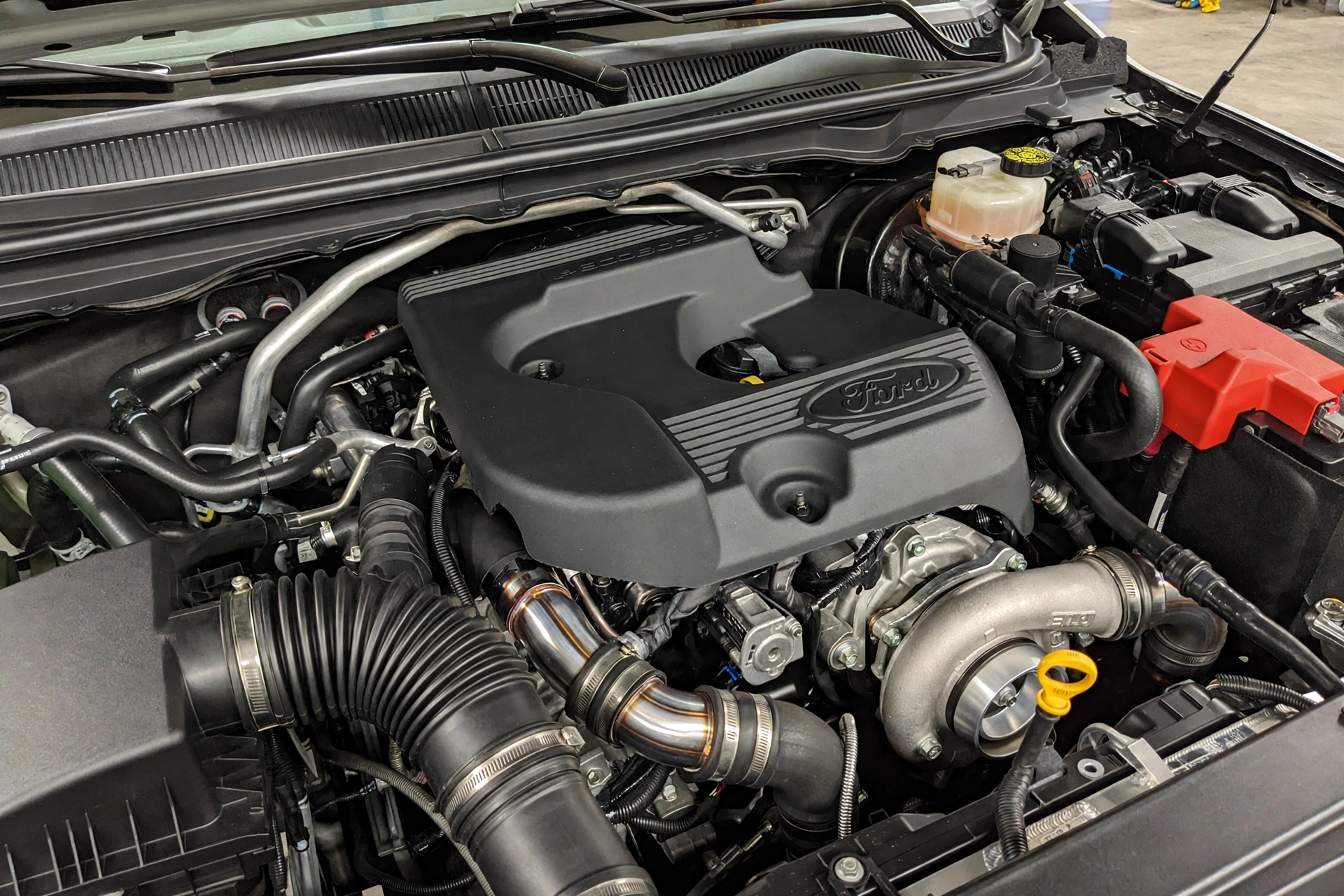
AI-generated illustration: the 2.3L EcoBoost engine bay in a Ford Ranger.
Fuel Economy by Configuration
Fuel economy is the Ranger’s quiet strength against the F-150. The 2.3-liter with rear-wheel drive earns an EPA estimate of 21 mpg city, 25 highway, and 23 combined.
Four-wheel drive drops that to 19 city, 24 highway, and 21 combined. The 2.7-liter V6 with four-wheel drive earns 18 city, 23 highway, and 20 combined.
The Raptor earns 16 city, 18 highway, and 17 combined on premium fuel. That is the price of 405 horsepower and off-road hardware, and it is worth knowing before you sign.
Our Ford engine oil recommendation chart lists the exact oil spec for each EcoBoost engine. The 2.3-liter and 2.7-liter run on regular fuel, while the Raptor needs premium for full power.
How the Ranger Tows and Hauls Best
Towing is where the Ranger earns its keep. A properly equipped XL, XLT, or Lariat tows up to 7,500 pounds, and that rating holds with either the 2.3-liter or the 2.7-liter engine.
The Trailer Tow Package is required to reach that number. A Ranger without the package tows far less, so check the window sticker or the build sheet before you buy a used truck for towing.
That package point matters more than the headline number. Two identical looking Rangers can tow thousands of pounds apart, and the difference is one option box on the order sheet.
Our Ford Ranger towing capacity chart breaks the rating down by year, engine, and drivetrain. Use it to check the exact truck in front of you, not the lineup maximum.
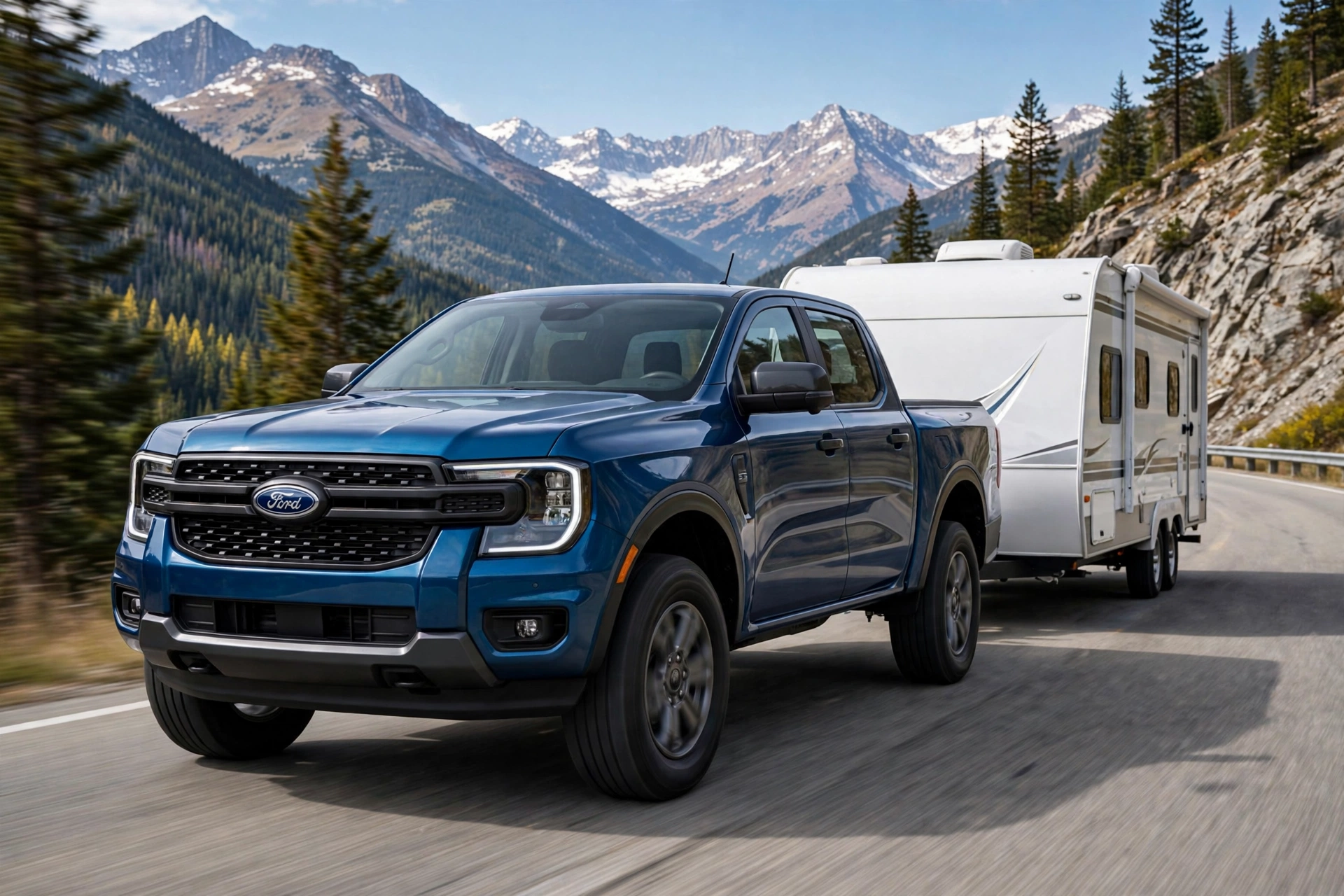
AI-generated illustration: a Ford Ranger towing a travel trailer.
Payload Leads the Class
Payload is the Ranger’s clearest win. The 2.3-liter 4×2 carries up to 1,767 pounds, the 2.3-liter 4×4 carries 1,763 pounds, and the 2.7-liter 4×4 carries 1,513 pounds.
That beats the Tacoma at 1,705 pounds and the Colorado at 1,710 pounds. The gap is small on paper, and it is real when you load tools, a camper shell, and a full cab of passengers.
Payload drops as you add weight to the truck. Four-wheel drive, the V6, off-road hardware, and a loaded cab all take pounds off the rating, so always read the door-jamb label on the exact truck you buy.
The bed holds 43.5 cubic feet with the 5-foot box. That is enough for most weekend loads, but a buyer who hauls full sheets of plywood will want the Tacoma’s available 6-foot bed instead.
Towing Versus the F-150
The Ranger tows about half of what a well-equipped F-150 tows. The F-150 tows more, carries more, and costs more to buy, fuel, and park.
That trade is the Ranger’s reason to exist. It tows a 7,000-pound boat or a mid-size camper without the size, weight, or fuel bill of a full-size truck.
Our F-150 towing capacity chart shows the full-size numbers side by side with the Ranger’s. If your trailer tops 7,500 pounds, the Ranger is the wrong truck, and the F-150 is the right one.
A good rule is to tow no more than 80 percent of the maximum rating on a regular basis. That puts a comfortable Ranger trailer at about 6,000 pounds, with room for passengers, gear, and a full fuel tank.
Is the Ranger Reliable Enough to Own
Reliability is where the Ranger story splits in two. One set of scores calls it above average, and another set puts it near the bottom of its class.
Both sets are real, and they measure different things. RepairPal measures the cost, frequency, and severity of actual repairs, while Consumer Reports measures owner-reported problems across many systems.
RepairPal rates the Ford Ranger 4.0 out of 5, which ranks it 3rd out of 7 midsize trucks. The average annual repair cost is $615, against $548 for midsize trucks and $652 for all models.
Owners bring a Ranger in for unscheduled repairs an average of 0.2 times per year. The chance that a given repair is severe is 12 percent, which matches the midsize average of 13 percent.
Those numbers describe a truck that rarely breaks badly. They also describe a truck that costs a little more than the midsize average to keep running each year.
Our guide to how reliable Ford Rangers are covers the RepairPal data in more depth. It is the best companion read if reliability is your main worry.
Consumer Reports Tells a Tougher Story
Autoblog reports Consumer Reports scores for the current generation Ranger of 43 out of 100 for 2024, 34 for 2025, and a predicted 43 for 2026. The three-year average is 40 out of 100.
The previous generation averaged 35.8 out of 100 over its five-year run. The current truck is better than the one it replaced, and it is still below par for the segment.
Owner complaints in the current generation focus on build quality and the climate control system. The 10-speed automatic also draws complaints for rough or jerky shifts between gears.
The rival gap is wide. Consumer Reports predicts 74 out of 100 for the 2026 Tacoma, 62 for the Frontier, and 57 for the Ridgeline. The Ranger at 43 sits just ahead of the Gladiator at 40.
Those scores come from Consumer Reports member surveys, as reported by Autoblog. They are not a laboratory test, and they weigh minor annoyances next to major failures.
Lifespan and Resale in Real Numbers
iSeeCars gives the Ranger a reliability rating of 7.5 out of 10, ranking it 4th out of 7 midsize trucks. Its analysis covers more than 300 million vehicles.
The same analysis puts the average Ranger lifespan at 155,888 miles, or about 13.6 years. A Ranger has a 23.1 percent chance of reaching at least 200,000 miles.
Typical use is about 10,498 miles per year during the first 10 years. That is a normal truck life, not a short one, and it matches what owners report in forums.
Resale is fair rather than strong. CarEdge estimates a first-year drop of about $10,566, with about 36.1 percent of original value kept after 10 years.
That is a third-party estimate, not a Ford figure, and it should be read as a rough guide. The Tacoma holds value better, and that gap is part of the Tacoma’s price premium.
Safety Ratings and Warranty Cover
NHTSA gives the Ranger 4 out of 5 stars overall. Frontal crash scores are 5 of 5, side scores are 5 of 5, and the rollover score is 3 of 5.
Those scores hold across the 2024, 2025, and 2026 model years. The rollover score is the weak point, and it is common for tall trucks with a high center of gravity.
The factory warranty is 3 years or 36,000 miles bumper to bumper, with 5 years or 60,000 miles on the powertrain. Corrosion cover runs 5 years with unlimited miles, and roadside assistance runs 5 years or 60,000 miles.
Our guide to the Ford factory warranty explains what each layer covers. Our guide to how to check your Ford warranty shows how to confirm the cover on a used truck by VIN before you pay.
5 Problems to Check Before You Buy
No truck is perfect, and the Ranger has a short list of known issues. Check each one on any used Ranger, and check the first two on a new one too.
- 10-speed transmission shifts. The 10R80 automatic can shift harshly or hesitate, mainly on 2019 to 2023 trucks. Test drive at low speed, in stop and go traffic, and on a cold start, and walk away from a truck that slips or bangs into gear.
- CDF drum bushing failure. Rangers built before August 15, 2022 can suffer a bushing that shifts and blocks hydraulic ports inside the transmission. The result is harsh shifts, gear slipping, or power loss in higher gears, and Ford TSB 24-2254 covers a redesigned drum.
- Carbon buildup on intake valves. The 2.3-liter EcoBoost uses direct injection, so fuel does not wash the intake valves clean. Ask for oil change records, and budget for a valve cleaning if a high-mileage truck idles rough or loses power.
- Climate control and build quality. Current-generation owners report HVAC problems and build quality niggles more than engine failures. Run the heat and air conditioning through every mode on a test drive, and check panel gaps, trim fit, and door seals.
- Recall history on 2024 to 2026 trucks. The current generation has recalls covering engine cooling, the electrical system, and airbags. A May 2026 recall covers certain 2025 and 2026 Rangers for possible engine failure, with a free engine long block replacement, so check the VIN on nhtsa.gov/recalls before you buy.
That list is short, and that is good news. The Ranger has no single catastrophic engine failure that defines it, unlike the 4.0-liter timing chain problem on older trucks.
The transmission is the one item that can turn into a big bill. A fluid change every 30,000 to 50,000 miles is the cheapest insurance, even though Ford officially allows a longer interval.
Our Ford transmission identification chart helps you confirm which transmission a given truck has. The 10-speed is standard on every Ranger since the 2024 redesign, and on all 2019 to 2023 trucks too.
Which Ranger Years Are the Best Bets
The year matters as much as the badge on a Ranger. The truck has lived through five generations, and the reliability story changes sharply between them.
The ratings below are J.D. Power quality and reliability scores. The complaint counts come from CarComplaints, as compiled by CarBuzz.
| Years | Generation | Verdict |
|---|---|---|
| 2010-2011 | Classic compact | Best classic years, J.D. Power 86-87 |
| 2019 | Midsize return | Avoid, launch year growing pains |
| 2020-2022 | Midsize refined | Sweet spot, fewest complaints |
| 2023 | Midsize final year | Best modern year, J.D. Power 87 |
| 2024-2026 | Redesign | Good truck, early build issues |
The 2010 and 2011 Rangers are the best of the classic trucks. J.D. Power rated them 87 and 86 out of 100, with only 11 and 27 complaints on file, and mechanics still recommend them for simple, cheap ownership.
The 2019 Ranger is the one year to avoid if you have a choice. It was the first year of the truck’s return, and owners reported transmission hesitation, electrical issues, and paint complaints, plus a recall for a loose shift cable bracket.
The 2020 to 2022 trucks are the sweet spot for used buyers. Ford fixed the worst launch issues, and CarComplaints counts fell to 7, 8, and 4 across those three years.
The 2023 Ranger is the best modern year on the numbers. It earned a J.D. Power score of 87 out of 100 with only 3 complaints on file, the lowest of any modern Ranger.
Newer trucks have had less time to collect complaints, so treat the count as a guide, not a verdict.
The 2024 to 2026 redesign is a better truck than the one it replaced, with a nicer cabin, more tech, and the 2.7-liter V6 option. It also carries early-production build quality and HVAC complaints, so a 2025 or 2026 truck is a safer pick than a first-year 2024.
Our guide to the Ford Ranger years to avoid covers every year in detail. Read it before you shop for any used Ranger, and take its checklist to the test drive.
Ranger Versus Tacoma and Colorado in 2026
The midsize class has three real contenders in 2026. Each one wins a different category, and the right pick depends on which category you value most.
| Measure | Ford Ranger | Toyota Tacoma | Chevy Colorado |
|---|---|---|---|
| Max towing | 7,500 lb | 6,500 lb | 7,700 lb |
| Max payload | 1,767 lb | 1,705 lb | 1,710 lb |
| Top horsepower | 405 hp, Raptor | 326 hp, hybrid | 310 hp |
| Predicted reliability | 43 out of 100 | 74 out of 100 | 29 out of 100 |
| Starting price | $33,550 | $32,145 | About $32,400 |
| Best for | Payload and value | Reliability and resale | Max towing |
The Colorado tows the most at 7,700 pounds, but only with the Advanced Trailering Package. Without that package, WT and LT models tow 3,500 pounds, which is less than half the headline number.
The Ranger tows 7,500 pounds with the Trailer Tow Package on either the 2.3-liter or the 2.7-liter engine. That is a simpler story, and it is easier to verify on a window sticker.
The Tacoma tows the least at 6,500 pounds, or 6,000 with the hybrid. It also offers the only hybrid in the class, the only 6-foot bed, and the best predicted reliability by a wide margin.
The Ranger is the best all-rounder of the three. It leads on payload, sits second on towing, and offers the most powerful engine at the top of its lineup, all for a starting price near the bottom of the class.
Buy the Tacoma if reliability and resale value matter more than towing. Buy the Colorado if you tow near the limit and will order the trailering package. Buy the Ranger if you want the best blend of payload, towing, and price.
Who Should Buy a Ranger in 2026
The Ranger fits some buyers better than others. These four profiles cover most shoppers, and each one gets a different recommendation.
Daily Drivers Who Tow Sometimes
Buy the XLT with the 2.3-liter engine and four-wheel drive. It tows 7,500 pounds, earns 21 mpg combined, and costs $35,575 before destination.
This is the Ranger sweet spot. It does everything the truck is good at, and it skips the options that add cost without adding capability.
Work Truck Buyers
Buy the XL with the 2.3-liter engine and rear-wheel drive. It carries the most payload at 1,767 pounds, and it starts at $33,550.
Add the Trailer Tow Package if you tow at all. The XL is a plain truck, and that is the point, since every dollar goes to capability rather than trim.
Off-Road Enthusiasts Choose Carefully
Buy the Raptor only if you drive fast off-road on a regular basis. It is brilliant in the desert, and it is the wrong truck for towing and payload.
Most off-road buyers are better served by an XLT or Lariat with the FX4 package. The FX4 is now available on the XL for 2026, and it adds real trail hardware without the Raptor price.
Used Truck Shoppers
Buy a 2021 to 2023 Ranger with a full service history. Those years have the fewest complaints, high J.D. Power scores, and a proven 2.3-liter engine.
Check the transmission on a cold start, ask for the build date, and confirm the CDF drum fix if the truck was built before August 15, 2022. A clean 2022 Ranger is a better buy than a cheap 2019 Ranger.
Questions Ford Owners Ask About the Ranger
Is the Ford Ranger a Good Truck
Yes, for most buyers. It tows 7,500 pounds, carries the best payload in its class at 1,767 pounds, and earns a RepairPal score of 4.0 out of 5, though its predicted reliability trails the Tacoma.
What Is the Best Ford Ranger Year
The 2023 Ranger is the best modern year, with a J.D. Power score of 87 out of 100 and only 3 complaints on file with CarComplaints. The 2021 and 2022 trucks are close behind, while the 2010 and 2011 trucks are the best classic years.
How Much Can a Ranger Tow
A properly equipped 2026 Ranger tows up to 7,500 pounds with the Trailer Tow Package, on either the 2.3-liter or the 2.7-liter engine. The Raptor tows 5,510 pounds, and a Ranger without the tow package tows far less.
Is the Ranger Better Than the Tacoma
The Ranger beats the Tacoma on towing and payload, with 7,500 pounds against 6,500 and 1,767 pounds against 1,705. The Tacoma beats the Ranger on predicted reliability at 74 out of 100 against 43, and on resale value.
How Long Does a Ranger Last
The average Ranger lasts about 155,888 miles, or 13.6 years, based on iSeeCars analysis of more than 300 million vehicles. About 23.1 percent of Rangers reach at least 200,000 miles with regular maintenance.
What Engine Should I Choose
Choose the 2.3-liter EcoBoost for the best blend of price, fuel economy, payload, and towing, since it already reaches the 7,500-pound tow rating. Choose the 2.7-liter V6 only if you want stronger mid-range pull and accept lower payload and fuel economy.
Your 5 Step Check Before You Buy
Is the Ford Ranger a good truck? Yes, for most buyers, and the numbers back that up: 7,500 pounds of towing, 1,767 pounds of payload, a RepairPal score of 4.0 out of 5, and a starting price of $33,550.
Run the five step check before you buy. Confirm the Trailer Tow Package, test the transmission cold, check the VIN for open recalls, read the door-jamb payload label, and buy the 2021 to 2023 truck or the newest redesign you can afford.
That check costs you an hour. It can save you from the one expensive Ranger problem, and it leaves you with the truck that tows more, hauls more, and costs less than its rivals.