
2.3L EcoBoost I-4 Engine 2026 Ultimate Complete Guide

The 2.3L EcoBoost I-4 engine makes 270 to 350 hp, depending on which Ford it sits in. That spread is the whole story of this engine, because Ford tunes the same basic four-cylinder very differently for a Mustang, a Ranger, and a Bronco.
It is a turbocharged, direct-injected inline-four that Ford first sold in the 2015 Lincoln MKC and the 2015 Mustang. Since then it has powered the Focus RS, the Explorer, the Ranger, the Bronco, and the Lincoln Corsair.
This guide gives you the engine in one place: the core specs, the power figure for every application, and how the turbo works. It also covers the 2024 redesign, the known problems by year, and the oil specs for your exact model. For fastener torque values, use our dedicated torque chart instead of the summary here.
2.3L EcoBoost I-4 Engine Specs in One Table
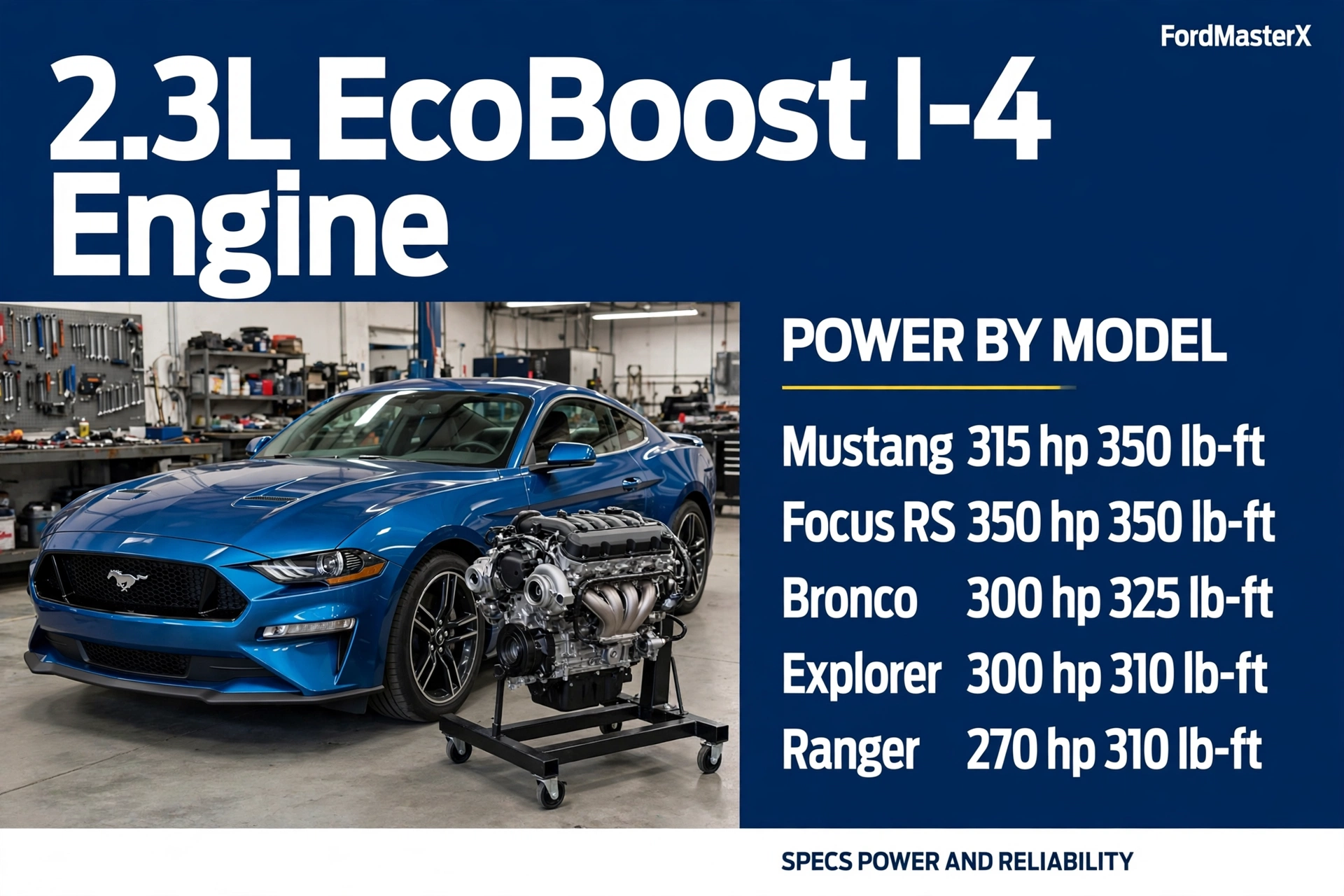
Here is the whole answer in one table. The infographic after it gives you the same power figures to save or share.
| Ford model | Model years | Horsepower | Torque |
|---|---|---|---|
| Mustang | 2015 to 2017 | 310 hp | 320 lb-ft |
| Mustang | 2018 to 2023 | 310 hp | 350 lb-ft |
| Mustang High Performance | 2020 to 2021 | 330 hp | 350 lb-ft |
| Mustang | 2024 and newer | 315 hp | 350 lb-ft |
| Focus RS | 2016 to 2018 | 350 hp | 350 lb-ft |
| Explorer | 2016 to 2019 | 280 hp | 310 lb-ft |
| Explorer | 2020 and newer | 300 hp | 310 lb-ft |
| Ranger | 2019 and newer | 270 hp | 310 lb-ft |
| Bronco | 2021 and newer | 300 hp on premium, 275 hp on regular | 325 lb-ft on premium, 315 lb-ft on regular |
| Lincoln MKC | 2015 to 2019 | 285 hp | 305 lb-ft |
2.3L EcoBoost Power at a Glance
Ford factory ratings by model. Same basic engine, different tune, fuel grade, and model year.
| Ford model | Power | Torque |
|---|---|---|
| Mustang, 2024 and newer | 315 hp | 350 lb-ft |
| Focus RS, 2016 to 2018 | 350 hp | 350 lb-ft |
| Bronco, premium fuel | 300 hp | 325 lb-ft |
| Explorer, 2020 and newer | 300 hp | 310 lb-ft |
| Ranger, 2019 and newer | 270 hp | 310 lb-ft |
Direct answer: the 2.3L EcoBoost I-4 makes 270 to 350 hp and 310 to 350 lb-ft of torque. Check your model and year before you quote a number, because the Ranger tune and the Focus RS tune are 80 hp apart.
Sources: Ford.com 2026 Mustang specs; FordMasterX 2.3 EcoBoost torque specs chart (Ford Workshop Manual and owner manuals); MotorReviewer 2.3L EcoBoost specs. Bronco figures are premium fuel ratings.
Two details in that table catch most owners out. First, the Bronco loses 25 hp and 10 lb-ft on regular gas, so a Bronco filled with 87 octane makes 275 hp and 315 lb-ft, not the headline 300 hp figure.
Second, the Mustang gained torque in 2018 without gaining horsepower. It went from 320 lb-ft to 350 lb-ft while staying at 310 hp, which is why a 2018 Mustang EcoBoost feels stronger in daily driving than a 2016 car with the same hp badge.
Torque is the number that matters most in a truck or SUV. Peak torque arrives at about 3,000 rpm in most applications, so the engine pulls hard from low revs instead of needing to be wound out.
Our 2.3 EcoBoost torque specs chart by year lists every output figure and the fastener torque values for home service.
What Is the 2.3L EcoBoost I-4 Engine
The 2.3L EcoBoost I-4 is a turbocharged inline-four gasoline engine with direct fuel injection and twin independent variable cam timing. Ford built it as a larger, stronger version of the second-generation 2.0L EcoBoost, with a longer stroke and a fortified block to handle higher boost.
Displacement is 2,264 cc, or 138 cubic inches. Bore is 87.5 mm and stroke is 94.0 mm, and compression is 9.5 to 1.
The block and head are aluminum, the crankshaft and connecting rods are forged steel, and the valvetrain is dual overhead cam with four valves per cylinder.
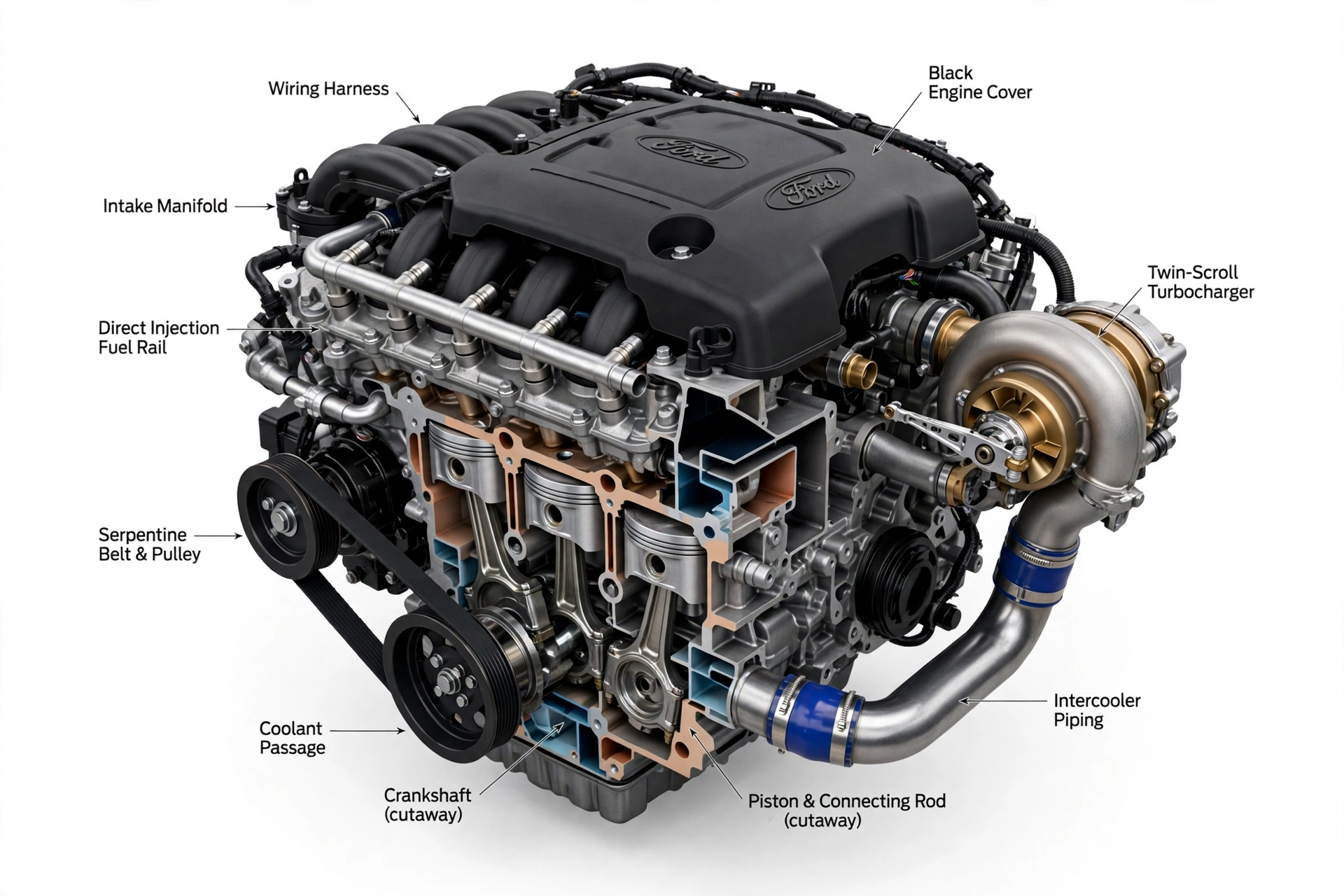
AI-generated illustration: a labelled cutaway of the 2.3L EcoBoost I-4 showing the turbo, intake, and fuel rail.
The engine fires in the order 1-3-4-2. A chain drives the cams, a balance shaft smooths the four-cylinder shake, and oil jets spray the underside of the pistons to carry heat away.
Those details matter because they explain why this small engine can hold up under boost that would have broken an older four-cylinder.
Three Systems That Define It
The first system is the twin-scroll turbocharger. Exhaust pulses from cylinders 1 and 4 travel down one scroll path, and pulses from cylinders 2 and 3 travel down the other, so the pulses do not fight each other on the way to the turbine.
The second system is direct injection. A cam-driven high-pressure fuel pump feeds injectors that spray fuel straight into each combustion chamber at pressures above 2,000 PSI under load.
That precise spray lets Ford run more boost on regular fuel without knock.
The third system is Ti-VCT, or Twin Independent Variable Cam Timing. Each cam can shift its timing on its own, which widens the torque curve and helps fuel economy at light load.
MotorReviewer lists the full 2.3L EcoBoost design spec, including the forged crankshaft, the 94 mm stroke, and the integrated exhaust manifold that feeds the twin-scroll turbo.
Where the Engine Fits in Ford
Ford uses this engine wherever a strong four-cylinder beats a thirsty V6. It is the base engine in the Mustang, the standard engine in the Ranger and Bronco, and the standard engine in the Explorer.
It also served in the Lincoln MKC and now serves in the Lincoln Corsair.
The Maverick does not use this engine. It uses the 2.0L EcoBoost, so none of the figures in this guide apply to a Maverick.
That mix-up is common in search results, and it is worth checking the badge under the hood before you order parts.
For a part-by-part map of the engine, see our 2.3 EcoBoost engine diagram guide. It shows where the sensors, the high-pressure fuel pump, and the turbo parts sit, and it flags the failure points that a diagram makes easy to find.
How It Compares With the 2.7L
The 2.3L is the four-cylinder in the EcoBoost family, and the 2.7L is the smaller twin-turbo V6 above it. The 2.7L makes more torque and tows more, but it costs more, weighs more, and sits in heavier trucks. The 2.3L wins on lightness, simplicity, and fuel use in a Ranger or Bronco.
Our 2.7L EcoBoost specs guide lists the V6 figures side by side with this engine, so you can compare the two before you choose a truck. In a Mustang, the choice is different, because the 2.3L is the efficiency pick and the 5.0L V8 is the power pick.
2.3L EcoBoost Power by Model in 6 Applications
The same engine makes ten different factory outputs, and the differences come from calibration, fuel grade, and model year, not from a different engine family. Use the row that matches your exact Ford, and ignore the rest.
Mustang 310 to 315 Horsepower
The Mustang is the home of this engine, and it has carried the highest regular-production tune since 2015. Early cars made 310 hp and 320 lb-ft, then Ford raised torque to 350 lb-ft for 2018 while horsepower stayed at 310.
The High Performance Package for 2020 and 2021 raised output to 330 hp with the same 350 lb-ft, using a larger turbo and a revised tune. The 2024 redesign, covered below, raised the standard Mustang to 315 hp and kept torque at 350 lb-ft.
Ford lists the 2026 Mustang EcoBoost Fastback at 315 hp and 350 lb-ft of torque, with a 10-speed automatic. That is the current factory figure, and it is the one to quote for a new Mustang.
Focus RS 350 Horsepower
The Focus RS made 350 hp and 350 lb-ft from 2016 to 2018, the highest factory output this engine ever got. It used a larger turbo, stronger internals, and a tune built for a hot hatch, not for towing or daily comfort.
That output came with a known weak point, covered in the problems section below. Early Focus RS cars got the wrong head gasket at the factory, and Ford fixed affected cars under a 2018 service action.
A used RS needs a service history check before anything else.
The RS is out of production, so its figures are a used-car reference now. Do not apply its 350 hp rating to a Ranger or an Explorer, because those trucks use a much softer tune.
Ranger 270 Horsepower
The Ranger carries the lowest rating at 270 hp and 310 lb-ft, with peak torque at 3,000 rpm. Ford tuned it for sustained load, long grades, and towing, so the calibration is more conservative than the Mustang tune.
That conservatism is a feature for a truck. The Ranger tows up to 7,500 pounds with this engine when properly equipped, and the 10-speed automatic keeps the engine in its torque band on a grade.
Check the Ranger towing capacity chart by year before you hitch a trailer, because the rating changes with cab, bed, and axle.
Ranger oil capacity also changes by year, from 6.2 quarts on 2019 to 2023 trucks to 6.0 quarts for 2024 and 5.6 quarts for 2025 and newer. The oil section below lists every figure, so check your year before you buy oil.
Bronco 300 Horsepower on Premium
The Bronco makes 300 hp and 325 lb-ft on premium fuel, and it drops to 275 hp and 315 lb-ft on 87 octane. That fuel-grade gap is the largest in the 2.3L family, and it matters off road, where low-end torque is what gets you over an obstacle.
Ford Performance sold a calibration for 2021 to 2022 Broncos that raised output to 330 hp and 385 lb-ft on premium fuel. That kit shows how much headroom the hardware has, and how much of the factory gap is software rather than parts.
Our Bronco model comparison chart shows which trims pair the 2.3L with which gearbox and axle, so you can see whether the base engine or the 2.7L V6 fits your off-road plan.
Explorer 280 to 300 Horsepower
The Explorer used the 2.3L as an option from 2016, at 280 hp and 310 lb-ft, then made it the standard engine in 2020 at 300 hp and 310 lb-ft. It is the family SUV tune: smooth throttle, quiet running, and enough torque for a full load of passengers and cargo.
Explorer oil capacity is the smallest in the family at 5.2 quarts for 2020 to 2024 models and 5.0 quarts for 2025 and newer. That small sump is one reason the oil grade matters so much on this application, because there is less oil to absorb heat and contamination.
Lincoln MKC 285 Horsepower
The Lincoln MKC was the first Ford to sell with this engine, in 2015, at 285 hp and 305 lb-ft. It was the launch tune, and it set the pattern for the SUV versions that followed.
The MKC ran through 2019, and the Lincoln Corsair took over the 2.3L from 2020. Both are used-car references now, so check the year before you quote a figure.
How the Twin Scroll Turbo Works in 4 Steps
A twin-scroll turbo sounds complex, but the idea is simple: keep the exhaust pulses apart until they reach the turbine. That separation is what gives the 2.3L its flat torque curve and its quick response at low revs.
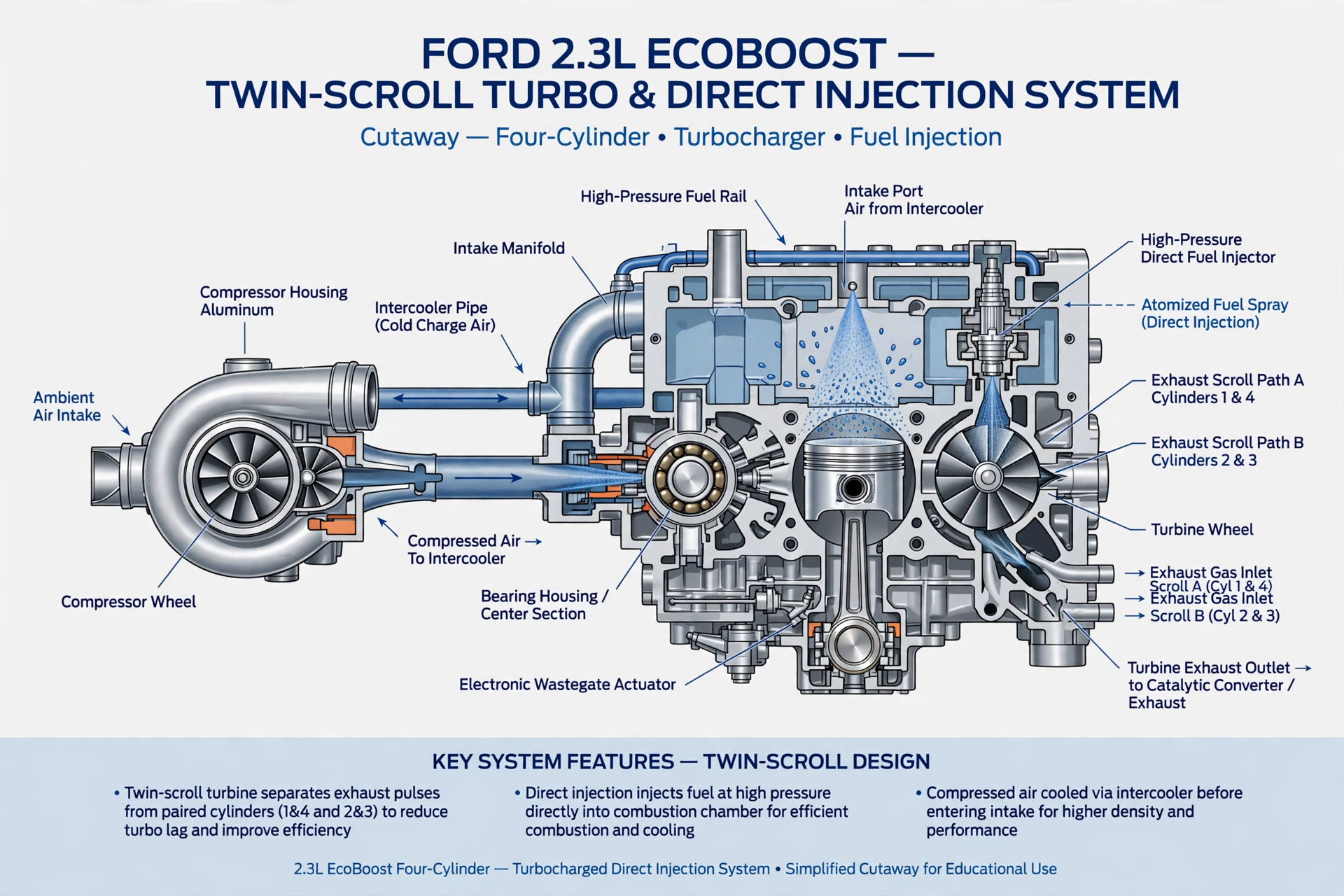
AI-generated illustration: the twin-scroll turbo and direct injection system, with the two exhaust scroll paths labelled.
Step 1 Exhaust Pulses Stay Separate
Exhaust gas leaves cylinders 1 and 4 down one scroll path, and gas from cylinders 2 and 3 down the other. The integrated exhaust manifold in the cylinder head has three high-flow ports that feed those two paths.
Keeping the pulses apart stops one cylinder from pushing exhaust gas back into another cylinder that is still filling. That backflow is what makes a single-scroll turbo feel laggy at low revs.
The result is a turbine that spins up sooner. You feel it as torque from about 3,000 rpm, rather than a sudden surge higher in the rev range.
Step 2 Turbine Spins the Compressor
Exhaust gas spins the turbine wheel, and the turbine shares a shaft with the compressor wheel on the intake side. The compressor squeezes fresh air and pushes it toward the engine.
An electronic wastegate controls how much exhaust gas bypasses the turbine. The powertrain control module opens the wastegate to limit boost, and closes it to build boost when you ask for power.
That electronic control is faster and more precise than the old vacuum wastegates. It also lets Ford protect the engine by cutting boost when intake temperatures climb.
Step 3 Intercooler Cools the Charge
Compressed air is hot, and hot air holds less oxygen than cool air. The charge air cooler, or intercooler, drops the temperature of the compressed air before it reaches the intake manifold.
Cooler air means a denser charge in each cylinder, which means more power from the same displacement. It also cuts the risk of knock, which is why the intercooler matters as much as the turbo itself.
Check the intercooler pipes and end tanks if you ever get an under-boost code. Plastic end tanks can crack with age, and a small boost leak feels like a large power loss.
Step 4 Direct Injection Fires Fuel
Fuel goes straight into the combustion chamber through a high-pressure injector in each cylinder, not into the intake port. The cam-driven high-pressure fuel pump supplies that fuel at pressures above 2,000 PSI under load.
Direct injection cools the charge as the fuel evaporates, which lets Ford run higher compression and more boost on pump fuel. It also gives precise control over when and how much fuel each cylinder gets.
The trade-off is carbon buildup on the intake valves, because fuel never washes over them. That trade-off is covered in the problems section, and the 2024 redesign addresses it directly.
2024 MPC Redesign Changes in 3 Ways
Ford redesigned the 2.3L EcoBoost for the 2024 Mustang, and the new engine is close to a clean-sheet design. It uses Modular Power Cylinder, or MPC, architecture, and not every older spec transfers to it. MotorReviewer lists the MPC engine changes, including the new bore and stroke, the new head, and the dual fuel system.
Change 1 Dual Fuel Injection
The MPC engine adds port fuel injection alongside direct injection. Port injectors spray fuel into the intake ports, so fuel washes over the intake valves again, which cuts the carbon buildup that plagued the direct-injection-only engine.
Direct injection still does the heavy lifting at high load, at 350 bar. Port injection handles light load and valve cleaning. That split is the single most useful change for long-term owners.
The Ranger got the port-plus-direct version for 2025 with the same 270 hp and 310 lb-ft rating. Power did not change, but the maintenance outlook did.
Change 2 New Cylinder Dimensions
The MPC engine uses modified bore and stroke dimensions and a new cylinder head design. Ford has not published a single headline figure for the new bore and stroke in the same way it did for the old engine, so this guide does not guess at them.
What matters for owners is that the new head flows better and runs cooler. That helps both power and durability, and it is part of why the Mustang gained 5 hp in the redesign.
Parts do not swap freely between the two generations. Confirm your engine generation before you order a head, a turbo, or a fuel system part.
Change 3 New Low Inertia Turbo
The MPC engine uses a new twin-scroll low-inertia turbocharger with a high-speed electronic wastegate. A lighter turbine wheel spins up faster, so boost arrives sooner and lag drops further.
That faster spool is why the 2024 Mustang feels sharper at low revs even though peak torque is unchanged at 350 lb-ft. The shape of the torque curve improved, not just the peak.
Turbo service still starts with the same checks: boost leaks, oil supply, and wastegate function. The parts are new, but the diagnostic path is familiar.
No long-term reliability data exists yet for the 2024 MPC engine, so its durability is unproven and this guide gives it no lifespan rating.
5 Known 2.3L EcoBoost Problems by Model Year
This engine is generally reliable after 2018, but it has a short list of known problems, and each one has a clear model-year pattern. Knowing the year matters more than knowing the symptom, because the same symptom means different things on a 2016 Focus RS and a 2022 Ranger.
Problem 1 Head Gasket Failure
Head gasket failure is the best-known 2.3L problem, and it is concentrated in early Focus RS cars. Ford fitted some 2016 and 2017 Focus RS engines with the Mustang head gasket, even though the RS coolant passages are different.
Symptoms are white exhaust smoke, coolant loss with no visible leak, misfire on a cold start, a sweet coolant smell from the exhaust, overheating, and loss of cabin heat. Failures were reported in low-mileage cars, some with as little as 6,000 miles on them.
Ford addressed the RS issue with a 2018 service action that offered pressure testing and head gasket replacement for affected cars. The Mustang did not share this problem, because its gasket matched its own coolant passages.
A used RS without a service record for this fix needs a pressure test before you buy it.
Problem 2 Carbon Buildup on Valves
Every pre-2024 2.3L uses direct injection only, so fuel never washes the intake valves. Oil vapor from the crankcase ventilation system leaves carbon deposits on the valves and intake ports, and the buildup restricts airflow over time.
Symptoms usually appear between 80,000 and 120,000 miles: rough idle, power loss, higher fuel use, and misfires that new plugs do not fix.
Walnut blasting is the standard fix, and it is reported at $400 to $800 in labor. CarTipsDaily covers the carbon buildup pattern and the 2024 dual injection fix in its 2.3L specs guide. The 2024 MPC engine should suffer far less from this issue, because its port injectors wash the valves.
Problem 3 Coolant Intrusion and Overheating
Coolant intrusion on the 2.3L is tied to head gasket failure and, in some high-mileage cases, to head gasket fatigue or block deck erosion. Coolant leaks into a cylinder, the engine overheats, and the head can warp if the car keeps running.
Watch the coolant level, not just the temperature gauge. A level that drops month after month with no puddle under the truck is a warning sign, and it needs a pressure test, not a top-up.
Do not confuse this with the coolant intrusion pattern on the 1.5L and 2.0L EcoBoost engines, which is a different design issue. The 2.3L problem is a gasket and sealing issue, and the fix is a gasket and surface check, not a short block by default.
Problem 4 Turbocharger Wear
Turbo failures are more common on 2015 to 2017 cars than on later ones. Heat, oil starvation, and delayed oil changes wear the turbo bearings, and a worn turbo shows up as a whine, blue smoke, low boost, or an under-boost code.
Oil quality is the main defense. The turbo spins at very high speed on a thin film of oil, so old oil or the wrong grade shortens its life fast.
A turbo that gets clean 5W-30 on schedule can last past 150,000 miles.
Let the engine idle for a short time after hard driving before you shut it off. That cooldown lets oil carry heat away from the turbo bearings instead of cooking in place.
Problem 5 Spark Plugs and Coils
Spark plugs and coils are a service item, not a design flaw, but they cause more misfire complaints than any other part on this engine. Ford calls for new plugs every 100,000 miles, and the Motorcraft plug is SP-594.
Plug torque is 106 lb-in, or 12 Nm, with a gap of 0.030 in. That figure is in pound-inches, not pound-feet, and several online guides list 18 lb-ft, which is about double the Ford value on an aluminum head. Head bolt stage values are not published here because public sources conflict, so use the Ford Workshop Manual for that job.
Use an inch-pound wrench.
Coil bolts take 89 lb-in, or 10 Nm. If a misfire follows a plug change, check the coil seating and the plug gap before you blame the coil itself.
One recall also touches this engine. Ford recalled 69 Explorer and Ranger trucks from model year 2022 under campaign 22V-685, because a high-pressure fuel line was not torqued correctly at the plant.
The risk was a fuel leak, and the fix was a torque check, not a part swap.
2.3L EcoBoost Oil and Maintenance in 6 Checks
Oil is the single most useful maintenance item on a turbocharged direct-injection engine. The right grade, the right capacity, and a steady interval protect the turbo, the timing chain, and the pistons all at once.
| Ford model | Model years | Oil grade and spec | Capacity with filter |
|---|---|---|---|
| Mustang 2.3L | 2017 to 2023 | 5W-30, WSS-M2C971-A1 | 6.0 quarts |
| Mustang 2.3L | 2024 to 2026 | 5W-30, WSS-M2C971-A1 | 5.7 quarts |
| Bronco 2.3L | 2021 to 2024 | 5W-30, WSS-M2C971-A1 | 6.0 quarts |
| Bronco 2.3L | 2025 to 2026 | 5W-30, WSS-M2C971-A1 | 5.6 quarts |
| Ranger 2.3L | 2019 to 2023 | 5W-30, WSS-M2C971-A1 | 6.2 quarts |
| Ranger 2.3L | 2024 | 5W-30, WSS-M2C971-A1 | 6.0 quarts |
| Ranger 2.3L | 2025 to 2026 | 5W-30, WSS-M2C971-A1 | 5.6 quarts |
| Explorer 2.3L | 2020 to 2024 | 5W-30, WSS-M2C971-A1 | 5.2 quarts |
| Explorer 2.3L | 2025 to 2026 | 5W-30, WSS-M2C971-A1 | 5.0 quarts |
Capacities in that table come from the Ford Motorcraft Oil Quick Reference, Version 23, dated July 2026, as listed on our oil chart. Always confirm your exact capacity in your owner’s manual, because it can change by model year and trim.
Our Ford engine oil recommendation chart lists the grade, spec, capacity, and filter for every Ford engine from 2017 to 2026.
Check 1 Use 5W-30 to Spec
Ford specifies SAE 5W-30 meeting WSS-M2C971-A1 for the 2.3L EcoBoost in US models. That spec covers the additive chemistry, the turbo deposit protection, and the low-speed pre-ignition protection that a turbocharged direct-injection engine needs.
Do not substitute 5W-20, even if a shop offers it. The thinner oil does not meet the spec, and it leaves the turbo bearings with less protection at high temperature. Use full synthetic oil that lists the WSS code on the bottle.
Older guides list WSS-M2C961-A1 or WSS-M2C946-A for this engine. Those were earlier specs for the same grade, and the July 2026 Motorcraft chart now lists WSS-M2C971-A1. Buy the current spec when you can.
Check 2 Fill to Your Year Capacity
Capacity changes by model and year, from 5.0 quarts on a 2025 Explorer to 6.2 quarts on a 2019 Ranger. A single generic figure will overfill one truck and underfill another.
Fill gradually and check the dipstick, because the filter holds part of the fill. Add the last half quart slowly, run the engine for a minute, let it sit, and then read the level.
Our guide to how much an oil change costs shows what a shop charges for a full synthetic change by model, so you can tell a fair quote from an upsell before you book.
Check 3 Change Oil on Time
Ford sets the normal oil interval at 7,500 to 10,000 miles, with a hard ceiling of one year or 10,000 miles. Turbocharged engines punish late changes more than naturally aspirated engines do, because the oil also cools and lubricates the turbo.
Short trips, towing, and dusty driving all shorten the useful life of the oil. If your driving matches those patterns, change the oil at the short end of the range, not the long end.
Our guide to how often a car needs an oil change explains the Ford interval rules by driving style, and the oil-life monitor is the simplest way to track it between services.
Check 4 Service Plugs and Filters
Spark plugs go in every 100,000 miles, with the SP-594 plug at 106 lb-in and a 0.030 in gap. The air filter and cabin filter follow the scheduled maintenance table, and a clogged air filter costs power and fuel economy on a turbo engine.
Coolant service matters as much as oil service on this engine. Ford puts the first coolant change at about 100,000 miles on orange-coolant models and 200,000 on yellow-coolant ones, so check your manual. A low coolant level is a warning sign, not a top-up job.
Keep the service record. A 2.3L with a full oil and coolant history is worth more at sale time, and it is the first thing a buyer should ask for on a used Mustang or Ranger.
Check 5 Watch Coolant and Boost
Check the coolant level every month, and check the boost pipes if you ever feel a sudden power loss. A cracked intercooler end tank or a loose clamp can drop boost without setting a code at first.
Listen for a turbo whine that changes with speed, and watch for blue smoke on startup. Both point to turbo bearing wear, and both are cheaper to fix early than after the turbo fails outright.
Scan for codes if the check engine light comes on, and write the code down before you clear it. A P0299 under-boost code and a P0300 misfire code point to very different jobs on this engine.
Check 6 Use the Cam Phaser Guide
The 2.3L does not share the cam phaser failure pattern of the 3.5L EcoBoost, but the two engines share the EcoBoost name and many service habits. If you hear a rattle on a cold start, do not assume it is a phaser without a diagnosis.
Our 3.5 EcoBoost cam phaser replacement guide explains what a phaser rattle sounds like and what the repair involves, so you can tell a phaser noise from a timing chain or turbo noise on your own truck.
How Long Does a 2.3L EcoBoost Engine Last
A well-maintained 2.3L EcoBoost can realistically reach 150,000 to 200,000 miles, and many owners report 200,000 miles or more with disciplined oil and coolant care. That range is consistent across owner reports and independent guides, and it is the range our own lifespan guide uses.
Maintenance habits set the outcome more than model year does. Regular oil changes with the right 5W-30 spec, steady coolant service, and prompt attention to leaks and misfires are what separate a 200,000-mile engine from a 120,000-mile engine.
Early cars need more care than later ones. A 2015 to 2017 Mustang or a 2016 Focus RS carries more risk than a 2021 Bronco, because Ford revised the block, the cooling passages, and the turbo over time.
Our 2.3 EcoBoost lifespan guide breaks down the factors that shorten or extend life, and it is the deep dive to read after this overview.
Tuning changes the math. Most tuners put the practical safe limit at about 400 to 450 wheel horsepower, and power past that point stresses the stock internals and the head gasket.
A stock engine with a good service record is a safer used buy than a tuned engine with no records.
Is the 2.3L EcoBoost I-4 Engine Worth It
Yes, for most buyers, the 2.3L EcoBoost I-4 is worth it. It gives V6 power with four-cylinder fuel use, it tows and hauls in a Ranger and Bronco, and it makes a Mustang fun to drive without V8 running costs.
The case is strongest in the Ranger, Bronco, and Explorer, where the engine is standard and the alternative costs more. In those trucks, you are not paying extra for the 2.3L, you are getting a strong standard engine with a long service record.
The case is narrower in the Mustang, where the choice is between the 2.3L and the 5.0L V8. Buy the 2.3L if you want lower fuel and insurance costs and a lighter front end, and buy the V8 if you want the sound and the top-end power that no four-cylinder can match.
Skip a car with coolant loss, a rough idle that new plugs do not fix, or a turbo whine with no service record. Those are the three warning signs that turn a good engine into an expensive one, and they are easy to check on a test drive.
Questions Ford Owners Ask About 2.3L EcoBoost
How Much Horsepower Does a 2.3L Make?
It makes 270 to 350 hp, depending on the Ford. The Ranger makes 270 hp, the Bronco and Explorer make 300 hp, the Mustang makes 310 to 315 hp, and the Focus RS made 350 hp.
Is the 2.3L EcoBoost a Good Engine?
Yes, it is a good engine when it is maintained, and it is one of Ford’s most durable four-cylinder turbos after 2018. Early Focus RS cars had a head gasket issue, and pre-2024 engines can build carbon on the intake valves, but neither issue defines the later engines.
What Oil Does a 2.3L EcoBoost Take?
It takes SAE 5W-30 full synthetic oil meeting Ford spec WSS-M2C971-A1. Capacity runs from 5.0 quarts on a 2025 Explorer to 6.2 quarts on a 2019 Ranger, so check your model year in the oil table above.
How Long Does a 2.3L EcoBoost Last?
A well-maintained 2.3L EcoBoost lasts 150,000 to 200,000 miles, and many reach 200,000 miles or more. Regular oil changes, coolant service, and prompt repair of leaks and misfires are what get the engine to that range.
Does the 2.3L EcoBoost Have Carbon Buildup?
Yes, pre-2024 engines can build carbon on the intake valves, because direct injection never washes them with fuel. The 2024 MPC engine adds port injection to cut that buildup, and walnut blasting is the standard cleaning method for older engines.
Which Fords Use the 2.3L EcoBoost Engine?
The Mustang, Ranger, Bronco, Explorer, Focus RS, Lincoln MKC, and Lincoln Corsair all use it. The Maverick does not use it, because that truck uses the 2.0L EcoBoost instead.
Is the 2024 2.3L EcoBoost New?
Yes, the 2024 Mustang engine is a redesigned MPC engine with dual fuel injection, a new head, and a new turbo. Power is close to the old engine at 315 hp, but the design is different enough that parts and specs do not all carry over.
Choose the Right 2.3L EcoBoost Ford for You
The 2.3L EcoBoost I-4 is one engine with many tunes, and the right choice starts with your Ford, not with a single horsepower number. A Ranger at 270 hp and a Focus RS at 350 hp share a block and a turbo idea, but they are built for different jobs.
Match the row in the specs table to your model and year, check the oil capacity for that same year, and watch for the problems that fit your year range. Those three checks cover most of what a buyer or an owner needs to know.
Then drive the truck or car you are considering, and listen for the warning signs in this guide: coolant loss, a rough idle, and a turbo whine. A clean service record and a quiet cold start are worth more than any horsepower figure on a spec sheet.