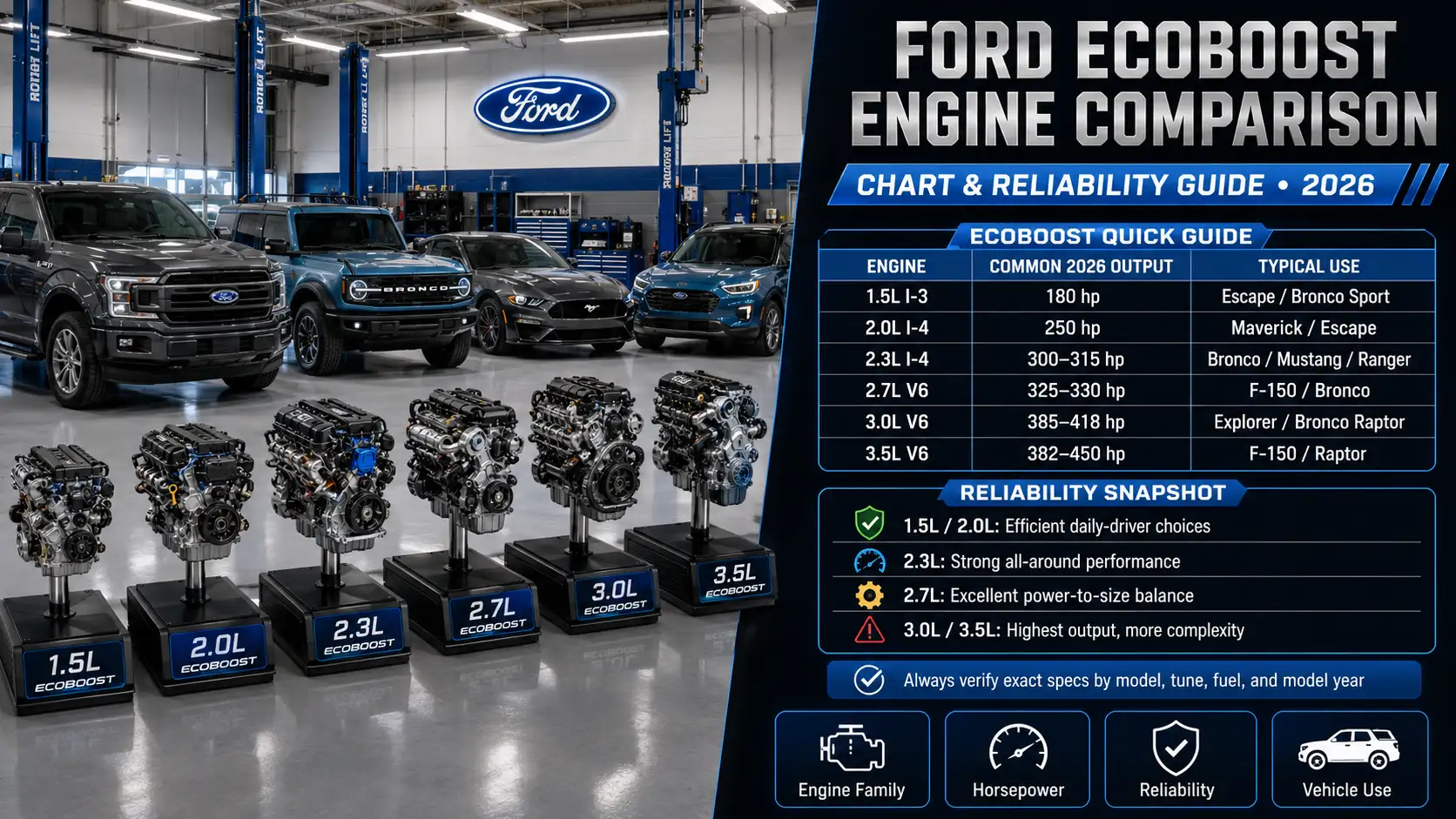
Ford EcoBoost Engine Comparison Chart and Reliability Guide 2026

The global automotive industry has experienced a massive paradigm shift over the past two decades. The traditional reliance on large-displacement, naturally aspirated V8 and V6 engines has steadily given way to smaller, smarter, forced-induction powerplants.
At the absolute forefront of this mechanical revolution is the Ford Motor Company’s EcoBoost technology. By combining turbocharging, direct gasoline fuel injection, and Twin Independent Variable Camshaft Timing (Ti-VCT), these engines promise V8 power with V6 efficiency.

Prime for Young Adults — 6 Months Free
Students and 18–24s get six months of Prime free, then half price.
Start 6 Months Free As an Amazon Associate I earn from qualifying purchases.Originally co-developed in partnership with FEV Inc., this engine family was briefly marketed under the moniker “TwinForce” during its concept phase. The technology officially debuted in 2009 and was swiftly rebranded as EcoBoost to highlight its environmental and efficiency goals.
Since its inception, EcoBoost has become the absolute lifeblood of Ford’s global vehicle lineup. Today, these advanced turbocharged engines power almost everything the brand produces, ranging from the nimble Fiesta hatchback to the heavy-duty F-150 pickup and the track-ready Mustang.
However, the evolutionary journey of these highly complex engines has not been without significant mechanical hurdles. Understanding the true intricacies of the EcoBoost family requires much more than simply reading a basic manufacturer specification sheet.
Buyers, mechanics, and automotive enthusiasts must expertly navigate a maze of generational updates, block material changes, and varying fuel delivery systems. Furthermore, well-documented and sometimes catastrophic reliability issues make engine selection a critical aspect of long-term vehicle ownership.
These defects range from relatively minor inconveniences like rattling cam phasers to total engine failures caused by coolant intrusion and degrading internal wet belts. This comprehensive report provides an exhaustive, data-driven analysis of every major EcoBoost engine produced to date.
We will deeply explore performance specifications, underlying engineering architectures, real-world fuel economy data, and historical defect tracking. Whether you are researching a used daily driver crossover or specifying a high-performance off-road machine, this guide offers unparalleled, expert-level clarity.
Ultimate Ford EcoBoost
Engine Comparison Chart
Recommended Best Deal Products


Navigating the Ford lineup means understanding the power under the hood. The EcoBoost engine family combines turbocharging and direct fuel injection to deliver V8 power with V6 fuel economy.
Whether you are towing massive loads with an F-150 or commuting in a nimble Escape, choosing the right displacement is critical. We have compiled the definitive performance data.
This guide compares horsepower, torque, and application data to help you decode the EcoBoost lineup. Data is sourced from independent testing and official manufacturer specifications.

Audible — Listen Free for 30 Days
One free credit a month and thousands of titles included.
Listen Free for 30 Days As an Amazon Associate I earn from qualifying purchases.Turbocharged Power
EcoBoost engines utilize forced induction to cram more air into the cylinders. This creates massive power surges across smaller engine blocks.
Direct Injection
High-pressure fuel is injected directly into the combustion chamber. This cools the charge and allows for higher compression ratios.
Variable Cam Timing
Twin Independent Variable Camshaft Timing (Ti-VCT) optimizes performance across the rev band. It ensures low-end torque and high-end horsepower.
EcoBoost Spec & Output Matrix
Ford’s strategy replaces traditional displacement with technology. A modern 2.7L V6 now easily outpaces older naturally aspirated V8 engines in both payload and raw acceleration.
Below is the core spec sheet for the most prominent engines in the current and recent fleet. Figures represent standard output, though high-output (HO) variants exist for performance models.
| Engine | Cylinders | Horsepower | Torque (lb-ft) | Key Vehicles |
|---|---|---|---|---|
| 1.0L EcoBoost | Inline-3 | 123 HP | 125 | EcoSport, Fiesta |
| 1.5L EcoBoost | Inline-3 / I4 | 181 HP | 190 | Escape, Bronco Sport |
| 2.0L EcoBoost | Inline-4 | 250 HP | 275 | Maverick, Edge |
| 2.3L EcoBoost | Inline-4 | 310 HP | 350 | Mustang, Ranger |
| 2.7L EcoBoost | V6 | 325 HP | 400 | F-150, Bronco |
| 3.5L EcoBoost | V6 | 400 HP | 500 | F-150, Expedition |
Horsepower vs. Torque Analysis
Recommended Best Deal Products


Understanding the difference between horsepower and torque is vital for truck and SUV buyers. Horsepower dictates top speed and highway passing power, while torque gets heavy loads moving.
The chart below highlights how Ford tunes its larger displacement engines heavily toward low-end torque. This characteristic makes the 2.7L and 3.5L exceptional for towing scenarios.
Visualizing the progressive leap in capabilities from the commuter-focused 1.0L up to the workhorse 3.5L V6.
Engineering Efficiency
Displacement isn’t everything in the modern automotive era. We analyze “Power per Liter” to reveal which engines are technically the most efficient at extracting performance.
The 2.3L High-Performance block (often found in the Mustang) is a marvel, generating massive figures from just four cylinders. It represents the pinnacle of Ford’s four-cylinder tuning.
Audible Premium Plus — Annual Membership
12 audiobook credits up front, plus the full Audible catalogue.
See Annual Plans As an Amazon Associate I earn from qualifying purchases.Conversely, the 3.5L V6 relies on larger turbochargers to create its massive 500 lb-ft of torque. It sacrifices a bit of per-liter efficiency for raw, undeniable towing supremacy.
- ✔ 1.0L efficiency shines in urban environments.
- ✔ 2.3L offers the best balance of sports performance.
- ✔ 3.5L prioritizes structural strength for hauling.
HP per Liter (Density)
Which EcoBoost Engine is Right for You?
Recommended Best Deal Products


The Daily Commuter
Opt for the 1.5L or 2.0L EcoBoost. Found in the Escape and Maverick, these provide brisk acceleration while maintaining excellent MPG.
The Weekend Warrior
The 2.3L and 2.7L hit the sweet spot. They offer thrilling sports car dynamics or enough mid-range torque to pull medium-sized boats.
The Heavy Hauler
The 3.5L V6 is undisputed. If you are towing large travel trailers or heavy equipment, accept no substitute in the half-ton class.
Ford EcoBoost Engine Lineup Comparison Chart
| Engine Displacement | Configuration | Turbocharger Setup | Max Horsepower | Max Torque (lb-ft) | Notable Applications |
| 1.0L Fox | Inline-3 | Single Turbo | 123 hp | 148 lb-ft | EcoSport, Focus, Fiesta |
| 1.5L Dragon | Inline-3 | Single Turbo | 181 hp | 190 lb-ft | Escape, Bronco Sport |
| 1.6L Sigma | Inline-4 | Single Turbo | 197 hp | 214 lb-ft | Fiesta ST, Escape, Fusion |
| 2.0L (Gen 1/Gen 2) | Inline-4 | Twin-Scroll Turbo | 250 hp | 280 lb-ft | Edge, Escape, Maverick |
| 2.3L MPC | Inline-4 | Twin-Scroll Turbo | 310 hp | 350 lb-ft | Mustang, Focus RS, Ranger |
| 2.7L Nano | V-6 | Twin-Turbo | 325 hp | 400 lb-ft | F-150, Bronco, Edge ST |
| 3.0L Nano | V-6 | Twin-Turbo | 418 hp | 440 lb-ft | Explorer ST, Bronco Raptor |
| 3.5L Cyclone | V-6 | Twin-Turbo | 400 hp | 500 lb-ft | F-150, Expedition, Navigator |
| 3.5L High-Output | V-6 | Twin-Turbo | 450 hp | 510 lb-ft | F-150 Raptor, F-150 Limited |
| 3.5L PowerBoost | V-6 Hybrid | Twin-Turbo + Motor | 430 hp | 570 lb-ft | F-150 Hybrid |
The 1.0L Fox EcoBoost: Micro-Displacement Innovation
The 1.0-liter inline-three engine represents Ford’s most aggressive and polarizing pursuit of extreme engine downsizing. Developed primarily at Ford’s Dunton Technical Centre in the United Kingdom, this tiny powerplant was designed for ultra-compact global markets.
The engine is an engineering marvel in terms of packaging, featuring a cast-iron cylinder block with a footprint literally the size of a standard A4 sheet of paper. Despite its incredibly diminutive size, the 1.0L utilizes a highly advanced, low-inertia turbocharger to produce up to 123 horsepower and 148 lb-ft of torque.
The turbocharger provides a surprisingly broad torque curve, allowing the engine to hit maximum twist consistently between 1,400 and 4,500 rpm. Furthermore, higher-performance variants of this engine feature an integrated “overboost” function for highway passing.
This overboost capability allows the engine to briefly alter its wastegate parameters, delivering up to 200 N⋅m (148 lb-ft) of torque for 30-second bursts during heavy throttle application. While the 1.0L EcoBoost won multiple prestigious international engine awards for its innovative packaging, its real-world reliability has been highly controversial.
Reliability Concerns: The Wet-Belt Oil Pump Recall
To reduce internal engine friction, improve fuel economy, and dampen the inherent vibrations of a three-cylinder engine, engineers made a fateful design choice. They placed the oil pump drive belt and its tensioner directly inside the engine block, bathing it constantly in hot engine oil.
Unfortunately, as the rubber belt material degrades over time due to heat and chemical exposure to the oil, it begins to lose its structural teeth and shed fibrous debris. This degraded rubber material inevitably sinks to the bottom of the oil pan and completely clogs the oil pump pickup screen.
Once the pickup screen is clogged, the engine suffers an immediate and total loss of oil pressure while driving. The sudden loss of oil pressure leads to catastrophic internal engine damage, locked bearings, and unexpected engine stalling.
Because the vehicle’s power braking assist system relies heavily on engine vacuum generated during operation, stalling at highway speeds dramatically increases the risk of a fatal crash. In response to this severe safety hazard, Ford was forced to act.
Ford officially issued NHTSA Safety Recall 23V-905 (internally coded as(https://www.ford.com/support/how-tos/recall/recalls-and-faqs/23s64-ecosport-and-focus-2016-2022-engine-oil-pump-failure-recall/)). This massive and costly recall currently covers 2018-2022 EcoSport, 2016-2018 Focus, and 2017-2021 Fiesta models equipped with the automatic transmission.
Because the engineered permanent remedy parts were delayed by supply chain issues, Ford authorized its dealer network to completely replace the entire engine assembly as an interim repair if a failure occurs. Parts for the final, permanent remedy are officially scheduled to be available by the first quarter of 2025.
Aside from the devastating wet belt issue, the 1.0L engine is also highly prone to severe coolant leaks. Early models featured a brittle nylon coolant pipe that easily degraded under extreme under-hood temperatures, leading to rapid coolant loss and severe overheating.
Visual Plan: 1.5L Dragon Engine Specifications
1.5L EcoBoost “Dragon” Technical Specifications
| Category | Specification Details |
| Engine Type | 1.5L Inline-3, Turbocharged |
| Internal Nickname | “Dragon” |
| Block / Head Material | Aluminum |
| Horsepower | 181 hp @ 6,000 rpm |
| Torque | 190 lb-ft @ 3,000 rpm |
| Fuel Delivery | Direct Injection and Port Fuel Injection |
| Compression Ratio | 11.0:1 |
| Key Technologies | Cylinder Deactivation, Integrated Exhaust Manifold |
The 1.6L Sigma and 1.5L Dragon EcoBoost Evolution
The 1.5-liter and 1.6-liter EcoBoost lineup features a complex evolutionary history, transitioning from an inline-four design to an advanced inline-three configuration. Introduced in 2009, the original 1.6-liter EcoBoost engine was directly derived from Ford’s earlier naturally aspirated Sigma engine family.
This original four-cylinder engine was heavily utilized across global markets, finding its way into popular models like the Escape, Fusion, Transit Connect, and Fiesta ST. During this era, Ford also owned Volvo Cars, meaning the 1.6L EcoBoost was dropped into various Swedish models, ranging from the V40 hatchback to the S80 executive sedan.
In its most potent factory-tuned form, the 1.6L generated an impressive 197 horsepower and 214 lb-ft of torque in the Fiesta ST200. However, while it delivered punchy performance for compact cars, the 1.6L EcoBoost suffered from massive, dangerous reliability campaigns.
The engine was recalled on multiple occasions due to localized cylinder head overheating concerns. Coolant circulation problems and cracking cylinder heads allowed both oil and coolant to leak directly onto the scalding exhaust system.
This specific defect triggered a massive 360,000-vehicle recall covering the Escape, Fiesta ST, Focus, and Fusion due to catastrophic engine fire risks. Seeking to improve efficiency and reliability, Ford eventually phased out the 1.6L in favor of a newer 1.5L four-cylinder, and subsequently, the 1.5L “Dragon” three-cylinder.
The 1.5L Dragon: Three Cylinders and Deactivation
The modern 1.5L Dragon engine boasts a displacement of 1,496 cc, utilizing an 84.0 mm cylinder bore and a 90.0 mm piston stroke. It is an entirely aluminum design, featuring both an aluminum block and an aluminum cylinder head to drastically reduce front-end weight.
The Dragon engine is highly advanced in its fuel delivery, utilizing both port fuel injection and direct fuel injection to maximize efficiency and prevent carbon buildup. When spooled, it produces roughly 181 horsepower at 6,000 rpm and 190 lb-ft of torque at an accessible 3,000 rpm.
One of its absolute most notable technological achievements is the seamless inclusion of active cylinder deactivation. It is widely recognized as the first mass-produced three-cylinder engine to successfully implement this fuel-saving technology.
Under light engine loads, such as steady-state highway cruising, the engine control module shuts down fuel and spark to one cylinder. With an integrated exhaust manifold and low-inertia variable turbochargers, the 1.5L spools rapidly and delivers a surprisingly lively exhaust note.
Cracked Fuel Injectors and Severe Fire Risks
Despite its advanced fuel-saving technology and peppy dynamics, the 1.5L Dragon engine has unfortunately been plagued by a highly dangerous fuel system defect. A structural flaw in the manufacturing process can cause the engine’s high-pressure fuel injectors to physically crack open during operation.
When an injector cracks, highly pressurized liquid gasoline and combustible fuel vapor leak rapidly into the cylinder head area. This raw liquid fuel can then travel out of a specially designed engine drain hole and drop directly onto the scalding hot exhaust and turbocharger surfaces.
This rapid accumulation of raw fuel near extreme ignition sources creates a severe, immediate risk of an under-hood fire. Drivers experiencing this failure may notice a strong smell of gasoline in the cabin, visible smoke emanating from the engine compartment, or sudden instrument cluster warnings prior to ignition.
Ford initially issued recalls in November 2022 and March 2024 to address this, attempting a band-aid fix by installing an extended drain tube and updating the engine control software. However, these early remedies proved wholly insufficient for completely mitigating the extreme fire hazard.
Consequently, Ford issued a massive follow-up recall, designated as((https://static.nhtsa.gov/odi/rcl/2025/RCLRPT-25V467-3548.pdf)) (internal Ford code 25S76), affecting over 355,000 Escape and Bronco Sport vehicles. This recall explicitly acknowledges that earlier fixes (such as 24V187) failed and must be superseded by a completely new, permanent hardware remedy once parts become available.
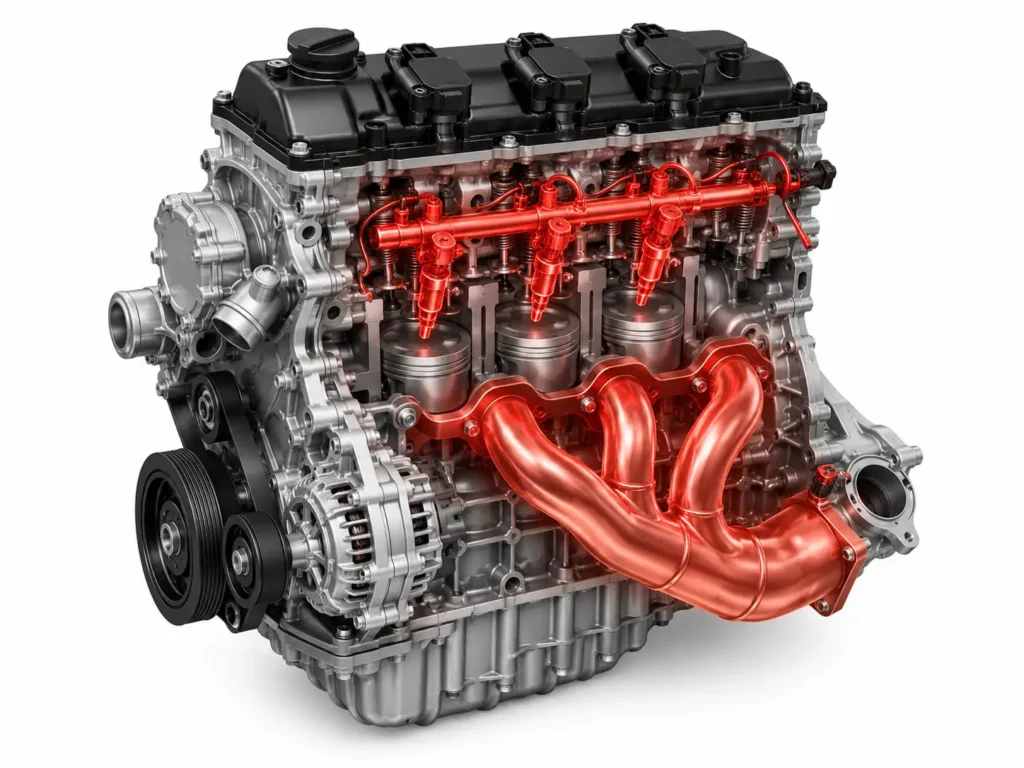
The 2.0L EcoBoost: Twin-Scroll Power and Engine Swaps
The 2.0-liter EcoBoost is arguably the most versatile and heavily utilized workhorse of Ford’s mid-size vehicle lineup. The first generation of this four-cylinder engine debuted in 2010, relying heavily on a block architecture originally derived from the reliable Mazda L-series engine.
However, when the strategic corporate partnership between Ford and Mazda eventually dissolved, Ford engineers completely redesigned the engine in 2015. This Second Generation 2.0L featured an all-new proprietary aluminum block, a new cylinder head with an integrated exhaust manifold, and a slightly higher compression ratio.
The single most significant performance upgrade for the 2015 redesign was the introduction of a BorgWarner twin-scroll turbocharger. By physically separating the exhaust pulses from the engine cylinders into two distinct channels, the twin-scroll turbo drastically reduced turbo lag.
This allowed the turbine to spool much faster, vastly improving low-RPM torque and low-speed drivability. Producing up to 250 horsepower and 280 lb-ft of torque, this engine transforms mundane vehicles like the Ford Edge and the modern Maverick pickup into highly capable machines.
Interestingly, because the Gen 1 and Gen 2 engines are so prevalent, a massive engine-swapping community has developed around them. Owners of older Focus ST hatchbacks frequently source used 2.0L engines from Ford Escapes or Fusions on eBay for cheap replacements.
However, mechanics must be extremely careful during these swaps to ensure compatibility. A Gen 2 twin-scroll engine cannot be easily dropped into a vehicle wired and plumbed for a Gen 1 mono-scroll engine without significant hardware modifications.
Yet, despite its impressive performance metrics and aftermarket support, the second-generation 2.0L is heavily overshadowed by a fatal flaw. It suffers from one of the most infamous and costly design defects in modern automotive history.
The Catastrophic Coolant Intrusion Crisis
The redesigned 2015-2019 2.0L EcoBoost engines suffer from a catastrophic structural block defect commonly known as “coolant intrusion”. The Gen 2 engine block features a semi-open deck design with extremely narrow coolant passages routed directly between the engine cylinders.
Over thousands of miles of driving, the constant thermal expansion and contraction cycles cause the thin block material between these cylinders to physically crack. This structural failure allows highly pressurized engine coolant to breach the cylinder head gasket and leak directly into the combustion chamber.
Drivers typically experience a rapid, unexplained loss of engine coolant in the reservoir without any visible external fluid leaks under the car. Secondary, more aggressive symptoms include thick white smoke billowing from the exhaust tailpipe, severe engine misfires (triggering P0300 through P0304 OBD2 codes), and a violently rough idle.
Because the engine coolant is actively being burned inside the cylinders, it washes away the vital lubricating oil film on the cylinder walls, eventually leading to total engine seizure. This defect is so widespread and financially devastating to consumers that it sparked a massive consolidated class action lawsuit.
The lawsuit, Miller, et al. v. Ford Motor Company, was filed by the legal team at Capstone Law APC and alleges Ford knowingly sold defective blocks. Ford eventually addressed the issue internally through several strict Technical Service Bulletins, including TSB 19-2208, 19-2346, and 22-2133.
The official Ford warranty remedy does not involve simply changing a head gasket. Mechanics are required to completely remove and replace the entire engine long block assembly, a procedure that bills out at over 14 hours of labor.
Identifying Safe 2.0L Model Years
Buyers looking at the used car market for Ford Edges, Fusions, Escapes, or Lincoln MKZs must be highly vigilant regarding exact vehicle production dates. The deeply flawed open-deck block design severely impacts 2015-2018 Edges, as well as 2017-2019 Fusions and Escapes.
Ford quietly fixed this massive engineering defect in the spring of 2019 by reverting the 2.0L architecture to a much stronger closed-deck block design. To avoid purchasing a defective vehicle, consumers must check the driver’s side door jamb sticker for the exact build date.
Specifically, any 2.0L Fusion or Lincoln MKZ built on or after April 9, 2019, features the updated, reliable engine block. For the Ford Escape and Lincoln MKC, the safe production cutoff date is slightly later, occurring on May 16, 2019.
If you are purchasing an older model that falls within the danger zone, verify through dealership service records if the engine has already been replaced. You want to ensure it was swapped under warranty with the updated “J2GZ-6006” service kit long block, which contains the fixed closed-deck design.
The 2.3L EcoBoost: The High-Performance Variant
Introduced in 2015 directly alongside the second-generation 2.0L, the 2.3-liter MPC (Mustang Performance Calibration) engine was built expressly for speed and durability. It proudly stands as the most powerful four-cylinder engine in the entire EcoBoost family.
Displacing exactly 2,261 cc with a 3.45-inch cylinder bore and robust internals, the 2.3L utilizes a large-capacity twin-scroll turbocharger. In its standard factory trim, it generates a very healthy 310 horsepower and 350 lb-ft of torque.
This highly impressive power output and relatively light physical weight made it the perfect base engine for the S550 generation Ford Mustang. It also serves as the dependable heart of the modern Ford Ranger pickup truck and the wildly aggressive, all-wheel-drive Ford Focus RS hot hatch.
The Focus RS Head Gasket Recall Disaster
While the 2.3L has proven to be highly reliable in longitudinal applications like the Mustang and Ranger, its transverse deployment in the 2016-2017 Focus RS was a public relations nightmare. Early Focus RS models began suffering from severe white exhaust smoke and rapid, unexplained coolant consumption almost immediately after delivery.
The enthusiast automotive community quickly banded together and discovered that Ford assembly plants in Saarlouis had made a monumental error. The factory had accidentally installed the wrong head gasket on thousands of Focus RS engines.
Specifically, assembly line workers mistakenly fitted the gasket meant for the Mustang 2.3L onto the Focus RS 2.3L engine block. Though the engine blocks are fundamentally similar in displacement, crucial internal coolant routing differences exist between the two vehicle platforms.
The Mustang head gasket features a specific coolant flow hole that does not align properly with the water jackets on the Focus RS block. This misalignment led to a tiny V-shaped depression between the cylinder bores where engine coolant would completely stagnate rather than flow.
This severe coolant stagnation caused localized thermal hot spots, ultimately boiling the fluid, destroying the gasket material, and warping the aluminum cylinder head. Ford eventually issued Customer Satisfaction Program 17B32, officially recalling affected RS vehicles.
Dealers were instructed to perform rigorous cooling system pressure tests on every vehicle. Depending on the severity of the damage found during the pressure test, dealers replaced either just the head gasket or the entire cylinder head assembly entirely free of charge.
The Nano Architecture: 2.7L vs 3.0L Specs
| Specification | 2.7L EcoBoost (Nano) | 3.0L EcoBoost (Nano) |
| Engine Configuration | 60-degree V-6 | 60-degree V-6 |
| Block Material | Compacted Graphite Iron (CGI) | Compacted Graphite Iron (CGI) |
| Displacement | 2,694 cc (164 CID) | 2,967 cc (180 CID) |
| Horsepower | 325 hp | Up to 418 hp |
| Torque | 400 lb-ft | Up to 440 lb-ft |
| Induction | Twin-Turbocharged | Twin-Turbocharged |
| Key Applications | F-150, Bronco, Edge ST | Explorer ST, Bronco Raptor |
The 2.7L Nano EcoBoost: The Over-Engineered V6
Introduced in 2015 specifically for the aluminum-bodied F-150, the 2.7-liter EcoBoost “Nano” proved conclusively that massive towing power could come from tiny displacement. Ford engineers boldly designed the 2.7L from the ground up specifically for turbocharging, rather than simply slapping turbos onto an existing naturally aspirated block.
To safely handle the immense internal cylinder pressures generated by twin turbochargers, Ford utilized Compacted Graphite Iron (CGI) for the upper cylinder block. CGI is an advanced metallurgy that is monumentally stronger and stiffer than traditional cast aluminum.
In fact, CGI is a material technology borrowed directly from heavy-duty commercial diesel engines, like Ford’s own 6.7L PowerStroke. The resulting 2.7L engine is incredibly sturdy, featuring a partially closed-deck design interwoven with an aluminum lower webbing structure for crucial weight savings.
Automotive reviewers and truck owners alike frequently dub the 2.7L the “Goldilocks” engine for the F-150 platform. It offers a seemingly perfect blend of rapid, lag-free acceleration, diesel-like low-end torque for towing, and excellent daily fuel economy.
The first generation 2.7L (2015-2017) produced 325 horsepower and 375 lb-ft of torque, seamlessly matched to a 6-speed automatic transmission. However, for the 2018 model year, Ford introduced the vastly improved and highly refined Second Generation 2.7L EcoBoost.
Gen 1 vs Gen 2 Updates: Fixing Carbon Buildup
The Gen 2 update completely revolutionized the 2.7L engine’s internal fueling system. Ford implemented a highly complex dual-injection setup, combining high-pressure direct fuel injection with lower-pressure port fuel injection.
This dual-injection system was implemented specifically to combat severe carbon buildup on the intake valves. Carbon caking is a notorious inherent flaw of early direct-injection-only engines because raw fuel never washes over the back of the intake valves to clean them.
By adding port injection back into the mix, the Gen 2 engine effectively washes the intake valves with a solvent mixture of gasoline during specific engine loads. This keeps the entire induction system perfectly clean over hundreds of thousands of miles of driving.
Furthermore, the Gen 2 update added modern electronic wastegates to the revised turbochargers for much more precise and rapid boost control. It also introduced a more durable dual-chain camshaft drive system, an electronic variable displacement oil pump, and a high-pressure EGR system to lower combustion temperatures.
While peak horsepower remained steady at 325 hp, the low-end torque was bumped to a stout 400 lb-ft. Furthermore, all Gen 2 engines were exclusively paired with Ford’s new 10R80 10-speed automatic transmission, allowing for vastly improved highway cruising efficiency and tighter gear ratios for towing.
The Plastic Oil Pan Leaking Controversy
While the internal CGI block of the 2.7L is nearly indestructible, Ford made a disastrous cost-cutting decision regarding the engine’s oil pan. Early Gen 2 engines (specifically 2018-2019 models) utilized a composite plastic oil pan to save weight.
This plastic pan was sealed directly to the metal engine block using Room Temperature Vulcanizing (RTV) silicone rather than a traditional rubber gasket. Due to the extreme, fluctuating heat cycles of the turbocharged engine, these plastic oil pans inevitably warp and deform at the mating surface.
Once the plastic warps even a fraction of a millimeter, the RTV sealant bond breaks down, causing severe oil leaks that leave messy puddles under the truck. The problem was so pervasive that owners found themselves returning to dealerships multiple times for re-sealing, only for the leaks to quickly return as the pan continued to warp.
Adding insult to injury, the specialized quarter-turn plastic drain plugs were also highly prone to snapping or leaking during routine oil changes. Eventually, Ford issued Technical Service Bulletin 19-2189 (later superseded and updated for other models via 19-2219 and 19-2387) to officially address the fiasco.
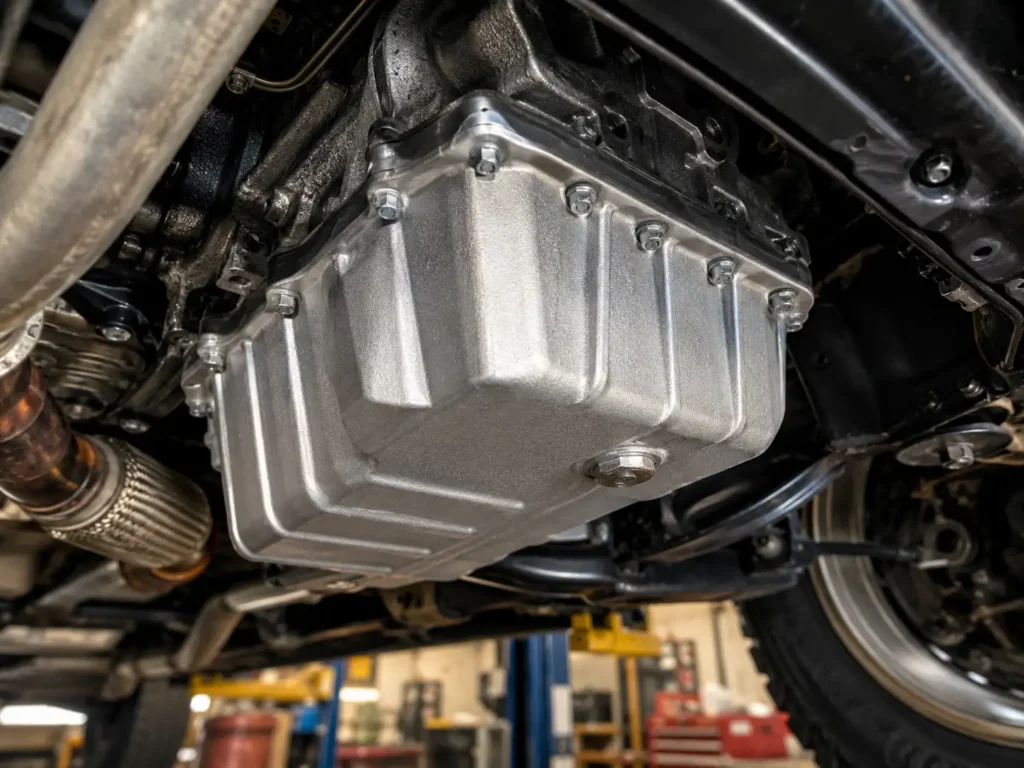
The official dealership fix involves painstakingly ripping off the old RTV-sealed pan, cleaning the block, and installing an updated version of the plastic pan that finally uses a true press-in-place rubber gasket. For owners who are currently out of warranty, the aftermarket has completely solved this frustrating issue.
Companies like Dorman now produce high-quality, cast aluminum replacement oil pans specifically for the 2.7L EcoBoost. These aluminum pans utilize a traditional gasket and a standard threaded metal drain plug, permanently eliminating the warping risk and ending the leaks forever.
The 3.0L Nano EcoBoost: Maximum Displacement
Expanding upon the massive commercial success of the 2.7L Nano, Ford introduced the 3.0L EcoBoost specifically for its high-performance division. By increasing the cylinder bore to 85.34 mm and lengthening the piston stroke to 86.11 mm, engineers squeezed 180 cubic inches of displacement out of the compact 60-degree V6 block.
Just like its smaller truck sibling, the 3.0L features a Compacted Graphite Iron (CGI) block mated to high-flow cast-aluminum cylinder heads. The incredibly robust rotating assembly is completely forged from the factory, allowing it to withstand extreme boost pressures without fear of internal rod or piston failure.
This heavily fortified engine serves as the high-revving heart of the aggressively tuned Ford Explorer ST and the monstrous, wide-body Ford Bronco Raptor. In the Bronco Raptor application, the 3.0L twin-turbo V6 belts out an astonishing 418 horsepower and 440 lb-ft of torque when fueled with premium octane gasoline.
While it shares the bulletproof CGI architecture of the 2.7L, it unfortunately also inherits some of its minor engineering annoyances. The 3.0L utilizes the exact same failure-prone plastic oil pans that require careful monitoring for leaks.
It also utilizes a wet rubber oil pump belt similar to the 1.0L, though it has proven far more durable in this specific V6 application. Regardless of these quirks, the raw durability of the 3.0L block was definitively proven when a completely stock Ford Ranger Raptor successfully completed the grueling Baja 1000 off-road race with zero engine issues, driving all the way back to Los Angeles afterward.
The 3.5L Cyclone EcoBoost: The Flagship V6
If there is one single engine that defines the modern era of the Ford Motor Company, it is undoubtedly the 3.5-liter EcoBoost V6. Originally manufactured at the Cleveland Engine Plant #1, this engine completely disrupted the full-size pickup segment when it was introduced heavily to the truck market in 2011.
It proved to deeply skeptical truck buyers that a twin-turbo V6 could easily out-tow and out-run traditional, large-displacement V8s. Based loosely on the naturally aspirated Duratec 3.5L aluminum block, the EcoBoost version was heavily fortified with a forged steel crankshaft to survive a harsh turbocharged life.
Over its highly successful lifespan, the longitudinal 3.5L F-150 engine has undergone three distinct, major generational redesigns. Each generation aimed to incrementally improve towing power while simultaneously patching glaring reliability flaws.
First-Generation 3.5L (2011–2016)
The Gen 1 3.5L engine produced between 365 and 375 horsepower, alongside 420 to 470 lb-ft of torque depending on the specific model year. It featured a purely direct-injection fuel system and utilized a pneumatic wastegate actuator for controlling the twin turbochargers.
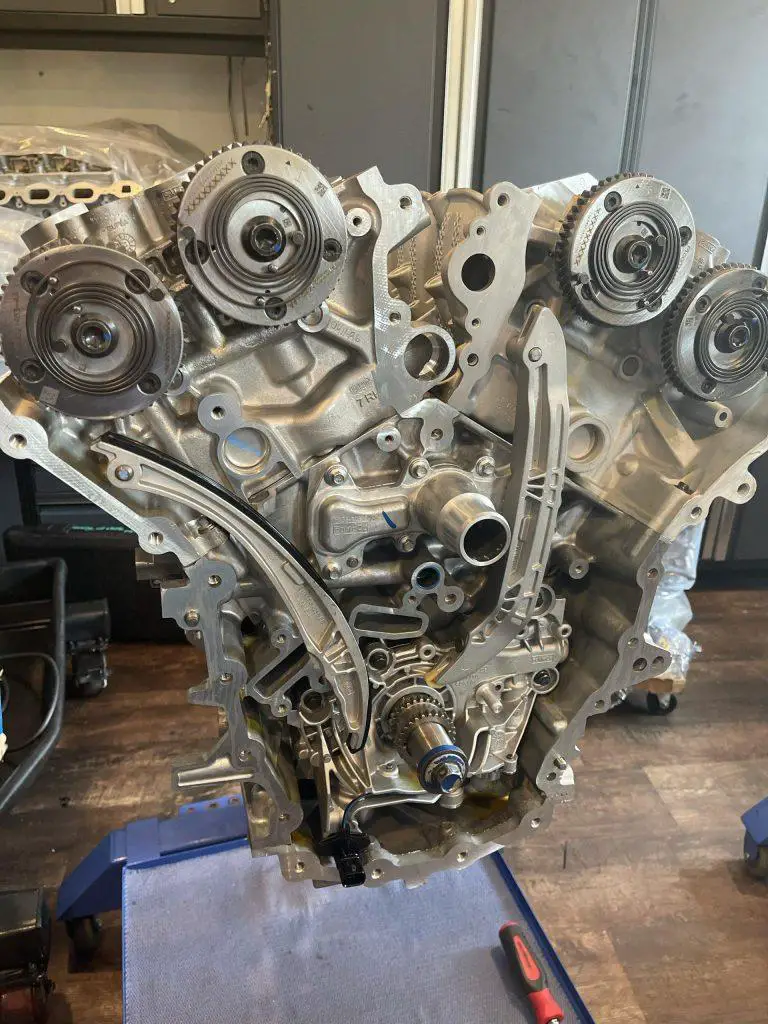
While these early motors are generally considered robust for towing, their ultimate achilles heel is the internal timing system. The Gen 1 engine uses a single, massively long timing chain that wraps around the entire front of the engine block to drive all four overhead camshafts.
Over time, irregular oil changes and the immense mechanical tension of driving four cams cause this extremely long chain to physically stretch out of specification. This “timing chain stretch” throws the engine out of mechanical time, triggering persistent check engine lights and requiring a highly expensive, labor-intensive teardown to replace the chain and guides.
Second-Generation 3.5L (2017–2020)
Recognizing the flaws of the original design, Ford completely overhauled the 3.5L architecture for the 2017 model year. To fix the intake valve carbon buildup issues associated with the Gen 1’s direct injection, Ford added port fuel injectors to the intake manifold, creating a much cleaner dual-injection system.
To permanently solve the timing chain stretch issue, engineers completely abandoned the single long chain design. Instead, they implemented a much stronger multi-chain system with individual, shorter chains driving each cylinder bank.
Horsepower rose to an even 400 hp, and torque hit a massive, class-leading 500 lb-ft. Unfortunately, while Ford successfully fixed the chain stretch, the Gen 2 engines introduced a highly notorious new flaw: catastrophic cam phaser failure.
The Variable Cam Timing (VCT) phasers located inside the Gen 2 cylinder heads lock up or fail internally. When the locking pins shear off, it causes a terrifyingly loud, metallic rattling noise during cold engine startups before oil pressure can build.
Furthermore, Gen 2 engines suffer from severe harmonic vibrations at certain RPMs, leading to premature wear on the crank pulley and bottom-end engine bearings. Like the 2.7L, early 2017-2018 Gen 2 engines also suffered from the leaking plastic oil pan defect.
Third-Generation 3.5L (2021–Present)
For the 2021 F-150 platform redesign, Ford introduced the Gen 3 3.5L EcoBoost to finally perfect the aging architecture. Ford fundamentally revised the cylinder head design and, most importantly, installed completely redesigned Gen 3 cam phasers that finally resolved the dreaded cold-start rattle.
Ford also wisely ditched the brittle plastic timing chain guides of previous generations, returning to highly durable metal timing chain guides and newly designed chain tensioners. Furthermore, to combat the harmonic vibration issues that plagued the Gen 2, Ford installed an all-new harmonic balancer.
This new balancer features a heavy inertia ring, functioning very similarly to expensive aftermarket racing pulleys. The Gen 3 engine represents the absolute pinnacle of the 3.5L architecture, producing a buttery smooth 400 horsepower while utilizing an optimized EGR system to actually boost horsepower rather than restrict it.
The Transverse Water Pump Warning
It is highly important to clarify a major mechanical misconception regarding the 3.5L engine’s water pump design, as it drastically affects reliability. F-150s, Expeditions, and Mustangs feature engines mounted longitudinally (front-to-back), utilizing a standard, external water pump that is safely bolted to the front of the timing cover.
However, in transverse (sideways) mounted front-wheel-drive applications—such as the Ford Edge, Flex, Explorer, and various Lincoln vehicles—Ford utilized an internal water pump. This internal pump is driven directly by the engine’s internal timing chain, placing it behind the sealed front cover.
When these internal water pumps eventually wear out and their seals fail, they do not simply leak onto the ground. Instead, they dump gallons of engine coolant directly into the crankcase oil.
This instantly creates a highly toxic, milky emulsion that completely destroys the engine’s main bearings within miles. This specific design flaw regularly results in a $3,000+ total engine replacement bill for what should be a routine $150 water pump failure.
High-Output and PowerBoost Variants
Ford engineers did not stop at 400 horsepower. In 2017, the 3.5L EcoBoost High Output (HO) engine was introduced exclusively for the mighty, Baja-inspired Ford F-150 Raptor.
This HO variant utilizes much larger turbochargers, highly aggressive ECU tuning, and a high-flow dual exhaust system to crank out 450 horsepower and 510 lb-ft of torque. Recognizing the demand for premium power, the High Output engine was later dropped into the luxury-tier F-150 Limited trims and the flagship Ford Expedition.
For the modern era, Ford integrated advanced hybridization into the 3.5L architecture to create the revolutionary PowerBoost drivetrain. By cleverly sandwiching a 35kW electric motor directly between the 3.5L gas engine and the 10-speed automatic transmission, the PowerBoost produces a staggering 430 horsepower and 570 lb-ft of combined torque.
This hybrid integration makes the PowerBoost the absolute torque king of the half-ton truck market, capable of towing massive trailers while functioning as a mobile electrical generator for job sites.
While the 3.5L HO engine remained essentially unchanged for the newest Raptors, the “Gen 3.5” (2024+) Raptor features significantly upgraded suspension technology to handle that power. The Gen 3.5 introduces Fox Live Valve Gen 3 dual-valve 3.1 shocks, replacing the older single-valve dampers found on the 2021-2023 models for drastically improved high-speed off-road control and rebound damping.
Fuel Economy Comparison: Real-World Efficiency Data
While the branding “EcoBoost” heavily implies a corporate focus on ecological efficiency, the reality is that turbocharged engines heavily depend on individual driving style. Stay out of the boost, and fuel economy is excellent; spool the turbos under a heavy payload, and fuel economy plummets rapidly.
Ford F-150 MPG Ratings
When comparing the highly competitive half-ton truck segment, the 2.7L EcoBoost is widely considered the absolute fuel economy champion for daily drivers. In a standard rear-wheel-drive configuration, the 2.7L delivers an impressive EPA-estimated 20 MPG in the city and 26 MPG on the highway.
The physically larger 3.5L EcoBoost naturally sacrifices a bit of fuel efficiency in exchange for its massive 13,500-pound maximum towing capacity. The standard 3.5L is officially rated at 17 MPG city and 25 MPG highway (yielding a 20 MPG combined rating).
Unsurprisingly, the monstrous 3.5L High-Output engine found in the heavy, aerodynamically challenged wide-body Raptor yields the poorest fuel economy, netting just 14 MPG city and 18 MPG highway. Conversely, the 3.5L PowerBoost Hybrid utilizes regenerative braking and battery power in stop-and-go traffic to achieve an incredible 22 MPG city and 24 MPG highway, making it the most efficient truck in the entire F-150 lineup.
| F-150 Engine Model | Drivetrain | City MPG | Highway MPG | Combined MPG |
| 2.7L EcoBoost V6 | 2WD | 20 | 26 | 22 |
| 2.7L EcoBoost V6 | 4WD | 19 | 24 | 21 |
| 3.5L EcoBoost V6 | 2WD | 17 | 25 | 20 |
| 3.5L PowerBoost Hybrid | 4WD | 22 | 24 | 23 |
| 3.5L High Output V6 | 4WD | 14 | 18 | 16 |
Ford Escape MPG Ratings
Transitioning to the compact crossover segment, the 1.5L Dragon engine provides a fantastic balance of pep and commuting efficiency. With a front-wheel-drive setup, the 1.5L Escape achieves a highly respectable 27 MPG city and 34 MPG highway.
Opting for the much more powerful 2.0L twin-scroll EcoBoost engine drops those numbers slightly due to the increased horsepower. The 250-horsepower 2.0L Escape, paired with All-Wheel Drive, manages 23 MPG city and 31 MPG highway.
For absolute maximum commuter efficiency, the Escape Hybrid models completely dominate the chart. The standard 2.5L Hybrid powertrain pulls an excellent 42 MPG city and 36 MPG highway, while the advanced Plug-In Hybrid version attains an astonishing 101 MPGe combined rating.
Ford Mustang EcoBoost MPG Ratings
The EcoBoost Mustang definitively proves that modern sports cars do not have to be relentless gas guzzlers. The 2.3-liter four-cylinder Mustang provides V8-rivaling power while maintaining excellent daily fuel efficiency.
When equipped with the enthusiast-focused 6-speed manual transmission, the Mustang EcoBoost achieves an EPA-estimated 21 MPG city and 32 MPG highway. When paired with the fast-shifting 10-speed automatic transmission, highway efficiency remains high at 30 MPG.
During real-world highway cruising tests at a steady 70 mph, automotive journalists have routinely recorded the Mustang EcoBoost achieving closer to 34 MPG. Combined with its generous 16-gallon fuel tank, the EcoBoost Mustang boasts an excellent, uninterrupted highway cruising range of over 500 miles, making it an incredible road-trip vehicle.
Critical Questions Readers Ask (FAQ)
What is the most reliable Ford EcoBoost engine?
The 2.7L Nano V6 and the Gen 3 3.5L V6 (2021+) are widely regarded by mechanics as the most reliable engines in the modern lineup. The 2.7L’s CGI iron block makes it incredibly robust under heavy boost, and its dual-injection system permanently prevents intake carbon buildup. Similarly, the Gen 3 3.5L finally solved the expensive timing chain stretch and cam phaser rattling issues that plagued earlier 3.5L models.
Which EcoBoost engines should I absolutely avoid buying used?
Buyers should exercise extreme caution with the 1.0L Fox engine due to the catastrophic wet-belt oil pump failure, which leads to total engine seizure. You should also completely avoid purchasing the 2015-2018 2.0L EcoBoost engines found in Edges and Fusions, as they suffer from a nearly guaranteed coolant intrusion defect that requires a complete engine block replacement.
Do all Ford EcoBoost engines require premium gas?
While most standard EcoBoost engines are specially tuned from the factory to run safely on regular 87-octane unleaded gasoline to save money at the pump, premium fuel is highly recommended for heavy towing or spirited track driving. High-performance variants, like the 3.0L in the Bronco Raptor and the 3.5L HO in the F-150 Raptor, strictly require premium 91+ octane to achieve their maximum advertised horsepower and torque ratings without ECU timing retardation.
How do I permanently fix the 2.7L EcoBoost oil pan leak?
The factory RTV-sealed plastic oil pans on early 2018-2019 2.7L engines are notorious for thermally warping and leaking oil. The official Ford warranty fix under TSB 19-2189 involves carefully installing a redesigned plastic pan with a true press-in-place rubber gasket. For a permanent, worry-free aftermarket solution, out-of-warranty owners can purchase a cast aluminum oil pan from Dorman that uses a traditional gasket and a standard threaded metal drain plug.
What exactly causes the loud cold-start rattle on the 3.5L EcoBoost?
The terrifying, metallic rattling noise heard immediately upon starting a Gen 2 3.5L engine is caused by failed Variable Cam Timing (VCT) phasers. The internal locking pins sheer off due to wear, allowing the camshaft to rattle aggressively back and forth until engine oil pressure builds up inside the unit to stabilize it.
Did Ford ever fix the coolant intrusion issue on the 2.0L engines?
Yes, Ford secretly resolved the devastating coolant intrusion flaw by completely redesigning the engine block. Any Ford Fusion or Lincoln MKZ built precisely after April 9, 2019, and any Ford Escape built after May 16, 2019, features the vastly stronger, closed-deck block design that is immune to cracking.
What is the primary difference between Gen 3 and Gen 3.5 F-150 Raptor?
While the 3.5L High Output engine remains essentially the exact same between the two generations, the “Gen 3.5” (2024+) Raptor features significantly upgraded Fox suspension technology. It officially introduces Fox Live Valve Gen 3 dual-valve 3.1 shocks, replacing the single-valve dampers found on the 2021-2023 Gen 3 models for drastically improved high-speed off-road control and smoother on-road manners.
Conclusion: Engineering Triumphs and Costly Tribulations
The vast Ford EcoBoost engine lineage represents a deeply fascinating study in modern automotive engineering and mass production. It is fundamentally a story of incredible technological ambition, punctuated by highly frustrating—and occasionally catastrophic—mechanical growing pains.
When EcoBoost technology functions perfectly as designed, it delivers an intoxicating driving experience that traditional, naturally aspirated engines simply cannot match. The explosive, lag-free low-end torque of the 2.7L Nano and the mind-bending towing supremacy of the 3.5L PowerBoost hybrid definitively prove that smart turbocharging is the undeniable future of the global truck market.
However, the relentless corporate pursuit of extreme fuel efficiency and weight reduction has frequently led to overly complex internal designs that do not age gracefully in the real world. From the degrading, oil-soaked rubber belts in the 1.0L Fox engine to the inherently flawed, cracking open-deck blocks in the 2.0L, buyers must carefully navigate a veritable minefield of Technical Service Bulletins, safety recalls, and class-action lawsuits.
For prospective vehicle buyers navigating the complex new and used car markets, the strategic purchasing advice is abundantly clear. Consumers should heavily focus their attention and budgets on the robust, heavy-duty Nano architecture (2.7L/3.0L) or the highly refined, fully updated Gen 3 3.5L models.
By deeply understanding the historical manufacturing defects, block material changes, and specific generation cut-off dates exhaustively outlined in this report, consumers can confidently leverage the immense power and efficiency of Ford’s EcoBoost platform. Armed with this data, buyers can secure a thrilling, highly capable vehicle while successfully avoiding thousands of dollars in devastating, unexpected engine repair bills.