
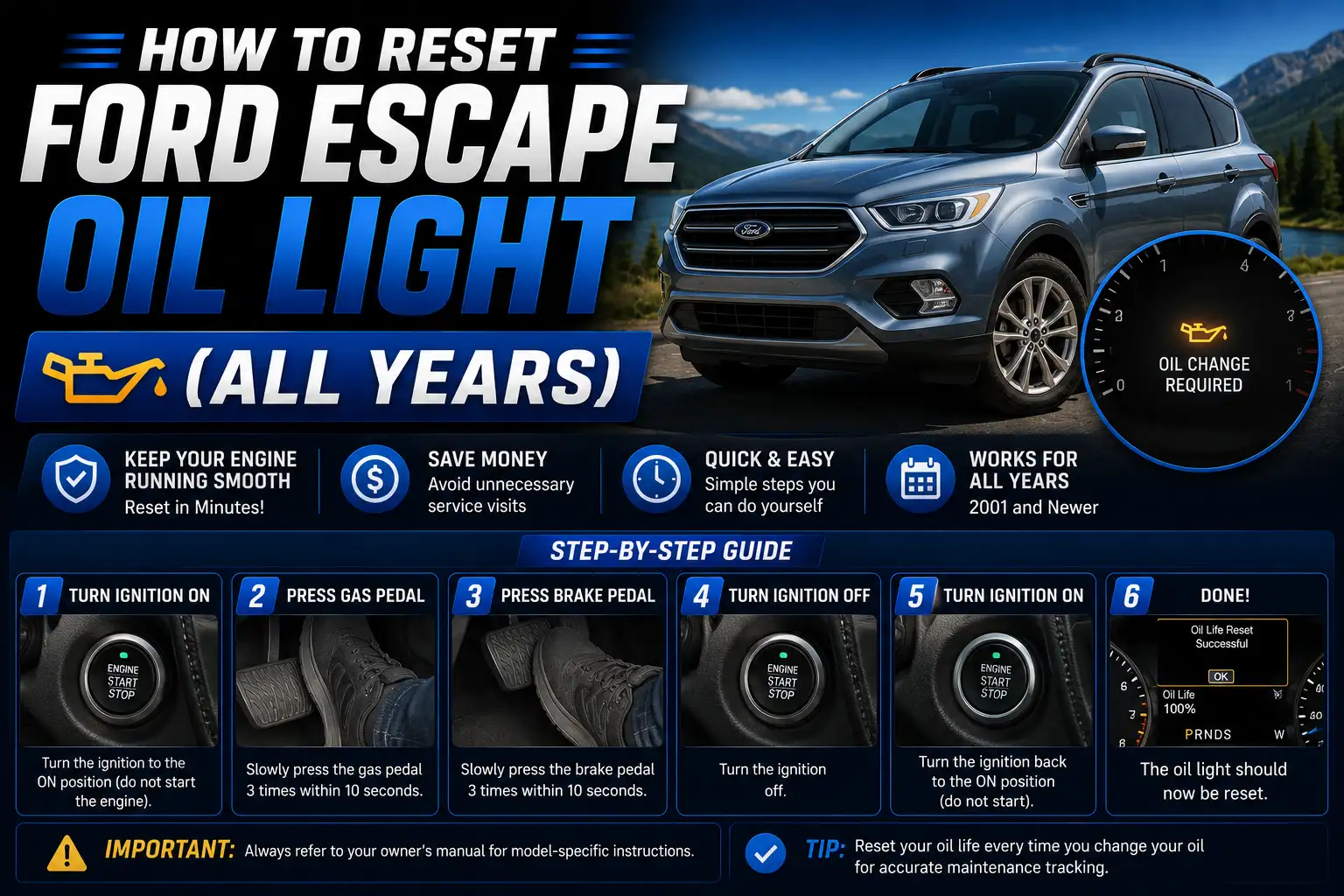
How to Reset Ford Escape Oil Light: All Generations (2001-2026)

The Ford Escape remains one of the most reliable and widely driven compact SUVs on the global automotive market. Maintaining this reputation for longevity requires strict adherence to scheduled maintenance intervals.
Regular engine oil and filter changes are the absolute foundation of this maintenance routine. However, replacing the physical fluid is only half the battle.

Prime for Young Adults — 6 Months Free
Students and 18–24s get six months of Prime free, then half price.
Start 6 Months Free As an Amazon Associate I earn from qualifying purchases.After completing an oil service, the vehicle’s powertrain control module does not automatically detect the presence of fresh fluid. The internal computer system requires a manual reset procedure.
This procedure communicates to the vehicle that the maintenance has been completed, allowing it to accurately track the lifespan of the new oil. Failing to reset the oil change indicator leads to premature warnings and an inaccurate maintenance history.
This exhaustive guide breaks down the precise reset procedures for every Ford Escape generation spanning from 2001 to 2026. It explores the sophisticated algorithms behind Ford’s monitoring systems and details precise oil capacities.
By following these highly specific, data-driven procedures, automotive technicians and daily drivers alike can ensure peak engine performance.
How to Reset Ford Escape Oil Light
Recommended Best Deal Products


A comprehensive, data-driven guide to mastering the Ford Intelligent Oil-Life Monitor across every generation.
The IOLM Science
Ford’s Intelligent Oil-Life Monitor is not a simple mileage counter. It is a predictive algorithm that calculates oil degradation based on engine thermal cycles, speed, and environmental load.
Driving Style vs. Oil Life
Severe city driving can reduce oil life by 50% compared to highway cruising due to moisture buildup and fuel dilution.
Reset Procedures by Generation
Recommended Best Deal Products


4th Gen (2020-2026)
Menu StyleUses the steering wheel directional pad and ‘OK’ button.
- Ignition to ON (Engine Off).
- Press Menu on steering wheel.
- Select Settings > Vehicle.
- Find Oil Life and Hold OK.
3rd Gen (2013-2019)
Pedal StyleA unique combination of brake and gas pedal inputs.

Audible — Listen Free for 30 Days
One free credit a month and thousands of titles included.
Listen Free for 30 Days As an Amazon Associate I earn from qualifying purchases.- Ignition to ON (Engine Off).
- Press Brake + Gas simultaneously to floor.
- Hold for 25 seconds until message displays.
- Release once “Reset Complete” appears.
2nd Gen (2008-2012)
Button BankUses physical INFO/SETUP/RESET buttons on the dash.
- Press SETUP repeatedly for Oil Life.
- Once displayed, Hold RESET.
- Release when it reads “100%”.
1st Gen (2001-2007)
Stem StyleManaged via the odometer trip/reset stem.
- Click Trip Stem to find System Check.
- Hold Stem to enter sub-menu.
- Select Hold Reset if New Oil.
Engine Capacities & Viscosity
The reset is only the final step. Using the correct fluid volume is critical to prevent engine starvation or oil aeration.
| Engine Type | Capacity (Quarts) | Viscosity | Filter |
|---|---|---|---|
| 1.5L EcoBoost | 5.4 Qt | 5W-20 | FL910S |
| 2.0L EcoBoost | 5.7 Qt | 5W-30 | FL910S |
| 2.5L Hybrid | 5.7 Qt | 0W-20 | FL910S |
| 3.0L V6 | 6.0 Qt | 5W-20 | FL820S |
Know Your Warnings
Change Oil Soon
IOLM is at 5%. You have roughly 500 miles to service the vehicle.
The Wrench Icon
NOT an oil light. Indicates a powertrain fault or electronic throttle error. Requires OBD2 scan.
Oil Pressure (Red)
CRITICAL. Physical loss of oil pressure. Stop engine immediately to prevent seizure.
Understanding the Ford Escape Intelligent Oil-Life Monitor
Modern Ford Escape models no longer rely on antiquated, hard-coded mileage countdowns to dictate oil change intervals. The days of simply changing the oil every 3,000 miles are entirely obsolete.
Instead, Ford utilizes a highly advanced software system known as the Intelligent Oil-Life Monitor (IOLM). This system represents a massive leap forward in automotive maintenance technology.
It is important to note that the IOLM is not a physical sensor submerged in the oil pan measuring chemical clarity. Rather, it is an advanced, algorithm-driven program.
The Powertrain Control Module (PCM) calculates oil degradation based on real-time, real-world driving conditions. This computer system constantly monitors a variety of critical data points throughout the engine’s operation.
Audible Premium Plus — Annual Membership
12 audiobook credits up front, plus the full Audible catalogue.
See Annual Plans As an Amazon Associate I earn from qualifying purchases.These data points include engine block temperature, vehicle speed, engine RPM history, and overall engine load. By synthesizing this data, the algorithm precisely predicts when the oil’s chemical additives will break down.
How the Algorithm Calculates Oil Life
If a Ford Escape is driven primarily on the highway at steady speeds in moderate weather, the algorithm calculates a much slower rate of oil breakdown. Highway driving allows the engine to reach and maintain optimal operating temperatures.
These ideal thermal conditions burn off moisture and unburned fuel that may have slipped past the piston rings. Under these perfect conditions, the IOLM may allow the Ford Escape to reach up to 10,000 miles before triggering an alert.
Conversely, severe driving habits drastically accelerate the algorithm’s internal countdown. Short, stop-and-go city commutes prevent the engine from reaching its ideal operating temperature.
This leads to significant moisture accumulation and fuel dilution in the crankcase. Towing heavy loads, extensive idling in extreme heat, or driving in sub-zero ambient temperatures also place severe stress on the fluid.
Under these harsh operating conditions, the IOLM will demand an oil change much sooner. It is not uncommon for the system to trigger an alert at just 3,000 to 5,000 miles to protect the internal engine bearings.
The Dashboard Warning Thresholds
The dashboard display communicates the real-time status of the IOLM to the driver through distinct percentage thresholds. As the calculated oil life depletes, the system issues varying levels of warnings.
When the algorithm determines that the oil has reached the 5% remaining mark, the instrument cluster will display a “Change Engine Oil Soon” message.
This initial warning grants the driver a short, convenient grace period to schedule an appointment with their local dealership or trusted mechanic.
However, once the algorithm determines the oil life has hit 0%, the message aggressively changes to “Oil Change Required”. This final warning indicates that immediate servicing is necessary to prevent accelerated internal engine wear and potential catastrophic failure.
| Warning Message | Remaining Oil Life | Required Action |
|---|---|---|
| System Check: Oil Life OK | 100% to 6% | Continue normal driving operation. |
| Change Engine Oil Soon | 5% to 1% | Schedule an oil change within the next 500 miles. |
| Oil Change Required | 0% | Perform an oil change and filter replacement immediately. |
Generational Differences in the Ford Escape
Because the Ford Escape has evolved through four distinct generations and multiple electronic architectures, the reset procedure varies heavily.
Attempting a reset using the wrong generation’s methodology will inevitably fail. This often leaves the driver frustrated with a persistent and annoying dashboard warning chime.
Automotive electronics shifted from simple analog clusters in the early 2000s to the highly digitized CAN bus networks of today. Consequently, the methods for communicating with the vehicle’s computer have completely transformed.
Below is an exhaustive, step-by-step breakdown of the reset procedures for all four distinct generations of the Ford Escape platform.
Fourth Generation 2020 to 2026 Steering Wheel Method
The fourth-generation Ford Escape features a highly digitized interior environment. This modern architecture relies heavily on steering wheel controls and the SYNC central information display.
This generation completely abandons the quirky pedal-reset methods of the past. Instead, it utilizes the directional arrow pad located on the steering wheel to navigate the digital instrument cluster.
The procedure is highly intuitive and provides clear visual feedback throughout the entire process.
Navigating to the Vehicle Settings
To begin the reset procedure, safely park the vehicle and ensure the physical engine is turned off. The vehicle must be placed into accessory mode to power the digital dashboard screens.
Insert the key and turn the ignition to the “ON” position without cranking the engine. If your Escape is equipped with a push-button start system, press the “Start/Stop” button exactly once without placing your foot on the brake pedal.
This action activates the vehicle’s electrical systems and illuminates the instrument cluster. Locate the directional arrow pad on your steering wheel.
Press the “Menu” or the back arrow button to escape any active prompts and access the main display options. Scroll through the primary menu until you locate the “Settings” tab, and press the “OK” button to select it.
Executing the Reset Command
Once inside the Settings menu, use the directional pad to navigate downward to the “Vehicle” submenu. Select it, and then locate the option labeled “Oil Life” or “Oil Life Reset”.
The digital screen will now display the current remaining oil life percentage, which will likely be at or near 0%.
To execute the reset command, press and hold the “OK” button firmly. You must maintain pressure on the button; do not simply tap it.
The display will show a visual progress bar or indicate that the reset is currently in progress. After a few seconds, a “Reset Successful” message will populate the screen, and the oil life will return to 100%.
Once the screen confirms the 100% status, you may release the “OK” button and turn off the ignition. The next time you start the engine, the warning indicator will be completely cleared. You can verify this process through resources like the Ford Service Content portal.
Third Generation 2013 to 2019 Gas and Brake Pedal Method
The third-generation Ford Escape introduced a highly unique, hands-free reset method. This specific generation relies entirely on the simultaneous application of the vehicle’s foot pedals.
Many owners find this method deeply confusing initially, as it lacks a dedicated physical button on the dashboard. However, it is actually one of the fastest reset procedures available once the mechanics are understood.
This specific pedal-command sequence tells the Powertrain Control Module to initiate a system override for the oil life monitor.
Preparing the Vehicle for the Pedal Reset
Securely park the vehicle, engage the electronic parking brake, and ensure all doors are completely closed. Open doors can trigger warning chimes that interrupt the dashboard screen’s reset messaging.
Turn the ignition key to the “ON” position, but absolutely do not crank the engine. For models equipped with a push-button start, simply press the ignition button once while keeping your foot completely off the brake pedal.
The dashboard warning lights should illuminate, indicating that the vehicle’s accessory power is active and the computer is listening for inputs.
The Simultaneous Pedal Sequence
With the accessory power on, simultaneously press both the accelerator pedal and the brake pedal all the way to the floorboard.
Hold both pedals down with firm, continuous pressure. After approximately three seconds, a diagnostic message reading “Service: Oil reset in prog.” will appear on the digital cluster.
Continue holding both pedals down without letting up even slightly. This is a critical juncture where many drivers fail by releasing their feet too early.
After roughly 20 to 25 seconds of continuous pressure, the message on the screen will change to read “Service: Oil reset complete”.
Once this final completion message is verified visually on the screen, you may release both the gas and brake pedals. Turn the ignition off, then start the engine normally to verify the oil change warning light has successfully vanished.
Second Generation 2008 to 2012 Message Center Method
The second-generation Escape features a very prominent physical button bank on the dashboard. This bank is typically located to the left or right of the center console, depending on the specific trim level.
These models are equipped with three distinct, clearly labeled buttons: “INFO,” “SETUP,” and “RESET.”
This era of Ford electronics relied on scrolling through text-based menus to alter vehicle preferences and clear maintenance codes.
Accessing the System Check Menu
Insert the ignition key and turn it to the “RUN” position, which is exactly one click before the engine actually engages.
Wait a moment for the standard warning chimes to stop and for the default dashboard information screen to load fully.
Press the “SETUP” button repeatedly. Each press will cycle the system through various diagnostic checks and vehicle settings.
Continue pressing “SETUP” until the instrument cluster clearly displays the message “OIL LIFE XXX% HOLD RESET = NEW”.
Confirming the Reset Command
While this specific oil life message remains active on the screen, press and hold the “RESET” button.
Keep the “RESET” button held down firmly for about two seconds. The digital display will update to read “OIL LIFE SET TO 100%”.
This confirms that the internal computer has registered the new fluid. You may now turn the ignition switch back to the off position.
Start the vehicle’s engine to confirm the oil change indicator no longer illuminates. Detailed visual guides for this specific era can often be found through publishers like Haynes Manuals.
Some late-model second-generation Escapes also allow owners to manually customize the reset percentage. By pressing “RESET” multiple times during the sequence, you can set the baseline oil life to 90%, 80%, or 70% if you prefer earlier maintenance warnings.
First Generation 2001 to 2007 Trip Stem Method
The original, first-generation Ford Escape features much simpler electronics than its modern counterparts. These early models typically utilize the analog trip odometer stem to navigate basic maintenance resets.
Depending on the specific trim level, such as the XLT versus the Limited, and the exact production year, this process can vary slightly. However, it generally relies entirely on the dashboard cluster’s trip button.
Navigating the Analog Cluster
Turn the ignition key to the “ON” or “RUN” position, ensuring the engine remains completely off during the process.
Locate the slender “TRIP/RESET” stalk protruding directly from the plastic face of the instrument cluster behind the steering wheel.
Press and quickly release the “TRIP/RESET” button to toggle through the analog menus until you reach a screen that reads “SETUP MENU HOLD RESET”.
Finalizing the Stem Sequence
Once you see the setup menu prompt, press and hold the “TRIP/RESET” button until “SYSTEM CHECK HOLD RESET” is displayed on the screen.
Release the button momentarily, then press it again to scroll through the system checks until you find the specific prompt reading “HOLD RESET IF NEW OIL”.
Press and hold the “TRIP/RESET” button one final time. Maintain pressure until the screen confirms the action with the message “OIL LIFE SET TO 100%”.
Release the stalk and turn the ignition off. Start the engine to ensure the reset was fully accepted by the vehicle’s powertrain control module.
| Ford Escape Generation | Production Years | Primary Reset Method | Required Action Duration |
|---|---|---|---|
| Fourth Generation | 2020 – 2026 | Steering Wheel Menu | Hold ‘OK’ for 5 seconds |
| Third Generation | 2013 – 2019 | Gas + Brake Pedal | Hold pedals for 25 seconds |
| Second Generation | 2008 – 2012 | Dashboard Setup Buttons | Hold ‘Reset’ for 2 seconds |
| First Generation | 2001 – 2007 | Trip Odometer Stem | Hold ‘Stem’ through System Check |
Advanced Troubleshooting for Reset Failures
Occasionally, the manual oil reset procedure will fail to register with the vehicle’s internal computer. This leaves the irritating oil change light illuminated on the dashboard despite your best efforts.
While this usually points to a simple user timing error, it can occasionally indicate deeper electrical faults or software glitches within the module.
Here is an expert-level troubleshooting guide designed to help you force the system to recognize the maintenance reset.
Fixing Timing and Pedal Application Errors
The single most common point of failure occurs during the third-generation (2013-2019) pedal reset method. Drivers frequently release the gas and brake pedals before the full 25 seconds have entirely elapsed.
The vehicle’s computer requires a sustained, uninterrupted voltage signal from both pedal position sensors. If your foot slips even slightly off the accelerator, the sequence is instantly broken.
The dashboard display will immediately read “Reset Cancelled” if the connection is interrupted. To fix this, ensure your thick winter floor mats are not obstructing the physical travel of the pedals.
The pedals must travel completely to the floorboard to register 100% input. Restart the procedure from step one, applying firm, deliberate, and unwavering pressure.
Overcoming Push-Button Start Complications
For modern vehicles equipped with keyless push-button ignition, getting the car into “Accessory Mode” without accidentally starting the engine can be frustrating.
If you press the brake pedal while tapping the start button, the engine will physically crank. If the engine is running, the reset procedure will immediately fail and abort.
You must ensure your feet are entirely clear of all pedals when you push the start button to activate the electronics. Only apply your feet to the pedals after the dashboard has fully illuminated.
Dealing with Battery Voltage Drops
A weak or failing 12-volt battery can cause modules to miscommunicate across the vehicle’s CAN bus network. If the battery voltage dips too low while the engine is off, the Powertrain Control Module (PCM) may reject the oil life reset command.
When voltage drops below operational thresholds, the computer prioritizes essential functions and ignores maintenance inputs.
If the light absolutely refuses to clear, hook the vehicle up to a battery maintainer or jump starter. Ensure the voltage reads above 12.2V, and attempt the reset procedure again with a stable power supply.
Using OBD2 Diagnostic Tools and FORScan
If manual methods continually fail—sometimes due to a highly stubborn software glitch in the instrument cluster programming—the oil life can be forced to 100% using professional diagnostic software.
Advanced tools like FORScan, paired with a high-quality OBD2 interface adapter, allow advanced users to directly access the vehicle’s internal computer modules.
By opening the Instrument Cluster (IC) module menu within the FORScan software on a laptop, technicians can manually overwrite the oil life percentage. This entirely bypasses the need to use physical buttons or pedals.
Differentiating Dashboard Warnings Oil Light versus Wrench Light
A rampant source of confusion among Ford Escape owners is the visual difference between the standard engine oil reminder and the dreaded orange “Wrench” light.
Misinterpreting these two entirely distinct warning symbols can lead to severe engine damage or unnecessary driver panic.
Understanding what the vehicle is trying to communicate is the first step in proper automotive diagnostics.
Decoding the Standard Oil Change Indicator
The standard oil change light usually manifests as a text message on the digital display, reading “Oil Change Required.” Occasionally, older models feature an icon of a dripping oil can.
This specific alert strictly relates to routine fluid maintenance. It indicates that the IOLM algorithm has counted down to zero based on your historical driving habits.
Resetting this light is completely harmless, provided the engine oil and the physical oil filter have actually been replaced.
Decoding the Orange Wrench Light
The orange wrench icon is an entirely different beast. It does not mean your vehicle needs an oil change, nor can it be cleared using any of the oil reset procedures listed in this guide.
The wrench light indicates that the vehicle’s computer has detected a serious powertrain fault or a critical electronic throttle control issue.
When the wrench light illuminates, the vehicle will frequently force itself into a protective “Limp Mode”. This safety protocol drastically reduces engine power and caps vehicle speed to prevent catastrophic mechanical failure.
Common mechanical triggers for the wrench light in the Ford Escape include a dirty or failing electronic throttle body, transmission fluid pressure loss, or a malfunctioning accelerator pedal position sensor.
If the wrench light appears on your dash, do not attempt an oil reset. The vehicle must be scanned with an advanced OBD2 diagnostic tool to pull the specific transmission or engine codes causing the powertrain fault. Dealerships and platforms like Greg Hubler Ford strongly advise professional diagnostics for wrench codes.
Ford Escape Oil Capacity Viscosity and Filter Guide
A successful dashboard oil reset must always be preceded by a proper, high-quality fluid exchange.
Using the incorrect oil viscosity or failing to add the proper fluid capacity can trigger dangerous low oil pressure warnings. Running an engine low on oil will rapidly destroy internal bearings and score camshaft journals.
Because the Ford Escape has utilized a massive variety of engines over its lifespan, the required specifications vary significantly from year to year.
From high-revving naturally aspirated 4-cylinders to turbocharged EcoBoosts and modern Atkinson-cycle Hybrid powertrains, each block has distinct thermal requirements.
Specifications for the 1.5L EcoBoost Engine
The 1.5L EcoBoost engine, available in both 3-cylinder and 4-cylinder configurations depending on the year, is highly sensitive to oil quality. This sensitivity is due to its incredibly tight internal tolerances and intense turbocharger heat.
The fluid capacity for the 1.5L EcoBoost is 5.4 quarts (5.1 liters) when including a fresh filter change.
Ford strictly recommends SAE 5W-20 full synthetic motor oil for this specific block. The 5W-20 viscosity is engineered for optimal fuel economy and rapid turbocharger bearing lubrication upon cold starts.
It is important to note that turbocharged engines shear their oil much faster than standard engines. Even if the dashboard IOLM allows a 10,000-mile interval, many independent experts strongly suggest a 5,000-mile interval to maximize turbocharger longevity.
Specifications for the 2.0L EcoBoost Engine
The highly popular and powerful 2.0L EcoBoost variant requires slightly more fluid capacity and a distinctly different oil viscosity to manage its increased thermal loads.
The fluid capacity for the 2.0L EcoBoost is 5.7 quarts (5.4 liters) when completing a standard filter change.
Unlike the smaller 1.5L engine, SAE 5W-30 motor oil is strictly mandated for the 2.0L block. The thicker 5W-30 viscosity provides much better high-temperature shear protection when the engine is under heavy boost.
Always pair this oil with a high-quality OEM filter, such as the Motorcraft FL910S. A premium filter prevents anti-drainback valve failures, ensuring oil remains in the upper valvetrain after the engine is shut off.
Specifications for the 2.5L Duratec and Hybrid Engines
The 2.5L engine architecture, whether in its older naturally aspirated Duratec form or the highly modern Atkinson-cycle Hybrid (FHEV & PHEV) layout, is renowned for being incredibly durable.
The fluid capacity for the 2.5L engine family is 5.7 quarts (5.4 liters) with a corresponding filter change.
While older 2.5L Duratec models require standard SAE 5W-20, modern hybrid variants frequently utilize ultra-thin SAE 0W-20 full synthetic oil to achieve peak mechanical efficiency.
Hybrid engines frequently shut their internal combustion engines entirely off during low-speed city driving. This constant stopping and starting requires an incredibly thin oil that flows instantly upon startup, making the 0W-20 weight absolutely ideal.
Specifications for the Older 3.0L V6 Engines
Older generation Ford Escapes equipped with the burly 3.0L V6 feature a larger oil pan capacity to adequately lubricate the larger engine block.
The fluid capacity for the 3.0L V6 is a robust 6.0 quarts (5.7 liters) when including a fresh oil filter.
Ford recommends SAE 5W-20 for these older V6 models.
It is highly advised that owners of high-mileage V6 models manually check their oil level using the physical dipstick periodically between electronic intervals. These older engines often suffer from minor rear main seal or valve cover leaks that the computer cannot detect.
| Engine Variant | Total Capacity (w/ Filter) | Recommended Viscosity | Standard OEM Filter |
|---|---|---|---|
| 1.5L EcoBoost | 5.4 Quarts (5.1 L) | SAE 5W-20 Synthetic | Motorcraft FL910S |
| 2.0L EcoBoost | 5.7 Quarts (5.4 L) | SAE 5W-30 Synthetic | Motorcraft FL910S |
| 2.5L FHEV/PHEV | 5.7 Quarts (5.4 L) | SAE 0W-20 Synthetic | Motorcraft FL910S |
| 3.0L V6 (Older) | 6.0 Quarts (5.7 L) | SAE 5W-20 Blend | Motorcraft FL820S |
Comprehensive Ford Escape Maintenance Intervals
Resetting the oil change light is only one small fraction of the total required vehicle maintenance regimen.
When the IOLM chimes to alert you that it is time for service, professional Ford dealerships and independent technicians use this specific milestone to perform a broader multi-point inspection.
If you are an at-home DIY mechanic performing the oil change and dashboard reset in your driveway, you must not neglect the other mechanical systems that require simultaneous attention.
What to Inspect at the 10,000-Mile Mark
Alongside every routine oil change, the vehicle’s tires should be carefully rotated. Rotating the tires ensures even tread wear across all four corners, which is especially critical on All-Wheel Drive (AWD) Escape models to prevent drivetrain binding.
During this interval, brake pads, rotors, and rubber brake hoses must be visually inspected for safe friction thickness and hydraulic leakages.
Furthermore, the engine cooling system, including the radiator hoses and the pressurized coolant reservoir, should be thoroughly checked for proper fluid strength and level.
What to Inspect at the 30,000-Mile Mark
As the vehicle crosses the 30,000-mile threshold, the interior cabin air filter should be replaced. A clean cabin filter maintains HVAC blower efficiency and prevents musty interior odors.
The primary engine air filter must also be inspected and replaced if it appears heavily soiled. A restricted engine air filter suffocates the intake tract, drastically reducing fuel economy and horsepower.
Suspension components, including the lower ball joints, tie rod ends, and steering linkages, should be physically evaluated with a pry bar for excessive mechanical play.
What to Inspect at the 100,000-Mile Mark
Major powertrain fluids require complete exchange as the vehicle ages into high mileage territory. The Power Transfer Unit (PTU) fluid on AWD Escapes is notoriously prone to overheating and thermal breakdown.
The PTU gear oil should be flushed periodically to prevent the transfer case from internally destroying its own gears.
The automatic transmission fluid (ATF) should also be drained and refilled. Fresh ATF maintains smooth clutch pack shifting and prolongs the lifespan of the planetary gear sets.
Finally, the engine’s spark plugs generally require replacement near the 100,000-mile mark. However, turbocharged EcoBoost models may benefit from significantly earlier replacement intervals due to the extreme cylinder pressures of forced induction.
FAQs
Can I reset my oil life monitor without actually changing the oil?
Technically, yes, the reset procedure will work regardless of fluid condition. The vehicle’s computer cannot physically detect if the actual fluid in the pan is new or old.
However, doing so is incredibly dangerous and ill-advised for engine health. Resetting the digital monitor without replacing the severely degraded oil defeats the entire engineering purpose of the IOLM system.
Continuing to drive on exhausted oil will rapidly lead to severe internal sludge buildup, spun engine bearings, and entirely voided manufacturer powertrain warranties.
Why does my oil light keep coming back on right after an oil change?
If the “Oil Change Required” text message remains illuminated immediately after a professional service, it simply means the lube technician forgot to perform the manual dashboard reset procedure.
You can easily perform the reset yourself using the generation-specific steps outlined in this guide. However, if the light that appears is a red icon shaped like a dripping oil can, this indicates low oil pressure, not oil life.
A low oil pressure warning means there is a severe mechanical leak, a dangerously loose oil drain plug, a double-gasketed oil filter, or a failing internal oil pump. Immediately turn off the engine if the red oil pressure light appears.
How does the Intelligent Oil-Life Monitor actually work on a Ford Escape?
The IOLM uses a highly advanced, proprietary software algorithm to predict chemical oil degradation.
It continuously monitors real-time engine block temperatures, RPM history, idle times, and ambient climate data. It calculates exactly how quickly the oil’s synthetic chemical additives and detergents are breaking down.
By analyzing this data, it alerts you precisely when the oil’s protective qualities are exhausted, rather than relying on an inaccurate, flat 5,000-mile rule.
What happens to my engine if I continually ignore the oil change light?
Ignoring the digital warning allows the engine to run on heavily degraded, highly acidic oil. As the motor oil breaks down over time, it loses its viscosity and shear strength, causing direct metal-on-metal friction.
This excessive friction generates massive internal heat, stretching steel timing chains, scoring aluminum camshafts, and clogging variable valve timing (VVT) solenoids.
Ultimately, ignoring the light leads to catastrophic, irreparable engine failure requiring a complete motor replacement.
Does a Ford Escape Hybrid need oil changes as often as a traditional gas model?
Hybrid models, including the FHEV and PHEV variants, often feature much longer physical intervals between oil changes.
This extended interval is because the internal gasoline engine shuts off frequently during low-speed city driving and coasting. The IOLM tracks exactly how many hours the internal combustion engine is actually running and generating heat, not just how far the vehicle has traveled.
Because of this intelligent tracking, a Ford Escape hybrid driven mostly on electric power might safely exceed 10,000 total miles before the monitor finally hits 0%.
What is the specific difference between 5W-20 and 5W-30 motor oil for the Ford Escape?
The “W” in the oil weight stands for Winter, indicating the oil’s flow rate and viscosity when the engine is entirely cold.
The second number dictates the oil’s thickness and protective film strength at peak operating temperatures. 5W-20 is a thinner fluid generally prioritized by engineers for maximum fuel efficiency in the 1.5L and 2.5L engines.
Conversely, 5W-30 is a thicker oil at high temperatures. This higher viscosity offers vastly better thermal protection and shear resistance for the much hotter, turbocharged 2.0L EcoBoost engine.
Can a low battery affect my ability to perform the oil reset procedure?
Yes, electrical voltage is critical to modern vehicle networks. A failing 12-volt battery can cause widespread module communication errors across the vehicle’s CAN bus system.
If the battery voltage drops significantly while the ignition is placed in the accessory position, the computer may lack the power to properly register the pedal or button inputs required to reset the IOLM.
Always ensure your battery is fully charged if you are struggling to get the dashboard to accept the reset sequence.
Why does my third-generation dashboard constantly say “Reset Cancelled”?
This specific error message is almost entirely exclusive to the third-generation (2013-2019) Escape models that utilize the gas and brake pedal reset method.
It occurs when the driver inadvertently releases either the accelerator or the brake pedal prematurely during the countdown.
The pedals must be held firmly flat to the floorboard for a full, uninterrupted 20 to 25 seconds until the definitive “Reset Complete” message appears on the screen.
What physical mechanic tools do I need to reset the oil light?
Absolutely zero mechanical tools, wrenches, or scanners are required to reset the standard oil light on any generation of the Ford Escape.
The entire process is handled entirely through the vehicle’s interior electronics and software menus.
You execute the command using either the dashboard buttons, the digital steering wheel controls, or the gas and brake pedals.
How often does Ford recommend checking the oil level manually on the dipstick?
Even with the highly sophisticated IOLM tracking chemical oil degradation, the computer cannot reliably track slow oil consumption, burning, or sudden external leaks.
Ford explicitly recommends manually pulling the yellow dipstick to check the physical fluid level at least once a month.
You should also check the level before embarking on any long-distance road trip to ensure the engine crankcase remains adequately filled and protected.
Related Ford Guides
Escape Oil Reset By Model Year
- 2011 Ford Escape Oil Reset
- 2012 Ford Escape Oil Reset
- 2013 Ford Escape Oil Reset
- 2014 Ford Escape Oil Reset
- 2015 Ford Escape Oil Reset
- 2016 Ford Escape Oil Reset
- 2017 Ford Escape Oil Reset
All Ford models: Ford Oil Life Monitor Reset Guide (All Models & Years)



One Comment