
What Ford Diesel Engines to Avoid 2026 Complete Buyer Guide

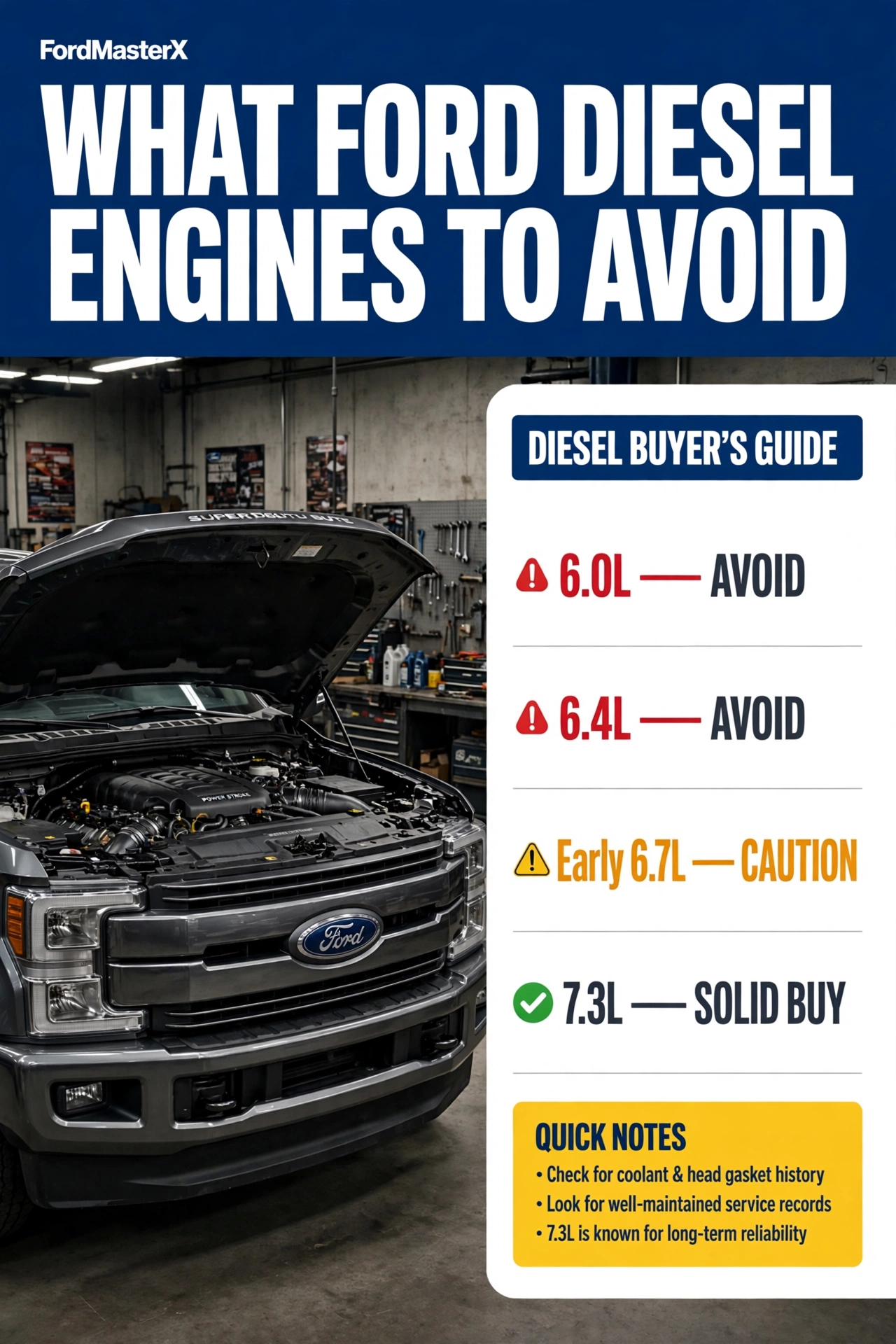
What Ford diesel engines to avoid comes down to three names. Skip the 6.0L Power Stroke from 2003 to 2007, skip the 6.4L from 2008 to 2010, and approach the early 6.7L from 2011 to 2012 with caution.
Those three engines carry the most expensive failure patterns in Ford diesel history. The 6.0L suffers a cooling chain failure that ends in blown head gaskets.
The 6.4L dilutes its own oil with diesel fuel and cracks pistons. The early 6.7L can lose its turbo bearings and high pressure fuel pump.
Ford also built diesels worth buying. The 7.3L Power Stroke from 1994 to 2003 is the most durable diesel Ford ever sold.
The later 6.7L trucks from 2015 onward fixed the early turbo problems and are strong used buys. This guide ranks every generation, explains each failure plainly, and gives a checklist for the truck in front of you.
The Short Answer in 4 Verdicts
Four verdicts cover every Ford diesel a used buyer is likely to meet. Read the table first, then read the section for any engine you are considering. The verdict is the starting point, and the inspection checklist near the end is what turns it into a decision on one truck.
| Engine | Years | Verdict | Main Risk |
|---|---|---|---|
| 6.0L Power Stroke | 2003-2007 | Avoid | Oil cooler and EGR cooler failure, head gaskets |
| 6.4L Power Stroke | 2008-2010 | Avoid | Fuel diluted oil, cracked pistons, DPF and EGR |
| Early 6.7L Power Stroke | 2011-2012 | Caution | Turbo bearing failure, CP4 fuel pump risk |
| 7.3L Power Stroke | 1994-2003 | Solid buy | Age related wear, low power by modern standards |
Ford Diesel Verdicts At a Glance
Four verdicts that cover every Ford diesel a used buyer is likely to meet, as observed in November 2026.
| Engine | Years | Verdict | Main Risk |
|---|---|---|---|
| 6.0L Power Stroke | 2003-2007 | Avoid | Oil cooler and EGR cooler failure, head gaskets |
| 6.4L Power Stroke | 2008-2010 | Avoid | Fuel diluted oil, cracked pistons, DPF and EGR |
| Early 6.7L Power Stroke | 2011-2012 | Caution | Turbo bearing failure, CP4 fuel pump risk |
| 7.3L Power Stroke | 1994-2003 | Solid buy | Age related wear, low power by modern standards |
Direct answer: Avoid the 6.0L and 6.4L Power Stroke engines. Treat early 6.7L trucks with caution, and buy the 7.3L or a later 6.7L when the inspection checks out.
Sources: Diesel Power Products avoid guide, Mark Regan Auto years to avoid guide, Westco Automotive buyer guide, and Truck Ranch 6.7L problems guide. Verdicts reflect documented failure patterns, not failure rate statistics.
The verdicts above are blunt on purpose. A buyer who only reads this table still walks away with the right short list. The rest of the guide explains why each verdict exists, so the buyer can judge a specific truck instead of only a model year.
One warning applies to every generation. No engine is good or bad by itself.
A documented truck with full service records beats a neglected truck from a good year every time. The checklist near the end of this guide is what separates the two.
How We Ranked These Diesel Engines
Each engine was ranked on three things. The first is the failure pattern: how often the same part fails, and whether the failure damages the rest of the engine.
The second is the repair bill: what the common failure costs to fix at a shop. The third is whether a fix exists that actually lasts.
An engine earns an avoid verdict when its main failure is common, expensive, and likely to return. The 6.0L and the 6.4L both meet that test. Their signature failures cost thousands of dollars, and the same parts can fail again if the repair only replaces the broken piece.
An engine earns a caution verdict when its main risk is real but narrower. The early 6.7L meets that test.
Its turbo and fuel pump problems are serious, but they affect specific parts that can be checked before purchase. A clean inspection and full records change the answer for one truck.
An engine earns a solid buy verdict when its record is long and its failures are small. The 7.3L meets that test.
Its known problems are sensors, seals, and gaskets that a shop can fix without opening the engine. Age is its real enemy, not design.
No failure rate percentages appear in this guide. No observed source provided a verified failure rate for any of these engines, so none is invented here.
Diesel Power Products ranks the same three engines as the ones to approach with caution, and the verdicts in this guide match that ranking. Our guide to the Ford diesel engines by year technical guide covers the same generations in technical detail for readers who want the full year by year picture.
The ranking also leaves out engines that are not part of this question. The 3.0L Power Stroke in the F-150 and the 6.7L in medium duty chassis cabs are separate topics with their own records. This guide covers the Super Duty pickup diesels that used buyers actually shop for.
The 6.0L Power Stroke Problems Explained
The 6.0L Power Stroke ran in Super Duty pickups from 2003 to 2007, with Excursion versions through 2005 and E-Series van versions into 2010. Navistar built the engine, and Ford rated it at 325 horsepower, with 560 lb-ft of torque in 2003 and 2004 and 570 lb-ft from 2005 onward, according to CarWhere. It replaced the 7.3L to meet stricter emissions rules, and it arrived with a failure chain that owners are still paying for.
The engine is not slow or weak. It pulls hard and responds well to tuning.
Its problem is heat management. The cooling system and the emissions system are linked in a chain, and when one link fails, the next one follows. That chain is why a stock 6.0L is a buyer beware purchase.
A 2013 class settlement covered owners of 2003 to 2007 models, according to CarWhere. That settlement is a matter of public record, and it shows how widespread the warranty claims were. It does not tell a buyer which truck to buy, but it confirms that the problems were real and common enough to reach court.
Oil Cooler Failure Chain
The failure chain starts in the engine oil cooler. The factory oil cooler has small coolant passages, and those passages clog with debris and casting sand over time. Coolant flow through the cooler drops, and the oil runs hotter than it should.
The EGR cooler sits downstream of the oil cooler in the coolant path. When oil cooler flow drops, the EGR cooler loses cooling too.
It runs hotter than it was designed for, cracks under thermal stress, and leaks coolant into the exhaust or the intake. CarWhere notes that the 2003 round EGR cooler is considered less failure prone than the 2004 to 2007 square design.
The signs are easy to spot once the chain has started. White steam like smoke at startup, steady coolant loss with no visible leak, and overheating under load all point at the same chain. A scan tool that compares engine oil temperature with coolant temperature will show the gap growing as the oil cooler clogs.
The fix is to replace the oil cooler and the EGR cooler together. Replacing only the EGR cooler leaves the clogged oil cooler in place, and the new EGR cooler will fail the same way. Any seller who says the EGR cooler was replaced should be asked whether the oil cooler was done at the same time.
Head Gasket And Bolt Weakness
The 6.0L clamps each cylinder head with four torque to yield bolts. Those bolts stretch under high cylinder pressure, and once they stretch, the heads lift off the block. The head gaskets blow, coolant escapes, and the engine loses compression.
Heat and pressure from a failed EGR or oil cooler make the problem worse. Excess pressure in the cooling system pushes coolant out of the degas bottle, a symptom owners call puking. That pressure is what turns a cooling problem into a head gasket job.
Tuning makes the risk higher. Adding a tuner raises cylinder pressure, and the factory bolts were already near their limit. A tuned 6.0L with stock bolts is a truck that has been pushed toward the exact failure the bolts cannot hold.
The lasting fix is head studs with new gaskets. Studs clamp far harder than the factory bolts and do not stretch the same way.
Mark Regan Auto reports that a head gasket replacement on a 6.0L commonly runs 3,000 to 5,000 dollars at a shop. That figure is a planning range, not a quote, and it explains why the 6.0L is an avoid verdict for most buyers.
FICM And Injector Trouble
The fuel injection control module, known as the FICM, drives the injectors on the 6.0L. It fails often enough that it is one of the best known 6.0L problems. Low voltage from a weak FICM causes hard starts, rough running, and injector damage that follows.
Injector stiction is the other common complaint. The injector spool valves stick when cold, which causes rough idle and white smoke on cold mornings.
The problem gets worse every winter, and it ends in injector replacement. Westco Automotive lists stiction below 40 degrees as one of the three early warning signs a buyer cannot ignore.
Turbo vane sticking adds to the list. Soot builds up on the variable geometry turbo vanes, and the turbo stops responding cleanly. The 2003 to 2005 engines also used a turbo oil drain tube that Ford updated for 2006 and 2007, according to CarWhere.
None of these parts is cheap on its own. Together they explain why a low price 6.0L is rarely a bargain. The buyer is not buying a truck, they are buying a list of repairs that the last owner chose not to finish.
Worst Years Within The 6.0L
The worst 6.0L years are 2003 and 2004. Both years carry severe first production problems, including high pressure oil pump failures and EGR cooler failures, according to CarsCounsel. The early high pressure oil pumps fail from weak internal fittings and seals, and the first year trucks had the most unresolved problems.
The 2005 model year improved the high pressure oil pump, but the weak factory head bolts stayed. A 2005 truck still needs the fastener and cooling upgrades before it can be trusted. The 2006 and 2007 trucks are the most refined factory versions, with updated turbo parts and tuning.
Our guide to the 6.0 Powerstroke years to avoid covers this breakdown in full. The short version is simple.
A 2003 or 2004 truck is an avoid even at a low price. A 2006 or 2007 truck is only worth considering if the records show the coolers, the studs, and the FICM were all addressed by a reputable shop.
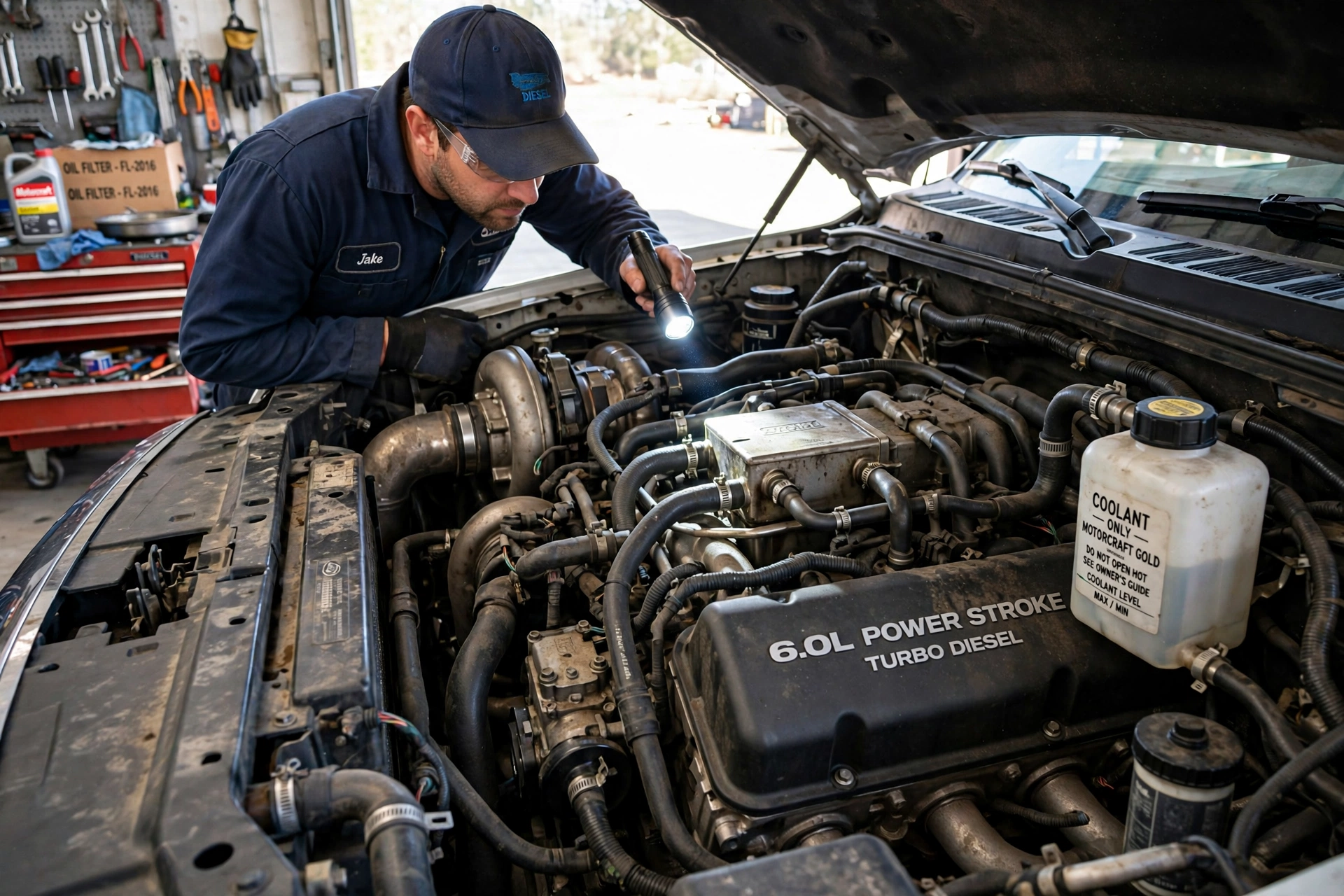
AI-generated illustration: a mechanic inspecting the EGR cooler and oil cooler area of a 6.0L Power Stroke engine bay. Component positions are illustrative, not a factory service diagram.
Bulletproofing is the word owners use for the full set of fixes. Westco Automotive lists six weak points that a proper bulletproofing addresses, including the EGR cooler, the oil cooler, the head studs, and the FICM.
A properly bulletproofed 6.0L can run 300,000 miles or more, according to the same guide. The catch is the cost and the proof. A seller who claims the work was done should show invoices from a known shop, and a buyer should verify them before paying a premium for the claim.
The 6.4L Power Stroke Problems Explained
The 6.4L Power Stroke ran in Super Duty pickups from 2008 to 2010. Navistar built it to fix the 6.0L and to meet new emissions rules, and it added a diesel particulate filter, two EGR coolers, and a high pressure common rail fuel system. DieselHub’s spec page lists Ford’s official rating at 350 horsepower and 650 lb-ft of torque.
The engine made good power and ran smoother than the 6.0L. It also introduced a new set of failures that were worse in one important way.
When the 6.4L fails, it often fails fast and damages the engine itself. That is why most used truck experts recommend skipping it entirely, according to Mark Regan Auto.
The 6.4L lasted only three model years before Ford replaced it with the 6.7L and ended the Navistar partnership. A three year production run for a work truck engine is a short life, and it tells a buyer most of what they need to know.
DPF Regen And Fuel Dilution
The diesel particulate filter traps soot from the exhaust, and the engine cleans it by burning extra fuel during regeneration. On the 6.4L, that extra fuel is injected during the exhaust stroke to raise exhaust temperature. Some of that raw fuel slips past the piston rings and into the crankcase, where it mixes with the engine oil.
Fuel diluted oil loses viscosity and lubricating strength. Bearings, cylinder walls, the valvetrain, and turbo bearings all wear faster when the oil is thinned by diesel. Tuner Depot explains that this is a well known concern on the 6.4L platform, and that frequent oil changes are the most effective way to fight it.
The warning sign is a rising oil level on the dipstick. Oil level should fall slowly between changes, not rise.
A level that climbs, or oil that smells strongly of diesel, means fuel is getting into the crankcase. SlashGear reports the same mechanism, and notes that the fuel is injected by design during regeneration, so the problem is built into how the system works.
Short trips make the problem worse. A truck that never completes a full regeneration cycle runs more partial cycles, and each one adds more fuel to the oil. A 6.4L used for short runs and light loads is the worst case for this failure.
Cracked Pistons And Radiators
Cracked pistons are the most serious 6.4L failure. SlashGear lists cracked pistons among the problems that plague the 6.4L. A cracked piston is an engine out repair, not a service item.
Leaking radiators are the other common failure. SlashGear lists leaking radiators among the problems that plague the 6.4L. A radiator leak starts small and grows, and a diesel that loses coolant under load will overheat fast.
The 6.4L also clogs its oil coolers, just like the 6.0L before it. A clogged oil cooler starves the rest of the cooling system, and the same chain of heat damage follows. The engine did not carry over the head bolt problem, but it replaced it with failures that are just as expensive.
Injector failure is common past 100,000 miles, according to Ritchie Bros. The high pressure fuel system puts heavy stress on the injectors, and a full set replacement is a significant cost. That mileage point matters, because most used 6.4L trucks on the market today are well past it.
Dual EGR Cooler Failures
The 6.4L uses two EGR coolers instead of one, and both are prone to the same cracking seen on the 6.0L. Mark Regan Auto reports that labor alone to replace both can exceed 2,500 dollars. That figure is a planning range, and it covers labor only, before parts.
The DPF adds its own bill. Mark Regan Auto reports that a full DPF replacement costs 2,000 to 4,000 dollars.
Ritchie Bros separately reports that DPF replacement can exceed 3,000 dollars. Either way, the filter is a wear item with a four figure replacement cost, and it sits on top of the other 6.4L bills.
The emissions system is also where buyers get into legal trouble. Removing the DPF and EGR hardware is a common owner response to these failures, and it is not legal for road use. Mark Regan Auto notes that emissions delete modifications are intended for off road or closed course use only, and are not legal for use on public roads in the United States.
A deleted truck can also fail an emissions inspection, lose resale value, and leave the buyer with no legal way to register it in some states. A buyer should ask the seller directly whether any emissions equipment has been removed or modified. Our guide to how long the Ford emissions warranty lasts explains what emissions coverage normally includes and how long it runs.
Worst Years Within The 6.4L
The 2008 model year carries the highest risk. It was the launch year, and early trucks show the full range of known problems without the benefit of dealer updates or prior owner repairs, according to Ritchie Bros. Ford issued several technical service bulletins in response to the early failures.
The 2009 trucks gained from software calibration updates and component revisions based on field failure data. EGR cooler and DPF problems persist on 2009 trucks, but maintained examples with known repairs completed are generally considered the most stable of the three years, according to the same guide.
The 2010 model year was the final year before the 6.7L arrived. It is no safer than the others in any meaningful way, because Ford never redesigned the engine during its short run.
Our guide to the 6.4 Powerstroke years to avoid covers the year by year detail. The short version is that there is no safe 6.4L year, only a less bad one, and the price has to reflect that risk before the truck is worth a look.
Early 6.7L Power Stroke Risks Explained
The 6.7L Power Stroke arrived for the 2011 model year as a complete redesign. Ford brought the design in house, dropping Navistar, and the engine has been in the Super Duty lineup ever since. It is a far better engine than the 6.0L and 6.4L, but the first years still carry two risks that a buyer must check.
Output rose steadily across the generations, and Powerstroke Online lists the pickup ratings as 390 horsepower and 735 lb-ft at launch in 2011, rising to 400 horsepower and 800 lb-ft with the factory update. The ratings then climb to 440 horsepower and 860 lb-ft for 2015 and 2016, 440 horsepower and 925 lb-ft for 2017, 450 horsepower and 935 lb-ft for 2018 and 2019, and 475 horsepower with 1,050 lb-ft from 2020 onward. The High Output version makes 500 horsepower and 1,200 lb-ft.
The caution window for this guide is 2011 to 2012, with a wider watch window to 2014 for the turbo and to 2022 for the fuel pump. A 2011 or 2012 truck can still be a good buy, but only after the two checks below. A later 6.7L truck is a different purchase, and it is covered in the solid buys section.
Early Turbo Bearing Failures
The first generation 6.7L used a compound turbo setup with a small high pressure turbo and a large low pressure turbo working together. Truck Ranch reports that the small high pressure turbo was prone to premature failure, especially on trucks that towed hard or were tuned. Professional Diesel Repair notes the weak point was the ceramic ball bearings in the early center section, which commonly failed under heat and load.
Ford redesigned the turbo system for the 2015 model year, switching to a single variable geometry turbo. Professional Diesel Repair reports the same change and the same cause, noting that early trucks used a Garrett dual sided compressor turbo with ceramic ball bearings that had a reputation for failures. The 2015 and newer trucks are significantly more reliable in this area, according to Westco Automotive.
The warning signs are a siren noise from the turbo, a loss of boost, and boost related fault codes. A truck that whistles loudly under load or falls flat when the driver asks for power has a turbo that needs attention. A buyer should listen for that noise on the test drive and ask whether the turbo has been replaced.
Cooling system leaks are the other early 6.7L complaint. Radiator leaks usually start where the plastic end tanks join the core, and coolant line fittings also leak. A buyer should check the radiator end tanks and the coolant level before paying, because a slow leak becomes a roadside overheat under a trailer.
CP4 Fuel Pump Contamination
The Bosch CP4.2 high pressure fuel pump is the biggest issue on the 6.7L, and it is the one that gets the most attention online. Truck Ranch reports that the pump is sensitive to fuel contamination and low lubricity, and that when it fails it sends metal shavings through the entire high pressure fuel system, contaminating the injectors, fuel rails, and lines.
The pump is lubricated only by the diesel fuel passing through it. Water in the fuel, air in the fuel, running low on fuel, and low lubricity diesel all wear the internal roller and cam lobe against each other. Westco Automotive explains that once the roller turns sideways to the lobe, lubrication is lost and the parts grind each other into metal filings.
The first warning is often fault code P0087, which means fuel rail pressure is low. Extended cranking, a loss of power under load, and a rough idle after a cold start follow. Truck Ranch advises buyers to open the fuel filter housing on 2011 to 2019 trucks and look for any metallic sheen or particles in the fuel, because any sign of metal means the pump has already started failing.
The repair bill is the reason this pump matters so much. Truck Ranch reports that replacing a fuel system after a CP4 failure typically costs between 8,000 and 15,000 dollars, depending on how far the contamination spread.
Professional Diesel Repair separately reports that repairs often cost 10,000 dollars or more. Both figures are planning ranges, and both cover the pump, the injectors, the rails, the lines, and cleaning the tank.
EGR Valve And Sensor Faults
The EGR system on the early 6.7L causes fewer disasters than the 6.0L and 6.4L systems, but it still fails. The most common EGR problem is the cooler core getting restricted with soot, which reduces flow and commonly sets code P0401. Ford issued a service bulletin for 2011 and 2012 Super Duty trucks on exactly that problem.
Exhaust gas temperature sensors also fail often enough to be a routine repair, according to Professional Diesel Repair. A failed sensor can block regeneration, which sets codes in the P2032 to P2080 range and leaves the DPF unable to clean itself. The repair is small, but a truck with a blocked regeneration will keep setting codes until the sensor is fixed.
These faults are not reasons to avoid the engine. They are reasons to scan the truck before buying it.
A code scan takes minutes, and it will show the EGR and sensor faults that a test drive cannot. The inspection section below explains how to run that scan.
CP4 Risk Years Explained
Truck Ranch and Professional Diesel Repair report the CP4.2 pump on 2011 to 2019 6.7L trucks, with a pump design change for the 2020 model year. Ford recall 24S78 shows the risk runs wider than that: Bosch CP4 family RP7 pumps were fitted to certain 2020 to 2022 trucks, and the RP8 variant replaced the RP7 in production on August 23, 2021. The fuel pump risk window therefore runs to 2022, not 2019, and it is wider than the turbo risk window.
That does not mean every 2011 to 2022 truck will suffer a CP4 failure. Most do not.
It means the buyer should check for the warning signs and ask about prevention. A CP4 protection kit, also called a bypass kit or fuel contamination kit, reroutes the pump lubrication fuel so a failure cannot send metal through the whole system.
Fresh fuel filters, draining the water separator, and buying fuel from busy stations are the daily habits that protect the pump, according to Professional Diesel Repair. A seller who can show a fuel filter history is a seller who understood the risk. A seller with no filter history at all is a warning sign on any 6.7L truck.
Our guide to how much horsepower a 6.7 Powerstroke has lists the output for every year, so a buyer can match the truck in front of them to the right generation. The power figures matter less than the pump and turbo checks, but they help confirm which generation the truck really is.
Which Ford Diesels Are Solid Buys
The avoid list is only half the answer. A buyer who walks away from a bad truck still needs a truck, and Ford built two diesel families that are worth buying.
The first is old and simple. The second is new and strong.
Both solid buys come with trade offs. The old one is slow and loud by modern standards, and it needs age related work.
The new one costs more to buy and more to fix when it does fail. The sections below explain both, so the buyer can choose with open eyes.
7.3L Power Stroke Strengths
The 7.3L Power Stroke ran from 1994 to 2003, and it is widely regarded as the most reliable diesel Ford ever built. Hot Shot’s Secret calls it the gold standard, citing its longevity, basic electronics, and ease of repair. Westco Automotive reports that these trucks will run 300,000 to 500,000 miles with basic maintenance.
Ford rated the engine with a B50 life of 350,000 miles, which means half of all engines were expected to reach that mileage without a major failure, according to CarTipsDaily. Many owners report 400,000 to 500,000 miles with proper maintenance. The engine earned that record through simple design and conservative power, with 210 to 275 horsepower and 425 to 525 lb-ft of torque depending on the year, according to the same source.
The 7.3L has no EGR valve, no diesel particulate filter, and no diesel exhaust fluid system. That absence is its biggest strength.
The emissions hardware that causes most of the failures on later engines simply is not there to break. The fuel system is a hydraulic electronic unit injection design that proved durable over a long production run.
The 7.3L is not maintenance free. Westco Automotive lists the cam position sensor, the injector driver module, valve cover gaskets, turbo pedestal seals, and fuel bowl leaks as the failures that show up past 200,000 miles. Those are small jobs compared with a head gasket or a cracked piston, and a shop can fix them without opening the engine.
Later 6.7L Power Stroke Strengths
The later 6.7L trucks are the modern solid buy. The 2015 redesign fixed the early turbo, and the 2020 redesign revised the fuel pump, although CP4 family pumps remained in some 2020 to 2022 trucks.
A 2015 or 2016 truck still carries CP4 risk, so it needs the fuel checks in the inspection section. A 2020 or newer truck has the revised pump design and the 10 speed automatic, and it is the strongest used diesel Ford sells, but buyers of 2020 to 2022 trucks should still check recall 24S78 by VIN and run the fuel filter check.
Truck Ranch names 2015 to 2016 and 2020 and newer as the best years to buy a used 6.7L Power Stroke. Mark Regan Auto agrees, and adds that 2015 to 2016 trucks are among the better used Super Duty years when the recall work is done and maintenance is documented. The verdict is consistent across the guides.
The later trucks are also far more powerful than the 7.3L. A 2020 truck makes 475 horsepower and 1,050 lb-ft of torque, according to Powerstroke Online.
That power comes with more complex emissions hardware, so the buyer should still check the DPF and DEF systems. The hardware is the price of the power, and on the later trucks it generally works.
Our guide to the Ford factory warranty explains what coverage a newer truck may still carry. A 2020 or newer truck may still have powertrain coverage left, and that coverage changes the risk of a CP4 style failure completely. Check the warranty before paying, because a covered truck is a different purchase from an uncovered one.
2015 And 2016 6.7L Trucks
The 2015 and 2016 trucks are the value pick in the 6.7L range. They have the revised single turbo, 440 horsepower, and 860 lb-ft of torque. They cost far less than a 2020 truck, and they tow well.
The catch is the CP4 pump, which stayed in place into the 2022 model year. A buyer of a 2015 or 2016 truck should run the fuel filter check, look for metal in the fuel, and ask whether a protection kit was fitted. A truck with a protection kit and a filter history is a reasonable buy at the right price.
Carbon buildup is the other issue Mark Regan Auto notes for 2015 to 2016 trucks, and it is manageable with maintenance. The buyer should ask about intake cleaning and service history, and should not treat a low price as a substitute for records.
2020 And Newer 6.7L Trucks
The 2020 and newer trucks are the safest modern buy. Ford revised the engine, changed the fuel pump design, and paired it with a 10 speed automatic, but certain 2020 to 2022 trucks still carry a CP4 family RP7 pump covered by recall 24S78, so check the VIN before buying. Power rose to 475 horsepower and 1,050 lb-ft of torque, and the High Output version added in 2023 makes 500 horsepower and 1,200 lb-ft.
The price is the trade off. These trucks cost far more than any 6.0L or 6.4L, and their repairs cost more too.
A buyer who can afford one gets the strongest diesel Ford has built. A buyer who cannot should look at a 7.3L or a 2015 6.7L instead of stretching for a truck they cannot afford to fix.
Age and use still matter. A 2020 truck that towed heavy every day and missed its service intervals is a worse buy than a 2016 truck with full records. The inspection checklist below applies to every year, including the newest ones.
Your 5 Step Pre Purchase Inspection Checklist
An inspection takes about an hour and a scan tool. It will not catch every problem, but it will catch the expensive ones. Run it in this order, because the early steps can end the inspection and save the rest of the hour.
Insist on a cold start. A seller who warms the truck up before the buyer arrives may be hiding a cold start problem, and a cold start is when injector stiction, hard starting, and white smoke show up. Arrive early, touch the engine to confirm it is cold, and watch the exhaust for the first ninety seconds.
Bring a scan tool that reads diesel codes, not just engine codes. A cheap code reader will miss transmission and emissions codes, and those are the codes that matter on a diesel. A diesel specialist shop can run the same scan if the buyer does not own a tool.
Start With A Cold Start
Start the truck cold and walk to the back to watch the exhaust. White smoke that clears quickly is normal on a cold diesel. White smoke that keeps going after the engine warms up means coolant is getting into the combustion chamber, which points at a head gasket or a cracked head.
Blue smoke means the engine is burning oil. Black smoke at idle on a diesel that is not under load means a fueling problem, a sticking injector, or a boost issue. The exhaust tells the buyer whether to keep looking or walk away in the first two minutes.
Listen while the engine warms up. Knocking, ticking, or rattling that does not fade as the engine warms is a warning sign. A smooth diesel idle has a steady rhythm, and any cylinder that misses that rhythm will show up as a shake the buyer can feel through the seat.
Read The Oil And Coolant
Pull the dipstick and look at the oil on a rag. Diesel oil is dark, and that is normal.
Gritty oil means metal particles, which means something internal is wearing fast. Oil that smells like fuel means the injectors are leaking into the crankcase, and on a 6.4L it means the DPF regeneration is diluting the oil.
Check the oil level too. A level that has risen since the last change is a warning sign on a 6.4L, because fuel is getting into the crankcase. A level that is low on a truck someone is trying to sell is also a warning sign, because it means the seller did not check it or did not care.
Open the coolant reservoir and look at the coolant and the cap. The coolant should be the right color for the truck and it should be clean.
Murky coolant, an oily film, or a pink or orange residue under the cap means oil is mixing with the coolant, which points at a head gasket or an oil cooler failure. Ask when the coolant was last flushed and replaced.
Look at the degas bottle for signs of pressure. A bottle that is stained, cracked, or wet around the cap has been pushing coolant out under pressure.
That is the puking symptom that follows a failed EGR cooler or a blown head gasket on a 6.0L. Our guide to how to check transmission fluid on a 2016 F-150 shows the same dipstick method on a Ford truck, and the habit of checking fluid condition before buying applies to every fluid on a diesel.
Scan For Codes And Data
Scan for codes and write down every one, including pending codes. Codes in the P0400 range point at the EGR system.
Codes in the P0087 and P0088 range point at fuel rail pressure and the CP4 pump. Codes in the P2032 to P2080 range point at exhaust temperature sensors and the DPF.
Ask the scan tool for live data, not just codes. On a 6.0L, compare engine oil temperature with coolant temperature after a drive at highway speed.
A gap that keeps growing means the oil cooler is clogged, even if no code has set yet. On a 6.7L, watch fuel rail pressure under load and look for a pressure drop that the pump cannot keep up with.
Check the DPF, EGR, and DEF systems for warning messages, fault codes, leaks, and crystallized DEF around fittings. Westco Automotive closes its buyer guide by recommending a pre-purchase inspection by a certified diesel shop, and that advice is worth following, because a general shop can miss a diesel specific fault.
Check Paperwork And Recalls
Confirm that the VIN matches across the truck and the paperwork. Then run a vehicle history report and check for open recalls on the NHTSA recall lookup, as Mark Regan Auto recommends. A dealer can also pull the build date, the in service date, and some of the work done on the truck from the VIN.
Ask for service records and read them. The records should show oil changes, fuel filter changes, coolant flushes, and any major repairs with invoices.
A seller who claims bulletproofing, a new turbo, or a CP4 protection kit should show the invoice from the shop that did the work. A claim with no paper is not a repair, it is a story.
Ask the seller directly whether any emissions equipment has been deleted or modified. A deleted truck may look clean and run well, but it cannot be registered in some states and it will fail an emissions inspection. The answer to that question belongs in writing before the buyer pays.
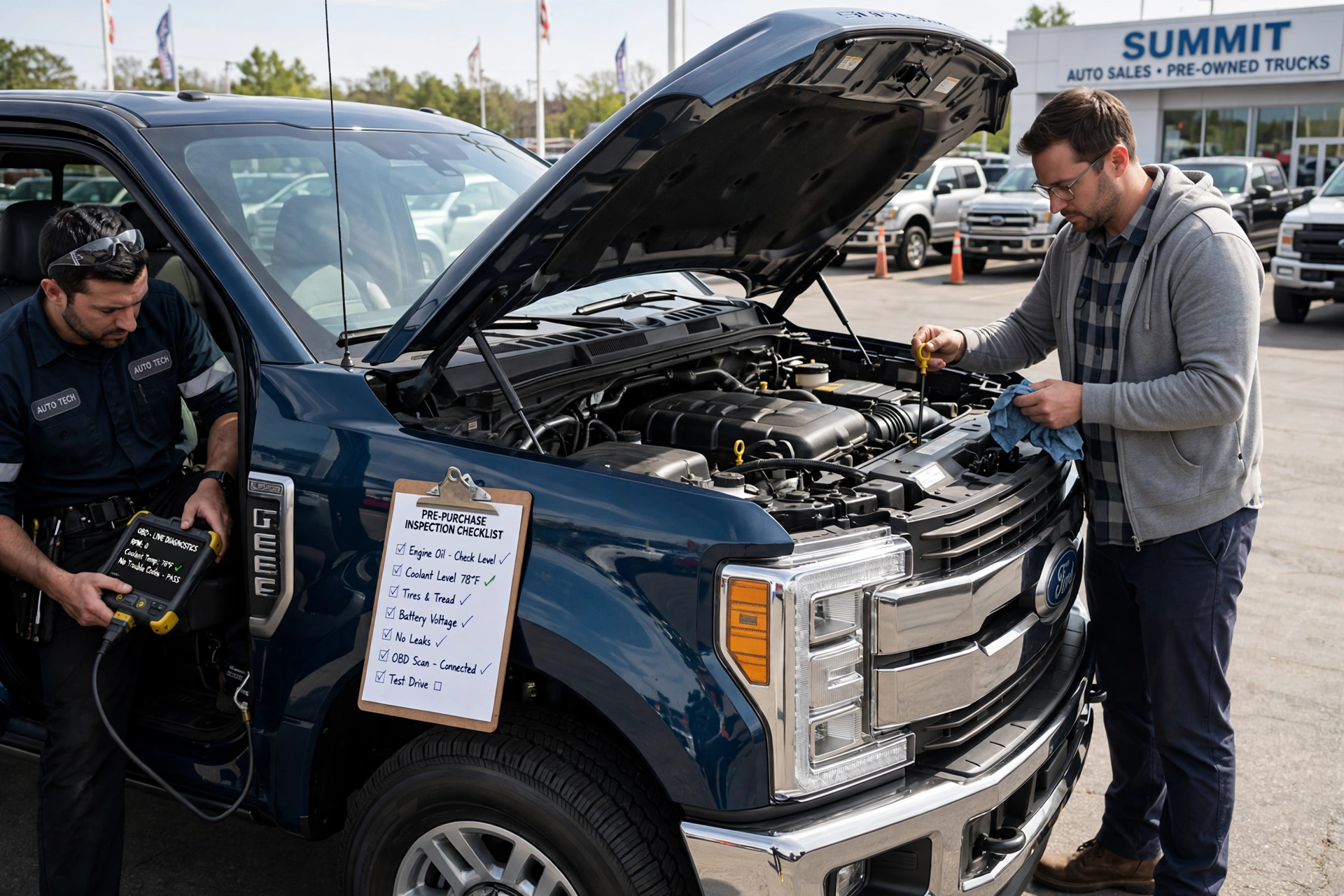
AI-generated illustration: a buyer and mechanic inspecting a used Super Duty diesel with a scan tool and dipstick. The checklist values shown on the clipboard are illustrative, not readings from a real vehicle.
Finish with a test drive that includes a highway run and a hill if one is nearby. Watch the temperature gauges, listen for the turbo, and feel for a transmission that slips or flares. A truck that runs clean on a short flat drive can still overheat under load, and the buyer will not find that out until the first trailer is hooked up.
What Repairs Cost Before You Buy
Repair costs decide whether a cheap diesel is a bargain or a trap. The ranges below are national planning figures from the named sources, and they are useful for deciding whether a repair is worth pursuing before getting a written estimate. Labor rates, the model, and the damage can move a real quote well outside the range.
Westco Automotive gives the same warning in its Power Stroke buyer guide: a truck that looks cheap can cost more in repairs than a clean truck costs to buy. The table below is the buyer version of that warning, with each figure tied to the source that published it.
| Repair path | Planning range | Engine | Source |
|---|---|---|---|
| Head gasket replacement | 3,000 to 5,000 dollars | 6.0L | Mark Regan Auto |
| DPF replacement | 2,000 to 4,000 dollars | 6.4L | Mark Regan Auto |
| Dual EGR cooler labor only | More than 2,500 dollars | 6.4L | Mark Regan Auto |
| CP4 fuel system replacement | 8,000 to 15,000 dollars | 6.7L | Truck Ranch |
| CP4 fuel system replacement | 10,000 dollars or more | 6.7L | Professional Diesel Repair |
The CP4 range is the widest because the damage spreads. A pump that fails early may only need the pump and the filters. A pump that runs until the truck stalls has sent metal through the injectors, the rails, and the lines, and the whole system has to be replaced and the tank cleaned.
The 6.0L head gasket range is the most common bill a buyer will face. It does not include the studs, the coolers, or the FICM work that a proper repair adds. A buyer who budgets only for the gasket will be short when the shop opens the engine and finds the rest of the chain.
Routine maintenance is cheap by comparison, and it is what keeps a good diesel good. Our guide to how much an oil change costs covers the basic service that every diesel needs on schedule. Skipped oil changes are the fastest way to turn a solid buy into an avoid.
Check warranty cover before paying for any repair. Our guide to how to check Ford warranty coverage shows how to confirm what is still covered on the truck in front of you. A truck with powertrain coverage left is a different purchase from the same truck without it, and the check takes minutes.
Planning Ranges By Repair
Use the table as a walk away test. If the truck needs a repair from the table and the seller has not priced it into the asking price, walk away or renegotiate. A seller who says the repair is cheap is a seller who has not paid for it.
Get a written estimate that names the fault and the parts before agreeing to buy a truck that needs work. A shop that quotes a rebuild without scanning for codes or checking the fluids has skipped the diagnosis, and a targeted repair can save thousands when the codes point at one part.
The cheapest diesel is rarely the cheapest truck to own. A 7.3L with records and a 2015 6.7L with a protection kit will both cost less over two years than a low price 6.4L that needs a DPF, two EGR coolers, and a set of injectors.
Questions Buyers Ask About Ford Diesels
Which Ford Diesel Should I Avoid
Avoid the 6.0L Power Stroke from 2003 to 2007 and the 6.4L Power Stroke from 2008 to 2010. Both engines have documented failure patterns that cost thousands of dollars to fix, and the 6.4L is the riskier of the two because its failures damage the engine itself.
Is The 6.0L Power Stroke Always Bad
No, a 6.0L with documented bulletproofing can be reliable. The coolers, head studs, and FICM must all have been addressed by a reputable shop, with invoices to prove it. A stock 6.0L with no records is the truck to avoid.
Is The 6.4L Power Stroke Worth Buying
Only at a very low price with a plan for the emissions system and a full inspection. The 6.4L dilutes its oil with fuel, cracks pistons, and needs expensive DPF and EGR cooler work. Most buyers are better off spending the same money on a 7.3L or a later 6.7L.
Which 6.7L Years Should I Avoid
Approach 2011 and 2012 with caution, because the early turbo bearings fail and the CP4 pump risk starts there. The 2011 to 2014 trucks need a turbo check, and the 2011 to 2022 trucks need a fuel system check. The 2015 to 2016 and 2020 and newer trucks are the recommended buys.
Is The 7.3L Power Stroke Reliable
Yes, the 7.3L is widely regarded as the most reliable diesel Ford ever built. Ford rated it with a B50 life of 350,000 miles, and owners routinely report 400,000 to 500,000 miles with proper maintenance. Its trade offs are age, low power by modern standards, and an older truck around the engine.
Should I Buy A Bulletproofed 6.0L
Yes, if the work is documented and the price reflects it. Ask for invoices from the shop that did the coolers, the studs, and the FICM, and verify them before paying a premium. A claim with no paper is not a repair, and a poorly done bulletproofing job is worse than none at all.
Your 5 Step Diesel Buying Check
What Ford diesel engines to avoid is now a short list, and the choice is clear. Skip the 6.0L and the 6.4L, treat the early 6.7L with caution, and buy the 7.3L or a later 6.7L when the inspection checks out.
Run the five step check before paying for any used diesel. Start the truck cold and watch the exhaust, read the oil and the coolant, scan for codes and live data, check the paperwork and recalls, and finish with a highway test drive under load.
That check takes about an hour, and it is the cheapest insurance a diesel buyer can buy. It separates a workhorse from a money pit, and it gives the buyer the facts to walk away from a bad truck. Our sister guide on what year Ford Focus to avoid uses the same approach, and it shows how a short inspection can save thousands.