6.0 Powerstroke Years to Avoid and One Year Worth the Risk in 2026

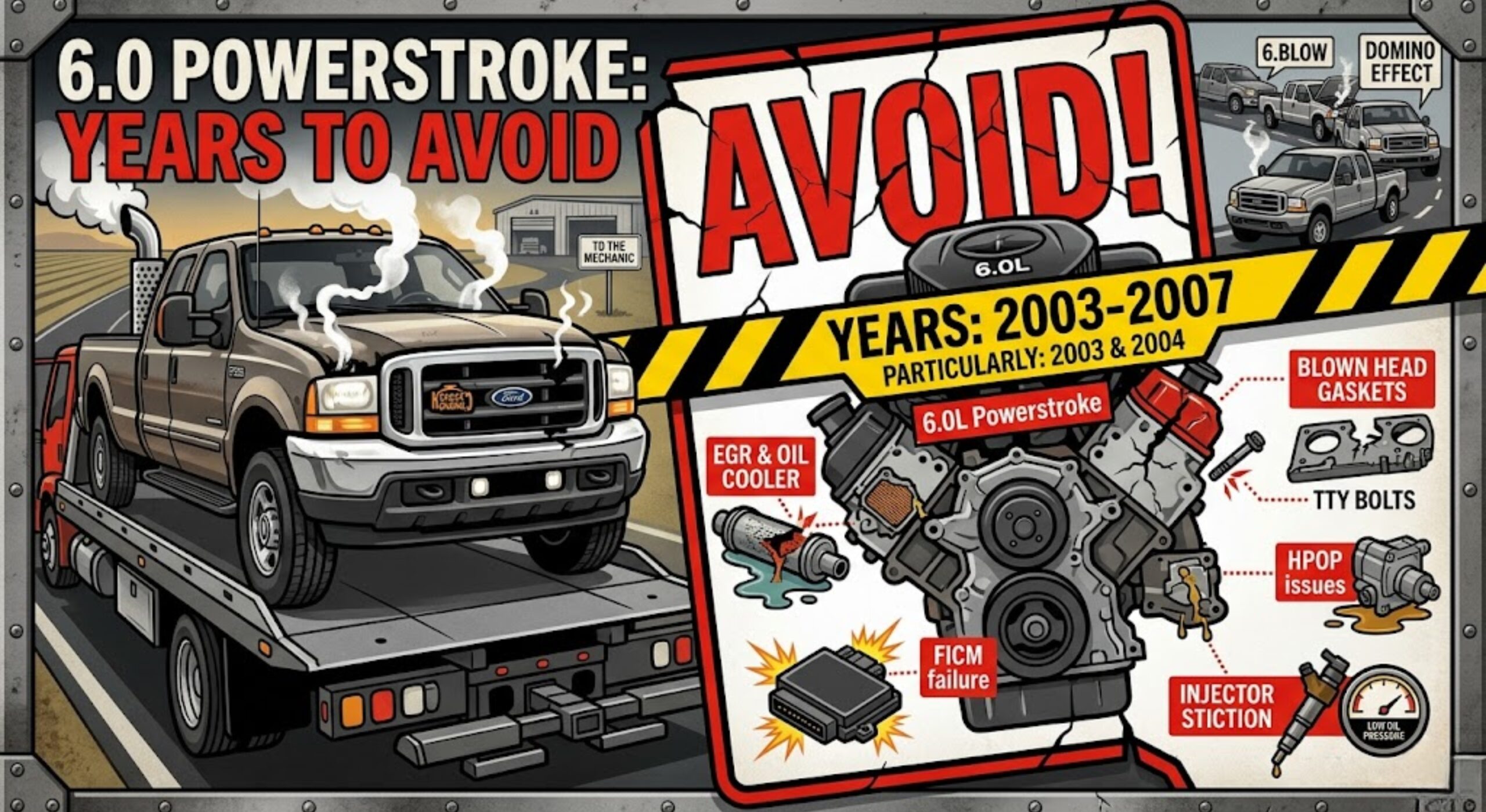
The 6.0 Powerstroke years to avoid are 2003 and 2004 — but that answer is incomplete without knowing three other things about the truck. Ford ran this engine in F-250 and F-350 Super Duty trucks from 2003 through 2007, and the risk profile is not the same across all five years.
Year matters, but build status, service history, and your repair budget matter just as much. This guide breaks down which years to hard-avoid, which are conditional buys, and the one variable that overrides year entirely.

Prime for Young Adults — 6 Months Free
Students and 18–24s get six months of Prime free, then half price.
Start 6 Months Free As an Amazon Associate I earn from qualifying purchases.Why the 6.0 Powerstroke Has a Reputation Problem
Recommended Best Deal Products


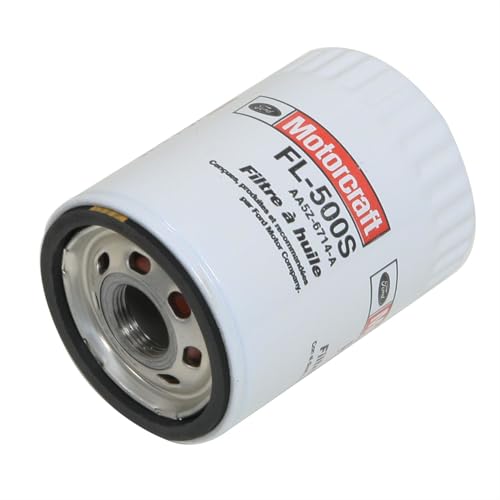
The 6.0 Powerstroke replaced the legendary 7.3 in 2003. Ford did not build it — Navistar (International) did, under a supplier contract. That relationship eventually ended badly, and the 6.0 was at the center of it.
The engine’s problems are not random. They follow a predictable chain that starts with one component.
The Failure Chain Explained
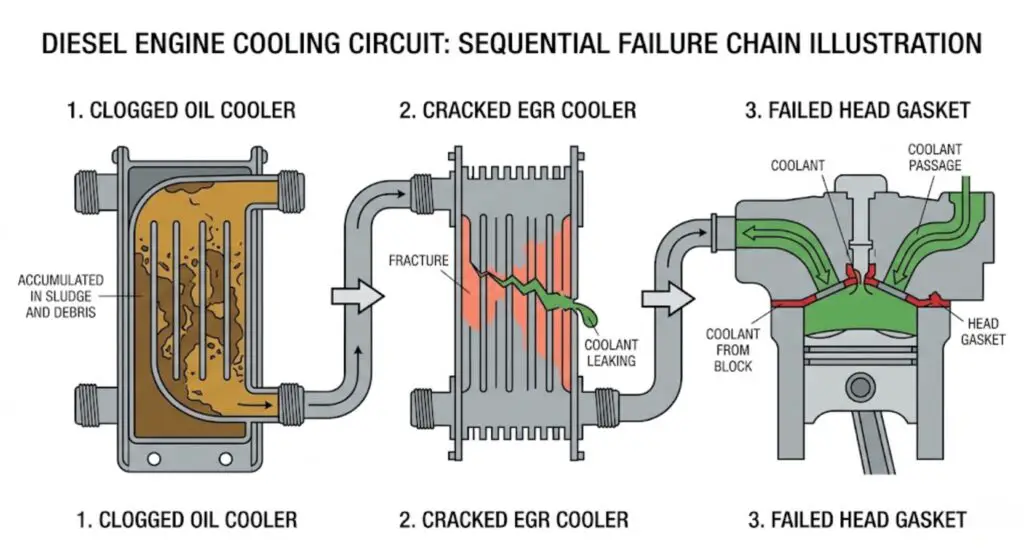
- Step 1 — Oil cooler clogs. Small debris accumulates in the narrow passages of the liquid-to-liquid oil cooler, restricting coolant flow through the system.
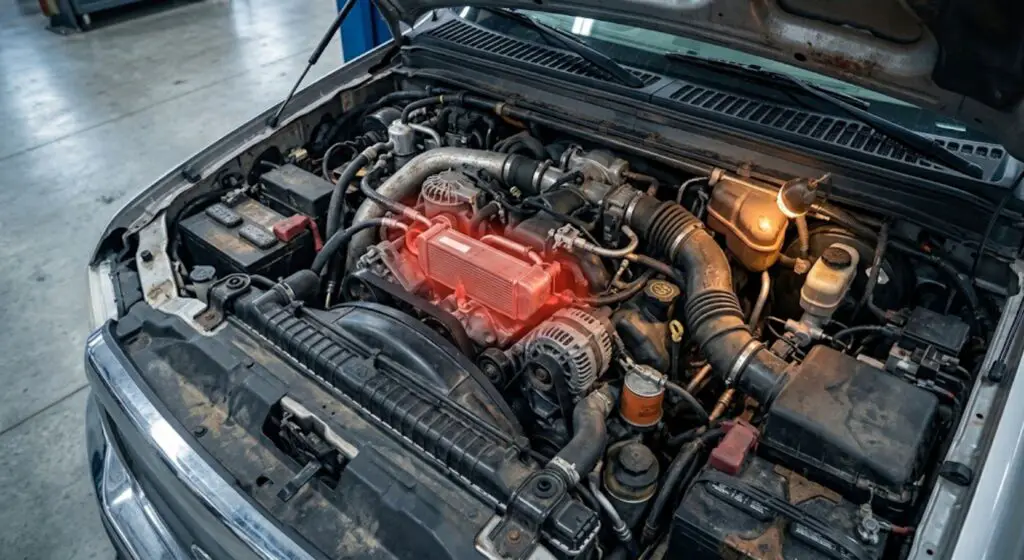
- Step 2 — EGR cooler overheats. With restricted coolant flow, the exhaust gas recirculation (EGR) cooler loses adequate cooling. Internal brazing cracks, and coolant enters the intake manifold.
- Step 3 — Head gaskets fail. Coolant in the combustion chamber causes rapid overheating. The factory torque-to-yield (TTY) head studs lose clamping force under pressure, and head gaskets blow.
Two additional failures sit outside this chain but are equally common. The FICM (Fuel Injector Control Module) — the module that fires the fuel injectors — fails from excess heat and vibration, causing hard starts, rough idle, and no-start conditions. The variable geometry turbo (VGT) accumulates soot on its vanes over time, causing them to stick open and reducing boost.
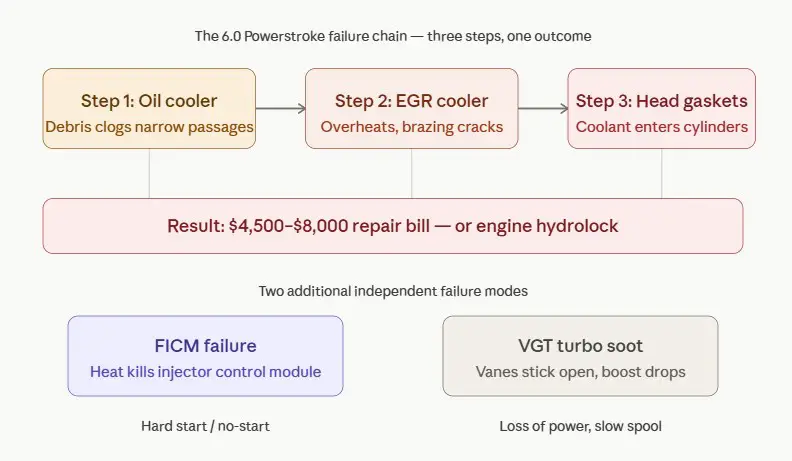
Knowing this chain matters because it directly determines which years carry the highest risk, and why.
4 Variables That Determine If a 6.0 Is Worth Buying
Before using any year as a hard filter, answer these four questions about the specific truck.
1. Model year. The 2003 and 2004 carry the worst factory design without any mid-cycle corrections. The 2005 sits in a transitional position. The 2006 and 2007 reflect later production with more field-proven components. Year sets the baseline risk.
2. Mileage and documented service history. A 6.0 with documented oil changes using the correct 15W-40 diesel oil matters more than raw mileage. If you want to choose the right oil for this engine, our guide to the best oil for the 6.0 Powerstroke covers the correct spec. The 6.0’s oil cooler fails faster when intervals are stretched or incorrect oil is used. An unknown-history truck at 80,000 miles can be riskier than a documented truck at 150,000 miles. If you cannot verify service history, add risk regardless of year.
3. Bulletproof build status. Has the oil cooler been replaced or upgraded? Has the EGR cooler been replaced or deleted? Have ARP head studs been installed? Is there a coolant filtration system in place? If all four are done and documented, this variable overrides year almost entirely. More on this in the dedicated section below.
4. Your budget for potential repairs. If a major repair would leave you financially strained, the risk calculus shifts toward hard-avoid regardless of year or price. A great-looking 2004 at $9,000 is not a deal if you have no room for a $4,500–$6,000 repair bill.

Audible — Listen Free for 30 Days
One free credit a month and thousands of titles included.
Listen Free for 30 Days As an Amazon Associate I earn from qualifying purchases.The 2003 and 2004 Model Years Hard Avoid
Recommended Best Deal Products

The 2003 and 2004 model years carry the highest risk for a specific reason: they represent the first two production years before Ford addressed any of the known failure points.
The 2003 was the engine’s first appearance in the F-250 and F-350. Early-build 2003 trucks — particularly those built in the first half of the model year — had the most concentrated failure reports. The EGR cooler design used in 2003 is the most failure-prone iteration of the entire production run. The oil cooler passages are the original, narrowest spec. The TTY head studs are at their original clamping rating, which is insufficient when the cooling system stress begins. The FICM units from this period are the earliest design and the most heat-sensitive.
The 2004 carried over every unresolved issue from 2003 without material improvement to the core failure components.
What Makes 2003 the Worst Year Specifically
- Earliest EGR cooler design — original internal brazing, most prone to cracking under thermal cycling
- Narrowest-spec oil cooler passages — fastest clogging rate, shortest interval to failure
- Original TTY head stud spec — lowest clamping force of any production year; head lift begins before visible symptoms appear
If a 2003 or 2004 truck is stock and has no documented bulletproof work, the probability of a major repair within the next 30,000 miles is high. When the full failure chain completes — oil cooler, EGR cooler, and head gaskets — you are looking at a combined repair bill of $4,500 to $8,000 at a diesel-specialist shop, depending on whether the heads need machine work and which parts are used. That figure assumes you catch it before the engine hydrolock from coolant entering the cylinders. If you do not, the number climbs significantly.
If the truck is a stock 2003 or 2004 with no documented bulletproof work, walk away. The 2005 is a different story — and here is exactly why.
Why 2005 Is the Transition Year Worth Watching
The 2005 model year sits in an uncomfortable middle ground — better than 2003 in some ways, but not meaningfully different in the ways that matter most.
Ford made incremental updates for the 2005 production run, including revisions to the turbocharger oil drain tube (a common source of oil coking and turbo failure on earlier trucks) and some fuel system calibration adjustments. However, the 2005 still uses the same original-design EGR cooler, the same TTY head studs, and the same fundamental oil cooler configuration as 2003 and 2004. The core failure chain is still intact on an unmodified 2005.
The 2005 is a “verify before buying” year. If it has a clean documented history, you evaluate it on its own merits. If history is unknown, treat it like a 2004.
How to Evaluate a 2005 Before Buying
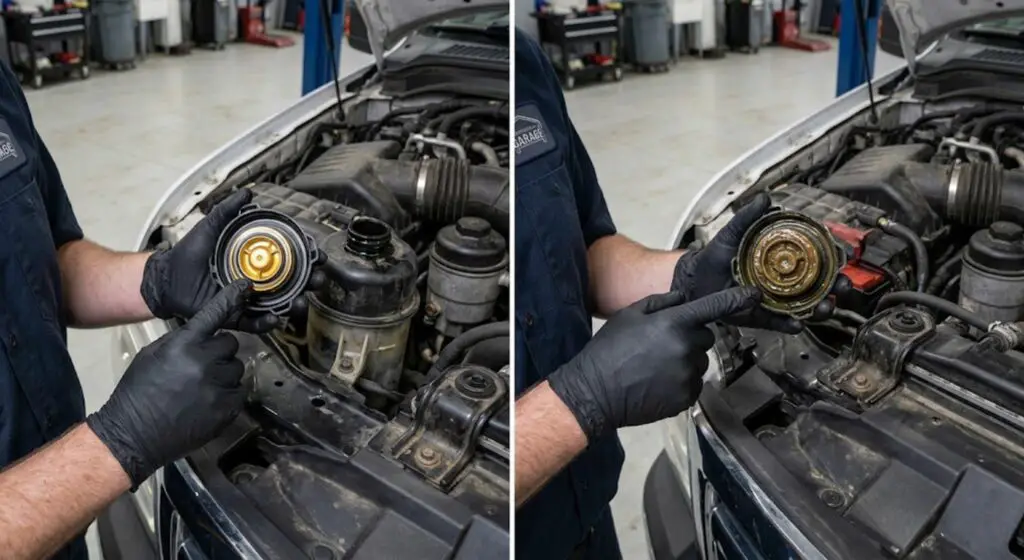
- Check coolant color and condition. Pull the degas bottle cap when the engine is cold. Coolant should be clean Ford Gold or equivalent. If it is brown, murky, or has an oily sheen, the oil cooler has likely already been compromised. Using the best coolant for the 6.0 Powerstroke and maintaining the correct coolant spec is one of the most important things a 6.0 owner can do.
- Look for white or gray smoke at startup. This is the most visible sign the EGR cooler is leaking coolant into the intake.
- Ask for any EGR or oil cooler service records. Even a standard oil cooler replacement (not a full bulletproof build) on a 2005 reduces risk significantly.
- Check under the oil cap. Milky residue inside means coolant and oil are already mixing — walk away immediately.
If the 2005 passes all four of these checks and has documented maintenance, it moves from hard-avoid to cautious-consider. If it fails any of them, treat it the same as a 2003.
The 2006 and 2007 are where the calculus starts to shift — under specific conditions.
Audible Premium Plus — Annual Membership
12 audiobook credits up front, plus the full Audible catalogue.
See Annual Plans As an Amazon Associate I earn from qualifying purchases.When a 2006 or 2007 6.0 Powerstroke Becomes a Calculated Buy
A 2006 or 2007 with the right service history is not the same truck as a stock 2003 — and treating them as equivalent is the most common mistake buyers make about this engine.
By the 2006 model year, many trucks in the used market had already been through Ford’s extended warranty repair program or had repairs completed by prior owners. A 2006 or 2007 that has documented EGR cooler and oil cooler work done — even at a dealer under warranty — is a meaningfully lower-risk purchase than a stock 2003 at the same price.
The 2007 was the final production year of the 6.0. Ford’s experience with the engine was at its peak, and late-production 2007 units reflect the most refined version of the platform. Finding a well-maintained 2007 with a clean service history and documented cooling system work is the closest you can get to a defensible 6.0 purchase without a full bulletproof build.
If the 2006 or 2007 has a receipts trail showing oil cooler replacement or full bulletproof work, and the coolant is clean with no signs of prior overheating, it becomes a calculated buy — not a guaranteed one, but a defensible one. The key phrase is “receipts trail.” A seller saying the work was done is not the same as documentation. Require paper.
How a Bulletproofed 6.0 Changes the Year Calculus
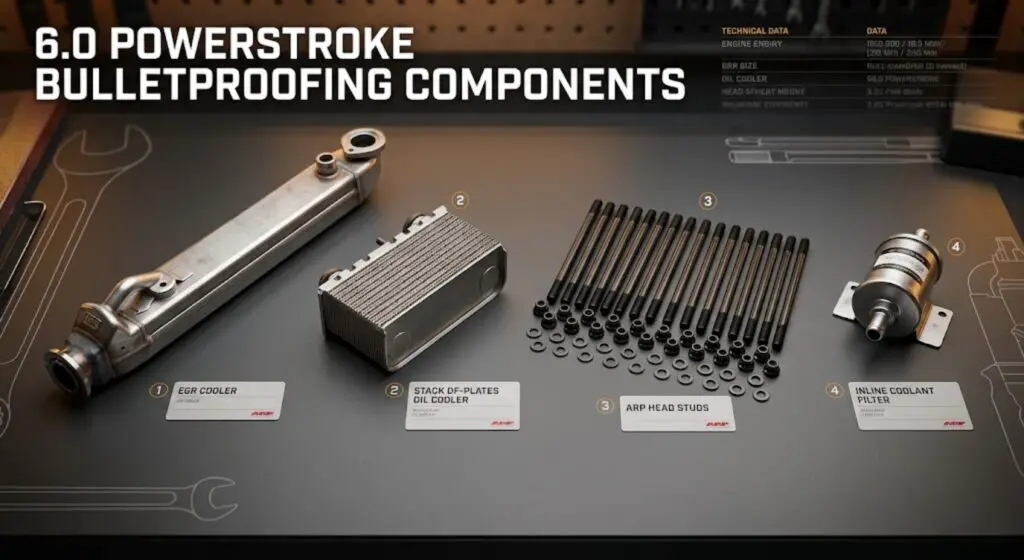
The word “bulletproofed” gets thrown around in 6.0 listings like it means something — and it does, but only if all four core components were addressed and documented.
A true bulletproof build on the 6.0 Powerstroke addresses the entire failure chain, not individual symptoms. If a 2003 has been fully bulletproofed with documented receipts from a reputable diesel shop, it becomes more reliable than an unbulletproofed 2006. Year becomes secondary to build status.
What a Complete Bulletproof Build Includes
| Component | What It Does | Approximate Parts Cost |
|---|---|---|
| Upgraded EGR cooler (BulletProof Diesel or equivalent) | Replaces failure-prone OEM cooler with high-flow stainless unit | $350–$600 |
| Oil cooler replacement or relocation kit | Replaces clogged OEM cooler; eliminates root cause of failure chain | $500–$2,000+ (BPD relocation kit) |
| ARP head studs + head gasket kit | Replaces TTY studs with reusable high-clamping studs; ARP kit runs ~$599 in parts | $600–$900 parts |
| Coolant filtration kit | Catches debris before it reaches the oil cooler passages | $50–$150 |
Labor for a complete bulletproof build, including cab removal at a reputable diesel shop, runs $4,000 to $5,000 for parts and labor combined at a shop with 6.0 experience. A budget shop can quote as low as $3,000, but head work quality varies — the machining matters as much as the parts.
A FICM replacement or upgrade adds another $700 to $1,500 depending on whether you go OEM, aftermarket, or a rebuilt 58-volt unit. This is typically done when the FICM shows symptoms, not as part of every initial build.
One critical distinction: a partial build — just head studs, or just an EGR cooler, without the oil cooler — is not a bulletproof build. The oil cooler is the root cause of the failure chain. If it has not been addressed, the rest of the work will eventually fail again.
If a seller cannot produce receipts for the work, treat the truck as stock regardless of what they say. For trucks you plan to keep long-term, pairing the build with a quality best tuner for the 6.0 Powerstroke can also help monitor engine parameters and catch stress before it becomes a repair.
6.0 Powerstroke Year vs Condition Decision Matrix
This table maps every combination of year and build status to a single recommendation.
| Year | Stock + Unknown History | Stock + Documented History | Partial Build (EGR or Oil Cooler Only) | Full Bulletproof Build (All 4 Components) |
|---|---|---|---|---|
| 2003 | Hard Avoid | Hard Avoid | Caution | Conditional Buy |
| 2004 | Hard Avoid | Hard Avoid | Caution | Conditional Buy |
| 2005 | Hard Avoid | Caution | Caution | Buy |
| 2006 | Caution | Conditional Buy | Conditional Buy | Buy |
| 2007 | Caution | Conditional Buy | Conditional Buy | Buy |
Reading the table: “Hard Avoid” means walk away. “Caution” means inspect thoroughly before any offer — a single red flag moves it to Avoid. “Conditional Buy” means it is defensible at the right price with a buffer for future maintenance. “Buy” means the core failure chain has been addressed and year-related risk is substantially reduced.
The pattern is clear: early years require a complete bulletproof build to become defensible; later years with clean documented history can be cautious considerations even in stock form.
When to Walk Away From Any 6.0 Regardless of Year
No year of the 6.0 Powerstroke survives these red flags — they override everything else in this guide.
- White or gray smoke at cold startup. This is coolant burning off in the combustion chamber. The EGR cooler has already failed internally, and the head gaskets may not be far behind.
- Coolant with an oily sheen, or oil with a milky appearance. Coolant and oil are already mixing. This is a repair already in progress — not a risk, an active failure.
- Seller cannot produce any service records. No history means unknown oil cooler condition, unknown FICM voltage, and unknown head stud status. You are buying a ticking clock with no information about how much time is left.
- The asking price leaves no room for a bulletproof build. Factor $4,000–$6,000 into any 6.0 purchase as a reserve. If the total — truck price plus that reserve — exceeds what a comparable 6.7 Powerstroke costs in your market, the math does not work. Our guide to 6.7 Powerstroke years to avoid covers the safer alternative.
- The truck has been tuned but has no EGR or head stud work. Adding a tune to a stock 6.0 accelerates cylinder pressure and thermal stress. It makes the failure chain run faster. A tuned, unbuilt 6.0 is a higher-risk truck than a stock one.
- Any sign of prior overheating in the service history. An overheating event in the 6.0’s past often means head warpage. Even if the truck was “repaired,” heads that were resurfaced once are at elevated risk of failing again.
If any of these are true: walk away regardless of year, regardless of price. The deal always looks better than it is when one of these conditions exists.
Frequently Asked Questions
What is the worst year for the 6.0 Powerstroke?
The 2003 model year is the worst. It was the first production year with the highest concentration of unresolved EGR cooler, oil cooler, and FICM failures — and the earliest-build 2003 units had the most factory issues before any running production changes were made.
Is any year of the 6.0 Powerstroke reliable?
A 2006 or 2007 with a documented full bulletproof build — upgraded EGR cooler, oil cooler replacement, ARP head studs, and a coolant filtration kit — is significantly more reliable than a stock unit from any year. Reliability comes from build status, not just the year on the door jamb sticker.
How much does it cost to bulletproof a 6.0 Powerstroke?
A complete bulletproof build at a reputable diesel shop runs $4,000 to $5,000 for parts and labor. That covers the EGR cooler upgrade, oil cooler replacement, ARP head studs with head gasket kit, and a coolant filter. A partial build that skips the oil cooler is not a bulletproof build — the oil cooler is the root of the failure chain.
What are the most common 6.0 Powerstroke problems?
The four major failure points are oil cooler clogging, EGR cooler failure, head gasket failure from the resulting overheating, and FICM (Fuel Injector Control Module) failure. These typically occur in sequence — the oil cooler fails first and causes everything downstream.
Should I buy a 6.0 Powerstroke or look at the 6.7 instead?
If your budget allows, the 6.7 Powerstroke is a more reliable modern engine. A fully bulletproofed 2006 or 2007 6.0 at the right price can still be a viable workhorse — but run the math including a $4,000–$6,000 build reserve before deciding. Our breakdown of 6.7 Powerstroke years to avoid gives you the comparison data you need.
Conclusion
The 6.0 Powerstroke years to avoid in stock form are 2003 and 2004 — full stop. The 2005 requires a careful inspection before any offer. The 2006 and 2007 with documented cooling system work are the only years that can be considered calculated buys without a full bulletproof build already in place.
The single variable that overrides all of this is documented bulletproof build status. A properly built 2003 beats an unknown-history 2007. Use the decision matrix in this guide before you make any offer. Price the build reserve into your total from day one — and if the numbers do not work, walk away. There will be another truck.