Ford F-250 Bolt Pattern Guide: Year-by-Year Fitment Table

The Ford F-250 transitioned from an 8×6.5 inch (165.1mm) pattern to a 8x170mm pattern in 1999 with the launch of the Super Duty line. Modern F-250s manufactured from 1999 to the present day all utilize the 8x170mm spacing, making wheels from older ‘Old Body Style’ trucks incompatible with newer models.
🎯 Key Takeaways
- Pre-1999 F-250 models use the classic 8×6.5 inch (165.1mm) bolt pattern.
- 1999 to present Super Duty F-250s use the 8x170mm bolt pattern.
- The thread pitch changed from M14x2.0 to M14x1.5 in the 2003 model year.
- F-250 wheels are hub-centric with a standard center bore of 125.1mm.
- Lug nut torque should typically be set between 150 and 165 lb-ft.
If you are looking for new wheels for your Ford F-250, the most critical piece of information you need is the bolt pattern. For most of the F-250’s history, the truck has used one of two primary patterns: the classic 8×6.5-inch (165.1mm) pattern or the modern 8x170mm metric pattern. Knowing which one your truck uses is the difference between a perfect fit and a set of expensive wheels that simply will not bolt onto your hubs.
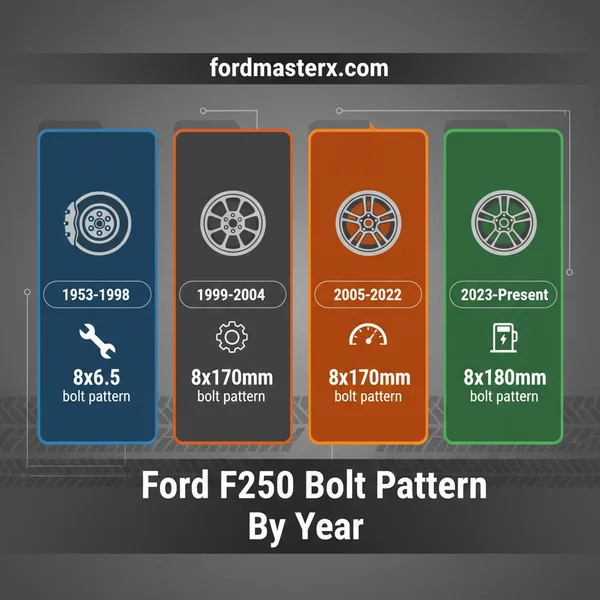
The dividing line for these patterns occurred in 1999 with the introduction of the Super Duty line. Before this shift, Ford shared its lug pattern with brands like Chevrolet and Dodge, making wheel swaps relatively easy. Today, the 8x170mm pattern is unique to the Ford Super Duty series. Beyond just the bolt circle, you also need to track changes in thread pitch and torque requirements to ensure your wheels stay securely fastened under heavy loads. This guide breaks down exactly what you need for your specific model year.
Chronological Breakdown of F-250 Bolt Pattern Generations
The Ford F-250 has undergone several platform shifts over the decades. Each major redesign typically brought changes to the hub assembly and the wheel mounting hardware. Understanding these generations helps you identify which wheels from other F-series trucks or aftermarket brands will actually work on your rig.
The Classic Era: 1953 to 1998 (8×6.5″ / 8×165.1mm)
For nearly half a century, the Ford F-250 utilized the “standard” 8-lug pattern used by almost every heavy-duty truck manufacturer in America. This 8×6.5-inch pattern (equivalent to 165.1mm) was the industry benchmark. If you own a high-boy from the 70s or an OBS (Old Body Style) truck from the 90s, this is your pattern. Because this was a universal standard, wheels from older Chevy Silverados or Dodge Rams of the same era often physically fit the bolt pattern, though center bore diameters still vary.
- Model Years: 1953–1998 (Excluding 1997-1999 Light Duty)
- Pattern: 8×6.5 inches (8×165.1mm)
- Compatibility: Compatible with most vintage 8-lug domestic trucks, but check the center bore for clearance over the hub.
The “Light Duty” Exception: 1997 to 1999 (7x150mm)
There is a rare “oddball” F-250 that catches many owners off guard. Between 1997 and 1999, Ford produced a Light Duty F-250 that used the F-150 body style but featured beefier suspension. These trucks use a unique 7-lug pattern (7x150mm). If your truck looks like a 10th-generation F-150 but has an F-250 badge, count your lugs carefully. These wheels are not interchangeable with any other F-250 generation.
The Super Duty Era: 1999 to Present (8x170mm)
When Ford launched the Super Duty brand in 1999, they moved to a metric 8x170mm bolt pattern. This was a significant departure from the rest of the industry. This pattern remains the standard for every F-250 produced today. It is important to note that while the bolt pattern has stayed the same for over 25 years, the offset and thread pitch of the studs have changed, meaning a wheel from 1999 might not sit correctly on a 2024 model without adjustments.
- Model Years: 1999–2024+
- Pattern: 8x170mm
- Constraint: These wheels will not fit pre-1999 trucks. The 4.9mm difference is enough to prevent the wheel from seating, and attempting to force them on will shear the studs.
Essential Lug Nut Specs: Thread Pitch and Torque Requirements
Finding the right bolt pattern is only half the battle. To safely mount your wheels, you must use the correct lug nuts. Ford changed the thread pitch on the F-250 studs mid-way through the Super Duty production run. Using the wrong thread pitch will strip your studs and could lead to a wheel coming off while driving. You must also adhere to specific torque values, as heavy-duty trucks exert massive force on the wheel mounting surface.
Understanding Thread Pitch Changes
From 1999 to early 2002, Ford used a coarse thread (M14 x 2.0). Starting in late 2002 and 2003, they switched to a fine thread (M14 x 1.5). This is a common trap for owners buying aftermarket lug nuts. Even if the bolt pattern is 8x170mm, the nuts from a 2000 F-250 will not thread onto a 2010 F-250.
- 1953–1991: 1/2″ x 20 or 9/16″ x 18 (Varies by specific GVWR)
- 1992–1998: 9/16″ x 18
- 1999–2002: M14 x 2.0 (Metric Coarse)
- 2003–Present: M14 x 1.5 (Metric Fine)
Recommended Torque Values for Safety
Proper torque ensures that the clamping force is evenly distributed across the wheel face. For the F-250, these values are significantly higher than your average passenger car. Under-torquing can lead to the nuts backing off, while over-torquing can stretch or snap the studs. Always use a calibrated torque wrench rather than an impact gun for the final tightening sequence.
- Pre-1999 Models: Typically 120–140 lb-ft.
- 1999–2016 Super Duty: 150 lb-ft.
- 2017–Present Super Duty: 165 lb-ft (Some newer models with heavy-duty packages require this higher spec).
Note: Always re-torque your lug nuts after the first 50 to 100 miles of driving on new wheels. Aluminum wheels, in particular, can compress slightly during the first few heat cycles, which may cause the lug nuts to lose their initial tension.
The Importance of Center Bore and Hub-Centric Fitment
When you are upgrading the wheels on a heavy-duty workhorse like the Ford F-250, the bolt pattern is only one piece of the puzzle. You also need to pay close attention to the center bore. This is the large hole in the middle of the wheel that slides over the axle hub. For modern F-250 Super Duty models, the center bore is typically 124.9mm, and getting this measurement right is vital for safety.
Why Hub-Centric Design is Critical
Ford F-250s utilize a hub-centric design. This means the wheel is centered by the hub itself rather than the lug nuts. This design is superior for trucks that tow and haul because it transfers the truck’s massive weight directly from the wheel to the hub. If you install “lug-centric” aftermarket wheels where the center bore is too large, you place all the shear stress on the wheel studs, which can lead to catastrophic failure under heavy loads.
Practical Tips for Bore Fitment
- Use Hub-Centric Rings: If you find a set of aftermarket wheels you love but the center bore is larger than 124.9mm, always use high-quality hub-centric rings to bridge the gap.
- Avoid Vibration: An incorrect center bore fitment is the most common cause of “steering wheel shimmy” at highway speeds, even if the wheels are perfectly balanced.
- OEM Consistency: Most factory Ford wheels are designed with a tight tolerance to the hub, so swapping between different F-250 trims usually guarantees a perfect hub-centric fit.
Cross-Generation Compatibility and Offset Considerations
Many owners wonder if they can swap wheels from a newer F-250 onto an older model to save money or refresh the truck’s look. Since Ford has stuck with the 8x170mm pattern since 1999, the answer is often “yes,” but there are significant caveats regarding offset and backspacing that can affect how the truck drives.
The Shift in Wheel Offset
In 2005, Ford made a major change to the F-250’s front suspension and widened the track. As a result, the wheel offset increased significantly. If you attempt to put wheels from a 2020 F-250 onto a 1999–2004 model, the wheels will sit too far inward. This often causes the tires to rub against the leaf springs or inner fender liners during tight turns. Conversely, putting older wheels on a newer truck may cause the tires to poke out past the fenders, potentially throwing road debris along the side of your truck.
Brake Caliper Clearance
As the F-250 has evolved, so have its brakes. Modern Super Duty trucks feature much larger brake calipers than their predecessors to handle increased towing capacities. This means that while a 20-inch wheel from a 2024 model will physically bolt onto a 2001 truck, you cannot go the other way. Older 16-inch or 17-inch wheels will often fail to clear the massive brake calipers on 2005 and newer models.
- 2005+ Wheels on Older Trucks: Usually require a hub-centric wheel spacer (typically 2 inches) to correct the offset and prevent rubbing.
- Check Load Ratings: Ensure any wheel you swap onto your F-250 is rated for the truck’s Gross Vehicle Weight Rating (GVWR). Never use wheels designed for lighter SUVs.
- Test Fitment: Always test fit a front wheel first to ensure the spokes clear the brake calipers and the tire clears the suspension at full lock.
Conclusion
Finding the correct bolt pattern for your Ford F-250 is the foundation of any successful wheel upgrade. Whether you are maintaining a classic 1990s model with the 8×6.5″ pattern or customizing a modern Super Duty with the 8x170mm standard, accuracy is everything. By matching the bolt pattern, verifying the center bore, and accounting for offset changes between generations, you ensure your truck remains both stylish and safe on the road.
Before you make a purchase, take a moment to double-check your specific model year against our fitment table and verify your hub diameter. Once you have the specs confirmed, you can confidently choose a wheel that handles the heavy-duty demands of your F-250. It’s time to get those new wheels mounted and get back to work!
❓ Frequently Asked Questions
Why did Ford change the bolt pattern in 1999?
With the introduction of the Super Duty platform in 1999, Ford moved to the metric 8x170mm pattern to modernize the chassis and differentiate the heavy-duty trucks from the light-duty F-150 and the older 8×6.5″ industry standard.
What is the difference between 8×6.5 and 8×165.1?
There is no difference; 8×165.1mm is simply the metric conversion of the 8×6.5 inch imperial measurement used on pre-1999 F-250 trucks.
Can I use 8x170mm wheels on an older F-250 with adapters?
While wheel adapters exist to convert 8×6.5″ to 8x170mm, they are generally discouraged for heavy towing as they can add stress to the wheel bearings and change the effective offset.
How do I identify a ‘Light Duty’ 1997-1998 F-250 bolt pattern?
The rare ‘Light Duty’ F-250 (F-150 7700) from 1997-1998 features a unique 7-lug pattern (7x150mm), which is distinct from both the standard 8-lug F-250s and the 5-lug F-150s.
What is the recommended torque for F-250 lug nuts?
For most 1999-present Super Duty models, the recommended torque is 150-165 lb-ft (203-224 Nm), but you should always verify the specific rating in your owner’s manual.
Does the offset matter when swapping F-250 wheels?
Yes, F-250 wheels typically have a positive offset (around +40mm); installing wheels with a negative offset may cause the tires to rub on the wheel wells or fenders during tight turns.