
2000 7.3 Powerstroke HP & Torque: Factory Specs & Ratings

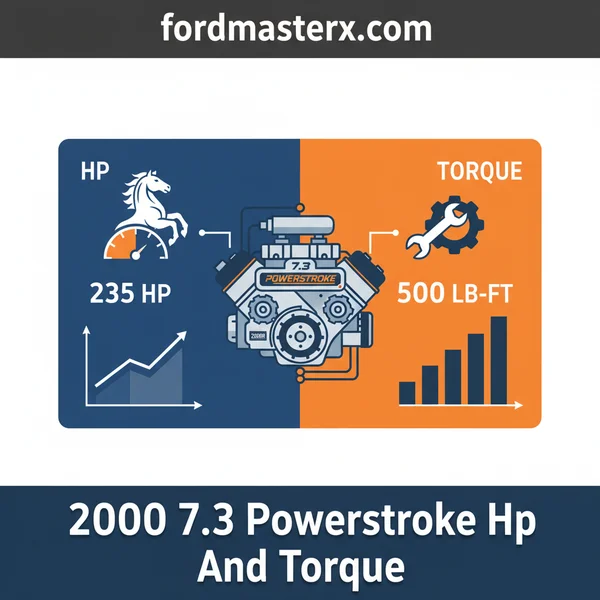
The 2000 7.3L Powerstroke engine delivers 235 hp and 500 lb-ft of torque for automatic models, while manual versions are rated slightly higher at 250 hp and 505 lb-ft. These ratings are achieved at 2,700 RPM for peak power and a low 1,600 RPM for peak torque, making it a legendary platform for towing.
Prime Day Pick
Limited-time Prime Day price. Check current discount on Amazon.
🎯 Key Takeaways
- Manual transmission models provide 15 more horsepower than factory automatics.
- Peak torque is achieved early at 1,600 RPM for heavy hauling.
- The 2000 model year includes an air-to-air intercooler for better efficiency.
- Split-shot AD-code injectors are standard for quieter, cleaner engine operation.
- Horsepower ratings increased significantly over the earlier non-intercooled 7.3L versions.
The 2000 Ford 7.3L Powerstroke remains a benchmark for diesel reliability, but its factory power ratings depend entirely on the transmission behind it. If your truck is equipped with the 4R100 automatic transmission, it left the factory with 235 horsepower and 500 lb-ft of torque. However, if you have the six-speed ZF6 manual, those numbers bump up to 250 horsepower and 505 lb-ft of torque. These figures represent the peak output Ford determined would provide maximum longevity while still handling heavy-duty workloads.
Understanding these specific ratings is critical whether you are keeping your truck stock or planning performance upgrades. These factory specs dictate your towing confidence and how the truck responds under a heavy load. Since the 2000 model year falls right in the middle of the “Super Duty” era, these ratings were class-leading at the time. They provide the necessary baseline for calculating your truck’s remaining life and performance potential in today’s demanding environments.
Prime Day Pick
Limited-time Prime Day price. Check current discount on Amazon.
Factory Horsepower and Torque Specs for the 2000 7.3L
The 2000 model year was a sweet spot for the 7.3L Powerstroke. By this time, Ford had integrated the wastegated Garrett GTP38 turbocharger and split-shot “AD” code injectors as standard equipment. These components allowed the engine to produce smooth, predictable power across the rev range. While the horsepower numbers might seem modest compared to modern diesel engines, the 7.3L was designed for sustained work and thermal efficiency rather than high-speed racing.

Peak Performance and RPM Ranges
The beauty of the 2000 7.3L is where it makes its power. Unlike gasoline engines that need to scream at high RPMs to move a heavy load, this diesel thrives in the low-to-mid range. You reach maximum pulling power almost immediately after stepping on the pedal. This low-end grunt is what makes the 2000 Super Duty feel so capable when pulling a trailer up a steep grade or merging onto the highway with a full bed.
Prime Day Pick
Limited-time Prime Day price. Check current discount on Amazon.
- Peak Horsepower: Produced at approximately 2,600 to 2,700 RPM.
- Peak Torque: Achieved at a remarkably low 1,600 RPM.
- Governed Speed: The engine is typically governed around 3,250 to 3,400 RPM to protect the valvetrain.
- Compression Ratio: A steady 17.5:1, designed for durability under high boost.
Technical Foundation of the 2000 Output
The engine’s ability to hit 500+ lb-ft of torque at just 1,600 RPM is due to the HEUI (Hydraulic Electronic Unit Injection) system. This system uses high-pressure engine oil to fire the injectors, allowing for precise fuel delivery even at low engine speeds. In the 2000 model, the inclusion of an air-to-air intercooler was also standard. This helped maintain these power levels by keeping intake temperatures low during heavy load cycles, ensuring your engine didn’t have to “de-rate” or cut back fuel during a long, hot haul over a mountain pass.
The Ultimate 2000 7.3 Powerstroke Horsepower and Torque Walkthrough
The 2000 Ford 7.3L Powerstroke is a legendary workhorse, originally rated at approximately 235 horsepower and 500 lb-ft of torque. While these figures were impressive for the turn of the millennium, modern demands and heavier towing requirements often leave owners wanting more. This comprehensive guide details the exact steps required to unlock the latent potential of your 7.3 diesel engine. By following this systematic approach, you can safely increase your output to over 350-400 horsepower and 700+ lb-ft of torque while maintaining the reliability that made this engine famous. We will cover everything from foundational airflow improvements to advanced electronic tuning and fuel delivery optimizations.
Prime Day Pick
Limited-time Prime Day price. Check current discount on Amazon.
Step 1: Open the Airflow Path with a High-Flow Intake
What you need: A cold air intake kit (such as S&B, aFE, or the DIY “6637” Napa filter mod), basic socket set (8mm, 10mm, 13mm), and a flathead screwdriver.
Instructions: The factory airbox on the 2000 model is notorious for “dusting” engines because the plastic housing often warps, allowing unfiltered air to bypass the filter. Begin by removing the factory airbox and the plastic intake tube leading to the turbocharger. Install a high-volume open-element filter or a sealed cold air box. Ensure all clamps are tightened to prevent leaks. This modification reduces vacuum restriction, allowing the turbocharger to spool faster and lowering your Exhaust Gas Temperatures (EGTs) by providing a denser, cooler air charge to the cylinders. You can expect a modest gain of 10-15 horsepower and improved throttle response immediately.
Prime Day Pick
Limited-time Prime Day price. Check current discount on Amazon.
Pro Tip: If you use the DIY “6637” filter, buy a pre-filter “sock” to protect the pleated paper from moisture and large debris, which extends the filter life significantly in dusty conditions.
Step 2: Upgrade to a 4-Inch Turbo-Back Exhaust System
What you need: A 4-inch mandrel-bent exhaust kit, a reciprocating saw or chain cutter for the old pipe, penetrating oil (WD-40 or PB Blaster), and a 15mm deep socket.
Instructions: The stock exhaust on a 2000 Powerstroke features a restrictive 3.5-inch downpipe that is smashed flat in certain sections to clear the firewall. Use penetrating oil on the turbo v-band clamp and all hangers. Cut out the old exhaust and install a 4-inch mandrel-bent downpipe followed by a full 4-inch system. Mandrel bends maintain a constant diameter, unlike “crush” bends, which restrict flow. This allows the spent exhaust gases to exit with less backpressure, which is critical for lowering EGTs when you start adding fuel in later steps. This upgrade is the foundation for any torque increase over 550 lb-ft.
Pro Tip: When installing the new downpipe, use a pry bar to slightly move the firewall insulation out of the way to prevent vibrations and rattling against the cab floor.
Step 3: Install Essential Monitoring Gauges
What you need: An EGT (Pyrometer) gauge, Boost gauge, and Transmission Temperature gauge (or a digital monitor like the Edge CTS3), a drill, and a 1/8-inch NPT tap.
Instructions: Before adding significant power, you must be able to monitor the engine’s vitals. The most critical is the Pyrometer, which measures the temperature of the exhaust gases entering the turbo. Drill and tap the driver-side exhaust manifold (pre-turbo) to install the thermocouple. If you have an automatic transmission (4R100), a temp gauge is vital as increased torque generates massive heat. Mount the gauges on the A-pillar or a dash pod. These tools don’t add power themselves, but they prevent you from melting pistons or burning up your transmission once the tuning is installed. Never exceed 1,250°F EGT for extended periods.
Pro Tip: When drilling the exhaust manifold, keep the engine idling. The outward pressure of the exhaust gases will blow the metal shavings out of the hole, preventing them from falling into the turbocharger.
Step 4: Enhance the Turbocharger Compressor Wheel
What you need: A “Wicked Wheel 2” or a similar billet compressor wheel, a turbo rebuild kit (optional but recommended), and a 12nd/8mm 12-point socket.
Instructions: The 2000 model year turbochargers are prone to “turbo surge” or “flutter” when under load or high boost. This is not only annoying but hard on the turbo bearings. Remove the turbocharger from the engine valley (requires disconnecting the pedestal and up-pipes). Swap the factory cast compressor wheel for a billet “Wicked Wheel” design. The different blade geometry increases boost pressure by 3-5 PSI and moves the surge line, allowing for smoother power delivery across the RPM range. This modification improves mid-range torque and helps the engine breathe better at the top end of the power band.
Pro Tip: While the turbo is out, check the “up-pipes” for soot stains. If they are leaking, your boost will be low. This is the best time to upgrade to bellows-style up-pipes.
Step 5: Install a Custom Multi-Position Chip
What you need: A Hydra Chip or TS 6-Position chip, Scotch-Brite pad, and denatured alcohol.
Instructions: This is where the largest gains in horsepower and torque occur. The 7.3L is electronically controlled; a chip modifies the fuel injection timing, pulse width, and injection pressure. Access the PCM (Powertrain Control Module) located behind the emergency brake pedal. You must pull the PCM and carefully clean the protective “jelly” and tin plating off the circuit board connectors using the Scotch-Brite pad until the copper is shiny. Plug the chip into the PCM and run the selector switch to your dashboard. High-quality custom tunes (like those from Power Hungry Performance) can add up to 140 HP and 250 lb-ft of torque on an otherwise stock engine.
Pro Tip: Never “hot swap” the chip or change positions while your foot is on the accelerator; always let the engine return to idle before switching between extreme power levels.
Step 6: Upgrade the High-Pressure Oil Pump (HPOP)
What you need: A heavy-duty HPOP (such as the Adrenaline or CNC Fab Stage 1), HPOP reservoir gasket, and a fuel line disconnect tool.
Instructions: The 7.3L uses HEUI injectors, which rely on high-pressure engine oil to fire. The stock 15-degree or 17-degree pump often struggles to maintain the 3,000+ PSI required when high-performance tunes demand more fuel. If your “Injection Control Pressure” (ICP) drops under load, your power will fall off. Replace the stock pump with a high-volume unit. This ensures that even at high RPMs, the injectors receive the oil volume needed to fully atomize the fuel. This results in a cleaner burn, more consistent torque, and a significant reduction in “smoke” or unburnt fuel during hard acceleration.
Pro Tip: Replace the IPR (Injection Pressure Regulator) valve at the same time as the HPOP. A sticky IPR can cause erratic idling and power surges that negate the benefits of a new pump.
Step 7: Optimize Fuel Delivery with a Regulated Return
What you need: A fuel-regulated return kit, fuel pressure gauge, and basic wrenches.
Instructions: The factory fuel system on the 2000 7.3 is a “deadhead” design, meaning fuel enters the back of the heads and has nowhere to go. This leads to air being trapped in the fuel rails, causing “cackle” and starving the #8 and #0 injectors. A regulated return kit creates a full loop, allowing fuel to flow through the heads and back to the tank, with a regulator maintaining a constant 60-65 PSI. This ensures that every injector has a fresh, air-free supply of fuel at all times. This mod smooths out the engine’s torque curve and provides a noticeably quieter idle while protecting your expensive injectors from cavitation damage.
Pro Tip: Install a fuel pressure sensor on the regulator and wire it to your digital monitor. If fuel pressure drops below 45 PSI under load, you are risking injector failure.
Step 8: Upgrade Transmission Cooling and Firmness
What you need: A 6.0L Powerstroke transmission cooler, extra 3/8-inch transmission hose, and a John Wood or BTS valve body.
Instructions: Torque kills the 4R100 automatic transmission. With your new power levels, the stock cooler is insufficient. Remove the small stock cooler and install the much larger 26-row or 31-row cooler from a 2003-2007 6.0L truck. This can drop fluid temperatures by 30-40 degrees. Additionally, installing an upgraded valve body will “firm up” the shifts. Stock shifts are “soft” to please average drivers, but soft shifts involve friction-plate slipping, which creates heat and wear. A performance valve body reduces shift duration, putting more of that new torque to the ground instead of losing it to heat inside the transmission case.
Pro Tip: If your transmission fluid smells burnt or looks dark brown, perform a full flush before adding more power, as the increased torque will quickly finalize the failure of an already weak unit.
✅ Final Checklist
- Verify that the EGT probe is seated correctly and the gauge reads ambient temperature before startup.
- Check all intake boots and clamps for tightness; a “boost leak” will cause high EGTs and low power.
- Confirm the PCM chip is securely taped or shimmed into place so it cannot vibrate loose while driving.
- Check fuel pressure at idle and under load to ensure it stays between 60-70 PSI.
- Monitor transmission temperatures during a test drive; they should ideally stay under 180°F during normal operation.
Important Notes:
- Safety: Always use jack stands when working under the vehicle. Be aware that the 7.3L holds 15 quarts of oil; ensure you have adequate drainage containers.
- When to seek help: If you are uncomfortable drilling into your exhaust manifold or modifying the PCM circuit board, consult a specialized diesel performance shop.
- Estimated Time: Total time for all steps is approximately 15-20 hours of labor.
- Cost Range: Expect to spend between $1,500 and $3,500 depending on whether you choose DIY options or premium bolt-on kits.
Transmission Differences: Automatic vs. Manual Ratings
One of the most common questions for 2000 7.3L owners is why the power ratings differ between transmission types. Ford intentionally tuned the engines differently based on whether they were paired with the 4R100 four-speed automatic or the ZF6 six-speed manual. This wasn’t just a random choice; it was a calculated move to balance drivetrain durability with driver control and mechanical efficiency.

The 4R100 Automatic Transmission Setup
The automatic version of the 2000 7.3L was rated at 235 hp and 500 lb-ft of torque. These slightly lower figures were implemented to protect the 4R100 transmission’s torque converter and internal clutch packs. Because an automatic transmission generates significant heat through fluid friction and torque converter slippage, Ford kept the power levels slightly more conservative. This ensured the transmission could survive the 100,000-mile warranty period and beyond under heavy towing conditions without overheating the ATF (Automatic Transmission Fluid).
- Automatic HP Rating: 235 hp @ 2,700 RPM
- Automatic Torque Rating: 500 lb-ft @ 1,600 RPM
- Practical Impact: Smoother power delivery and easier drivability in stop-and-go traffic, though with slightly more parasitic power loss.
The ZF6 Manual Transmission Power Advantage
Trucks equipped with the ZF6 manual transmission received a “hotter” factory calibration, resulting in 250 hp and 505 lb-ft of torque. Since a manual transmission uses a physical clutch and solid gears rather than a fluid-driven torque converter, it is inherently more efficient at transferring power to the ground. There is less heat buildup and less energy lost in the transfer process. Ford’s engineers took advantage of this mechanical robustness by allowing the engine to output an extra 15 horsepower and 5 lb-ft of torque right from the factory.
- Manual HP Rating: 250 hp @ 2,600 RPM
- Manual Torque Rating: 505 lb-ft @ 1,600 RPM
- Practical Impact: Better control over gear selection and a noticeable increase in “lugging” capability when starting a heavy load from a standstill.
This 15-horsepower gap might seem small on paper, but it is often felt when the truck is fully loaded. The manual trucks tend to hold their speed better on inclines because they can utilize that extra bit of factory-tuned fueling without the efficiency losses associated with the older-style 4R100 automatic. When you are looking at your door jamb sticker or engine valve cover, remember that these ratings are the “as-shipped” numbers that Ford guaranteed for the life of the vehicle.
Technical Components Behind the 2000 Performance Specs
The 2000 model year benefited from several key engineering choices that allowed it to reach its peak factory output. Unlike modern common-rail diesels, the 7.3L Powerstroke relies on high-pressure engine oil to fire the fuel injectors. This HEUI (Hydraulic Electronic Unit Injection) system is the primary driver behind those 500+ lb-ft torque numbers, as it allows for precise fuel delivery even at low engine speeds.
The Role of the HPOP and AD Injectors
At the heart of the 2000 Powerstroke’s performance is the High-Pressure Oil Pump (HPOP) and the “AD” code split-shot injectors. By the 2000 model year, Ford and Navistar had refined these components to provide a smoother combustion cycle. The split-shot design fires a tiny “pilot” charge of fuel before the main injection, which helps stabilize cylinder pressure and results in a more efficient power stroke.
- 17-Degree HPOP: Most 2000 models featured a pump capable of maintaining higher oil volume than earlier versions, ensuring the injectors stayed fully “fed” during high-demand towing.
- Wastegated Turbocharger: The Garrett GTP38 turbo used in 2000 featured a wastegate to manage boost pressure. This allowed for quicker spool-up at low RPMs (peak torque) while protecting the engine from over-boost at high RPMs.
- IDM 120: The Injector Driver Module sends the electrical pulse to the injectors. The 2000 trucks used a 120-volt module, providing snappier injector response than the older 100-volt units.
Practical Tip: If your truck feels sluggish or fails to hit its torque potential, check the “ICP” (Injection Control Pressure) sensor. A failing sensor can tell the computer to pull back on power, making a healthy engine feel like it has lost 50 horsepower overnight.
Performance Comparisons with Earlier 7.3L Powerstroke Years
While the 7.3L engine family is legendary for longevity, the 2000 model year sits in a “sweet spot” of the production run. It features factory improvements that owners of mid-90s trucks often have to install as aftermarket upgrades just to keep up.
The Impact of the Factory Intercooler
The biggest leap in performance occurred between the 1997 and late 1999 model years. By 2000, the air-to-air intercooler was a standard feature. This component cools the compressed air from the turbo before it enters the cylinders. Cooler air is denser, meaning more oxygen is available for combustion. This is a major reason why the 2000 model could safely produce 235-275 HP, whereas the non-intercooled 1994-1997 models were limited to around 215 HP from the factory to prevent melting internal components.
Evolution of Horsepower and Torque Ratings
To see how far the 7.3L came by the year 2000, consider the progression of these factory ratings for the F-250 and F-350 lineups:
- 1994.5 – 1997: 215 HP and 425 lb-ft torque (Non-intercooled, smaller injectors).
- Early 1999: 235 HP and 500 lb-ft torque (Smaller turbo and intake piping).
- 2000 (Automatic): 235 HP and 500 lb-ft torque (Optimized for transmission longevity).
- 2000 (Manual): 275 HP and 520 lb-ft torque (Higher factory fueling parameters).
For many enthusiasts, the 2000 model is highly desirable because it combines these higher output ratings with forged connecting rods. Engines produced before October 2000 typically feature these stronger rods, making them much more capable of handling aftermarket power increases compared to the powdered metal rods found in later 2001-2003 units.
Conclusion
The 2000 7.3 Powerstroke remains a benchmark in the diesel world, offering a factory balance of 235 to 275 horsepower and up to 520 lb-ft of torque. While these numbers might seem modest compared to the 1,000+ lb-ft monsters of today, the 2000 model’s ability to maintain these ratings for hundreds of thousands of miles is what earned its reputation. By utilizing the HEUI system and a factory intercooler, Ford created a workhorse that redefined what a light-duty truck could do.
If you are looking to maintain or improve these specs, your first step should be to ensure your HPOP and turbocharger are in peak condition. Ready to get more out of your rig? Start by checking your engine’s build date to see if you have the coveted forged rods for future tuning!
❓ Frequently Asked Questions
Why does the manual transmission have higher HP than the automatic?
Ford provided a slightly more aggressive factory tune for manual trucks because the ZF6 manual transmission could handle higher sustained loads without the heat build-up risks associated with the 4R100 automatic at the time.
What are the peak RPM ranges for the 2000 7.3 Powerstroke?
Peak horsepower is achieved at 2,700 RPM, while peak torque is delivered much lower in the powerband at 1,600 RPM, which is ideal for starting heavy loads from a stop.
How do the 2000 specs compare to the earlier 1994-1997 models?
The 2000 model offers significantly more power; the early 7.3 engines were rated at roughly 215 hp and 425 lb-ft of torque and lacked the intercooler found on the 2000 model.
Does the 2000 7.3 Powerstroke have forged or powdered metal rods?
Most 2000 model year engines were equipped with forged connecting rods, which are highly sought after for high-performance builds, though the transition to powdered metal rods began mid-way through the 2001 model year.
How much boost does a stock 2000 7.3 Powerstroke make?
Under full load, a healthy stock 2000 7.3L Powerstroke typically produces between 15 and 18 PSI of boost from its Garrett GTP38 wastegated turbocharger.
Can I easily increase the HP and torque on a 2000 7.3?
Yes, because these engines are detuned from the factory, a simple electronic tuner or ‘chip’ can often add 60 to 100 horsepower and significantly more torque without mechanical changes.