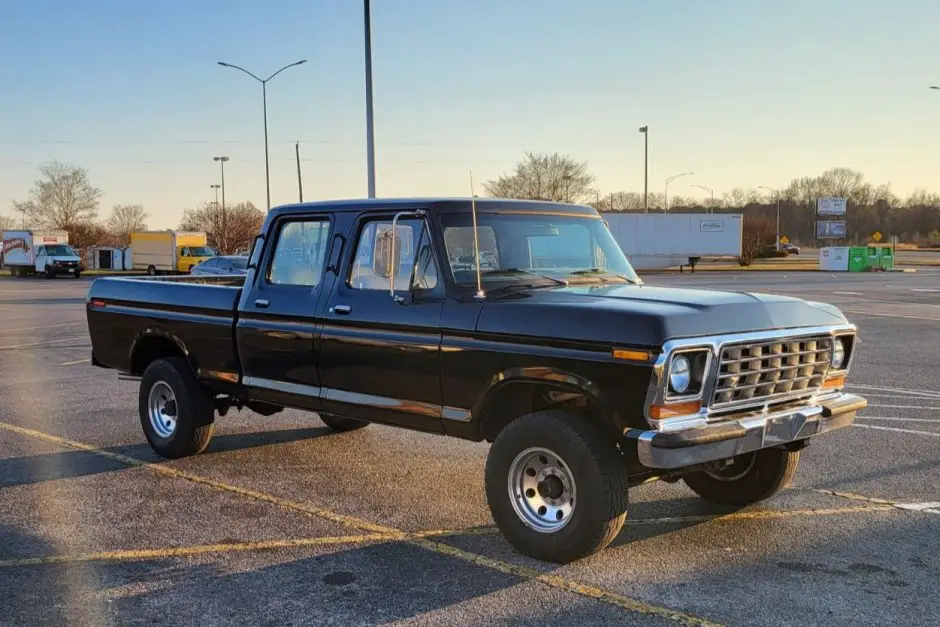
1978 Ford F250 Crew Cab: Buyer’s Guide, Prices & Specs
The 1978 Ford F250 Crew Cab is a high-demand ‘Dentside’ classic with market values typically ranging from $15,000 for projects to over $70,000 for restored 4×4 models. To avoid purchasing a ‘cab swap,’ buyers must verify the VIN prefix (F26 for 4WD) to ensure the truck is a factory-original crew cab.
🎯 Key Takeaways
- Verify the VIN prefix ‘F26’ to confirm an original factory 4WD Crew Cab chassis.
- Market prices for 4×4 configurations are significantly higher than 2WD versions.
- Inspect drip rails and rear cab mounts specifically for hidden structural rust.
- The 460 V8 is the most sought-after engine swap, though 351M/400 were common.
- Check Bring a Trailer and Hemmings for high-quality, investment-grade restorations.
If you are looking to buy a 1978 Ford F250 Crew Cab today, expect to pay between $15,000 for a rough project and over $85,000 for a pristine, 4WD restoration. These trucks, often considered the holy grail of the “Dentside” era, are increasingly rare because Ford produced far fewer crew cabs than standard or super cabs. Finding one usually requires scouring specialty auction sites like Bring a Trailer, browsing Hemmings, or joining dedicated “Crew Cab Dentside” Facebook groups where deals often happen before they ever hit the open market.

Understanding current values is critical because the market for these 6th-generation Fords has exploded in the last five years. You need to distinguish between a genuine factory crew cab and a converted “Frankenstein” truck to protect your investment. A real 1978 F250 Crew Cab holds its value remarkably well, frequently outperforming modern heavy-duty trucks in terms of long-term appreciation. Knowing where to look and what to pay ensures you don’t overspend on a truck that may have hidden structural issues or a mismatched VIN.
Current Market Value and Pricing Trends for the 1978 Crew Cab
The market for the 1978 Ford F250 Crew Cab is currently divided into three distinct price tiers. Because these trucks were originally built as industrial workhorses, many were driven into the ground on farms or construction sites. This makes high-quality survivors extremely valuable. Today, the “Dentside” body style is at its peak popularity, and the crew cab configuration is the most sought-after version for collectors who want to haul their families to car shows.
Pricing Tiers: From Field Finds to Showroom Quality
Your budget will dictate the condition of the truck you can realistically acquire. Here is a breakdown of what you should expect to pay based on current 2024-2025 market data:
- The Project Truck ($8,000 – $18,000): These are usually 2WD models or 4WD trucks with significant rust in the floor pans, cab corners, and roof lines. They may or may not be running. Expect to spend another $20,000+ to make them reliable and presentable.
- The Reliable Driver ($25,000 – $45,000): This is the sweet spot for most buyers. These trucks usually feature a functional 400 or 460 V8 engine, decent paint, and minimal structural rust. They are perfect for weekend cruising but might have minor interior wear or non-original parts.
- The Professionally Restored or “Restomod” ($60,000 – $100,000+): At this level, you are buying a truck with a high-end paint job, upgraded upholstery, and often a modern engine swap (like a Cummins diesel or a Coyote V8). These trucks frequently appear at Barrett-Jackson or Bring a Trailer.
Factors That Drive Up the Price
Not all 1978 F250s are created equal. If you find a truck with the following features, expect to pay a premium of 20% to 50% over the base value:
- Factory 4WD: Original 4×4 crew cabs are significantly rarer and more valuable than 2WD versions.
- The “Short Bed” Configuration: While most crew cabs were long beds, many enthusiasts prefer the proportions of a short bed. If it was converted correctly, the price stays high.
- Original 460 V8: While the 400 was common, a factory-equipped 460 engine remains a major selling point for those looking for maximum towing power.
The Ultimate 1978 Ford F250 Crew Cab Walkthrough
The 1978 Ford F250 Crew Cab, often referred to as part of the “Dentside” generation, is one of the most sought-after vintage workhorses in the automotive world. Whether you have just acquired a “barn find” or are looking to maintain your daily driver, this guide provides a comprehensive roadmap for restoring and maintaining this classic 3/4-ton pickup. Following these steps ensures your truck remains structurally sound, mechanically reliable, and aesthetically true to its 1970s heritage, preserving both its utility and its market value.
Step 1: Structural Integrity and Frame Inspection
What you need: A high-lumen flashlight, a wire brush, a small hammer, and jack stands.
Instructions: Begin by placing the truck on a level surface. The 1978 F250 Crew Cab has a long wheelbase, making frame rigidity crucial. Inspect the “C-channel” frame from the front bumper to the rear. Pay specific attention to the areas where the steering box mounts to the frame, as these are prone to stress cracks. Use your hammer to tap along the frame rails; a sharp “ping” indicates solid steel, while a dull “thud” suggests internal rot. Inspect the cab mounts—specifically the rear mounts of the front cab section and the front mounts of the rear crew section. These rubber bushings often dry rot, leading to body misalignment and “cab sag” that can make doors difficult to latch.
Pro Tip: Focus heavily on the rear fuel tank crossmembers. These areas trap mud and road salt, leading to “Swiss cheese” corrosion that can compromise the truck’s ability to tow or haul heavy loads.
Step 2: Engine Assessment and Ignition Tuning
What you need: A compression tester, timing light, basic socket set, and a vacuum gauge.
Instructions: Most 1978 F250s came with the 351M, 400, or the massive 460 V8. Start by performing a cold compression test on all eight cylinders; you want to see values within 10% of each other (typically 130–150 PSI). Next, check the Duraspark II electronic ignition system, which was standard for 1978. Inspect the control module (the “blue grommet” box) for leaking resin, which signals imminent failure. Set your base timing—usually between 6° to 10° BTDC—depending on your specific engine and local altitude. Replace the spark plugs with Autolite 45s gapped to .044 inches to ensure a clean burn and easier cold starts.
Pro Tip: The 351M/400 engines are notorious for low oil pressure when warm. If your gauge reads low at idle, consider switching to a high-quality 15W-40 diesel-grade oil to provide better shear protection for the flat-tappet camshaft.
Step 3: Cooling System Overhaul
What you need: New thermostat (180° or 195°F), heavy-duty radiator hoses, fresh 50/50 ethylene glycol coolant, and a cooling system pressure tester.
Instructions: These heavy Crew Cabs generate significant heat, especially when loaded. Drain the old coolant and flush the heater core separately to avoid clogging the radiator with cabin-side debris. Inspect the radiator for “blooming” or white deposits on the fins. Replace the thermostat—ensure you use a high-flow Robertshaw-style thermostat if you have a 335-series engine (351M/400) to ensure the bypass plate functions correctly. Check the fan clutch; if it spins freely with no resistance when the engine is hot, it is failed and will cause overheating in traffic. Pressure test the system to 13 PSI to identify leaks in the water pump weep hole or the bypass hose.
Pro Tip: If your truck has air conditioning, consider upgrading to a three-row or four-row aluminum radiator. The extra cooling capacity is essential for the extended engine bays of the Crew Cab models.
Step 4: Steering and Suspension Geometry
What you need: Grease gun with molybdenum grease, tie-rod separator, and a torque wrench.
Instructions: The 1978 F250 uses a Twin-I-Beam (2WD) or a solid Dana 44/60 (4WD) front end. Jack up the front axle and check the kingpins (or ball joints on later 78 models) by grabbing the tire at 12 and 6 o’clock and rocking it. Any visible play requires replacement. Grease all 11-13 Zerk fittings on the steering linkage. Inspect the “rag joint” (steering coupler) at the base of the steering column; if the rubber is torn, your steering will feel vague and “floaty.” If your truck suffers from “death wobble,” inspect the track bar bushings and the steering stabilizer shock, which are common failure points on these heavy-duty frames.
Pro Tip: Check the leaf spring hangers in the rear. The Crew Cab’s weight often causes the rear hangers to thin out over decades, which can lead to a dangerous spring failure under load.
Step 5: Brake System Refresh
What you need: Brake bleeder kit, DOT 3 brake fluid, new front pads, and rear drum shoes.
Instructions: The F250 utilizes heavy-duty front discs and large rear drums. Start by inspecting the rubber brake lines at the front wheels and the single drop line to the rear axle; these often swell shut internally with age. Remove the rear drums—you may need a 3-pound sledgehammer to loosen them from the hub. Check the wheel cylinders for leaks. When bleeding the system, start at the wheel furthest from the master cylinder (passenger rear) and work your way forward. Ensure the proportioning valve, located on the frame rail below the driver’s feet, hasn’t tripped, which would limit fluid flow to one half of the system.
Pro Tip: Because the Crew Cab is significantly heavier than a standard cab, never turn (resurface) the front rotors beyond their minimum thickness stamped on the hub. Thin rotors will warp almost immediately under the heat generated by this truck’s mass.
Step 6: Electrical and Interior Grounding
What you need: Digital multimeter, contact cleaner, and replacement 14-gauge primary wire.
Instructions: Ford trucks of this era are famous for “phantom” electrical issues caused by poor grounding. Check the main ground strap from the engine block to the frame and the smaller strap from the engine to the firewall. If your gauges are flickering or reading inaccurately, remove the instrument cluster and clean the copper traces on the printed circuit board with an eraser. Inspect the headlight switch connector; these often melt due to the high amperage draw of the factory sealed-beam headlights. Inside the cab, check the floor pans under the heavy rubber mat; moisture traps here easily in Crew Cabs, leading to rust that can eventually swallow the seat mounting bolts.
Pro Tip: Install a relay harness for the headlights. This pulls power directly from the battery rather than through the dashboard switch, resulting in significantly brighter lights and a cooler-running dashboard.
✅ Final Checklist
- Verify all frame-to-body mounts are tightened to 60 lb-ft and show no signs of crushing.
- Ensure the engine oil is at the “Full” mark and the coolant is holding pressure at 13 PSI.
- Test the steering for “dead spots” and confirm the rag joint is intact.
- Verify that the brake pedal is firm and does not “creep” toward the floor under constant pressure.
- Check all exterior lighting, including the roof-mounted cab lights if equipped.
Important Notes:
- Safety Warning: Always use jack stands rated for at least 3 tons when working under an F250. Never rely on a hydraulic jack alone.
- Professional Help: If you find significant cracks in the frame rails or the steering box mounting area, seek a professional welder experienced in automotive chassis repair.
- Estimated Time and Cost: A basic mechanical refresh takes 20–40 hours. Parts cost ranges from $500 for basic maintenance to $3,000+ for full suspension and brake overhauls.
Identifying Authentic Factory Crew Cabs vs. Cab Swaps
As prices climb, more “tribute” trucks are entering the market. A common practice is taking a crew cab from a 2WD truck or a later model and mounting it onto a 1978 4WD frame. While these can be great trucks, they are not worth as much as a factory-original 1978 F250 Crew Cab. You must verify the truck’s identity before handing over your cash.
The VIN Doesn’t Lie: Decoding the Door Tag
Your first step is to check the VIN plate located on the driver’s side door or the door pillar. You should also verify that this VIN matches the stamped number on the frame rail (typically found on the passenger side top-rail near the engine). For a 1978 F250, the VIN should start with a specific sequence:
- F26: This designates a 1978 F250 4WD pickup.
- F25: This designates a 1978 F250 2WD pickup.
- The Fifth Character: This is the engine code (e.g., “S” for the 400 V8 or “J” for the 460 V8).
- The Body Code: Check the “Body” section on the door tag. A factory crew cab will often have a code starting with “C” or specific trim digits that denote the six-passenger seating.
Visual Clues of a Cab Swap
If the VIN checks out but you still have suspicions, look at the physical assembly of the truck. Factory crew cabs have specific structural reinforcements that are often missed during a home-built swap. Inspect the following areas closely:
- Cab Mounts: Check if the cab mounts look like they were cut and re-welded to the frame. Factory mounts will have clean, consistent factory welds.
- Driveshaft and Brake Lines: In “Frankenstein” trucks, the brake lines and wiring harnesses often look stretched or spliced to accommodate the longer cab length.
- Transmission Tunnel: High-hump tunnels were standard on 4WD models. If the truck is 4WD but has a low-hump tunnel that has been crudely cut for a shifter, it is likely a 2WD cab swapped onto a 4WD frame.
- The “Dentside” Line: Ensure the body groove (the “dent”) aligns perfectly from the front fender through the doors to the bed. Misalignment here is a dead giveaway of a mismatched body and frame.
Mechanical Specifications: Engine Options and 4WD Systems
Under the hood of a 1978 Ford F250 Crew Cab, you will find the quintessential DNA of 1970s American muscle. This was a transitional year for Ford, moving away from some older engine designs while solidifying the reputation of others. Whether you are looking for a dedicated workhorse or a highway cruiser, the powertrain configuration dictates the truck’s personality.
The Powerplant Palette: V8 Dominance
While the 300 cubic-inch inline-six was available in many F-Series trucks, most 1978 Crew Cabs left the factory with V8 power to handle the extra weight of the extended cabin. The most common engines you will encounter in the wild today include:
- The 351 Modified (351M): The standard V8 for many F250s, offering decent torque but often hampered by period-correct emissions equipment.
- The 400 V8: Essentially a longer-stroke version of the 351M, this engine provides significantly more low-end grunt, making it a favorite for those who plan to tow or haul.
- The 460 V8: The “Big Block” king. While traditionally restricted to 2WD models in factory form, many have been swapped into 4WD Crew Cabs. It offers massive torque but requires a healthy fuel budget.
Drivetrain and Suspension: Built for Utility
The 1978 model year is famous among enthusiasts because it sits in the “Lowboy” era for 4WD models. Unlike the earlier “Highboys,” these trucks featured a married transfer case (usually the New Process 205) and a revised frame design that sat lower to the ground. This setup improved stability and made the trucks slightly more civilized on the road. For transmissions, you’ll typically find the bulletproof C6 three-speed automatic or the NP435 four-speed manual, the latter featuring a “granny gear” first ratio that can pull a house off its foundation.
Critical Inspection Points: Common Rust and Maintenance Issues
Finding a 1978 F250 Crew Cab is one thing; finding one that isn’t held together by hope and structural Bondo is another. Because these trucks were often used as industrial workhorses on farms and construction sites, they frequently suffered from neglect and exposure to the elements.
Where the Tin Worm Hides
Rust is the primary predator of the “Dentside” Ford. When inspecting a potential purchase, you must look beyond the shiny paint. Pay close attention to these specific areas where moisture tends to trap and fester:
- Drip Rails: The gutters above the doors are notorious for rusting from the inside out. If the roof is bubbling here, it is a difficult and expensive fix.
- Cab Mounts and Corners: Crew Cabs are heavy. If the rear cab mounts are rotted, the entire body can sag, causing doors to misalign.
- Bed Floors and Wheel Wells: Check for “swiss cheese” patterns under bed mats, especially where the bed meets the wheel arches.
- Door Bottoms: The long rear doors of the Crew Cab are prone to clogged drain holes, leading to rotted lower skins.
Mechanical Red Flags
Beyond the bodywork, the mechanical components require a discerning eye. Listen for “exhaust manifold tick,” a common issue on the 351M and 400 engines caused by warped manifolds or broken bolts. You should also check the steering box for excessive play. These trucks were never known for “surgical” steering precision, but more than two inches of play in the wheel usually indicates a worn steering box or tired rag joints. Lastly, inspect the cooling system; the extra weight of the Crew Cab puts more strain on the radiator, especially when climbing grades.
Conclusion
The 1978 Ford F250 Crew Cab remains one of the most iconic “Dentside” trucks ever produced. It successfully bridges the gap between a rugged utilitarian tool and a comfortable family hauler, all wrapped in that unmistakable late-70s aesthetic. While finding a clean example is becoming increasingly difficult and expensive, the rewards of owning a piece of Ford history are well worth the effort. These trucks are simple to work on, have massive aftermarket support, and possess a presence on the road that modern pickups simply cannot replicate.
If you are ready to start your journey, your next steps are to set a firm budget and begin scouring specialized forums and classic car marketplaces. Don’t be afraid to travel for a rust-free frame—it is much easier to fix an engine than it is to rebuild a cab. Good luck with your hunt, and enjoy the process of bringing home a true American legend!
❓ Frequently Asked Questions
What is the difference between a Custom and a Ranger XLT trim in 1978?
The Custom was the base work-truck trim with minimal chrome, while the Ranger XLT offered woodgrain accents, upgraded upholstery, and full exterior brightwork. High-end XLT models are currently the most desirable for collectors.
Where do 1978 Ford F250 Crew Cabs typically rust?
The most critical areas are the roof drip rails, cab mounts, floor pans, and the rear cab corners. Because Crew Cab-specific sheet metal is harder to find than regular cab parts, severe rust in the rear doors or roof can be expensive to repair.
Why are 1978 models preferred over other Dentside years?
The 1978 and 1979 models are favored for their iconic square headlight styling and refined interior options compared to earlier years. They represent the peak of the sixth-generation F-Series evolution before the 1980 redesign.
Can I swap parts from a regular cab F250 into a Crew Cab?
Most front-end parts, including the hood, fenders, and front doors, are interchangeable. However, the rear doors, roof, and interior rear bench are unique to the Crew Cab and can be difficult to source if missing or damaged.
What is the ‘F26’ VIN code and why does it matter?
The F26 code signifies a factory F250 4WD chassis; many ‘Crew Cabs’ on the market are actually 2WD frames that have been modified with 4WD axles. A true F26 Crew Cab holds significantly more value due to its rarity and factory engineering.
How does the 1978 F250 Crew Cab handle modern highway speeds?
With original 3-speed automatic or 4-speed manual transmissions, these trucks often run at high RPMs on the highway. Many owners install overdrive units or swap in ZF5 transmissions to make them more comfortable for modern long-distance driving.