
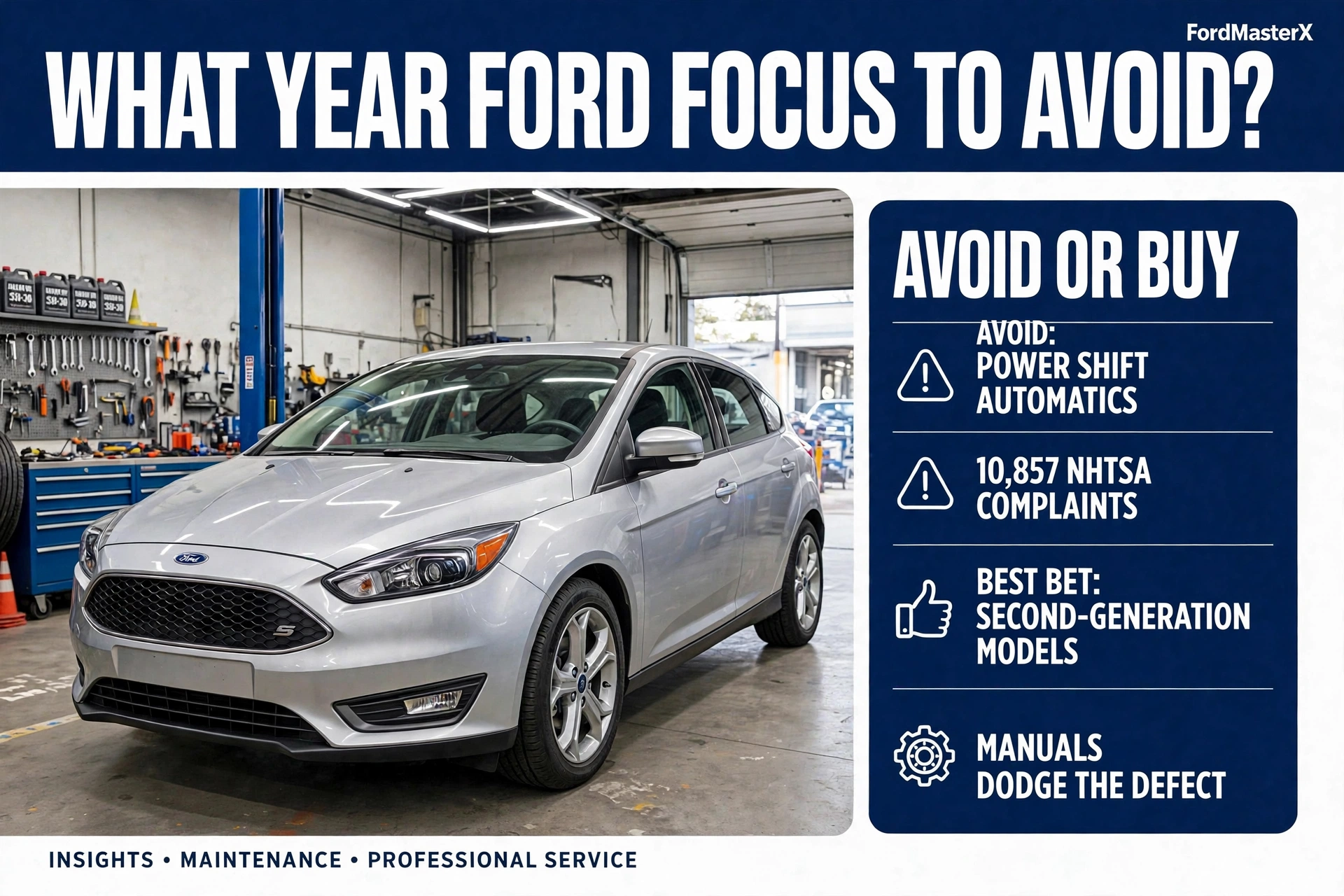
What Year Ford Focus to Avoid? 7 Worst Years to Skip in 2026

If you are asking what year Ford Focus to avoid, start with this: skip the 2012, 2013, and 2014 models with an automatic transmission. Those three years carry the worst version of Ford’s PowerShift dual-clutch gearbox, and the repair bills that follow it can cost more than the car is worth.
The year alone does not tell the whole story. A 2012 Focus with a manual transmission dodges the defect entirely, while a 2018 automatic still carries the same basic gearbox design. This guide ranks the seven worst years, explains why each one fails, and names the years you can buy with confidence.
The Short Answer: 7 Ford Focus Years to Avoid
Here is the list in order, worst first. The table below is the whole verdict in one place, and the infographic after it gives you the same answer to save or share.
| Year | Transmission | Main Problem | Verdict |
|---|---|---|---|
| 2012 | Automatic | PowerShift shudder, clutch and TCM failure, power steering failure | Worst — avoid |
| 2014 | Automatic | PowerShift failure, engine stalling, 12 recalls (tied for the most) | Avoid |
| 2013 | Automatic | PowerShift failure, loss of acceleration | Avoid |
| 2015 | Automatic | PowerShift failure, TCM failure | Avoid |
| 2016 | Automatic | PowerShift failure, stalling-engine complaints | Avoid |
| 2000 | Any | Ignition lock failure, 12 safety recalls | Avoid |
| 2007 | Any | Alternator failure, suspension and steering complaints | Avoid with care |
Ford Focus Years to Avoid — At a Glance
The transmission decides the verdict more than the year does. Every 2012–2018 automatic below is a 2.0L with the DPS6 PowerShift dual-clutch gearbox unless noted.
| Model Years | Transmission | Verdict | Why |
|---|---|---|---|
| 2012–2014 | Automatic | AVOID | Worst PowerShift years: shudder, clutch failure, TCM failure, most NHTSA complaints |
| 2015–2016 | Automatic | AVOID | Same DPS6 design; improvements were small and the warranty extensions have expired |
| 2000–2003 | Any | AVOID | Ignition lock failures, 12 safety recalls on the 2000 model, aging electronics |
| 2017–2018 | Automatic | CAUTION | Revised software and hardware, fewer complaints, but the DPS6 was never replaced on the 2.0L |
| 2007 | Any | CAUTION | Alternator failures; check it before you buy |
| 2008–2011 | Automatic or manual | BUY | Conventional automatic, durable 2.0L engine, best budget pick |
| 2012–2018 | Manual | BUY | Manual gearbox dodges the PowerShift defect entirely |
| 2013–2018 ST / 2016–2018 RS | Manual only | BUY | Performance trims never used the DPS6; budget for performance-car running costs |
Verified numbers: 10,857 NHTSA complaints for the 2012–2016 Focus, 4,813 of them about shudder, slipping, or clutch problems; 6,198 transmission complaints for the 2012–2018 Focus; class-action payments up to $2,325. Sources: NHTSA complaint data via MotorAlmanac and TheWeeklyDriver; Vargas v. Ford settlement.
Why the PowerShift Transmission Fails
The 2012-2018 Focus with a 2.0L engine and an automatic uses the DPS6 PowerShift, a six-speed dry dual-clutch gearbox built by Getrag. It works like two manual gearboxes sharing one case, with a computer shifting the clutches for you.
Dry clutches have no oil bath to cool them. In stop-and-go traffic they overheat, wear fast, and start to shudder when you pull away from a stop.
The second failure is a leak. The input shaft seals let transmission fluid seep onto the dry clutch plates. Once oil touches those plates, they slip, and the shudder gets violent.
The third failure is the control module. The TCM sits on the transmission case, where heat cycles and vibration crack its solder joints. When it fails, the car can drop into neutral, refuse to start, or lose drive without warning.
Our guide to the 2015 Focus transmission control module explains the symptoms, the trouble codes, and the cost of a replacement in detail.
Ford issued multiple technical service bulletins and several software updates for the DPS6. None of them changed the basic design. The gearbox stayed a dry dual-clutch unit until US Focus production ended in 2018.
The DPS6 is a sealed unit with no dipstick. Our guide to the 2014 Focus transmission fluid dipstick location explains how the fluid level is checked, and why you cannot check it yourself with a dipstick.
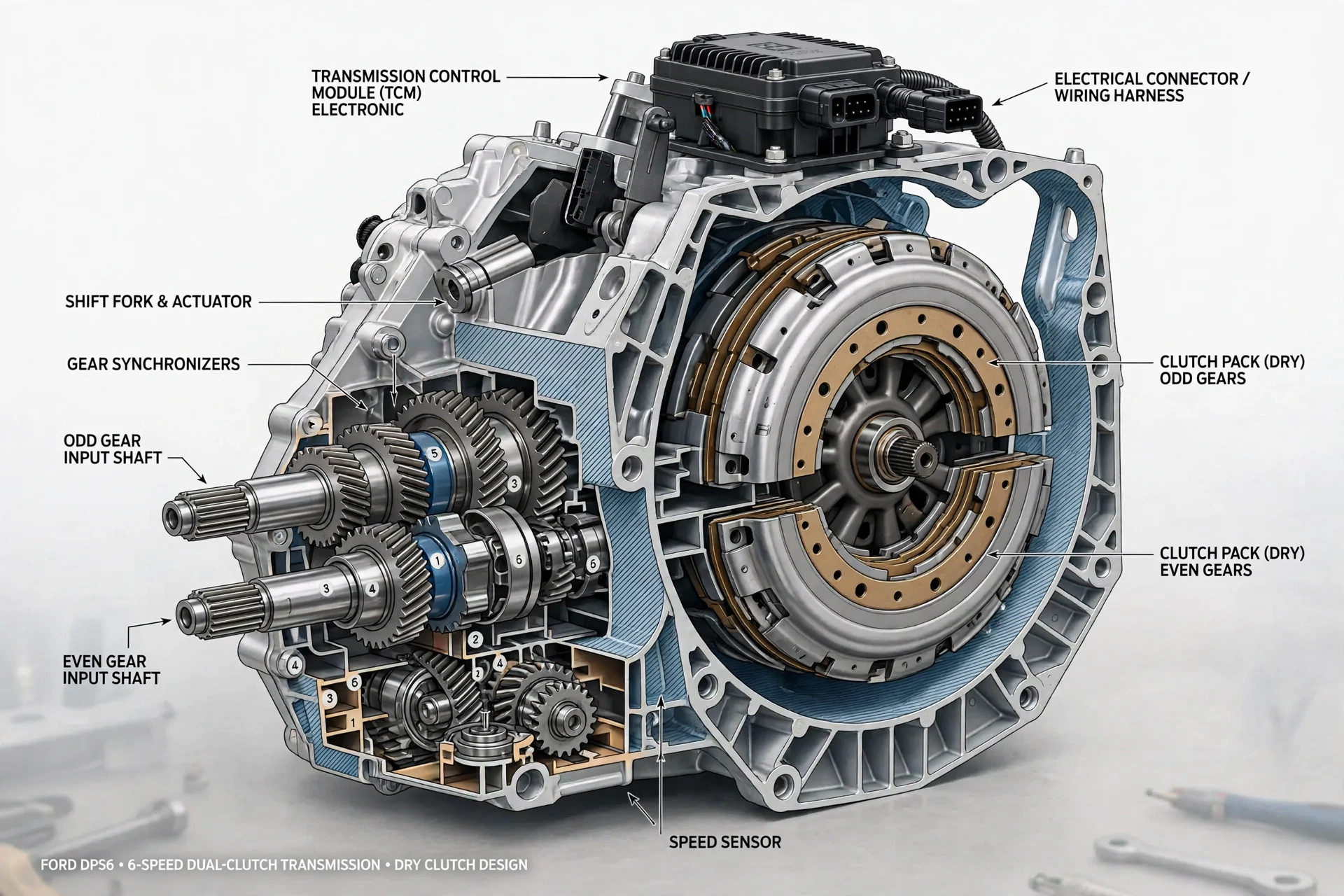
AI-generated illustration: the DPS6 dual-clutch transmission and its control module, the two parts behind most Focus failures.
The Worst Years, One by One
2012 Ford Focus — the Worst of All
The 2012 Focus is the worst year to buy, and most guides agree on it. It was the first year of the third generation, and the PowerShift arrived with aggressive software that wore the clutches fast.
247VehicleCheck’s count of NHTSA complaints shows 3,802 owner complaints for the 2012 model, the most of any Focus year in that count, along with 8 recall campaigns. CarComplaints.com gave the 2012 Focus its “Avoid Like the Plague” seal.
Power steering failure is the other 2012 problem. Owners reported the steering dying while driving, which is a safety fault on top of the transmission trouble.
A 2012 manual is a different car. The 5-speed manual uses a conventional gearbox and dodges the whole PowerShift problem.
2014 Ford Focus — High Complaints and the Clunker Seal
The 2014 Focus recorded 2,657 NHTSA complaints and 12 recall campaigns in the October 2026 count. CarComplaints.com ranks it among the 20 worst vehicles of all time, and gave it a “Beware of the Clunker” seal.
Transmission shudder is the top complaint, followed by engine stalling. Some owners reported oil and fuel leaks that added a safety worry to the drivability faults.
The 2014 model also carries the purge valve and door latch recalls that affect most 2012-2018 cars. Check the VIN for open recalls before you pay for any 2014.
2013 Ford Focus — Almost as Bad as 2012
The 2013 Focus drew 2,181 NHTSA complaints and 12 recall campaigns. Consumer Reports gave it a reliability rating of 1 out of 5, and CarComplaints.com rated it a “Clunker”.
Transmission complaints dominate the 2013 file. Owners reported the car losing acceleration and the transmission shorting out. CarProblemZoo’s count of NHTSA complaints lists 31 transmission-failure problems for the 2013 Focus.
The 2013 is slightly better than the 2012 because it has fewer power steering complaints. That is a small comfort when the transmission is the same.
2015 and 2016 Ford Focus — Better, Still Not Safe
Ford revised the PowerShift software and some hardware by 2015, and complaint counts fell. TheWeeklyDriver’s complaint-based reliability score rises from 1.6 for 2014 to 2.0 for 2015 and 1.9 for 2016, on a 10-point scale where 7.0 is average.
A small improvement is not a fix. The 2015 and 2016 automatics still use the DPS6, and owners still report shuddering, TCM failure, and clutch replacement. Stalling-engine complaints are the most reported issue for the 2016 model.
The 2015 and 2016 manuals are a different story. They are among the best late-generation cars to buy, and they cost little more than the automatics.
2000 to 2003 Ford Focus — Ignition and Recall Trouble
The first-generation Focus launched with serious quality problems. The 2000 model drew 12 safety recalls and 7 defect investigations, including one for rear wheels coming off.
The ignition lock cylinder is the fault to know. It breaks or refuses to turn, and owners of the 2002 model filed 277 complaints about it, usually between 43,000 and 89,000 miles.
These cars are now more than 20 years old. Even a clean one needs a full recall check, because age has added rust and worn suspension to the original faults.
2007 Ford Focus — the Weakest of the Good Years
The 2007 Focus drew more than 700 NHTSA complaints, mostly about the alternator dying early. It also drew suspension and steering complaints, so check those parts before you buy.
This year is still far safer than any 2012-2014 automatic. Treat it as a caution year: check the alternator, the suspension, and the tires, then buy with confidence if those pass.
The Years You Can Buy With Confidence
The safe list is short, and the transmission is the test. If the car passes the transmission test, the Focus is a cheap, fun, and economical used car.
2008 to 2011 — the Best Budget Pick
The second-generation Focus uses a durable 2.0L Duratec engine with a conventional 4-speed automatic or a 5-speed manual. Most buying guides call 2008-2011 the most reliable Focus years. The 2008 model is the weakest of the four: check it for alignment and suspension wear that chews through tires.
The 2010 model stands out in owner feedback, with a J.D. Power reliability score of 85 out of 100 reported by secondary sources. Expect worn motor mounts, door handles, and air conditioning parts on high-mileage cars, not transmission failure.
Our full verdict on the car, Is Ford Focus a Good Car, covers the whole lineup and the prices to expect.
Manual Transmission Focus, 2012 to 2018
Every manual Focus dodges the PowerShift defect, because the DPS6 never went into a manual car. A 2015-2018 manual is the best late-generation choice, with modern styling and a reliable gearbox.
Check the clutch before you buy. A worn clutch on a manual is a normal wear item, not a defect, and it costs far less than a DPS6 rebuild.
2017 and 2018 Automatics — Better, With a Condition
Ford’s final revisions cut the complaint rate for 2017 and 2018 automatics. These are among the best automatics of the third generation, and the only ones worth considering.
They still carry the DPS6 on the 2.0L, so buy one only with full service history and a clean test drive. A car with a documented clutch or TCM replacement is a safer bet than one with no transmission records at all.
Focus ST and RS — the Performance Exception
The Focus ST (2013-2018) and RS (2016-2018) never used the DPS6. Both are manual only, with turbocharged engines and sharp handling.
They are not cheap to run. Performance wear, tires, and brakes cost more, and the RS has reported head gasket issues in secondary sources. Buy one for fun, not for a cheap commute.
The 1.0L EcoBoost Automatic
The 1.0L EcoBoost automatic (2015-2018) uses a conventional 6-speed torque-converter automatic, the 6F15. It does not share the PowerShift design.
Watch the coolant degas hose and the wet-belt service on the 1.0L. Those are the faults that matter for this engine, not the transmission.
What a Bad-Year Focus Costs You
A cheap listing price is not a bargain if the transmission fails. Here is what the numbers look like for a bad-year car.
| Program | Covers | Limit | Status in 2026 |
|---|---|---|---|
| 14M01 | Clutch assembly, input shaft seals, software | 7 years / 100,000 miles | Expired by age |
| 14M02 | Transmission control module | 10 years / 150,000 miles | Expired; one-time free replacement ended June 30, 2025 |
| 19N08 | Clutch assembly (2014-2016) | 7 years / 100,000 miles | Expired by age |
| Vargas class action | Repair reimbursement, payments up to $2,325 | Settlement effective April 2020 | Closed to new claims |
Note the program numbers carefully. Some secondary pages swap 14M01 and 14M02. The assignment above follows the Vargas settlement agreement and Ford’s bulletin texts: 14M01 is the clutch, and 14M02 is the TCM.
Out of warranty, a clutch replacement typically costs $1,500 to $2,200, and owners report full transmission work at $4,000 to $8,000. A dealer TCM job runs $1,200 to $1,800 all in.
Compare that with the car’s value. Kelley Blue Book put a 2015 Focus SE sedan at about $5,400 and a Titanium sedan at about $7,225 in November 2026. One transmission repair can cost more than the car.
Check the VIN before you buy. Our guide to how to check your Ford warranty shows the steps, and the Ford factory warranty page explains what coverage a used Ford can still carry. The emissions warranty page matters too, because some TCM service rules depend on it.
Recall 26S40, from June 2026, covers about 255,000 to 258,000 model-year 2012-2018 Focus cars. It is a free PCM software update for a canister purge valve fix, not a transmission recall. Do not confuse it with TCM coverage.
7 Checks Before You Buy a Used Focus
Run these seven checks on every used Focus, and walk away if the car fails the first two. They take about 30 minutes and a short test drive.

AI-generated illustration: a pre-purchase inspection of a used Ford Focus before you pay.
- Confirm the transmission. Check the shifter and the VIN: an automatic 2.0L Focus from 2012-2018 has the DPS6. Our Ford transmission identification chart shows how to confirm it.
- Cold-start test drive. Drive from cold and feel for shudder or jerking when you pull away, harsh 1-2 shifts, and delayed engagement. Any of those is a walk-away sign on an automatic.
- Scan for codes. A scan tool will show TCM codes such as P0606 and U0101. A check engine light with transmission codes means the car needs a module, a clutch, or both.
- Check the VIN for recalls and programs. Use NHTSA’s recall lookup and Ford’s owner portal. Look for open door latch and purge valve recalls, and for any completed clutch or TCM work.
- Check the tires and size. Uneven wear points to alignment or suspension trouble. Our guide to the 2014 Focus tire size lists the factory sizes so you can spot wrong rubber.
- Inspect the 1.0L extras. On a 1.0L EcoBoost, check the coolant degas hose and ask for wet-belt service records.
- Get a pre-purchase inspection. A mechanic on a lift can spot leaks, worn mounts, and rust that a test drive hides. Budget for it; it is cheaper than one transmission repair.
Frequently Asked Questions About Ford Focus Years to Avoid
What Is the Worst Year for the Ford Focus?
The 2012 Focus, with an automatic transmission. It has the most NHTSA complaints of any Focus year, the worst PowerShift failures, and power steering faults on top. The 2012 manual is a different car and a fair buy.
Are 2017 and 2018 Ford Focus Automatics Safe?
Safer, not safe. Ford’s revisions cut complaints, but the 2.0L automatic still uses the DPS6. Buy one only with full service history and a clean cold-start test drive.
Is a Manual Ford Focus Reliable?
Yes. Manual Focus models from 2012 to 2018 dodge the PowerShift defect entirely, and the 2008-2011 manuals are among the most reliable used cars in the class. Check the clutch, then buy with confidence.
How Long Does a Ford Focus Last?
With the right drivetrain and maintenance, 200,000 to 250,000 miles is realistic, according to used-car buying guides. The DPS6 automatics are the ones that rarely get there without major transmission work.
Should I Buy a Cheap 2012-2014 Ford Focus Automatic?
No, unless it carries documented proof of a complete transmission replacement and passes an independent inspection. The low price disappears the first time the clutch or TCM fails.
Your Next Step
If you are asking what year Ford Focus to avoid, the answer is simple: skip the 2012-2016 automatics, and treat 2012-2014 as the worst of all. Buy a 2008-2011 car, a manual from any year, or a 2017-2018 car with full records instead.
Run the seven checks before you pay, scan for TCM codes, and check the VIN for open recalls. A good Focus is a cheap, fun car to own. A bad-year automatic is a repair bill with a car attached.