
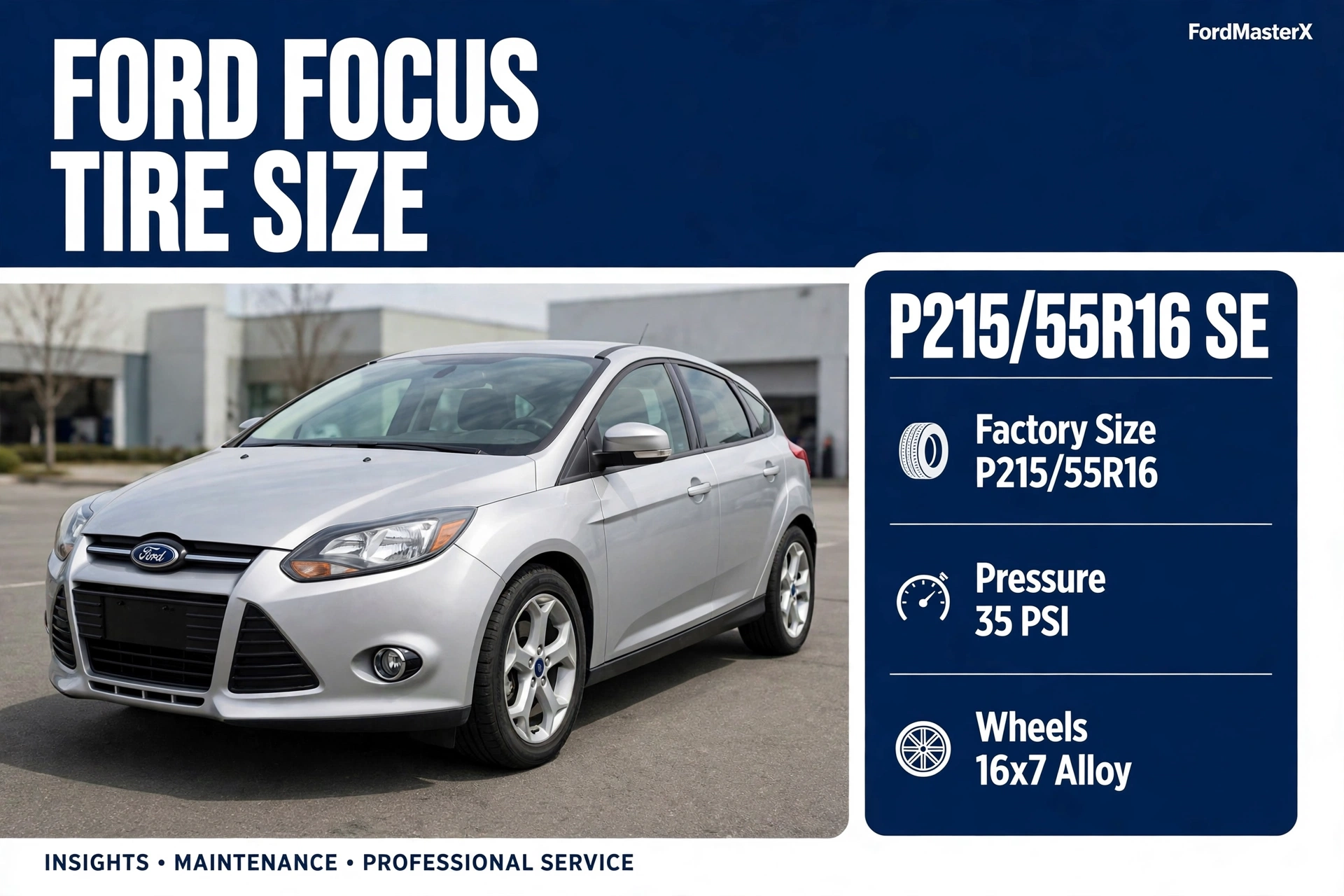
2014 Ford Focus Tire Size P215/55R16 SE Proven Guide for 2026

The factory tire size for a 2014 Ford Focus SE on 16-inch wheels is P215/55R16, inflated to 35 psi front and rear. That size fits the standard SE on 16-inch alloys, and the SE with the SFE package on 16-inch steel wheels.
If your SE has the optional Appearance package with 17-inch wheels, your factory size is 215/50R17 instead. Check the placard on your driver-side door jamb before you order tires.


If you are still deciding whether a 2014 Focus is worth owning, our guide to whether the Ford Focus is a good car covers reliability.
What Size Tires Does a 2014 Ford Focus SE Use
The standard 2014 Focus SE left the factory on P215/55R16 tires on 16×7-inch alloy wheels. Ford fitted the same size to the SE with the SFE (Super Fuel Economy) package, which used 16-inch steel wheels with aero covers and low-rolling-resistance tires.
Two option packages change the answer. The SE Appearance package swapped in 17-inch alloy wheels with 215/50R17 tires. The Titanium trim used 215/50R17 as standard, with 235/40R18 in the Handling package.
Some tire guides online list 215/50R17 as the standard SE size. That reading mixes up the optional Appearance package with the base car, which has 16-inch wheels and P215/55R16 tires.
Both sizes are genuine factory fitments, which is why pressure tables list both under the SE name. Your door-jamb placard shows the size fitted to your exact car. TirePressure.org lists the 2014 Focus pressure and size data by trim, and it confirms 35 psi for both the 215/55R16 and 215/50R17 fitments.
2014 Ford Focus Tire Sizes by Trim and Package


Every 2014 Focus trim shipped with a different wheel and tire combination. The table below lists the factory fitment and cold pressure.
| Trim | Factory Tire Size | Wheel | Cold Pressure |
|---|---|---|---|
| S | 195/65R15 | 15-inch steel | 35 psi |
| SE | P215/55R16 | 16-inch alloy | 35 psi |
| SE SFE package | P215/55R16 | 16-inch steel | 35 psi |
| SE Appearance package | 215/50R17 | 17-inch alloy | 35 psi |
| Titanium | 215/50R17 | 17-inch alloy | 35 psi |
| Titanium Handling package | 235/40R18 | 18-inch alloy | 39 psi |
| ST | P235/40R18 | 18-inch alloy | 36 psi |
| Electric | P225/50R17 | 17-inch alloy | 38 psi |
The ST is the outlier: P235/40R18 tires on 18×8-inch wheels with a 55 mm offset, per the 2014 Focus ST Supplement. The Electric model is the only trim at 38 psi.
Wheel fitment matters as much as tire size when you change wheels. The 2014 Focus uses a 5×108 mm bolt pattern with a 63.4 mm center bore and a factory offset near ET50. Our Ford bolt pattern chart lists the pattern and bore details for aftermarket wheels.


2014 Ford Focus SE Tire Size at a Glance
Factory fitment for the SE on 16-inch wheels
| Trim | Factory Tire Size | Wheel |
|---|---|---|
| S | 195/65R15 | 15 in steel |
| SE | P215/55R16 | 16 in alloy |
| SE Appearance package | 215/50R17 | 17 in alloy |
| Titanium | 215/50R17 | 17 in alloy |
| ST | P235/40R18 | 18 in alloy |
Always confirm your exact size on the driver-side door-jamb placard before ordering tires.
What Your Tire Size Code Means in Plain English
The code P215/55R16 is a full specification, not a part number. Each piece describes one dimension. Once you can read it, you can check any replacement tire in seconds.
The letter P means a P-metric passenger-car tire, built for cars and light crossovers, not for trucks or trailers. The number 215 is the section width in millimeters, across the widest part of the tire.
The number 55 is the aspect ratio: the sidewall height is 55 percent of the section width. On this tire the sidewall stands 118.25 mm tall, about 4.66 inches.


The letter R means radial construction, standard on every modern passenger tire. The number 16 is the rim diameter in inches, so this tire only fits a 16-inch wheel.
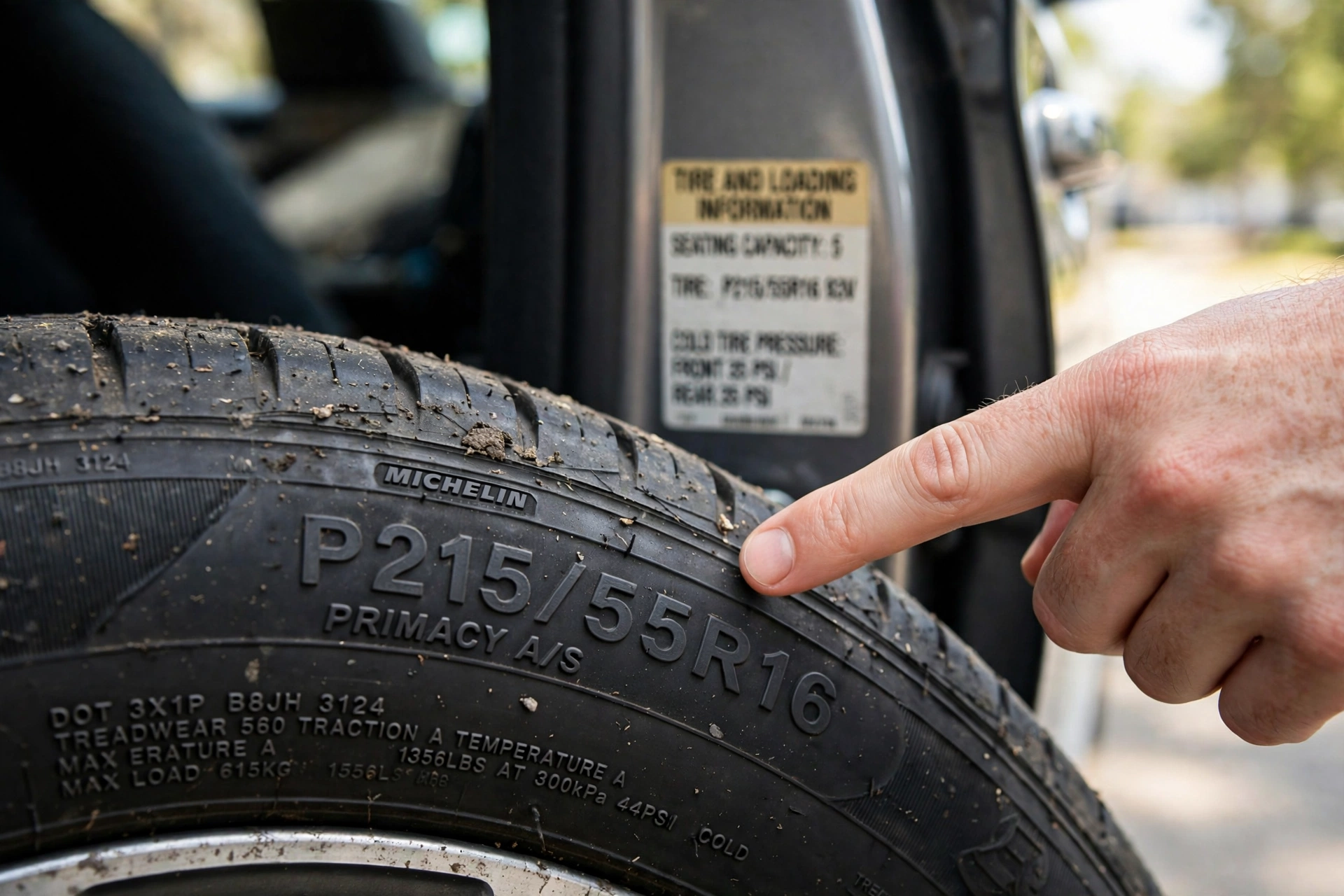
Those four numbers also fix the overall diameter. Double the sidewall height and add the rim diameter: 2 times 118.25 mm plus 16 times 25.4 mm gives 642.9 mm, or 25.3 inches. The tire rolls about 2,020 mm per revolution, or roughly 797 revolutions per mile.
That diameter matters most when you consider a different size. Your speedometer, odometer, ABS, and stability control all assume a tire close to 25.3 inches tall.
Continental lists 215/55R16 among the common Ford Focus sizes for 2012 to 2018 cars, alongside 215/50R17 and 235/40R18 for higher trims. The size code on your current tires should match the placard.
5 Approved Alternate Sizes Within 3 Percent


You do not have to buy P215/55R16 again. Any alternate size works if its overall diameter stays within about 3 percent of the factory 642.9 mm. That keeps your speedometer, ABS, and stability control calibrated.
| Alternate Size | Overall Diameter | Difference vs Stock | Verdict |
|---|---|---|---|
| 215/50R17 | 646.8 mm / 25.46 in | +0.6% | Factory Appearance size |
| 205/60R16 | 652.4 mm / 25.69 in | +1.5% | Acceptable |
| 205/55R16 | 631.9 mm / 24.88 in | -1.7% | Acceptable |
| 225/50R16 | 631.4 mm / 24.86 in | -1.8% | Check clearance |
| 195/65R15 | 634.5 mm / 24.98 in | -1.3% | Needs 15-in wheels |
Each percentage is calculated from the stock 642.9 mm diameter. The 215/50R17 is the easiest swap because Ford fitted it to the SE Appearance package from the factory.
Two popular sizes do not make the list. The 215/60R16 is 3.3 percent taller than stock and sits outside the guideline. The 235/40R18 is only 0.4 percent taller, but it needs 18-inch wheels and a higher load and speed rating.
Ford publishes tire size charts across its lineup. Our Ford F-250 tire size chart shows the same diameter-matching logic on trucks: match the rolling diameter first, then the load index and speed rating.
Tread and Brake explains the same 3 percent rule for the 2014 Focus hatchback and lists 215/55R16 as the standard size for most cars. A wider tire is not automatically better: the 225/50R16 adds dry-road grip, but it also adds rolling resistance and can rub the inner fender liner at full steering lock.
The 205/55R16 saves a little money and fuel, but it gives up ride comfort and load margin. Stay with P215/55R16 unless you have a clear reason to change.
Load Index 93 and Speed Rating H Explained
The size code is only half the story. The service description after the size, usually 93H, sets the tire’s load and speed limits. Both must meet or beat what Ford specified for your Focus.
Load index 93 means each tire can carry 1,433 lb (650 kg), which covers passengers, cargo, and the extra load of hard braking and cornering. Speed rating H means the tire is rated for sustained speeds up to 130 mph.
Your Focus will never reach that speed, but the rating also reflects how the tire handles heat at highway speeds. A lower rating can overheat on a long summer drive even at legal speeds.
Never fit a tire with a lower load index or speed rating than the placard calls for. A 91H tire looks identical from the outside, but it carries less load and leaves no safety margin.
The ST is stricter still: its 235/40R18 fitment requires a 95Y XL (extra load) rating. Check the service description on the sidewall before you pay: it sits right after the size code and reads like 93H or 93V.
A V rating (149 mph) is fine as a step up, but a T rating (118 mph) or a lower load index is not.
Correct Tire Pressure and TPMS Reset for 2014 Focus SE
Ford specifies 35 psi cold for the P215/55R16 fitment, front and rear. Cold means the car has sat for at least three hours or has been driven less than a mile. Pressure rises as tires warm up, so a highway reading looks higher than the true cold pressure.
Check pressures at least once a month and before any long trip. Temperature moves pressure by about 1 psi for every 10 degrees Fahrenheit, so a tire set in September can read 4 to 5 psi low in January.
Your Focus uses a direct TPMS, with a sensor in each wheel that measures pressure and sends the reading to the car by radio. The warning light comes on when pressure falls roughly 25 percent below the placard value, as federal standard FMVSS 138 requires.
If the light comes on, inflate all four tires to 35 psi cold and drive above 20 mph for a few minutes. The light should go out on its own. A flashing light means a sensor fault, not low pressure, and usually points to a dead sensor battery.
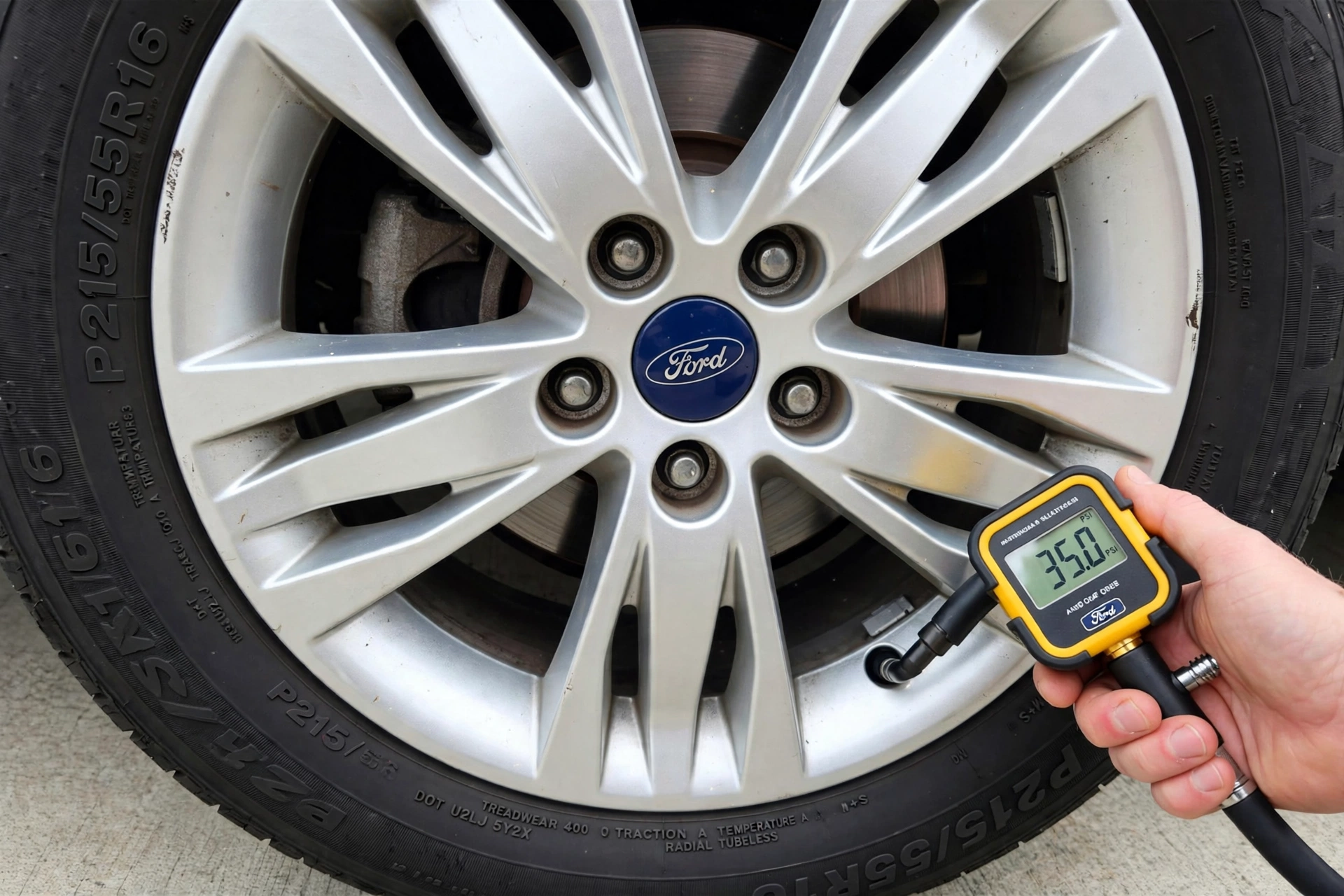
After a tire rotation or a sensor replacement, the car may need a sensor retrain, and the 2011 to 2023 Focus uses the hazard flashers for it.
Turn the ignition on with the engine off, then cycle the hazard flashers on and off three times. One horn beep confirms train mode. Then deflate the tires in order until the horn beeps at each wheel: front left, front right, rear right, rear left.
Re-inflate all four tires to 35 psi and drive above 20 mph for a few minutes. Two horn beeps means the procedure failed, so start over. TPMS Reset walks through this retrain procedure for the Focus in full, including the drive cycle that finishes it.
TPMS sensor batteries last about 5 to 10 years, or up to roughly 100,000 miles. The battery cannot be replaced on its own, so a dead sensor means a new sensor and valve stem. On a 2014 car, a flashing light after a tire change usually means a sensor.
What Happens When You Fit the Wrong Tire Size
A tire that is too tall or too short changes more than the look of the car. The speedometer reads from wheel speed, so a taller tire makes it read slow: with a 215/60R16, 3.3 percent taller than stock, 60 mph indicated is really about 62 mph.
With a 205/55R16, 1.7 percent shorter, an indicated 60 mph is really about 59 mph. The odometer makes the same error, so fuel economy math and service intervals skew with it.
ABS and stability control assume the factory tire diameter. A large change alters the wheel speed the computer expects, and traction control can intervene early or late. A difference under 3 percent stays inside Ford’s designed tolerance.
Ride and handling change too: a taller sidewall softens the ride but dulls steering response.
A shorter sidewall sharpens steering but transmits more road shock. Wider tires add rolling resistance and cost fuel.
If your Focus has the dual-clutch automatic, wrong tire sizes add another variable to a transmission that already needs correct calibration. Our 2015 Ford Focus transmission control module guide covers that module.
Winter Tires and All Season Choices for Your SE
Most SE owners run one set of all-season tires in P215/55R16 all year. That is the simplest choice, and modern all-season tires handle rain and light snow well. They are a compromise, though, and it shows in winter.
A dedicated winter tire in the same P215/55R16 size is the best cold-weather setup. Winter rubber stays flexible below about 45 degrees Fahrenheit, while all-season rubber stiffens and loses grip. The braking difference on snow and ice matters in an emergency.
The simplest winter setup is a second set of 16-inch steel wheels with winter tires mounted. The 215/55R16 size is also the ST snow-chain-approved size in the Focus ST Supplement. Swap the whole wheel set in November and back in March, and retrain the TPMS sensors after each swap.
Budget roughly 80 to 150 dollars per tire for a reliable all-season model in this size, based on 2024 fitment-guide pricing. Winter tires cost about the same, plus wheels for a second set.
Check the tread depth and the DOT date code on any tire you buy. Tires older than six years deserve a close inspection, and tire makers generally advise replacement at ten years from manufacture regardless of tread.
How to Check Your Own Focus Before You Buy
Five minutes of checking before you order tires can save a return trip to the shop. Start with the placard on the driver-side door jamb, which lists the factory size and cold pressure for your exact car.
Photograph the placard, then read the sidewall of the tires already on the car. The size code is molded into the rubber near the rim, so compare it with the placard: if the two disagree, a previous owner changed the size.
Check the spare tire too. Most 2014 Focus trims shipped with a mini-spare, not a full-size tire. The ST is the exception, with a full-size 215/55R16 spare on a steel wheel.
A missing or flat spare is easy to miss until you need it. Measure tread depth with a gauge or a coin: a tire at 2/32 inch is legally worn out in most states, and wet grip falls off well before that point.
Uneven wear points to alignment or inflation problems rather than normal aging.
Our guide to the 2014 Ford Focus transmission fluid dipstick location shows where to check the fluid. After any service, use our 2014 Ford Focus oil reset steps to clear the oil life monitor.
2014 Ford Focus Tire Size Questions Answered
What tire size does a 2014 Ford Focus SE take?


P215/55R16 on 16-inch wheels, at 35 psi front and rear. The SE with the optional Appearance package takes 215/50R17 on 17-inch wheels instead. Check your door-jamb placard.
Can I use 215/50R17 instead of 215/55R16?
Yes, if you also fit 17-inch wheels. The 215/50R17 is only 0.6 percent taller than stock, so your speedometer stays accurate. It is the factory Appearance package size.
What tire pressure should a 2014 Ford Focus SE use?


Ford specifies 35 psi cold, front and rear. Measure pressure when the tires are cold and recheck monthly. Temperature changes pressure by about 1 psi per 10 degrees Fahrenheit.
How do I reset the TPMS light on a 2014 Focus?
Inflate all four tires to 35 psi cold, then drive above 20 mph for a few minutes. The light should go out on its own. After a rotation or sensor replacement, use the hazard-flasher retrain.
What is the bolt pattern on a 2014 Ford Focus?


The bolt pattern is 5×108 mm with a 63.4 mm center bore and a factory offset near ET50. Any replacement wheel must match the pattern and bore. Wheels outside ET48 to ET52 can cause rubbing or handling problems.
Can I put 215/60R16 tires on my Focus?
We do not recommend it. The 215/60R16 is 3.3 percent taller than stock, outside the 3 percent guideline. Your speedometer would read about 2 mph slow at 60 mph, and the taller tire risks rubbing.
The Right Tire Size Keeps Your Focus Safe
The 2014 Ford Focus SE takes P215/55R16 tires on its standard 16-inch wheels, at 35 psi front and rear. That answers most of the question, but details matter when you shop.
Confirm your trim and packages on the door-jamb placard before you order. Match the 93H load and speed rating, and keep any alternate size within 3 percent of the factory diameter. Then your speedometer, TPMS, and stability control keep working the way Ford calibrated them.
When the tires are right, the car rides, steers, and stops the way it was designed to. Spend five minutes checking the placard, and the next set of tires you buy will fit the first time.