
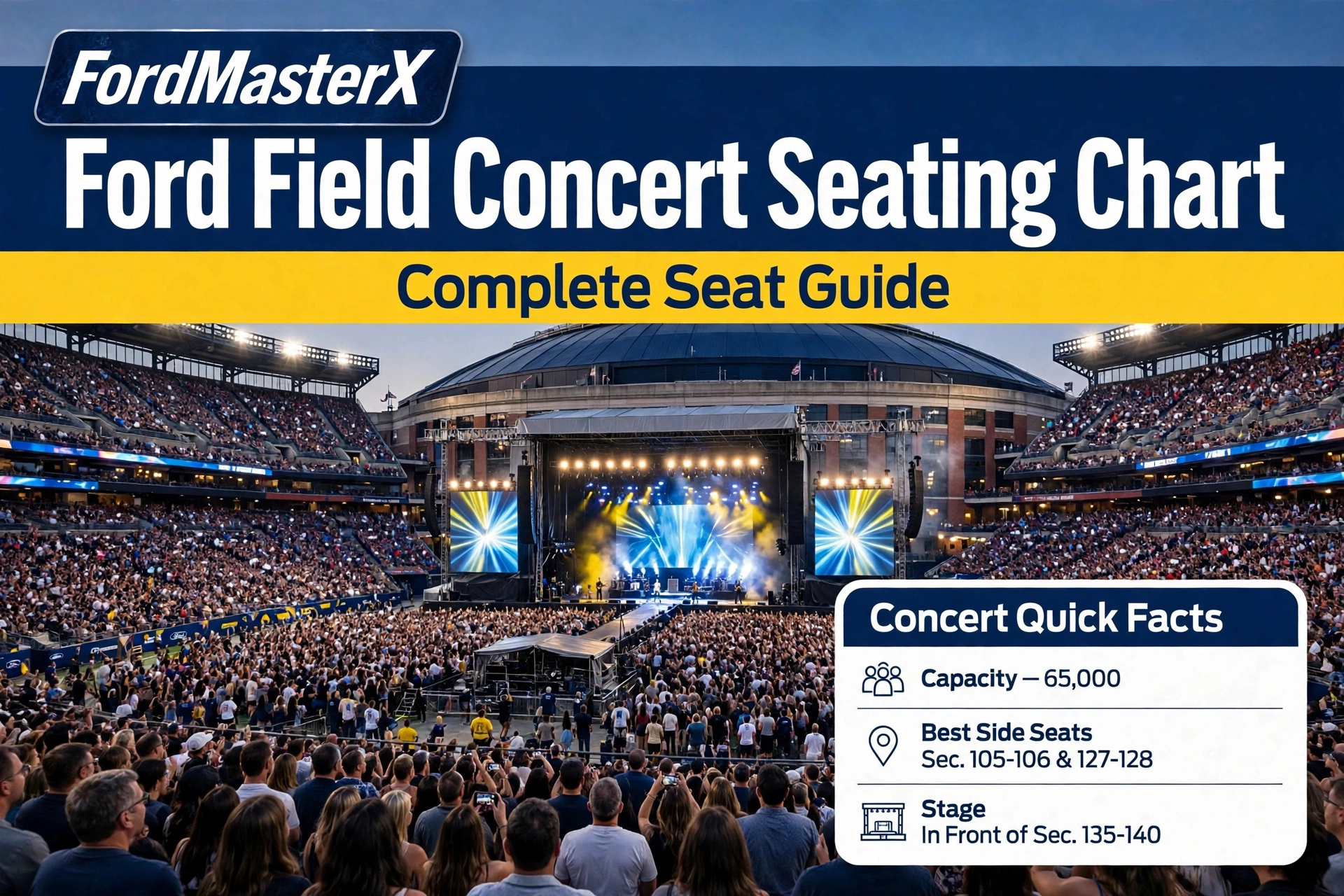
Ford Field Concert Seating Chart 2026: Ultimate Seat Guide

For most concerts, Ford Field uses an end-stage layout, with the stage typically set in front of sections 135–140 and reserved floor seating spread across the field in front of it. That single fact flips the football seating logic upside down, so the best concert seats are the floor sections nearest the stage, the lower-bowl side sections with a clean angle on it, and the upper sections that face it head-on.
The sections to treat with caution are the ones beside or behind the stage, where the view can be limited or blocked by the production itself. Always match your ticket to the seating chart for your specific show, because each tour brings its own stage design, catwalk, and speaker layout.
How to Read the Ford Field Concert Seating Chart
Ford Field is an indoor stadium at 2000 Brush Street in downtown Detroit, Michigan, and it is the home of the Detroit Lions. It opened on August 24, 2002, and a $100 million renovation in 2017 added new video boards and an updated sound system.
The permanent bowl has three main levels, and concert floor seating is added on the field itself. The 100 Level wraps all the way around the field, the 200 Level sits above it with club and mezzanine seating, and the 300 Level forms the upper bowl on three sides of the building.
There are no 300 Level seats along the south sideline, because that side of the stadium is taken up by suite levels inside the former Hudson’s warehouse building. Most grandstand seats instead sit along the northern sideline and behind both end lines, which is why the Ford Field bowl looks different from a typical NFL stadium.
When you look at a concert chart, find the stage first and work outward from it. Every section number only makes sense once you know which end of the field the stage occupies and whether the floor is reserved seating, general admission, or a mix of both.
Ford Field Concert Configurations Compared
Most large tours at Ford Field use the end-stage configuration, but the chart can also place the stage in the center of the field for in-the-round style productions. The table below compares the layouts you are most likely to see, using only the seating patterns that venue and seating sources describe for this stadium.
| Configuration | Stage position | Floor seating | Best areas | Areas to check carefully |
|---|---|---|---|---|
| End-stage (most common) | At one end of the field, typically in front of sections 135–140 | Reserved field sections, labeled Field A–K on many concert charts, or general admission on some tours | Front floor sections; lower-bowl side sections 105–106 and 127–128; upper sections 315–321 facing the stage head-on | Sections beside or behind the stage, including 335 and 339 in the upper level, which are flagged as behind or side stage for most shows |
| Center-stage | In the middle of the field | Floor seating or standing areas around the stage, varying by production | Lower-bowl sideline sections on both sides, which sit closest to a central stage | End sections at either end of the field, which are farthest from a central stage |
| Football layout (for comparison) | No stage; full field in play | None; the field is the playing surface | Midfield sections 106 and 127 in the lower bowl | Not applicable — use this only to understand the permanent bowl numbering |
The end-stage row is the one that matters for almost every ticket search. If your event page shows a different stage position, the same principle still applies: seats facing the front of the stage head-on are safer than seats level with it or behind it.
Productions also differ in the details that never appear in a generic chart. A thrust stage or catwalk can bring the performer halfway down the floor, speaker stacks can block a side section, and a video wall can change which seats see the full show.
Floor Seating: Field Sections and General Admission
Floor seats are the closest seats in the building for an end-stage show, and they are temporary seats or standing space placed on the field. On many Ford Field concert charts those floor blocks are labeled Field A through Field K, running from the front of the stage toward the opposite end of the field.
Some tours sell the floor as reserved sections with assigned rows and seats, while others sell part or all of it as general admission. End-stage shows fill the floor with general admission or reserved chairs, so check your ticket wording carefully before you assume you have an assigned seat.
The front floor sections give you the closest view of the performer, but the floor is flat, so sightlines further back depend on the people standing or sitting in front of you. If you are shorter, a slightly elevated bowl seat can honestly give you a better view than a floor seat twenty rows back.
General admission floor rewards an early arrival, because your position is set by where you stand when you enter. Reserved floor seating removes that scramble, and the letter and row on your ticket tell you exactly how far from the stage you will be.
The 100 Level: Closest Bowl Seats to the Stage
The 100 Level is the largest level at Ford Field, with 41 sections wrapping the entire field. Each lower-bowl section has more than 40 rows, and a typical section such as 124 is labeled rows 1–41 plus an ADA row at the top.
For football, sections 104–108 sit behind the Lions bench and sections 125–129 sit behind the visiting bench, with sections 106 and 127 directly at midfield. Those football landmarks help you orient yourself on a concert chart, even though the stage changes which of them matter.
For concerts, the best side views in the lower bowl are found in sections 105–106 and 127–128. These sections sit to the side of a typical end stage, close enough to feel near the performance while still angled toward the front of the stage.
Lower rows put you closest to the field, but the lower bowl is fairly flat, so a higher row gives you useful elevation. Seating guides for the 100 Level recommend row 20 or higher for a clearer look over the people on the sideline, and the same logic helps at a concert when the floor crowd is standing.
Standard seats on this level are stadium chairs with a cupholder, without the lounge access of the club areas. The one notable upgrade is the Soaring Eagle Dream Seats at the top of sections 100 and 141, which trade proximity for recliner-style comfort and personal screens.
The 200 Level: Club and Mezzanine Seating
The 200 Level sits between the lower and upper bowls and mixes true club seating with standard mezzanine sections. Club seats are concentrated on the sidelines, in sections 200–214 on the south side and in the 226–235 range on the north side.
Club sections are smaller than lower-bowl sections, which makes them feel calmer and easier to move around in. Published row counts vary by side of the stadium: sections 200–214 are listed with 16 rows, while sections 226–235 are listed with just 8 rows.
For a concert, a sideline club seat gives you an elevated, TV-style angle toward an end stage without the distance of the upper bowl. That combination of height, a padded seat, and lounge access is why many concertgoers rate the club level as the most comfortable way to watch a show here.
Not every 200 Level section is a club section, so read the ticket description rather than assuming lounge access from the number alone. Corner and end sections on this level are standard seating, and their concert value depends entirely on how they line up with the stage.
The 300 Level: Upper Bowl Value and Head-On Views
The 300 Level is the highest tier at Ford Field, and it wraps around three sides of the stadium. Upper sections are much smaller than lower-bowl sections, with rows commonly labeled 1–21 in sections such as 317, 318, and 321.
For concerts, sections 315–321 sit opposite the stage and provide head-on views of the performance. You will be far from the stage in this part of the building, but you see the full production — lighting, video, and staging — exactly as the show designer framed it.
Sections 332 and 333 are seated closest to the stage in the upper level, and sections 330–331 offer ideal angles to it. The first five rows of sections 330, 331, and 332 also include club seating for Lions games, which tells you how well placed that stretch of the upper bowl is.
The trade-off at the top of the building is distance, and in a stadium of this size the stage can look small from the far end. Upper-bowl tickets are usually the lowest-priced way in, so they suit fans who want the full-show view and the atmosphere more than facial detail.
Best Seats for a Concert at Ford Field
The best seat depends on what you value most, so use the stage position first and your priorities second. The shortlist below follows the seating patterns described for Ford Field concerts, not a generic stadium formula.
For the closest experience, choose the front floor sections in front of the stage. You give up elevation, but no bowl seat can match being that near the performer.
For the best balance of view and comfort, choose lower-bowl sections 105–106 or 127–128, or a sideline club seat in the 200 Level. These seats are angled toward the stage, elevated enough to see over the floor, and close enough to feel part of the show.
For the best full-production view on a budget, choose upper sections 315–321, which face an end stage head-on. You trade proximity for a clean, centered picture of the whole stage design.
For a premium night out, suites are available for concerts and other special events as well as for Lions games. Ticketmaster’s venue guide notes that suite packages can include premium food and beverages, VIP parking and entrance, and a dedicated service attendant.
Ford Field · Detroit, Michigan
Ford Field Concert Seating at a Glance
Most concerts use an end-stage layout. Read the chart from the stage outward: floor seats are closest, side sections balance view and comfort, and the upper sections opposite the stage face the show head-on.
STAGE Typically set in front of sections 135–140
Floor — Field A–K
Temporary field sections in front of the stage on many concert charts. Sold as reserved seats or general admission, depending on the tour.
Best Side Views — 100 Level
Sections 105–106 and 127–128 give the strongest side views in the lower bowl. The level has 41 sections wrapping the field, each with more than 40 rows.
Head-On Views — 300 Level
Sections 315–321 sit opposite the stage for a head-on view. Sections 332–333 are closest to the stage, and 330–331 offer ideal angles.
Check Before You Buy
Upper sections 335 and 339 are behind or beside the stage for most concerts and can have a limited view. Accessible seating is listed as row ADA at the top of sections on all levels, with companion seats alongside.
Concert capacity is not a fixed figure: the stage removes some bowl seats while floor seating adds capacity back, so the total changes from show to show. Always confirm your section on the seating chart for your specific event.
Obstructed and Limited-View Seats to Check
The biggest concert risk at Ford Field is not a permanent stadium flaw, because this bowl has few fixed obstructions. The risk comes from the production: large stage structures, lighting rigs, and speaker stacks can partially block seats beside or behind the stage.
Sections 335 and 339 in the upper level are specifically flagged as behind or side stage for most concerts, with a restricted or limited view of the performance. If a ticket in that area is not labeled with its view restriction, ask the seller directly before you buy it.
Behind-stage seats at concerts are usually closed or sold as limited view, and that labeling matters more than the price. A cheap behind-stage ticket is only a bargain if you are happy hearing the show and watching the screens rather than the stage itself.
Camera platforms, temporary sound desks, and other field installations can also affect a small number of nearby floor rows on some productions. This is one more reason the event-specific chart, with its obstructed-view labels, always beats a generic seating map.
Accessible Seating at Ford Field
Accessible seating is available on all levels at Ford Field, at the top of sections on the lower and upper concourses. On a ticket, that wheelchair and companion area is listed as row “ADA,” and the section entrance is typically located at that same row.
Companion seats sit next to the accessible spaces, so a guest and their companion can sit together. The accessible areas use a mix of folding chairs and permanent stadium chairs, and the folding chairs can be moved to make room for wheelchairs and other medical devices.
Guests who arrive without accessible tickets can ask about an exchange on the event day, subject to availability. Published guidance points guests to the advance ticket windows at Gate A, by the escalators near section 100, or Gate G, near the escalators by section 112.
If you need accessible seating, buying it in advance is still the safer plan, because event-day exchanges depend on what remains unsold. Filtering a ticket listing for wheelchair-accessible seats before you check out is the simplest way to see the available ADA rows for your show.
Ford Field Capacity: Football vs. Concerts
Ford Field’s regular seating capacity is approximately 65,000, and it is expandable up to 70,000 for football. Basketball configurations have gone much higher, and the building’s record attendance is 80,103 for WrestleMania 23 in 2007.
There is no single fixed concert capacity for Ford Field, because a stage removes some bowl sections while floor seating adds capacity back. An end-stage show, a center-stage show, and a general admission floor will each produce a different total, so treat any exact concert figure you see on a resale page with caution.
What you can rely on is the scale: this is a roughly 65,000-seat football stadium that hosts some of the largest tours in North America. Artists who have played here include Taylor Swift, Beyoncé, Ed Sheeran, U2, and Metallica.
How to Check the Chart for Your Exact Show
Start on the official Ford Field website and open the event page for your show, because that page links to the chart drawn for that production. Then compare it with the seller’s interactive map before you pay, and confirm that the section, row, and seat numbers match on both.
Ticketmaster’s Ford Field venue guide is a useful second source for the basics, including the address, the August 24, 2002 opening, and the 65,000 listed capacity. For section-by-section detail, the RateYourSeats guide to section 124 shows how row labels, ADA rows, and concert notes are presented for an individual section.
Background on the building itself, including its capacity figures and its unusual warehouse design, is summarized on the Ford Field Wikipedia page. Use those sources to verify the facts, then let the event-specific chart make the final decision on any individual seat.
Frequently Asked Questions
What is the best seat for a concert at Ford Field?
The front floor sections are closest to an end stage, while lower-bowl sections 105–106 and 127–128 give the best side views with real elevation. If you prefer a head-on view of the full production, upper sections 315–321 face the stage directly.
Where is the stage usually set up for Ford Field concerts?
For most concerts the stage is set at one end of the field, typically in front of sections 135–140. Some productions use a center stage instead, so always confirm the stage position on the chart for your specific event.
How many people does Ford Field hold for a concert?
There is no single published concert capacity, because the stage configuration and floor layout change the total from show to show. The stadium holds approximately 65,000 for football and can expand to 70,000, which gives you the right sense of scale.
Are floor seats at Ford Field reserved or general admission?
It depends on the tour, because end-stage shows fill the floor with general admission or reserved chairs. Your ticket will say which one you have, and a reserved ticket lists a field section, row, and seat.
Which Ford Field sections have obstructed views for concerts?
Sections beside or behind the stage carry the main risk, and upper sections 335 and 339 are flagged as behind or side stage for most shows. Speaker stacks and lighting rigs can also affect nearby seats, so check the obstructed-view labels on the event chart.
Does Ford Field have accessible seating for concerts?
Yes, accessible and companion seating is available on all levels, at the top of sections, and it is listed as row ADA on tickets. Event-day exchanges may be available at the Gate A or Gate G ticket windows, subject to availability.
Bottom Line
Read the Ford Field concert seating chart from the stage outward, and most decisions become simple. Floor seats win on proximity, lower-bowl side sections 105–106 and 127–128 win on balance, club seats win on comfort, and upper sections 315–321 win on a head-on view for the money.
Just as important, respect the warnings built into the chart for your show. Seats beside or behind the stage can turn a great night into a limited-view one, and the event-specific map is the only version that tells you the truth about your exact seat.