
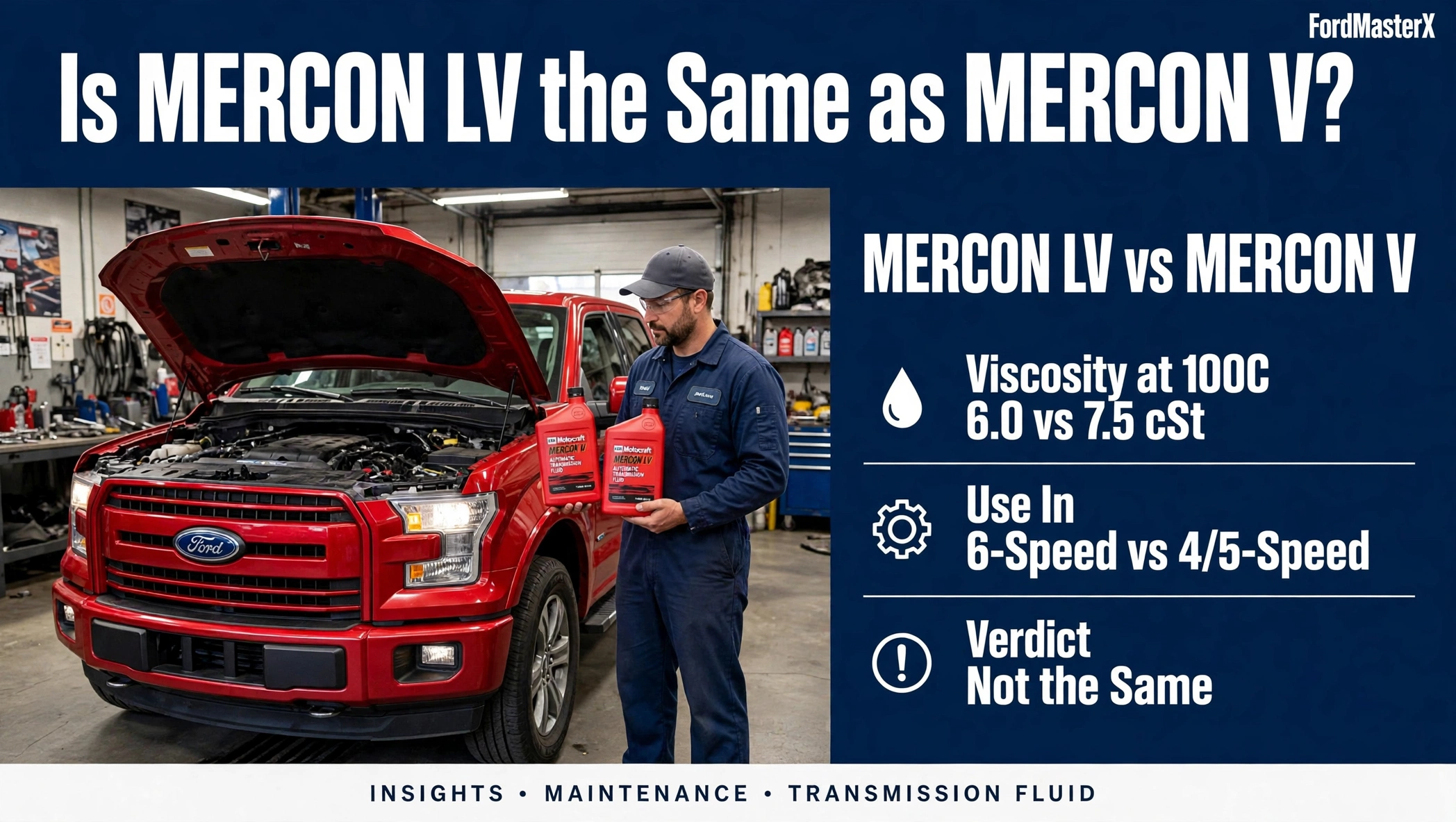
Is MERCON LV the Same as MERCON V? Proven Facts for 2026

No, MERCON LV is not the same as MERCON V. They are two separate Ford automatic transmission fluid specifications with different viscosity, different friction chemistry, and different application lists.
MERCON LV is the thinner fluid Ford built for newer six speed automatics. MERCON V is the thicker fluid Ford specified for older four and five speed units. Using the wrong one can change shift feel, set fault codes, and shorten transmission life.


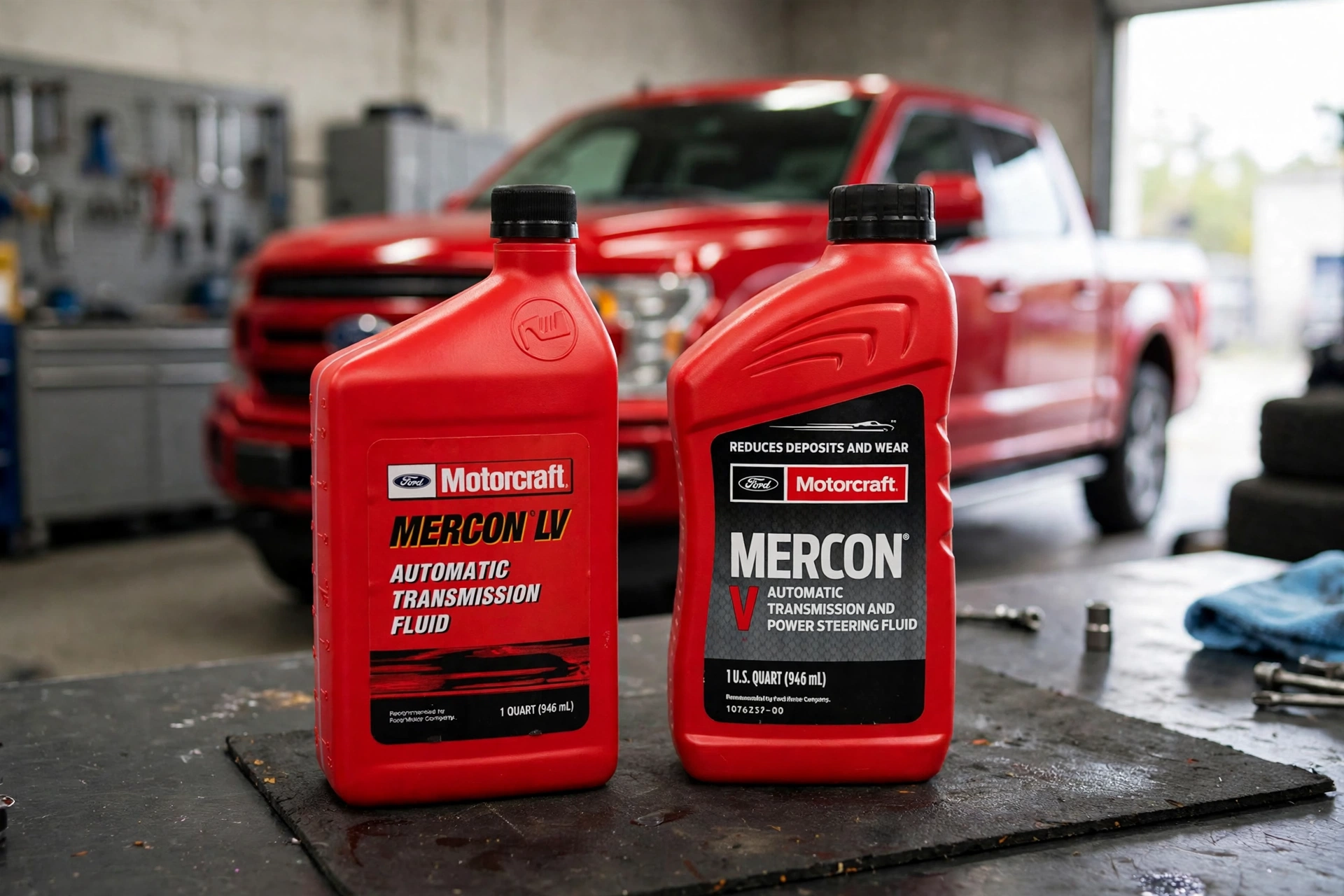
The names look alike, and both bottles sit side by side at the parts store. This guide gives you the verified specs, the application lists, the back service cases Ford actually allows, and a three step check for your truck.
8 Verified Differences Between MERCON LV and MERCON V
The table below puts the two specifications side by side. Specifications and part numbers come from Ford’s Motorcraft fluid chart.
Viscosity figures come from the licensed Ravenol data sheets for MERCON LV and MERCON V. Values are approximate where formulations vary by brand.
| Difference | MERCON LV | MERCON V |
|---|---|---|
| Ford specification | WSS-M2C938-A | WSS-M2C202-B |
| Motorcraft part number | XT-10-QLVC | XT-5-QMC |
| Viscosity at 100°C | About 6.0 cSt | About 7.5 cSt |
| Viscosity at 40°C | About 29.2 cSt | About 34.8 cSt |
| Viscosity index | About 150 | About 178 |
| Fluid type | Low viscosity synthetic ATF | Standard-viscosity ATF |
| Main applications | 6 speed automatics, TorqShift | 4 and 5 speed automatics |
| Interchangeable | No, not a substitute for V | No, never where LV is specified |
The viscosity gap is the heart of the matter. At operating temperature, MERCON V is about 25 percent thicker than MERCON LV. That difference changes how fast fluid moves through valve body passages and how clutch packs engage.
A transmission calibrated for thin fluid expects quick, low drag flow. Fill it with thicker fluid and shifts turn harsh or late.
A transmission built for thicker fluid expects a heavier cushion between clutch plates. Fill it with thin fluid and clutches can slip or shudder.
Ford’s own Motorcraft fluid chart states the rule in plain language. The fluids listed are unique fluids and must be used in applications recommending that particular fluid. Use of any other fluid may cause reduced functionality or transmission damage.
That warning is not marketing. It reflects real engineering.
Each specification controls viscosity, friction, oxidation stability, and seal compatibility as one package. Swapping one for the other changes the whole package.


The infographic below shows the same comparison in one glance.
MERCON LV vs MERCON V
Two Ford fluids. Two specifications. Not the same.
MERCON LV
- Spec WSS-M2C938-A
- About 6.0 cSt at 100°C
- Motorcraft XT-10-QLVC
- 6 speed automatics
- 6R80, 6F35, 6F50
MERCON V
- Spec WSS-M2C202-B
- About 7.5 cSt at 100°C
- Motorcraft XT-5-QMC
- 4 and 5 speed automatics
- 4R70W, 4R75E (2007–2008), 5R55
What MERCON LV Is and Which Fords Use It


MERCON LV stands for low viscosity. Ford introduced it in the late 2000s alongside its new six speed automatics. The thinner fluid cuts internal drag and keeps shift timing quick.
The fluid is a full synthetic ATF built to hold its viscosity over a long service life. Ford describes it as fill for life in some applications, with less than 5 percent viscosity change over its life. A licensed MERCON LV data sheet lists 5.9 cSt at 100°C.
MERCON LV is specified for the 6R80 six speed in most F-150 trucks from 2009 through 2017, plus the 3.3L V6 trucks through 2020. It also serves the 6R140 TorqShift in Super Duty trucks from 2011 through 2026, the 5R110 TorqShift from 2007 through 2016, and the 6F35 and 6F50 transaxles.


The 4R75W and 4R75E four speeds switched to MERCON LV for model years 2009 through 2014, and the 6R60 and 6R75 six speeds from 2007 and 2008 also take it.
If your truck has a six speed automatic, MERCON LV is the fluid to check first. Confirm it against the chart for your exact year and transmission code. Our Ford transmission identification chart lists every Ford automatic with its years and correct fluid.
What MERCON V Is and Which Fords Use It
MERCON V is the older specification. Ford rolled it out in the late 1990s for its four and five speed automatics, replacing the original MERCON fluid.
The fluid is thicker than LV at operating temperature, at about 7.5 cSt at 100°C against about 6.0 cSt for LV. Its viscosity index is also higher, at about 178 against about 150 for LV.
Viscosity index measures how much a fluid thins as it heats up. The “low viscosity” in the LV name refers to how thin the fluid is at operating temperature, not to its viscosity index.
MERCON V is thicker when hot. MERCON LV starts thinner, which is what the six-speed calibrations are built around.
MERCON V remains the correct fluid for the 4R70W and 4R70E four speeds, the 4R75W and 4R75E from 2007 and 2008, and the 5R55, 5R44E, and 4R44E family from 2007 through 2011. It also covers many older Ford automatics that predate the chart years, including the 4R100 and the AODE family, per Ford TSB 06-14-4.
If your truck is a 2000s F-150 with a four speed, or an older Ranger or Explorer with a five speed, MERCON V is the fluid you need. Check the owner manual, because Ford moved some of these units to LV in later years.
Our best MERCON V transmission fluid guide covers licensed V fluids and what to look for on the label. Buy a fluid that states it meets Ford specification WSS-M2C202-B, not one that only says “for Ford vehicles.”
Can You Use MERCON LV Instead of MERCON V


This is where the simple answer needs care. In general, no, you should not use MERCON LV in a transmission that specifies MERCON V.
Ford has said exactly that. A Ford marketing statement quoted in a truck forum thread reads: due to viscosity differences, LV is not intended as a substitute for Mercon V.
The thinner fluid changes clutch engagement timing in a transmission calibrated for thicker fluid. Using LV where V is specified can cause harsh shifts, shudder on engagement, and gear ratio fault codes.
Ford authorizes no LV-for-V substitution. Its Motorcraft fluid chart does authorize back servicing specific older transmissions with MERCON LV for complete refill and top off. The best documented case is the TorqShift 5R110.
Ford Special Service Message 21114 directed dealers to service 2003 through 2008 TorqShift transmissions with MERCON LV in place of MERCON SP, not in place of MERCON V. The Ford truck forum thread on MERCON LV quotes the full message and Ford’s marketing note on the change.
The 4R75W and 4R75E units from 2009 through 2014 are also listed for MERCON LV on Ford’s chart, even though the same family took MERCON V in 2007 and 2008. That is a model year specification change for those build years, not a general permission to swap fluids.
So the rule is simple. Never substitute LV for V on your own judgment.
Do use LV where Ford’s current chart lists LV for your exact transmission and year. If your transmission is not on that list, stay with V.
Can You Use MERCON V Instead of MERCON LV
No. This direction is the more dangerous one, and there is no exception for it. Ford does not approve MERCON V in any transmission that specifies MERCON LV.
A six speed automatic calibrated for thin fluid needs fast flow through narrow valve body passages and precise clutch timing. Thicker fluid moves slower when cold and builds pressure differently when hot. The result is delayed engagement, harsh shifts, torque converter shudder, and extra wear on clutch packs and solenoids.
The 6R80 is the most common unit in this group. It went into millions of F-150s, Expeditions, Mustangs, and Navigators.
Every one of them calls for MERCON LV, part number XT-10-QLVC. Putting MERCON V in a 6R80 is not a “close enough” choice.
The same warning applies to the 10 speed 10R80, which needs an even thinner fluid, MERCON ULV. That fluid is a third specification, WSS-M2C949-A, at about 4.5 cSt at 100°C.
The oil specifications guide to Ford MERCON ULV, LV, and SP fluids explains how the three relate and why none substitutes for another.
If a shop or a seller tells you MERCON V works “just fine” in an LV transmission, ask them to show the Ford approval in writing. They will not find one, because Ford has never issued it.
What Happens If You Mix MERCON LV and MERCON V
Mixing the two fluids creates a blend with a viscosity between the two specifications. That blend matches neither specification, so the transmission runs on a fluid its calibration was never tested with.
In the short term, most drivers notice nothing. The blend still lubricates, and the transmission still shifts. That quiet start makes mixing tempting when the right bottle is not on hand.
Over weeks and months, the symptoms show up. Shift timing drifts, engagement gets rough or delayed, and the torque converter may shudder under light load. The mixed fluid also ages differently, so its friction properties fade sooner than the service interval assumes.
A small accidental top off is not a reason to panic, but it is a reason to act. If you added the wrong fluid, have the transmission drained and refilled with the correct specification at the next service.
Never mix on purpose to “split the difference” between the two specs. There is no middle specification, and no Ford document approves a blend. Ford’s chart also warns against supplemental fluid additives and treatments, because they may affect transmission operation and damage internal components.
How to Check Your Ford Fluid in 3 Steps
Guessing from the model year alone causes most of the mistakes in this topic. Three quick checks remove the guesswork.
Step 1 Find Your Transmission Code


Open the driver door and read the certification label. The transmission code sits in the TR field. Cross reference that code on the Ford transmission identification chart linked above.
You can also find the code in the owner manual or on the transmission tag on the side of the case. Clean it first, because road grime hides the stamping.
Step 2 Match the Code to the Chart
Look up your transmission and year on Ford’s Motorcraft fluid chart, version 21, published in September 2026. It lists the correct fluid for every Ford automatic from 2007 onward.
For older trucks, use the owner manual or the specification printed on the dipstick or fill plug. Some older owner guides show a different fluid than the current chart. When they differ, service with the fluid shown on the current chart.
Our Ford transmission fluid capacity chart gives refill quantities by transmission, so you can buy the right amount in one trip.
Step 3 Read the Bottle Before Pouring


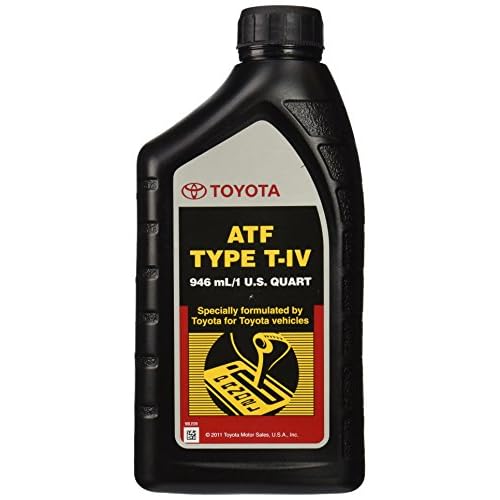
Check the label for the exact Ford specification, not just the brand name. MERCON LV bottles must state WSS-M2C938-A, and MERCON V bottles must state WSS-M2C202-B. A bottle that says only “suitable for Ford vehicles” or “multi vehicle ATF” has not claimed either specification.
Licensed fluids carry the MERCON name under Ford’s licensing program. Unlicensed fluids may claim to “meet or exceed” a specification without passing Ford’s tests. For a service, buy licensed.

The Verdict on MERCON LV vs MERCON V
MERCON LV and MERCON V are not the same fluid, and they are not interchangeable. LV is thinner, built for six speed automatics, and specified as WSS-M2C938-A. V is thicker, built for four and five speed automatics, and specified as WSS-M2C202-B.
There is no approved crossover from V to LV. Ford authorizes MERCON LV only where its current chart lists LV for your exact transmission and year.
The named cases are not exceptions to that rule. LV replaced MERCON SP in 2003 through 2008 TorqShift units, and the 4R75W and 4R75E changed specification by model year. MERCON V never belongs in a transmission that specifies MERCON LV.
Once you know the transmission code, the decision takes thirty seconds. Find the code, match it to Ford’s chart, and buy the bottle that states that specification.
If you are planning the service, check the F-150 transmission fluid change cost guide for parts and labor ranges. If your truck has the 10 speed instead, read our Ford 10 speed transmission problems guide before you buy fluid, because that unit needs MERCON ULV, not LV or V.
Frequently Asked Questions About MERCON LV and MERCON V
Is MERCON LV the same as MERCON V
No. MERCON LV is a low viscosity fluid specified as WSS-M2C938-A, while MERCON V is a thicker fluid specified as WSS-M2C202-B. They serve different transmissions and are not interchangeable.
Can I use MERCON LV instead of MERCON V


No, not as a substitute for V. Ford authorizes no LV-for-V swap. Use LV only where Ford’s current chart lists LV for your exact transmission and year.
Can I use MERCON V instead of MERCON LV
No. Ford does not approve MERCON V where MERCON LV is specified. The thicker fluid can cause harsh shifts, delayed engagement, shudder, and extra wear in six speed units like the 6R80.
What happens if I mix MERCON LV and MERCON V
Mixing creates a blend that matches neither specification. Shift quality can drift over time and the fluid ages faster than either pure fluid. Drain and refill with the correct specification at the next service.
Which Ford transmissions use MERCON LV
The 6R80, 6R140 TorqShift, 5R110 TorqShift, 6R100, 6HP26, 6F35, 6F50, 6F55, 6R60, 6R75, and the 2009 through 2014 4R75W and 4R75E. Always confirm your exact year and transmission code on Ford’s fluid chart.
Is MERCON LV the same as MERCON ULV
No. MERCON ULV is an ultra low viscosity fluid, WSS-M2C949-A, at about 4.5 cSt at 100°C for the 10 speed 10R80. It is thinner than LV and is not a substitute for LV or V.
Pick the Fluid Your Transmission Was Built For
MERCON LV is not the same as MERCON V. The two fluids differ in viscosity, specification, and application, and the wrong choice costs real money.
Check your transmission code, match it to Ford’s current fluid chart, and buy the bottle that names the matching specification. Do that, and your transmission gets the fluid its engineers calibrated it for. The viscosity gap is small on paper and large inside a transmission.
A fluid much thicker or thinner than the calibration expects changes shift timing, clutch pressure, and wear. When in doubt, trust the chart and the bottle label.