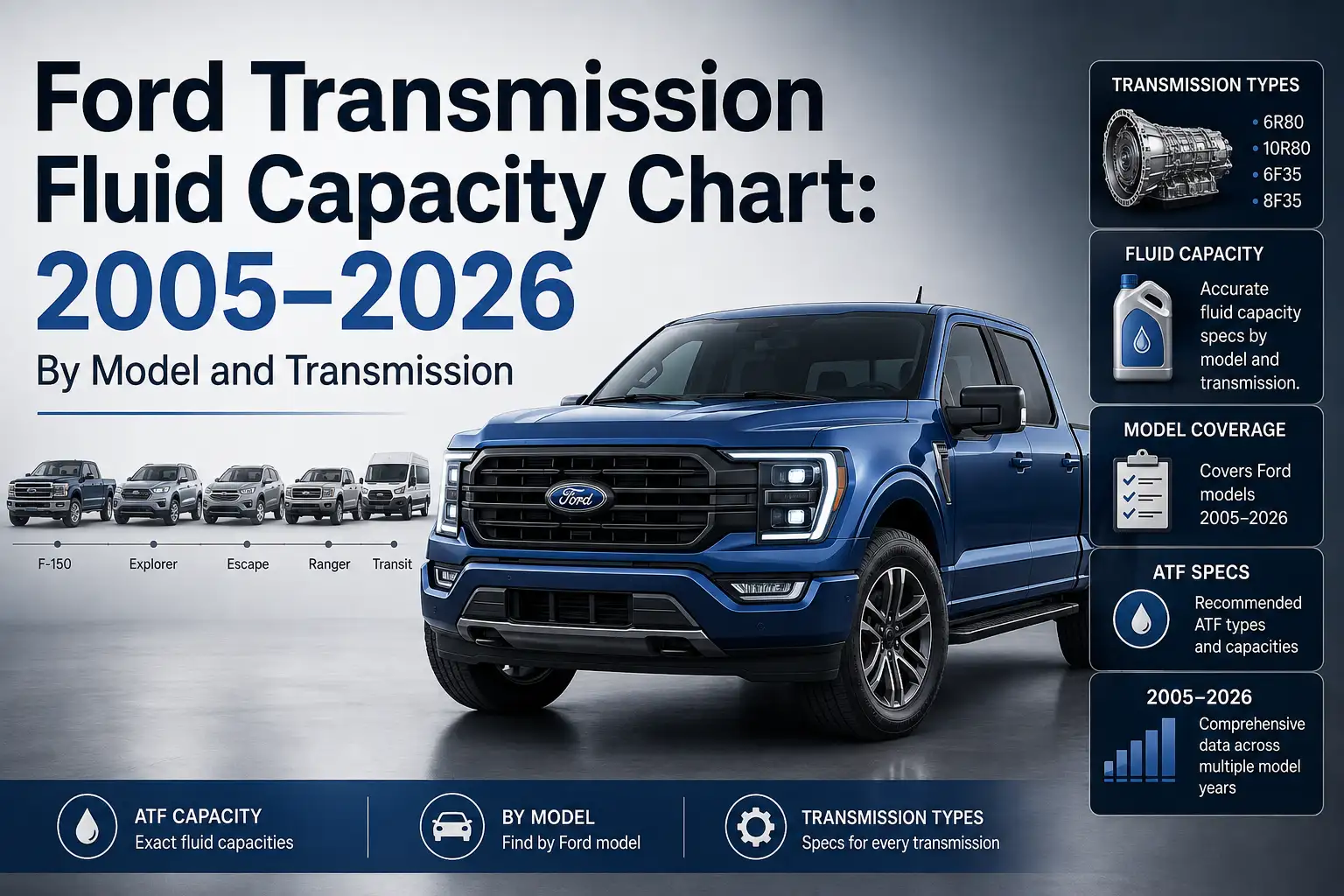
Ford Transmission Fluid Capacity Chart: 2005-2026 Model and Transmission

The Ford transmission fluid capacity chart below helps you match common Ford automatic transmissions with their approximate dry-fill capacity and required transmission fluid. Capacity can change with the transmission, model year, engine, cooler system, and application.
Do not treat dry-fill capacity as the amount to pour in after a normal transmission service. Ford repeatedly states that its published capacities are approximate dry-fill figures and that the actual amount used during a fluid change can vary.
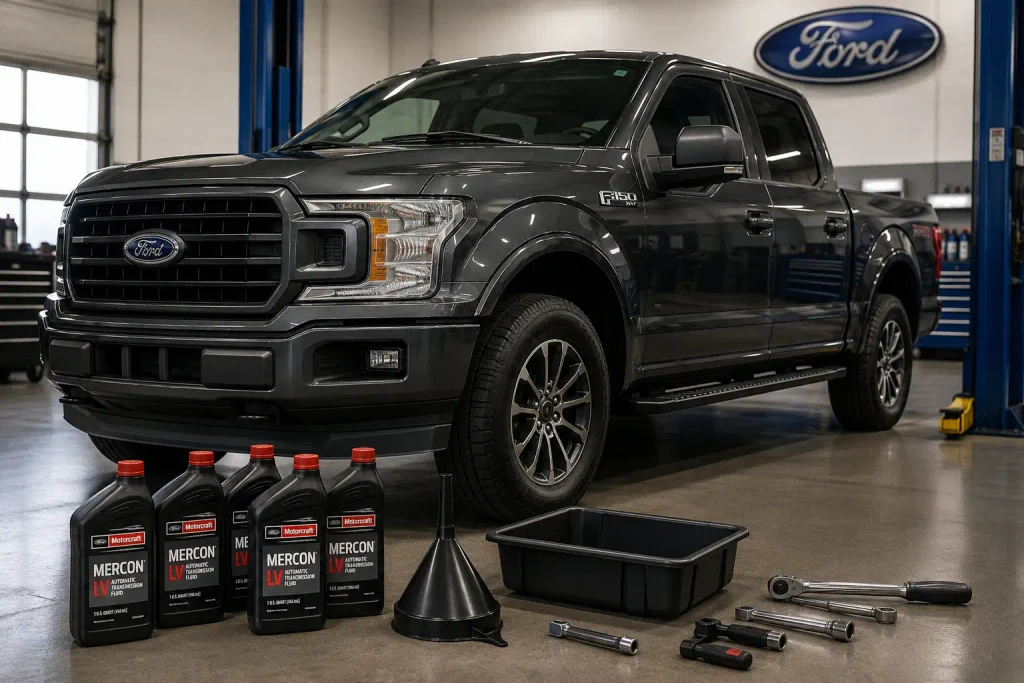
If you do not know which transmission your Ford has, identify it before buying fluid or deciding how many quarts you need.
Ford Transmission Fluid Capacity Quick Reference
Compare common Ford automatic transmissions by published dry-fill capacity, required MERCON fluid, and service-fill guidance.
| Transmission | Verified Application | Approx. Dry Fill | Required Fluid | Ford Spec | Service Refill |
|---|---|---|---|---|---|
| 10R60 | Current Ford reference | 13.09 qt / 12.39 L | MERCON ULV | WSS-M2C949-A | Set by Ford level procedure |
| 10R80 | Current Ford reference | 12.7 qt / 12.0 L | MERCON ULV | WSS-M2C949-A | Set by Ford level procedure |
| 10R80 | 2023 Ford F-150 | 13.0 qt / 12.3 L | MERCON ULV | WSS-M2C949-A | Application-specific level procedure |
| 10R100 | Super Duty application | 13.2 qt / 12.5 L | MERCON ULV | WSS-M2C949-A | Set by Ford level procedure |
| 10R140 | Super Duty application | 18.2–18.3 qt / 17.2–17.3 L | MERCON ULV | WSS-M2C949-A | Set by Ford level procedure |
| 6R80 | Ford reference | 12.12 qt / 11.47 L | MERCON LV | WSS-M2C938-A | Verify using specified level procedure |
| 6R80 | 2015 Ford F-150 | 13.1 qt / 12.4 L | MERCON LV | WSS-M2C938-A | Set by fluid-level procedure |
| 6R100 | Super Duty application | 13.9 qt / 13.2 L | MERCON LV | WSS-M2C938-A | Set by specified level |
| 6R140 | Super Duty application | 17.2 qt / 16.3 L | MERCON LV | WSS-M2C938-A | Set by specified level |
| 5R110W | Super Duty and commercial Ford | 17.5–18.2 qt / 16.6–17.2 L | MERCON SP or LV | Verify by model year | Use dipstick level procedure |
| 5R55E | Explorer Sport 4×2 | 10.0 qt / 9.5 L | MERCON V | Verify owner’s manual | Set by specified level |
| 4R70E / 4R75E | 2005 Ford F-150 | 13.9 qt / 13.2 L | MERCON V | Verify owner’s manual | Use dipstick level |
| 4R100 | 2001 Ford E-Series | 15.9 qt / 15.0 L | MERCON | Original Ford specification | Use dipstick level |
How to Identify Your Ford Transmission Before Checking Capacity
Recommended Best Deal Products


Capacity should be matched to the transmission code, not just the Ford model on the tailgate.
Ford has used many automatic transmissions, including the 4R70W, 4R75E, 4R100, 5R55E, 5R110W, 6R80, 6R100, 6R140, 10R60, 10R80, 10R100, and 10R140.
A single model can also use different transmissions across generations. Ford’s own records, for example, identify the 10R80 in 2017 to 2020 F-150s, 2018 to 2021 Expeditions and Mustangs, and 2019 to 2023 Rangers covered by a Ford service bulletin.
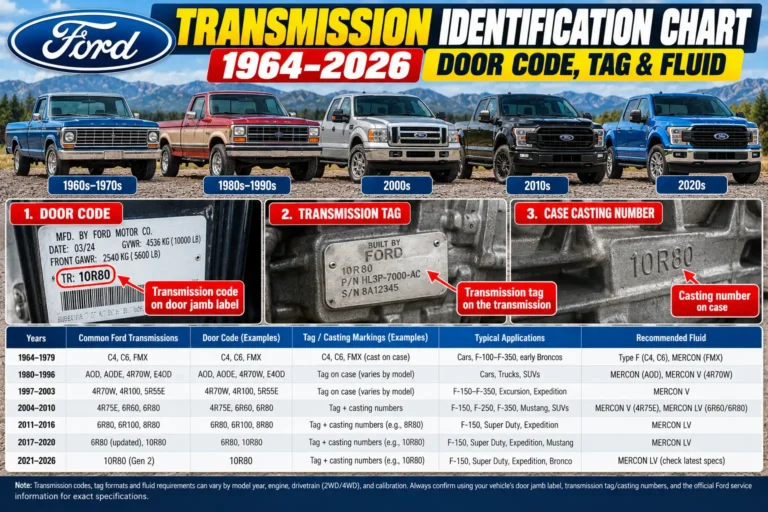
Before using the table, check your transmission code, model year, engine, and original owner’s manual. Our Ford transmission identification chart can help if you are unsure which gearbox is installed.
With the transmission identified, the capacity numbers become much more useful.
Ford Transmission Fluid Capacity Chart by Transmission Type
The table below combines Ford-published capacity data for several widely used transmissions. These are reference capacities, primarily approximate dry-fill figures.
| Transmission | Verified Ford Application or Reference | Approx. Dry Capacity | Fluid Specification | Service Refill |
|---|---|---|---|---|
| 10R60 | Ford applications covered by current manual data | 13.09 qt / 12.39 L | MERCON ULV, WSS-M2C949-A | Set by Ford level procedure |
| 10R80 | Current Ford application reference | 12.7 qt / 12.0 L | MERCON ULV, WSS-M2C949-A | Set by Ford level procedure |
| 10R80 | 2023 F-150 | 13.0 qt / 12.3 L | MERCON ULV, WSS-M2C949-A | Set by Ford level procedure |
| 10R100 | Super Duty application | 13.2 qt / 12.5 L | MERCON ULV, WSS-M2C949-A | Set by Ford level procedure |
| 10R140 | Super Duty application | 18.2 to 18.3 qt / 17.2 to 17.3 L | MERCON ULV, WSS-M2C949-A | Set by Ford level procedure |
| 6R80 | Ford reference including Ranger application | 12.12 qt / 11.47 L | MERCON LV, WSS-M2C938-A | Set by fill plug or specified level procedure |
| 6R80 | 2015 F-150 automatic | 13.1 qt / 12.4 L | MERCON LV, WSS-M2C938-A | Set by fluid-level procedure |
| 6R100 | Super Duty application | 13.9 qt / 13.2 L | MERCON LV, WSS-M2C938-A | Set by specified level |
| 6R140 | Super Duty application | 17.2 qt / 16.3 L | MERCON LV, WSS-M2C938-A | Set by specified level |
| 5R110W TorqShift | Super Duty and Ford commercial applications | 17.5 to 18.2 qt / 16.6 to 17.2 L | MERCON SP originally, MERCON LV on later Ford service references | Set by dipstick level |
| 5R55E | Explorer Sport 4×2 | 10.0 qt / 9.5 L | MERCON V | Set by specified level |
| 5R55E | Explorer Sport 4×4 | 10.3 qt / 9.8 L | MERCON V | Set by specified level |
| 4R70W | 2001 E-Series | 13.9 qt / 13.1 L | MERCON V in cited application | Set by dipstick |
| 4R70E and 4R75E | 2005 F-150 | 13.9 qt / 13.2 L | MERCON V | Set by dipstick |
| 4R100 | 2001 E-Series except E-Super Duty | 15.9 qt / 15.0 L | Original manual specifies MERCON | Set by dipstick |
| 4R100 | 2001 E-Super Duty | 16.4 qt / 15.5 L | Original manual specifies MERCON | Set by dipstick |
Ford publishes 12.7 qt for the 10R80, 13.09 qt for the 10R60, and 12.12 qt for the 6R80 in one current capacity reference. Ford also specifies MERCON ULV for the 10-speed units and MERCON LV for the 6R80 in that application.
The 2023 F-150 owner’s manual lists its 10R80 at 13.0 qt rather than 12.7 qt. That small but meaningful difference shows why a transmission name alone should not be treated as a universal capacity specification.
Ford Super Duty documentation shows the same pattern. One 10R140 reference lists 18.2 qt, while another application lists 18.3 qt.
The best rule is simple. Use the table to identify the expected capacity, then confirm the owner’s manual for your exact model and year before filling.
What Dry Fill Versus Service Refill Capacity Means
Recommended Best Deal Products


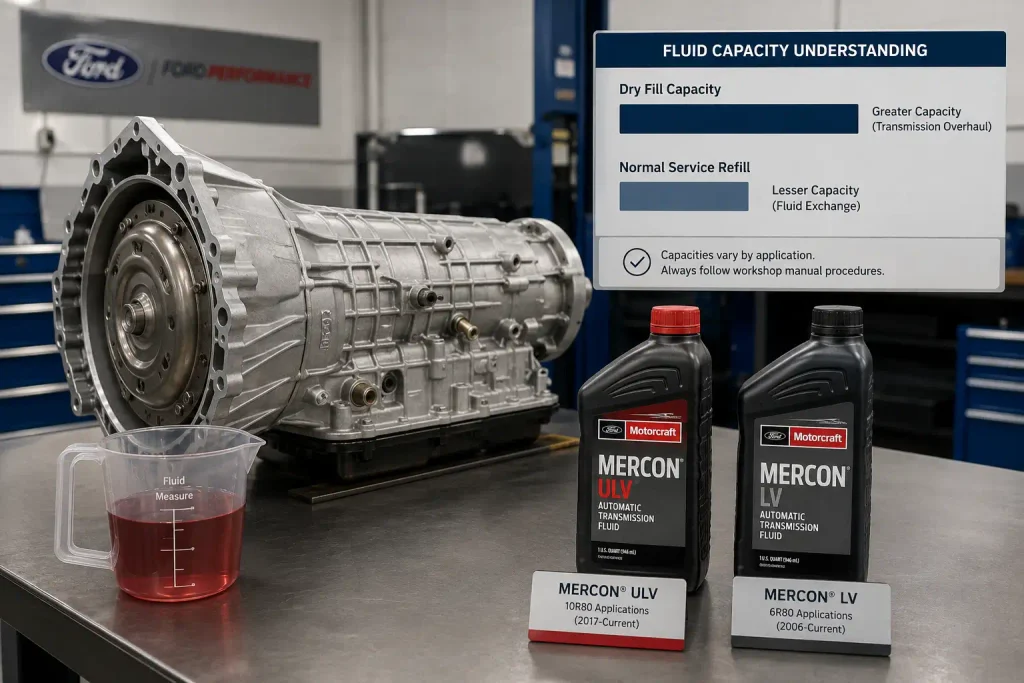
The biggest mistake with any transmission capacity chart is treating dry-fill capacity as a drain-and-refill instruction.
Dry Fill Capacity
Dry fill represents a transmission system that is essentially empty. Depending on the application, that can include fluid stored in the transmission, torque converter, cooler, and cooler lines.
Ford labels many published capacities as approximate dry-fill quantities. It also warns that cooler size and other application differences can change the final amount.
Routine Drain and Refill
A normal transmission service usually leaves fluid inside the torque converter, cooler, internal passages, and other parts of the system.
That means a transmission with a 13-quart dry capacity does not automatically need 13 quarts after removing the pan.
An older Ford F-150 workshop procedure illustrates the difference well. The 4R70 and 4R75 transmission had an approximate 13.9-quart dry capacity, but the refill procedure began by adding 5 quarts before starting the engine and continuing the prescribed level-setting process.
Fluid Exchange
A fluid exchange can replace more oil than a simple pan drain, but the final level still has to be established using the procedure for that transmission.
The practical rule is to measure what came out when possible, add fluid in stages, and finish according to Ford’s specified level-check method.
Which MERCON Fluid Does Each Ford Transmission Require
Capacity tells you how much the transmission can hold. The Ford specification tells you what should go into it.
| Transmission Family | Fluid | Ford Specification |
|---|---|---|
| 10R60 | MERCON ULV | WSS-M2C949-A |
| 10R80 | MERCON ULV | WSS-M2C949-A |
| 10R100 | MERCON ULV | WSS-M2C949-A |
| 10R140 | MERCON ULV | WSS-M2C949-A |
| 6R80 | MERCON LV | WSS-M2C938-A |
| 6R100 | MERCON LV | WSS-M2C938-A |
| 6R140 | MERCON LV | WSS-M2C938-A |
| 5R110W TorqShift | MERCON SP originally, MERCON LV in later Ford service documentation | Verify by model year |
| 5R55E | MERCON V | Verify owner’s manual |
| 4R70 and 4R75 family | MERCON V in cited F-150 application | Verify owner’s manual |
| Early 4R100 | Original manuals specify MERCON | Verify current service recommendation before purchase |
Ford says transmissions requiring MERCON ULV should use MERCON ULV and warns that using another fluid can cause transmission damage. The current ULV specification is WSS-M2C949-A.
MERCON LV carries a different requirement. Motorcraft describes it as the fluid for Ford and Lincoln applications designed for MERCON LV and specifically tells owners to check the owner’s guide or transmission-fluid chart for the application.
The 5R110W TorqShift deserves extra attention. Earlier Ford documentation specified MERCON SP, including a 17.5-quart Ford TorqShift capacity reference. Later Ford documentation shows TorqShift applications using MERCON LV. Motorcraft’s current MERCON LV guidance also makes an exception for TorqShift when discussing MERCON SP applications.
For older transmissions that require MERCON V, our MERCON V transmission fluid guide covers suitable options in more detail.
Never choose ATF only because the bottle says it works with many Ford transmissions. Match the specification first.
Ford F150 Transmission Fluid Capacity by Year and Transmission
F-150 transmission capacity changed as Ford moved through different automatic transmission families.
A full year-by-year chart can become misleading because engine and transmission combinations changed within generations. These verified examples show the size of the variation.
| F-150 Reference | Transmission | Approx. Dry Capacity | Fluid |
|---|---|---|---|
| 2005 F-150 automatic | 4R70E or 4R75E | 13.9 qt / 13.2 L | MERCON V |
| 2012 era 3.7L application | 6-speed automatic | 12.1 qt / 11.7 L | MERCON LV |
| 2012 era 5.0L, 6.2L and 3.5L EcoBoost | 6-speed automatic | 13.1 qt / 12.4 L | MERCON LV |
| 2015 F-150 automatic | 6-speed automatic | 13.1 qt / 12.4 L | MERCON LV |
| 2023 F-150 | 10R80 | 13.0 qt / 12.3 L | MERCON ULV |
Ford’s 2005 F-150 guide specifies 13.9 qt for the 4R70 and 4R75 family and calls for MERCON V in that automatic-transmission application.
Later F-150 documentation lists 12.1 qt for the 3.7L application and 13.1 qt for 5.0L, 6.2L, and 3.5L EcoBoost applications, using MERCON LV.
The 2015 F-150 manual lists 13.1 qt and identifies MERCON LV meeting WSS-M2C938-A. Ford labels that value approximate dry fill.
By 2023, the F-150 10R80 reference is 13.0 qt and uses MERCON ULV meeting WSS-M2C949-A.
If you are servicing an F-150 rather than rebuilding a dry transmission, use the correct level-check procedure instead of adding the full number from this table.
Ford Super Duty Transmission Capacity by Transmission Generation
Super Duty owners also need to match the transmission to the model year and powertrain.
| Transmission | Verified Capacity | Fluid |
|---|---|---|
| 5R110W TorqShift | 17.5 qt / 16.6 L in one Ford reference | MERCON SP originally |
| 5R110W TorqShift | 18.2 qt / 17.2 L in later Ford documentation | MERCON LV |
| 6R100 | 13.9 qt / 13.2 L | MERCON LV |
| 6R140 | 17.2 qt / 16.3 L | MERCON LV |
| 10R100 | 13.2 qt / 12.5 L | MERCON ULV |
| 10R140 | 18.2 to 18.3 qt / 17.2 to 17.3 L | MERCON ULV |
Ford published a 17.5-quart TorqShift 5-speed capacity with MERCON SP in older documentation. Later Ford technical specifications list an 18.2-quart TorqShift capacity with MERCON LV.
For the 6R140, a Ford manual lists 17.2 qt and MERCON LV meeting WSS-M2C938-A.
Ford’s 10-speed Super Duty data lists 10R100 capacity at 13.2 qt and 10R140 capacity at about 18.3 qt, both using MERCON ULV meeting WSS-M2C949-A.
These differences are another reason to use the exact year-specific owner’s manual before purchasing a full case of ATF.
How Much Transmission Fluid Should You Add After Service
After routine service, add the amount required to restore the correct fluid level rather than automatically adding the published dry capacity.
- Confirm the transmission. Check the code and application before selecting fluid.
- Use the correct Ford specification. MERCON V, LV, SP, and ULV are not interchangeable simply because they are all Ford transmission fluids.
- Measure the drained fluid when practical. This gives you a useful starting point for a normal pan service.
- Refill gradually. Follow Ford’s initial-fill instructions for the transmission rather than pouring in its entire dry capacity.
- Set the final level correctly. Follow the specified engine-running, gear-selection, temperature, dipstick, or fill-plug procedure for your transmission.
Ford’s older manuals explicitly instruct owners to use the dipstick’s normal operating range to establish the actual transmission-fluid level instead of relying only on approximate dry capacity.
F-150 owners working on a six-speed truck can use our guide on how to check transmission fluid on a 2016 F150 for the model-specific checking process.
Getting the level right is just as important as selecting the right fluid.
5 Transmission Capacity Chart Mistakes Ford Owners Should Avoid
1. Using Dry Capacity After Draining the Pan
A pan drain does not normally empty the entire transmission system.
Adding a full dry-fill quantity after a partial drain can overfill the transmission.
2. Assuming Every 10R80 Has One Capacity
Ford lists 12.7 qt for one 10R80 application and 13.0 qt for the 2023 F-150.
Always check the specific model and year.
3. Choosing Capacity by Model Alone
A model such as the F-150 can use several different transmissions across its production history.
Identify the transmission first, then check its application-specific capacity.
4. Buying Fluid by Color
Red fluid does not mean two ATFs meet the same specification.
Ford separately specifies MERCON V, MERCON LV, MERCON SP, and MERCON ULV for different applications. Motorcraft explicitly warns against using MERCON SP in transmissions requiring ULV, V, or LV.
5. Ignoring the Final Level Check
Capacity is a reference number. Fluid level is the final service target.
Cooler size, retained fluid, service method, and application can all affect how much ATF is actually required.
3 Checks Before Buying Ford Transmission Fluid
Before ordering ATF, confirm three things.
- Transmission code: Identify whether you have a 6R80, 10R80, 5R110W, 6R140, or another unit.
- Required specification: Match MERCON type and Ford specification to the owner’s manual.
- Service quantity: Decide whether you are performing a pan drain, filter service, exchange, or filling a dry transmission.
If you own an F-150 and are unsure where the fill point is located, our guide to where to add transmission fluid on a Ford F150 covers the basic locations and differences between configurations.
Identify first, verify the fluid specification second, then establish the actual level using the correct Ford procedure.
5 Common Ford Transmission Fluid Capacity Questions
How Many Quarts of Transmission Fluid Does a Ford Take
There is no single Ford transmission-fluid capacity. Verified Ford examples range from about 10 quarts for some 5R55E applications to more than 18 quarts for the 10R140. The exact number depends on the transmission, model, year, and configuration.
How Much Fluid Does a Ford 10R80 Hold
A Ford 10R80 can hold approximately 12.7 to 13.0 quarts in the verified applications covered here. Ford lists 12.7 qt in one reference and 13.0 qt for the 2023 F-150, both as approximate dry-fill capacities.
How Much Fluid Does a Ford 6R80 Hold
Ford lists 12.12 qt for the 6R80 in one Ranger reference, while some F-150 applications carry a higher overall automatic-transmission capacity. Treat the number as application-specific and verify your owner’s manual before filling.
Is Dry Fill the Same as Transmission Fluid Change Capacity
No. Dry fill assumes a much more completely emptied system, while a normal drain usually leaves fluid in the torque converter, cooler, lines, and internal passages. Ford repeatedly states that actual fluid-change quantities can vary from the published dry capacity.
Can I Use MERCON LV Instead of MERCON ULV
No, not unless Ford specifically approves that fluid for your application. Ford states that transmissions requiring MERCON ULV should only use MERCON ULV, and Motorcraft separately defines MERCON LV for transmissions designed for that specification.
Which Ford Transmission Capacity Number Should You Use
Use the capacity that matches both your Ford transmission and its specific application. The Ford transmission fluid capacity chart is a starting reference, not a substitute for the owner’s manual or the final fluid-level procedure.
Dry capacity applies to a nearly empty transmission system. A routine drain, pan removal, or filter replacement normally requires less fluid because part of the original ATF remains inside.
Match the transmission code, verify the required MERCON specification, and use Ford’s prescribed procedure to establish the final level. That approach prevents the two most common service errors: using the wrong ATF and adding the full dry capacity after a partial drain.
Identify any Ford transmission by code and year: Ford Transmission Identification Chart