
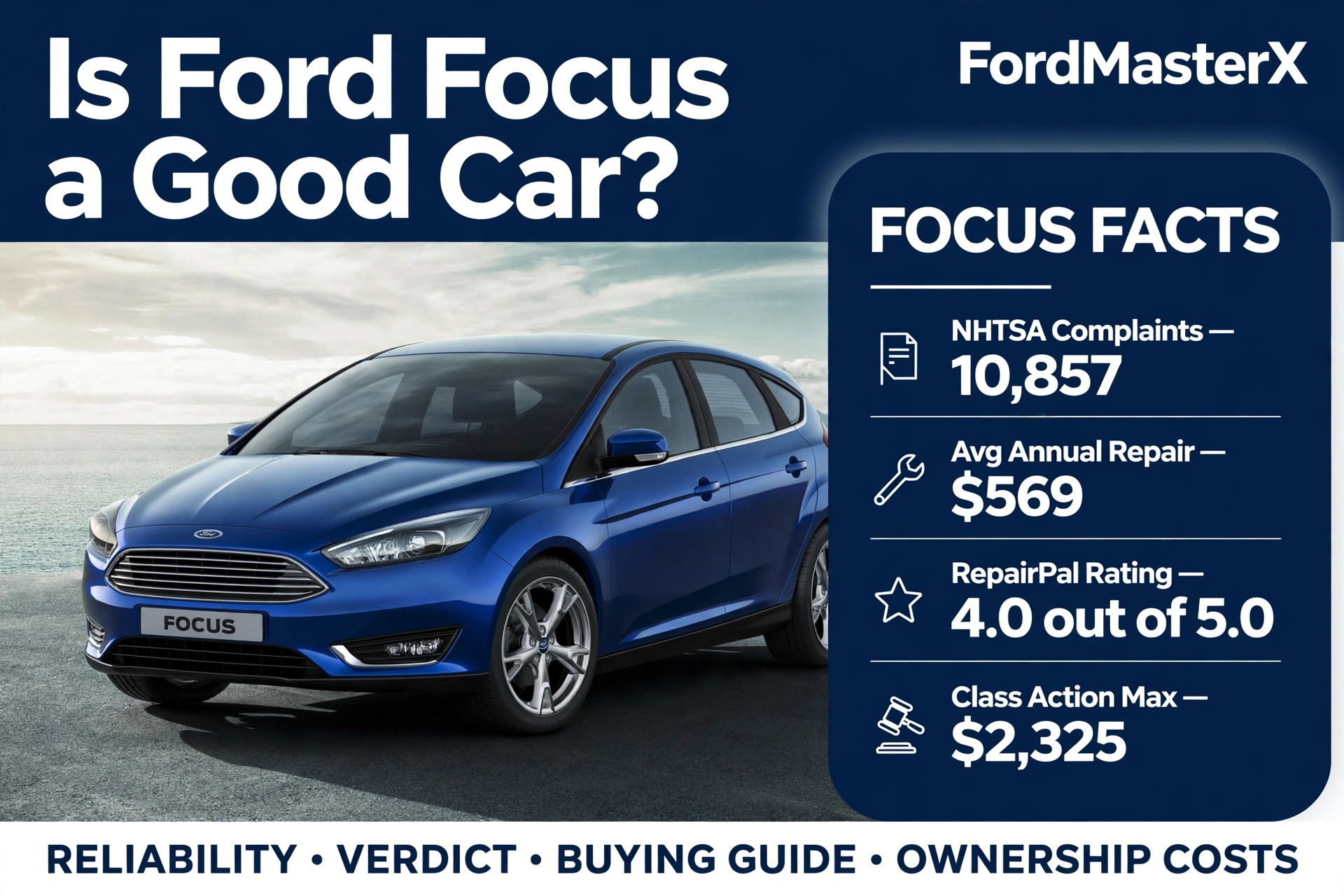
Is Ford Focus a Good Car? 7 Honest Answers for 2026

Yes, a Ford Focus is a good car if you buy the right transmission. The manual models and the 1.0L EcoBoost with its conventional automatic are cheap, fun, frugal commuters. The 2.0L with the PowerShift dual-clutch automatic is the one to avoid, and it is the version most used listings show. This guide covers the US Focus from 2000 through 2018, the final model year Ford sold here. Read the generation breakdown, the PowerShift numbers, and the six checks below, and you will know which Focus to buy and which to walk away from.
3 Ford Focus Generations That Decide Reliability
The Focus changed completely three times in the United States, and each generation has a different reliability story. The year on the title tells you less than the generation and the gearbox.


Ford sold the Focus in the US from the 2000 model year through 2018. In April 2018 Ford announced it would stop investing in next-generation North American sedans, and US production ended the following month. Sales had fallen from 269,272 cars in 2012 to 113,345 in 2018, and the fourth-generation Focus never came here. Every used Focus you can buy in America is therefore a first, second, or third-generation car.
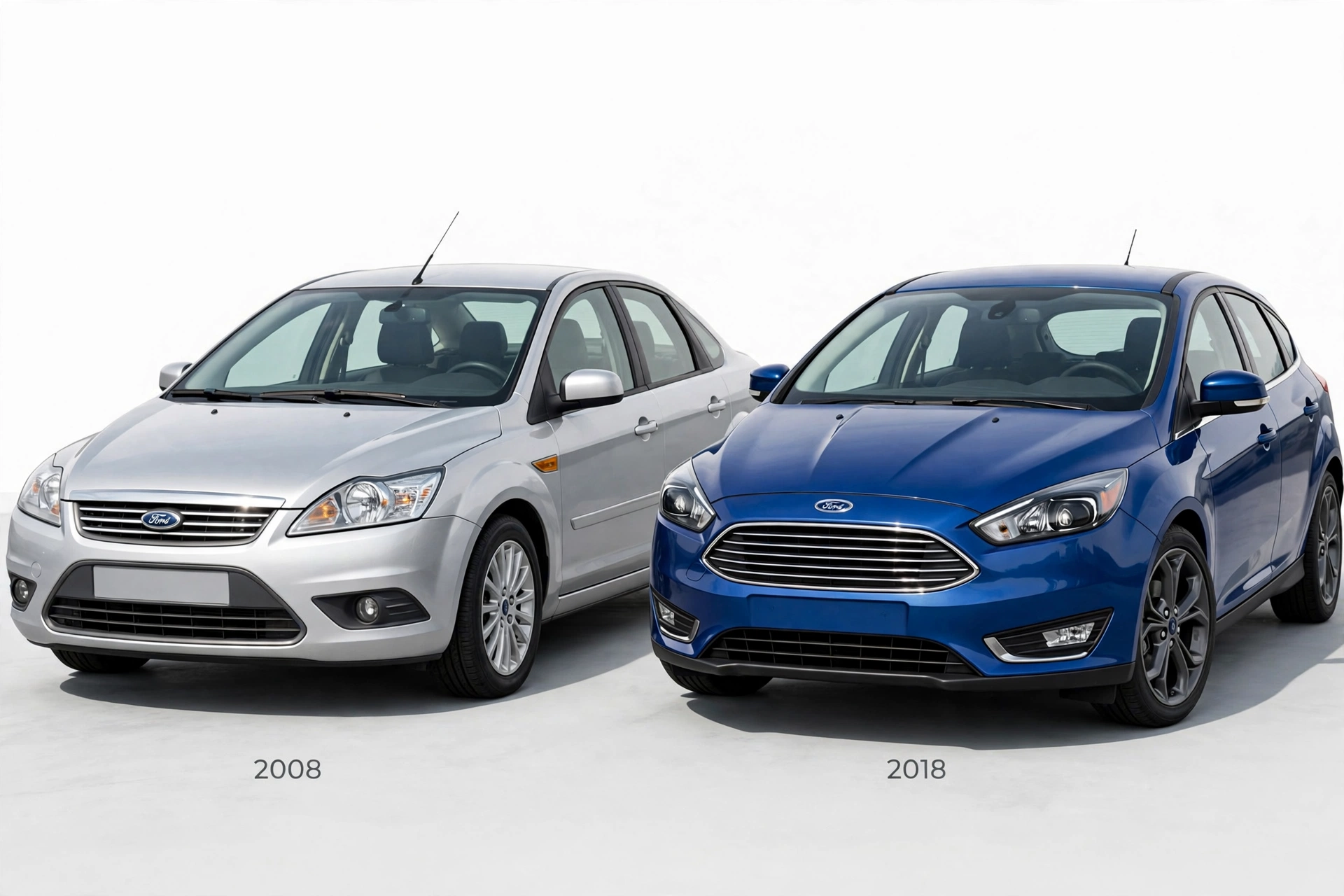
First Generation 2000 to 2007
The first Focus was a simple, light, sharp-handling compact. Early cars had ignition switch recalls and electrical quirks, and rust around the wheel wells and rocker panels is now the main enemy in salt states. Parts are cheap, and the 2.0L Duratec engine in later cars is durable. Buy one only as a low-budget runabout, after a rust inspection underneath.
Second Generation 2008 to 2011



The second generation is the quiet sweet spot of the Focus story. It used a conventional four-speed automatic and the proven 2.0L Duratec engine, with none of the dual-clutch trouble that came later. The 2011 model year is the pick of this generation. Expect modest equipment and an older interior, but repair bills stay low. Watch for suspension wear on 2007 and 2008 cars and alternator failures on 2007 cars, and test the air conditioning.
Third Generation 2012 to 2018
The third generation brought the global Focus to America, with the best handling and nicest cabin of any Focus sold here. It also brought the PowerShift transmission, which defines this generation for buyers. A 2015 facelift sharpened the styling and brought Sync 3 from 2016, and the range stretched from the frugal 1.0L EcoBoost to the 252 hp Focus ST and the 350 hp all-wheel-drive Focus RS. The details on how long a 2012 Focus lasts show how far the first year can go when the transmission holds up.
PowerShift Problems in the Numbers That Matter


One transmission decides whether a third-generation Focus is a bargain or a money pit. The PowerShift DPS6 is a six-speed dry dual-clutch automatic built by Getrag, fitted to every 2.0L automatic Focus from 2012 through 2018 in the United States. The year alone does not save you, because the 2.0L automatic kept the same basic design through 2018, with only revised clutch materials and software.
The numbers below explain why this transmission matters more than any other fact about the car. MotorAlmanac counted the federal complaint file and the warranty record.
Ford Focus Transmission Decoder


Match the engine and gearbox before you check the year. The gearbox decides the verdict.
2.0L engine with PowerShift automatic, 2012 to 2018Dual-clutch automatic with shudder, slipping, and control module failures.


2.0L engine with 5-speed manual, any yearConventional manual gearbox with none of the PowerShift defects.
1.0L EcoBoost with 6-speed automatic, 2015 to 2018Conventional torque-converter automatic, not a dual-clutch unit.
1.0L EcoBoost with 6-speed manual, 2015 to 2018Small turbo engine with a manual gearbox and the best fuel economy.
Focus ST or Focus RS, manual onlyPerformance models sold only with heavy-duty manual gearboxes.
How the Dry Clutch Fails
A normal automatic uses a fluid-filled torque converter to smooth the engine-to-gear connection. The PowerShift uses two dry clutches instead, so it works like two manual gearboxes shifted by a computer, with air cooling only. In stop-and-go traffic the clutches overheat, the friction material wears early, and leaking seals can contaminate the clutch faces. Owners report violent shuddering when pulling away, jerky low-speed shifts, delayed engagement, and in severe cases a complete loss of drive. Control module failures were reported as early as 35,000 miles.


The complaint record backs up the owner stories. Of the 10,857 NHTSA complaints filed for the 2012 to 2016 Focus, 4,813 describe shuddering, juddering, hesitation, slipping, jerking, or the car dropping into neutral. That is one of the largest federal complaint files for any small car.
What Ford Did Next


Ford never recalled the transmission for shuddering or slipping. The company issued software updates and more than 20 technical service bulletins, then extended warranty coverage in stages. Program 14M01 covered the clutch assembly and seals for 7 years or 100,000 miles on 2011 to 2014 models, program 19N08 gave similar clutch coverage to 2014 to 2016 models, and program 14M02 covered the control module for 10 years or 150,000 miles. In 2019, NHTSA found no evidence of an unreasonable risk to safety.
The courts moved where the recall process did not. The class action Vargas v. Ford Motor Company covered about 1.9 million owners of 2012 to 2016 Focus and 2011 to 2016 Fiesta models with the dual-clutch transmission, and the settlement became effective in April 2020 with payments of up to $2,325 plus repair reimbursements. Owners of 2017 and 2018 models were outside that settlement and filed a separate class action in 2022, still moving through the courts in early 2026. The 2014 Focus transmission recall record shows the smaller safety recalls that did apply to these cars, for door latches and fuel system parts, but none covers the clutch shudder itself.


Why Warranties No Longer Help
Nearly every PowerShift warranty extension has now expired by vehicle age. The 7-year clutch coverage ended years ago for the earliest cars, and the 10-year control module coverage is expiring for the last of them. The one-time free control module replacement under program 14M02 expired on June 30, 2025, so a buyer today has no factory support left for a failed module. A clutch replacement typically runs $1,500 to $2,200, and owner reports put full out-of-warranty transmission work at $4,000 to $8,000. A cheap 2013 automatic can turn expensive in a single repair visit.
There is one safe automatic in this generation, and it is easy to miss. The 1.0L EcoBoost models sold from 2015 to 2018 use a conventional six-speed torque-converter automatic instead of the PowerShift unit, so they do not share the defect. The Ford Focus 1.0 litre EcoBoost technical guide covers that engine in detail, including the wet belt that needs attention on its own schedule.
Best and Worst Ford Focus Years by Transmission


Year lists mislead buyers when they ignore the gearbox, so read this table by the combination. A 2012 manual and a 2012 automatic are two different cars for reliability purposes.
| Year Range | Transmission | Verdict | Why |
|---|---|---|---|
| 2000 to 2007 | Manual or 4-speed automatic | Budget buy | Simple and cheap, but check for rust and old electrical parts |
| 2008 to 2011 | Manual or 4-speed automatic | Best older buy | Conventional automatic, proven 2.0L engine, 2011 is the pick |
| 2012 to 2014 | PowerShift automatic | Avoid | Worst complaint years, power steering failures, no warranty left |
| 2012 to 2014 | 5-speed manual | Good buy | Same car without the defective gearbox, verify the clutch |
| 2015 to 2016 | PowerShift automatic | Avoid | Revised clutches helped, but the design flaw stayed |
| 2015 to 2016 | Manual or 1.0L automatic | Good buy | Manual is safe, 1.0L automatic uses a normal torque converter |
| 2017 to 2018 | PowerShift automatic | Approach with care | Complaints fell, but the 2.0L automatic still uses the DPS6 |
| 2017 to 2018 | Manual or 1.0L automatic | Best late buy | Newest cars, best equipment, no PowerShift risk |
The 2012 model year is the worst single year, with the highest complaint count and a cluster of power steering failures. The 2013 and 2014 automatics sit just behind it. The 2015 and 2016 automatics improved through revised clutch material and software, yet the dry-clutch design never changed, so they still deserve caution. The 2017 and 2018 automatics carry the lowest risk of the PowerShift years, but they are not fixed cars. The record on how many miles a 2014 Focus can last shows why the transmission question comes before the mileage question.
What a Used Ford Focus Costs in 2026
Low prices attract buyers to the Focus, and the PowerShift reputation is the reason prices stay low. Kelley Blue Book data observed in November 2026 for ZIP 20146 puts a 2018 Focus S sedan at a fair purchase price of $6,330, with private party values of $4,555 to $6,180. A 2018 SEL hatchback lists at $9,305 and a Titanium sedan at $9,050. The Focus RS is the exception at $26,130, because collectors value its 350 hp engine and all-wheel drive. Edmunds puts the full 2018 Focus range at $3,234 to $15,213, and CarBuzz reports an average used price near $7,490 for 2018. Kelley Blue Book values for the 2018 Focus S sedan show how far prices fall for the base car.
| 2018 Focus Trim | Fair Purchase Price | Private Party Range |
|---|---|---|
| S sedan | $6,330 | $4,555 to $6,180 |
| SEL hatchback | $9,305 | $6,705 to $9,080 |
| Titanium sedan | $9,050 | $6,540 to $8,840 |
| RS hatchback | $26,130 | $22,430 to $25,730 |
Running costs stay friendly once you avoid the transmission trap. RepairPal rates the Focus 4.0 out of 5.0 for reliability, ranking it 27th of 36 compact cars, with an average annual repair cost of $569 against a compact-car average of $526. Owners average 0.3 unscheduled repair visits per year, and the chance of a repair being severe is 13 percent, slightly above the 11 percent class average. Routine work is cheap because parts are plentiful. The 2014 Focus oil reset steps show how much basic maintenance an owner can handle at home.
Fuel economy is a genuine strength. EPA figures from fueleconomy.gov put the 2.0L manual at 25 city and 34 highway mpg, and the 2.0L automatic at 26 city and 38 highway mpg. The 1.0L EcoBoost manual reaches 30 city and 40 highway mpg, the best in the range, while its automatic returns 27 city and 38 highway mpg. The Focus ST manages 22 city and 30 highway mpg, and the Focus RS drops to 19 city and 26 highway mpg. A 12.4-gallon tank gives the most efficient Focus a range near 420 miles.
Safety ratings are solid for a car of this age. NHTSA gives the 2018 Focus a five-star overall rating for sedan and hatchback, with five stars for frontal and side protection and four for rollover resistance. The IIHS rates it Good in four of five crash tests, with an Acceptable result in the driver-side small overlap test, and it never earned a Top Safety Pick because Ford offered no automatic emergency braking on this car. Edmunds rates the 2018 Focus 6.7 out of 10, J.D. Power gives it a consumer score of 78 out of 100, and secondary sources report that Consumer Reports rates the 2017 and 2018 models better than average for predicted reliability. Driver assistance features were optional on the Titanium trim only, so expect a basic safety package on most used cars.
6 Checks Before You Buy a Used Focus
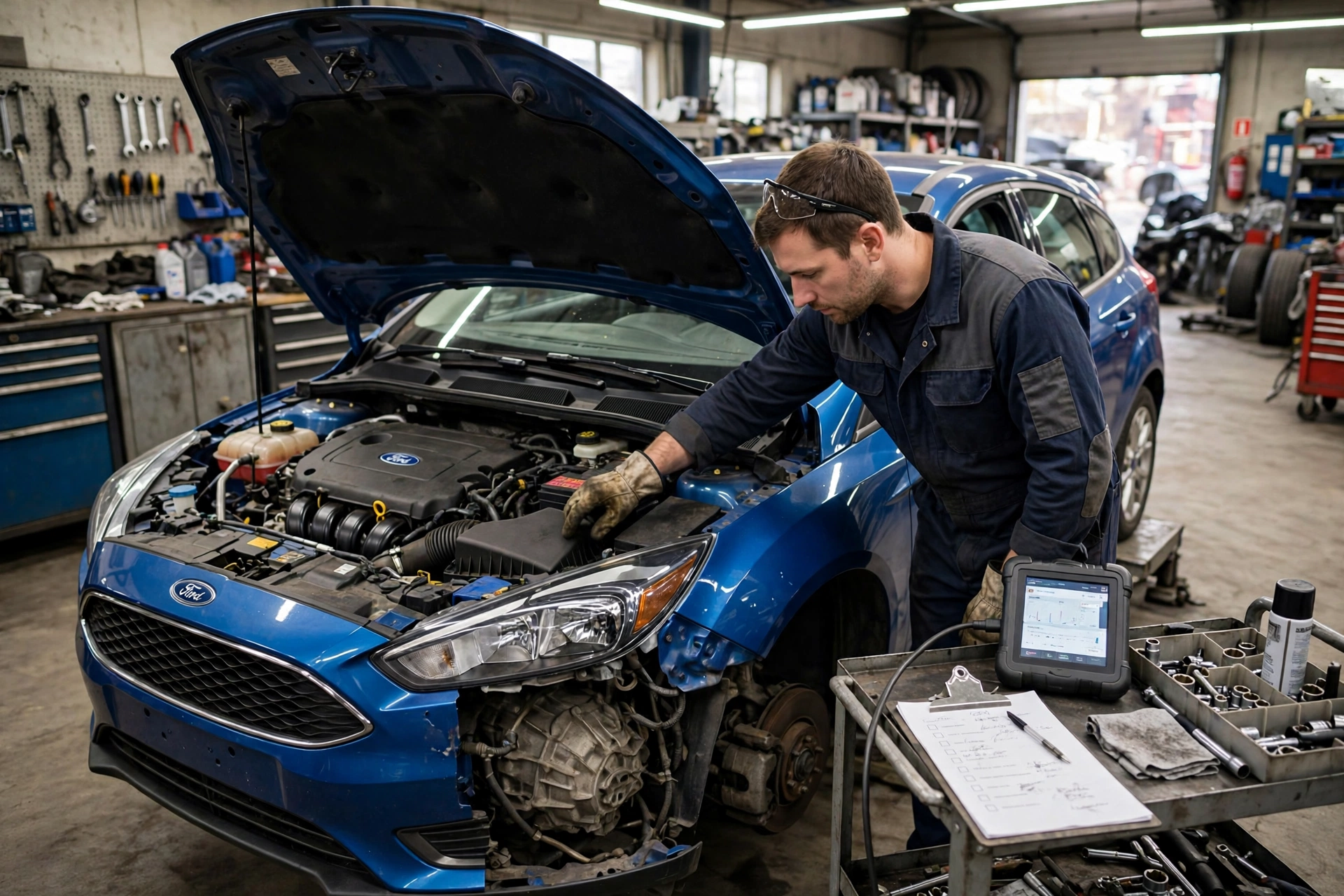
Run these six checks in order, and do not skip the test drive. A Focus that passes all six is a good car at a fair price. A Focus that fails the first two is a car to walk away from.
- Identify the transmission from the engine and the shifter. A 2.0L with an automatic is a PowerShift car from 2012 through 2018. A 1.0L EcoBoost automatic uses the safe torque-converter unit, and any manual is safe. Confirm with the VIN when the seller is unsure.
- Test drive the car cold, in slow traffic. Start from cold and drive at parking-lot speeds with frequent stops. Shuddering when pulling away, harsh shifts between first and second gear, or a delay when you select drive are warning signs. A smooth cold drive is not a guarantee, but a shuddering one is a clear rejection.
- Ask for the transmission service history in writing. Look for clutch replacements, control module replacements, and software updates, with dates and mileage. A car with a replaced clutch and module is a better bet than one with no record, but check the dates, because the factory coverage behind those repairs has expired.
- Check the VIN for open recalls and campaigns. Look for door latch recalls, fuel system purge valve recalls, and on 1.0L cars the wet belt and oil pump drive recalls. The Ford Focus timing belt change guide explains the belt intervals that matter on the small EcoBoost engine.
- Inspect the body, the air conditioning, and the infotainment. Check the wheel wells and rocker panels for rust, run the air conditioning until it blows cold, and test the MyFord Touch or Sync 3 screen. Slow screens, frozen menus, and Bluetooth dropouts were common on third-generation cars.
- Pay for an independent pre-purchase inspection. Ask the shop to scan the transmission control module for stored codes and check for clutch slip on a road test. The inspection costs far less than one clutch replacement, and it gives you a written reason to negotiate or walk away.
5 Questions Buyers Ask About the Focus
Is a 2012 Ford Focus Reliable?
No, a 2012 Focus with the PowerShift automatic is not reliable, and it is the worst model year of the range. The 2012 manual can be a sound cheap car, but the automatic carries the highest complaint count and the most power steering failures.
Which Focus Years Are Safest?
The safest picks are 2008 to 2011 with the conventional automatic, any manual from 2012 to 2018, and the 1.0L EcoBoost automatic from 2015 to 2018. The 2017 and 2018 manuals and 1.0L automatics are the best late-generation buys.
How Long Does a Focus Last?
A Focus with a manual gearbox or a conventional automatic can last well past 150,000 miles with regular maintenance. A PowerShift automatic rarely reaches that distance without expensive transmission work, so the gearbox matters more than the odometer reading.
Is the Focus ST a Good Buy?
Yes, the Focus ST is a good buy for an enthusiast who wants a fun hatchback. It uses a 252 hp 2.0L EcoBoost engine with a six-speed manual only, so it has no PowerShift risk, and Edmunds rates it 7.7 out of 10.
Should I Buy a Focus Automatic?
Buy an automatic Focus only if it is a 2008 to 2011 model or a 1.0L EcoBoost from 2015 to 2018. Avoid any 2.0L automatic from 2012 through 2018 unless the price covers a transmission repair and a mechanic has inspected it first.
Your Next Step Before You Buy
So, is Ford Focus a good car? Yes, when you buy the right one. A manual Focus, a 2008 to 2011 automatic, or a 1.0L EcoBoost automatic gives you sharp handling, honest fuel economy, and a purchase price under $10,000 for most examples. A 2.0L automatic from 2012 through 2018 gives you the same car with a transmission that can erase every dollar you saved. Check the engine and the gearbox first, drive the car cold, and pay for an inspection before you sign. Do that, and the Focus is one of the best cheap cars you can buy in America today.