
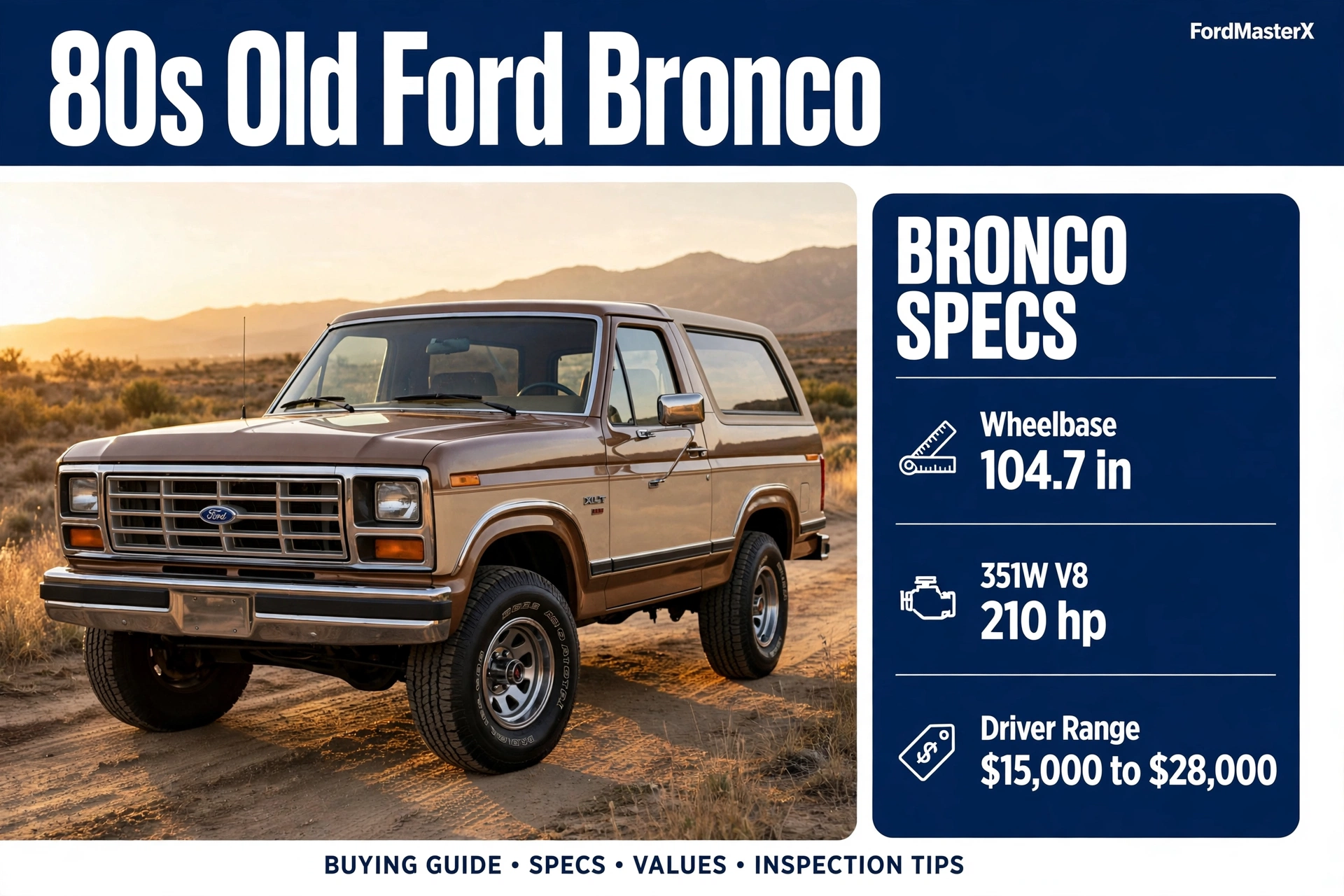
80s Old Ford Bronco 2026 Buying Guide With 7 Proven Tips

An 80s old Ford Bronco is a full-size, three-door, removable-top 4×4 from the third generation (1980 to 1986, nicknamed Bullnose) or the fourth generation (1987 to 1991, nicknamed Bricknose). Both share the F-150 platform, a 104.7-inch wheelbase, and a choice of the 4.9L inline-six, the 5.0L V8, or the 5.8L V8. Expect to pay $15,000 to $28,000 for a driver-quality 1980s example, and $25,000 to $45,000 for a clean, rust-free 1987 to 1991 truck. The best buy for most shoppers is a 1988 to 1991 truck with the 5.0L or 5.8L EFI V8. Rust decides value more than the engine does, so inspect the frame before you fall for the paint.
80s Old Ford Bronco Generations Explained in 2 Groups
Ford built 1,148,926 Broncos across the original 1966 to 1996 run. The third generation arrived in 1980 on a shorter, lighter F-150 chassis. The fourth generation followed in 1987 with smoother styling and fuel injection across the range. Both are full-size, three-door trucks with a removable fiberglass rear top. Neither is the smaller Bronco II, a Ranger-based model sold from 1984 to 1990. Do not confuse the two: Bronco II values sit far below full-size values.


The two generations look alike at a glance, and the Ford Bronco model comparison chart lays out the full generation timeline. Tell them apart by the front end. Bullnose trucks have a protruding grille with inset turn signals. Bricknose trucks have flush composite headlamps and a flatter, more aerodynamic nose. The change matters because it marks the switch to modern fuel injection, better interiors, and rear anti-lock brakes.
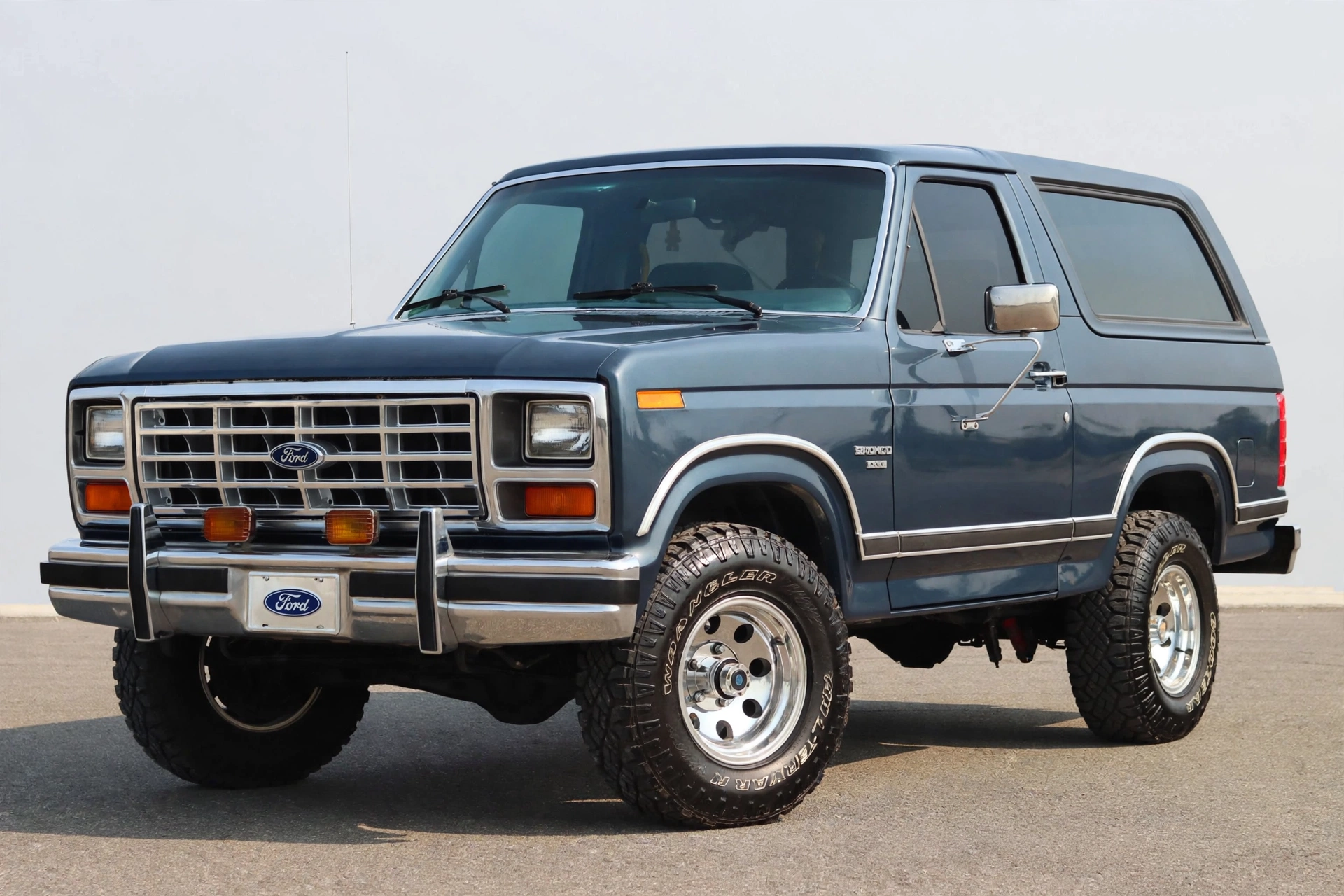
Bullnose Trucks at a Glance
The Bullnose covers model years 1980 to 1986. It rides on a 104.7-inch wheelbase with Dana 44 Twin-Traction Beam independent front suspension, a first for the Bronco. The rear top lifts off for open-air driving, and the tailgate drops down like a pickup. Trims ran from the plain Custom through XL, XLT, and XLT Lariat, with the Eddie Bauer luxury trim joining in 1985.
Bricknose Trucks at a Glance


The Bricknose covers model years 1987 to 1991. It keeps the same wheelbase and chassis but wears a smoother body, flush headlamps, and a more modern interior. Every engine gained electronic fuel injection by 1988, and rear anti-lock brakes became standard in 1987. The Borg Warner 1356 transfer case arrived with a 2.69 to 1 low range, and an electric-shift Touch Drive option was offered with the 302 and the AOD automatic.
1980 to 1986 Bronco Specs and 4 Key Changes


Four changes define the third generation. First, the Twin-Traction Beam front suspension replaced the solid front axle in 1980. Second, the 351 Windsor V8 replaced the 351M in 1982. Third, the 302 V8 gained electronic fuel injection in 1985. Fourth, the Eddie Bauer trim arrived in 1985. A 1982 facelift also swapped the FORD hood lettering for the Blue Oval grille badge and replaced the light 1980 to 1981 frame with a stronger one.
Engines and Power Output
The base engine was the 4.9L inline-six with 119 horsepower, offered only with a manual transmission in the early years. The 5.0L V8 made 137 horsepower with a carburetor, then 185 horsepower once it gained multiport fuel injection in 1985. The 351M V8 made 163 horsepower in 1980 and 1981. The 351 Windsor replaced it in 1982, and the high-output 351W reached 210 horsepower in 1984. The MotorTrend generation guide lists these horsepower figures by generation.
Transmissions and Four Wheel Drive


Manual buyers could choose the NP435 or BorgWarner T-18 four-speed, with the Tremec RTS overdrive four-speed joining in 1981. Automatic buyers got the tough C6 three-speed, then the AOD four-speed overdrive automatic from 1985. All 1980 to 1986 Broncos used part-time four-wheel drive. The front axle was the Dana 44 Twin-Traction Beam, and the rear axle was the Ford 9-inch until the Ford 8.8-inch phased in during the mid-1980s, with the changeover complete by the end of 1986. Axle ratios ranged from 3.00 to 1 up to 4.11 to 1.
Trim Levels and Options
Custom trucks are work trucks with vinyl and steel wheels. XL adds basic comfort items, XLT adds chrome and cloth, and XLT Lariat adds the most brightwork and the nicest interior of the early range. Eddie Bauer arrived in 1985 with two-tone paint and upgraded trim, and it is the trim collectors ask for first. The Ford Bronco trim levels chart shows how trims stack up across generations, which helps when a seller claims a rare trim.


1987 to 1991 Bronco Upgrades Worth Paying For


The fourth generation is the same truck with the rough edges filed off. Fuel injection became standard across the engine range by 1988, which fixed cold starts and rough warm-up. Horsepower settled at 145 for the 4.9L inline-six, 185 for the 5.0L V8, and 210 for the 5.8L V8. Serpentine belts replaced the old V-belt setup, and a five-speed manual became standard in 1988. The interior gained better seats, clearer gauges, and more sound insulation.


Production stayed strong through the generation. Hagerty lists 43,074 trucks built for 1987, 69,470 for 1989, 54,832 for 1990, and 25,001 for 1991, with 1989 as the best sales year. Buyer guides agree: the 1987 to 1991 5.8L EFI trucks give the best balance of capability, parts support, and value, and a clean 1988 to 1991 5.0L is the most attainable driver. Spend your budget on a late fourth-generation truck with fuel injection and a solid frame.
Third Generation Versus Fourth Generation in 7 Rows
This table compares the two generations on the seven points that change price and driving feel.
| Point | Third Generation | Fourth Generation |
|---|---|---|
| Model years | 1980 to 1986 | 1987 to 1991 |
| Nickname | Bullnose | Bricknose |
| Engines | 4.9L I6, 5.0L V8, 5.8L V8 | 4.9L I6, 5.0L V8, 5.8L V8 |
| Fuel delivery | Carburetor, 302 EFI from 1985 | EFI standard on all engines by 1988 |
| Transmissions | 4-speed manual, C6, AOD from 1985 | 5-speed manual from 1988, AOD, E4OD later |
| Standout feature | First TTB front suspension | Rear anti-lock brakes, modern interior |
| Driver price range | About $15,000 to $28,000 | About $25,000 to $45,000 clean |
80s Bronco Generations at a Glance


Two generations, one platform. Pick the one that fits your budget and patience.
Third generation. Carburetor engines with 302 fuel injection from 1985. First Twin-Traction Beam front suspension. Top power 210 hp from the 351W high-output V8.
Fourth generation. Fuel injection standard on all engines by 1988. Rear anti-lock brakes standard from 1987. Top power 210 hp from the 351W V8.



How Much Is an 80s Old Ford Bronco Worth
Price depends on condition first, generation second, and engine third. The Trail Manual buyer guide puts a driver-quality 1980s example at $15,000 to $28,000 and a clean, rust-free 1987 to 1991 truck at $25,000 to $45,000. It also states plainly that the days of finding a driver-quality Bronco under $10,000 are behind us. Hagerty values a 1987 Ford Bronco Eddie Bauer at about $13,607 in good condition with average spec, with auction sales in the last three years from $4,240 to $55,000.
Auction data tells the same story from the other side. Classic.com data cited by CarGurus puts the third-generation average near $25,000, with sales logged from about $3,000 to $72,000, and the fourth-generation average near $20,000, with sales from about $3,000 to $90,000. A 1983 Bronco XLT sold for $31,250 in April 2026, with 1982 and 1984 XLTs near $26,000 to $28,000. Motivyn auction records from November 2024 to November 2026 show medians of $17,600 for 1985, $19,688 for 1986, and $13,913 for 1987, though each median rests on 9 to 13 sales. All figures are market observations from November 12, 2026.
| Condition | Third Generation 1980 to 1986 | Fourth Generation 1987 to 1991 |
|---|---|---|
| Project, rough or non-running | $3,000 to $8,000 | $3,000 to $8,000 |
| Driver, running and honest | $15,000 to $28,000 | $15,000 to $28,000 |
| Clean, rust-free and sorted | $20,000 to $35,000 | $25,000 to $45,000 |
| Restored or low-mileage | Up to about $72,000 | Up to about $90,000 |
What Moves the Price Up
A rust-free frame and original body panels move the price more than any option. The 5.8L V8 commands a premium over the 5.0L, and fuel-injected trucks sell for more than carbureted ones. Eddie Bauer trim, two-tone paint, low mileage, and a Marti build sheet that proves original equipment all add value.
What Pulls the Price Down
Rust in the frame, floor pans, or tailgate hinge area pulls the price down fast, because bodywork costs more than engine work. A non-running truck, an undocumented engine swap, or a missing removable top all cut value. Early 1980 to 1981 trucks with the lighter frame and the 351M engine sell for less than later third-generation trucks. The biggest price trap is the Bronco II: it is a smaller Ranger-based truck with a median sale price near $11,288, and sellers sometimes list it as if it were a full-size Bronco.
7 Inspection Checks Before You Pay for a Bronco
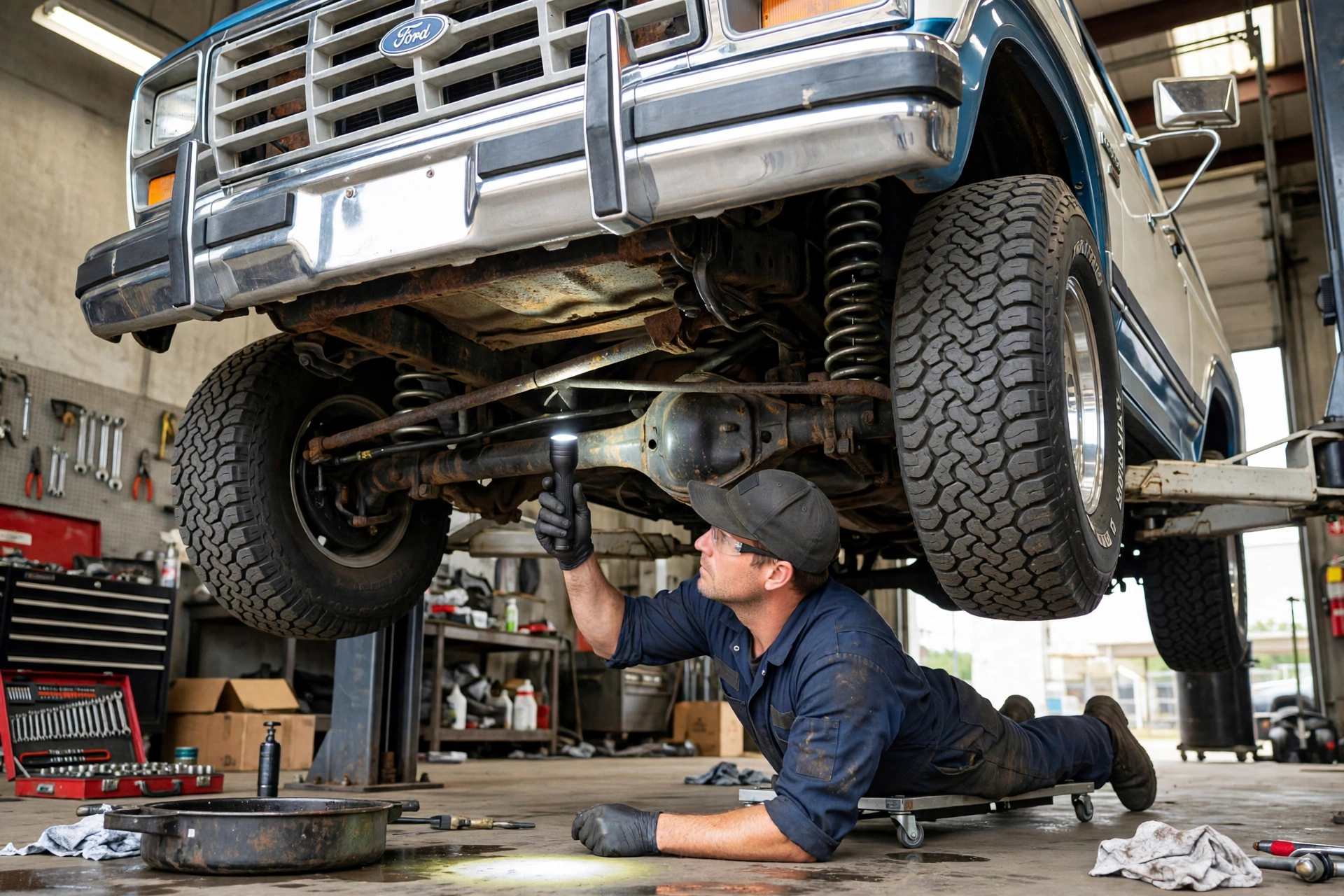
Inspect in this order: frame, floor pans, tailgate structure, then everything else. The body is secondary. The frame decides whether the truck has a future.
- Check the frame rails and radius arm mounts. Look at the front section where the radius arms mount, the middle section at the body mounts, and the rear where the frame kicks up behind the axle. Surface rust is expected, but perforation changes the story, and rust at a radius arm mount is structural.
- Lift the carpet and check the floor pans. Pull the carpet in the front footwells and under the rear seat. Soft spots and holes mean water got in through the top seal or the windshield. Full pan work costs $800 to $2,000 at shop rates.
- Test the tailgate and its window. Check the hinge area for rust and watch for a sagging tailgate, which usually means the hinge plates have rusted. The tailgate window motor is a common failure, so run the rear window up and down.
- Check the Twin-Traction Beam front end. Lift each front wheel and check the upper ball joints for play. Worn ball joints, tie rods, and radius arm bushings cause uneven tire wear and wandering steering. Replacement runs $400 to $700 installed including alignment.
- Identify the engine and check its health. The engine code sits on the emissions label under the hood, and it tells you whether the truck has the 4.9L six, the 5.0L, or the 5.8L. Check coolant, oil leaks, and cooling health, with extra care on the hotter-running 5.8L.
- Engage four-wheel drive on the test drive. Shift into 4-Hi and 4-Lo and listen for chain slap on deceleration, which sounds like a clunk or rattle when you lift off the throttle. Test the automatic locking hubs, because vacuum hubs are known for failing to engage the front axle.
- Verify originality with paperwork. Ask for the Marti build sheet, which confirms the original engine, transmission, axle ratio, paint code, and options for 1967 and later Broncos. Check the paint code against the Ford Bronco paint code chart and match the trim badges to the build sheet. Check wheel fitment against the Ford bolt pattern chart before you pay for aftermarket wheels.
5 Costly Problems 80s Bronco Buyers Must Avoid
- Frame rust at the body mounts. Rust eats the frame at the body mount points and the radius arm mounts first. A truck with a perforated frame needs professional repair, and that bill can exceed the price of a better truck. Walk away from perforation, even if the paint looks good.
- Twin-Traction Beam wear and bad alignment. The TTB design is harder on ball joints than a solid axle, and it is harder to keep aligned. A truck that eats front tires or wanders at highway speed needs ball joints, bushings, and a proper alignment.
- Early E4OD transmission trouble. Later fourth-generation trucks can carry the E4OD four-speed automatic, and early examples are known for overheating and harsh shifting. Test every shift on a warm truck, check the fluid color and smell, and ask for transmission service history.
- Dead vacuum hubs and tailgate window motors. Vacuum automatic locking hubs can fail to engage the front axle, which leaves you with two-wheel drive when you need four. The tailgate window motor fails often too. Test both before you pay.
- Hard-to-diagnose early fuel injection faults. Trucks from the carburetor-to-injection changeover years use early EEC-IV engine computers, and ageing electronics can be hard to trace without patience and a wiring diagram. A truck that stalls at random needs a proper diagnosis, not sensor swaps. If the 302 needs top-end work during that diagnosis, the Ford 302 torque specs chart gives the bolt sequences for the job.
5 Questions Buyers Ask About 80s Ford Broncos
Which 80s Bronco Year Is Best
A 1988 to 1991 truck with the 5.0L or 5.8L EFI V8 is the safest pick for most buyers. It has fuel injection, rear anti-lock brakes, and the most modern interior of the 1980s trucks.
How Much Should I Budget
Budget $15,000 to $28,000 for a driver-quality 1980s Bronco and $25,000 to $45,000 for a clean, rust-free 1987 to 1991 truck. Keep money aside after the purchase for tires, brakes, seals, and a full service, because even a good old truck needs sorting.
Is the Bronco II the Same
No. The Bronco II is a smaller truck based on the Ranger pickup, sold from 1984 to 1990, with a V6 engine and a much lower value. Its median sale price sits near $11,288, far below full-size Bronco prices.
Can I Daily Drive One
Yes, if the truck is sorted and you accept old-truck maintenance. A fuel-injected 1988 to 1991 truck is the easiest daily choice. Check the brakes, steering, tires, and cooling system first, because these trucks have no airbags and almost no modern driver aids.
What Towing Can It Handle
Towing capacity varies by year, engine, axle ratio, and equipment, so no single number covers every 1980s Bronco. The 5.8L V8 tows best, so confirm the rating on the door sticker and in the owner manual. The Ford F-150 towing capacity chart gives a useful reference for the same engines.
Your Best Next Step Toward an 80s Ford Bronco
An 80s old Ford Bronco is still an affordable way into a full-size classic 4×4 with a removable top and real V8 power. Pick the fourth generation if you want fuel injection and an easier daily driver, or pick the third generation if you love the Bullnose look and a lower entry price. Either way, let the frame decide: inspect it first, verify the engine and the paperwork, and compare the asking price with the ranges in this guide. A rust-free truck with honest history is worth the premium. Find one, check it in daylight, and drive it before you pay.