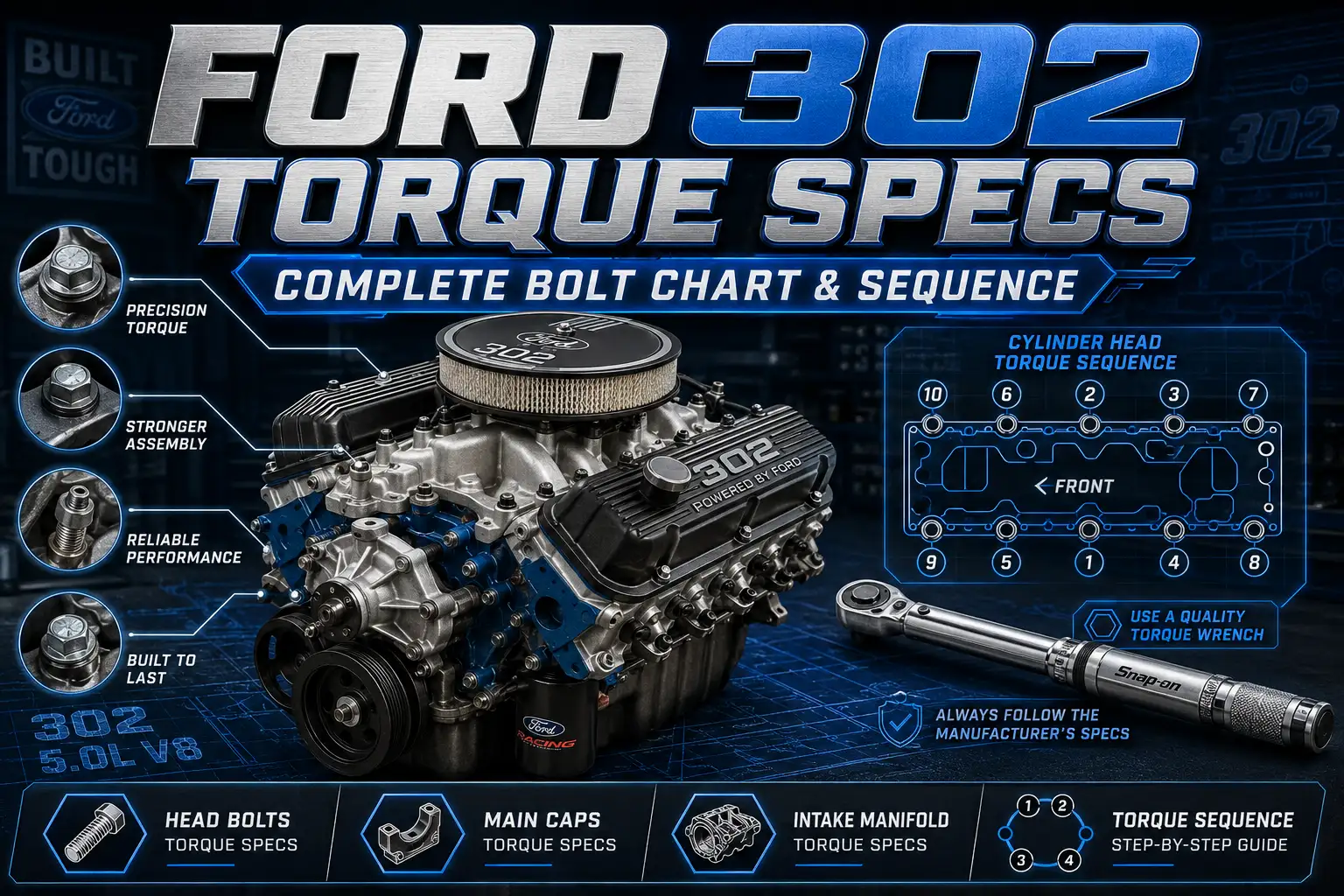
Ford 302 Torque Specs: Complete Bolt Chart & Sequence

Ask five different sources for Ford 302 head bolt torque and you’ll get five different numbers. Factory shop manuals, Chilton, gasket-kit instructions, and forum threads all cite slightly different figures, and on a 302, the “right” answer actually depends on which era of engine you’re working on.
This chart covers every major torque point on the Ford 302 (5.0L Windsor), which powered the Ford F-150, F-250, and F-350 from 1969 through 1996, alongside Mustangs and Broncos of the same era. Two things change the numbers below more than anything else: whether your engine uses stock torque-to-yield (TTY) head bolts or older reusable bolts, and whether you’re running factory hardware or aftermarket bolts like ARP.

Prime for Young Adults — 6 Months Free
Students and 18–24s get six months of Prime free, then half price.
Start 6 Months Free As an Amazon Associate I earn from qualifying purchases.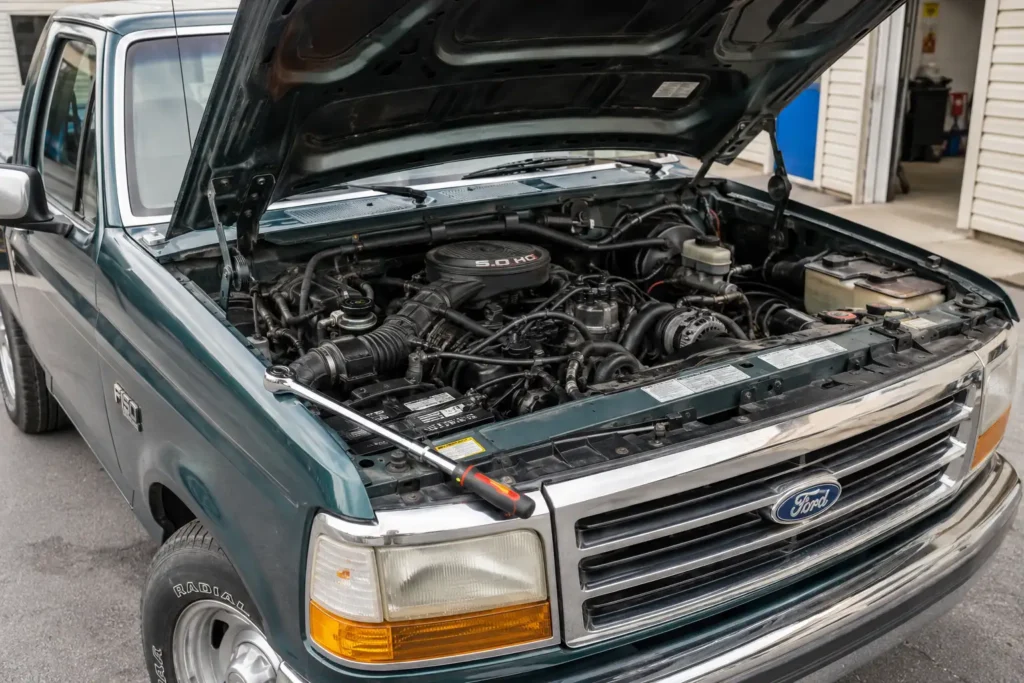
Both are called out below, and anywhere sources genuinely disagree, that conflict is flagged rather than papered over with a single made-up number.
Ford 302 Torque Spec Cheat Sheet
Head Bolts • Bottom End • Intake Manifold • Accessories
Head Bolts
Bottom End
Intake Manifold
Accessories
302 Head Bolt Torque Specs (Stock vs. TTY)
Recommended Best Deal Products

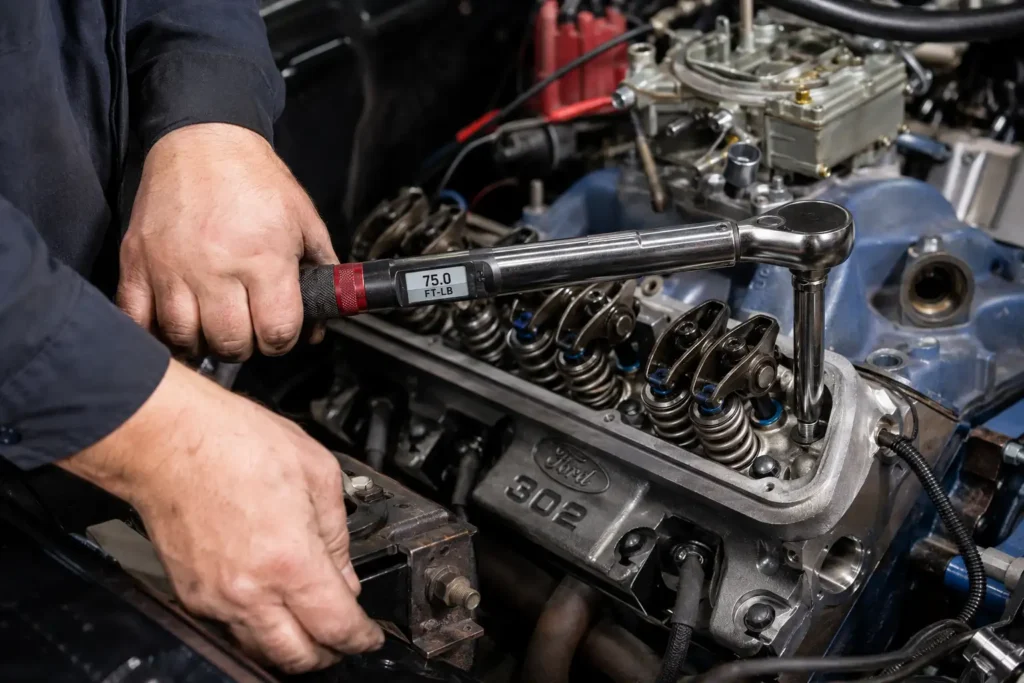
The 302 went through a real hardware change partway through its production run, and that’s the single biggest source of confusion in this spec.
Pre-1987 (reusable head bolts): Ford’s factory small-block procedure, echoed in Tom Monroe’s How to Rebuild Small-Block Fords, calls for a 3-step tightening sequence to a final torque of 65-72 ft-lb. Gasket manufacturer install sheets commonly list a slightly different split: 70 ft-lb on the short (bottom) bolts and 80 ft-lb on the long (top, valve-cover-area) bolts. Both procedures show up in circulation for the same engine family. If you have the exact factory shop manual for your model year, follow that over a generic gasket-kit sheet.
1987-and-later 5.0 H.O. (torque-to-yield bolts): Later 302s, including the high-output truck and Mustang variants, switched to one-time-use TTY head bolts. These are torqued in two steps: 55 ft-lb, followed by an additional 90-degree turn, not a straight ft-lb final value. TTY bolts stretch permanently during installation and should not be reused once removed.
Aftermarket (ARP) head bolts: ARP bolts are a different alloy and thread spec than factory Ford bolts, so they carry their own torque values (commonly higher than stock, applied with ARP’s specified assembly lube). Always follow the torque number printed on the ARP instruction sheet included with the bolt kit instead of the stock Ford number.
Sequence: Start at the center bolts and work outward, alternating side to side, in 3 steps (roughly 25-35 / 45-55 / final value).
| Bolt Type | Torque | Notes |
|---|---|---|
| Stock, pre-1987 (short/bottom bolts) | 65-72 ft-lb (or 70 ft-lb per gasket-kit spec) | 3-step, center-out sequence |
| Stock, pre-1987 (long/top bolts) | 65-72 ft-lb (or 80 ft-lb per gasket-kit spec) | Same sequence, higher spec on long bolts |
| TTY, 1987+ 5.0 H.O. | 55 ft-lb + 90° additional turn | One-time-use bolts, do not reuse |
| ARP aftermarket | Per ARP instruction sheet | Follow ARP spec, not factory Ford torque |
the 65-72 ft-lb vs. 70/80 ft-lb split shows up differently depending on source; if you have the factory manual for your exact year, it takes precedence over both figures above.
302 Main Bearing Cap and Rod Bearing Torque Specs
Internal bottom-end torque specs are more consistent across sources than the head bolt numbers above, but the stock-vs-aftermarket distinction still applies.

Audible — Listen Free for 30 Days
One free credit a month and thousands of titles included.
Listen Free for 30 Days As an Amazon Associate I earn from qualifying purchases.- Main bearing caps: 60-70 ft-lb, tightened in two steps.
- Rod bearing caps (stock bolts): 19-24 ft-lb.
- Rod bearing caps (ARP aftermarket bolts): commonly spec’d around 28 ft-lb. Follow the torque printed on the ARP kit, not the stock figure.
Rod and main bearings take a “crush” fit. Once a bearing has been removed from its cap, it should be replaced rather than reused, even if it looks fine.
| Component | Torque | Notes |
|---|---|---|
| Main bearing caps | 60-70 ft-lb | 2-step tightening |
| Rod bearing caps (stock) | 19-24 ft-lb | Do not reuse removed bearings |
| Rod bearing caps (ARP) | ~28 ft-lb | Confirm against ARP kit instructions |
302 Intake Manifold Torque Specs and Sequence
This is the second spec where factory documentation itself doesn’t fully agree. Ford Performance’s own intake manifold install sheet (M-9424, for 302/351W applications) specifies an initial torque of 10 ft-lb, followed by a final torque of 18 ft-lb for aluminum heads, tightened in the sequence printed on the sheet. Separately, a 1974 Ford truck factory shop manual lists 20-22 ft-lb, and Chilton’s manual lists a broader 19-27 ft-lb range depending on model year.
The practical takeaway: the lower Ford Performance figures (10/18 ft-lb) apply specifically to aluminum aftermarket heads using that intake gasket kit. For factory iron heads on an original F-150 or F-250 truck engine, the 20-22 ft-lb factory truck manual figure is the more directly applicable number. If your intake gasket kit includes its own instruction sheet, that sheet’s torque value takes precedence, since it’s matched to that specific gasket material.
Sequence: Center-out, alternating side to side, in at least two passes to reach final torque evenly.
| Application | Torque | Source |
|---|---|---|
| Aluminum heads (Ford Performance kit) | 10 ft-lb initial, 18 ft-lb final | Ford Performance install sheet M-9424 |
| Factory iron heads (truck) | 20-22 ft-lb | 1974 Ford truck factory shop manual |
| General (Chilton range) | 19-27 ft-lb | Varies by model year |
302 Exhaust Manifold and Accessory Bolt Torque
Rounding out the chart, these are the values a 302 owner most often needs during a service or rebuild:
| Component | Torque | Notes |
|---|---|---|
| Harmonic balancer / crank pulley bolt | 70-90 ft-lb | Consistent across multiple factory-manual references |
| Harmonic balancer (ARP bolt) | 90-120 ft-lb | Follow ARP’s instruction sheet, not the factory figure |
| Water pump bolts | 12-15 ft-lb | Don’t overtighten into a cast housing |
| Timing cover bolts | 12-15 ft-lb | |
| Oil pump bolts | 22-28 ft-lb | |
| Oil pan bolts (1/4″ bolts) | 7-10 ft-lb | Center-out, alternating sides |
| Oil pan bolts (5/16″ bolts) | 9-11 ft-lb | Same sequence as above |
| Exhaust manifold bolts | 20-25 ft-lb (shop-common figure) |
Oil pan and valve cover fasteners thread into thin castings. Overtightening here is a far more common cause of leaks than under-tightening. Snug evenly rather than cranking to a high number.
Why Ford 302 Torque Specs Conflict Across Sources
If the numbers above look like ranges instead of single values, that’s intentional. The conflicts are real, and here’s why they exist:
Bolt type changes the spec. A 302 built before 1987 uses reusable head bolts torqued to a straight ft-lb value. A later 5.0 H.O. uses one-time-use TTY bolts torqued by a ft-lb-plus-degree method. These are two different procedures for two different hardware types, not two competing opinions about the same bolt, which is exactly why forum threads full of “my manual says X” arguments often talk past each other. If you’re planning a 302 rebuild, confirm which bolt type your engine actually has before torquing anything.
Lubricant changes clamping force at the same reading. A bolt torqued to 70 ft-lb with plain engine oil on the threads achieves different actual clamping force than the same 70 ft-lb with moly lube or anti-seize, because friction at the threads is part of what a torque wrench measures. This is a documented reason gasket manufacturers and engine builders sometimes list different final numbers for what is mechanically the same bolt.
Aftermarket bolts follow their own spec, not Ford’s. ARP and other performance bolt makers use different alloys and thread engagement than factory Ford hardware, so their recommended torque is calculated separately, sometimes 20-30 ft-lb higher than the stock figure for the same bolt location.
Audible Premium Plus — Annual Membership
12 audiobook credits up front, plus the full Audible catalogue.
See Annual Plans As an Amazon Associate I earn from qualifying purchases.When specs conflict, this is the priority order to trust: the factory Ford shop manual for your exact model year first, followed by the install instructions included with the specific gasket or bolt kit you’re using, followed by general small-block reference guides, with forum-sourced numbers treated as a starting point to verify rather than a final answer.
FAQ
Do 302 head bolts need to be replaced after removal?
If your engine uses TTY (torque-to-yield) head bolts, standard on 1987-and-later 5.0 H.O. engines, yes, replace them every time they’re removed. Older reusable-style head bolts can typically be reused if they’re not stretched or damaged, but check them for thread condition first.
What torque do ARP head bolts use on a 302?
ARP head bolts use torque values specified on ARP’s own instruction sheet included with the kit, applied with ARP’s assembly lube, not the stock Ford torque figure, since the bolt material and thread spec differ from factory hardware.
Is the 302 in an F-150 the same torque spec as a Mustang 302?
Largely yes. The F-150’s 302 shares the same core architecture as the Mustang 302 of the same model year, so head, main, and rod torque specs are the same. The exceptions are accessory-specific brackets (like heavier-duty truck engine mounts), which aren’t covered by this chart.