
How Often Does a Car Need an Oil Change? 7 Proven Answers for 2026

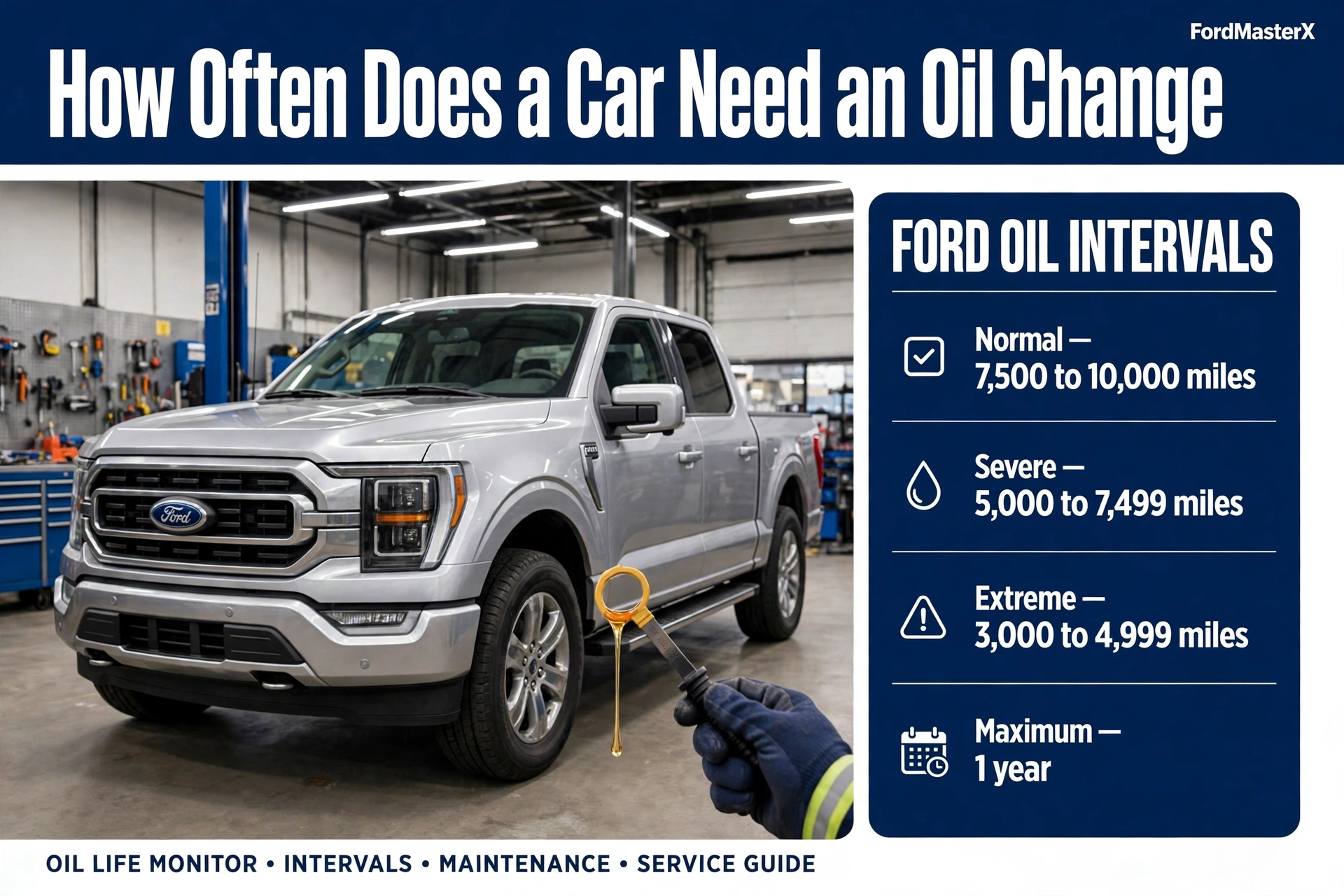
Your car needs an oil change when your owner’s manual or oil life monitor says so, and never later than one year or 10,000 miles after the last change. For most modern Fords, that works out to 7,500 to 10,000 miles under normal driving, and 5,000 to 7,499 miles when towing, short trips, or dusty roads enter the picture. The old 3,000 mile rule no longer fits a modern Ford engine on full synthetic oil. This guide gives you Ford’s own numbers for gasoline and diesel engines, shows you how the Intelligent Oil-Life Monitor decides, and helps you find the branch that matches the way you actually drive. Start with the chart in the intervals section, then check the signs section if your truck is already overdue.
How Often Does a Car Need an Oil Change
There is no single mileage number that fits every Ford. Ford builds the answer around three inputs: how you drive, which engine you have, and which oil it calls for. Your truck falls into one of three branches, and each branch has its own range.


Normal driving means mostly highway miles, light loads, and moderate temperatures, and the oil life message should appear between 7,500 and 10,000 miles. Severe driving means regular towing, mountain roads, extended idling, or heavy loads, and that pulls the message forward to 5,000 to 7,499 miles. Extreme use means maximum loads or very hot or very cold operation, dropping the interval to 3,000 to 4,999 miles on gasoline engines and 2,500 to 5,000 miles on diesels.
Time counts as much as miles. Oil degrades chemically as it sits, so a truck that covers only 4,000 miles in a year still needs fresh oil at the one year mark. Ford sets a hard ceiling of one year or 10,000 miles between changes, whichever comes first. General industry guidance lines up with Ford here: most modern engines on conventional oil run 5,000 to 7,500 miles, while full synthetic stretches that to 7,500 to 10,000 miles.
Use the monitor as your guide and the ceiling as your backstop. If the message appears, book the service within two weeks or 500 miles. If a year passes with no message, change the oil anyway.
What Ford Intelligent Oil Life Monitor Actually Measures


Ford’s Intelligent Oil-Life Monitor is an algorithm, not a mileage counter. It watches engine revolutions, load, operating temperature, trip length, and idle time, then estimates how much life the oil has left. Short cold trips wear oil faster than steady highway miles, so two identical trucks can show very different intervals.
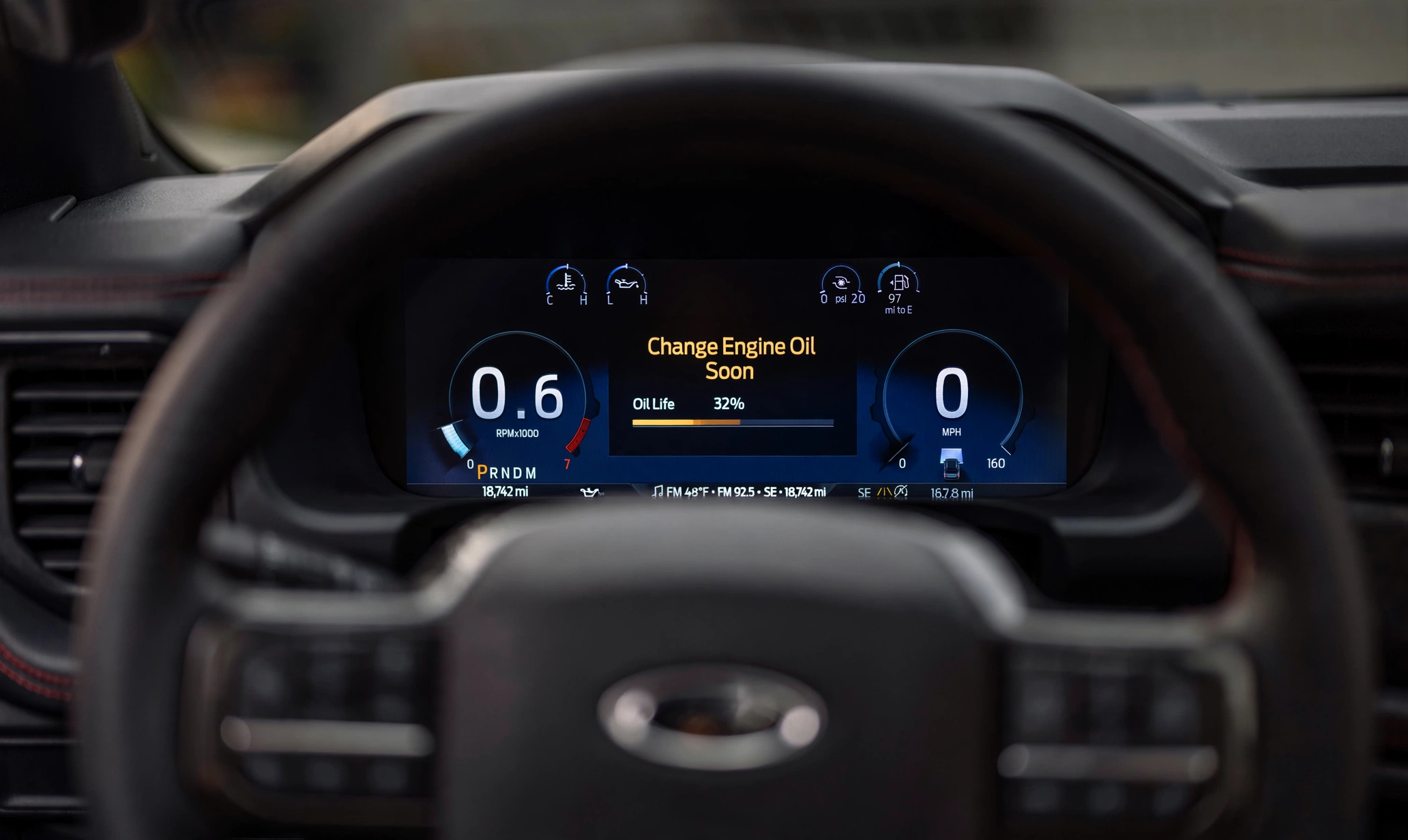
When the message appears, Ford says to complete the oil change within two weeks or 500 miles of the message. After each change, reset the monitor so it starts counting from a full oil life. A shop that skips the reset leaves you with a monitor that cries wolf early or stays silent too long. The meaning of the change engine oil soon warning on a Ford explains what each dashboard message says and what to do when it appears.
If the display is ever reset by accident or stops working, Ford gives a fallback: change the oil at six months or 5,000 miles from the last change, and never exceed one year or 10,000 miles. Hybrid Fords can run past 10,000 miles on the monitor because the gasoline engine rests part of the time, but the one year limit still applies to them.
The monitor assumes you use the oil your manual specifies. Ford’s official scheduled maintenance guidance states the interval may be up to one year or 10,000 miles. Pour in a thicker grade or an oil that misses the Ford spec on the bottle, and the monitor’s estimate no longer matches the oil in the sump.


7 Ford Oil Change Intervals by Driving Condition


Match your driving to a row in this chart, then read the range that applies to your engine. The ranges come from Ford’s own scheduled maintenance guidance and describe when the oil life message should appear. Treat the low end of each range as the safe choice if you sit between two rows.


Find Your Ford Oil Change Interval
Match your driving to a row. The monitor decides the exact day, and the ceiling is 1 year or 10,000 miles.
Mostly highway miles, light loads, flat roads, moderate temperatures. This is the range most daily commuters see.
Regular towing, mountain or off road use, extended idling, heavy loads, short trips under 5 to 10 miles. Diesel severe tops out at 7,500 miles.
Maximum loads, extreme hot or cold operation, on gasoline engines. Diesel extreme drops to 2,500 to 5,000 miles because soot loads the oil faster.
Normal Highway Driving


Normal means the easy life for oil: steady speeds, warm engine, light load. Ford expects the oil life message between 7,500 and 10,000 miles here, where most F-150 commuters land. Check the level monthly, because a slow leak can leave the sump low long before the message appears.


Severe Towing and Short Trips
Severe is more common than most owners think. Ford counts short trips under 5 to 10 miles, dusty conditions, extended idling, heavy loads, and towing as severe driving. If any of those describe most of your driving, follow the severe branch and expect the message between 5,000 and 7,499 miles on gasoline engines, or 7,500 miles on a diesel.
A work truck that tows a trailer on weekdays and idles at job sites is a severe service truck. Ford also notes that every hour of idling adds about 25 miles of wear, so a truck idling two hours a day ages its oil far faster than the odometer shows.
Extreme Loads and Heat


Extreme covers maximum towing, sustained very hot or very cold operation, and high sulfur diesel fuel on diesel engines. Ford puts gasoline engines at 3,000 to 4,999 miles here and diesels at 2,500 to 5,000 miles. A summer of max towing in desert heat or a winter of plowing in deep cold puts a truck there for that season.
The Ford engine oil recommendation chart lists the exact oil spec for each Ford engine. Match the bottle to your truck before you buy, because the monitor’s math assumes the right oil is in the engine.
6 Ford Oil Change Intervals by Engine Type
Engines do not all treat oil the same way. Turbocharged gasoline engines run hotter and shear oil harder than a naturally aspirated V8, and diesels load oil with soot. Use this table to pin the interval to your engine, then confirm it against your owner’s manual.
| Engine | Oil Spec | Capacity With Filter | Typical Interval |
|---|---|---|---|
| 3.5L EcoBoost | 5W-30, WSS-M2C971-A1 | 6.0 quarts | 7,500 to 10,000 miles |
| 2.7L EcoBoost | 5W-30, WSS-M2C971-A1 | 6.0 quarts | 7,500 to 10,000 miles |
| 5.0L V8 | 5W-20 or 5W-30 by year | 7.7 to 8.8 quarts by year | 7,500 to 10,000 miles |
| 7.3L gas V8 | 5W-30, WSS-M2C971-A1 | 8.0 quarts | 7,500 to 10,000 miles |
| 6.7L Powerstroke diesel | Diesel oil, Ford spec | 13.0 qt (2022 and older), 15.0 qt (2023 and newer) | 7,500 to 10,000 miles normal, 5,000 to 7,500 severe |
| Older Ford gasoline, no monitor | Per manual, often 5W-20 | Varies by engine | 7,500 miles or 6 months fixed |
EcoBoost Turbo Gasoline Engines
The 3.5L and 2.7L EcoBoost engines both hold 6.0 quarts with a filter change and call for full synthetic 5W-30. Ford’s July 2026 Motorcraft chart lists WSS-M2C971-A1 for 2017 to 2026 EcoBoost engines, while earlier years used WSS-M2C946-B1. Turbo heat breaks oil down faster than a naturally aspirated engine does, so the full synthetic spec is not optional. The best oil for the 3.5 EcoBoost compares oils that meet the Ford spec.
V8 Gasoline Truck Engines


The 5.0L V8 lands in the same 7,500 to 10,000 mile band as the EcoBoost engines. The 7.3L gas V8 takes 8.0 quarts of 5W-30 meeting WSS-M2C971-A1 and sits in the same band. Capacity varies by model year, from 7.7 to 8.8 quarts with a filter, so check the manual for your year before you pour. Older V8 trucks without a monitor, such as the 2010 F-150 5.4L, follow a fixed schedule instead, and the 2010 F-150 5.4 oil capacity guide lists the right fill for that generation.
Powerstroke Diesel Engines
The 6.7L Powerstroke holds 13.0 quarts with a filter through 2022 and 15.0 quarts from 2023, and it follows the diesel IOLM table: 7,500 to 10,000 miles under normal use, 5,000 to 7,500 miles under severe use, and 2,500 to 5,000 miles under extreme use. Soot is the reason the diesel floor sits lower. The 2020 6.7 Powerstroke oil capacity guide gives the exact fill for that model year.
Older Ford Trucks
Some older Ford gasoline models never had an Intelligent Oil-Life Monitor. Ford’s fixed schedule for those trucks is 7,500 miles or six months, whichever comes first. If your truck has no monitor message and no windshield sticker you trust, use that fixed schedule and keep a simple log of date and mileage at each change.
6 Signs Your Ford Needs an Oil Change Now
The monitor is the main signal, but your senses catch what the algorithm cannot. Check these six signs monthly, and act on any one of them even if the monitor is quiet.
- The oil life message is on. Book the change within two weeks or 500 miles, then reset the monitor.
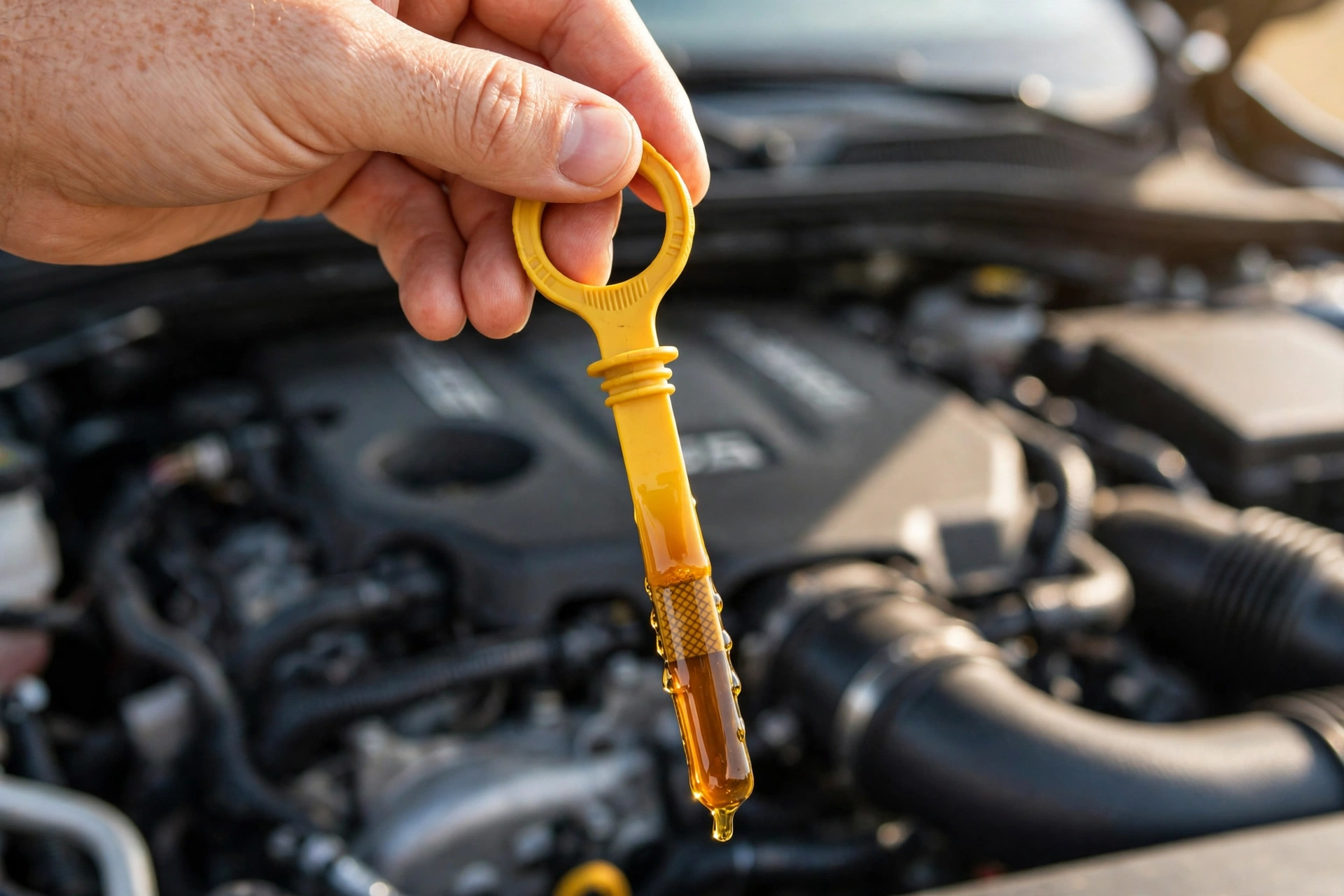
- The oil on the dipstick is black and gritty. Fresh oil is amber and smooth. Oil that looks black and feels gritty between your fingers is carrying wear particles past its useful life.
- The level sits below the low mark. A low level means the engine is either burning oil or losing it. Top it up to the full mark with the correct spec, then watch the level weekly. Ford notes that demanding conditions can push oil consumption toward one quart per 500 miles.
- The engine sounds louder or rougher than usual. Thin, worn oil protects less at startup and under load. A new tick or knock that appears near the end of an interval is a reason to change the oil first and ask questions second.
- The exhaust smells burnt or looks blue. Burnt oil smell or blue smoke points to oil reaching hot surfaces or passing worn seals. Change the oil, check the level daily for a week, and look for a leak before the next drive.
- A year has passed since the last change. Time alone is a sign. Oil oxidizes as it sits, and a low mileage truck still needs fresh oil at the one year mark.
A low level with no visible leak deserves a closer look. The common oil leaks on the 3.5 EcoBoost guide shows where that engine tends to lose oil.
5 Mistakes That Shorten Your Oil Change Interval
- Using the wrong oil spec. The monitor assumes the oil in the sump meets the Ford spec for your engine. A cheaper oil with the wrong viscosity shortens real oil life while the monitor still counts as if everything were fine. Buy the spec on the bottle, not the price on the shelf.
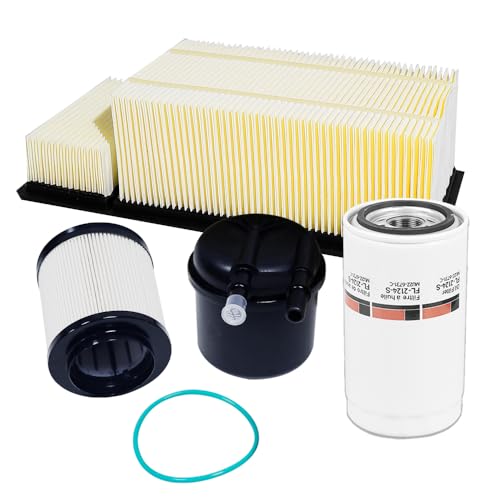
- Skipping the filter at every change. The filter holds the wear particles the old oil carried, so a new fill through an old filter starts dirty. Change the filter with every oil change. The best oil filter for the 3.5 EcoBoost lists filters that fit that engine.
- Ignoring the one year time limit. A truck that covers 3,000 miles a year still needs an annual change. Oxidation and moisture do not wait for the odometer, and a garage kept truck can still have degraded oil after twelve quiet months.
- Trusting the windshield sticker over the manual. The sticker shows whatever the last shop set, often a flat 3,000 miles regardless of your oil type or engine. Your manual and your monitor know your truck.
- Never checking the level between changes. AAA advises checking the oil level at least once a month, and that advice matters more as intervals get longer. A monthly dipstick check takes a minute and catches consumption before it becomes damage.
How to Check Oil and Reset the Monitor
Check the level on a level surface with the engine warm and off for five to ten minutes. Pull the dipstick, wipe it clean, push it fully back in, then pull it out again and read the level between the two marks. The oil should be amber to dark brown and feel smooth, not gritty. If the level is low, add the same spec oil a little at a time and recheck.
Reset the monitor after every oil change. On many newer Fords the reset runs through the instrument cluster menu using the steering wheel controls, but the exact path varies by model year and cluster. On a 2026 F-150, Ford lists Settings, then Vehicle Maintenance, then Oil Life, holding OK until the reset confirmation appears, or Truck Info, then Engine Information, holding OK until the reset confirmation appears. Check your owner’s manual for the path your truck uses. The Ford Escape oil change reset guide shows the menu path for that model.
Keep a simple record of each change: date, mileage, oil brand and spec, and filter part number. The record settles any doubt about when the next change is due.
5 Questions Ford Owners Ask About Oil Changes
Can I Go Past 10,000 Miles?
No. Ford sets a hard ceiling of one year or 10,000 miles between oil changes, and hybrid Fords may pass 10,000 miles on the monitor but never pass one year. Going past the ceiling risks warranty trouble and real engine wear.
Does Synthetic Oil Really Last Longer?
Yes. Full synthetic oil resists heat and oxidation far better than conventional oil. AAA reports that most modern engines run up to 7,500 miles, while cars on full synthetic can reach 15,000 miles where the maker allows it. Ford’s own range tops out at 10,000 miles, so use the Ford ceiling for your truck.
What If I Barely Drive My Truck?
Change the oil once a year even if the mileage stays low. Oil degrades with time, moisture, and short cold trips, so a truck that covers 3,000 miles a year still needs fresh oil at the twelve month mark.
Does Towing Shorten the Interval?
Yes. Towing is severe service in Ford’s definition, and it pulls the oil life message forward to 5,000 to 7,499 miles. Maximum towing in extreme heat can drop the interval to 3,000 to 4,999 miles on gasoline engines.
What Happens If I Wait Too Long?
Worn oil loses its ability to protect bearings, cam lobes, and turbochargers. Sludge builds up, passages narrow, and wear accelerates. One overdue change rarely kills an engine, but a habit of overdue changes shortens its life by years.
Set Your Next Oil Change Date in 5 Steps
How often does a car need an oil change? For your Ford, five steps settle it: follow the Intelligent Oil-Life Monitor, stay inside the 7,500 to 10,000 mile band for normal driving, shorten it to 5,000 to 7,499 miles when you tow or take short trips, never pass one year or 10,000 miles, and check the level monthly. Use the oil spec your manual names, reset the monitor after every change, and keep a record of the date and mileage. Open your owner’s manual, find your branch in the chart above, and put the next oil change date on your calendar today.