
How Much HP Does a 6.7 Powerstroke Have? 2026 Complete Guide

If you are asking how much hp a 6.7 Powerstroke has, the short answer is that it depends on the year. A 6.7 Powerstroke makes anywhere from 390 hp in its original 2011 calibration to 500 hp in the current High Output version.
That range is the whole point of this guide. Ford has raised the rating five times since 2011, and since 2023 there have been two versions on sale at once.
This page gives you the horsepower and torque for every model year, explains what changed and why, and shows you how to find out which version is in your truck.
The Short Answer: 6.7 Powerstroke HP by Year
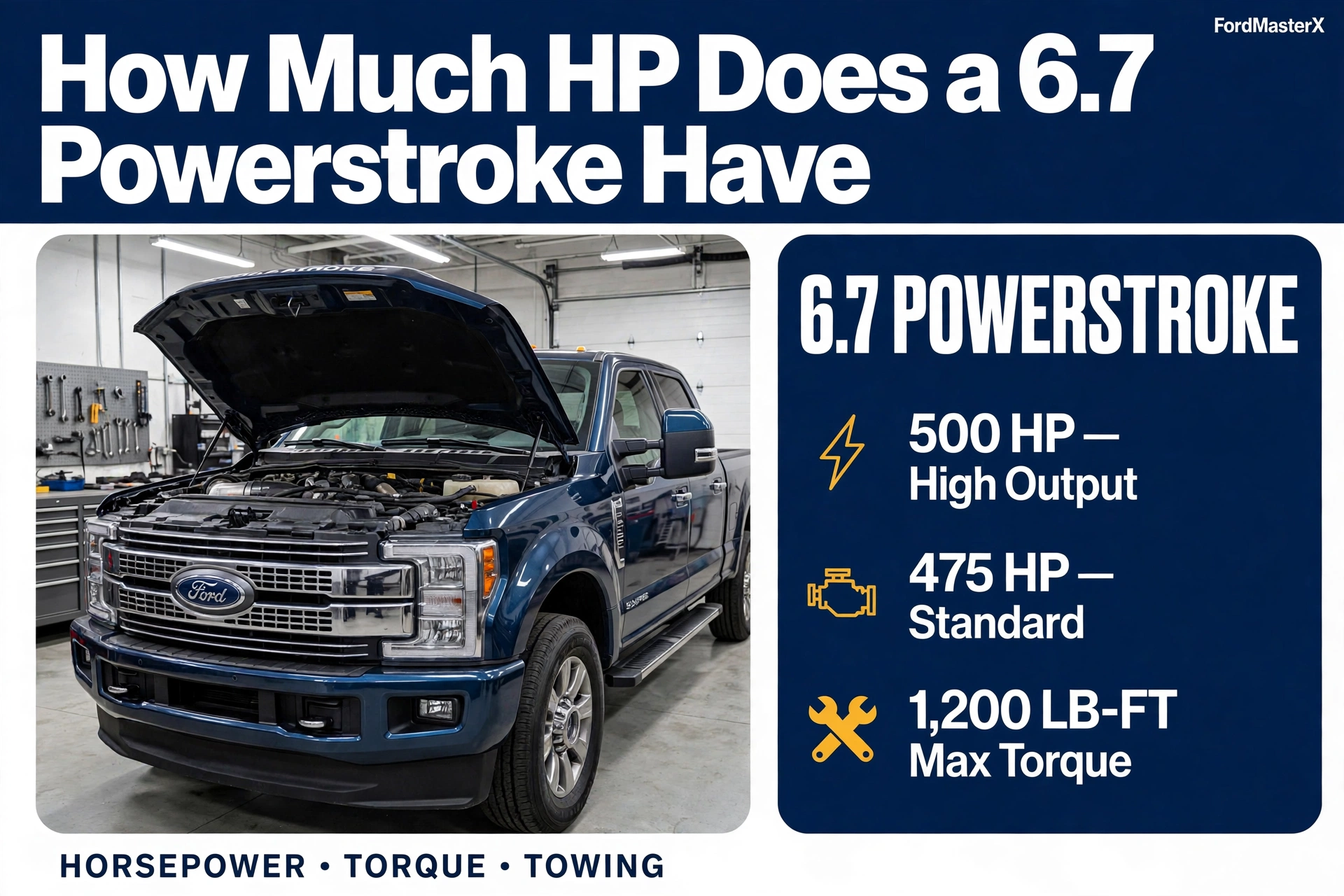
Here is the complete answer in one table. These are Ford-published ratings for Super Duty pickups in the United States, and the infographic after the table gives you the same answer to save or share.
| Model Years | Horsepower | Torque | Notes |
|---|---|---|---|
| 2011 (launch) | 390 hp @ 2,800 rpm | 735 lb-ft @ 1,600 rpm | Original calibration |
| 2011 (updated) – 2014 | 400 hp @ 2,800 rpm | 800 lb-ft @ 1,600 rpm | Free dealer software update for early 2011 trucks |
| 2015–2016 | 440 hp @ 2,800 rpm | 860 lb-ft @ 1,600 rpm | Larger single turbo |
| 2017 | 440 hp @ 2,800 rpm | 925 lb-ft @ 1,800 rpm | Same hp, more torque |
| 2018–2019 | 450 hp @ 2,800 rpm | 935 lb-ft @ 1,800 rpm | Small bump in both figures |
| 2020–2022 | 475 hp @ 2,600 rpm | 1,050 lb-ft @ 1,600 rpm | Third-generation engine, 10-speed automatic |
| 2023–2026 standard | 475 hp @ 2,600 rpm | 1,050 lb-ft @ 1,600 rpm | Same as 2020–2022 |
| 2023–2026 High Output | 500 hp @ 2,600 rpm | 1,200 lb-ft @ 1,600 rpm | Optional High Output version |
Two rows in that table trip people up. First, the 2011 model year has two ratings: early trucks left the factory at 390 hp, and Ford offered a free dealer reflash that raised them to 400 hp.
Second, 2017 is not a 450 hp year. The 2017 truck kept 440 hp and gained torque instead, rising to 925 lb-ft. The 450 hp rating started in 2018.
Chassis-cab trucks use lower ratings than pickups, even with the same engine badge. A 2023 or newer chassis cab is rated at 330 hp and 950 lb-ft, not the pickup figures above. Never apply a pickup rating to a work truck without checking its own specification sheet.
6.7 Powerstroke Horsepower — At a Glance
Ford-published pickup ratings, U.S. market. The year alone does not settle it on 2023 and newer trucks — check standard or High Output.
| Model Years | Horsepower | Torque | Version |
|---|---|---|---|
| 2011 launch | 390 hp | 735 lb-ft | STANDARD |
| 2011 updated – 2014 | 400 hp | 800 lb-ft | STANDARD |
| 2015 – 2016 | 440 hp | 860 lb-ft | STANDARD |
| 2017 | 440 hp | 925 lb-ft | STANDARD |
| 2018 – 2019 | 450 hp | 935 lb-ft | STANDARD |
| 2020 – 2022 | 475 hp | 1,050 lb-ft | STANDARD |
| 2023 – 2026 | 475 hp | 1,050 lb-ft | STANDARD |
| 2023 – 2026 | 500 hp | 1,200 lb-ft | HIGH OUTPUT |
Direct answer: a current 6.7 Powerstroke makes 475 hp, or 500 hp with the High Output option. An early 2011 truck makes 390 hp before the factory update and 400 hp after it.
Figures are SAE engine ratings at the crank, not rear-wheel horsepower. Chassis-cab and F-650/F-750 ratings are lower. Sources: Ford 2025 Super Duty Towing Guide; Ford model-year technical specifications via Powerstroke Online and DieselHub.
What Horsepower and Torque Actually Mean Here
Horsepower and torque describe two different things, and diesel buyers should care more about the second one. Horsepower is the rate at which the engine does work, and it decides how fast the truck can accelerate and hold speed. Torque is the twisting force the engine produces, and it decides how easily the truck gets a heavy trailer moving.
That is why the torque column in the table matters as much as the horsepower column. Torque on the 6.7 Powerstroke peaks at just 1,600 rpm on most model years, which is barely above idle.
The engine is already pulling hard before the tachometer needle has moved far, and that low-speed pull is what makes a diesel feel strong with a trailer behind it.
Ford publishes these figures as SAE engine ratings. That means they are measured at the engine’s crankshaft on a test stand, not at the rear wheels on a chassis dynamometer.
A dyno reading from your truck will always be lower, because the transmission, driveshaft, and axles absorb some power on the way to the wheels. A lower dyno number does not mean the factory rating is wrong.
Horsepower and torque also peak at different engine speeds, and Ford says so in its own footnotes. The two peaks are independent attributes and may not be achieved at the same time. A truck is never making its maximum horsepower and its maximum torque in the same instant.
The 6.7 Powerstroke, Generation by Generation
The 6.7 Powerstroke is Ford’s first diesel engine designed and built in-house for the Super Duty. It replaced the 6.4L Power Stroke for the 2011 model year, and it has been revised in three broad generations since. Each revision brought more power, and each one changed hardware, not just software.
2011–2014: The Scorpion Arrives — 390, Then 400 HP
Ford launched the 6.7L, codenamed Scorpion, at 390 hp and 735 lb-ft. It used a compacted graphite iron block, aluminum cylinder heads, and a GT32 DualBoost turbocharger with two compressor wheels. Before the first trucks even reached many buyers, Ford announced a higher rating of 400 hp and 800 lb-ft on August 3, 2010.
Early 2011 owners could get the higher rating with a free dealer software update. That is why two different horsepower figures circulate for 2011, and both are correct for different trucks. A 2011 truck that never got the reflash is still a 390 hp truck, while one that did is a 400 hp truck.
The 2012–2014 pickups all carry the 400 hp and 800 lb-ft rating. These first-generation trucks used a six-speed TorqShift automatic. They established the engine’s reputation, but they also had the teething problems of a brand-new design, including fuel system and turbocharger issues that later generations addressed.
2015–2016: A New Turbo Lifts Output to 440 HP
Ford revised the engine for 2015 with a larger single GT37 variable-geometry turbocharger, replacing the twin-compressor GT32. The fuel system was revised too, with new injectors and an upgraded high-pressure pump. Output rose to 440 hp and 860 lb-ft, a gain of 40 hp and 60 lb-ft over the first generation.
The turbo change was the headline, but the supporting changes mattered just as much. Ford added material to the cylinder heads and exhaust manifold, and fitted a new five-layer head gasket, so the engine could hold the higher output reliably.
This is the generation where the 6.7 started to feel like the modern diesel buyers expect, with stronger mid-range pull and cleaner emissions hardware.
Our guide to the 2023 6.7 Powerstroke oil capacity covers the later engine’s service needs, and the same habit applies here: confirm the exact year before ordering parts, because turbo and fuel parts changed between generations.
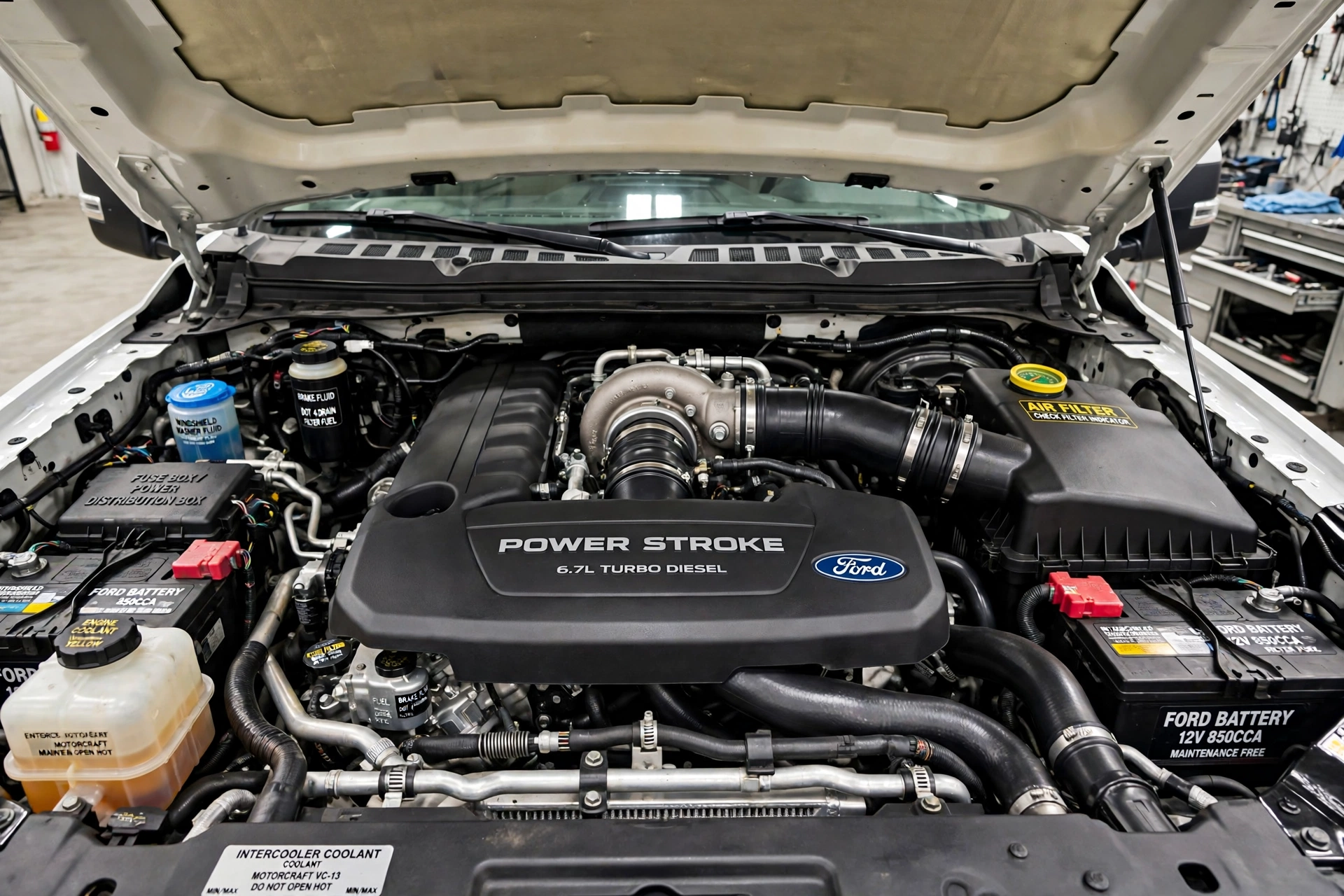
AI-generated illustration: the 6.7L Power Stroke V8 in a Super Duty engine bay, with the turbocharger and intake plumbing visible.
2017: The Torque-Only Year — 440 HP, 925 LB-FT
The 2017 Super Duty arrived on an all-new aluminum-bodied truck, and the engine got a major overhaul. Peak horsepower stayed at 440, but torque climbed to 925 lb-ft at 1,800 rpm. Ford revised the turbo oil supply line and pedestal as part of the update.
This is the year most online summaries get wrong. Many tables lump 2017 with 2018–2019 at 450 hp, but Ford’s own 2017 brochure lists 440 hp and 925 lb-ft.
The 2018 brochure is the first to list 450 hp. If you are buying a 2017, quote 440 hp, not 450.
The distinction matters for more than trivia. Parts catalogs split at the 2017 change, and a turbo or fuel component for a 2018 truck may not fit a 2017. Check the model year and the build date before ordering, not just the generation name.
2018–2019: 450 HP and 935 LB-FT
For 2018, Ford raised output to 450 hp and 935 lb-ft, a gain of 10 hp and 10 lb-ft over 2017. The change came from calibration and small hardware revisions rather than a new turbo or block. The 2019 truck carries the same rating.
These two years are the peak of the second-generation engine. They pair the revised 2017 hardware with the highest output that hardware ever produced. A 2018 or 2019 truck is the strongest 6.7 you can buy before the 2020 redesign, and it still uses the six-speed automatic.
Compared with the 2011 launch truck, a 2019 makes 60 hp and 200 lb-ft more. That is a large gain from the same 6.7 liters of displacement, achieved through turbo, fuel system, and calibration work over eight model years.
2020–2022: The Third Generation Breaks 1,000 LB-FT — 475 HP
The 2020 redesign was the biggest change since launch. Ford fitted forged steel pistons, a new turbocharger, and a fuel system running at 36,000 psi. Output jumped to 475 hp and 1,050 lb-ft, the first time a factory Power Stroke passed 1,000 lb-ft of torque.
The 10-speed TorqShift automatic arrived with the new engine. More gears let the engine stay near its torque peak more of the time, so the extra power is usable in real towing, not just on a specification sheet.
Peak horsepower now arrives at 2,600 rpm instead of 2,800, and peak torque at 1,600 rpm.
At this point the 6.7 had gained 85 hp and 315 lb-ft over the original 2011 launch rating. The block, pistons, and fuel system were all substantially stronger than the 2011 design. That strength is what later made the High Output version possible.
2023 and Newer: Two Versions — 475 HP or 500 HP
For the 2023 Super Duty redesign, Ford split the 6.7 into two versions. The standard engine carries the 2020–2022 rating of 475 hp and 1,050 lb-ft. The new High Output version makes 500 hp and 1,200 lb-ft, and it is the most powerful factory diesel Ford has ever put in a pickup.
Ford lists both versions in its 2025 towing guide, with the same peak speeds: 2,600 rpm for horsepower and 1,600 rpm for torque. The standard engine suits most heavy towing, while the High Output exists for trucks that work near the top of the Super Duty’s capability.
For 2027, Ford lists the 500-hp High Output as the only 6.7L diesel for pickups, according to Ford’s 2027 specifications cited by secondary sources.
The split means the model year alone no longer answers the question on a 2023 or newer truck. You have to know which version the truck has, and the section below on identifying your engine shows exactly how to check.
Standard vs High Output: What Is Different
The High Output is not the standard engine with a different tune. Ford fits a unique turbocharger with a water-cooled compressor, stainless-steel exhaust manifolds, and unique calibration. Those hardware differences are why the High Output makes 25 hp and 150 lb-ft more than the standard engine.
| Spec (2023–2026 pickups) | Standard 6.7L | High Output 6.7L |
|---|---|---|
| Horsepower | 475 hp @ 2,600 rpm | 500 hp @ 2,600 rpm |
| Torque | 1,050 lb-ft @ 1,600 rpm | 1,200 lb-ft @ 1,600 rpm |
| Turbocharger | Standard single turbo | Unique turbo, water-cooled compressor |
| Exhaust manifolds | Standard manifolds | Stainless-steel manifolds |
| Max gooseneck towing | 38,600 lbs | 40,000 lbs |
| Max payload | 6,952 lbs | 6,935 lbs |
The towing difference is smaller than the torque gap suggests. The High Output’s 40,000-lb gooseneck maximum needs the 40K Gooseneck Tow Package and an F-450 with the right configuration. On an F-250, the two engines tow nearly the same weight: 22,900 lbs gooseneck for the standard engine and 23,000 lbs for the High Output.
Payload even tilts the other way. The standard engine’s maximum payload is 6,952 lbs, slightly higher than the High Output’s 6,935 lbs. The two maxima come from different configurations, and payload is what is left after the truck itself is weighed.
Our full comparison, 6.7 Powerstroke High Output vs Regular, covers the two engines in detail, including which trims offer the High Output and what it costs. Read it before ordering, because the High Output is an option, not standard equipment.
Before 2023 there was no High Output pickup version. If someone offers you a 2021 “High Output” 6.7, the label is wrong. The 2020–2022 engine is the standard-output design at 475 hp, and that is the only 6.7 Ford sold in those years.
Which Trucks Got Which Version
Every 6.7 Powerstroke pickup is an F-250, F-350, or F-450 Super Duty. The engine has never been offered in the F-150, and the 7.3L gas V8 is the other heavy-duty choice in the same trucks. The 6.7 is the diesel option across the whole Super Duty pickup range, from the work-grade XL to the top trims.
The F-450 pickup is diesel-only, so every F-450 pickup has a 6.7. That makes the F-450 the natural home of the High Output, because the 40,000-lb gooseneck maximum belongs to the F-450 with the towing package. Our F-450 Super Duty Platinum guide covers the top F-450 trim and what its diesel delivers.
The F-250 is the most common 6.7 truck, and it is where the standard-versus-High Output choice matters least for towing. Both engines tow a 22,000-lb conventional trailer at their maximum, and their gooseneck ratings differ by only 100 lbs.
Buy the High Output on an F-250 for the extra torque and response, not for a towing number you will never reach. See our F-250 Super Duty overview for the full range.
Chassis cabs are a separate story. A chassis cab is the truck Ford sells without a bed, for upfits such as flatbeds, service bodies, and dump bodies.
Its 6.7 is detuned for durability under constant commercial load: 300 hp and 660 lb-ft for 2011–2016, 330 hp and 750 lb-ft for 2017–2019, 330 hp and 825 lb-ft for 2020–2022, and 330 hp and 950 lb-ft from 2023. The same badge, a much lower rating.
Medium-duty F-650 and F-750 trucks use the 6.7 too, at 270 to 330 hp depending on the year and rating. Their numbers have risen over time as well, reaching 330 hp with up to 850 lb-ft on the newest trucks. These are commercial ratings for commercial work, and they should never be quoted as pickup figures.
The Power Stroke name itself is older than the 6.7. The 7.3L Power Stroke powered Super Duty trucks from the 1990s into 2003, and our 1996 F-250 Powerstroke diesel 4×4 guide looks at one of those early trucks.
The 6.7 shares only the name with that engine. Everything else, from the block to the turbo, is a different design.
What the Horsepower Means for Towing
Horsepower sells trucks, but torque tows trailers, and the 6.7’s story is really a torque story. Torque rose from 735 lb-ft in 2011 to 1,200 lb-ft in the High Output, a gain of 465 lb-ft. That gain is what lets a current Super Duty pull a gooseneck trailer that would have been unthinkable for a pickup fifteen years ago.
Ford’s 2025 towing guide puts the numbers in context. A properly equipped standard-diesel Super Duty tows up to 38,600 lbs on a gooseneck hitch, and the High Output reaches 40,000 lbs with the 40K package.
Both figures need the right truck, axle ratio, and equipment. No single number applies to every truck with the engine. Ford’s 2025 Super Duty towing guide lists the rating for each cab, axle, and hitch combination.
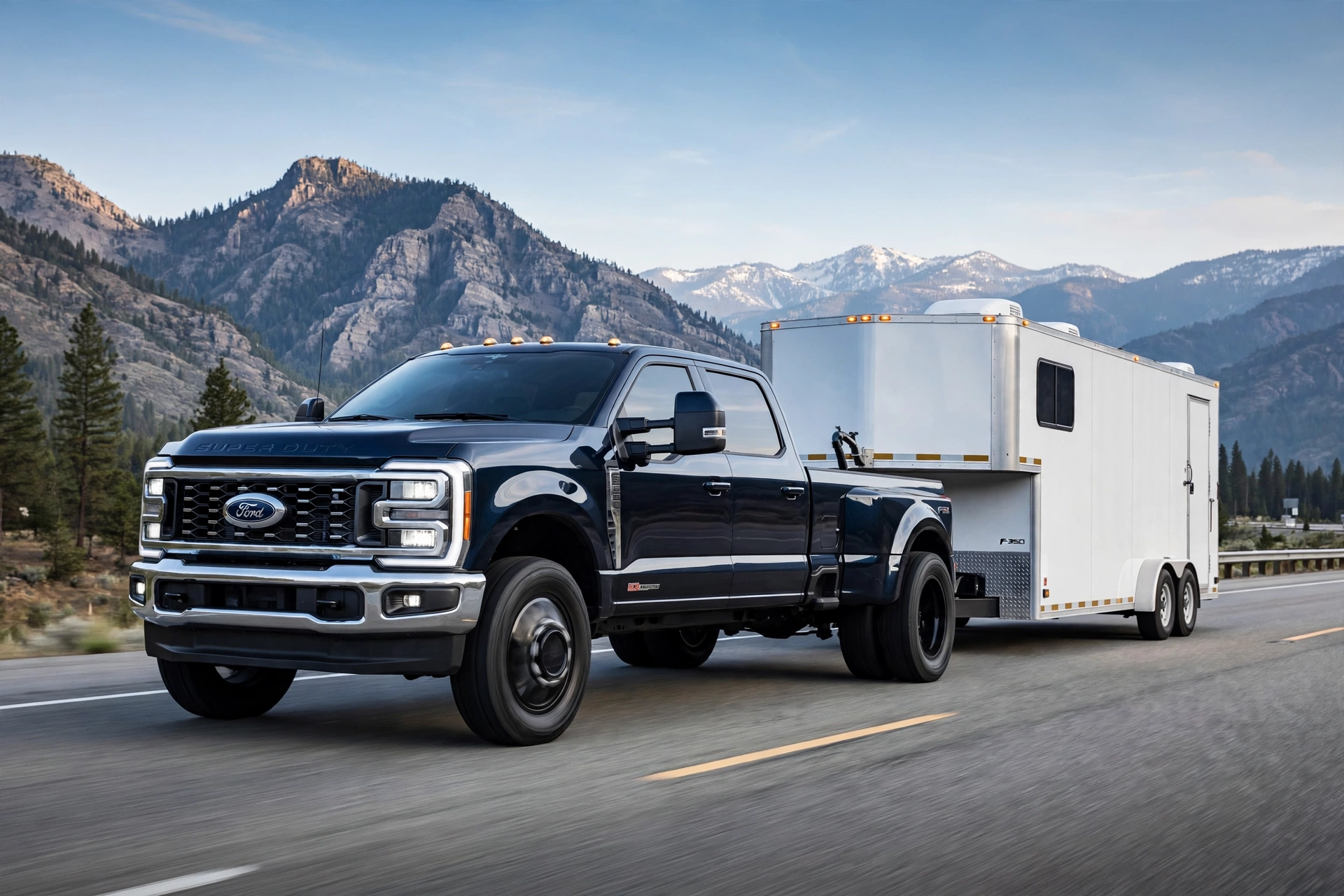
AI-generated illustration: a Ford F-350 Super Duty with a 6.7 Power Stroke diesel towing a gooseneck trailer.
On an F-250 the figures are far lower than the headline maximums, and that is normal. A properly equipped 2025 F-250 tows 22,000 lbs conventionally with either diesel, and 22,900 to 23,000 lbs on a gooseneck. The 40,000-lb figure belongs to a specific F-450 configuration, not to every Super Duty with a 6.7 badge.
Payload follows the same rule. Maximum payload varies by cab, bed, axle, and equipment, and the highest payload truck is not the highest towing truck.
Check the door jamb sticker and the towing guide row for your exact truck before hitching a trailer. The engine rating is only one input to the towing answer.
Tires matter too, because the truck’s rated capacity assumes rubber that can carry the load. Our tires for F-250 Super Duty 4×4 guide covers sizes and load ratings for the most common 6.7 truck. Worn or underrated tires cut into every towing number on this page.
How to Identify Which Version Your Truck Has
Start with the model year, because it settles the question for most trucks. A 2011–2022 pickup has one 6.7 rating for its year, and the table at the top of this page gives it. Only 2023 and newer trucks need a version check, because only those years offer both the standard and High Output engines.
For a 2023 or newer truck, read the window sticker first. It lists the engine as either “6.7L Power Stroke V8 Turbo Diesel” or “6.7L High Output Power Stroke V8 Turbo Diesel”. The sticker is the factory record of what was ordered, and it is the most reliable document you will find in the glovebox.
If the sticker is gone, use the VIN. A Ford dealer can pull the build record from the VIN, and Ford’s owner portal shows the original equipment for the truck.
The VIN record is authoritative in a way a badge or a seller’s description never is, and it also settles the model year when the truck’s history is unclear.
A red “6.7L” fender badge is a commonly reported clue for the High Output on 2023 and newer trucks. Treat it as a hint, not proof.
Badges can be changed, and a badge alone does not confirm the engine inside. Confirm any badge cue against the sticker or the VIN before you pay for a truck or order parts.
Check the under-hood emissions label as well. It carries engine identification for the truck as built, and it is hard to swap without leaving evidence. Service records and prior repair orders can also confirm the version, because the turbo and manifolds differ between the two engines.
- Confirm the model year. A 2011–2022 pickup has one rating for its year; only 2023 and newer need a version check.
- Read the window sticker. It names the engine “6.7L Power Stroke” or “6.7L High Output Power Stroke”. Keep a photo of it with the truck’s records.
- Run the VIN. A Ford dealer or the Ford owner portal returns the factory build record, including the engine version.
- Check the badges last. A red 6.7L badge suggests High Output, but confirm it against the sticker or VIN before trusting it.
- Match parts to the version. Turbo, manifold, and calibration parts differ, so give the parts counter the version and the VIN together.
Frequently Asked Questions About 6.7 Powerstroke Horsepower
How Much HP Does a 6.7 Powerstroke Have?
It depends on the year and version. The range is 390 hp for the original 2011 calibration up to 500 hp for the 2023 and newer High Output.
Most trucks on the road today make 400, 440, 450, or 475 hp, and a current truck makes 475 hp standard or 500 hp with the High Output option.
How Much HP Does a 2024 6.7 Powerstroke Have?
Either 475 hp or 500 hp. The 2024 standard engine makes 475 hp and 1,050 lb-ft, while the 2024 High Output makes 500 hp and 1,200 lb-ft. Check the window sticker or VIN, because the model year alone does not tell you which one the truck has.
What Is the Difference Between the Standard and High Output 6.7?
The High Output makes 25 hp and 150 lb-ft more, at 500 hp and 1,200 lb-ft against 475 hp and 1,050 lb-ft. It uses a unique turbocharger with a water-cooled compressor, stainless-steel exhaust manifolds, and unique tuning. It also raises the maximum gooseneck towing rating from 38,600 lbs to 40,000 lbs when properly equipped.
Is the 6.7 Powerstroke the Most Powerful Diesel Pickup Engine?
On factory ratings, yes, the High Output’s 1,200 lb-ft is the highest torque figure of any stock diesel pickup engine in its class. Its 500 hp is also the highest factory horsepower for a 6.7 Powerstroke. Aftermarket tuning can exceed both numbers, but those figures are no longer factory ratings.
Does More Horsepower Mean My Truck Can Tow More?
Not on its own. Towing capacity depends on the engine, transmission, axle ratio, cab, bed, hitch, and equipment together.
The High Output adds only 100 lbs to an F-250’s gooseneck rating, even though it adds 150 lb-ft of torque. Always use the towing guide row for your exact truck.
How Long Does a 6.7 Powerstroke Last?
With regular maintenance, owners commonly report 200,000 to 300,000 miles and beyond, and high-mileage examples pass 500,000 miles. Our how many miles trucks last guide covers realistic lifespans for gas and diesel trucks. Maintenance history matters more than the horsepower rating for longevity.
Keeping Your 6.7 Healthy
Horsepower is only useful if the engine stays healthy enough to make it. The 6.7 needs clean fuel, regular oil changes, and working emissions hardware to hold its factory output. A neglected fuel system or a clogged air filter will cost you power long before anything breaks.
Start with the air filter, because it is cheap and easy. Our best air filter for 6.7 Powerstroke guide covers the options for this engine. A restricted filter starves the turbo and the engine together, and the truck feels it under load first.
Then look at the modifications that actually help. Our best upgrades for 6.7 Powerstroke guide ranks the bolt-ons worth the money, from monitoring to exhaust. Avoid any tune that promises big power without supporting hardware, because the transmission and fuel system were built around the factory rating.
Finally, keep the service records. A truck with a documented oil, fuel filter, and coolant history is worth more than one without it, at any horsepower level. The next buyer will ask about maintenance before they ask about the dyno sheet.
Your Next Step
If you are asking how much hp a 6.7 Powerstroke has, write down the model year first, then the version. A 2011 truck makes 390 or 400 hp, a 2015 makes 440, a 2018 makes 450, a 2020 makes 475, and a 2023 or newer makes 475 or 500 depending on whether it is the High Output.
Check the window sticker or VIN on any 2023 or newer truck before you quote a number or pay a price. The year alone cannot answer the question anymore, and the 25 hp and 150 lb-ft gap between the two versions is worth knowing before you buy.
For the full historical picture, DieselHub’s 6.7 Power Stroke specifications list the ratings by application, Powerstroke Online’s horsepower by year guide covers 2011 through 2027, and ProSource Diesel’s 6.7 guide walks through each generation. Ford’s own towing guide is the final word for current ratings and towing maxima.