

6.7 Powerstroke High Output vs Regular: Specs, Towing and Which to Choose

Quick answer: On 2023–2026 Super Duty pickups, the 6.7L Power Stroke High Output (H.O.) is rated 500 hp and 1,200 lb-ft, versus 475 hp and 1,050 lb-ft for the standard 6.7L, according to Ford’s 2025 towing guide. The H.O. raises maximum gooseneck towing to 40,000 lbs (F-450 with the 535 package), versus 38,600 lbs for the standard diesel.
The 6.7L Power Stroke V8 comes in two pickup versions on the current Super Duty: the standard diesel and the High Output version added for 2023. Ford says the H.O. uses a unique turbo, upgraded exhaust manifolds and unique tuning. Both are 6.7-liter, 15.8:1 compression, single-turbo diesel V8s. This guide compares them using Ford’s published specs.


6.7 Powerstroke High Output vs Regular: Key Differences


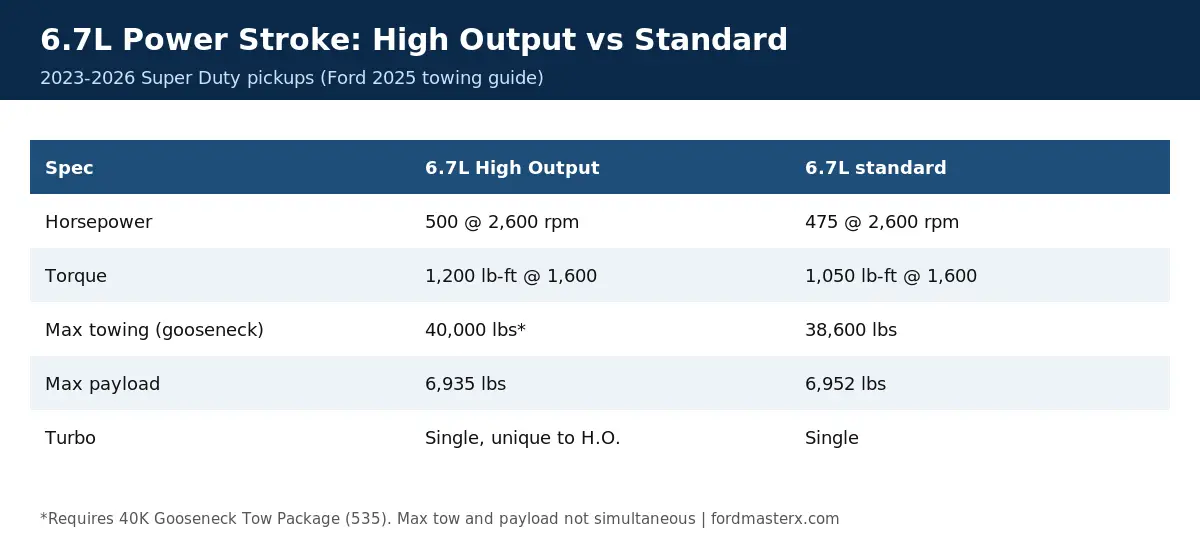
| Spec (2023–2026 Super Duty pickup) | 6.7L High Output | 6.7L standard |
|---|---|---|
| Horsepower | 500 @ 2,600 rpm | 475 @ 2,600 rpm |
| Torque | 1,200 lb-ft @ 1,600 rpm | 1,050 lb-ft @ 1,600 rpm |
| Turbo | Single turbo, unique to H.O. | Single turbo |
| Other hardware | Upgraded exhaust manifolds, unique tuning | — |
| Max towing (2025, gooseneck) | 40,000 lbs (requires 535 package) | 38,600 lbs |
| Max payload (2025) | 6,935 lbs | 6,952 lbs |
| Compression ratio | 15.8:1 | 15.8:1 |
| Transmission | 10-speed TorqShift | 10-speed TorqShift |
Sources: Ford 2025 RV & Trailer Towing Guide (Super Duty engine table) and Ford’s 2023 Super Duty reveal. Maximum towing and payload are for properly equipped trucks and can’t be achieved at the same time. Chassis cab 6.7L ratings are different.
Before 2023, there was no H.O. pickup version. The 2020–2022 6.7L was rated 475 hp and 1,050 lb-ft, the same as today’s standard diesel. Earlier 6.7L engines were rated lower, so comparisons that pit a “450 hp” regular against a “475 hp” H.O. are mixing different model years.
Performance Comparison


Horsepower and Torque
The H.O. adds 25 hp and 150 lb-ft, per Ford’s ratings. Peak torque arrives at the same 1,600 rpm on both versions, so the H.O.’s advantage is mostly felt under heavy load, such as pulling a large gooseneck up a grade.
Fuel Economy


Heavy-duty pickups like the Super Duty don’t get EPA fuel economy ratings, and Ford doesn’t publish mpg figures for either version. Any mpg difference depends on load, terrain and driving style, so treat claimed mpg numbers with caution.
Towing and Hauling


Capability Analysis


In Ford’s 2025 guide, the H.O. is listed at up to 40,000 lbs gooseneck (F-450 pickup with the 535 package), versus 38,600 lbs for the standard diesel. On the F-250, the gap is small: up to 23,000 lbs gooseneck with the H.O. versus 22,900 lbs with the standard diesel, and both reach 22,000 lbs conventional. See our F-250 towing capacity chart and Super Duty towing chart by year for configuration details.


Real-World Scenarios


If you regularly tow near the top of the ratings, such as large fifth-wheel RVs, livestock goosenecks or equipment trailers on an F-350 or F-450, the H.O.’s extra torque and higher maximum rating are the main reasons to choose it. For F-250 owners and for towing well below the limits, the standard 6.7L has the same 22,000 lb conventional rating and very similar gooseneck ratings.
Engine Components
Turbocharger Differences


Both versions use a single turbocharger. Ford says the H.O. gets a unique turbo, along with upgraded exhaust manifolds and unique tuning. Ford doesn’t publish turbo sizes or boost figures, so claims about exact boost or response times aren’t verified.
Fuel Injection Systems
Ford’s public specs don’t list different fuel-injection hardware for the H.O. Its added output is attributed to the turbo, exhaust manifolds and calibration. Don’t assume injectors or pumps are interchangeable without checking Ford parts information for your VIN.


Reliability and Maintenance
Common Issues
The H.O. has only been sold since the 2023 model year, so there isn’t enough long-term data to rank it against the standard 6.7L for reliability. Both share the same basic engine architecture. For known 6.7L issues and recalls by year, see our 6.7 Powerstroke problems by year guide.
Maintenance Tips
- Oil changes: follow the Intelligent Oil-Life Monitor and your owner’s manual schedule rather than a fixed mileage. Ford says the 2023+ 6.7L can go longer between oil changes. Our 6.7 Powerstroke oil capacity chart lists capacities.
- DPF and DEF: let regenerations finish, and keep DEF topped up. See our exhaust filter overloaded fix if you see that warning.
- Fuel filters and coolant: replace them at the intervals in your scheduled maintenance guide, especially if you tow heavily.
Cost Considerations
Initial Purchase Price
The H.O. is an extra-cost option over the standard 6.7L diesel, and its price and availability vary by model year, trim and series. Check current pricing in Ford’s Build & Price tool or with a dealer; this guide doesn’t quote a fixed premium.
Long-Term Costs
Both versions use the same basic engine and service schedule, so routine maintenance should be similar. Real-world fuel use depends on how hard you work the truck. Neither version has an official EPA rating to compare.


Which Should You Choose?
- Choose the H.O. if you tow near maximum ratings on an F-350 or F-450, especially heavy goosenecks, or you want the most torque available.
- Choose the standard 6.7L if you tow within the F-250’s ratings or well below the limits, where the ratings are nearly the same, and you’d rather save the option cost.
For all Power Stroke generations, see our Ford Powerstroke comparison chart.
Frequently Asked Questions
What is the difference between the 6.7 and 6.7 High Output?
On 2023–2026 Super Duty pickups, the High Output is rated 500 hp and 1,200 lb-ft, versus 475 hp and 1,050 lb-ft for the standard 6.7L. Ford says it uses a unique turbo, upgraded exhaust manifolds and unique tuning, and it raises maximum gooseneck towing to 40,000 lbs.
What are the changes to the Ford 6.7 High Output?
Ford lists a unique turbocharger, upgraded exhaust manifolds and unique calibration. The block, displacement (6.7L) and 15.8:1 compression ratio are the same as the standard 6.7L.
How much horsepower does the 6.7 High Output have?
Ford rates it at 500 hp at 2,600 rpm and 1,200 lb-ft at 1,600 rpm.
Is the High Output 6.7 Power Stroke reliable?
It has only been sold since the 2023 model year, so long-term data is limited. It shares its basic architecture with the standard 6.7L. Follow Ford’s maintenance schedule and check for open recalls with your VIN.
Which years have the 6.7 High Output?
The H.O. pickup engine was introduced for the 2023 Super Duty and is listed in Ford’s 2025 towing guide. Check your window sticker or build sheet to confirm your truck has it.
Conclusion
The 6.7L H.O. gives you 25 more horsepower and 150 more lb-ft, plus a higher maximum gooseneck rating on heavy-duty configurations. The standard 6.7L has the same conventional ratings on the F-250 and nearly the same gooseneck ratings. Match the engine to how close to the limits you actually tow, and confirm ratings in Ford’s towing guide for your exact configuration.