Ford 6.7 Powerstroke Problems by Year, Fixes and Costs 2026

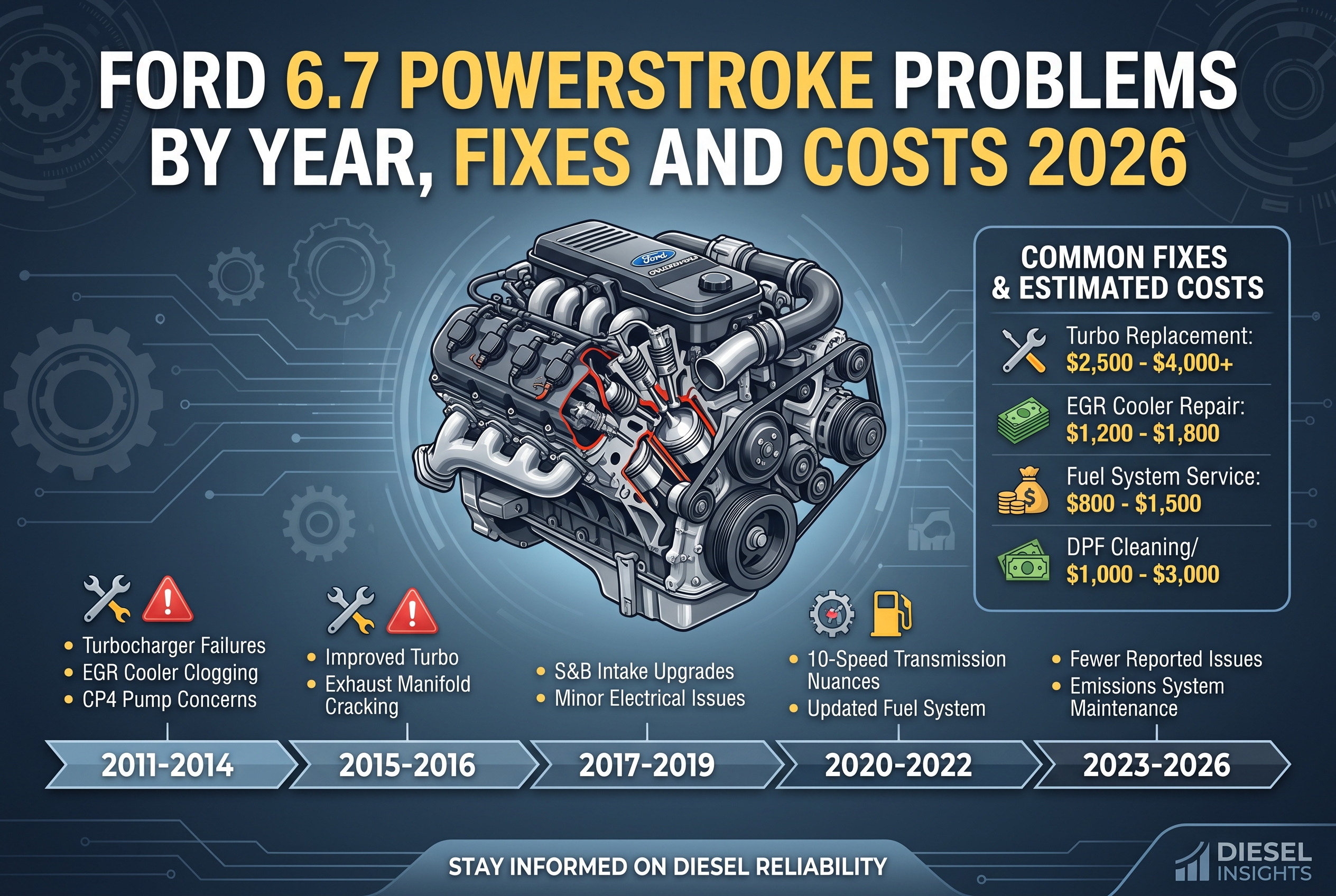
Ford 6.7 Powerstroke problems by year split into three groups, and your build date decides which one applies. Gen 1 trucks from 2011 to 2014 carry the turbo, exhaust valve, and sensor failures. Gen 2 trucks from 2015 to 2019 fixed most of that.
Gen 3 trucks from 2020 onward have a different issue. Ford logged 3,070 warranty reports on the high-pressure fuel pump by November 2024, and a second recall followed in March 2026.

Prime for Young Adults — 6 Months Free
Students and 18–24s get six months of Prime free, then half price.
Start 6 Months Free As an Amazon Associate I earn from qualifying purchases.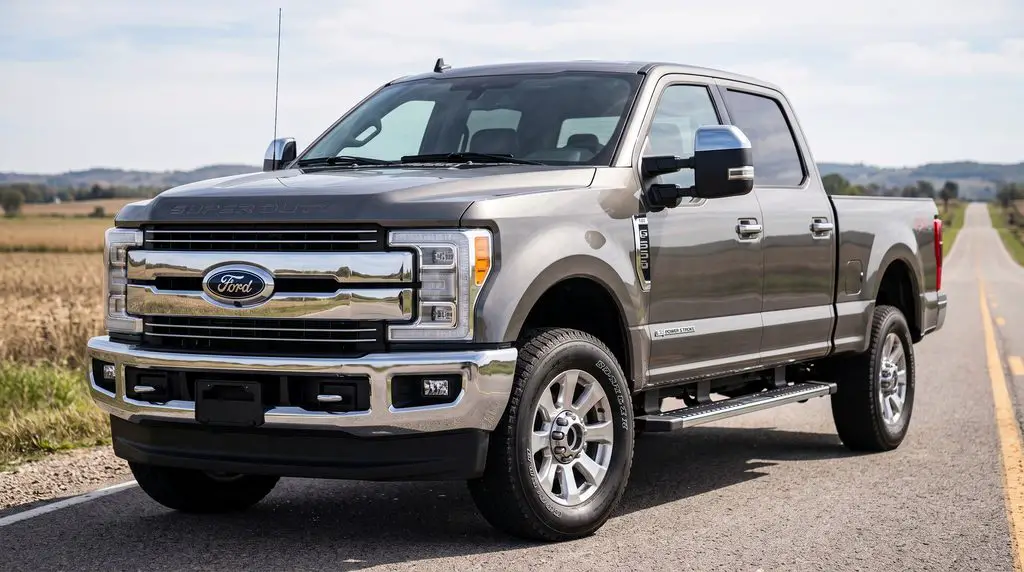
This guide covers what fails in each generation, at what mileage, and what it costs. A year-by-year chart near the end lets you scan the full range in seconds.
6.7 Powerstroke Problems by Year
What owners and Ford documents report for each model year group. Not a guarantee for every truck.
- Reported
- Ford program
- Recall
- Updated
- Disputed
- No pattern found
| Model Years | Turbo and Fuel System | Sensors and Emissions | Recall or Program |
|---|---|---|---|
| 2011Gen 1 | ReportedCeramic bearing turbo failures | ReportedEarly builds: exhaust valve damage (TSB 14-0127), NOx faults | Ford programNOx program 12B33 |
| 2012Gen 1 | ReportedCeramic bearing turbo failures | ReportedEGT sensor failures | Ford programChassis cab NOx warranty 18M04 |
| 2013 to 2014Gen 1 | DisputedBearing type differs between sources | ReportedRear NOx software error | Ford programRear NOx program 21N05 |
| 2015 to 2016Gen 2 | UpdatedLarger GT37 turbo, fan clutch updated | ReportedRear NOx faults, fan clutch stuck-on reports | Ford programRear NOx program 21N05 |
| 2017 to 2019Gen 2 | ReportedCP4.2 pump wear | ReportedDEF and NOx faults | No pattern foundNo fuel pump recall |
| 2020 to 2022Gen 3 | RecallRP7 pump, RP8 from Aug 23, 2021 | ReportedDEF and NOx faults | RecallRecalls 24S78 and 26S17 |
| 2023 to 2025Gen 3 | No pattern foundHigh Output added | No pattern foundNo confirmed pattern | RecallSmall 2025 fuel return line recall |
EGR cooler clogging, CP4.2 wear, and DEF faults can hit any year.
What Decides Which 6.7 Powerstroke Problems Hit Your Truck
Recommended Best Deal Products


Model year alone does not tell you which parts your truck carries. Three variables decide the answer.
Generation and Build Date
Ford launched the 6.7L Power Stroke for 2011 at 390 hp and 735 lb-ft, then raised the rating to 400 hp and 800 lb-ft with a free dealer reflash. The 2015 update swapped in a larger single GT37 variable-geometry turbo.
Trucks from 2020 through 2022 carry a rating of 475 hp and 1,050 lb-ft. Ford added the High Output version for 2023, rated at 500 hp and 1,200 lb-ft. Check the build date on the driver door label, because some changes land mid-year.
Fuel Pump Version
Parts suppliers list the earlier CP4.2 version of the Bosch high-pressure fuel pump on trucks from 2011 onward. Ford’s filing says the RP7 variant arrived with 2020 model year Super Duty production and gave way to the RP8 on August 23, 2021.
That date matters because the recalls cover specific build windows, not whole model years.

Audible — Listen Free for 30 Days
One free credit a month and thousands of titles included.
Listen Free for 30 Days As an Amazon Associate I earn from qualifying purchases.Duty Cycle and Fuel Quality
Use changes your odds. A technician on PowerStrokeHelp shows an EGR cooler clogged on one side and ties the buildup to long idle hours.
Start with the generation that matches your build date.
4 Gen 1 6.7 Powerstroke Problems From 2011 to 2014
Gen 1 trucks carry the longest problem list, and the 2011 model year stands out.
Ceramic Bearing Turbo Failures
Early trucks used a Garrett GT32 turbo, and its ceramic ball bearings struggled with heat and constant load cycling. A failing unit screeches loudly and blows smoke as it burns oil.
Sources disagree on the cutover to steel bearings. Some place ceramic bearings on 2011 and 2012 trucks only, while a 2014 owner thread says 2011 to 2014. We found no Ford-published VIN break, so treat any Gen 1 truck as a candidate.
Failure mileage varies. A poster in that thread described a 2011 truck at 90,000 miles, and one owner filmed a 2011 turbo failing at 117,000 miles. Repair guides cite 80,000 to 150,000 miles and put replacement at $2,000 to $5,000.
Exhaust Valve and Glow Plug Damage
Some 2011 trucks built on or before March 29, 2011 can suffer a broken exhaust valve. Ford covered it in service bulletin 14-0127, which lists glow plug circuit codes P0671 through P0678 as a sign of the damage.
Owners often describe it as a glow plug failure. Forum members argue the damaged glow plug is an effect of the valve failure, not the cause. One PowerStroke.org member reported an engine seizure at 70,490 miles, and another owner was quoted $17,000 for a new engine.
Not every early 2011 truck is affected. A reply in the PowerStroke.org thread says most early 2011 F-250s never had the issue.
NOx Sensor Faults
NOx (nitrogen oxide) sensor faults hit early builds. Owners received letters about Ford program 12B33 for 2011 trucks. The letters warn that a dead sensor can trigger a check engine light and cut power.
Audible Premium Plus — Annual Membership
12 audiobook credits up front, plus the full Audible catalogue.
See Annual Plans As an Amazon Associate I earn from qualifying purchases.Ford also extended NOx sensor warranty coverage to 10 years or 110,000 miles on certain 2011 to 2012 F-450 to F-550 chassis cabs.
EGT Sensor Failures
EGT (exhaust gas temperature) sensor failures show up most on 2012 trucks, especially ambulance package builds. The engine has four EGT sensors, so one bad reading can trigger a check engine light or a stop safely now warning.
One retailer lists a Motorcraft EGT sensor at $179.41. Prices vary by seller.
Gen 2 trucks changed the parts behind most of these failures.
3 Gen 2 6.7 Powerstroke Issues From 2015 to 2019
Recommended Best Deal Products



By 2015, Ford had updated the turbo, fan clutch, and crankshaft damper. BD Diesel lists those changes as second-generation updates, so the failure list gets shorter.
Suppliers disagree here. ProSource Diesel lists fan clutch, damper, and EGR cooler flow as Gen 2 problems. We treat them as watch items, not defects.
Fan Clutch Stuck On
The 6.7 uses a pulse width modulated, variable speed viscous fan clutch. A clutch that fails to engage sets a code, but one stuck on does not. Our 6.7 Powerstroke fan clutch problems guide covers this failure in more detail.
Rear NOx Sensor Faults
On 2013 to 2016 trucks, a software error masked certain NOx sensor and SCR faults, so the warning light stayed off. Emissions Recall 21E01 reprogrammed the PCM (powertrain control module) so it could see those faults.
Ford then extended rear NOx sensor warranty coverage for twelve months under program 21N05.
VGT Turbo Carbon Fouling
The larger turbo cuts bearing failures, but vane carbon buildup remains. One diesel shop reports vane issues between 80,000 and 130,000 miles on trucks that tow heavy and make frequent short trips. The shop says bench cleaning fixes most cases.
Gen 3 trades mechanical failures for recall paperwork.
3 Gen 3 6.7 Powerstroke Issues From 2020 to 2025
Gen 3 has the fewest mechanical complaints and the most recall paperwork.
Fuel Pump Recall 24S78
Ford filed recall 24S78 on December 20, 2024. The recall covers 295,449 trucks, and about 4 percent are suspected of having the condition.
Ford’s teardowns of returned pumps showed aged biodiesel deposits. Its data linked failures to state-level biomass diesel specifications and warmer average temperatures.
The original defect can cause extended cranking without starting, or a loss of power while driving. The fix is a free PCM software update at a dealer.
Software Recall 26S17
Some trucks never received that fix. Ford announced recall 26S17 in March 2026 for 7,105 trucks.
The update process did not follow the correct sequence, which left an older software version on those trucks. The population covers certain 2020 to 2022 Super Duty trucks built between August 23, 2019 and August 23, 2021. Owners can call Ford at 1-866-436-7332 and reference 26S17.
Newer Truck Reliability Reports
We found no confirmed failure pattern for 2023 and newer trucks, including the High Output. DieselIQ found no consistent problems in Gen 3 as of late 2023.
One PowerStroke.org member reported worn turbo bearings on a 2023 F-250 at 20,000 miles. That is a single report, not a trend, and data on 2024 and 2025 trucks is thin. A 2025 recall covers a fuel return line on a very small number of trucks.
Some problems cross every generation.
3 Problems That Show Up in Every 6.7 Powerstroke Year
Three failure points span generations, so a clean Gen 2 or Gen 3 truck still needs checking.
CP4.2 Fuel Pump Contamination
The CP4.2 relies on diesel fuel for internal lubrication. One diesel shop says failures arrive near 100,000 miles and send metal shavings through the fuel system. Repair guides put the bill at $8,000 to $15,000 because injectors, rails, and lines need replacement.
Some guides list the CP4.2 across 2011 to 2020 trucks. Ford’s filing dates the RP7 variant to the 2020 model year, so confirm which pump your truck has.
Recall 24S78 covers 2020 to 2022 trucks only, which leaves older trucks without recall coverage. Our 6.7 Powerstroke CP4 failure symptoms guide lists the warning signs.
EGR Cooler Clogging and Cracking
The EGR (exhaust gas recirculation) cooler can clog with soot and fail. The PowerStrokeHelp video shows a cooler with no flow through one side. Repair guides put replacement at $1,200 to $2,500 and the interval at 80,000 to 120,000 miles.
We found no Ford-published interval, and vendor claims vary.
DEF and NOx Sensor Faults
DEF (diesel exhaust fluid) and NOx faults appear in every generation. BD Diesel lists DEF, SCR, and NOx faults among its ten common issues.
Sensor prices swing widely. One Ford-Trucks thread lists sensors from $200 to $475 and a dealer part near $500, and a PowerStroke.org member was quoted $811 to replace one.
Here is the whole picture in one chart.
Which 6.7 Powerstroke Year Has Which Problem at a Glance
Find your model year in the chart, then jump to the matching section. Cells show what owners and Ford documents report, not a guarantee for every truck.
| Model Years | Generation | Turbo and Fuel System | Sensors and Emissions | Recall or Program |
|---|---|---|---|---|
| 2011 | Gen 1 | Ceramic bearing turbo failures reported | Early builds: exhaust valve damage (TSB 14-0127), NOx faults | NOx program 12B33 |
| 2012 | Gen 1 | Ceramic bearing turbo failures reported | EGT sensor failures reported | Chassis cab NOx warranty 18M04 |
| 2013 to 2014 | Gen 1 | Bearing type disputed between sources | Rear NOx software error | Rear NOx program 21N05 |
| 2015 to 2016 | Gen 2 | Larger GT37 turbo, fan clutch updated | Rear NOx faults, fan clutch stuck-on reports | Rear NOx program 21N05 |
| 2017 to 2019 | Gen 2 | CP4.2 wear reported | DEF and NOx faults reported | None for the fuel pump |
| 2020 to 2022 | Gen 3 | RP7 pump, RP8 from Aug 23, 2021 | DEF and NOx faults reported | Recalls 24S78 and 26S17 |
| 2023 to 2025 | Gen 3 | High Output added, no pattern found | No pattern found | Small 2025 fuel return line recall |
EGR cooler clogging, CP4.2 wear, and DEF faults can hit any year. Our 6.7 Powerstroke years to avoid guide ranks these years for buyers.
The last step is checking a specific truck.
How To Check a Used 6.7 Powerstroke Before You Buy
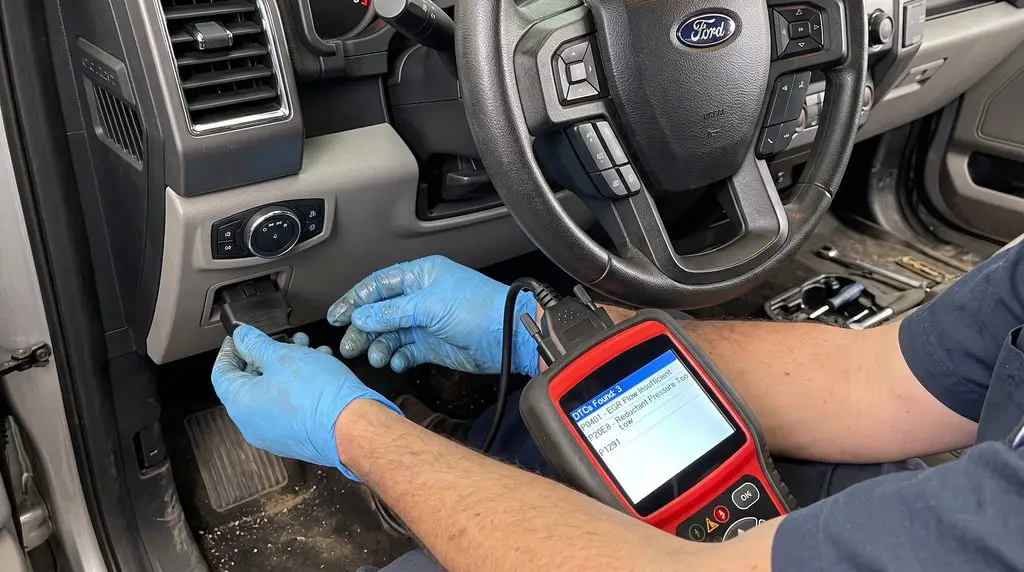
Run the VIN before you look at anything else. These five steps cover the checks the data above supports.
- Run the VIN through NHTSA. Enter it at the NHTSA recall lookup and note any open fuel pump recall.
- Confirm the software fix. On 2020 to 2022 trucks, ask for proof the correct PCM update was installed. Call Ford at 1-866-436-7332 if the record is unclear.
- Scan for stored codes. A diesel-capable OBD2 scanner for the Ford 6.7 shows stored and pending codes.
- Test a 2011 to 2014 truck for turbo noise. Listen for a loud screech and watch for oil smoke at the tailpipe.
- Ask for service records. Request oil and fuel filter receipts, and ask whether a 2011 truck ever had valve or glow plug work.
Bottom Line on 6.7 Powerstroke Reliability by Generation
The 6.7 Powerstroke problems by year point to one pattern. Gen 1 trucks carry the turbo, exhaust valve, and sensor risks. Gen 2 trucks fixed most of them. Gen 3 trucks carry recall paperwork instead.
Every generation shares three risks: CP4.2 fuel pump wear, EGR cooler clogging, and DEF or NOx faults.
Run the VIN, check the recall record, and scan for codes before you commit. Those checks matter more than the model year alone.
6.7 Powerstroke Problems by Year FAQ
What is the worst year for the 6.7 Powerstroke?
The 2011 model year carries the most serious reports. Owners describe ceramic bearing turbo failures, exhaust valve damage on early builds, and NOx sensor faults. The 2012 year comes next because the turbo and EGT sensor issues continue. Check the build date before you buy.
Does the 2020 and newer 6.7 Powerstroke have fuel pump problems?
Certain 2020 to 2022 trucks do. Ford recalled 295,449 of them under 24S78 for biodiesel deposits in the pump, then issued 26S17 for 7,105 trucks that received the wrong software. Run your VIN through NHTSA to see if your truck is covered.
When did Ford switch the 6.7 Powerstroke to steel turbo bearings?
Most sources place the change at 2013, but they disagree. Some say ceramic bearings ran through 2014, and we found no Ford-published VIN break. Treat any 2011 to 2014 truck as a candidate for bearing failure and inspect the turbo before you buy.
How much does a 6.7 Powerstroke turbo replacement cost?
One repair guide puts turbo replacement at $2,000 to $5,000, depending on whether you choose an aftermarket steel bearing unit. Failures cluster between 80,000 and 150,000 miles on early trucks, so ask whether a 2011 to 2014 truck already has a new turbo. Get a written quote before you approve the job.
How do I check if my 6.7 Powerstroke has an open recall?
Enter your VIN at the NHTSA recall lookup. You can also call Ford at 1-866-436-7332 and reference recall 24S78 or 26S17. Ask the dealer to confirm the correct software version was installed, since some 2020 to 2022 trucks received the wrong update.