Ford Powerstroke Comparison Chart: Specs & Generations 2020-2026

The origin of Ford’s heavy-duty diesel dominance began prior to the official launch of the Powerstroke brand.
In 1983, Ford partnered with Navistar International to introduce the 6.9L Indirect Injection (IDI) V8 engine.

Prime for Young Adults — 6 Months Free
Students and 18–24s get six months of Prime free, then half price.
Start 6 Months Free As an Amazon Associate I earn from qualifying purchases.This initial powerplant produced a modest 170 horsepower and 315 lb-ft of torque, prioritizing basic utility over high-performance towing.
By 1988, the engine evolved into the 7.3L IDI diesel, which featured a wider cylinder bore and upgraded cylinder heads.
The final 1993 turbocharged variant of the 7.3L IDI was structurally reinforced to withstand higher boost pressures.
This final IDI upgrade paved the way for the electronic direct-injection systems that defined the subsequent Powerstroke generation.
These early IDI powerplants remain highly valued by collectors for their mechanical simplicity and exceptional longevity.
Vehicles utilizing these engines frequently exceed 300,000 miles of service with only basic mechanical maintenance.
The Ultimate Ford Powerstroke Comparison Chart
Recommended Best Deal Products


A complete, data-driven analysis of displacement, horsepower, torque, and reliability across four generations of iconic diesel engines.
Decoding the Diesel Lineage
Welcome to FordMasterX. We are diving deep into the Ford Powerstroke lineage. Choosing the right diesel engine is critical for towing and longevity.
This comprehensive guide compares the 7.3L, 6.0L, 6.4L, and 6.7L models. We break down the performance data to show true capability.

Audible — Listen Free for 30 Days
One free credit a month and thousands of titles included.
Listen Free for 30 Days As an Amazon Associate I earn from qualifying purchases.You will see exactly how these engines stack up against one another. Our data visualizes the relentless pursuit of torque and efficiency.
Core Specifications Matrix
The table below provides the foundational metrics for each generation. This data forms the baseline for our visual analysis.
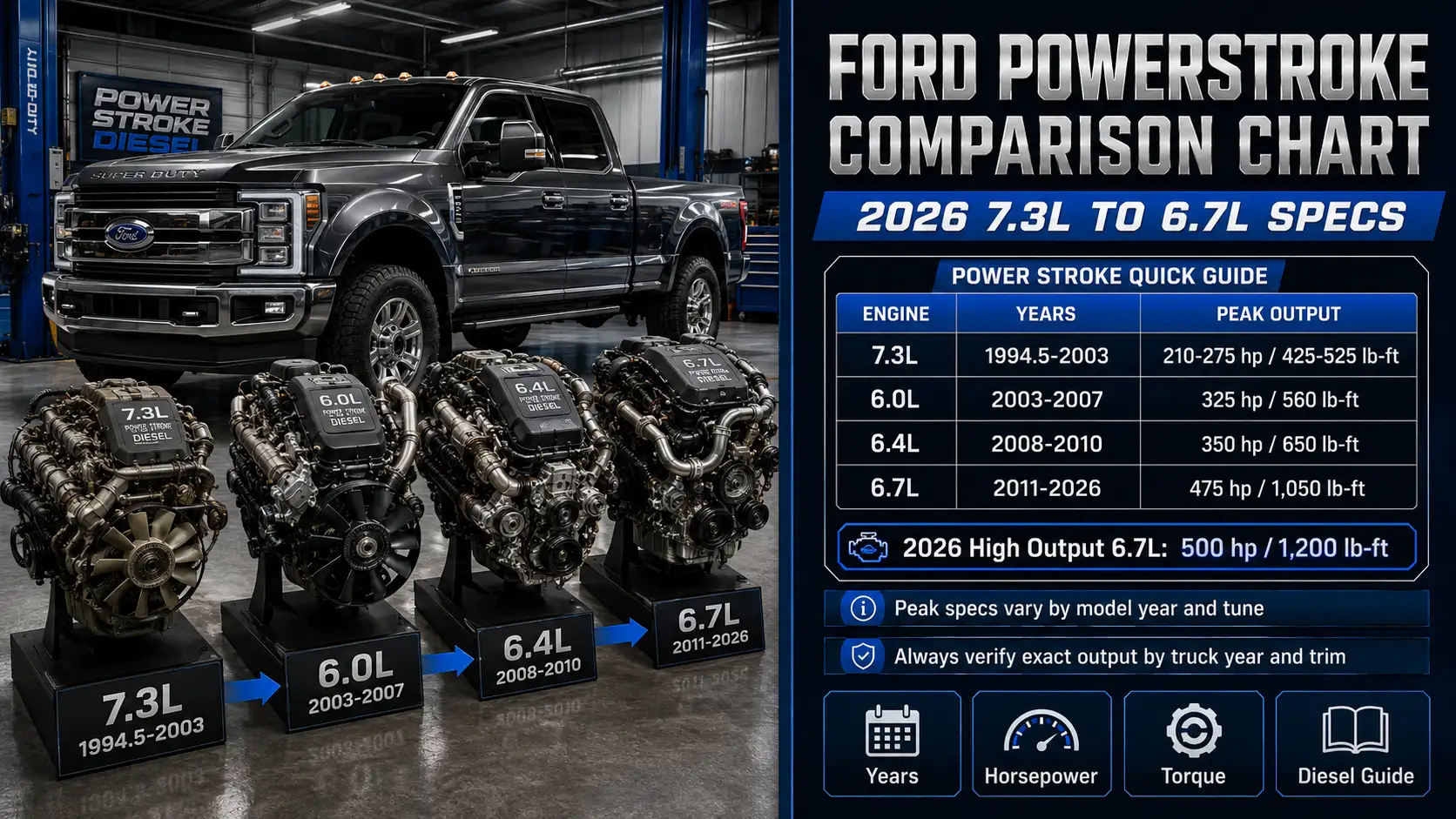
| Engine Model | Years Active | Displacement | Peak HP | Peak Torque |
|---|---|---|---|---|
| 7.3L V8 | 1994 – 2003 | 444 cubic inches | 275 hp | 525 lb-ft |
| 6.0L V8 | 2003 – 2007 | 365 cubic inches | 325 hp | 570 lb-ft |
| 6.4L V8 | 2008 – 2010 | 390 cubic inches | 350 hp | 650 lb-ft |
| 6.7L V8 (HO) | 2011 – Present | 406 cubic inches | 500 hp | 1200 lb-ft |
The Power Progression
Recommended Best Deal Products


Horsepower and torque have skyrocketed over the last three decades. The demand for heavier towing capabilities drove this massive engineering shift.
The chart on the right visualizes this exponential growth. Notice the massive spike in torque with the introduction of the 6.7L Scorpion engine.
According to MotorTrend’s historical analysis, the transition to in-house manufacturing changed everything.
Horsepower vs Torque (Evolution)
Engine Architecture & Efficiency
Bigger is not always better in modern diesel engineering. Ford actually reduced displacement while massively increasing boost and fuel pressure.
The 3D scatter plot below illustrates the relationship between displacement, horsepower, and torque. We utilize WebGL to render this complex data smoothly.
As noted by DieselHub, advanced variable geometry turbos allow smaller engines to perform like massive big-blocks.
3D Scatter: Performance vs Displacement
Market Dominance by Generation
Reliability & Market Impact
Recommended Best Deal Products


The 7.3L is legendary for its million-mile reliability. Conversely, the 6.0L and 6.4L faced significant challenges with emissions equipment.
The donut chart visualizes estimated enthusiast preference and aftermarket support volume. The 7.3L and 6.7L hold the lion’s share of market trust.
Audible Premium Plus — Annual Membership
12 audiobook credits up front, plus the full Audible catalogue.
See Annual Plans As an Amazon Associate I earn from qualifying purchases.Expert reviews on DrivingLine confirm the 6.7L finally restored Ford’s reputation in the heavy-duty sector.
Chronological Engineering Shifts
The Core Powerstroke Comparison Matrix
To assist fleet operators and diesel enthusiasts, this master comparison chart consolidates the key specifications of every Powerstroke engine.
The structural and performance data has been compiled from historical technical specifications and manufacturer data sheets.
| Engine Model & Displacement | Production Years | Fuel Injection System | Injector / Pump Pressure | Turbocharger Configuration | Horsepower Range | Torque Range |
| 7.3L V8 (T444E) | 1994.5–2003 | Split-Shot HEUI | Up to 21,000 PSI | Fixed TP38 (1994-1997) / Wastegated GTP38 | 210 hp – 275 hp | 425 lb-ft – 525 lb-ft |
| 6.0L V8 (VT365) | 2003.5–2007 | 2nd Gen HEUI | Up to 26,000 PSI | Single Garrett VGT | 325 hp @ 3,300 RPM | 560 lb-ft – 570 lb-ft |
| 6.4L V8 (MaxxForce 7) | 2008–2010 | Siemens Piezo Common Rail | Up to 29,000 PSI | Compound Sequential VGT | 350 hp @ 3,000 RPM | 650 lb-ft @ 2,000 RPM |
| 6.7L V8 (Scorpion Gen 1) | 2011–2014 | Bosch Common Rail | Up to 30,000 PSI | Single Sequential Dual-Compressor | 390 hp – 400 hp | 735 lb-ft – 800 lb-ft |
| 6.7L V8 (Scorpion Gen 2) | 2015–2019 | Bosch Common Rail | Up to 30,000 PSI | Single VGT (Redesigned) | 440 hp – 450 hp | 860 lb-ft – 935 lb-ft |
| 6.7L V8 (Scorpion Gen 3) | 2020–Present | Bosch Common Rail | Up to 36,000 PSI | Single VGT (Upgraded) | 475 hp – 500 hp (HO) | 1,050 lb-ft – 1,200 lb-ft (HO) |
| 3.2L I5 (Duratorq Puma) | 2015–Present | Bosch Common Rail | Up to 29,000 PSI | Single VGT | 190 hp @ 3,000 RPM | 346 lb-ft @ 1,750 RPM |
| 3.0L V6 (Power Stroke) | 2018–2021 | Bosch Common Rail | Up to 29,000 PSI | Single VGT | 250 hp @ 3,250 RPM | 440 lb-ft @ 1,750 RPM |
The architectural shifts documented in this matrix illustrate the industry-wide move toward high-pressure common-rail fuel injection.
This transition was driven by the dual requirements of reducing exhaust emissions and delivering greater low-end torque.
A comprehensive historical overview of these changes can be found on(https://www.jimburkeford.com/blog/every-generation-of-ford-diesel-truck/).
Generation-by-Generation Engineering & Architectural Analysis
7.3L Power Stroke (1994.5–2003): The Legend of Mechanical Simplicity
Introduced in mid-1994, the 7.3L Powerstroke was a completely new engine design built by Navistar.
These components are housed in a heavy cast-iron engine block utilizing six head bolts per cylinder.
The resulting structural rigidity is key to the engine’s long-term durability.
The historical specifications of this engine are fully detailed on the(https://en.wikipedia.org/wiki/Ford_Power_Stroke_engine).
6.0L Power Stroke (2003.5–2007): Performance Advantages and Design Flaws
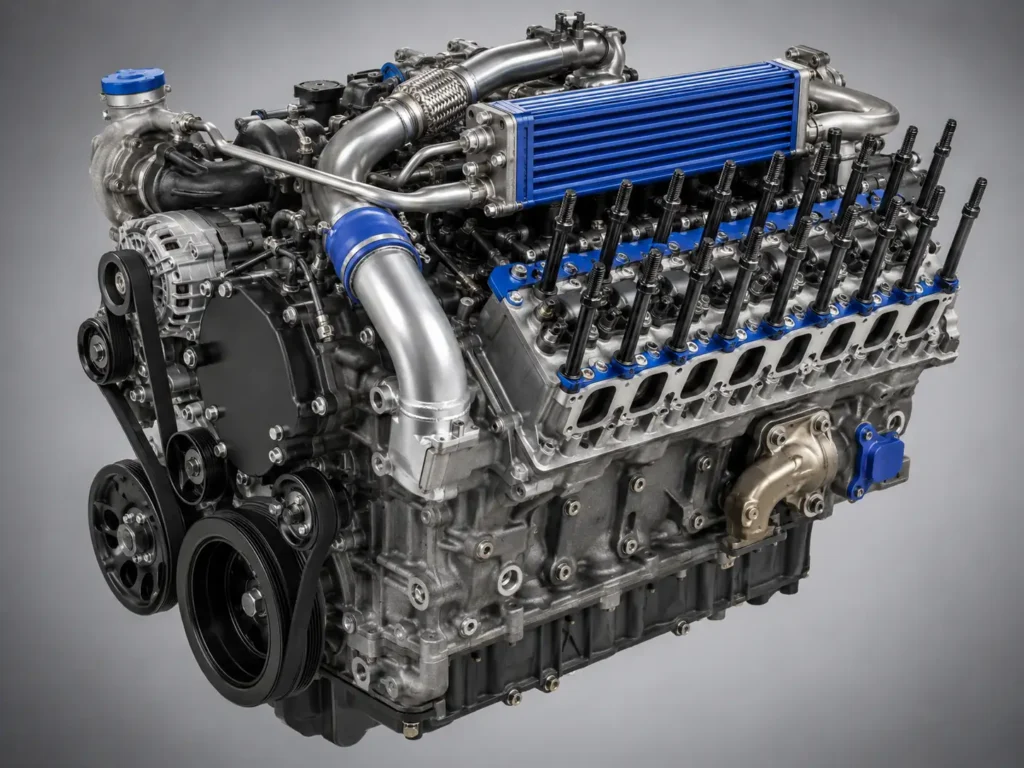
Faced with stricter federal emissions standards, Ford and Navistar developed the smaller-displacement 6.0L Powerstroke.
This engine produced 325 horsepower and 570 lb-ft of torque using a fast-spooling variable-geometry turbocharger (VGT).
It also integrated an Exhaust Gas Recirculation (EGR) system to lower combustion temperatures and reduce nitrogen oxide emissions.
However, the cylinder head design was reduced to only four torque-to-yield head bolts per cylinder.
Under high cylinder pressures, these factory bolts stretched, causing head gasket failures and cylinder head warping.
Furthermore, the factory oil coolers were prone to clogging with casting sand and cooling system debris.
This restricted coolant flow to the EGR cooler, causing it to rupture and leak coolant into the intake tract.
6.4L Power Stroke (2008–2010): The Short-Lived Twin-Turbo Transition
The 6.4L Powerstroke introduced compound sequential turbochargers and a high-pressure common-rail fuel injection system.
Utilizing advanced Siemens piezo injectors, this engine delivered rapid throttle response and produced 350 horsepower.
It was also the first Powerstroke designed with a factory Diesel Particulate Filter (DPF) to trap exhaust soot.
To clear accumulated soot, the engine initiated active DPF regeneration cycles by injecting extra fuel on the exhaust stroke.
This process often caused fuel dilution, as unburnt diesel washed past the piston rings into the engine oil.
The diluted engine oil lost its lubricating properties, causing accelerated wear on the valvetrain and rocker arms.
These lubrication failures regularly led to cracked pistons and catastrophic internal engine damage.
Due to these severe reliability issues, Ford discontinued the 6.4L engine after only three model years.
For more historical context on these transition-era issues, refer to(https://www.thoroughbreddiesel.com/history-of-the-ford-power-stroke-diesel-engine/).
6.7L Power Stroke (2011–Present): Ford’s Proprietary “Scorpion” Platform
In 2011, Ford ended its partnership with Navistar and designed the 6.7L “Scorpion” engine entirely in-house.
The 6.7L features a unique reverse-flow architecture, which positions the exhaust manifolds within the cylinder valley.
This design keeps exhaust path lengths short, maximizing heat energy delivery to the variable-geometry turbocharger.
Columns: Attribute, Gen 1 (2011-2014), Gen 2 (2015-2019), Gen 3 (2020+)
Data:
– HP / Torque: 390-400 HP / 735-800 Lb-Ft | 440-450 HP / 860-935 Lb-Ft | 475-500 HP / 1,050-1,200 Lb-Ft
– Turbocharger: Dual-compressor sequential (ceramic bearings) | Redesigned single-VGT (steel bearings) | Upgraded electronically-controlled VGT
– Fuel System: Bosch CP4.2 Pump (29k PSI) | Bosch CP4.2 Pump (upgraded) | Upgraded Bosch HPCR (up to 36k PSI)
– Engine Block: Compacted Graphite Iron (CGI) | CGI | CGI with strengthened internal rotating assembly
To comply with modern EPA regulations, the 6.7L utilizes a complete aftertreatment system.
This includes a Diesel Oxidation Catalyst (DOC), a DPF, and Selective Catalytic Reduction (SCR) requiring Diesel Exhaust Fluid (DEF).
First-generation models (2011–2012) suffered from ceramic turbocharger bearing failures and glow plug tip degradation.
Second-generation models (2015–2019) resolved these issues by adopting a larger, traditional steel-bearing single turbocharger.
The current third-generation engine (2020+) utilizes upgraded fuel injectors and strengthened steel pistons to manage up to 1,200 lb-ft of torque.
Structural Metallurgy and Fuel Injection Mechanics
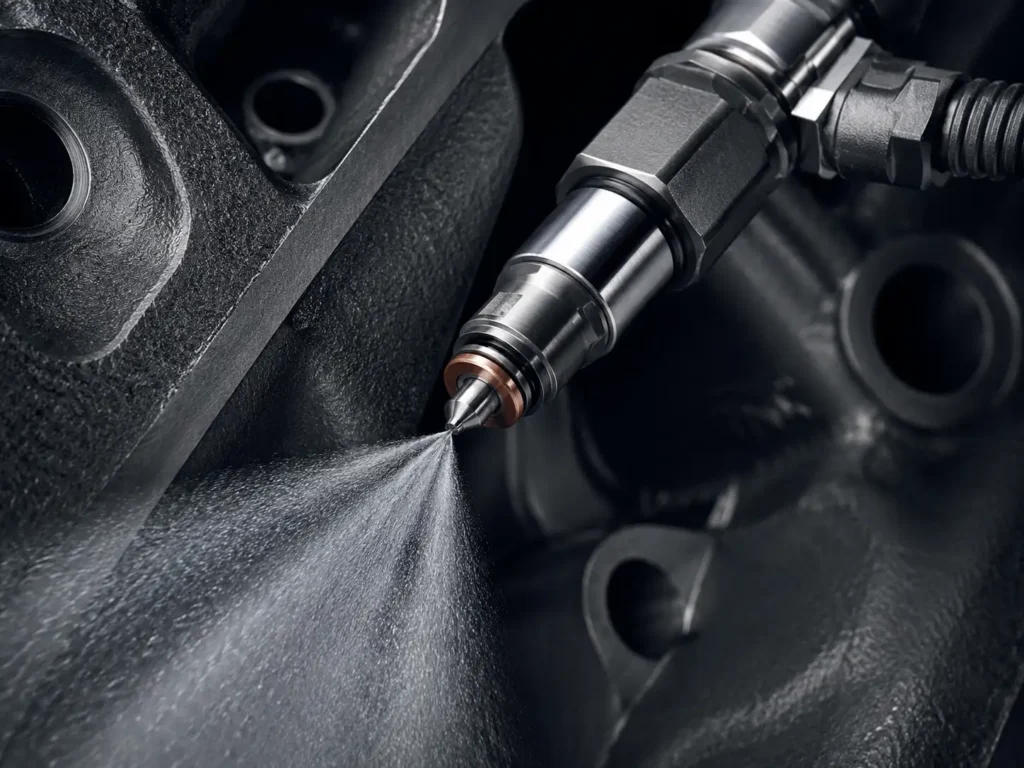
The evolution of the Powerstroke family highlights major advances in engine metallurgy and fuel injection technology.
The shift from heavy gray cast iron to Compacted Graphite Iron (CGI) is particularly significant.
CGI provides double the tensile strength of standard cast iron, allowing Ford to reduce the thickness of the 6.7L block walls.
This material change reduced overall engine weight while maintaining the structural rigidity needed for high-torque applications.
The fuel systems also evolved, shifting from the oil-driven HEUI configuration to modern high-pressure common-rail injection.
While the HEUI system was highly durable, its injection pressure was limited by engine oil viscosity and temperature.
Modern common-rail systems decouple injection pressure from engine speed, utilizing fuel pumps that deliver over 36,000 PSI.
This high pressure allows for precise fuel atomization, improving combustion efficiency and significantly reducing engine emissions.
However, common-rail systems are highly sensitive to water contamination, which can cause premature pump wear and system failure.
A detailed guide on maintaining these modern common-rail systems is available at(https://bsbuiltllc.com/power-stroke-diesel-guide-to-ford-generations-1994-2025/).
Towing and Payload Capacity Progression
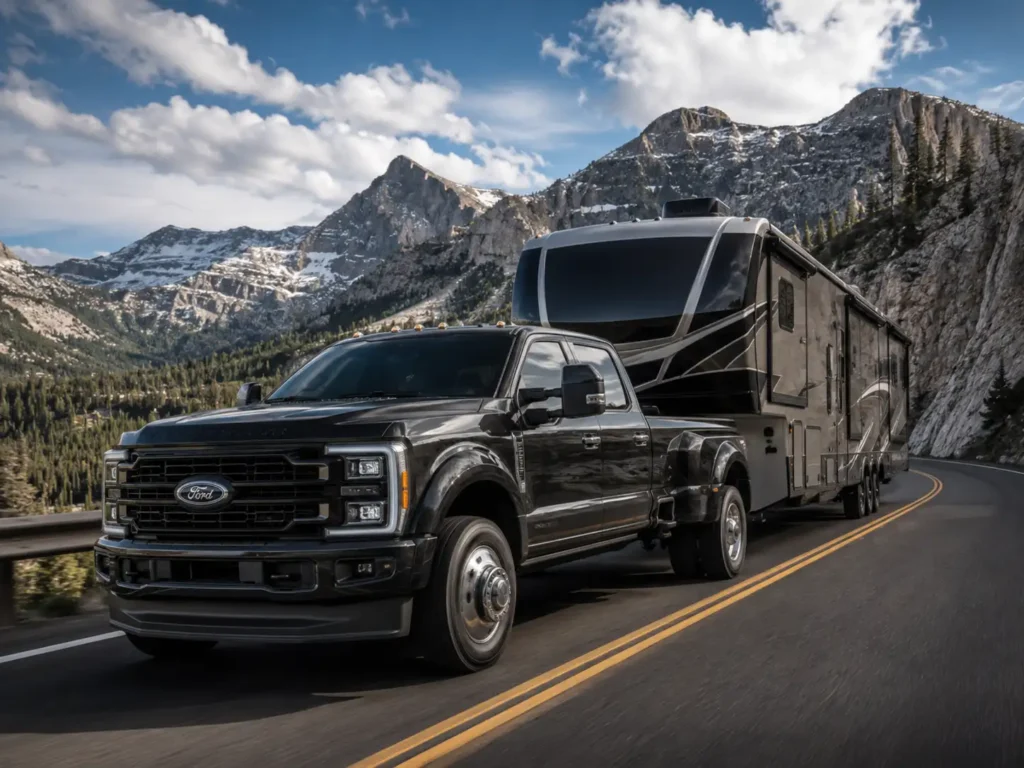
Towing capability has increased dramatically over the thirty-year history of the Powerstroke engine family.
These performance gains are driven by advancements in engine output, transmission design, and chassis construction.
| Engine & Chassis Generation | Max Conventional Towing | Max Gooseneck / 5th-Wheel | Max Payload Capacity | Paired Transmission System |
| 7.3L V8 F-250/F-350 (1994.5–1997) | Up to 10,000 lbs | Up to 13,500 lbs | Varies by Configuration | E4OD 4-Speed Auto / ZF5 Manual |
| 7.3L V8 F-250/F-350 (1999–2003) | Up to 12,500 lbs | Up to 13,900 lbs | Varies by Configuration | 4R100 4-Speed Auto / ZF6 Manual |
| 6.0L V8 F-250/F-350 (2003–2007) | Up to 13,500 lbs | Up to 16,500 lbs | Varies by Configuration | 5R110W TorqShift 5-Speed Auto |
| 6.4L V8 F-250/F-350 (2008–2010) | Up to 15,000 lbs | Up to 16,000 lbs | Varies by Configuration | 5R110W TorqShift 5-Speed Auto |
| 6.7L V8 F-250/F-350 (2011–2016) | Up to 16,000 lbs | Up to 16,800 lbs | Varies by Configuration | 6R140 TorqShift 6-Speed Auto |
| 6.7L V8 F-250/F-350 (2017–2019) | Up to 18,600 lbs | Up to 31,800 lbs | Up to 4,200 lbs | 6R140 TorqShift 6-Speed Auto |
| 6.7L V8 F-250/F-350 (2020–2022) | Up to 24,200 lbs | Up to 37,000 lbs | Up to 4,300 lbs | 10R140 TorqShift 10-Speed Auto |
| 6.7L V8 F-250/F-350 (2023–2026) | Up to 30,000 lbs | Up to 40,000 lbs | Up to 8,000 lbs (DRW) | 10R140 TorqShift 10-Speed Auto |
Early 4-speed automatic transmissions, like the E4OD, were prone to overheating under sustained heavy loads.
The introduction of the 5-speed 5R110W TorqShift transmission improved power delivery and gear spacing for towing.
Today, the 10-speed 10R140 TorqShift automatic transmission maximizes power transfer from the 6.7L engine.
This transmission uses a wide 7.39 gear ratio spread and a low 4.70:1 first gear to start heavy loads smoothly.
These drivetrain improvements have increased maximum fifth-wheel and gooseneck towing ratings to 40,000 lbs on properly equipped F-450 models.
For detailed model comparisons, the towing limits are outlined on(https://www.planetforddallas.com/ford-super-duty-towing-specs-previous-generations-included/).
FAQs
Which Powerstroke engine years are the most reliable to buy on the used market?
When evaluating the pre-owned diesel truck market, buyers consistently identify two primary eras of high reliability.
The 1999 to 2003 model years of the 7.3L Powerstroke are highly regarded for their mechanical simplicity.
Operating without complex EGR, DPF, or SCR emissions hardware, these engines suffer very few emission-related failures.
For buyers seeking a modern truck, the 2017 to 2022 model years of the 6.7L Powerstroke are highly recommended.
These vehicles feature upgraded aluminum bodies, refined emissions equipment, and highly durable steel-bearing turbochargers.
They represent an excellent balance of high performance, modern technology, and long-term mechanical reliability.
What are the mechanical steps required to fully “bulletproof” a 6.0L Powerstroke engine?
The process of bulletproofing a 6.0L engine involves replacing several key factory components that have high failure rates.
First, the factory torque-to-yield head bolts must be replaced with high-tensile strength ARP head studs.
These studs clamp the cylinder head tightly to the block, preventing head gasket failures under high combustion pressures.
Second, the failure-prone factory EGR cooler should be replaced with an upgraded, heavy-duty aftermarket version.
Third, a new oil cooler must be installed alongside an external coolant filtration system to prevent clogging.
Finally, a heavy-duty water pump with an aluminum impeller is installed to improve the reliability of the cooling system.
Why do early 6.7L Powerstroke engines (2011–2012) require extra inspection?
The initial production years of the 6.7L engine introduced several design elements that were updated in later models.
First-generation models relied on a small, dual-compressor turbocharger equipped with ceramic ball bearings.
These ceramic bearings were prone to premature wear, causing turbocharger failures under sustained high-temperature towing.
Additionally, the early fuel systems utilized a Bosch CP4.2 high-pressure pump that was sensitive to fuel contamination.
Any moisture or debris in the fuel system could cause the pump’s internal components to wear rapidly.
This wear generated metal shavings that quickly migrated through the common-rail system, damaging the fuel injectors.
How does fuel dilution occur in the 6.4L Powerstroke and how can it be managed?
Fuel dilution in the 6.4L engine is a side effect of its active DPF regeneration system.
To raise exhaust temperatures and burn off soot, the engine injects extra diesel fuel late in the combustion stroke.
Because this fuel is injected late, it does not fully ignite and can wash down the cylinder walls past the piston rings.
This fuel accumulates in the oil pan, diluting the engine oil and reducing its lubricating effectiveness.
Managing this issue requires a strict maintenance schedule, including oil changes every 5,000 miles.
Operators should also regularly check the dipstick level and perform oil analysis to monitor fuel dilution percentages.
What are the operational differences between standard and High-Output (HO) 6.7L engines?
The standard and High-Output 6.7L engines share the same basic block metallurgy and 15.8:1 compression ratio.
The performance differences are primarily achieved through electronic control module tuning and cooling upgrades.
The standard-output version produces 475 horsepower and 1,050 lb-ft of torque, which is sufficient for most towing applications.
The High-Output version is tuned to deliver 500 horsepower and 1,200 lb-ft of torque.
To manage the extra heat generated by this tune, Ford integrates a water-jacketed turbocharger and upgraded cooling lines.
This High-Output variant is designed for commercial operators who frequently tow heavy loads near the truck’s maximum capacity.
Related Ford Guides
- Ford F-150 alternator amperage chart
- Ford F-250 rear axle width chart
- Ford F-250 towing capacity by year